Country House Rescue: school’s out – High Elms Manor, Herts

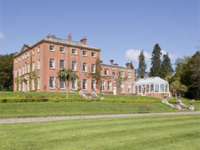
High Elms Manor, Hertfordshire (Image: Ishin Ryu)

If there was a prize for commitment above and beyond financial sense then the owner of High Elms Manor/Garston Manor could probably win ‘Highly Commended’ for her determination to rescue this once-derelict country house on the edge of Watford, Hertfordshire, which is the next destination of Ruth Watson and Country House Rescue. The house is an interesting example of the various pressures which can affect country houses and the solutions having experienced almost the complete range over the last century with the new owners adding a few more.

Built sometime before 1813 and once the centre of a 500-acre estate, High Elms Manor originally enjoyed fine rural seclusion, its nearest neighbours the St Pancras Industrial School and Metropolitan District Asylum to the west (now demolished and built over) and Bucknalls, a Victorian manor house now home to the Buildings Research Establishment, to the east.  Originally known as High Elms Manor, it was changed to Garston Manor in 1895, though the current owner has apparently decided to go back to using the original name; even if it’s not the one used by Channel 4.

Relentless urban growth over the last 100 years pushed housing estates and industry right up to the boundaries of many country estates – and usually then overwhelmed them.  The sad pattern was often industry moving closer and blighting the views, then the air, ruining the very attributes which had been their reason for being built in the first place.  As workers followed industry so more land was needed for housing and so estates on the edges of towns were particularly vulnerable (as they still unfortunately are today).

Cassiobury House, Hertfordshire (Image: Lost Heritage)

Watford has already lost one major house – Cassiobury – to just these pressures, though this was much closer to the centre of the modern town and was lost back in 1927. The long-time seat of the Capel family, Earls of Essex, who built a fine house which was altered by Hugh May c.1674-80 and which boasted superb interiors, with carvings by Grinling Gibbons, and which was later ‘Gothicised’ by James Wyatt (c.1800).  Visited by Country Life magazine in 1910 it was still rural:

“‘…set in great and delightful grounds and surrounded by a grandly timbered park. Therein is peace and quiet; the aloofness of the old-country home far from the haunts of men reigns there still, and Watford and its rows of villas and its busy streets is forgotten as soon as the lodge gates are passed’.”

Yet by 1922 the house and 458-acre park were for sale and were bought in 1927 by a consortium of local businessmen who stripped the house for materials, sold the carvings to museums and private collectors and then demolished the house, with residential estates over-running that once rural idyll.  Sadly this was the case for so many of our demolished country houses.

High Elms Manor, being further north, escaped these immediate pressures.  The house became home to the Watney brewing family around 1870, who commissioned alterations which enlarged the house.  The house was then sold to the Benskins, another family of brewers, before it was bought in 1911 by Walter Bourne, co-founder of the Oxford Street department store Bourne & Hollingsworth (now split into retail units and offices – history (scroll past the odd photos at top of the page)), who made further changes around 1920, shortly before his death in 1921.  Stafford Bourne, one of the sons of the founder, described High Elms as:

“…one of the finest and most dignified medium-sized estates in the county of Hertfordshire.”

With fine and interesting interiors, this was a house built for entertaining and accommodating large numbers of guests and visitors.  This was to perhaps save the house from demolition as the house was sold once again after Walter Bourne’s death and took on another of the many uses our country houses have been adapted for and became a medical rehabilitation unit, still known as Garston Manor.  It remained in this role until the 1990s when the council, faced with rising maintenance costs, abandoned it and left it to decay.

Sadly, although boarded up, the house suffered from repeated vandalism and theft, with roof lead and floorboards proving particularly attractive.  When the now-owner Sheila O’Neill came to view the house it was a daunting prospect:

‘It had been empty for years when I came to see it,’ says the present owner. ‘It was more or less derelict. Ceilings had fallen in, all the floors had been damaged, the wood panelling had turned green, chimneys had collapsed, lead had been stripped off the roof by vandals, there were 100 broken windows, the garden was a jungle, it was in a terrible state…”
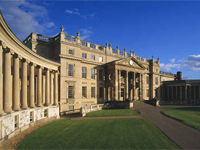
Stowe House, Buckinghamshire (Image: e-architect)

Thankfully, as many other country houses have discovered, they can be rescued from such a parlous state.  High Elms was now adapted to that familiar role for a country house; that of being a school.  There is a long and fine tradition of our country houses educating future generations in grand adapted ballrooms and dining rooms.  In cases such as the spectacular Stowe House in Buckinghamshire, (now being wonderfully restored by the Stowe House Preservation Trust with backing from the World Monuments Fund) it almost certainly saved it from demolition.  Stowe is an especially grand example of the country house as a school but there are hundreds across the UK, each doing their bit to preserve our architectural heritage – though sadly the necessary ancillary buildings can sometimes detract from the setting.

Thankfully though, in the case of High Elms Manor, the needs of the school have been accommodated within the 80-odd rooms of the house with, for example, the ballroom serving as a gymnasium.  However, a house of this size requires significant funding not only in terms of capital investments in the house but also just to meet the £75,000 per year running costs.  Having bought it for £500,000, Sheila O’Neill estimates she has poured at least that much again in her quest to restore the house.  Faced with her own need for a replacement hip, and the relatively low profits from running her Montessori school, Mrs O’Neill has turned to Ruth to provide guidance as to how to make more from the not-very-successful wedding hire business and for any other tips. With strong local competition from the incredibly pretty Hunton Park, it seems that it is the posse of daughters who appear to hold the key to maintaining and improving their situation.

Country House Rescue: ‘Garston Manor‘ [Channel 4]

Country House Rescue: see complete previous episodes

Interview with Sheila O’Neill: ‘Country House Rescue in Garston‘ [Hertfordshire Life]
A bad omen: the spring country house relaunch

One rather unscientific barometer of the health of the country house market is the thickness of Country Life magazine as it comes through the letterbox each week.  After the thinning of the issue in the run-up to Christmas it’s always pleasing to feel the first weighty edition of the new year.  Yet, though this week’s issue (2 March) boasts ’70 pages of property for sale’ it’s remarkable that the estate agents have so few significant country houses to offer and of those that are there, it seems, along with last week’s issue, the largest houses are relaunches.

Pyrford Court, Surrey (Image: Savills)

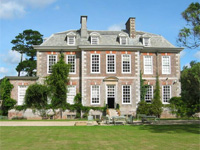
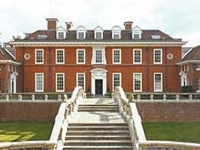
One of the most interesting is grade-II listed Pyrford Court, Surrey.  Originally built in 1910 for the 2nd Lord Iveagh, of the Guinness brewing family, it was one of a group of houses built around that time on the profits of beer (along with Polesden Lacey, Elveden Hall, and Bailliffscourt). The land was sold to Lord Iveagh by his father-in-law, Lord Onslow, whose family had owned the area since the 17th-century.  The house was designed by Clyde Young who had also worked at Elveden, another seat of the Guinness family, though the sensitively designed wings were added in 1927-29 by J.A. Hale of Woking to designs by Lord Iveagh.  The stylish neo-Georgian house is an elegant red-brick composition which originally sat in a 1,000-acre estate – though sadly now reduced to just 21-acres.  Lord Iveagh died in 1967 and the house sat empty until sold in 1977 – apart from a brief burst of fame as a location in the 1976 film ‘The Omen’.  The house then became an old people’s home with all the attendant damage until the current owners started their seven-figure restoration.

Pyrford Court was originally launched on the market in January 2010 for an ambitious £20m, a staggering rise in valuation from the £3.25m paid in 2000 and from the £8m asking price when it was offered for sale in 2002 (reduced, a year later, to £6.5m).  Yet this proved too much for the market to take; even for a ‘super-prime’ house within 25 miles of central London, and despite the high-quality restoration of the impressive interiors.  It subsequently languished and has now been promoted with a double-page advert – though the price is ‘on application’ meaning we won’t yet know quite how far the price has dropped.  However, looking at the other houses Savills have for sale in the area this is by far the most interesting and attractive house.

Brockhampton Park, Herefordshire (Image: Jackson-Stops & Staffs)

Another impressive house is the classically elegant, red-brick Brockhampton Park, Herefordshire.  Although the architect hasn’t been confirmed, the fact that it is virtually identical to Hatton Grange in Shropshire by Thomas Farnolls Pritchard, means it can probably be attributed to him.  The house was built in the late 1750s for Bartholomew Richard Barneby, probably using the £3,000 brought to him through his marriage in 1756 to one Betty Freeman. The Barneby family had owned the estate since the 15th-century and were to own it until 1946 when John Talbot Lutley (who was a descendent of the  Barneby family) left the house and 1,200-acre estate to the National Trust. Col. Lutley was a no-nonsense man who, on hearing of the NT country houses scheme, wrote them a short letter in 1938 saying that as he was a bachelor whose heirs were rather distant, would they be interested?

James Lees-Milne was duly dispatched – and almost rejected it on sight as it wasn’t pure Georgian due to some relatively small Victorian alterations.  However, after a tour of the estate and on seeing the beautiful Lower Brockhampton Manor, he felt that the latter two would be fine additions for the Trust – even if the big house would be a drain. It was duly left to the NT in 1946 following the Colonel’s death. Neither the house nor the contents were of sufficient quality to justify retaining or opening to the public so they sought to let it.  Unfortunately no private tenant wished to take it on, usually citing its remoteness, however in 1985 an insurance company let the house as offices and undertook a comprehensive restoration programme.  After they moved out in 1996 it was again restored as a private home and is now available with just 8-acres but surrounded by the rest of the NT-owned estate.  Interestingly the house is listed under the ‘Sales’ section of the Jackson-Stops & Staff website but I suspect this is due to it being leasehold – again ‘price on application’ so the price of the privilege is unknown, but the house has been advertised since last summer so it may be cheaper than before.

Ebberly House, Devon (Image: Savills)

Perhaps the most surprising house to still be available is the grand Ebberly House, Devon.  Rather than the expected provincial house, this is a house which displays remarkable architectural sophistication. Described by Pevsner as ‘unusual and attractive’, whose distinctive rounded ends ‘hint at the variety of room shapes inside; a provisional echo of the interest of contemporary architects such as Nash and Soane’.  Designed by Thomas Lee of Barnstaple, a pupil of Sir John Soane, the grade-II* house compensates for it’s remoteness with a fantastic house set in a fine 250-acre estate.  Offers in excess of £4m on the back of a postcard to Savills in Exeter.

Perhaps there are some clever marketing plans being hatched at the estate agents which means that rather than pushing their best properties in the first big property edition of Country Life of 2011 they’re saving them for…when?  Bonuses have just been announced and those looking to buy are probably active so perhaps there is just a general scarcity of significant country houses coming to the market.  Does this indicate 2011 will be rather thin for the agents as uncertainty limits buyers to the super-rich looking for somewhere in London or will the market pick up and a slew of new houses soon be released to whet our appetites?

The price of progress: country houses and the High Speed 2 rail project

One of the sadly almost inevitable side-effects of urban and industrial growth is the loss of more of our countryside. Sometimes it can be on a smaller scale for residential developments and industrial units but occasionally society’s plans are much grander and require a greater sacrifice. This has been shown with the publication of the latest proposed route for the new High Speed 2 rail project to provide a fast link between London and Birmingham.  In previous generations, landowners could influence the path of developments such as roads or canals to their benefit but as their power has diminished so routes of these developments can now threaten the settings of our country houses.

The High Speed 2 railway is aiming to dramatically reduce the need for internal domestic flights in the UK by linking London to, first, the West Midlands, followed by Leeds and Manchester.  The plan has always been controversial, requiring the loss of hundreds of homes in the urban areas around the terminals and also a significant loss of farmland.  Following an initial proposal, the latest route was announced to the House of Commons on 20 December 2010 which reflected some concerns about the initial proposal.  However, 13 of the 30 sections (yes, I have been through all of them!) contain a number of country houses and manors which will still be significantly affected by the plans.

Edgcote House, Northamptonshire (Image: Bacab)

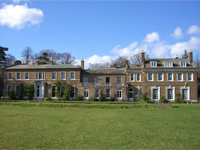
One bit of good news is that fears over the proximity of the link to the wonderfully elegant West Wycombe Park (raised in a blog post in Oct 2009) have been alleviated as the new route is further away.  However, another significant house will still be badly affected; the Georgian, grade-I listed, Edgcote House, Northamptonshire.  The proposed route now slices through the remarkably unlisted grounds with the line passing just to the east of the ornamental lake which forms one of the main axial views from the house.  Edgcote was built between 1747-1752 for London merchant Richard Chauncey by architect William Jones and featured as ‘Netherfield’ in the 1995 TV adaptation of ‘Pride and Prejudice’.  The house and grounds form the centrepiece to a 1,700-acre estate which was bought for £30m in 2005. Interestingly, this value has not deterred the planners (who moved the line from the original position cutting across the lake) so it will be interesting to see if the owner submits a claim a for ‘statutory blight‘ [.pdf]. This gives the Secretary of State the option to buy the property at the current market value if the owner can show that they have been unable to sell due to the Government proposals, or only at a substantially lower value.

Hartwell House, Buckinghamshire (Image: Giano via Wikipedia)

Amendments have also been made to protect another significant property; Hartwell House in Buckinghamshire.  A grade-I listed house, now run as a hotel, it was built in the early 17th-century for the Hampden family but was later let to the exiled King Louis XVIII of France who lived there between 1809-14.  Originally Jacobean, it was substantially enlarged and ‘Georgianised’ between 1759 and 1761 by the architect Henry Keene.  Again, following initial concerns, the route has now been moved further away from the house so that it would not be visible and will benefit from extra earth works and planting to reduce the noise.

Stoneleigh Abbey, Warwickshire (Image: PinkyVicki via Flickr)

Another grade-I house which would have been worse affected if it hadn’t been blighted already is Stoneleigh Abbey in Warwickshire.  This imposing house, now converted into apartments, is part medieval, part Georgian designed by the talented Francis Smith of Warwick, exists in a seriously compromised setting with the Stoneleigh Park exhibition and conference venue built in one half of the immediate parkland.  The proposed line will not only cut through the conference venue but also forever separate the house from the northern edge of the original park – though the massive scale of development already means this was never a house which was going to be returned to splendid isolation.

Another compromised house is Swinfen Hall in Staffordshire where the train will pass in front but quite some distance away.  The house itself, a beautiful Baroque-style Georgian mansion was built in 1757 to a design by Benjamin Wyatt and remained the home of the Swinfen family for nearly 200 years.  After the death of the last Swinfen in 1948 the land was sold and later a huge youth detention centre built to the immediate north-west with the house being left to deteriorate until it was converted into a hotel in the 1980s.  Having a railway line in the middle distance is the least of the concerns for the setting of this house.

Waddesdon Manor, Buckinghamshire (Image: National Trust)

Despite the vocal complaints of Lord Rothschild it seems that the route will be quite far from their old family seat of Waddesdon Manor.  However, Rothschild has become one of the leading opponents of the scheme – along with 16 other Conservative MPs whose constituencies will be affected.

With the rail route cutting across the countryside it was unavoidable that it would pass near to country houses, ironically which, of course, were often built to get away from the industrial blight.  Other houses which now lie close to the proposed route include:

  • The Vache (image), Buckinghamshire
  • Pollard Park House – a 1903 house built to a Lutyens design.
  • Classical Shardeloes, built between 1758-66 for William Drake MP by the architect Stiff Leadbetter would also suffer from the high speed line cutting across the main view from the house.
  • Grade-II* Doddershall House would be within a couple of hundred metres of the line on which up to 18 trains per hour are expected to rush past at speeds of up to 400kph.
  • Chetwode Manor
  • Oatley’s Hall
  • Berkswell Hall, Warwickshire – a grade-II* listed house now converted into apartments
  • Coleshill Manor, Birmingham – now offices and already suffering from being surround by motorways, the house will now have the line within metres, also necessitating the demolition of a new office complex next door.

The route also cuts across the old estate of the now demolished Hints Hall in Staffordshire – an elegant two-storey Georgian mansion with giant pilasters to enliven the facade.  It’s unlikely that if the house had survived it would have prevented the proposed route but again, without the house, an estate becomes even more vulnerable.

These are just the houses affected by the first 120 miles of the proposed 355 mile scheme.  If successful, we can expect more houses to be blighted as the route carves through the Midlands and up into Lancashire, shattering the peace and quiet that were the original reasons for the creation of these refuges from the industrial reality of the cities.  Although progress can often bring benefits, in this case the price is being paid by our country houses as their parklands and estates are judged the path of least resistance.


More information: High Speed 2 [wikipedia]

The growth of smaller country houses: Harewood Park, Herefordshire

The size of a country house was traditionally the physical embodiment of the wealth (or aspirations) of the owner.  Yet as the role of the country house changed and the emblems of power altered, new, smaller forms of houses to emerge for both the aristocracy and minor gentry.  The acceptability of a smaller house was to prove valuable in the financial crises of the 20th-century – though this is not to say that the later houses lacked anything in terms of quality of interiors or the richness of the architectural language used outside.

Puslinch House, Devon (Image: Devon Rural Archive)

Wealth was obviously the most important consideration when deciding on the size of the house.  However, the learned sophistication of many of the lesser aristocracy meant that although their funds may not be able to provide a palace, they were well-versed in the aesthetics of good (often Classical) architecture. This meant they were able to commission or design for themselves coherent and elegant smaller houses, giving us the much-coveted Queen Anne or Georgian smaller houses we see today up and down the country, such as Puslinch House in Devon.

The considerations in the 20th-century were also financial but driven by a different set of demands.  The financial pressures of the early part of the century, particularly the agricultural slump and the Wall Street crash, naturally limited the size of the houses built (though not all e.g. Gledstone Hall by Sir Edwin Lutyens built in 1926). Yet, the changing social climate also meant that not only was it considered somewhat insensitive to build such large palaces, it was also unnecessary as the houses no longer required so many bedrooms to accommodate the now vanished armies of staff and house guests who used to turn up for the large weekend parties.

Hurtwood Edge, Surrey

Yet smaller didn’t have to mean less interesting as architects faced up to the new challenges with intelligent interpretations of Georgian, whilst others sought to experiment with different styles, such as at the now grade-II listed Hurtwood Edge in Surrey, where the builder/architect Arthur Bolton created an Italian villa in the English countryside.

In the immediate period following World War II, many larger houses, having been requisitioned and mistreated, were demolished, but the families often retained the ancestral estate but now required a new seat.  The tight restrictions on materials, particularly for ‘luxury building’ under the Socialist Attlee government, naturally limited the ambitions of the owners.  Yet the election of Conservatives in 1951 ushered in the gradual lifting of the restrictions until their abolition in 1954 which allowed a new wave of construction.  The war seemed to have had a lasting effect – or maybe fear of a future Socialist government enacting a tax based on house size – as many of the houses were significantly smaller than those in previous eras.

Eaton Hall by John Dennys for Duke of Westminster (Image: Kathryn Gammon)

An example of this is Eaton Hall, seat of the Dukes of Westminster, where, following the demolition between 1961-63 of Sir Alfred Waterhouse’s high Gothic-Revival masterpiece, it was decided that a new house should be built.  The commission went to John Dennys, who happened to be the Duke’s brother-in-law, for a starkly modern house which sat cross-wise on the main axis of the old house.  Unfortunately in this case the new house was overwhelmed by the grandeur of the setting, appearing too small against the remaining buildings and the as the focus for the grand gardens.  Worse, the house was unsuccessfully remodelled again in the late 1980s in an almost French chateau-style to create a larger house.

In recent years, planning restrictions have usually limited the size of new houses (though not always; see my recent post on large houses).  The lack of architecturally educated clients has naturally led to a growth in crass, ugly smaller country houses, but all is not lost as determined clients are still able to demand and produce good designs, such as the one proposed for Harewood Park in Herefordshire, now mooted as the potential marital home for Prince William and Kate Middleton.

Harewood Park (proposed), Herefordshire (Image: Craig Hamilton Architects)

Ever since the Harewood Park estate was bought by the Duchy of Cornwall in 2000 as part of a larger purchase of 12,000 acres, rumours had been circulating that it would be for one of the Princes.  The original house had been demolished in 1959 so the expectation was that another would have to be built if it was to have such a role.  Considering the views of the Prince of Wales on modern architecture there was little surprise when a planning application was submitted in 2006 for a strongly Classical small country house by Craig Hamilton Architects.

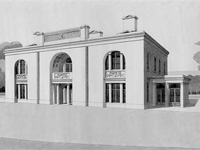
Craig Hamilton originally prepared three designs but the final design (shown above) complements the existing stables and is perhaps the most interesting and the one successfully submitted for approval.

The house is based around the motif of the triumphal arch but, apparently drawing on the influence of Sir John Soane, it presents a simplified version rather than the more decorated versions often seen.  Soane was schooled in the Classical style but re-invented the language to create a new direction for Neo-Classicalism; a much simpler version with an emphasis on the effective use of space and most importantly, light.  Soane spent several years in Italy and was well-versed in Roman architecture and incorporated the three-arch motif into his designs, notably the entrance front to his own house at Pitzhanger Manor, Ealing, west London, and in one of his most impressive commissions for the old Bank of England (scandalously demolished in the the 1920s) as seen in the internal Lothbury Court.

The new Harewood Park is an inventive extension of this Soanian language and it’s encouraging that the planners had the courage to approve what will surely be one of the most interesting smaller country houses built in the UK.  Sadly, I suspect that for security reasons, we won’t see the house featured in Country Life but I keep my fingers crossed.


Competition: nominate your choice for ‘England’s Favourite House’

Competition: 'England's Favourite House'

This seems a good moment to mention the competition to find the best smaller country house (i.e. with less than seven bedrooms).  Most people have a favourite and usually it’s not so much the grand palaces of Chatsworth or Blenheim but the smaller houses of our local areas which form part of our local heritage.  The competition is being run by Country Life magazine and Savills the estate agents and the house should be in private ownership and not currently for sale. The deadline is Wednesday 24 November 2010 so submit your suggestions as soon as possible.

To nominate a house simply either print this form [pdf] and send it in or email favourite_house@ipcmedia.com

More information: ‘England’s Favourite House‘ [Country Life]


The state of the country house market: Autumn 2010

Noseley Hall, Leicestershire (Image: Knight Frank)

Throughout September, the increasing weight of each week’s ‘Country Life‘ magazine heralds the starts of one of the busy periods for launches of country houses.  As an relatively unscientific barometer it would appear that the market is doing well with some impressive estates and houses being offered up to tantalise the armchair enthusiast and serious purchaser alike – but a few houses are still proving difficult to shift.

The September 1 magazine provided a summary of the successes of the year-to-date with glowing reports from estate agents who, despite some fears in January about an uncertain year ahead, are happy to highlight their successes.  The article quotes Crispin Holborow of Savills who rightly points out that ‘best in class‘ houses will always sell quickly and for above their guide price if the right buyers start competing.  He cites Ropley House in Hampshire which sold at over it’s guide price of £4.25m, as did the grade-I listed Shanks House in Somerset which was offered with 70-acres for £5.5m, but their biggest success was the coveted Chadacre estate in Suffolk with 680-acres which reputedly sold for more than double it’s £10m asking price.  Other houses such as the elegant grade-I Worlingham Hall – regarded by Norman Scarfe as ‘the most beautiful house of manageable size in Suffolk’ – also sold over it’s guide price of £3.9m.

Other houses sold close to their guide include Peatling Hall in Leicestershire (mentioned on this blog in July) which was offered at £4.75m, whilst the stunning Compton Pauncefoot Castle in Somerset suffered from an unfortunately timed launch in September 2008 at £17m which knocked buyer confidence meaning that it hung around until Febuary 2010 before selling at £15m.  Others had to drop their prices or accept being sold in lots with Kiddington Hall in Oxfordshire selling for £15m to Jemima Khan once the rest of the 2,000-acre estate had been sold (originally offered as one for £42m), whilst Fillongley Hall in Warwickshire has yet to find a buyer even after selling 400- out of the original 500-acres originally offered when it went on the market in 2005 (£3.5m, Savills).  Pusey House in Oxfordshire, which was originally launched with 643-acres but when featured as the lead property advert in the September 15 magazine it was offered with just 67.

So who are the awkward squad?  Grade-I listed Noseley Hall in Leicestershire is still with Knight Frank with the same acreage; though now at £12m rather than the original £14m asking price, and Iver Grove in Buckinghamshire, a pocket Palladian gem, is still being offered (again with Knight Frank) – though mysteriously with no price, so probably less that the £4.5m guide in February 2010; and way down from it’s original price of £6.5m when it was first launched in 2007.  Up country, Yester House in Scotland is still available despite having had it’s price halved from £15m to £8m since the original launch in August 2008.

So, although the property market does seem buoyant, it does seem that some are struggling.  Perhaps the flurry of launches will bring an influx of new buyers who may take a renewed interest in the harder-to-sell properties, but they equally may well wonder why they are still available and pass them over.  It seems that some owners who are keen to sell are being flexible, either dropping the price or selling in lots, but for owners who refuse to budge the market may take a very long time to rise to meet what they think their property is worth.  It seems flexibility is still a vital attribute whatever rung of the property ladder you are on.