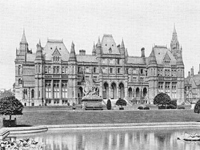
Possibly for sale – a landmark for landowners: Crichel House, Dorset

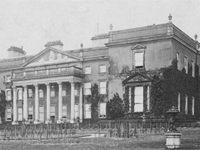
Crichel House, Dorset (Image: BNPS / Daily Mail)

When to believe the rumours? Occasionally one of the old families will decide that they no longer wish to hold onto the estate which has been the family seat for many years – sometimes centuries. When these estates come to market they usually attract a significant price-tag which truly reflects their beauty, significance and acreage.  If the unconfirmed rumours which feature very prominently on page 2 of the Sunday Times (26 June 2011) are to be believed, then the Marten family of Crichel House in Dorset have decided to sell – almost 60-years after the family won a decision against the government of the day which became a landmark in the rights of landowners against government.

Crichel House is widely regarded as one of the best houses in the county – indeed, John Julius Norwich states that it “…possesses the most spectacular series of state rooms in all Dorset.“.  Crichel started off as a modest house in 1743; hastily built to replace a charming Elizabethan house which was burnt down in 1742.  This smaller seat of a country squire – brick-built and just five bays by seven – was for Sir William Napier, who left it to his nephew, Humphry Sturt, in 1765.  Sturt had inherited not only his uncle’s house and wealth but had also married well. He didn’t feel the house was grand enough for a man of his fortune, and so embarked on an impressive rebuild, creating a house “…so immensely enlarged that it has the appearance of a mansion of a prince more than that of a country gentleman.” (Hutchin’s ‘History of Dorset‘ – 1774).
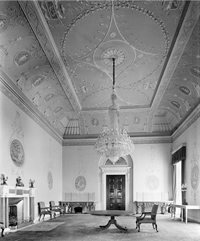
Dining Room, Crichel House, Dorset (Image: A. E. Henson / Country Life Picture Library)

Sturt, using an unknown architect (though thought to be from nearby Blandford), effectively wrapped a new house around the old one to the east and the west, and linking the two on the south front with an impressive recessed portico and suite of rooms on the first floor.  However, the need to accommodate the dimensions of the old house created a slightly cramped feeling to the first floor elevations.  However, all is forgiven by the splendid interiors which are, in parts, a curious mix of early Georgian created late (e.g. the staircase, the library), and fashionable later Georgian, particularly in the stunning Hall, Dining Room and Drawing Room where Adam-style plasterwork reigns.  The latter rooms were probably designed by James Wyatt who was working nearby at Milton Abbey and at Bryanston.  The Dining Room is considered the finest room in the house; a coved ceiling framing delicate plasterwork and decorative panels in the style of Cipriani and Angelica Kauffmann.

So, how did part of the Crichel estate become so significant that it became immortalised as a set of planning procedures known as the ‘Crichel Down Rules’? In part, it was due to the bureaucratic arrogance of the post-War era which meant the Civil Service felt able to deal rather high-handedly with anyone, and particularly landowners who were not popular under Attlee’s socialist government. In 1937, 742-acres of Crichel Down had been compulsorily bought as part of a larger area for use as a bombing range. Churchill had given a very public commitment in the House of Commons in 1942 that land purchased in this way would be offered back to the original owners once it was no longer required for the original purpose.
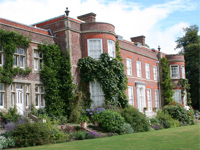
Hinton Ampner, Dorset (Image: ec1jack / flickr)

However, there was an even greater danger of compulsory purchase for houses which had been adapted for wartime use under the ‘Requisitioned Land and War Works Act (1945)’ (sections 8 & 9 Geo. 6 c.43 in case you were wondering!) which gave officials the right to buy, regardless of the wishes of the former owner or any previous assurances. At Hinton Ampner in Hampshire where Ralph Dutton (the 8th and last Lord Sherborne), having just finished an extensive remodelling in 1939 only to be turfed out by a girls school, received a letter saying that the Royal Observatory were interested as a new Royal Observatory.  Dutton took the day off work at the Foreign Office and was on the doorstep when the officials arrived and gave an impassioned speech about the importance of the house, how it had been in the family for generations and that losing it would be akin to an amputation. The officials apparently looked somewhat embarrassed but gave no sign of retreating until a short note arrived a little later confirming that they were taking Hurstmonceaux Castle instead.

At Crichel Down, the government had decided to retain the land as a new model farm.  Lt-Cdr George Marten (who had married Mary Sturt, the only child of the 3rd Lord Alington), began a vigorous one-man campaign to examine the conduct and procedures of the relevant departments.  In doing so, he exposed a series of administrative errors as officials tried to evade the requirement to offer back the land and retain it for the government’s use.  Eventually, in 1954, public and press criticism led to the minister in charge, Sir Thomas Dugdale, resigning in one of the first examples of a minister taking responsibility even though he had not been involved in the earlier decisions and the land was sold back to the Martens.  To avoid a repeat of such failings, new planning rules regarding compulsory purchase were drawn up which are today known as the ‘Crichel Down Rules’ and are a vital part of the framework protecting landowners from the sometimes autocratic decisions of officials.

The death of Mary Marten in 2010 (her husband pre-deceased her) led to the recent sale of some of the contents of the house including a small collection of Asian jade ornaments which raised some £12.5m.  However, if the rumours are right, the rest of the house and 5,000-acre estate are also quietly on the market with an estimated price tag of around £100m, which, if it sold as a whole estate, would make it the most expensive sale ever outside of London.  It’s always a regret when families no longer wish to keep an estate which has been in the family for centuries, however, with the demands of sibling equality it is understandable that each of the six children – five females, one male – should wish to share their inheritance.  It would be a wonderful outcome if it could be bought in its entirety and remain one of the most important estates in Dorset, with the glorious Crichel House at it’s heart.

————————————————————————-

Update – 7 July 2013: Crichel House has been sold

Daily Mail confirms that the house plus 400-acres has been bought by Richard L. Chilton, a US hedge fund billionaire.  Initial reports indicate that he is a ‘conservationist’ having rescued other houses in the States so it seems promising that he is the right buyer; one with both the right attitude and pockets deep enough to do the house justice.  Though sadly it’s the end of an era for the Marten family, one hopes that this next phase will see the house restored to its former glory.

And if Mr Chilton happens to read this, it would be great to get your perspective – please do email me.

————————————————————————-

More images – both interior and exterior: ‘Crichel House, Dorset‘ [Country Life Picture Library]
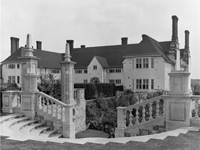
The Country House Revealed – Marsh Court, Hampshire

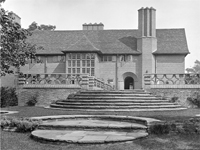
Marsh Court, Hampshire (Image: Country Life Picture Library)

As with artists, some architects start well and then just get better, culminating in masterpieces which are rightly praised.  With buildings, and particularly the usually distant country house, it can be difficult to truly appreciate them; their beauty a pleasure reserved for those invited.  Thus one of the delights of ‘The Country House Revealed‘ series has been to elevate us mere viewers into guests of some lesser known, but wonderful houses – and Dan Cruickshanks’ visit to Marsh Court in Hampshire proves just what gems are nestled in the countryside.

The house is the work of one of the best architects to have been produced by this country; Sir Edwin Landseer Lutyens.  A master at the re-interpretation of traditional building forms and styles, his work is, in many cases, instantly recognisable. Yet, in others, his sensitive updating of existing historic buildings blends so seamlessly it’s hard to distinguish between old and new (one of the best examples of this is Great Dixter, Sussex).  Lutyens was working at the end of the Victorian era and his work grew into the perfect response to the glory days of the Edwardian period; those long summers of country house entertaining from the turn of the 19th-century which were so firmly ended by the horrors of WWI.  Yet this was also a time of a confident nation, with fortunes being made (and lost) in an increasingly mercantile world, in which wealth was not related to the land. This fact was reflected in a new style of country house which required the trappings of the traditional entertainments and accommodation but which didn’t require a vast estate to support it.

Deanery Garden, Berkshire (Image: Country Life Picture Library)

Lutyens was the right man at the right time – and with the right connections.  His rise coincided with a new interest in the countryside, which was now being opened up to the new middle class with their leisure time and the rail network.  Spotting an opportunity, Edward Hudson started ‘Country Life‘ magazine in 1897, which quickly became the publication of the country set – and, more importantly, those who aspired to join them.  Hudson had been impressed with Lutyens’ work, to the extent that he had him design his own house, the brilliant Deanery Garden in Berkshire.  The distinguished architectural writer (and Country Life writer) Christopher Hussey said that it:

“…may be called without overstatement a perfect architectural sonnet, compounded of brick and tile and timber forms, in which his handling of the masses and spaces serve as a rhythm: it’s theme, a romantic bachelor’s idyllic afternoons beside a Thames backwater.”

Replace ‘Thames’ with ‘Hampshire’ and this praise might equally, and perhaps more so, be applied to Marsh Court. However, one other key difference would be the material used in the construction of Marsh Court; clunch, the local hard chalk stone; used for centuries in churches and cottages but never for an entire country house.  It’s a mark of Lutyens’ mastery of materials and style that he would even consider it – and the effect is what helps elevate this house to being one of the finest in the country.

Marsh Court echoes something of the character of the client, Herbert Johnson, who was as an “adventurer, stockjobber, and sportsman” who made a fortune, lost it, and made another.  Lutyens came to the attention of Johnson through the regular articles in Country Life featuring his various commissions which Hudson was only to happy to publicise.  In many ways, Johnson was an ideal Lutyens client – willing to think big, with a suitable budget and, although wishing to join the country life, not excessively bound by tradition.  This suited Lutyens as he was able to develop his ideas around the ‘Tudor’ style house, but marry them with a modern take which dramatically elevated the design to ensure no-one could ever call it ‘pastiche’.

West front - Marsh Court, Hampshire (Image: Country Life Picture Library)

The house, built between 1901 and 1904 with later additions also by Lutyens, is essentially an ‘H-plan’, though without the south-east leg, and goes back to his earlier interest in historic English architecture.  As the architectural writer Lawrence Weaver highlights, this house only works because Lutyens has perfected the balance of local materials through clever groupings of shapes and elevations, combined with contrasts in size and stone.  But even a good design might become too dominant in such an exposed location, sitting on a rise above the river Test.  Again, Lutyens has the ideal answer in his use of the sloped site to create terraces which ease the house into the landscape – note the change from two-storey on the north front to three on the south.  The stark white stone is also softened through the introduction of slates, flint and red-brick into the walls to create a mix of regular and irregular patterns, such as on the west front which gives the impression of tiles sliding down the walls like rain to pool at the bottom.  Only someone of Lutyens’ skill could attempt and succeed with such an architectural fancy.  The interiors are similarly impressive, with grand, almost Baroque, plasterwork in the hallway, combined with the fine panelling elsewhere.

Herbert Johnson moved out in sometime after 1940 and the house became home to evacuated children, and then, in 1948, a prep school.  It remained in this role for nearly 50 years before it was bought, for £800,000, in 1994, by Sir Geoffrey Robinson; industrialist, Labour MP but, most importantly, a heritage-minded multi-millionaire. Working with Michael Edwards, Sir Geoffrey and his wife Marie Elena undertook a comprehensive, yet sensitive, restoration of the house; removing partitions, restoring the ceiling plasterwork and updating the services. It was then sold for £6m in 1999 and then offered at £13m in 2007, before being relaunched in June 2008 at £10m before selling at £11m later that year.

Lutyens’ brilliant output was somewhat overlooked by the wider contemporary architectural world which was more interested in the developing Modern movement. Hudson’s constant championing of this visionary architect ensured that Lutyens’ work and reputation were assured even if he had never gone on to his later, much grander, projects designing the Viceroy’s Palace in New Dehli. In 1909, G. Lloyd Morris, although talking specifically about Marsh Court, provided an elegant summary of the essence of Lutyens’ skill in that the;

‘ unity’ which ‘…is the pre-eminent quality underlying the orderly and tranquil beauty manifest in [his] houses.  He never fails in this respect; one may cavil at certain details, or question the use and treatment of a material, but in the handling of the general conception there is always a breadth and a certainty in the composition that remains in the memory long after the details may have been forgotten.’

Certainly, Marsh Court succeeds overwhelmingly in this respect and is a worthy inclusion in any series looking at the finest country houses in the UK.

————————————————————————————-

Official website: ‘The Country House Revealed‘ [BBC2]

Superb photos of the house and gardens: ‘Marsh Court, Hampshire‘ [Country Life Picture Library]

More on the house and Lutyens:

The Royal country house honeymoon

So the happy Royal couple, our new Duke and Duchess of Cambridge, have taken just the long weekend for their honeymoon leaving an interesting question as to whether they are breaking with the tradition of spending their first days of marriage in an British country house?  With the twin demands of luxury and privacy, the country houses of the UK have often proved particularly attractive, though Royal palaces even more so.

Hampton Court Palace, Surrey (Image: Gail Johnson / flickr)

In an earlier age, the Royal family would often simply use one of their own palaces as a convenient venue.  Already secure and well-established for the great demands of catering and supporting a King or Queen, they had a natural advantage.  One often used has been Hampton Court Palace, in Surrey, one of the finest Royal residences ever built and a worthy equal to the splendour of Versailles.  Construction started in 1514 by Thomas Wolsey, an Archbishop of York, who built a palace which rivalled any that King Henry VIII then possessed.  With over a 1,000 rooms and accommodation for 280 guests, Wolsey wisely answered, when asked by the King in 1526 why he had built such a magnificent house, “To show how noble a palace a subject may offer to his sovereign.”

Having now taken ownership, Henry then embarked on his own ambitious programme, adding a third courtyard and stamping his mark on all aspects of the palace. It was in this sprawling residence which he enjoyed at least two of his honeymoons; with Jane Seymour, his third wife, in 1537, and with Kathryn Howard, his sixth, who he married at Hampton Court in 1543.  Due to his unhappiness with the looks of his fourth wife, Anne of Cleves, and the very short marriage (Jan-July 1540), it seems unlikely that he would have made any significant arrangements and so possibly used Hampton Court as his most convenient palace near London.

Henry VIII’s daughter, Mary I, also spent her honeymoon with Philip I at Hampton Court  in 1544. It was used again by King James I on his marriage to Henrietta Maria in 1625 and then by Charles II and Katherine of Braganza in 1662.

Rycote Park (Palace), Oxfordshire (Image: Thame History)

Henry VIII obviously had several opportunities to honeymoon, though his first was more a working tour as, following his marriage to Catherine of Aragon in 1501, he was sent to Ludlow Castle to preside over the Council of Wales and the Marches. His second, with Anne Boleyn in 1533, was at Shurland Hall, Isle of Sheppey in Kent, which has recently become the 70th building to be rescued by The Spitalfields Trust (and which is currently for sale).  His honeymoon with Catherine Howard, his fifth wife, in 1540, was spent at Rycote Park, in Oxfordshire. It’s not entirely clear who originally built this Tudor mansion but it certainly of a status to attract the Royal couple.  The house suffered a devastating fire in 1745, but was rebuilt before being emptied in a contents sale in 1779, and then sold for materials in 1807.

The tradition of the Royal family using their own houses has largely continued, though in more recent times they have also used suitable private houses as the retinues required have shrunk making it unnecessary to require a palace.

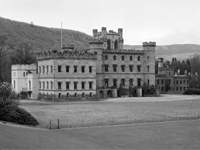
Taymouth Castle, Scotland (Image: RCAHMS)
Taymouth Castle, Scotland (Image: RCAHMS) - click for more images of interior

Queen Victoria and HRH Prince Albert enjoyed only a mini-honeymoon of three days in 1840, which was spent at Windsor Castle. The Queen, unwilling to ignore her duties and responsibilities as monarch which require frequent contact with her ministers, wished to stay close to London – even if her husband might have preferred a quieter break further away.  They did take a belated honeymoon in 1842 to Scotland where they stayed at the impressive Taymouth Castle, seat of the Marquesses of Breadalbane, owners of one of the largest estates covering 450,000-acres, which took over 40 years to build and had only recently been completed but to standard above almost any other seat in Scotland.  Designed by James Gillespie Graham, it was a convalescence home in WWII and a school but is currently unused whilst negotiations continue about turning it into a ‘seven star’ hotel.

Polesden Lacey, Surrey (Image: Matthew Beckett)

In the early part of the 20th-century, King George VI and his new bride, later the Queen Mother, stayed in 1923 with the remarkable society hostess, Mrs Ronald Greville, at her country retreat Polesden Lacey in Surrey (now National Trust).  An accomplished hostess, Mrs Greville and her staff were well used to catering for the cream of society.  Once home to Richard Brinsley Sheridan, after his death it was largely demolished and rebuilt by Thomas Cubitt in 1821 as, essentially, a neo-classical seaside villa.  After being bought by the Grevilles in 1906, she employed Mewes and Davis, architects of the Ritz, to remodel the interior.  The new opulence was matched by with an equal measure of intimacy, with rooms flowing between each other and the outside to create a fluid social space lined with portraits by Lely, Raeburn and Reynolds and cabinets full of Meissen china – a perfect venue for a Royal honeymoon.  Continuing the tradition started by Queen Victoria, they also spent time in Scotland at Glamis Castle, ancestral home of the Earls of Strathmore, and that of the future Queen Mother.

Balmoral Castle, Scotland (Image: Stuart Yeates / flickr)

On her marriage in 1947, our current monarch, Her Majesty Queen Elizabeth II, continued this practice and stayed at Broadlands in Hampshire, one of the best mid-sized Georgian houses, which largely appears to day as it was when it was finished in 1766. Elizabeth II also stayed at the family’s Scottish estates at Balmoral Castle and Birkhall, which were also destinations for the Prince and Princess of Wales in 1981 along with Birkhall which also used by Prince Edward and Sophie Wessex in 1999 and by the Prince of Wales and Camilla in 2005.

Alternatively, if they do wish to go abroad, they have the examples of the Duke and Duchess of Windsor who, in 1937, who spent three months at Castle Wasserloenburg in Austria, or Princess Anne who, in 1973, chose to spend her honeymoon cruising in the West Indies.  So, seeking peace and security, perhaps we’ll see the Duke and Duchess of Cambridge take a short break in a smaller country house before spending time in Scotland – or perhaps jetting off, but either way is in keeping with a long history of Royal honeymoons.

For sale: ‘Shurland Hall, Kent‘ [Jackson-Stops & Staff]

Thanks to Andrew for his help.

Country House Rescue: spectacular spats – Hill Place, Hampshire

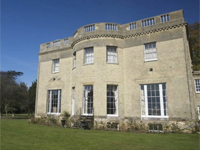
Hill Place, Hampshire (Image: Historic Houses Association)

The challenges of inheritance have been a recurring theme throughout Country House Rescue.  The obvious challenges are perhaps more tangible; taking on the new house, contents, gardens and the related discoveries – for good or ill.  Yet part of the nature of inheritance is often the bequeathing of disappointment to others who expected to benefit or who disagree with the choices of the new owners.  Country House Rescue this week (17 April) visits Hill Place in Hampshire where Ruth Watson’s skills seem to be in demand to placate some disgruntled aunts rather than to simply identify business opportunities.

Hill Place is an elegant, grade-II listed Georgian villa, built in 1791 on the back of wealth made in India.  The architect is unknown but there is a beautiful simplicity to it, with each side five bays wide with a canted three-bay projection on the entrance front and a graceful three-bay bow front to the south.  The style is in the fine traditions of Sir John Soane and there are even suggestions that it may have been by the man himself.   At some stage, a mansard roof was added and then later removed, leaving an unfortunate flat roof with the stub end of the staircase still rising to a small access extension.  Overall, this is a particularly neat example of the smaller country villa which was to prove so popular at that time.  However, what is of particular interest that the current owner, Will Dobson, inherited the house due to his grandparent’s commitment to the tradition of primogeniture – that of the eldest male inheriting, which, in Will’s case, meant the bypassing of his grandparent’s four daughters, which is the cause of the strife in the programme.

The rules of inheritance in the UK have ensured that ownership of country houses, estates and contents can be passed down as a unified possession.  This has ensured a multi-generational continuity which has benefited the country by embedding a very long-term perspective to plans and that a culture of paternalism was fostered; the spirit of noblesse oblige. Ironically, in France, the Napoleonic code demands equal shares for all potential inheritors, forcing the break-up and sale of large estates, preventing the same depth of connection between the nobility and society.  Yet, for this culture to be preserved it is important that the estate is kept together – especially as it usually has to fulfil its traditional role of funding the main house.

Knighton Gorges, Isle of Wight (Image: wikipedia)

Yet inheritance has caused incredible friction for hundreds of years between those favoured by those who inherit and those who do not, leading to extreme outcomes and court cases.  One example of the former was Knighton Gorges, a manor house on the Isle of Wight, where, in 1821, the owner George Maurice Bisset had the entire ancient house demolished to ensure that his heir (his daughter or nephew – accounts vary) wouldn’t be able to cross his threshold even after his death, their having angered him through an unauthorised marriage.  In Kent, Lynsted Park was originally a huge Elizabethan E-plan house built for Sir John Roper, later Lord Teynham, in 1599, but an inheritance dispute between two Roper brothers in the 1800s led to the one living there demolishing all but the entrance porch (later Georgian additions created the current house) as he thought he would lose the case and have to give the house to his brother.

Gopsall Hall, Leicestershire (Image: Lost Heritage)

Perhaps the most famous litigation from inheritance was that surrounding William ‘the Rich’ Jennens which reputedly took nearly 120 years before the cases finished being heard and was also thought to be the inspiration for Jarndyce v Jarndyce in Charles Dickens’ Bleak House – though recent scholarly opinion now discounts that. The Jennens family had created a huge family fortune as ‘ironmasters’ in Birmingham but due to a lack of heirs and, more importantly, a will, when William died intestate in 1798, his fortune (including houses such as Gopsall Hall, Leicestershire and Acton Place, Suffolk) was passed to three distant – though very aristocratic – relatives.  This was the catalyst for a small cottage industry of claimants who all thought themselves related and therefore due a share of the inheritance.  This was partly due to a popular fad at the time for novels to feature an unexpected inheritance – though, in real life, it was usually just the lawyers who became richer.

So, inheritance can often be a mixed blessing, laden with expectations and complications.  A recent survey by Country Life magazine (6 April 2011) found that 61% of current owners were concerned that estates stay in the family – with only 25% not bothered if their heir were to sell (it would be interesting to see if there was a correlation between whether those in the latter group were also those whose family had owned for the least time).  For some, it’s particularly important to ensure that the family name is preserved. In the same Country Life article, David Fursdon, whose family have been on the Fursdon estate in Devon since 1289, highlights that after 750 years in single ownership the pressure is on to ensure that a male heir is produced to provide that continuity (though with three sons he should be OK).

Holker Hall, Cumbria (Image: andrew_j_w / flickr)

Primogeniture, or full inheritance by the eldest son, has been the rule for hundreds of years.  It was expected that all other children either had to marry or make their own fortune or living with the second son often going into the Army and the third to the clergy.  The strict rules may now be relaxing with parents choosing the child most inclined and best equipped to take on the inheritance – the Country Life article highlights how Holker Hall in Cumbria will be inherited by the middle child, Lucy Cavendish, who has moved back to the estate to learn the ropes before her parents ‘retire’ and move out in a few years time.

The challenge for families such as the Dobson’s is ensuring that the one who inherits feels they have complete ownership and is able to take decisions for the good of the house and estate without sniping from other quarters.  It is no light responsibility to be the owner of a country house and the Dobson’s should be thanked for taking on such a lovely home when others might have simply sold up and enjoyed the spoils.  Here’s hoping they can truly make a success of the house as a business to ensure that they can also pass it on to future generations.

Country House Rescue: ‘Hill Place‘ [Channel 4]

Country House Rescue: see complete previous episodes

Official website: ‘Hill Place

The front line: the campaigners for country houses

Apethorpe Hall, Northamptonshire (Image: English Heritage)

Despite the image of wealth and power a country house might create, in reality their existence is far more precarious – as can be seen with nearly 1,800 houses lost over the last two centuries.  A house facing the threats of being uninhabited without a concerned, well-funded owner with an inclination to keep it in good repair can quickly deteriorate leaving another gap in the tapestry of the countryside.  Sometimes it requires someone other than concerned locals and architectural historians to highlight and campaign on behalf of those ‘at risk’ so here’s a quick round-up of the main English organisations fighting on behalf of country houses and who are very worthy of support.

English Heritage inhabits a prime position in view of its role in defining and, in conjunction with local authorities, implementing the statutory protection of our built heritage.  Its role can be traced back to the Ancient Monuments Act of 1882 – though the legislation specifically excluded privately owned houses. The responsibilities were exercised through various government departments until it became a quango in 1984.  As well as being responsible for the listing system and the annual production of the various ‘at risk’ registers (focussing mainly on grade-I and -II* properties), EH is also directly responsible for various country houses including Brodsworth Hall (Yorkshire), Rufford Abbey (Nottinghamshire), Hill Hall and Audley End (Essex), Kirby Hall (Northamptonshire), Witley Court (Worcestershire), Stokesay Castle (Shropshire), and Apethorpe Hall (Northamptonshire).   It’s at the grade-I listed Apethorpe where EH has done some of it’s most interesting work; taking a direct role in the restoration of one of the finest Elizabethan/Jacobean houses in the country following a long period of neglect. Since 2008, the house has been for sale for around £5m – though there is a compulsory £4m list of renovations, and if you want complete privacy expect to pay another £8m to fully reimburse EH otherwise you have to open it for 28 days a year; so a nice round £20m to restore, furnish and keep as your own. However, this is a role that I fully support them in taking on – they should be there as owner and restorer of last resort for threatened grade-I houses.  Now perhaps we can interest them in the sadly deriorating Melton Constable Hall in Norfolk…?

Another important group of campaigners are recognised in the 1968 Town and Country Planning Act which formalised the role of what are known as ‘amenity societies‘; that is, well-established voluntary societies who are experts in their areas, who must, by law, be informed of any applications for listed building consent to demolish listed buildings in whole or in part in England and Wales.

One of the best known is the Georgian Group who cover a period broadly from 1700-1837.  The society was established in 1937 and has long campaigned for the sensitive restoration and retention of not only the buildings but the many important, and sometimes sadly overlooked, internal features which are a key part of the character of a building.  Current active campaigns and cases they are involved in include Bank Hall in Lancashire and Trewarthenick House in Cornwall and many others. They also produce a scholarly annual research journal which provides a much more in-depth view of aspects of Georgian architecture.  Access for the wonderful trips to houses not normally open to the public are worth joining for alone.

Eaton Hall, Cheshire (by Alfred Waterhouse - dem. 1961) (Image: Lost Heritage)

The Victorian Society (which also covers Edwardian buildings too) was formed in 1958 at a time when almost all things Victorian were disliked and an easy target for demolition.  Founded at the suggestion of Anne, Lady Rosse, along with her influential friends such as Sir John Betjeman and Sir Nicklaus Pevsner, the Society has fought some notable battles; losing some such as Euston Station but winning others, such as the soon-to-reopen St Pancras Midland Grand Hotel building.  Victorian country houses have suffered badly as, although designed by eminent architects such as Richard Norman Shaw and Alfred Waterhouse, they were often built on a much grander and therefore less economically sustainable scale and at the times of greatest threat (the 1930s and 1950s) had few friends to argue on their behalf.  Luckily though this has changed – but with the predominant ‘gothic-revival’ style being quite polarising, threats to houses from this period will always be present. Again, well worth joining.

Perhaps more controversially for this blog, it’s also worth bearing in mind the Twentieth Century Society.  Although the focus of the houses usually covered is before 1900, there has been a growing recognition that some of the country houses built in the 20th-century were well-planned and architecturally pleasing, even if they sometimes replaced a much more attractive Georgian or Victorian house.  It does seem to take about 50 years after a style has passed from being fashionable for it to be appreciated, so I suspect there will be a growing realisation that we need to protect the work of those such as Francis Johnson, Craig Hamilton, Quinlan Terry, and Robert Adam (amongst many others) in the future.

The Society for the Protection of Ancient Buildings (SPAB) is, as its name makes clear, not usually concerned with country houses as they are relatively ‘modern’ in terms of its remit.  However, they do immensely important work in promoting good repair practice to all buildings and their courses have taught generations of owners and craftsmen to respect the country houses and to approach any work required with a more ‘heritage’ mindset.

Although not ‘amenity societies’, two other organisations deserve a mention. The first is the Historic Houses Association which acts on behalf of the private owners of country houses and often lobby government to make them aware of the immense work done by the individual owners to maintain their slice of the national architectural heritage.  It may seem unfashionable in wider society to support the wealthy but they are the ones not only maintaining their homes to the exacting standards of English Heritage, but also restoring and rescuing houses and converting them back into homes again – and for that they deserve our thanks.

The Grange, Hampshire (Image: mpntod / Wikipedia)

The other organisation is one in which I have an interest having worked with them for several years: SAVE Britain’s Heritage.  Founded in 1974, SAVE have taken a very active stance on campaigning, willing to create media interest at short notice, but also to take time to produce some excellent research on houses at risk with thoughtful proposals for their re-use.  These campaigns have saved houses such as Calke Abbey in Derbyshire, The Grange in Hampshire, Barlaston Hall in Staffordshire (where SAVE bravely took on the house for £1!), and, working with Kit Martin, have acted as a catalyst for the saving of other houses through conversion into apartments.  Supporting SAVE’s work and becoming a Friend also gives access to their extensive ‘Buildings at Risk Register’ which features over 800 properties, including several country houses, which are in need of rescue – could it be you?

It is also worth keeping an eye out for local activists and campaigns which can also be remarkably successful at highlighting buildings at risk but can also sometimes take a more direct role; see the wonderful work at Poltimore, Devon, Bank Hall, Lancashire, and Copped Hall, Essex.  These are just three examples where concerned locals have organised themselves and presented a credible alternative and prevented the complete loss of the house.

All of these organisations are worth joining but economics being what they are it can be best to join a national organisation and then another to focus on the period which you prefer.  Joining up means that you are helping to support research but also active campaigns to ensure that as much of our built heritage is passed on to future generations.

———————————————————

I realise this selection is not comprehensive and is quite national in focus and deficient in regional organisations but this will be remedied in another post once I’ve had time to learn a bit more about who’s out there.

– Matthew

———————————————————