‘An agreeable surprise’ – the country house and garden sculpture

Statue - Castle Howard, Yorkshire (Image: Paul Barker / Country Life Picture Library)
Statue – Castle Howard, Yorkshire (Image: Paul Barker / Country Life Picture Library)

The country house has long been at a nexus of art, display and tourism with the treasures, mainly statues, collected by the owner shown in a grand gallery which often formed one of the main staterooms.  Whereas the house provided the setting for the art, outdoors, the gardens and parkland provided a setting not only for the house but also for the many sculptural works they had acquired – a trend which continues today, though often with a necessarily more commercial edge.

The first country house owners to place statues in their English gardens were the Romans.  However, as homes became castles, gardens fell from favour and with them, the ornaments to decorate them.   The trend for statuary only really returned with the Tudors and their love of the outdoor space as an extension of the symbolism they incorporated into the architecture of their houses.  One of the earliest collectors, and most acquisitive, was Thomas Howard Arundel, 2nd Earl of Arundel, who, as a youth, had been at the excavation of the Roman Forum, which had sparked a live-long passion for antiquities.  Arundel amassed one of the greatest collections of the age, rivalling that of the King, including a famed selection of Graeco-Roman statues found in Turkey, which became known as the ‘Arundel Marbles‘. These statues were then displayed at both their town and country seats, both indoors and out – though later, by the mid-17th-century, as a result of the uncertainties of the Civil War, John Evelyn found the Marbles “…miserably neglected, & scattred up & downe about the Gardens & other places of Arundell-house.”.  The statues were later donated to the Ashmolean Museum where they remain today.

The later rise and popularity of the Georgian grand tour firmly embedded the desire to purchase statues along with the requisite paintings. They provided a visual clue as to both the learning and wealth of the owner and so were displayed prominently, especially indoors where they might be shown in the entrance hall where guests would inevitably look at them as they waited. Some of the most famous dedicated indoor galleries include those at Holkham Hall, Norfolk, Chatsworth, Derbyshire, and Woburn Abbey, Bedfordshire (though sadly now not as shown in previous link as it’s now a wedding venue).  Other notable galleries, though now lost due to dispersal or demolition, were those at Clumber Park, Ickworth House and Hamilton Palace, the latter described as “…peopled with bronze statuary on Irish black marble bases polished to such a gloss that they reflected the pavement like a mirror.“.

Chiswick House, Middlesex (Image: curry15 / flickr)

Outside, the display was no less formal – symmetry and structure dominated.  However, by the 1730s, the more formal display of statues outdoors gave way to a more naturalistic style whereby they became almost secreted amongst a more informal – but no less planned – landscape.  One thing often forgotten now is that we see gardens after over 250 years of growth, but when first planted they would have been much sparser giving the ornaments greater prominence.  The return of the Roman influence can be closely linked with the rise of Palladianism and the influence of Lord Burlington and his circle; most notably, the brilliant designer William Kent. Other notable influences include Batty Langley, who published his ‘New Principles of Gardening‘ in 1728 and Stephen Switzer’s ‘Ichnographica Rustica‘, published in 1718 – the latter of which was the first to show serpentine walks and streams. Life also imitated art, with the popularity of the Arcadian visions of painters such as Claude Lorrain, Nicholas Poussin, and Salvator Rosa also inspiring those who collected the paintings to attempt to bring them to life.

Temple - Studley Royal Gardens, Yorkshire (Image: Matthew Beckett)
Temple – Studley Royal Gardens, Yorkshire (Image: Matthew Beckett)

The more secure and rising wealth of the 1730s enabled owners to create larger estates and so giving them more space to indulge their plans.  However, no stream will rival a raging river so to create a sense of theatre, the landscape was used and moulded to create a series of views which took advantage or distant landmarks or by introducing elements such as statues, temples and obelisks.  Often these gardens were designed to entertain the knowledgeable visitor with allusions to myths and noble virtues – though in one lesser known example, the owner of the famous Vauxhall Gardens in London, built a darker memento mori‘ garden at Denbies, his home in Surrey.

However, the main aim was to delight and to stimulate emotions. One of the most famous Georgian gardeners, Philip Miller, wrote in his 1739 edition of his ‘Gardener’s Dictionary’:

“In laying out these walks through woods there should be a great regard had to the neighbouring country, so as whenever there are any distant objects which appear to the sight, there should be openings to which the serpentine walks should lead, from whence objects may be viewed, which will be an agreeable surprise to strangers…”
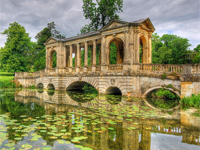
Bridge - Stowe House, Buckinghamshire (Image: Evoljo / flickr)
Bridge – Stowe House, Buckinghamshire (Image: Evoljo / flickr)

These principles were translated according to the whims and finances of owners across the country, leading from the sublime creations of Stowe, Stourhead and Studley Royal to many lesser known and private gardens.

The statuary could sometimes cause the odd drama. Dallam Towers, Cumbria was archly described by Pevsner as “…undoubtedly the finest Georgian facade in the county; but what the visitor may not realise is that, behind all the stucco, there’s the finest Queen Anne facade in the county.“. Between the facade and the landscape once stood (or perhaps still stands) a line of statues standing guard between the garden and the ha-ha. Yet this line is slightly marred by one of the statues being headless – the unfortunate outcome of a 1820s dinner which led to a very ‘well-refreshed’ Lord Milthorpe.  Thinking he had seen a poacher, he grabbed a rifle, and despite the protests of his guests, he duly dispatched the ‘poacher’/statue; a loss for the world of garden ornaments but perhaps a gain for the forces of law and order.

With such vast quantities of marble scattered out the gardens, occasionally a prized statue may slip slowly into obscurity. This can lead to discoveries in the same way that an Old Master may be found in the attic, so they can also be found in the shrubbery, such as this rare Chinese Ming tomb horse or the lucky owner of a castle somewhere in northern Europe who had a statue by the Renaissance sculptor Adriaen de Vries.

The tradition of sculpture in the gardens of country houses is certainly alive and well today and has developed beyond the more formal Roman statuary towards a decidedly more contemporary ethos – though perhaps more commercial than for simple pleasure.

'Huge Sudeley Bench' by Pablo Reinoso at Sudeley Castle (Image: Christies)
‘Huge Sudeley Bench’ by Pablo Reinoso at Sudeley Castle (Image: Christies)

At the beautiful Sudeley Castle in Gloucestershire, Christies are holding their selling exhibition of contemporary sculpture from luminaries such as Marcel Wanders, Marc Quinn and Pablo Reinoso.  Over in Sussex, the Cass Sculpture Foundation at Goodwood, hosts a regularly changing line-up with a focus on supporting emerging talent along with the more established artists such as Lynn Chadwick and Anish Kapoor.  One more recent venue is the Jupiter Artland at Bonnington House in Scotland, just outside Edinburgh.  The vision the Wilsons, who own the house, Jupiter Artland features large-scale works such as the monumental ‘Life Mounds’ by Charles Jencks’ who specialises in landscape art that I suspect would appeal to the likes of ‘Capability’ Brown if he were around today.

These are just some of the examples of contemporary schemes which are taking place across the country. Each is enlivening the grounds of a house and again maintaining that artistic thread which has been spun out over hundreds of years, linking country houses, an owners’ taste and some of the best art in the country.

————————————————————————–

More wonderful examples of works available outdoors can be seen in the Country Life Picture Library collection.

This blog post is a little off my usual patch so I’m grateful for the research of David Stuart in ‘Georgian Gardens

Finest prospects: the artist and the country house (and a challenge)

The country house has always been a trophy to be admired and enjoyed.  Yet, in the age before mass media and transportation made it easier to see these fine houses, often the only way to remind yourself and, more importantly, guests to your London townhouse, of your rural wealth and power was through the rather special branch of art that is the country house portrait.  Though originally European, it found new and invigorating life once it had crossed the Channel, creating an important and fascinating record of the lives, tastes and architecture of the landed classes. We also have a mystery house in a painting to find…

The country house first started appearing in paintings in France, with one of the very earliest depictions being that of the Duc de Berry’s houses and estates in 1416 by Pol de Limbourg.  These paintings served not only as reminders of wealth but also as practical tools for the running of extensive estates. The earliest English contemporary of these paintings is a 15th-century portrait of John of Kentchurch with a view of Kentchurch Court, Herefordshire in the background.  Although the depiction of the country house was a primarily European feature, it was still a relatively niche pursuit until the late 1500s, with painters more usually employed to portray the religious, historical or mythological.

Detail of 'An Aerial View of Tottenham Park, Wiltshire' by Pieter Andreas Rysbrack (after 1737) - this picture hung for many years in the estate office.

The trade in country house views was particularly popular in the Netherlands, where a demand for topographical engravings combined with many estates created a ready market.  The genesis of the English tradition is also to be found here as the Royalist aristocracy fled to the region during the Civil War. The connections made at this time were to prove fruitful for the many painters who followed their current and prospective patrons back across the Channel after the the Restoration in 1660. Before then, views of a country house were usually part of an estate survey, bar a few exceptions such as those of Conway Castle in c.1600, Nonsuch Palace and Richmond Palace c.1620, and the ‘King’s houses’ by Alexander Kierincx in 1639-40.  It was the famous engraver Wenceslas Hollar who completed the first significant set; five views of Albury House in Surrey in the late 1630s. Hollar was also significant in establishing the new fashion for these views once confidence was restored in the late 1650s.

The Restoration of Charles II gave new life to the art, with Dutch artists eager to record the newly invigorated estates of the aristocracy.  Without the artistic constraints often found in Europe, the style of the art in England was largely determined by the owner rather than royal preference.  By the 1680s, the country house portrait was as well established, as well  as those of the family, and reflected both pride and change.  Views were often painted to record the old house before it was swept away or remodelled or after the work had finished to showcase their new seat.

One of the finest artists of this period was Leonard Knyff who had arrived in England in around 1676 but whose first country house painting, completed in 1696, is of Dunham Massey, Cheshire.  A few more paintings followed, but his master work was a collection of eighty engraved views published (by Johannes Kip) in 1707 under the title ‘Britannia Illustrata: Or Views of Several of the Queen’s Palaces, also of the Principal seats of the Nobility and Gentry of Great Britain…’.  It remains one of the finest records of the country houses of the period – today, even individual prints can sell for hundreds of pounds and full copies of the book for tens of thousands.

Detail of 'Westwood, Worcestershire' published 1709 for "Britannia Illustrata: Or Views of Several of the Queen's Palaces, also of the Principal seats of the Nobility and Gentry of Great Britain...." by Johannes Kip & Leonard Knyff
Detail of 'Westwood, Worcestershire' published 1709 for "Britannia Illustrata" by Johannes Kip & Leonard Knyff

From the 1700s, the composition of the paintings shifts to include, and give greater prominence to, sporting activities and also the setting of the house, particularly the gardens. With sports such as riding and hunting being such a key part of the enjoyment and reputation of an estate, it was natural that these should feature in any artistic celebration.   As the fashions for landscaping and elaborate gardens took hold, so to did a desire for these to also be included in such detail that the house became a much smaller element, subsumed into a wider bucolic vision.  The more ‘survey’-like paintings showed in almost cartographic detail the layout of the gardens with the tree-lined rides radiating away from the house.

'Lowther Castle, Westmorland, Seen from a Distance by 'Day' in 1810' - J.M.W. Turner

This trend was not only driven by the owners who were very proud of their new environment but also because it was a natural continuation of the earlier work of these artists, as recorders of landscapes. John Harris argues that it would be difficult to confirm the exact influence which art exerted over landscaping but the popularity of landscape painters such as Claude Lorrain, coincided with the popularity of advocates of the more natural landscape such as Humphrey Repton and Lancelot ‘Capability’ Brown in the 1760s.  Parkland now moved from the more formal ‘boxes’ which Knyff had so accurately portrayed, and was now shown as a more rural, naturalistic form, the landscape now dominating the picture.  How far this style departed from formal country house portraiture can be seen in the works of J.M.W. Turner who frequently reduced the house to a mere smudge in the distance – and even when the house featured clearly, it was subordinate to the overall setting and atmosphere.  That’s not to say that the ‘Claudian’ view was the only one – the preferences of the owners for clear visions of their seats kept artists such as William Hodges, James Barret, William Marlow, and Theodore de Bruyn busy too.

By the mid-1800s there had been a marked decline in the demand for these type of paintings. Improved communications meant that houses were no longer so remote, and with the advent of mass printing, publishing filled the demand for images of the houses as typified by the eleven volumes of J.P. Neale’s ‘Views of the Seats of Noblemen and Gentlemen‘ (1818-1829).  Owners of houses were also now increasingly from the new wealthy who had their powerbases in cities and the country house was merely a retreat. By 1880, photography was also firmly supplanting oil paint as the medium of choice, as shown by the success of photographers such as Bedford Lemere, and, by the 1900s, the success of magazines such as Country Life which placed a high priority on using only the best photos.

Detail of 'Carclew, Cornwall' by Algernon Newton (house built 1720s, burnt out in 1934) - painting commissioned for the family which owned it at the time of the fire

However, in the last twenty years, a resurgent interest amongst country house owners has again created a demand for the country house portrait.  Artists such as Algernon Newton, Julian Barrow, James Hart Dyke, Jonathan Warrender, and Marcus May have led the way in continuing the tradition.  One artist has even been responsible for creating a country house which only existed in one of his paintings. Felix Kelly had painted an imaginary scene of Palladio’s Villa Rotunda within an English landscape; inspired by this, Sebastian de Ferranti then commissioned the architect Julian Bicknell to translate this art into reality, completing the house in 1986.

These important paintings are now, for some houses, the only record of how they were before later changes obscured or obliterated them forever. For many others, they are a wonderful reminder of the beauties of architecture and are a unique and invaluable record of our country houses.

—————————————————————-

Detail from 'Portrait Group' (1936) - William Bruce Ellis Ranken
Detail from 'Portrait Group' (1936) - William Bruce Ellis Ranken - click for full painting

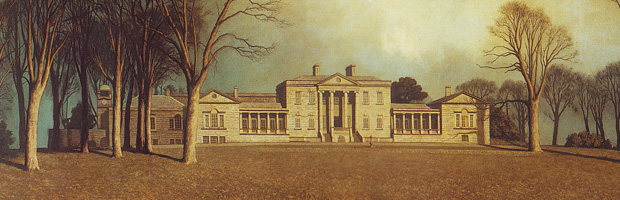
The Challenge: can you identify the mystery house in this painting?

Detail from 'Portrait Group' (1936) - William Bruce Ellis Ranken

The catalyst for this post about country houses in paintings was an email I received from Wendy & Gordon Hawksley who are working to re-establish the reputation of William Bruce Ellis Ranken (1881-1941). A famous artist in his day, he socialised with the great and good and painted many of them before fading into obscurity after his death.  This painting was exhibited at the Royal Academy in 1936 (this is also the year it was painted) under the title of ‘Portrait Group’ but as yet it has not been possible to identify either the sitters or the house. And so to the challenge: simply, can we identify the house – almost certainly English or Irish, Palladian, engaged columns to the front (a la Kedleston Hall) with flanking curved colonnaded wings facing a large reflecting pool.  Obviously there may be some degree of artistic licence but it seems likely that this was the home of the subjects of the portrait. Suggestions either via the comments below or via email to me.  No prizes I’m afraid beyond a credit here and the happy thought that art history is slightly richer for your efforts.

—————————————————————-

For a more in-depth history and many images (and to which this post is much indebted)  I recommend ‘The Artist and the Country House: from the Fifteenth Century to the Present Day‘ by the ever-brilliant John Harris – unfortunately now out of print.

Want to lease a Vanbrugh? Kings Weston House, Bristol for sale

Kings Weston House, Somerset (Image: Knight Frank)

For some, the height of connoisseurship is to own a Picasso or a Rembrandt, and, in the same way, one can also aspire to live in a house designed by one of the great architects.  Yet, although some were prolific, the best were often to be found working on the largest projects, limiting their capacity to turn their hands to other projects, making their surviving buildings rare.  The damage and devastation which subsequent generations have wrought on our architectural heritage have also made these special houses all the rarer.  So it is always of particular interest when the opportunity to own one of these houses arises; such as Kings Weston House, Somerset, designed by the wonderful Sir John Vanbrugh.

Vanbrugh (b.1664 – d.1726) was one of the most interesting architects this nation has ever produced.  Yet to think of Vanbrugh is inevitably to also think of Nicholas Hawksmoor (b.1661 – d.1736) who provided the technical support necessary to ensure that Vanbrugh’s flights of architectural fancy were realisable as solid buildings worthy of his aristocratic patrons. However, this was not a partnership which diminished one through association with the other – both were brilliant architects who each gained from their collaboration. As John Summerson put it in Architecture in Britain (1530-1839): ‘The truth can only be that both Hawksmoor and Vanbrugh were very exceptional men.

Vanbrugh was an intensely private person – the few hundred surviving letters in his hand betray few family details or about his early adventures as a soldier, spy, hostage, East India Company trader, or playwright.  His time in the Forces seems to have imbued his style with a tendency towards the militaristic, most clearly expressed in his work in landscapes where huge sham fortified ‘defenses’ march across parkland, defending nothing and fooling few.  Yet this bombastic nature is part of the flamboyant and theatrical nature of the man, part of what gave him the flair to succeed architecturally in an age when statements in stone were as important as any made in print or Parliament.

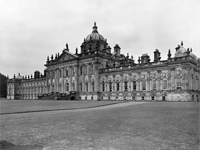
Castle Howard, Yorkshire (Image: Country Life Picture Library)

In his grandest buildings, Vanbrugh appears to almost be designing monuments which happen to have living accommodation – but he was especially pleased that Castle Howard was as practical as it was impressive. Writing in 1713 to Edward Southall, his client at Kings Weston, he states:

“I am much pleased here (amongst other things) to find Lord Carlisle so thoroughly convinced of the Conveniencys of his new house, now he has had a years tryall of it.”

Proud of how draught-free the house was, which helped retain heat, Vanburgh stated;

“He likewise finds, that all his Rooms, with moderate fires Are Ovens.”

Kings Weston House, Somerset (Image: Country Life Picture Library)

Kings Weston (built between 1710-19) was to be Vanbrugh’s fourth commission (after Castle Howard, Blenheim Palace and Kimbolton Castle) and was a house very much to Vanbrugh’s style, creating a ‘Noble and Masculine Shew‘.  The house, dramatically sited above the Bristol Channel, was built for Sir Edward Southall, a well-educated civil servant, well-versed in architecture who had spent considerable time travelling in Italy. Southall clearly had strong ideas as to the influences and design of his house; and Vanbrugh, with his long history of collaboration, was the ideal architect to work with this knowledgeable client.  That said, this is clearly a Vanbrugh house – the imposing giant pilasters, the strong Classical detailing, the almost military look which is reinforced by the unusual arcaded design of the chimneys which emphasised a castle-like quality of a central bastion.

(By the way, it’s interesting the close similarity between the entrance to Kings Weston and that of the smaller Iver Grove in Buckinghamshire (built 1722-24) by John James, who had worked with Sir Christopher Wren).

The house passed through several generations of Southalls including Edward’s great-grandson who employed Robert Mylne in 1763 to add stables and the Shirehampton Lodge and also remodel the principal rooms. Edward’s son, also Edward, lived there until his death in 1832 without issue. The house was then sold in 1833 to Philip John Miles for £210,000 (approx. £17m today) who became the local MP, as had the Southalls been before him.  Three generations of the Miles family lived there until the death of Philip Napier Miles in 1935, marking the last time the house was used as a home. The house was sold at auction for £9,800 (approx. £500,000) with the intention of using it as a school.  This was interrupted by the Second World War when it became a hospital – a role it has also fulfilled in the Great War.  Post-war, it became the Bristol College School of Architecture, before becoming a Police training centre from 1970-1995.

Perhaps one of the saddest aspects is how the setting of this fine house has been compromised: to the north, a road and housing estate, to the west, more houses, and to the south, a golf course.  This is often the outcome of houses which lack a determined owner with the need to keep a large estate, and particularly of houses which fall into the clutches of local authorities who are only too happy to build over the parkland, often with little sensitivity as to the overall setting.

With the departure of the Police, the house was boarded up, neglected and facing an uncertain future.  However, in 2000, it was bought by a local businessman, John Hardy, who converted the house in to a successful wedding and conference venue, apparently pouring significant funds into the project.  His commitment ultimately cost him his marriage and the remaining lease – probably 115-years – is now for sale for £2m (the freehold is still owned by Bristol City Council).  Although this would still make an ideal family home, Mr Hardy has expressed a desire that it remain open to the public.  Whoever buys Kings Weston will certainly be buying one of the finest houses in the country. Perhaps it will remain open to the public, but it would be equally exciting to see the house restored as a home, a private retreat overlooking the Bristol Channel where the owner can contemplate the genius of Vanbrugh and enjoy knowing that an architectural DNA links their domain with the palaces of Castle Howard and Blenheim, a smaller scale distillation of the grand flamboyance which came to define English Baroque.

————————————————————-

Original story: ‘Bristol’s Kings Weston House up for sale for £2 million to help pay for owner’s divorce‘ [Bristol Evening Post]

More details: ‘Love affair with a £2m mansion that ended in divorce… King Weston House’s owner was ‘totally consumed’ by major Georgian renovation‘ [Daily Mail]

Property details: ‘Kings Weston House‘ [Knight Frank] – £2m

More images: ‘Kings Weston House‘ [Country Life Picture Library]

History of the house: ‘Kings Weston House‘ [kingsweston.com]

Possibly for sale – a landmark for landowners: Crichel House, Dorset

Crichel House, Dorset (Image: BNPS / Daily Mail)

When to believe the rumours? Occasionally one of the old families will decide that they no longer wish to hold onto the estate which has been the family seat for many years – sometimes centuries. When these estates come to market they usually attract a significant price-tag which truly reflects their beauty, significance and acreage.  If the unconfirmed rumours which feature very prominently on page 2 of the Sunday Times (26 June 2011) are to be believed, then the Marten family of Crichel House in Dorset have decided to sell – almost 60-years after the family won a decision against the government of the day which became a landmark in the rights of landowners against government.

Crichel House is widely regarded as one of the best houses in the county – indeed, John Julius Norwich states that it “…possesses the most spectacular series of state rooms in all Dorset.“.  Crichel started off as a modest house in 1743; hastily built to replace a charming Elizabethan house which was burnt down in 1742.  This smaller seat of a country squire – brick-built and just five bays by seven – was for Sir William Napier, who left it to his nephew, Humphry Sturt, in 1765.  Sturt had inherited not only his uncle’s house and wealth but had also married well. He didn’t feel the house was grand enough for a man of his fortune, and so embarked on an impressive rebuild, creating a house “…so immensely enlarged that it has the appearance of a mansion of a prince more than that of a country gentleman.” (Hutchin’s ‘History of Dorset‘ – 1774).

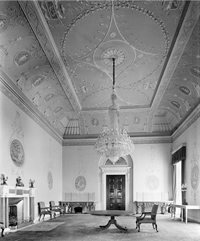
Dining Room, Crichel House, Dorset (Image: A. E. Henson / Country Life Picture Library)

Sturt, using an unknown architect (though thought to be from nearby Blandford), effectively wrapped a new house around the old one to the east and the west, and linking the two on the south front with an impressive recessed portico and suite of rooms on the first floor.  However, the need to accommodate the dimensions of the old house created a slightly cramped feeling to the first floor elevations.  However, all is forgiven by the splendid interiors which are, in parts, a curious mix of early Georgian created late (e.g. the staircase, the library), and fashionable later Georgian, particularly in the stunning Hall, Dining Room and Drawing Room where Adam-style plasterwork reigns.  The latter rooms were probably designed by James Wyatt who was working nearby at Milton Abbey and at Bryanston.  The Dining Room is considered the finest room in the house; a coved ceiling framing delicate plasterwork and decorative panels in the style of Cipriani and Angelica Kauffmann.

So, how did part of the Crichel estate become so significant that it became immortalised as a set of planning procedures known as the ‘Crichel Down Rules’? In part, it was due to the bureaucratic arrogance of the post-War era which meant the Civil Service felt able to deal rather high-handedly with anyone, and particularly landowners who were not popular under Attlee’s socialist government. In 1937, 742-acres of Crichel Down had been compulsorily bought as part of a larger area for use as a bombing range. Churchill had given a very public commitment in the House of Commons in 1942 that land purchased in this way would be offered back to the original owners once it was no longer required for the original purpose.

Hinton Ampner, Dorset (Image: ec1jack / flickr)

However, there was an even greater danger of compulsory purchase for houses which had been adapted for wartime use under the ‘Requisitioned Land and War Works Act (1945)’ (sections 8 & 9 Geo. 6 c.43 in case you were wondering!) which gave officials the right to buy, regardless of the wishes of the former owner or any previous assurances. At Hinton Ampner in Hampshire where Ralph Dutton (the 8th and last Lord Sherborne), having just finished an extensive remodelling in 1939 only to be turfed out by a girls school, received a letter saying that the Royal Observatory were interested as a new Royal Observatory.  Dutton took the day off work at the Foreign Office and was on the doorstep when the officials arrived and gave an impassioned speech about the importance of the house, how it had been in the family for generations and that losing it would be akin to an amputation. The officials apparently looked somewhat embarrassed but gave no sign of retreating until a short note arrived a little later confirming that they were taking Hurstmonceaux Castle instead.

At Crichel Down, the government had decided to retain the land as a new model farm.  Lt-Cdr George Marten (who had married Mary Sturt, the only child of the 3rd Lord Alington), began a vigorous one-man campaign to examine the conduct and procedures of the relevant departments.  In doing so, he exposed a series of administrative errors as officials tried to evade the requirement to offer back the land and retain it for the government’s use.  Eventually, in 1954, public and press criticism led to the minister in charge, Sir Thomas Dugdale, resigning in one of the first examples of a minister taking responsibility even though he had not been involved in the earlier decisions and the land was sold back to the Martens.  To avoid a repeat of such failings, new planning rules regarding compulsory purchase were drawn up which are today known as the ‘Crichel Down Rules’ and are a vital part of the framework protecting landowners from the sometimes autocratic decisions of officials.

The death of Mary Marten in 2010 (her husband pre-deceased her) led to the recent sale of some of the contents of the house including a small collection of Asian jade ornaments which raised some £12.5m.  However, if the rumours are right, the rest of the house and 5,000-acre estate are also quietly on the market with an estimated price tag of around £100m, which, if it sold as a whole estate, would make it the most expensive sale ever outside of London.  It’s always a regret when families no longer wish to keep an estate which has been in the family for centuries, however, with the demands of sibling equality it is understandable that each of the six children – five females, one male – should wish to share their inheritance.  It would be a wonderful outcome if it could be bought in its entirety and remain one of the most important estates in Dorset, with the glorious Crichel House at it’s heart.

————————————————————————-

Update – 7 July 2013: Crichel House has been sold

Daily Mail confirms that the house plus 400-acres has been bought by Richard L. Chilton, a US hedge fund billionaire.  Initial reports indicate that he is a ‘conservationist’ having rescued other houses in the States so it seems promising that he is the right buyer; one with both the right attitude and pockets deep enough to do the house justice.  Though sadly it’s the end of an era for the Marten family, one hopes that this next phase will see the house restored to its former glory.

And if Mr Chilton happens to read this, it would be great to get your perspective – please do email me.

————————————————————————-

More images – both interior and exterior: ‘Crichel House, Dorset‘ [Country Life Picture Library]

Peckforton Castle, Cheshire, seriously damaged in arson attack

Peckforton Castle, Cheshire (Image: the pepper tree / flickr)

In the early hours of Sunday (19 June 2011) a serious fire broke out in the Drawing Room of grade-I listed Peckforton Castle and has gutted all three floors of that wing, affecting approximately 25% of the building. Sadly, it appears that this terrible destruction in one of the finest mock castles in the country is reported to be the result of an arson attack by the groom, apparently over the wedding bill.  That such a wonderful building could be damaged over something so stupid is beyond belief.  The full extent of the damage – and credit to the fire service for preventing it spreading – will only become truly apparent over the next few days.

Peckforton Castle sits on a Cheshire hill-top, facing down the medieval Beeston Castle on the neighbouring peak.  Yet, Peckforton is a Victorian creation for the 1st Lord Tollemache, who had commissioned Anthony Salvin to marry the conveniences demanded by a Victorian landowner with a scholarly re-creation of an ancient castle, creating the muscular skyline so visible today.  The style of the castle is a reflection of the character of Tollemache – vigorous sportsman, statesman, father to 24 children, and, above, benevolent landlord.  Tollemache had inherited the 26,000-acre estate through his grandmother, co-heiress of the 4th Earl of Dysart, and had particularly Victorian vision of how an estate should be run, saying “The only lasting pleasure to be derived from the possession of a landed estate is to witness the improvement of the social condition of those residing on it.” To this end, he reduced the size of each farm to 200-acres and rebuilt every farmhouse and labourers cottage on the estate at a cost of £280,000 (approx. £20m) and to each cottage he allocated a further 3-acres to help them grow their own produce.

The estate lacked a main house and so Tollemache went against the prevailing fashion of the time and commissioned an authentic re-creation of a medieval castle which was built between 1844 and 1850.  The fashion for sham castles had grown out of the Georgian Picturesque movement which applauded such visions of a castle – symbol of ancient chivalry – and landscape combined to create an aesthetically pleasing view. Yet, in demanding an accurate castle, Tollemache rejected many of the compromises that had previously characterised the lesser shams, such as having a great gatehouse but also acres of glass, which were being roundly criticised by architects such as Pugin who demanded architectural authenticity.

Courtyard, Peckforton Castle, Cheshire (Image: Bob W / flickr)

Tollemache’s architect was Anthony Salvin (b.1799 – d.1881), who, on the strength of the success of Peckforton, was commissioned to also work on Alnwick Castle and the Tower of London, and many more.  Salvin was the perfect architect for the job with his Victorian understanding of the romance of castles and the appeal of the Middle Ages but also a sound practical training with John Nash which gave him the skill to successfully, as Alfred Waterhouse wrote to Lord Tollemache in 1878, “…combine the exterior and plan of an Edwardian [Edward I] Castle with nineteenth-century elegance and comfort.

Castle Drogo, Devon (Image: wikipedia)

Faced with the choice between architectural accuracy and convenience most of Tollemache’s contemporaries opted for more fashionable styles leaving relatively few of these large-scale re-creations.  Other examples of ‘real’ sham castles include William Burges‘ designs for Lord Bute at Castell Coch, Belvoir Castle for the Dukes of Rutland, and the powerfully brooding Penryhn Castle, built between 1840-50, for George Hay Dawkins-Pennant.  The demand for an authentic castle then largely abates until Julius Drewe’s commission, built in the 1910s and 1920s, for Sir Edwin Lutyens which results in the wonderful Castle Drogo.  By their very nature, their stern exteriors make them untraditional country houses yet they hark back to the oldest form of home for the landed gentry, and a symbol of power and prestige.

Sadly, arson attacks on country houses are not unknown – witness the terrible devastation brought to Hafodunos Hall in Wales by two bored idiots in 2004. With Peckforton Castle, the success of the design, both as an exterior composition, but also for the practical yet impressive interiors is why the house is such an important part of the nation’s architectural heritage.  The house was only recently subject to a £1.7m restoration programme by the Naylor family who own it and have worked immensely hard to bring to life a house that had been empty since WWII.  Hopefully the damage will not turn out to be as extensive as feared – though estimates for restoration are already said to be around £1m.  The strength of the construction means that it will almost certainly be restorable and will hopefully again rise soon from the ashes of this terrible fire.

———————————————————————

News stories:

Listing description: ‘Peckforton Castle‘ [britishlistedbuildings]