Indulging a fantasy; the art of the architectural capriccio

Probably one of the greatest frustrations for an architect must be the commissions which remain unrealised.  For the architecture fan the frustrations can be being unable to see those buildings now lost.  In response to this, one form of art, the capriccio or architectural fantasy, has sought to forever memorialise the works of the architect through portraying them in one single painting which also, in one glorious sweep, provides a fascinating overview of the collected output of some of our finest architects.  These technically demanding works have been created for hundreds of years and an exhibition in London (open until the 2 July 2011) shows the brilliant work of Carl Laubin, the latest artist to create a breath-taking vista, this time using the combined works of one of our greatest architects, Sir John Vanbrugh.

Panini, Giovanni Paolo - Gallery of Views of Modern Rome, 1759 (Image: Web Gallery of Art)
Paini, Giovanni Paolo - 'Gallery of Views of Modern Rome', 1759 (Image: Web Gallery of Art)

The art of the capricci is regarded as having come to prominence through the skill of Marco Ricci (b.1676 – d.1730) who enjoyed popular success with his imagined views of ruins when he came to England in 1710.  The style was later developed by Giovanni Paolo Panini (b.1691 – d.1765) whose works of Rome included views of the architecture arranged as pictures in a gallery. This construct allowed many images of the famous buildings in a city to be accommodated within one picture than any physical viewpoint would permit.

In the 1740s, Giovanni Battista Piranesi created a famous series of engravings entitled ‘Prisons (Carceri)‘ which, instead of the idealised and tourist-friendly views of Rome, created an imagined labyrinth of vaulted, subterranean spaces filled with all manner of industrial machinery.  The creation of entirely imagined spaces moved the art of the capricci out of strict reality and gave artists and architects the space to dream any number of fantastical schemes.

One of the most gifted British architectural artists was Joseph Michael Gandy (b.1771 – d.1843) – a frustrated architect who found a more productive output as the ghost-artist for the brilliant, and eminently more practical and successful, Sir John Soane.  For many years, Gandy produced exquisitely rendered landscape views of Soane’s designs, usually as part of the proposals to clients to win work (aka marketing).  Soane’s sophisticated use of light and elegant façades were particularly suited to Gandy’s dramatic style which cast the buildings within lush landscapes and varied weather.  Soane was especially interested in his own architectural legacy – something which Gandy recognised when he created in 1818 his elaborate ‘Selection of public and private buildings’ parts according to Sir John Soane’s projects RA. FSA., for the metropolis and other places of the United Kingdom between 1780 and 1815‘ (to give it its full title!)

Gandy, Joseph Michael - 'A Selection of Pand Private buildings’ Parts according to Sir John Soane’s projects RA. FSA., for the metropolis and other places of the United Kingdom between 1780 and 1815', 1818 (Image: Cottbus University)
Gandy, Joseph Michael - 'A Selection of Public and Private buildings’ Parts according to Sir John Soane’s projects RA. FSA., for the metropolis and other places of the United Kingdom between 1780 and 1815', 1818 (Image: Cottbus University)

As Brian Lukacher (Joseph Gandy: An Architectural Visionary in Georgian England‘, Thames & Hudson, 2006) points out, this ingenious painting (which shows not only buildings as though models but also paintings of others a la Panini) not only serves the purpose of commemorating the many fine works of Sir John Soane but also records the many renderings which Gandy had produced in the course of their collaboration.

Soane’s successor as Professor of Architecture at the Royal Academy, Charles Robert Cockerell (b.1788 – d.1863), also indulged in this architectural inventiveness in his own capriccio, painted in 1848, called ‘The Professor’s Dream‘. In it, rather than focus on one architect, he encompasses much of the canon of western classical architecture spanning a period of 4,000-years.  Traditionally, timelines are represented as moving from left (oldest) to right (latest), yet Cockerell brilliantly creates a receding perspective with plain earth in the foreground, then moving back in architectural development, starting with Egyptian and then moving back in four ‘terraces’ of evolution – though finishing with the great pyramids at Cheops, which at that time, were still the tallest structures on Earth.
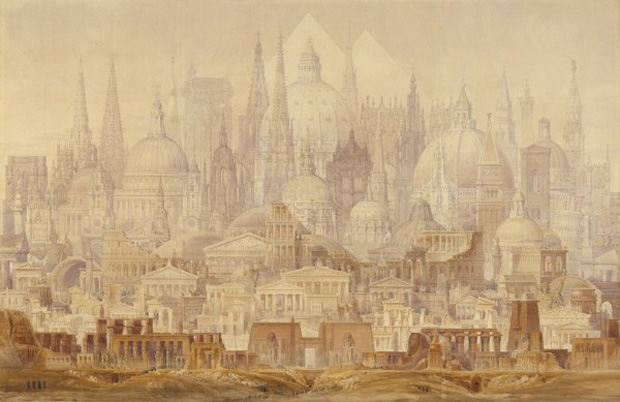
Cockerell, C.R. - 'The Professor's Dream', 1848 (Image: Royal Academy)

This brilliant image was essentially a teaching aid for Cockerell to show his students that the skills and achievements of the past were the foundations for creating good architecture in the future.

So, these paintings are not only commemorative but also allegorical and instructive, but, perhaps most of all, they are beautiful. They are complex evocations of imagined landscapes not bound by the reality of whether buildings existing in the same view – or even at all.  This wonderful tradition of the capricci is now being continued by Carl Laubin, whose latest works, ‘Vanbrugh’s Castles‘ and ‘Vanbrugh Fields‘, capture, in two sweeping landscapes, the varied brilliance of Sir John Vanbrugh. Laubin originally trained as an architect but found his passion for art the stronger influence, but has combined them both, creating a series of capricci on various architectural subjects including the works of Nicholas Hawksmoor and houses of the National Trust.
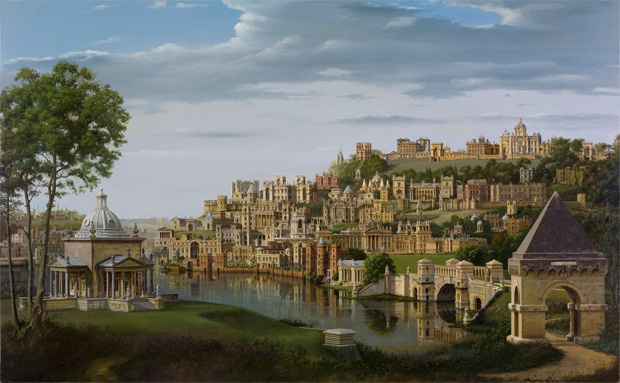
Laubin, Carl - 'Vanbrugh Fields', 2011 (Image: from the artist)

The detailed views in these new paintings include all the buildings designed by Vanbrugh, both executed and unexecuted, and also some only ever vaguely sketched out, which Laubin has then worked up as fully realised buildings in his distinctive hyper-realist style: this is truly architecture as art.  What is particularly fascinating is to see all of an architect’s output in one sumptuous view – as though the finest hill town possibly imagined had been created.  These works are also created on a scale which allows for such detail to be included that every building is identifiable. Laubin has created an indulgence for any architecture fan which provides a simple, but beautifully constructed, way to get a better understanding of Vanbrugh’s creative genius; his ability to vary form, mass and architectural vocabulary but within that rich Baroque tradition of which he was an obvious master.

Capricci require immense amounts of research, planning, and dedication hence their relative scarcity but as an art form they form about as instructive body of work as one could hope for.  Architecture is very much about the physical but sometimes the fantastical can be just as satisfying; creating glorious vistas which bring home the skill of not only the architect but also the artist.

————————————————————————————–

Carl Laubin at the Plus One Gallery, London – until 2 July 2011 – the gallery is a short walk from Sloane Square tube station

More about J.M. Gandy:

More about capricci: ‘Architectural fantasies‘ [jsblog.com]
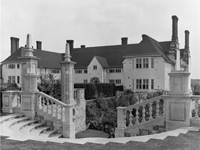
The Country House Revealed – Marsh Court, Hampshire

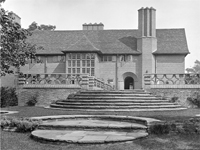
Marsh Court, Hampshire (Image: Country Life Picture Library)

As with artists, some architects start well and then just get better, culminating in masterpieces which are rightly praised.  With buildings, and particularly the usually distant country house, it can be difficult to truly appreciate them; their beauty a pleasure reserved for those invited.  Thus one of the delights of ‘The Country House Revealed‘ series has been to elevate us mere viewers into guests of some lesser known, but wonderful houses – and Dan Cruickshanks’ visit to Marsh Court in Hampshire proves just what gems are nestled in the countryside.

The house is the work of one of the best architects to have been produced by this country; Sir Edwin Landseer Lutyens.  A master at the re-interpretation of traditional building forms and styles, his work is, in many cases, instantly recognisable. Yet, in others, his sensitive updating of existing historic buildings blends so seamlessly it’s hard to distinguish between old and new (one of the best examples of this is Great Dixter, Sussex).  Lutyens was working at the end of the Victorian era and his work grew into the perfect response to the glory days of the Edwardian period; those long summers of country house entertaining from the turn of the 19th-century which were so firmly ended by the horrors of WWI.  Yet this was also a time of a confident nation, with fortunes being made (and lost) in an increasingly mercantile world, in which wealth was not related to the land. This fact was reflected in a new style of country house which required the trappings of the traditional entertainments and accommodation but which didn’t require a vast estate to support it.

Deanery Garden, Berkshire (Image: Country Life Picture Library)

Lutyens was the right man at the right time – and with the right connections.  His rise coincided with a new interest in the countryside, which was now being opened up to the new middle class with their leisure time and the rail network.  Spotting an opportunity, Edward Hudson started ‘Country Life‘ magazine in 1897, which quickly became the publication of the country set – and, more importantly, those who aspired to join them.  Hudson had been impressed with Lutyens’ work, to the extent that he had him design his own house, the brilliant Deanery Garden in Berkshire.  The distinguished architectural writer (and Country Life writer) Christopher Hussey said that it:

“…may be called without overstatement a perfect architectural sonnet, compounded of brick and tile and timber forms, in which his handling of the masses and spaces serve as a rhythm: it’s theme, a romantic bachelor’s idyllic afternoons beside a Thames backwater.”

Replace ‘Thames’ with ‘Hampshire’ and this praise might equally, and perhaps more so, be applied to Marsh Court. However, one other key difference would be the material used in the construction of Marsh Court; clunch, the local hard chalk stone; used for centuries in churches and cottages but never for an entire country house.  It’s a mark of Lutyens’ mastery of materials and style that he would even consider it – and the effect is what helps elevate this house to being one of the finest in the country.

Marsh Court echoes something of the character of the client, Herbert Johnson, who was as an “adventurer, stockjobber, and sportsman” who made a fortune, lost it, and made another.  Lutyens came to the attention of Johnson through the regular articles in Country Life featuring his various commissions which Hudson was only to happy to publicise.  In many ways, Johnson was an ideal Lutyens client – willing to think big, with a suitable budget and, although wishing to join the country life, not excessively bound by tradition.  This suited Lutyens as he was able to develop his ideas around the ‘Tudor’ style house, but marry them with a modern take which dramatically elevated the design to ensure no-one could ever call it ‘pastiche’.

West front - Marsh Court, Hampshire (Image: Country Life Picture Library)

The house, built between 1901 and 1904 with later additions also by Lutyens, is essentially an ‘H-plan’, though without the south-east leg, and goes back to his earlier interest in historic English architecture.  As the architectural writer Lawrence Weaver highlights, this house only works because Lutyens has perfected the balance of local materials through clever groupings of shapes and elevations, combined with contrasts in size and stone.  But even a good design might become too dominant in such an exposed location, sitting on a rise above the river Test.  Again, Lutyens has the ideal answer in his use of the sloped site to create terraces which ease the house into the landscape – note the change from two-storey on the north front to three on the south.  The stark white stone is also softened through the introduction of slates, flint and red-brick into the walls to create a mix of regular and irregular patterns, such as on the west front which gives the impression of tiles sliding down the walls like rain to pool at the bottom.  Only someone of Lutyens’ skill could attempt and succeed with such an architectural fancy.  The interiors are similarly impressive, with grand, almost Baroque, plasterwork in the hallway, combined with the fine panelling elsewhere.

Herbert Johnson moved out in sometime after 1940 and the house became home to evacuated children, and then, in 1948, a prep school.  It remained in this role for nearly 50 years before it was bought, for £800,000, in 1994, by Sir Geoffrey Robinson; industrialist, Labour MP but, most importantly, a heritage-minded multi-millionaire. Working with Michael Edwards, Sir Geoffrey and his wife Marie Elena undertook a comprehensive, yet sensitive, restoration of the house; removing partitions, restoring the ceiling plasterwork and updating the services. It was then sold for £6m in 1999 and then offered at £13m in 2007, before being relaunched in June 2008 at £10m before selling at £11m later that year.

Lutyens’ brilliant output was somewhat overlooked by the wider contemporary architectural world which was more interested in the developing Modern movement. Hudson’s constant championing of this visionary architect ensured that Lutyens’ work and reputation were assured even if he had never gone on to his later, much grander, projects designing the Viceroy’s Palace in New Dehli. In 1909, G. Lloyd Morris, although talking specifically about Marsh Court, provided an elegant summary of the essence of Lutyens’ skill in that the;

‘ unity’ which ‘…is the pre-eminent quality underlying the orderly and tranquil beauty manifest in [his] houses.  He never fails in this respect; one may cavil at certain details, or question the use and treatment of a material, but in the handling of the general conception there is always a breadth and a certainty in the composition that remains in the memory long after the details may have been forgotten.’

Certainly, Marsh Court succeeds overwhelmingly in this respect and is a worthy inclusion in any series looking at the finest country houses in the UK.

————————————————————————————-

Official website: ‘The Country House Revealed‘ [BBC2]

Superb photos of the house and gardens: ‘Marsh Court, Hampshire‘ [Country Life Picture Library]

More on the house and Lutyens:

The Country House Revealed – Clandeboye, County Down

Clandeboye, County Down (Image: Paul Barker / Country Life Picture Library)

One of the great glories of the private incomes afforded to previous generations was the ability to indulge in their passions.  Given the opportunity, many of us would similarly be happy to devote our lives to our interests and, for some, in doing so they have created great collections – not just of art, but in the fields of anthropology, Egyptology, armour, botany…the range is endless.  In this week’s ‘The Country House Revealed‘, Dan Cruickshank visits Clandeboye in County Down, Northern Ireland; seat of a branch of the Guinness family, but also home to an impressive collection of artefacts.

Clandeboye (also sometimes known by the original name Ballyleidy) sits in a 2,000-acre estate in the heart of the Ulster countryside – a smart, elegantly Georgian seat; the design semi-Soanian (originally), part-the-owner (later additions).  The professional architect involved was a former pupil of Sir John Soane, Robert Woodgate, to whose designs the house was built in 1801-4.  Woodgate had a brief career, cut short by his early death in 1805, having joined Soane’s practice as an apprentice in 1788, before graduating in 1791 and then being sent to Ireland to Baronscourt, Co. Tyrone (note the triffid-like march of the wind turbines now marring the skyline!), to supervise the building Soane’s commission of a new house for the Marquess of Abercorn.

Clandeboye, for the 2nd Baron Dufferin, was one of Woodgate’s earliest commissions and is unusual, ignoring the more common ‘Palladian’ central block with flanking wings layout, of houses at the time.  At Clandeboye, whilst still Soanian in it’s style, the layout is focussed on two wings at right-angles to each other with the corner due south taking maximum advantage of both the setting and the sun.  All-in-all, a good, competent design by a well-trained young architect – though perhaps lacking some of the drama a more experienced architect might have brought to the plan.

What is particularly special about Clandeboye today is that it contains the remarkable and diverse collections of the wonderfully named Frederick Temple Hamilton-Temple-Blackwood, 5th Baron Dufferin and Claneboye (note the different spelling of the title).  A prominent politician and administrator, he served as Governor General of Canada  (1872-1879) and Viceroy of India (1884-1888).  The Lord Dufferin was also something of a radical social reformer and fell out with the PM, Gladstone, believing that the land ought to be owned by the farmers.  Not content with just arguing for this, he sold off much of the 18,000-acres the family had amassed, leaving the estate we see today.

Very well-educated, Lord Dufferin, as with many other wealthy Victorians, used the opportunities of his many diplomatic postings to acquire large quantities of objects – not just the usual art and furniture but curiosities from around the globe.  This led to a new programme of work in the mid-19th century to enlarge the house to display these prizes, resulting in a large west wing.  Dufferin had toyed for years with grand plans for the complete rebuilding of Clandeboye to a faux-Elizabethan nostalgic ideal.  After a few years, his tastes changed and he then sought out Benjamin Ferrey to provide a French-chateaux style house – but again this came to nothing.  In 1865, his preferences had ebbed back towards a more ‘romantic’ style and he began a long collaboration with William Henry Lynn, who then advised Dufferin on the alterations to Clandeboye which are what we see today.   One aspect of the process which probably infuriated Lynn was, as Harold Nicolson has described, that Lord Dufferin’s ‘passion for glass roofing was… uncontrolled‘, leading to the broad use of skylights.  Considering how Soane, and therefore probably Woodgate, sought to carefully manage the effects of light, this crude flooding of the interior spaces may not have met with approval from the original architect.

Today, the contents of the house can be seen as a snapshot of the passions and interests of a wealthy aristocrat at the height of the British Empire. Victorian Britain seemed to foment this type of collector with other houses similarly becoming self-indulgent museums – though often with a great intellectual rigour which helped drive forward our understanding of the world and science.

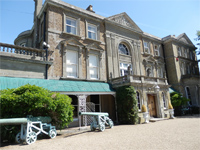
Quex Park, Kent (Image: ..george / flickr)

For example, Quex Park in Kent became the showcase of the Powell-Cotton family, who, over six generations, created a superb collection of natural history with specimens taken during Major Percy Horace Gordon Powell-Cotton’s expeditions to Africa,which has subsequently been expanded by later generations.  Another showcase was Goodrich Court (dem. 1950) which was designed by the owner Sir Samuel Rush Meyrick specifically to accommodate his world-renowned collection of arms and armour which forms an important part of the incredible Wallace Collection in London.

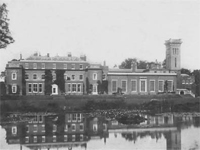
Didlington Hall, Norfolk - demolished 1950/52 (Image: Lost Heritage)

As at Clandeboye, Egypt has long held a fascination in Britain.  One early and noted collection was assembled by William Amherst Tyssen-Amherst (the 1st Baron Amherst) at Didlington Hall in Norfolk (dem. 1950/52).  By chance, Lord Amherst employed a Mr Samuel Carter, a well-known artist to paint at the house, and he would often bring his son, who spent many an hour in the extensive Egyptian museum in the house.  That son was Howard Carter who famously went on to discover Tutankhamun’s Mask with George Herbert, 5th Earl of Carnarvon.  Highclere Castle also holds a small but important collection of Egyptian antiquities amassed by the 5th Earl and which are now on display in a purpose-built gallery in the cellars of the house.

Waddesdon Manor, Buckinghamshire (Image: National Trust)

Perhaps the greatest example of a house built to show a collection is Wadddesdon Manor in Buckinghamshire; that slice of French architecture which enchantingly appears in the middle of the English countryside.  Funded by the vast Rothschild fortunes, the mansion, designed by Gabriel Hippolyte Destailleur, was built between 1874-1889 for Baron Ferdinand de Rothschild primarily to showcase what must easily be one of the finest collections of Dutch and English paintings and French art, tapestries and furniture.  Used only in the summer months for parties and entertaining this was the ultimate expression of the desire to use a private residence as a gallery – or was it merely a gallery with bedrooms?

So Clandeboye is part of a long and fine tradition of the wealthy owners of large houses not merely adding a scattering of objet d’art to show-off the taste of their interior decorators. These houses are true collections, in some cases museums, even monuments, to the eclectic passions of their owners.  The wide-ranging nature of these collections demonstrates one of the many benefits of single family ownership, such as at Clandeboye, where intellect and wealth can be combined over generations to create a rich and interesting tapestry that no public organisation would be likely to be imitate; and our nation would be all the poorer without it.

————————————————————————————–

Official website: ‘The Country House Revealed‘ [BBC2]

A wonderful interview (and slideshow) with the Countess of Dufferin and Ava: ‘The Marchioness‘ [wmagazine]

The Clandeboye estate: official website / history [clandeboye.co.uk]

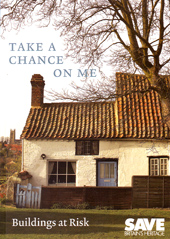
‘Take a Chance on Me’ – Buildings at Risk Register 2011

'Take a Chance on Me' - 2011 SAVE Buildings at Risk Register

Despite the obvious deep and passionate interest society has with historic buildings every year the SAVE Britain’s Heritage Buildings at Risk Register highlights just how many properties are still under threat from neglect and those in power who believe the only good building is a new one with their name on the opening ceremony plaque.  The 2011 BaR register – ‘Take a Chance on Me‘ – has just been published and sadly, as always, it contains some country houses which really deserve a better fate.

Perhaps the one of the most attractive, both architecturally and in terms of being a  case for restoration is Blackborough Hall, near Cullompton in Devon. This elegant, if thoroughly dilapidated grade-II house, is a remnant of the grand building plans of the Earl of Egremont whose many-columned main house, Silverton Park, was demolished in 1902.  The house is actually two, as when built in 1838, it formed one house at the front and a second at the rear for the local rector.  In recent years it became a car scrap yard which covers most of the immediate grounds and would obviously need clearing first – though I suspect the costs could be made back through selling some of the classic cars. The house is currently for sale for a nice round £1m and has been listed with Winkworths who, after an initially poor showing, have now managed to put a few more photos and a floor-plan online.

Elvaston Castle, Derbyshire (Image: Steve Tomkinson / Friends of Elvaston Castle)

Elvaston Castle in Derbyshire has a grade-II* listing putting it in the top 4% of buildings nationally but that hasn’t stopped it making an entry into the Register this year.  Originally built in 1633 for the Earls of Harrington it was largely rebuilt in a ‘Gothick’ style c.1817 to designs by James Wyatt.  Now owned and managed by Derbyshire County Council (who had a fairly poor record in the 20th-century of demolishing country houses in their ‘care’) it is today mostly vacant and with the Council now claiming it can’t afford to maintain it they are seeking a developer to get them out of a hole of their own making.  Luckily an active local campaigning group – the Friends of Elvaston Castle – have been objecting to these plans and trying to force the Council to face up to their responsibilities – though perhaps there is an opportunity for someone else to come up with a viable plan.

Stone Cross Mansion, Cumbria (Image: HiddenShadow / 28dayslater)
Stone Cross Mansion, Cumbria (Image: HiddenShadow / 28dayslater) - click for more images of the house today

Stone Cross Mansion, Cumbria presents the interesting confusion of a Scots Baronial design in England.  Built in the 1870s by a stubborn man, one Myles Kennedy, who wanted to buy Conishead Priory for £30,000, but who met an equally stubborn vendor who wouldn’t accept less than £35,000.  Mr Kennedy may have come to regret his obstinacy when presented with the final bill which totalled nearly £45,000.  The sum reflected the high quality of the workmanship, particularly the impressive High Victorian Gothic grand hall (scroll down) which originally had a fine staircase which was later removed when the house became a special school to make it easier to play indoor football (seriously, where do they find these people?!).  The house then became a corporate headquarters during which it time it was restored to a high-standard before falling into neglect.  Repeated enabling development proposals have been rejected (not that the council is against it) so this house either needs someone willing to restore the house on the back of a sensitive ED proposal – or, ideally, someone to rescue this house and make it a home again.

Plas Gwynfryn, Wales (Image: SAVE Britain's Heritage)

Another house which would make a fantastic home is Plas Gwynfryn in south Wales.  This house has been featured before on this blog (‘Orphan seeks new carers: Plas Gwynfryn, Gwynedd‘) which sparked some passionate debate in the comments about who the owner is – and that same unresolved question is why the house makes an appearance in the BaR this year. Built in 1866 to replace an earlier one, this distinctive house – described in the listing description as ‘romantically assymetrical’ – was a hospital in WWII, before becoming an orphanage and then a hotel before a serious fire in 1982 gutted it.  Although in a derelict condition this house can be restored and would once again be a fine part of the local architectural heritage.

The Register is available from 1 June 2011 priced at £15 (£13 to Friends of SAVE) and can be ordered from the SAVE website. The BaR contains many other types of property so even if your budgets are less lavish than these house might require it is well worth having a look.  Of course, SAVE does superb work across the country to protect our architectural heritage and I would strongly urge everyone to become a Friend to help support their efforts (well, I would say that as I’m on the Committee – but I’d also say it anyway!) which will also give you access to the online version of the BaR register which contains hundreds of other potential future success stories.

——————————————————————————–

A more comprehensive list of country houses currently at risk can be found on my Lost Heritage website: ‘Houses at Risk

The Country House Revealed – Easton Neston, Northamptonshire

Easton Neston, Northamptonshire (Image: Trish York)

The stated objective of Dan Cruickshank’s series ‘The Country House Revealed‘ is to “…explore Britain’s finest country houses” and after the relatively low-key start with South Wraxall Manor, it upped the ante with the elegant Kinross House, and now it truly reaches one of the finest houses in the country: Easton Neston, Northamptonshire.  The only country house by one of the finest architects of his generation, when it was put up for sale in 2005, it marked the end of one of the great family estates.

Although many fine adjectives can be applied to Easton Neston, one seems to sum it up: noble.  Sitting on a slight rise of ground, this beautifully proportioned house neither lords it over the area but neither does it shirk from elegantly dominating its environment.  That the house looks as it does is due to a unique set of circumstances which gave the opportunity for Nicholas Hawksmoor (b. c.1662 – d.1736) to design his only country house – though he did help with others.

Hawksmoor was born in Nottinghamshire and, after finishing school, was employed as a clerk by a local landowner.  Such was his ‘early skill and genius‘ that word of his talent reached the finest architect in the country, Sir Christopher Wren, who took him on as a clerk at the age of 18.  This employment gave Hawksmoor a role in almost all Wren’s projects from c.1684 onwards, including Winchester Palace, the London City churches and St Paul’s Cathedral. In 1689, thanks to Wren, Hawksmoor obtained the post of Clerk of Works at Kensington Palace – the first in a series of official state roles he was to hold throughout his life, which provided both opportunities and frustrations.

It was this close relationship with Wren which gave Hawksmoor the opportunity to design the house at Easton Neston for Sir William Fermor.  Wren seemed not to display much of an interest in designing country houses but, as he was related by marriage to Sir William, he had originally been consulted about a new house in 1682 and had provided designs for two wings built in the early 1690s, of which one now survives (despite a serious fire in 2002).  Importantly, these two facing wings were 125-feet apart, limiting the size of the main house which would site between them.

Oak model of Easton Neston, c.1690 (Image: Sotheby's?)
Oak model of Easton Neston (as proposed? as built?) (Image: Sotheby's?)

Due to the lack of virtually any drawings or documents relating to Hawksmoor and Easton Neston, there seems to be some debate between such distinguished historians as Howard Colvin, John Julius Norwich and Kerry Downes as to exactly what Hawksmoor designed.  The couple of surviving letters relating to the build from Wren and others indicate that there was possibly a brick house, to Wren’s design, which looked similar but the house as it is today differs in several notable ways, not least the use of engaged columns and giant pilasters.

The first use of the giant pilaster order in English residential architecture can be seen in the south front of Chatsworth, designed by William Talman in 1687 and which also introduced the rectangular silhouette, the echoes of both of which can be seen in Easton Neston.  If the house as modelled is what was proposed or built then it is Wren’s design as Talman’s influence was not yet to be felt.

Staircase, Easton Neston (Image: English Heritage / NMR)

Norwich argues that the form of the house was substantially Wren’s, as was the interior, though Downes argues that, on the evidence of Hawksmoor’s sophisticated alterations for the interior at Ingestre Hall in 1688, with its clever use of internal screens of columns and dramatic spaces, and similarly demonstrated with the original hall and the brilliant cantilevered, shallow-stepped staircase at Easton Neston, he comes down firmly on the side of Hawksmoor.

The overall look of the house as it stands today is clearly Hawksmoor – it’s exciting, erudite, and draws on his extensive knowledge of classical architecture to create  bold fronts but with brilliant proportions which make perfect use of the form.  Hawksmoor also had the advantage of the use of Helmdon stone which, due to its durability and exceptional crispness when carved, ensures the house looks as good today as when it was first built.

Easton Neston as shown in 'Vitruvius Britannicus' (Image: wapedia)
Easton Neston as shown in 'Vitruvius Britannicus' - click for larger image (Image: wapedia)

Hawksmoor never undertook the usual Grand Tour to Italy so his architectural style was essentially drawn from a close study from various books of earlier classical architects.  This gives his work an intellectual quality which others lacked but also gave him the vocabulary to be inventive.  Easton Neston appears as a much bigger house, including a huge forecourt, in Colen Campbell‘s ‘Vitruvius Britannicus‘ though, thankfully they were never executed.  However, the drawing clearly show a clear link between Hawksmoor’s country house and the six London churches (of the 12 built from the proposed 50) he designed: St Alfege’s Church, Greenwich, St George’s Church, Bloomsbury, Christ Church, Spitalfields, St George in the East, Wapping, St Mary Woolnoth, and St Anne’s, Limehouse.

Hawksmoor was also to work, from 1702, with that other genius architect of that age; Sir John Vanbrugh; the playwright turned architect who came to rely on Hawksmoor’s practical skills to translate his fanciful visions into a reality at Castle Howard and Blenheim Palace (even more so when he had to take over following Vanbrugh’s bitter falling out with the Duchess of Marlborough).  Hawksmoor can therefore be seen as a link between Wren’s classicism and the exuberance of Vanbrugh’s particular brand of English Baroque.

Easton Neston remained essentially unchanged (except for some later flamboyant and slightly rampant interior plasterwork by a local artisan in the 18th-century) and in the Fermor-Hesketh family for nearly 500-years until in 2004 Lord Hesketh decided that he was not willing to burden his children with running a house and estate which “…in a good year it loses £500,000 and in a bad year it could lose £1.5m.” and risk seeing the family wealth slowly ebb away on maintenance. He was possibly also influenced by the likely cost of the restoration of Wren’s badly-damaged East wing which suffered a serious fire in 2002. Originally the house and 3,000-acres were put on the market for £50m in a once-in-a-generation opportunity to purchase one of the finest estates to come on the market for decades. Yet with no takers for the whole, Knight Frank sold over 2,200-acres for around £20m leaving just the house and 600-acres for £15m.

In July 2005 it was announced that Easton Neston had been sold to the American clothing retail tycoon Leon Max, the Russian-born owner of the California-based Maxstudio.com retail chain.  For all the fear about overseas buyers, Mr Max appears to have taken his custodianship of this grade-I masterpiece very seriously; hiring the architect Ptolemy Dean to oversee the work and investing an estimated £5m on the restoration to update the services of the house but also to restore the damaged wing to create a European headquarters for his company.  The interiors are equally splendid, overseen by Henrietta Spencer-Churchill (who grew up at Blenheim), with Max taking an ‘almost pedantically historicist approach‘ to sourcing furnishings and furniture which includes Aubusson tapestries from a chateau in France, Louis XVI chairs, and even a couple of the paintings sold by Lord Hesketh as he emptied the house of everything in a series of grand country house sales before moving out.

Easton Neston probably now looks better now than it has done since it was built, with the investment from the new owner likely to have secured the future of one of our greatest and most interesting country houses.

——————————————————————–

Book of the series: ‘The Country House Revealed‘ [Waterstones]

Official listing: ‘The Country House Revealed‘ [BBC2]

Quotes, figures and details in final paragraph come from an interview with Leon Max in the Sunday Times ‘Home’ section – 3 October 2010.