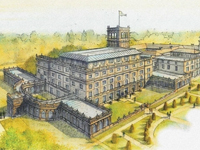
Proposal for Trentham Hall to be rebuilt as a hotel

Trentham Hall proposal, Staffordshire (Image: Property Week)

One of the greatest losses in the many country houses demolished in the 20th-century was that of Trentham Hall, the Staffordshire seat of the Dukes of Sutherland.  Originally a large Georgian house, it was rebuilt and greatly extended for the second Duke in the 1830s by the famous architect Sir Charles Barry, who was also responsible for the rebuilding of the Houses of Parliament.  The house became a celebrated venue for entertaining and was filled with fine works of art and sculpture.

Unfortunately the relentless expansion of the nearby Potteries areas of Staffordshire led to increasing amounts of pollution entering the rivers which fed the lakes and gardens designed by Capability Brown. By 1898 the smell was so bad that the house was effectively abandoned by 1907.  The Duke tried to donate the house and estate to the local council  in 1905 but was rejected so in 1912 the house was demolished.

The gardens were eventually opened to the public with the remaining outbuildings sitting rather forlornly around the blank space which marked out the site of the now lost house.  The gardens had been maintained and delighted generations of locals who would walk through the extensive terraces which led down to the now clean lake.  Now the 750-acre Trentham Gardens are part of a £100m project to bring back the glory of the earlier eras, with the centrepiece being the £35m recreation of the house as a 150-room luxury hotel following Barry’s original designs.

Despite the economic turmoil, the developers, who originally planned for completion by 2011, are still hopeful that they will be able to proceed with the project.   Although the hotel will not bring back the history and unique architecture of the house, the idea of recreating a lost country house is one to be encouraged.  Although many houses were demolished, the parkland and gardens were often simply abandoned and are still visible today.  Perhaps other estates might be encouraged to look at whether a new house might be the most appropriate use of the estate – after all, this was the purpose of their creation.

Full story: ‘Trentham rebuilt‘ [Property Week]

An architectural gem – but still slow to sell: Iver Grove

Iver Grove, Buckinghamshire (Image: The Listed Property Owners Club)

When it was completed in 1724, Iver Grove was one of the first houses in Britain built using the then radical Palladian styling; pre-dating even Lord Burlington’s famous Chiswick House.  Iver Grove is a beautiful and compact red brick essay in the use of the Classical elements with a Doric portico and topped with an elegant pediment.  Although originally attributed to either Sir Christopher Wren or Nicholas Hawksmoor, it’s now more widely accepted to be the work of John James who worked with Wren on St Paul’s Cathedral and succeeded him as the surveyor of the Commissioners’ Churches.  The front steps lead into a spacious and light entrance hall featuring the original oak staircase.

That the house is here today is remarkable in itself as after WWII it was in a parlous state and at risk of becoming one of the many hundreds of country houses demolished in the 1950s.  The house was smothered in ivy, riddled with dry rot and had been subject to various thefts of lead and fixtures and vandals who had smashed all but one of the Wedgewood stained-glass panels in window over the staircase.  The house was one of the first to be bought by the Government in an effort to save it – although this led to angry questions in the House of Commons from philistine MPs who demanded to know why we had spent more saving an “extremely beautiful house” (Lord John Hope) than we had sent to aid the Congo.  Such amazing short-sightedness still prevails today with those asking why we spend any money on heritage with similarly spurious justifications.

Anyway, thanks to the Government, the house was rescued through a programme of works which included demolishing the collapsed Victorian wing – and in so doing bring the house back to it original scale, and conveniently making it more manageable.  So when the this grade-I listed house was first launched in 2007 with much press coverage including a glowing write-up by Marcus Binney in The Times (‘A fast track to perfection‘) and later in Country Life (‘Georgian estate for sale‘) it was thought it would sell quickly.  However, £6.5m price tag was probably boosted by its architectural importance above the fact that it was a six-bedroom house with just 17-acres near to the M25.  The price was probably quickly identified as the issue as in The Times article in May the price is £6.5m, by the time the Country Life article was published in December the price was given as ‘offers over £5m’.  Now, two and half years later the price has dropped to a more reasonable £4.25m, and hopefully this will entice a new sympathetic purchaser with a desire to live in an important country house with manageable grounds but who will appreciate being just 17 miles from Hyde Park corner.  Actually, if I win the lottery, I’ll probably go for it.

Full details: ‘Iver Grove, Buckinghamshire‘ [Knight Frank]

Thorpe Hall to be sold off?

Thorpe Hall, Cambridgeshire (Image: wikipedia)

Perhaps it’s reading too much into a story but when a journalist says that “…despite its magnificence the former stately home, built in 1653, is impractical as a hospice – haemorrhaging money, which could, and should, be spent on patient care.” does this indicate an intention to sell this important Grade-I listed house? And “…Thorpe Hall, however beautiful, is not an ideal site”.  Perhaps the fact that the Sue Ryder Foundation, who own the house, have also launched an £8m appeal for a new hospice in the city is related?

Thorpe Hall has the rare distinction of being one of the few houses built during the dark years of the Commonwealth when there was little building activity in England.  Although an undoubtably beautiful house the “principal staircase with heavily carved foliated open panels to broad balustrade” is probably not suitable for a stairlift.

Hopefully, the discussion and consultation process will be open as possible – the worst scenario would be for the hospice to move to a new location leaving this important building in a disused limbo.  Here’s a thought though; rather than passing to another institutional use, it would be interesting to explore the possibility of it becoming a home again.  This would be the least impact option in terms of long-term day-to-day use but would probably entail some covenants regarding the long-established access to the grounds and gardens.  Anyway, it’s just a thought.

Full story: ‘Sue Ryder Care: Encouraged by public’s support for new hospice‘ [Peterborough Evening Telegraph]

Holnest Park House seriously damaged by fire – may collapse

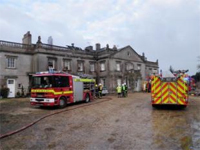
Holnest Park House, Dorset (Image: Bournemouth Echo)

Earlier today, the Grade-II listed Holnest Park House in Dorset suffered a serious fire which has gutted the central section of the house leaving the core at risk of collapse.  The fire started in one of the seven flats through the careless use of an electric blanket which lacked a thermostat and simply heated up until it caught fire.  The fire destroyed the two flats in the central section but the 60 firemen in attendance were able to prevent the blaze spreading to the wings.

The Georgian house was built in 1768, and rebuilt in the 1830s, on land formerly owned by the Bishops of Salisbury. It became a secondary seat of the Sawbridge-Erle-Drax family through marriage, and so was regularly tenented as the family were mainly based at Charborough Park (a large house also in Dorset) and Olantigh Towers in Kent.

The house was sold in 1919 and then used as military hospital for injured servicemen during WWII.  It was subsequently sold to timber merchants who stripped the park of it’s fine trees even felling the avenue to the house, and then selling the land off for agriculture.  The house then became an island in the middle of the fields, neglected until someone decided to ill-advisedly convert this remote house into a nightclub.  The left-hand side was divided up and much damage done to the interior during this process.  The right-hand side became (or was) houses.  After the inevitable failure of the nightclub the rest of the house was converted into further apartments.

Fire is one of the most worrying dangers faced by country houses as they can be started so easily, especially during renovations, and due to the materials used in construction the fire can spread quickly.  Of course, this danger is increased where a house has been split into multiple apartments as there are now more sources of ignition such as kitchens.  Older houses are usually not fitted with many of the modern fire safety features as this would compromise the historic fabric of the building meaning there is a extra responsibility for the owners to be vigilant.

Although the intial reports indicate that the fire-damaged section of the house has been declared structurally unsafe,  it’s hoped that restoration will be possible.  Insurance can cover the cost of re-instatement but it can’t bring back the historical aspect of what’s been lost.

Full story: ‘Fire hit Dorset stately home at risk of collapsing‘ [BBC News] / ‘Fire at stately home caused by electric blanket‘ [Bournemouth Echo]

Lease one of the best Charles II houses in England – but there’s a catch

Ashdown House, Oxfordshire (Image: wikipedia)

If an almost perfect example of a Grade-I listed, Charles II house set in beautiful protected parkland but only an hour from London was available for £4.5m you might think there was a typo.  However, it’s true but there are one or two minor catches.

Firstly, Ashdown House , built in 1661, is owned by the National Trust so your £4.5m only gets you a 60-year lease (or £205 a day if that’s easier).  Secondly, because it’s National Trust, the house is also open to visitors every weekend April to October (approx 2,000 last year) so that they can see the impressive staircase and ascend the 100 stairs to the viewing platform with it’s fine views over the Berkshire Downs.

So, basically, this is possibly the finest second home in the country – although rather than use it at weekends you may wish to be there during the week. The current owner, Mr Max Ulfane, a businessman and well-known philanthropist, has hosted such high-profile events as fund-raising receptions for the Ashmolean Museum.  Alternatively it might be possible to vary the lease to at least exclude some weekends – especially as the lease was offered with the same terms at the same price in May 2009.

*Update* The Sunday Times today (24 January) says that a 83-year lease is available for £5.3m (£175 per day for anyone putting it on expenses) and that the famous artist Anish Kapoor is planning to take a look and it has already been seen by several others including a top executive at Puma.

*Update* – Sept 2010 – The remaining lease has been taken by Pete Townshend of The Who.

Full story: ‘A grand Charles II house fit for a queen‘ [The Times]