#Repton200: Humphry Repton, landscape gardener – and architect?

Although principally known as a ‘landscape gardener’ – a job title he invented even if the role was already well-defined – Humphry Repton was clearly a man who understood that an estate was a composition of many parts and that architecture had a vital role to play in the success of his schemes. The challenge in assessing Repton’s contribution to architecture is that of his collaborations; what sprang from his inventive and knowledgeable mind, and what came from those he worked with, including his sons, John and George, and also that leading proponent of the Picturesque, John Nash.

Detail from Humphry Repton by Henry Bryan Hall, published by Longman & Co, after Samuel Shelley (1839) (NPG D5801 © National Portrait Gallery)
Detail from Humphry Repton by Henry Bryan Hall, published by Longman & Co, after Samuel Shelley (1839)
(NPG D5801 © National Portrait Gallery)

Humphry Repton (b.1752 – d.1818) had a lifelong passion for gardening, but it was not his first career.  After starting in business as a general merchant in Norwich, which failed, Repton decided to retire to the countryside and live with his sister and husband in Sustead, near Aylsham, in Norfolk.  With his father’s prosperity and sister’s indulgence, he developed his interest in botany and gardening.  After a brief period in 1783 as private secretary in Ireland to his neighbour William Windham of Felbrigg (he resigned after a month), Repton took a cottage near Romford, Essex, and decided to focus on turning his interest into a career.  Fortunately, circumstances meant that he was well placed to do so with his deep horticultural knowledge, his superlative skills as a watercolourist, which he used to create his visions in his beautifully produced Red Books, plus opportune timing, with the death of Lancelot ‘Capability’ Brown in 1783 creating a gap for someone with Repton’s grand ideas.

Although the setting of a house was a key consideration for any architect of the era, few  thought of themselves as landscape gardeners (Decimus Burton (b.1800 – d.1881) was something of an exception).  However, those who were of that profession seemed to not only have an opinion on architecture but also apparently felt confident that they could also practice in this as well as their primary domain. For Repton, although not trained as an architect, he saw architecture as ‘an inseparable and indispensable auxiliary‘ to his efforts. Repton was usually brought in after the house was complete and his plans would be presented in one of his famous Red Books, leather-bound volumes of his ideas for a specific property, in which he set out his vision of the landscape as it was, including the current house.  In it, Repton would often include his criticisms of what was there and include his suggestions for sympathetic alterations which would better enable the house to fit within his vision.

Detail showing example of possible changes to example house - Plate III of Repton's 'Sketches and hints on landscape gardening' (1794)
Detail showing possible changes to example house – Plate III, State B from Repton’s ‘Sketches and hints on landscape gardening‘ (1794) – source: copy held by University of Wisconsin and kindly shared online

A measure of Repton’s boundless confidence in his own abilities can be seen in whom he felt able to criticise for their architectural efforts, including Sir John Soane, probably the leading architect of his era.  Repton was commissioned to create a landscape at several of Soane’s commissions, usually appearing a year or two after completion, including at Mulgrave Castle, Moggerhanger House, Aynhoe Park, Holwood House and Honing Hall. In the case of the latter house, Soane had made extensive alterations in 1788, and in Repton’s Red Book, produced in 1792, he criticised Soane’s work saying:

The proportions of the house are not pleasing, it appears too high for its width, even where seen at any angle presenting two fronts; and the heaviness of a dripping roof always takes away from the elegance of any building above the degree of a farm house; it would not be attended with great expence to add a blocking course to the cornice, and this with a white string course under the windows, would produce such horizontal lines as might in some measure counteract the too great height of the house. There are few cases where I should prefer a red house to a white one, but that at Honing is so evidently disproportioned, that we can only correct the defects by difference of colour, while in good Architecture all lines should depend on depths of shadow produced by proper projections in the original design. (1)

In the illustrations in the Red Book for Honing Hall, Repton boldly showed the house, not as it was, but with his suggested improvements. Repton had form for his criticisms of Soane, having been asked, in 1790, to review the newly completed Tendring Hall, Suffolk, (demolished 1955) where he wrote:

…had I been previously consulted the house would neither have been so lofty in its construction nor so exposed in its situation.

For a man with no formal architectural training to be so forthright in his judgements gives a sense of Repton’s confidence in his own abilities.  Luckily (for Repton), it’s likely that the notoriously sensitive Soane never saw these criticisms and they maintained cordial relations for many years. Repton’s comment about rarely preferring a red house to a white one is also corroborated by other Red Books, including the designs for Stansted Hall, and Rivenhall Place, in Essex and Hatchlands Park, Surrey.
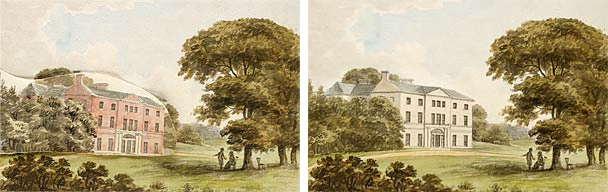
Images showing proposed exterior changes from H. Repton's Red Book for Hatchlands Park, Surrey (1800)
Images showing proposed exterior changes from H. Repton’s Red Book for Hatchlands Park, Surrey (1800) – source: The Morgan Library & Museum

Repton’s architectural contributions are often overlooked as he was never enough of an architect to be considered as one, and, in general, those primarily interested in his landscapes are insufficiently interested in his architecture.  A prime example of this (not mentioned in Colvin, or Stephen Daniels’ book, except buried in an endnote) is Repton’s vision for Port Eliot, Cornwall, the seat of Lord Eliot.  In 1792, in one of his earlier commissions, he was brought in for his advice on the estate. Repton assumed the role of architect and provided, in the Port Eliot Red Book, a broader set of broadly Gothic proposals which brought house, church, estate and even the nearby town into his remit. This expansive approach to his brief was a challenge for Sir John Soane who was asked in 1794 to contribute his ideas – but now within a Gothic framework set by Repton (a style to which Soane was hostile), whose designs had found a level of favour with Lord Eliot, and which he adapted.

One of the key questions when considering the architectural improvements suggested by Repton is to what degree they were his and what had been conceived by his eldest son John Adey Repton (b.1775 – d.1860). J.A. Repton had been a pupil to William Wilkins where he developed a profound understanding of Gothic architecture.  He had then moved in 1796 to the office of John Nash, with whom the elder Repton had established an arrangement to pass on any architectural commissions in exchange for 2.5% of the cost of the work – an agreement which Nash failed to honour, leading to the partnership being terminated in 1800.

Nash has a chequered reputation professionally and this extended to those in his office, including J.A. Repton but left to become his father’s assistant when the agreement between Nash and his father ended.  Nash was unfortunately a champion of the Picturesque but not of his assistants; he never acknowledged J.A. Repton’s significant contribution in various schemes. Unfortunately, John was to suffer the same issue to a certain extent with his father, though he was later clearly credited for his assistance ‘in the architectural department‘ for designs for a number of houses including Stratton Park, Scarisbrick, Panshanger, and others.

Detail from Port Eliot Red Book showing the house as found (© Eliots of Port Eliot)
Detail from Port Eliot Red Book showing the proposed changes to the house (© Eliots of Port Eliot)

In the Port Eliot Red Book, eighteen of the drawings are signed by the son and are probably his designs, however the scheme as a whole is attributed to the elder Repton, though he may have been angling for this to be a major commission for his son. Unfortunately for the Reptons, their grand vision for Port Eliot was never going to be realised, mainly due to financial constraints, though Soane was to provide an alternative scheme which he diplomatically managed to agree with Lord Eliot – much to Repton’s chagrin, later writing:

my beautiful plan for Port Eliot…my design for bringing together the house and the Abbey did not suit the fancy of my fanciful friend [Soane] (who knows but little about Gothic) so the plan was totally changed.

Repton’s architectural work was significant enough to merit inclusion in Howard Colvin’s seminal reference work, ‘A Biographical Dictionary of British Architects 1600-1840’.  The most important was the work at Welbeck Abbey in 1790 to remodel the east and west fronts (and the Red Book contains designs for an entirely new house) but the other entries are relatively insignificant – minor works in 1792 at Honing Hall, the enclosing of the courtyard at Sarsden House in 1795 to create a domed ‘hall of communication’, and a new entrance to Uppark in 1805. Beyond that, his association with John Nash meant he had an insight into the ‘cottage orne’ style and which Repton used in his design for a new ‘lodge of a new and singular description‘ comprising two thatched cottages on the Isle of Wight, one either side of the road.

Lodges at the entrance to Mr Simeon's grounds on the Isle of Wight, designed by H. Repton (Image from 'A New Picture of the Isle of Wight' by W. Cooke (1808)
Lodges at the entrance to Mr Simeon’s grounds on the Isle of Wight, designed by H. Repton (Image from ‘A New Picture of the Isle of Wight‘ by W. Cooke (1808)

Beyond that, his architectural contributions were mainly the designs within the books on landscape gardening.  The most important of these were ‘Sketches and hints on landscape gardening : collected from designs and observations now in the possession of the different noblemen and gentlemen, for whose use they were originally made : the whole tending to establish fixed principles in the art of laying out ground’, published early in his career in 1794, and the posthumous collection published in 1840, ‘The Landscape Gardening and Landscape Architecture of the late Humphry Repton’.

So, can Repton be considered an architect as well as a landscape gardener? On balance, his position seems to be more that of ‘frustrated architect but successful critic’. Repton doesn’t seem to have been able to establish a reputation as an expert on architecture, possibly because his commentary was often only available in the Red Books, with their naturally limited circulation. Also, his work was usually after the house was already built and often only recently finished, meaning the owner was unlikely to consider making significant changes very quickly, leaving few opportunities for him to showcase the talents he clearly thought he had.

However, his work was influential on the practices of contemporary and later architects, forcing them to acknowledge that their buildings did not exist in splendid isolation and had to be considered as whole; a three-dimensional, interactive, ever-changing landscape painting. Open, expansive parklands had the effect of placing the building on a visual plinth, majestic but with an aloof air. Repton firmly brought all the elements together, blending both Gothic with greenery and the Palladian with the planting.  His architectural contributions reflect this sensitivity and with more opportunities he may have been even more influential in the field of architecture, much as he dominated the landscapes represented so beautifully in his famous Red Books.


Further reading:


Sources:

(1) – Humphry Repton, Red Book for Honing Hall [1792], quoted in ‘The Surprising Discretion of Soane and Repton’ by Gillian Darley, in the Georgian Group Journal vol. XII 2002


Apologies for the long gap between articles – happily, just after I posted the last one in September 2017, our beautiful son was born. Mother and baby were, and remain, fine and his sister clearly loves him. However, as anyone with experience of small children knows, they’re justifiably demanding and, combined with having a day job, it’s meant I haven’t had the time to write, but as he gets a little older hopefully I should now be able to again…at least in some capacity, though they’ll remain sporadic.  Tweeting is easier to do regularly, so please do follow @thecountryseat and @lostheritage.  OK, on with the show…


A Sleeping Beauty: Ombersley Court, Worcestershire

The temptation when Country Life magazine arrives each week is to flick through the properties and make tabloid-esque comparisons about how a detached Regency villa in Dorset with space for a family, chickens, and an excitable spaniel, could be had for the price of a tatty flat in London. Yet sometimes these comparisons seem almost too unreal when faced with the exemplary beauty of a country house like Ombersley Court, Worcestershire, which, along with 39 beautifully wooded acres, has just been put up for sale for just £3.5m; the price of a 3-bed terrace house in Chelsea.

Ombersley Court, Worcestershire (© Savills)

Tucked away in a quiet corner of Worcestershire lies a house which, either through deliberate privacy or convenient obscurity, is little known to the world. Yet Grade-I listed Ombersley Court is one of the finest houses in Worcestershire, arguably even in the wider region, due not only to the sublime architecture and surrounding estate, but also the fine collection of paintings and artwork. The estate has long been the seat of the Sandys family who acquired the manor in the late sixteenth-century. The current house was originally built for the 1st Lord Sandys (b.1695 – d.1770) between 1723-26, replacing earlier monastic buildings on the site.  The house was designed by Francis Smith of Warwick (b.1672 – d.1738), one of the leading regional architects and, working with his brother William (b.1661- d.1724), ‘one of the most successful master builders in English architectural history’ (Colvin).

‘Smith of Warwick’, as Francis was more commonly known, was a clients ideal contractor due to his famous honesty and reliability, able to deliver buildings on time and on budget. His reputation spread amongst the Midlands gentry and aristocracy with almost all his work within a fifty-mile radius of Warwick.  Such was his standing that even the fractious Duchess of Marlborough (who had famously fallen out with Vanbrugh over Blenheim), demanded that for her house in Wimbledon, Surrey, ‘that Mr Smith of Warwickshire the Builder may be employed to make Contracts and to Measure the Work and to doe everything in his Way that is necessary to Compleat the Work as far as the Distance he is at will give him Leave to do’ (1732-33).

Smith’s solid reliability also manifested itself in his repetition of his well-developed plans and designs for houses, creating a distinctive style which is quite recognisable as his own. Broadly, this would be a three storey house with the centre section either projected or recessed, consistent fenestration, and relatively sparse external decoration, usually only decorative stone dressings such as keystones, quoins or balustraded parapets. This consistency was perhaps a double-edged sword, with the Hon. Daines Barrington stated in a letter in 1784, that although ‘all of them (are) convenient and handsome […] there is a great sameness in the plans, which proves he had little invention’.

Yet, this is to overlook that Smith was, at heart, a successful commercial builder whose understanding and appreciation for architectural ornament and variety was inevitably tempered by his determination to deliver the commission on time and on budget. As the architectural historian Sir Howard Colvin highlights, the core design is that of a standard seventeenth-century house such as Belton House, Lincolnshire, but with stylistic updates as fashions evolved.  ‘Smith’ houses such as Umberslade, Alfreton, and Wingerworth all share this readily accessible style, one which married domestic practicality with exterior grandeur.

Perhaps Smith’s greatest achievement was the tragically now-ruinous Sutton Scarsdale, Derbyshire; a house with a facade so stately as to rival Chatsworth. Built for the 4th Earl of Scarsdale in 1724, Sutton Scarsdale was one of the finest houses in the country. Although the form is familiar, the masterful control of a palisade of pilasters and columns topped with Corinthian capitals, gives it a gravitas, whilst the detailing such as the scrolled window surrounds to the projecting wings hint at Renaissance motifs; Fausto Rughesi (Santa Maria in Vallicella, 1605/06) filtered through William Talman (design for Thoresby House, 1685, – shown in Vitruvius Britannicus, C1, Pl.91) and James Gibbs (to whose designs Smith was building Ditchley Park, Oxfordshire, 1722).

derbyshire-Sutton_Scarsdale_Hall_circa_1900

One regret with Ombersley Court is that although the form and plan of the house and much of the superb unaltered early-Georgian internal decoration is still Smith, the exterior is now not his. The original design featured a hipped roof, and what looks to be pilasters, giving it the recognisable ‘Smith’ characteristics.  This was lost when the existing brick was refaced with ashlar in 1809 by the architect John Webb for Mary Sandys, the Marchioness of Downshire. In fairness though, this was a lucky escape as John Nash prepared a much more ambitious scheme in 1808, which proposed adding a two-storey pavilion to each side, linked by a seven-bay screen of giant Ionic columns, though this seems to have been rejected on cost.

Ombersley Court - proposed alteration by John Nash, 1808
Ombersley Court – proposed alteration by John Nash, 1808

One of the glories of the house are the interiors and especially the plasterwork and carving. With a desire for privacy which was rarely breached, few had seen the exceptional decorative work, except through the lens of a Country Life profile by Arthur Oswald in 1953. This extolled the virtues of many aspects including The Chippendale Room which featured bamboo framed silk wall pieces, remarking that ‘it is uncommon to find a Regency example as complete as this or as charming’. The rest of the house struck a careful tone of stately refinement; enough decoration to proclaim wealth and taste, but never excessive.

Ombersley Court - Hallway (© Savills)
Ombersley Court – Hallway (© Savills)
Ombersley Court - Drawing Room (© Savills)
Ombersley Court – Drawing Room (© Savills)
Ombersley Court - Morning Room (© Savills)
Ombersley Court – Morning Room (© Savills)

With the death of Lord Sandys in 2013 the house passed to Lady Sandys but following her recent death, concerns were raised and rebutted via letters in Country Life that this wonderful house would be forced (for complicated reasons) to become a care home; a fate which would have despoiled this jewel of a house. Instead, for the first time since it was built in 1724, it has been placed on the market. This is a house created by one of the finest craftsmen of the early-Georgian period, with connections to a wider, distinct Midlands architectural tradition which epitomises all that one would hope to see in a country seat. As an important house which deserves respect, one hopes that the new owner will appreciate this remarkable situation and that perhaps the best approach would simply be to buy the house and contents and perhaps another couple hundred acres to truly secure an Arcadian ideal, one which would be hard to better anywhere in the country.


Sales particulars: Omblersley Court, Worcestershire [Savills] – £3.5m with 39 acres

Listing description: Ombersley Court, Worcestershire [British Listed Buildings]

Romancing the stone; country houses built by love

Many a man has been driven to great lengths by love – and architecture is often a rewarding though insatiable mistress for such a passion.  Whether as an expression of love for a wife or a demonstration of a yearning, aching heart, each found that their country houses were caught in that very human desire to make real those Romantic desires which otherwise are sometimes only expressed in far more transient ways. Though sometimes love’s labours are lost to unrequited desires, often country houses were the ideal means to commemorate the passions which had created their happiness.

Osborne House, Isle of Wight - holiday home of Queen Victoria and Prince Albert (Image: English Heritage)
Osborne House, Isle of Wight – holiday home of Queen Victoria and Prince Albert (Image: English Heritage)

The motivations behind the choice of architecture or design or even the starting of the construction of a new country house is sometimes overlooked in the literature. The occasion of ennoblement was an important catalyst for a grander house and equally a marriage and new building project are often keen bedfellows – though often the new house was financed through the newly acquired wealth of the husband from his bride and was more an expression of his newly-bolstered financial strength.  With the status of the married woman somewhere equal to that of the china plates, for many, their influence was limited to the running of a home.  The choice of some furnishings and the interiors of the ‘female’ areas of the houses were often the accepted limits of the wife’s contribution – though there were exceptions such as Lady Leicester who, after 1759, was left £2,000 a year to finish several of the state rooms at Holkham Hall (n.b. website annoyingly plays birdsong automatically).

Syon House, Middlesex (Image: Syon House)

The choice of architect, interiors, furnishings, furniture and art were all reserved for the man as an expression of his taste and power. Writing of his design for Kimbolton Castle, the architect Sir John Vanbrugh said, “I’m sure this will make a Noble and Masculine Shew‘, and that in the exterior visitors would “See a Manly beauty in it when tis up…‘. Clearly reflecting the female taste, or even necessarily their comfort, was not high on an architects priorities. Although some enjoyed a level of luxurious indulgence, such as the Dowager Lady Egerton for whom James Wyatt created a sumptuous Pompeiian-style dressing room at Heaton Hall in the 1770s, perhaps the experience of the Duchess of Northumberland was more common.  When Robert Adam remodelled their London seat, Syon House, in the 1760s, he was careful to place the Duke’s private apartments in a separate area, accessed via a private staircase, whilst the Duchess’ dressing room enjoyed a much less secluded arrangement, as it was included in the main circuit of entertaining rooms.

Ham House, Surrey - now owned by the National Trust (Image: Matthew Beckett)
Ham House, Surrey – now owned by the National Trust (Image: Matthew Beckett)

Wives and widows were slowly asserting greater independence, often due to their personal wealth, but slowly changing attitudes did provide greater opportunities for their views and tastes to be heard and seen.  In the 17th-century, couples such as the Duke and Duchess of Lauderdale were acting very much in concert together in the design and furnishing of their home, Ham House. It had been the home of the Duchess and her father and she had fiercely held on to it during the dark years of the Civil War when he had been forced to escape abroad. After her marriage in 1672, Ham House became not only a symbol of their wealth, but also a testament to their shared love of travel and the finer things in life.

Dobroyd Castle, West Yorkshire (Image: wikipedia)

Romance was surely often part of the motivation to build; a golden word that could turn a mere building into architectural poetry. Dobroyd Castle in Todmorden was the creation of a wealthy local mill owner, John Fielden, to honour a promise after his intended bride, Ruth, a poor labourer’s daughter, had said, during their extended courtship, “Build me a castle and I’ll marry you.“.  This can be said with either a romantic or mercenary inflection but, in honour of St Valentine, let’s believe that her request was for a fairytale expression of their marriage.  At least it was not a pre-condition, as they married in 1857 and work started on the castle in 1866 with completion in 1869.  Designed by the little known architect John Gibson, throughout the house the initials of John and Ruth are carved into the building many times as a constant reminder of their love.

Luscombe Castle, Devon (Image: Country Life Picture Library)

The desire to do all one can for a wife, especially one who is ill, creates opportunities for love to be the patron of great architecture.  The delicate health of Dorothea Robinson, wife of Charles Hoare, a partner in the eponymous family bank, necessitated a more temperate climate and so an estate outside the small Devon coastal town of Dawlish was purchased. Requiring a house and not lacking in funds, Hoare commissioned the fashionable John Nash and Humphry Repton to create a retreat for rural recuperation.  With Repton’s help, Dorothea chose a most Picturesque site nestled in a secluded valley. Repton then recommended to Nash that it be in the ‘Character of a Castle’, and so Luscombe Castle was built between 1800-1804.  Considered one of the finest Regency houses, the external beauty is matched with a domestically convenient interior; a distilled version of Nash’s rather grander castle designs, but which perfectly suited the location and as a romantic reminder of a husband’s concern for his wife.

Kingston Lacy, Dorset (Image: wikipedia)

A love unrequited or thwarted is often a powerful force which can inspire many things.  For some, such as William Bankes, a prominent MP and renowned traveller, his enforced exile to escape a possible death penalty for being caught in a compromising situation with a soldier in Green Park in 1841, meant leaving his life’s work; the building and beautification of his Dorset home, Kingston Lacy. Subject to a punitive ‘outlawry‘ order, Bankes first escaped to France before settling in Venice. Bankes had been forced to give up, under threat of forfeiture, any legal title to his estates and contents to his brothers but he continued to be relatively well-funded and managed the building works at Kingston Lacy via detailed correspondence with the Clerk of Works.  One can only guess at the frustration of Bankes as he could only imagine how his plans were turning out, not only in relation to the building works but also the numerous pieces of art which he sent to Dorset.  Proving that for love, some will risk all, it is thought that Bankes risked imprisonment to be smuggled back into England in 1854 so that he might see his house and collection, which he had only been able to dream of, and give direction as to how it might be finished.

Wallington Hall, Northumberland (Image: Visit Northumberland)

By the Victorian era, it was often both the husband and the wife who would take increasingly equal roles, especially as the role of the house was firmly centred on entertaining; a role traditionally taken on by the wife. It also reflected a relatively more accommodating age when women were at last more broadly considered intelligent equals to men.  The increasing importance of women can also be seen in the literature where discussion of the creation of a house now talks more husband and wife, though still often with their roles demarcated to exteriors/interiors.  The wives often had their own circles of interest leading to interesting contributions such as at Wallington Hall in Northumberland where the Pre-Raphaelite painted decoration in the central hall is by the artist William Bell Scott, whom Lady Pauline Trevelyan met through her literary activities.

Osborne House, Isle of Wight (Image: English Heritage)

Perhaps the most famous husband and wife architectural collaboration in the Victorian era was the creation of the summer retreat at Osborne House on the Isle of Wight by Queen Victoria and her beloved husband, Prince Albert.  With a society leaning towards a more moral aspect, Victoria was determined that the royal family should be seen in step with it and so the planning of Osborne is not only to meet the needs of the family for entertaining but also, equally, that it be a family home. Indeed, writing to her daughter in 1858 from Windsor Castle, she tells how “I long for our cheerful and unpalacelike rooms at Osborne.”.  Her husband’s influence was the Italianate exterior, with the stucco work and belvedere towers, designed by the Prince and the London builder Thomas Cubitt, which matched his passion for Italian art, though Victoria was perhaps also influenced by the design of Trentham Hall, Staffordshire (by Sir Charles Barry) which was the home of her close friend the Duchess of Sutherland.  Osborne became the place she perhaps most associate with her husband and, after his death in 1861, it was one of the places she felt most at ease.

So, the building of a country house isn’t simply to mark ennoblement or new wealth, but can be an expression of love or passion between a couple, which one hopes might be more inspiring.  Certainly a love of country houses is something to be celebrated any day of the year.

—————————————————–

If you know of any other examples (and I’m sure there are many) please do add a comment below.

A poor prognosis: Great Barr Hall, Staffordshire

Great Barr Hall, Staffordshire (Image: English Heritage)

Many of the houses featured in this blog are shown as a celebration of the brilliance of our architects and craftsmen in creating one of the finest bodies of buildings of their type in the world.  Yet, in abundance is, perhaps inevitably, failure; where an interesting house becomes a victim of circumstance, policy, incompetence or, sometimes, all of the above.  Great Barr Hall, once outside Birmingham, now encircled by advancing urbanisation, is a sad example of where a house can languish and deteriorate whilst deliberate vandalism and institutional lethargy condemn it to its fate – and unless something is done soon, Great Barr Hall will join the already far-too-long list of the lost country houses of England.

Great Barr Hall c1800 (Image: artist known / sourced from Bill Dargue)

Despite its current sorry state, Great Barr Hall was once a sizable house – though precisely how large is unclear.  An early print in 1798 Stebbing Shaw’s ‘History and Antiquities of Staffordshire‘ shows a 11-bay castellated house with four corner turrets but the present house is 9-bays.  For comparison, it’s interesting to note the stylistic similarities with Syon House in west London, a seat of the Dukes of Northumberland, though it is also 9-bays wide and has an imposing porte cochere.

What is known is in the 1760s, Sir Joseph Scott, then head of a family line which had been in the area for 600 years, built a new house in a ‘gothick’ style.  The original architect is unknown but Stebbing Shaw describes how ‘The present possessor [Joseph Scott], about the year 1767, began to exercise his well known taste and ingenuity upon the old fabric, giving it the pleasing monastic appearance it now exhibits – and has since much improved it by the addition of a spacious dining room at the east end, and other rooms and conveniences‘. If Scott was his own architect, perhaps he was, in part, inspired by the remodelling of Syon House by Robert Adam which started in that same year.

Sir Joseph Scott’s original extensive works led to some financial difficulties and so, from 1785, he moved to the Continent and rented the house out.  The lease was taken by Samual Galton junior, a controversial Birmingham Quaker, banker,  gun manufacturer, and intellectual who hosted meetings of the Lunar Society at Great Barr Hall leading to it becoming a noted crossroads for industrial ideas, a crucible for the Midlands industrial growth and the wider Industrial Revolution.

Where Great Barr becomes particularly interesting from our point of view is with the arrival of the young architect John Nash and his business collaborator and famous landscaper, Humphrey Repton. Nash was there to provide the buildings which Repton needed to complete his  gardening visions. This worked well for both men; Nash was to pay Repton 2.5% for any work the latter passed his way so Nash charged his clients the then rather high fee of 7%, giving him a 4.5% fee. There is no record of Nash ever putting any work towards Repton – but Nash benefited with work on over one hundred estates. There seems to be some uncertainty as to exactly when Nash started working there but John Summerson gives the date as 1800 for the construction of a gothic archway to the adjacent chapel, but other works such as the gate lodges, an icehouse and a new steeple for the chapel started in 1797 and were probably also by Nash and Repton.

Corsham House, Wiltshire - copper engraved print published in The Beauties of England and Wales, 1813 (Image: Ancestry Images)

About this time, the house was also updated to create the appearance we can just make out today – but it hasn’t been confirmed that Nash was the architect.  However, there are tantalising clues that it could well be by him. Nash had been developing his particular style of Picturesque gothic during his time in Wales and had been applying it with varying degrees of success since then during alterations at Kentchurch Court, Herefordshire, (1795) and at Corsham House, Wiltshire (1797 – a disaster due to poor workmanship with Nash’s work later demolished).  Yet, some of the architectural fingerprints of each of these can be seen in Great Barr.  Externally, one such feature is the crenellations applied to both the roof and the tops of the projecting towers, another is the hooded Elizabethan-style windows. Another interesting piece of the jigsaw is a house which Nash was working on in 1800 in Buckinghamshire,  Chalfont Park, which bears not only a superficial stylistic similarity but also one of form – a long rectangular main body with a projecting 3-bay centre.  However, Chalfont Park was also altered by Anthony Salvin in 1840 so it’s not possible to tell how much of the gothic detailing is Nash’s.

The Scott’s return in 1797 prompted the works of Repton and Nash before further work in 1830 and 1848 which included moving the entrance from the west side to the north.  In 1863, a chapel was built to a design thought to be by Sir George Gilbert Scott, though it was never consecrated and so became a billiard room.

The replacement windows (Image: Simon Cornwell) - click to see 'before and after'

The house remained with the Scotts until the house became a hospital for the mentally ill in 1918 following the death of Lady Bateman-Scott in 1909.  As is usual, the institutional nature of hospital use was not kind to the house.  Beyond the extensive network of buildings which marched across Repton’s parkland (and the south eastern corner of the estate being carved up by the M6 motorway), the house itself had a modern two-storey extension added in 1925 and in 1955 the clock tower, stables and much of the east wing were demolished.  In the 1960s, some sensitive architectural ‘genius’ removed the two splendid first-floor oriel windows which flanked the main entrance and inserted a pair of non-matching government-issue casement windows.

The current plight of Great Barr Hall can largely be laid at the door of Bovis Homes and John Prescott, formerly the Deputy Prime Minister, and the one who eventually signed off on the architectural blight that now affects the house.  Considering that the hospital buildings were in two distinct campuses, one to the north west and another to the north east, if there had to be development, replacing the buildings to the NW would have placed them furthest from the house, with the advantage of creating a more complete parkland around the house, with the possibility of re-instating, to some extent, the earlier Picturesque drive.  To hope that someone of Prescott’s aesthetic insensibilities would see such a solution was always forlorn but one might hope that someone on the local council or in English Heritage might have proposed a more sensitive outcome.  Sadly it was not to be and now a large development of 445 executive-style homes has been built, the closest being scarcely a hundred metres from the back of the house.  Worse, following the sale of the house to a building preservation trust, little progress has been made, with questions now being asked about the trust’s failure to restore it as promised earlier.  It was again put up for sale in May 2011 by the Trust at the unrealistic price of £2.2m with the option to buy a further 100-acres of parkland – with the threat of even more development.

Despite some architectural uncertainties, what is clear is that those charged with its care in the recent decades have failed.  Perhaps this is a broader failure of policy, that without an explicit mandate to determine that the architectural heritage must be managed, maintained and preserved as far as is possible, it will fall to all-to-fallible councillors to look beyond their own short-term interests; sadly, an unlikely prospect.  The NHS generally has a poor record of managing historical assets once it has no further use for them e.g Sandhill Park, and Stallington Hall are just two examples and don’t forget that Soane’s Moggerhanger survived despite the NHS, not because of it. A strong national policy should provide a clear strategy for preservation of heritage assets taken over by the state rather than just relying on existing listed buildings legislation.  In Great Barr Hall’s sad circumstance, one can only hope that someone will be able to extract the money owed as part of the enabling development, which can then be devoted to restoring this interesting and significant house so that it once again can be something for the local residents to be proud of, rather than the monument to NHS, central government and local council incompetence which it is today.

————————————————————————

Still for sale? (thanks to Andrew for spotting this): Great Barr Hall might still be for sale – there is a page with details but it’s not listed on the agent’s website: ‘Great Barr Hall‘. Now listed for £3m but with 150-acres but with another 100-acres of parkland by separate negotiation.   Considering the Building Preservation Trust paid just £900,000 for the entire site this seems a little odd – perhaps someone will enlighten us.

————————————————————————

Listing description: ‘Great Barr Hall‘ [British Listed Buildings]

‘At Risk’ Register entry: ‘Great Barr Hall‘ [English Heritage]

Recent history of house and some proposals for rescue

News stories:

Peckforton Castle, Cheshire, seriously damaged in arson attack

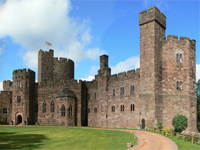
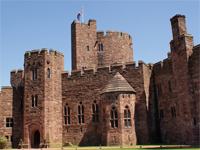
Peckforton Castle, Cheshire (Image: the pepper tree / flickr)

In the early hours of Sunday (19 June 2011) a serious fire broke out in the Drawing Room of grade-I listed Peckforton Castle and has gutted all three floors of that wing, affecting approximately 25% of the building. Sadly, it appears that this terrible destruction in one of the finest mock castles in the country is reported to be the result of an arson attack by the groom, apparently over the wedding bill.  That such a wonderful building could be damaged over something so stupid is beyond belief.  The full extent of the damage – and credit to the fire service for preventing it spreading – will only become truly apparent over the next few days.

Peckforton Castle sits on a Cheshire hill-top, facing down the medieval Beeston Castle on the neighbouring peak.  Yet, Peckforton is a Victorian creation for the 1st Lord Tollemache, who had commissioned Anthony Salvin to marry the conveniences demanded by a Victorian landowner with a scholarly re-creation of an ancient castle, creating the muscular skyline so visible today.  The style of the castle is a reflection of the character of Tollemache – vigorous sportsman, statesman, father to 24 children, and, above, benevolent landlord.  Tollemache had inherited the 26,000-acre estate through his grandmother, co-heiress of the 4th Earl of Dysart, and had particularly Victorian vision of how an estate should be run, saying “The only lasting pleasure to be derived from the possession of a landed estate is to witness the improvement of the social condition of those residing on it.” To this end, he reduced the size of each farm to 200-acres and rebuilt every farmhouse and labourers cottage on the estate at a cost of £280,000 (approx. £20m) and to each cottage he allocated a further 3-acres to help them grow their own produce.

The estate lacked a main house and so Tollemache went against the prevailing fashion of the time and commissioned an authentic re-creation of a medieval castle which was built between 1844 and 1850.  The fashion for sham castles had grown out of the Georgian Picturesque movement which applauded such visions of a castle – symbol of ancient chivalry – and landscape combined to create an aesthetically pleasing view. Yet, in demanding an accurate castle, Tollemache rejected many of the compromises that had previously characterised the lesser shams, such as having a great gatehouse but also acres of glass, which were being roundly criticised by architects such as Pugin who demanded architectural authenticity.

Courtyard, Peckforton Castle, Cheshire (Image: Bob W / flickr)

Tollemache’s architect was Anthony Salvin (b.1799 – d.1881), who, on the strength of the success of Peckforton, was commissioned to also work on Alnwick Castle and the Tower of London, and many more.  Salvin was the perfect architect for the job with his Victorian understanding of the romance of castles and the appeal of the Middle Ages but also a sound practical training with John Nash which gave him the skill to successfully, as Alfred Waterhouse wrote to Lord Tollemache in 1878, “…combine the exterior and plan of an Edwardian [Edward I] Castle with nineteenth-century elegance and comfort.

Castle Drogo, Devon (Image: wikipedia)

Faced with the choice between architectural accuracy and convenience most of Tollemache’s contemporaries opted for more fashionable styles leaving relatively few of these large-scale re-creations.  Other examples of ‘real’ sham castles include William Burges‘ designs for Lord Bute at Castell Coch, Belvoir Castle for the Dukes of Rutland, and the powerfully brooding Penryhn Castle, built between 1840-50, for George Hay Dawkins-Pennant.  The demand for an authentic castle then largely abates until Julius Drewe’s commission, built in the 1910s and 1920s, for Sir Edwin Lutyens which results in the wonderful Castle Drogo.  By their very nature, their stern exteriors make them untraditional country houses yet they hark back to the oldest form of home for the landed gentry, and a symbol of power and prestige.

Sadly, arson attacks on country houses are not unknown – witness the terrible devastation brought to Hafodunos Hall in Wales by two bored idiots in 2004. With Peckforton Castle, the success of the design, both as an exterior composition, but also for the practical yet impressive interiors is why the house is such an important part of the nation’s architectural heritage.  The house was only recently subject to a £1.7m restoration programme by the Naylor family who own it and have worked immensely hard to bring to life a house that had been empty since WWII.  Hopefully the damage will not turn out to be as extensive as feared – though estimates for restoration are already said to be around £1m.  The strength of the construction means that it will almost certainly be restorable and will hopefully again rise soon from the ashes of this terrible fire.

———————————————————————

News stories:

Listing description: ‘Peckforton Castle‘ [britishlistedbuildings]