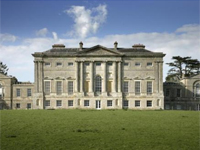
Tidmington House, Warwickshire (Image: Philip Halling/Geograph)
With sad co-incidence, having recently posted about how owners respond to fires in country houses, news comes through that Tidmington House in Warwickshire was badly damaged whilst undergoing renovations.
Tidmington was built in the early 17th-century but was re-fronted in the 18th-century giving it a pleasing and elegant facade, which is visible from the road. Distinctive gables top a neat front which successfully mixes Elizabethan elements with the classical. The recessed central section runs from a smaller middle gable featuring a Diocletian (or thermal) window, above a first floor tripartite Venetian window, sometimes known as Palladian or Serlian after the two architects most associated with popularising it, with finally the two wings being joined by a Tuscan colonnade. Two 1-bay pavilions extend to the left and right, providing a clever balance to the height of the main house.
The grade-II* listed house was once the home of Thomas Beecham, 2nd son of the famous conductor, before being put up for sale in 2009 for £3.95m by the owners who had moved there in 1988. The house was then given a glowing write-up in The Times by Marcus Binney who relished the bold use of colour; the sky-blue library, the jade green dining room – but I wonder if the bold colours in the house contributed to the situation as it was during renovations by the new owners that the fire started.
The blaze is reported to have badly damaged the first floor where the fire started and also part of the ground floor but hopefully a majority of the 8,500 sq ft house will have been spared from the flames – though the inevitable smoke and water damage will have spread beyond the immediate blaze. Again, it shows that insurance companies are right to demand to be told when works are taking place as it is so often during renovations when these fires seem to break out – please don’t let this be another workman being careless with a blow-torch.
With so many country houses lost in the twentieth century, almost any alternative which saved them from the demolition crew was to be welcomed; no matter how drastic. For some this meant institutional use but for many others of all sizes the solution was conversion into flats and apartments – though with varying degrees of success. However, as these properties come on to the market, is it perhaps time to consider converting them back into the single, glorious houses they were intended to be?
Launched this week (16 June 2010) in Country Life magazine is the principal apartment in what is considered James Paine’s finest creation; Wardour Castle, a supremely elegant essay in Palladian architecture.
Central stairwell and gallery, Wardour Castle, Wiltshire (Image: Strutt & Parker)
Built from 1770 – 76, for the eighth Lord Arundell the most impressive feature is a breath-taking central stairwell with first-floor gallery which Pevsner called ‘the most glorious Georgian interior of Wiltshire’ and which forms the core of Apartment One which is now for sale. Wardour Castle house has proved to be adaptable becoming Cranborne Chase School in 1960 until it closed in 1990 when it was then converted into ten apartments. As the divisions appear to have respected the natural sections of the house this seems to be a good example of where someone could convert the house back to a single home.
There are many examples of houses being rescued by conversion. SAVE Britain’s Heritage have long campaigned to protect these houses and have worked in conjunction with one of the leading architects, Kit Martin, in supporting conversion. A 1983 SAVE report entitled ‘The Country House: to be or not to be’, written by Kit Martin and Marcus Binney, includes particularly interesting studies of how these houses could be sensitively converted. These show that although almost any country house could be sensitively adapted some are naturally more suitable particularly where the overall layout of the house is symmetrical, shallow and long.
The study was an important milestone in the practice of country house conversion and saved many houses from complete loss or inappropriate use including The Hazells in Bedfordshire, the grade-I Northwick Park in Gloucesterhire, Dingley Hall in Northamptonshire. The sensitive approach they championed now means that it should be possible to consider converting a house back if the right opportunity arose. It should be said that some houses are never going to be converted back due to a variety of factors including there being too many apartments involved such as at Thorndon Hall in Essex which contains 37 flats, or where not enough land has been retained to make the unified house valuable enough to justify reversion.
Perhaps the idea of reversion becomes more realistic where more than one part of the same house comes on the market at the same time such as recently happened with grade II*-listed Ampthill Park House, Bedfordshire. Built by the Cambridge architect Robert Grumbold in 1687-9 and completed by John Lumley of Northampton in 1704-6, with major additions by Sir William Chambers in 1769 it is certainly one of the most impressive houses in the county. It was rescued from dereliction by conversion into just four large houses; two of which were put on the market in April 2010, the largest of which includes most of the principal rooms.
Although it’s nice to dream about these houses becoming single homes probably the biggest obstacles are not only being able to secure the other apartments but also that the value of the individual properties may be greater than the value of the unified house. However, it’s not entirely beyond the bounds of possibility that someone with deep pockets and a desire to restore a house could take on one of these conversion reversions and recreate a superb country house.
Kelly House has a series of long associations; there has been a house there for over 900 years, it has been the seat of the Kelly family for that entire time, and, sadly, has been on the English Heritage Buildings at Risk Register for over five years. Now the latest twist in the tale is that the house will feature in Channel 4’s ‘Country House Rescue’ on Thursday 1 April when expert Ruth Watson offer possible solutions which will help the Kelly family remain in their ancestral home.
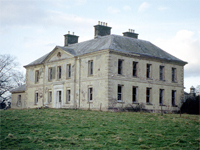
The Kelly’s are one of the very rare families able to trace their lineage back to pre-Conquest times. Warin Kelly is the 31st squire of the family to live in a house which has been passed down since 1100 through fathers, grandfathers, and brothers. Described as being ‘in a class of its own’ by Marcus Binney*, the elegant Palladian house was built in 1743 -45 for Arthur Kelly by Abraham Rundle (d.1750), a joiner and provincial but obviously skilled architect who lived in Tavistock. The house is grade-I listed and features a Portland stone doorcase, sash windows glazed with Crown glass and made in London, with local slat stone walls with moorstone quoins. Inside, the extensive high quality woodwork features superb carving including panelling, chair rails, and a particularly good staircase with chunky corkscrew balusters.
However, the fine panelling hides serious issues such as the periodic bouts of dry rot which break out. Mr Kelly, as a conservation architect advocating minimal intervention, admirably refuses to treat it with chemicals or by stripping out the panelling. This ongoing damage is largely the fault of death duties, with two demands being levied in swift succession which have severely limited the family’s ability to maintain the house. Kelly House is exactly the sort of house which the Historic Buildings Councils would have provided grants for when they were set up in the 1950s. Today, with English Heritage’s budgets under severe pressure, Mr Kelly was told in 2005 that they were unable to provide funds as the increase in the value of the restored house would be greater than the grant – meaning that they force owners towards the sale of their ancestral homes.
Much as it would appear difficult to argue for the provision of public money to preserve private residences, there has to be a better solution than just letting them slowly grow more derelict despite the often heroic efforts of the family involved. The current generation doesn’t want to be the one which is remembered for having to sell the family seat, leading to a battle against the elements of decay which saps finances and families and often doesn’t provide a long-term solution. Outside expertise is to be welcomed as it may show the way to a sustainable future for these beautiful homes. Hopefully Ruth’s suggestions can be taken on by the Kellys and other families to ensure their homes are self-financing and not a burden to either the state or the owners who are then able to look forward to the prospect of handing a home and not a liability to their descendants.
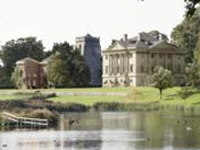
When the historic Ranton Abbey was accidentally set alight and gutted in 1942 by the Dutch troops stationed there, it was likely that it would go the way of many other houses and simply be demolished. Yet the Earls of Lichfield, who owned the 300-acre estate, simply left it and focused on turning the land into a first-class shoot, allowing the house to slowly collapse, leaving just the ivy-clad walls visible today.
The death of the 5th Earl, the famous photographer Patrick Lichfield, in 2005, prompted the family to look again at the estate. However, rather than simply sell it they decided to obtain planning permission for the building of a new house and have now put both for sale at £3.5m. Although an obvious course of action, the choices made seem a bit odd. The new house is strongly Palladian in design but the projections produced so far have it sited so close to the red-brick shell of the old house, and the grey stone of the church, that it seems to have almost landed there by accident. It certainly does not seem to appear at home in this location and appears almost arbitrary, resulting in three large architectural elements fighting for prominence in a small area.
As the respected architectural writer Marcus Binney says in the ‘Bricks and Mortar’ supplement of Friday’s Times newspaper, surely the better option would be to restore the original house. This would bring back the balance which existed before and remove at once the obvious difficulties of leaving the old house as a giant garden ornament to compete with the new house. Whoever buys the estate and planning permission will hopefully think again about this scheme and look seriously at restoration.


 The Country Seat