Guided missel: the rise of the country house guide book

‘Dear Picture Editor for the 2017 National Trust Handbook

National Trust Guide Book 2017

Yours is a challenging job. Faced with selecting one cover image to represent the National Trust for an entire year and with the myriad opportunities presented by having over two hundred country houses (unfortunately now minus Clandon), hundred of thousands of acres of countryside, and 775 miles of coastline, such a welter of natural and man-made beauty makes your task both enviable and daunting.

It’s therefore somewhat odd that the 2017 image is a close-up of a couple and their slightly disdainful-looking dog getting caught in a wave on a beach. The lady in the couple looks distinctly unhappy, the chap is possibly saying a swear word. Perhaps the oddest thing about it is that the bloke is wearing a bowler hat. For a walk on a beach. Of course, you would know that the bowler was created in August 1849 by the famous London hat-maker, James Lock, for the Coke family at Holkham Hall to help protect their gamekeepers from branches; both those attached to trees and those wielded by poachers. Holkham Hall, awkwardly, is not one of the many country houses (minus Clandon) under NT care so this image is, on many levels, a bit silly.

For next year, may I personally suggest a country house. Though I fear that they, as a class, appear to somewhat out of favour in the upper echelons of the NT, hopefully by appearing on the cover of the handbook, it may remind them that they are custodians of one of the finest groups of country houses one could dream to care for in perpetuity (minus Clandon).’

Guide books have long been a source of fascination for those who visit country houses. Topographical guides have been written for hundred of years to help those of us fascinated by country houses to determine which we might be able to gain entry to and revel in, whether in splendour or shabbiness.

Country house tourism is not a modern phenomenon.  Whether pilgrim or royalty, the idea of visiting houses was an ingrained part of the tapestry of life in the Middle Ages for providing hospitality.  One key difference can be seen in the preferences of Henry VIII who largely visited his own houses compared to Elizabeth I who frequently visited those of her favoured courtiers. Thus the concept of the country house (or palace) being built as much for display and prestige as the more mundane practicalities of large scale domestic occupation became a core characteristic of aristocratic life.

An Historical Account of Corsham House in Wiltshire, the seat of Paul Cobb Methuen [1806]
An Historical Account of Corsham House in Wiltshire, the seat of Paul Cobb Methuen by John Brittan [1806]
In the Georgian era, the burgeoning wealth of the expanded upper classes afforded increased leisure opportunities for travel and cultural pursuits. Their desire to assimilate themselves into the attitudes of the existing aristocracy fuelled a natural curiosity about their lives and tastes.  With frequent wars on the Continent often thwarting the traditional Grand Tour destinations, travellers now looked more domestically to visit their extended families and their friends. Even without the wars, it’s likely that the opportunities for women to travel were more restricted and to visit other ‘good’ families in their homes would have been an acceptable way for them to broaden their knowledge and tastes, thus cross-pollinating ideas, styles and fashions.

However, a family’s immediate social circle might contain only a limited number of contemporaries with whom they would be comfortable lodging.  Therefore, when visiting an area, either as a family guest or staying in accommodation, for example during the Season in Bath, day trip visits to other country houses was a favoured activity.  Despite the expectation that an owner would, as part of their duty to better society, open their house, the key question was how to find them and to determine whether they would even be amenable to visitors, no matter how genteel. Much as today, in fact, and hence the birth of the country house guidebook.

Opening Times in 'An Historical Account of Corsham House in Wiltshire, the seat of Paul Cobb Methuen' by John Brittan [1806]
Opening Times in ‘An Historical Account of Corsham House in Wiltshire, the seat of Paul Cobb Methuen’ by John Brittan [1806]
By the latter part of the eighteenth-century, an infrequent stream of visitors had become something of a torrent, if not a flood. Houses near large conurbations were particularly susceptible as Horace Walpole found at his charming neo-Gothic villa at Strawberry Hill, near Twickenham, described as ‘the prettiest bauble you ever saw’.  Writing to his friend Sir Horace Mann in July 1783, Walpole complained that ‘I am tormented all day and every day by people that come to see my house, and have no enjoyment of it in summer.’  Areas with a higher density of fine houses, which were within a day or two ride of a city or existing tourist destinations, such in as Norfolk, Derbyshire or Wiltshire, were soon part of an unofficial British Grand Tour. This was a natural progression for a society structured around the idea of circuits; domestically through suites of rooms and socially through visiting friend’s houses and at functions and balls.

Shirburn Castle, Oxfordshire (J. Skelton, 1825)

As the idea of country house visiting grew, so did the need to manage the number of visitors and their conduct whilst in the houses. Some simply refused access – a galling experience for those who might have travelled long distances such John Byng, who despite being just a civil servant, toured widely.  On being refused access to Shirburn Castle, Oxfordshire, he splenetically cried ‘Let people proclaim that their great houses are not to be view’d, and then travellers will not ride out of their way with false hopes.’ Owners increasingly favoured knowing when visitors may appear and so started having set days of admission. By 1760, Chatsworth was specifically open on two days per week. In 1774, Walpole, though ‘very ready to oblige any curious persons with the sight of his house and collection’ started personally issuing tickets and rules for good conduct.

The internal tours of country houses were usually conducted by the housekeeper who would provide rich accounts of the history of the building and family and details about the works of art – and sometimes the information was even true.  Unfortunately many myths about a family’s history and unwarranted artistic attributions for paintings are likely to have been started by the imagination of the unwitting guide. As the hobby of visiting grew in popularity so too did demand for more accurate accounts; giving birth to the new concept of the guidebook. The earliest from the 1730s-40s were more for reference at home rather than from a carriage and usually focused on individual houses, giving a history,  a catalogue of art works and sometimes a plan for the route to take through the house. These quickly spawned more democratic versions from competing booksellers, sometimes for the same property such as Benton Seeley’s ‘A Description of the House and Gardens…at Stow‘ (first published 1744, totalling twenty-two subsequent editions)

'Plan of the Library Story' from 'The Peak Guide; containing the topographical, statistical, and general history of Buxton, Chatsworth, Edensor, Castlteon [sic], Bakewell, Haddon, Matlock, and Cromford' by Stephen Glover of Derby [1830]
‘Plan of the Library Story’ from ‘The Peak Guide; containing the topographical, statistical, and general history of Buxton, Chatsworth, Edensor, Castlteon [sic], Bakewell, Haddon, Matlock, and Cromford’ by Stephen Glover of Derby [1830]
The guidebooks were both guide and tutor, ushering the visitor through an agreed route around a house but also providing sometimes detailed entries on each individual art work with the expectation that the visitor would view and gain a deeper understanding. This can be seen in ‘The Peak Guide‘ by Stephen Glover [1830] where the entry for the most significant house in the county, Chatsworth, runs to a generous thirty-seven pages. Starting with a description of the immediate vicinity, the bulk of the text runs to great detail on the Cavendish family, the architectural history (including the architects, painters, plasterers, even the plumber’), and the expected walking tour of the house.  A typical entry reads

The second Drawing-room is 36ft by 30ft hung with Gobelins’ tapestry, representing the Death of Ananias and Sapphira, Peter and John healing the cripple, and Paul and Barnabas at Lystra. In an oval compartment in the ceiling is painted the discovery of Mars and Venus. In this room are the following portraits, viz. William, first Earl of Devonshire, in his state robes, ascribed to Mytems; and declared by Mr. Walpole to be one of the finest single figures he had ever seen. Two fine whole-length portraits, said to be the Earls of Pembroke, with pointed beards, whiskers, vandyke sleeves and slashed hose; James, Duke of Ormond, and an Earl of Devonshire, in the costume of the seventeenth century

The level of detail created almost the sensation of a virtual tour, allowing those who could afford a copy of the book, or at least get access to one, the chance to imagine inhabiting the palaces and houses which may be socially or physically out of reach.

Guidebooks have evolved continuously as the requirements of owners and visitors have demanded. Early National Trust books were written by noted historians such as John Cornforth and maintained the seventeenth-century principle of guidance and education. However more recent editions have dispensed with much of the in-depth information in lieu of more pictures of daffodils or scones (and let’s not even get started on the paucity of information about the houses on the National Trust website *sigh*). Happily, other private owners have created lavish books very much in the form of those earlier versions – Woburn Abbey, Bedfordshire, and Boughton, Northamptonshire, are notable examples.

Whatever their role, the guidebooks are an essential component to the experience of the country house. Without them, the rooms would simply be an anonymous store of gilded treasures, without context or understanding. The books remain the key which unlocks the secrets of the houses; the owners and their motivations, their collections and tastes.

Handbook reviews

Hudson's Historic Houses & Gardens, Museums & Heritage Sites 2017
Hudson’s Historic Houses & Gardens, Museums & Heritage Sites 2017

Hudson’s Historic Houses & Gardens, Museums and Heritage Sites 2017

Content (design/layout): Having now been published for 30 years, the Hudson’s guide is a unique oracle for identifying ‘historic houses & gardens, museums and heritage sites’ for your visiting pleasure. In slightly-larger-than-A4 format, this is a book to be enjoyed as much at home, with full-page entries for leading houses, enhanced by full-colour photos. Bonus features include interviews and number of interestingly varied articles (including location filming / James Paine / The Clive Collection / Indian influences on the Royal Pavilion) and thematic guides such as dog friendly sites, events venues, and which properties have guided tours. If there is any criticism it’s that some of the smaller entries for houses read as though it were copied from their usual leaflet and sounds a little off-key.  However, given the comparatively almost lavish space, most sites have an informative, rather than purely functional, write-up with history and details on the art and architectural features.

Comprehensiveness: Unrivalled – the guide is invaluable when in an unfamiliar area and need to plan days out. It includes private properties, National Trust, HHA, plus other heritage sites.

Convenience: The larger-than-A4 format and number of pages means this is not one for the pocket and would be a bit hefty to carry all day. That said, the design means that planning your itinerary is both practical and a pleasure.

Verdict: Even if you get other member handbooks for free, for those wanting more detail or looking to visit a broader range of heritage sites, the Hudson’s guide is unequalled and definitely worth the modest investment. (Available on Amazon or all good bookshops)

*Transparency notice: Hudson’s did send me free copy to review but had no editorial input to any part of this blog post and I’d buy a copy anyway.

National Trust Members Handbook 2017

Content (design/layout):  As the product of many years of refinement, the guide is an excellent way to plan your visits. Set out with listings by county, each property or location has a brief write-up though some properties eclectically get more space and further details. All the useful information is in there including opening times and facilities. Bonus content includes a clever themed index highlighting which properties tick boxes for ‘Adventure playground, boat hire, bicycle hire, camping and caravanning, gardens, ghosts, and industrial heritage’. Note that neither ‘art’ nor ‘architecture’ make the cut as categories. Ghosts though, do.

Comprehensiveness: Unsurprisingly, it only covers National Trust properties.

Convenience: About the dimensions of a paperback novel so easy to leave in the glove box of the car or add to a rucksack.

Verdict: A benchmark for member organisation guides – one that marries convenience to practical information to help plan visits. Just wish it felt able to give equal billing to the houses and their contents as much to the playgrounds and cafes.

Historic Houses Association Friend’s Handbook / English Heritage

Unfortunately I’m not a member (there are limits to funds and time, you see) so I haven’t seen a copy of the latest version – but if said organisations would like to send me this year’s edition, I’ll add details to this page.

Other suggestions

If anyone can suggest other guides (either members or general) then please do comment below.

Find out more

Reflections on the loss of Clandon Park, Surrey

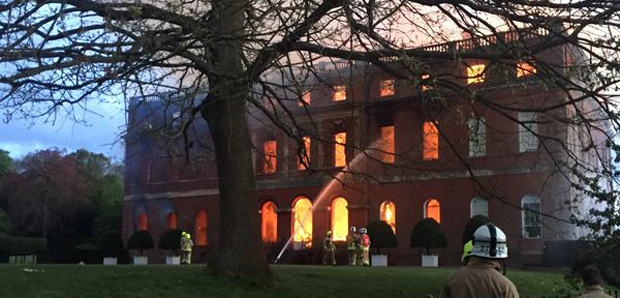
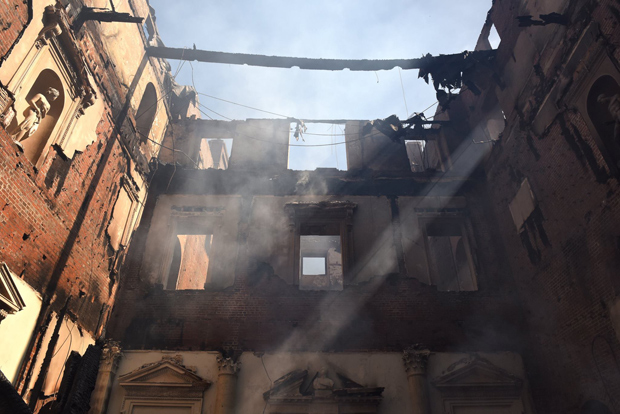
Loss is mainly regret that we will never see something, or that we have known it and will never see it again.  Where the loss is of something of beauty, which embodied ideas, history, culture, it takes on many facets. Fire is a destructive, cruel enemy, consuming all in its path; caring not for the value – either great or small – simply taking whatever it can as fuel for its avaricious need to grow. On 29 April 2015, as the fire at Clandon Park took hold we hoped for the best – yet sadly, less than twelve hours later, all that remained was a gaunt, blackened shell. The loss was not just the building and its beautiful interiors and contents, but also what it represented to UK architectural history.

Clandon Park, Surrey (Image: Matthew Beckett)

News breaks now on social media, the first photos and reports of huge plumes of smoke spreading much as the flames did; slowly at first, rapidly growing. Quickly it became clear that the fire had reached the roof and that the rooms on the ground floor of the south side had already gone – the Green Drawing, Palladio, Hunting, Prince Regent.  Each a small gem in themselves, their contents the result of decades of collecting and curation. As the floors above collapsed, it became clear that this was a very serious situation and thoughts immediately are to hope that, first, everyone is safe, but, secondly, how far would the fire go? Sadly, it soon became clear that the entire house was to be consumed in the inferno.

Clandon Park on fire, 29 April 2015 (Image: © Andrew Blondell / BBC Surrey)

Why was Clandon Park important? It wasn’t just the history and collections.  Most importantly, the design of the house was a key transitional link between two defining periods of British architectural history; the Anglo-Baroque and the Palladian. The house, both interior and exterior, was designed by a Venetian architect, Giacomo Leoni, and built between 1723-29.  Both the architect and the dates are key to understanding why the house was so significant.

Clandon Park on fire - two-thirds of the house was now on fire (Image: © Oliver Dixon)
Clandon Park on fire – two-thirds of the house was now on fire (Image: © Oliver Dixon)

Giacomo Leoni (b.1686 – d.1746) played a key role in bringing the ideas of Palladio to the UK through the publication of that architects’ ‘I Quattro Libri dell’Architettura (which he called ‘The Architecture of A. Palladio, in Four Books’). Although not an entirely accurate recreation (Leoni wasn’t above adding his own improvements) the instalments (published between 1715-20) were a huge success, casting the ideas of the Palladian ideal deep into the aspirational hearts of the British aristocracy.  Leoni’s edition remained the primary source of the nascent Georgian Palladianism until (prompted by Lord Burlington) Issac Ware produced a more accurate translation in 1738.

Clandon Park on fire - the flames reached the north side (Image: © Alex Greenwood)
Clandon Park on fire – the flames reached the north side (Image: © Alex Greenwood)

For all his intellectual influence, Leoni’s physical output was relatively meagre for a 45-year career – his earliest designs were for an unexecuted rebuilding of Wrest Park in August 1715 for the 1st Duke of Kent. His first completed work was in London in 1721, Queensberry House, 7 Burlington Gardens, for John Bligh, Lord Clifton, which featured an antique temple front, a reduced version of which appears on the south front of Clandon Park. Leoni’s output was mainly country houses; he designed eleven but only nine were completed (the two unfinished houses being Carshalton Park and Thorndon Hall) of which four have been lost already (Moulsham Hall – dem. 1809, Bold Hall – dem. 1901, Burton (or Bodecton) Park – fire 1826, and Lathom House – dem. 1929/1955).

Comparison of Leoni's 7 Burlington Gardens and south front of Clandon Park (Image: 7BG: Wikipedia / Clandon: Matthew Beckett)
Comparison of Leoni’s 7 Burlington Gardens and south front of Clandon Park (Image: 7BG: Wikipedia / Clandon: Matthew Beckett)

This left just four completed house which survived into the 21st-century; Lyme Park (c.1725-35), Alkrington Hall (1735-36), Wortley Hall (1743)- and Clandon Park (1723-29).

The brilliance of Leoni’s design for Clandon had survived almost unchanged as it had remained in the Onslow family until being handed to the National Trust in 1956. Where Clandon excelled was that the exterior was early-Anglo-Palladian; chaste, restrained decoration, subtle temple motif, but this was married with one of the greatest of the Anglo-Baroque rooms, the Marble Hall (the plasterwork of which Sir Simon Jenkins thought better than the similar room at Houghton Hall), and other rooms rich in beauty. This contrast between the quiet exterior and the exuberant interior is what made Clandon so important as the link between two of the most significant trends in British architectural history.

Marble Hall, Clandon Park (Image: Matthew Beckett)

So, what next? The incredible staff and volunteers of the National Trust swiftly put into place the plans they never hoped to have to use and clearly, the efforts are being directed to the care of the salvaged contents and an examination of what can be recovered from the debris.   Investigations will be undertaken and conclusions reached as to the cause but looking to the future the options are the same as ever; rebuild, re-use, or ruin.

Marble Hall, after the fire (Image: © John Millar / NT Picture Library)

As a nation, we have fetishised ruins for centuries with castles, abbeys, fortifications and now factories celebrated for their managed decay. We have enough derelict country houses (far too many, truth be told), so to consign another to that sad, lonely fate would miss the chance to grasp a recoverable beauty and miss the opportunity to demonstrate and inspire through an educational process around the reconstruction.

The Landmark Trust’s inspired recent work at Astley Castle, Warwickshire, to create a modern living space in a shell created by a fire in 1978, shows that ruins can be re-used intelligently and with great aesthetic success.  However, Astley Castle was a smaller house and also without the spectacular interiors which once graced Clandon Park.

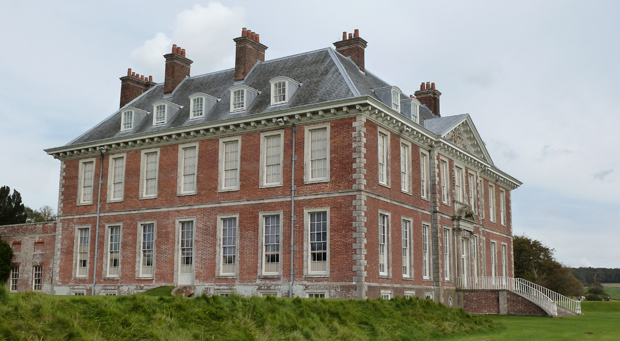
Uppark, Sussex (Image: © Matthew Beckett)

So the remaining option is rebuilding and restoration.  As has been shown at Uppark, Sussex, which also suffered a serious (though not quite as devastating) fire in August 1989, it is possible to restore the house back to as it was before.  This is not pastiche as it’s not conjectural – we have extensive, detailed records of the interiors and, combined with salvaged fabric, it is possible to recreate what was there.  As Sir Simon Jenkins argued in the Sunday Times (03/05/2015), it would be unthinkable not the reinstate the great Marble Hall – because we can.

Modern care and conservation means that the rate of losses of country houses has dropped from the hundreds each year in the 1950s to barely a handful and these are almost always due to fire. All those we have – that which survived this far – are fragile and it’s an uncomfortable truth to understand that they will not last forever.  As the painter Salvator Rosa once wrote:

All our works is fallen and sicken
Nothing is eternal
The Colossei die, the Baths
The worlds are dust, their pomp a nothing…

Rather than despair, we should celebrate and enjoy the architectural heritage which is still available to us and care for it for future generations. The original Clandon Park is lost; that patina of age, the individual details which only it knew are no more. Although the contents have been largely lost, resurrection is the most appropriate option as the main shell of the house has survived – the sterling work of the fire service has saved at least one half of Leoni’s vision. Modern craftsmen with ancient crafts, honed at Uppark, Hampton Court, and Windsor Castle, can recreate the beauty of the interior.  It won’t be the original but from our shock at the loss can come awe at the artistic skills that can recreate such wonders as the Marble Hall.

———————————————————————————

Gallery of images of the aftermath: ‘Clandon Park fire 2015‘ [National Trust Picture Library]

Statement: ‘Fire breaks out at Clandon Park, Surrey‘ [National Trust]

National Trust ‘stuff’ debate: ‘Re-presenting the Country House’ – Ben Cowell, Director, NT East of England

Since the earliest days of the country house, one of their primary roles has been display; conveying meaning through designs, devices and decoration. Through the generations this role remained, though each age had their own influence, mostly evolutionary or occasionally a more dramatic change.  The clearest messages were to be found in the houses which had remained in the family with their collections but as this became a rarer combination in private hands, the National Trust became one of the most important custodians of this legacy.

Library, Ickworth, Suffolk (Image: ©National Trust Images/Andreas von Einsiedel)

However, in an interview with Dame Helen Ghosh, the Director General of the National Trust, surprised many by saying:

People were also put off because there is “so much stuff” in some of the stately homes. The Trust was now looking at featuring only a handful of interesting artworks in some homes to see if it increased their appeal. Dame Helen said: “We just make people work fantastically hard, and we can make them work much less hard.” [Daily Telegraph – 23/03/15]

Cue much consternation – in his article ‘What’s wrong with the National Trust?‘, eminent art historian Bendor Grosvenor asked ‘Has the National Trust lost interest in art?‘. Mr Grosvenor then visited Ickworth and his follow-up article contained photos of the library, formerly full of contextually appropriate furniture, which now had bean bags.  I shared this via Twitter, prompting a spirited debate which raised the obvious curatorial and aesthetic concerns – who were these visitors who struggled, what about those who visit specifically to see the glorious contents? I confess to being firmly in the latter camp and have stated as much.

In the spirit of an honest debate about this important topic and to put the National Trust’s position, I offered Dr Cowell a guest blog post which he has taken up and is below.

After reading it, I understand why the National Trust feels it has a role to play in developing the interpretation of the country house.  Almost inevitably, these activities are going to be criticised. This is especially true where they conflict with the strongly held views of why most of the National Trust’s members visit these houses, namely, to see their unparalleled collections, married to the interiors for which they were intended.

The controversy is perhaps less about the experimentation and more about the less than transparent way that it has taken place.  One always fears that any action is the thin end of a wedge which permanently compromises what many would accept is the best way of displaying this historic collections. This is unfortunately compounded by Dame Helen’s frustratingly disrespectful description of the matchless art and furniture as mere ‘stuff‘, implying a rather disposable attitude.

Handled differently, I suspect that there would be much less outcry and reputational damage if they were less opaque and perhaps:

  • Shared, before changes were made, the proposed alterations and the research which led to them
  • Gave a clear indication of whether these changes were permanent or temporary (and, if the latter, for how long)
  • Indicated where the contents had been moved to if within the same building or that it was not available

I would also suggest that the National Trust facilitated a more formal feedback mechanism so that experts – both internal and external – can debate the merits of the changes along with contributions from their 4m members who care so deeply about the houses.  This would enable a more quantifiable response which could then feed into future proposals. Simply changing things is not sustainable if the National Trust wishes to retain the support and trust of their members and the wider heritage community.

Dr Ben Cowell, Regional Director for the National Trust in the East of England

Valiantly defending the position of the National Trust online is Dr Ben Cowell FSA, Regional Director for the National Trust in the East of England.  Dr Cowell is also Deputy Chairman of The Heritage Alliance. He worked formerly for English Heritage and the Department for Culture, Media and Sport, and has published widely on aspects of history and heritage.

Below is his specially commissioned response to the debate and the controversy, putting the other side to the argument about how the country house can be presented today.


‘Re-presenting the Country House’ – Dr Ben Cowell

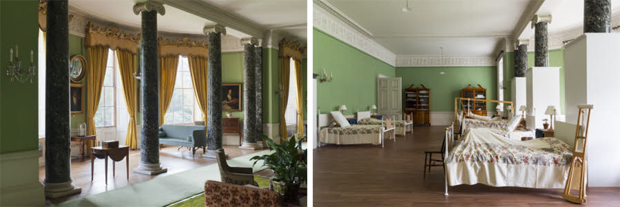
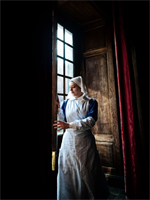
Visitors to Dunham Massey this year, as last, are shown a different version of a house they might know well. The saloon, a masterpiece of Edwardian country house design, has been stripped bare. In place of the fine furniture are metal beds, medical cabinets and hospital screens.

The Saloon, Dunham Massey - contrasting traditional and WWII themed presentation (Images: ©National Trust Images - James Dobson/Andreas von Einsiedel)
The Saloon, Dunham Massey – contrasting traditional and WWII themed presentation (Images: ©National Trust Images – James Dobson/Andreas von Einsiedel)

Dunham Massey has been returned to the time when it was Stamford Military Hospital, a place of repair and recuperation for soldiers from the Western front during the First World War. The effect is electrifying. A team of actors has been engaged to re-enact imagined scenes from the lives of those – both soldiers and nurses – who were known to have been at Dunham during this time. The details of their lives have been carefully researched, even if the dramas are fictions, albeit highly engaging ones.

Nurse closing the shutters at Dunham Massey (Image: Christopher Davies / Correct Aperture Photography)

Not everyone has appreciated what the National Trust has done with Dunham Massey during its temporary ‘Sanctuary from the Trenches’ re-fit. But huge numbers have. The property has had its most successful year by far, and recorded levels of visitor satisfaction have rocketed.  People love the sense of connection with lives as they were lived a century ago in the midst of unparalleled global conflict.

Does this inevitably point the way for every National Trust country house? Of course not. Has ‘Sanctuary from the Trenches’ been such a success that we are now wondering where else we might make other temporary, experimental interventions? Of course.  And there is nothing new here, since we have perpetually made changes to the way the rooms of our mansions are shown, whether to draw out a particular theme or highlight a particular age in a house’s history.

The National Trust is committed to offering ‘experiences that move, teach and inspire’ by raising the standard of presentation and interpretation across our historic mansions. That is apparent from our recent strategy document, Playing Our Part.  There is no single policy or approach. Curatorial decisions are made in situ, respecting the genius loci.  The curatorial eye needs to be constantly on the move, seeking out new ways to display or experience things, in order to delight or otherwise engage visitors.

Ickworth, Suffolk (Image: ©National Trust Images/Arnhel de Serra)

Two examples from my patch exemplify this. At Ickworth, following the highly successful recreation of the basement rooms, our attention has turned to the grand display rooms above them in the Rotunda. These rooms were conceived by Ickworth’s creator, the 4th Earl Bristol, as a gallery for his impressive collection. In the same spirit of wanting to show off the artworks to best effect, we are trying out some new approaches, confined to just a few rooms on the ground floor.

In the Library we’ve temporarily left the room bare (following cleaning work on the electrolier chandelier) in order to focus attention on the pictures and the chandelier itself.

Ickworth Electrolier: throwing new light after its clean (Image: ©National Trust)

Informal seating has been provided in order better to allow visitors the chance to stop and pause. When the project is complete (we’re only part way through the re-presentation at present), lighting elsewhere in the Rotunda will be enhanced, allowing works such as Titian’s portrait of an unknown man to be seen wholly afresh.

Up at Felbrigg, on the North Norfolk coast, another experiment is about to begin. Here, the grounds of the house are the venue for Wolf’s Child, part of this year’s Norfolk and Norwich Festival. Wolf’s Child is a perambulatory work of drama, experienced at nightfall. Visitors will move on a pre-determined walk through the woods. The story is drawn from Ovid; the tales explore all manner of human-animal transformations.

Felbrigg Hall, Norfolk (Image: ©National Trust Images/Andrew Butler)

Is this the ‘right’ way to experience the Felbrigg landscape? Ought we not to have moved a single piece of furniture in the Earl Bishop’s palace? There are those who are steadfastly certain of the answers to these questions. I am not one of them. All I know is that there can be no progress in the field of country house interpretation unless we are open-minded to the possibility of experiment.

We must do so in a way that is respectful of the spirit of the place, and we must never make permanent changes that would damage the inheritance that we hold in trust. We will make mistakes from time to time, and will be rightly chided for them. But to not explore different ways of seeing is surely to blinker us to the possibility of greater glories.


I very much thank Dr Cowell for his contribution to the debate and hope that it has helped provide an alternative viewpoint.  Comments can be left below but please remain respectful and on-topic.  The views expressed in the introduction are mine alone and have not been vetted or approved by the National Trust.

A mansion tax is a pox on all our country houses

It’s a widely accepted principle that even if trying to achieve a noble goal, it is not a justification to do harm in doing so.  Whether one is trying to fund the NHS or provide kittens and puppies for all, if ever such an ill-thought out idea as a mansion tax is introduced, it is likely that the law of unintended consequences will find myriad ways to demonstrate itself.  In few sectors will the damage be greater than in that of our nation’s cultural and architectural heritage where decades of hard work and conservation of our country houses will be sacrificed to play a short-term political game.

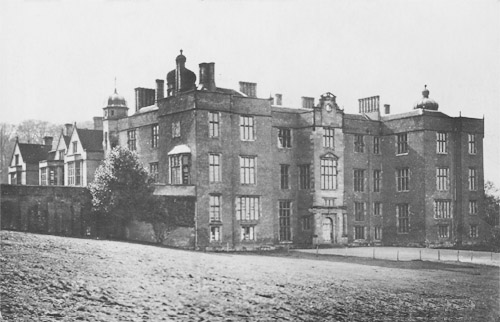
Beaudesert Hall, Staffordshire - demolished 1935 due to demands of heavy taxation (Image: Lost Heritage)
Beaudesert Hall, Staffordshire – demolished 1935 due to demands of heavy taxation (Image: Lost Heritage)

Let me make clear that this objection is not party political – I would object as vigorously regardless of whoever tried to propose it. Obviously the devil is in the detail but if we assume a tax levied on homes valued at £2m or more at 1% of the property value to be paid annually there are many obvious and profound flaws with the idea – below are a few of them:

  • Fallacy of numbers: there are more expensive houses than there are rich people who could afford the tax. Many houses which would be affected have been inherited thus exchanging the large liquid capital requirements of purchase for the more manageable (though not insubstantial) cost of on-going maintenance.
  • Value suppression: a house valued at £2m will immediately not be worth £2m when a mansion tax is introduced (thus reducing the projected tax receipts).  This will lead to a very hard ceiling on house prices, stagnating the market far below that level as it will prevent others trading up by imposing a disproportionate penalty on anyone purchasing over that price level. Think of all the disadvantages of the current crude banding of Stamp Duty, but magnified.
  • Incentive to neglect: if your house is worth just over £2m, there is a benefit to allowing your property to deteriorate so that it can be assessed at being below the threshold. But how often will they be valued? Will it lead to a cycle of neglect and repair to coincide with this? Who will wish to improve their property for fear that it will push it over the punitive threshold?

Perhaps the greatest threat is to the contents of country houses; the art, sculpture, books, tapestries which combine in such an intangible emotive way to create that atmosphere unique to each.  When the financial effects of the 1870-80s agricultural depression began to be felt, the first items to be sold were the contents – the Titians, Rubens, Caxtons, Shakespeares, Nollekens, Canovas were taken from their pride of place and sent to auction or dealers, the resulting funds merely delaying the inevitable sale of the house.  If we thought the National Lottery Fund was sorely stretched at the moment to acquire for the nation the occasional fine work which appears at auction, there is little chance of them being saved if the volume increases, meaning they will, in many cases, go overseas. Additionally, if the best works have already been sold, then death duties will be a final hammer blow to shatter the cultural and historical unity of the country house, with nothing left to sell or offer in lieu.

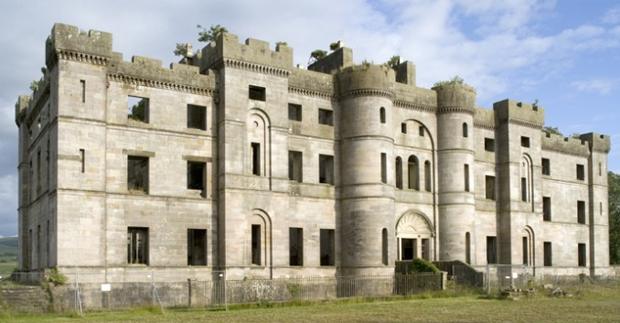
This type of crude taxation has been tried before and it is always heritage which pays the price.  The many gaunt shells of Scottish country houses, such as Dalquharran Castle or New Slains Castle, which were un-roofed to avoid punitive taxes are sad testament to the folly of this approach.  Supporting a mansion tax is to accept a probable return to an era where empty country houses become derelict – ironically coming so soon after the 40th anniversary of the ‘Destruction of the Country House’ exhibition. The National Trust will not be able to take them on without an endowment and English Heritage are sorely underfunded already – leaving either neglect or a hope for an influx of foreign wealth to purchase these houses. Without a local owner living there full time, there are likely to be fewer jobs reducing tax revenues and, with the dearth of rural jobs, leading to higher numbers relying on the State for assistance or an exodus to larger urban areas, further damaging the rural environment.

Dalquharran Castle, Ayrshire - built by Robert Adam c1785-1790, un-roofed 1967 (Image: RCAHMS)
Dalquharran Castle, Ayrshire – built by Robert Adam c1785-1790, un-roofed 1967 (Image: RCAHMS)

Perhaps there could be exemptions for houses which are open a certain number of days a year or which support useful charitable activities but the danger is that these would be used to justify an idea that is inherently wrong.

This article is deliberately painting a rather bleak picture, partially because there is a real likelihood of any of these outcomes, but also to emphasise just how badly-thought out this crude idea is.  It offers no benefits except as a bone to be thrown to a few class warriors but it should seriously worry anyone who cares about the UK’s cultural, artistic and architectural heritage.  Owning a country house is a responsibility, not only as a home for the owner and their family, but one owed to society as a whole.  It is inevitable and right that tax should be raised to pay for the society we hope to live in, but to wilfully sacrifice four centuries of heritage is an immoral and culturally destructive way to do so, no matter how noble the intended reason.

A theatre of innovation: Cragside, Northumberland

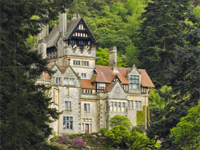
Cragside, Northumberland (Image: ©National Trust Images/Simon Fraser)

One hundred and fifty years ago, as 1863 drew to a close, the great industrialist Lord Armstrong may have reflected on a year in which innovation was sweeping across so many areas of life and, perhaps, his own future plans for his new country house at Cragside, Northumberland.  Country houses have often been at the nexus of innovation as they contain just the right mix of elements; namely a fashion for novelty, complex issues to be solved and a desire to impress others, along with the resources to experiment.  Cragside was to be a fine example of all these desires, a joint effort between an inventor owner and an inventive architect.

1863 was another year of great industrial developments as diverse as the running of the first Underground trains in London and the patenting of TNT, both of which would have far-reaching consequences.  That driving spirit of creativity spurred the Victorian engineer to look at many challenges, both large and small, seeking solutions which provided greater utility and comfort, though often tempered by the conservatism or financial reluctance of the owner.

Comfort and luxury are not always as synonymous as they are today and tales are legion of freezing country houses where one bathroom (used only for bathing naturally) served a whole house.  Owners of older aristocratic houses often felt little need to modernise; after all, if you had hot and cold running servants ferrying coal and water about the house this was often cheaper than a full refurbishment.  Worse, such improvements might be seen as nouveaux-riche (and therefore vulgar), unhealthy, or, worse, American. By contrast, the new money aristocrats in the Victorian era often had worked their way from less distinguished backgrounds and were keen to use anything which provided a better life – and also gave them the social bragging rights of novelty.

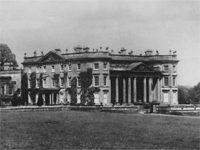
Bowood House, Wiltshire (demolished 1955-56) (Image: Lost Heritage - England's Demolished Country Houses)
Bowood House, Wiltshire (demolished 1955-56) (Image: Lost Heritage – England’s Demolished Country Houses)

Open fires have been the mainstay of country houses for hundreds of years but central heating – either steam, hot air or hot water – started making a comeback in the late Georgian period (remember the Romans introduced it first). The library at Bowood House, Wiltshire was thought to be the first modern room to be centrally heated when it was introduced in the 1790s (although it wasn’t all that successful).  Other centrally heated single rooms were to be found at Pakenham Hall, Co. Westmeath in 1807 where ‘The immense hall so well-warmed by hot air that the children play in it from morning to night‘.  The first multi-room ducted hot-air arrangements could be found at Coleshill, Berkshire in 1814, and Abercairny, Perthshire in 1829. Steam proved difficult to control (though it was installed by Sir Walter Scott at Abbotsford in 1823) so other early examples were either hot air (Osmaston Manor – 1846-49, Flixton – 1847, or Tortworth Court – 1849-52) or hot water via radiators (Mentmore Towers – 1850-55).  These systems rarely extended beyond the entrance areas, hallways and main downstairs rooms.

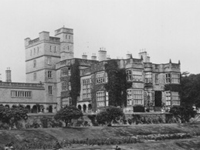
Osmaston Manor, Derbyshire (demolished 1965) (Image: Lost Heritage - England's Demolished Country Houses)
Osmaston Manor, Derbyshire (demolished 1965) (Image: Lost Heritage – England’s Demolished Country Houses)

Ventilation was always a challenge and the unpleasant accumulation of stale air and the smell of gas was exacerbated by the higher building standards of the Victorians which reduced drafts.  Many houses such as Kelham Hall, Mentmore, Dobroyd Castle and Wykehurst Place had ventilation shafts fitted in individual rooms but they were fairly inefficient.  One of the most advanced systems was created in 1846-49 for Francis Wright, a wealthy ironmaster, at his home Osmaston Manor in Derbyshire.  A single intake near the kitchen drew air from outside before heating it and distributing it around the house.  Coal fires in individual rooms then drew the stale air towards them but the flues all took the air downwards into a central extractor system which vented though a single huge 150-ft chimney in the kitchen garden, thus eliminating the need for huge chimneys in the main house (though it had smaller ones).  Sadly the house was demolished in 1965, thus denying us the chance to marvel at the ingenuity.

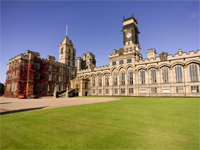
Carlton Towers, Yorkshire (Image: Landed Houses)

Bathrooms and indoor plumbing were often a great source of inconvenience. Even as late as 1873, such a grand house as Carlton Towers, Yorkshire, had no bathrooms with washing still undertaken via hand-filled basins and hip baths.  By contrast, Stoke Rochford Hall in 1839 had fifteen and by 1874 Wykehurst had the then radical innovation of each bedroom being a suite with its own bathroom.  A number of country houses were demolished for reasons of inconvenience with a  lack of bathrooms often cited, especially as the complexities of adding them to older houses was to prove insurmountable, either technically or financially.

Such challenges were often a catalyst for innovation – particularly if the owner was one of the industrial titans of the age, a man as comfortable in the workshop as the boardroom. Although William Armstrong (b.1810 – d.1900), 1st Baron Armstrong (after 1887), started his professional life as a solicitor he was able to turn his analytical mind to practical challenges as much as legal ones.  The genesis of his engineering career stemmed from his love of fishing where he noticed how inefficient waterwheels were and so designed a much more efficient water-powered engine. He successfully showed it could be used to hydraulically power cranes and thus improve the speed of cargo unloading at the docks.  This formed the basis for Armstrong’s engineering firm in 1847 and his first fortune.  The firm’s greatest fame/infamy came due to the later armaments work which Armstrong had turned to when he read that the British Army had difficulties with heavy field guns during the Crimean War. Success here with his revolutionary design and, later naval versions, led to the creation of a shipbuilding firm which won orders throughout the world, generating his second fortune.

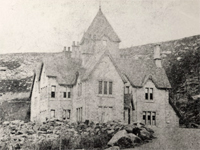
The Lodge 'Cragside', dated 1864-6, before Norman Shaw's editions at Cragside, Northumberland (Image: ©National Trust Images)
The Lodge ‘Cragside’, dated 1864-6, before Norman Shaw’s editions at Cragside, Northumberland (Image: ©National Trust Images)

Armstrong’s obviously busy and productive life gave him great status in Newcastle-upon-Tyne and beyond and his main home in the city was a grand, if heavy, suburban creation called Jesmond Dene House.  As befitted any Victorian man of wealth and social stature and due to the pressures of running his businesses, Armstrong sought a country retreat.  Having visited the Rothbury area as a child, he looked there for a suitable estate, eventually buying in 1863 the then small shooting lodge and 20-acres of land which formed part of a steep-sided valley through which ran the Debdon Burn. Over the next few years, as Armstrong came to reduce his involvement in his businesses, Cragside became a passion; a place to retreat but also to enjoy more domestic challenges with the help of one of the most brilliant architects of the age, Richard Norman Shaw. Armstrong eventually came to own 16,000-acres of Northumberland, including Bamburgh Castle, of which 1,759-acres surrounded Cragside in which he had planted over 7m trees and innumerable rhododendrons.

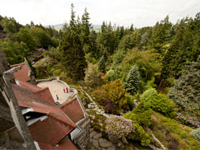
View from the Terrace, Cragside (Image: ©National Trust Images/John Millar)

Between 1869-84, Cragside was transformed into a modern Victorian plutocrats palace, but one incorporating all conceivable innovations, powered by his own hydraulic engines. The first challenge was the location, which was ideal for a small lodge but cramped for the house which it eventually supported.  The steep hillside meant that space for expansion either had to be created through excavation or by building up the ground.  What it lost in convenience, it gained in views; spectacular vistas overlooking the remote Northumberland countryside.  Unfortunately, those views – both from and of the house – are now somewhat obscured by some of those same trees planted by Armstrong.

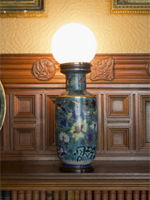
One of four of the original electric lamps at Cragside (Image: ©National Trust Images/James Dobson)

It was inside the house that the inventive mind of both owner and architect could really find effect.  For Shaw, Armstrong was an ideal patron, offering none of the conservative reticence he might have found in other clients, able to offer either his innovations or those of his friends. By December 1880, Cragside was the first private house in the UK (and Girouard thinks possibly in the world) to have electric light comprehensively installed, thanks to Armstrong’s friendship with Joseph Swan, with his eponymous filament bulbs throughout. Power for these innovations came from Armstrong’s own hydroelectric engines, running from the Burn below.

With the luxury of his own cheap and apparently limitless power supply, Armstrong and Shaw’s opportunities were myriad.  In addition to the lighting, the central heating system was also driven by a hydraulic engine.  That same power source also enabled the kitchen to boast a hydraulically-powered spit with the heavy pots in the conservatories moved by hydraulic machinery, with an electric sewing machine and electric communication throughout the house and even out to a shooting lodge on the moor.

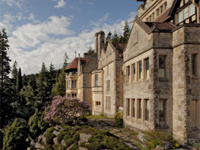
View of Cragside (Image: ©National Trust Images/John Millar)

To his contemporaries, Cragside must have seemed beyond ingenious – a place grown from an inhospitable hillside, packed with innovations.  The house became a significant marketing tool for Armstrong as visits from his prospective customers, including the King of Siam, the Shah of Persia and the Crown Prince of Afghanistan, gave him the chance to demonstrate the advanced technology they could be buying into, a true theatre of innovation.  The Prince and Princess of Wales also visited in August 1884, thus giving the royal seal of approval to such a modern approach to the traditions of the country house.

Cragside passed to the National Trust in 1977, sadly missing the best of Armstrong’s picture collection (sold in 1910), but cared for and open so we can enjoy seeing the products of two great Victorian minds.  Despite being the genesis of domestic hydroelectric power, a gas turbine was installed in 1895 to provide more power before being connected to the National Grid in 1945.  However, in early 2014, the National Trust is again installing a modern hydroelectric screw to once more generate electricity for the house providing a welcome return of innovation.

———————————————————

Article: ‘Hydro-electricity restoration work starts at Cragside‘ [BBC News]

Official site: ‘Cragside‘ [National Trust]

160+ images: ‘Cragside‘ [National Trust Images]