Supermodels: the rise and fall of architectural models of country houses

A William IV Cut-Card Model of an Unidentified Mansion, 1831 by John Bellamy (Image © Christie's - Sale of the Collection of Professor Sir Albert Richardson, P.R.A., Sep 17, 2013)
A William IV cut-card model of Newtown Park, Hampshire, dated 1831 by John Bellamy (Image © Christie’s – Sale of the Collection of Professor Sir Albert Richardson, P.R.A., Sep 17, 2013)

In a time before widespread literacy, a physical representation of what was intended to be built was a powerful aide to help ensure that the vision of the architect became the physical reality crafted by the builder.  Yet, the architectural model was more than this. Evolving from being a functional tool, it became an aspirational marketing device to demonstrate the proposed scheme but also as a three-dimensional business card for the architect and striking conversational piece for the wealthy patron who would possess both the miniature fantasy and the full-size reality of the design of their country house.

The role of the architectural model can be traced back to the earliest buildings, particularly the devotional and religious. Some of the oldest were found in Egyptian tombs, dating back over four thousand years, and represented functional spaces which may be required such as granaries or gardens. Later they were often displayed as a record of the beneficence of the donor (rather than skill of an architect), they appear in paintings or decorations being held as offerings (such as the 10th-century Vestibule Mosaic showing Justinian presenting the Hagia Sophia to Mary and Christ), or carved into their funerary monuments or other personal iconography such as portraits; all undoubtedly a handy aide-memoire to St Peter, come the reckoning on Judgement Day.

Detail of 17th-century portrait of Queen Marie Thérèse of France, as patron of the Cathedral of Notre-Dame de Paris (Studio of Beaubrun brothers) (Image: public domain via Wikipedia)

The creation of models of new buildings is recorded in the 15th-century with the renowned architect and theoretician Leon Battista Alberti (b.1402 – d.1472), stating that,

‘I always recommend the ancient builders’ practice by which not only drawings and pictures but also wooden models are made, so that the projected work can be considered and reconsidered, with the counsel of experts, in its whole and in all its parts.’

The fashion for the creation of architectural models as objects for study and decoration was one which grew with the interest and wider participation in what became known as the Grand Tour, particularly from the 1760s.  As wealthy young men would embark on extended study (and, if we’re honest, pleasure) tours of the Mediterranean and Middle East, so too did their desire to bring back a tangible memory of their time to display as a marker of their cultural and worldly sophistication.

Cork model of the Temple of Zeus or Apollo, Paestum (c. 1820), attributed to Domenico Padiglione. Courtesy of the Trustees of Sir John Soane's Museum
Cork model of the Temple of Zeus or Apollo, Paestum (c. 1820), attributed to Domenico Padiglione. ©Trustees of Sir John Soane’s Museum

Cork established itself as a popular material for the crafting of models of ancient ruins as it was intrinsically similar in its native form to the weathered appearance of the stones it was shaped to resemble. Light and easy to transport, it is easy to imagine that many hundreds of these were shipped back to country houses back in the UK as a reminder and an inspiration.  It is interesting to speculate how influential these romantically ruinous models were on the nascent Picturesque movement of the 1780s. The models may have generated not only new buildings but also the incorporation of existing ruins into new landscapes or the building of new ‘old’ ones too, energised by having at hand aesthetically compatible examples, steeped in irregularity and showing the forces of nature providing the finishing touches to the works of man.

For those who wished to show a more idealised representation of architectural purity, clearly the imprecise renderings of cork were not going to match their visions. In the 1780s, to demonstrate the beauty of the finer details of the classical world, entirely white, finely crafted ‘Plaster of Paris’ models started to be created.  Almost of these are thought to be the work of two French modellists, Jean-Pierre Fouquet (b.1752 – d.1829) and his son Francois (b.1787 – d.1870), who were based in Paris, trading as Fouquet et Fils.1 For architects, these models presented an alternative version of reality, one which enabled them to present their own schemes in a favourable context to the works of the ancient world.
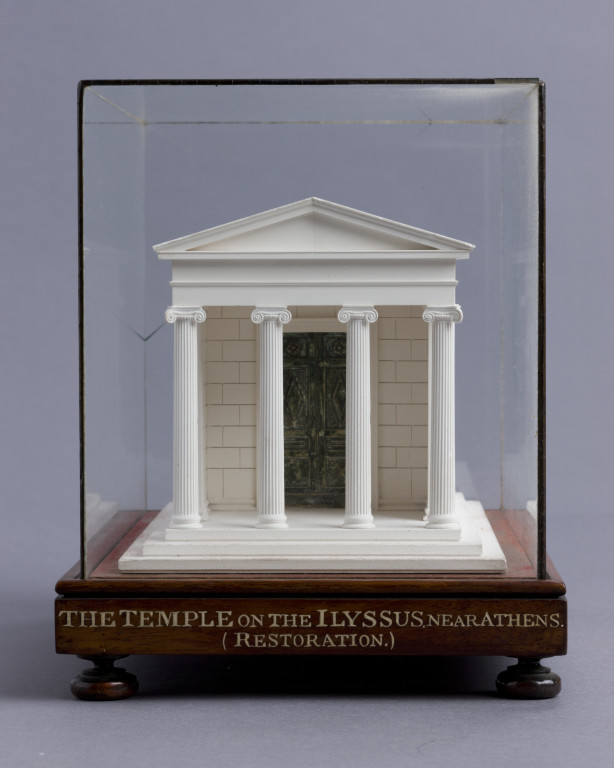
Model of the ancient Greek Ionic temple on the Illisus, near Athens, 'restored', c.1800-1834, plaster of Paris. (Photo: © Sir John Soane’s Museum, London)
Model of the ancient Greek Ionic temple on the Illisus, near Athens, ‘restored’, c.1800-1834, plaster of Paris. (Photo: © Sir John Soane’s Museum, London)

Beyond the decorative role, the models were also naturally didactic; their representations of the ruins of the ancient world creating opportunities to teach those who would not otherwise be able to travel to see them. Of those who embraced this approach, the most prominent and inventive was Sir John Soane.  His collection was one of the largest but who was also able to use them as inspiration, as teaching aids to his pupils and marketing tool for those who visited his home/studio at Lincoln’s Inn Fields in London, where they can still be seen today in the restored model gallery.

“Many of the most serious disappointments that attend those who build would be avoided if models were previously made of the edifices proposed to be raised. No building – at least none of considerable size or consequence – should be begun until a correct and detailed model of all its parts has been made.”
– Sir John Soane (Royal Academy lecture, 1815)

Soane was drawing on his own experience but what had clearly been a well-established technique within the building trade and architectural profession – but just how frequently were these model houses created as part of the commissioning process? The key challenge is that so few are known to have survived that it’s difficult to draw broad conclusions from such a small selection. However, it is instructive to take a tour of a sample to see the range and skills deployed by architects and craftsmen to not only convince the patron but also to explore proposed designs at a stage when corrections were far easier to make.

Quidenham Hall, Norfolk - architectural model of c.1606 (Norwich Museum Service)
Quidenham Hall, Norfolk – architectural model of c.1606 (Norwich Museum Service)

One of the earliest known examples (and my thanks to Jeremy Musson for bringing it to my attention), is a beautifully detailed model of Quidenham Hall, Norfolk, dating from the early 1600s. The manor was bought by the Holland family from in 1572 and the model was created for the construction of the first house in 1606 – probably in the same year, as it would act as the visual guide for the builders and masons.

In the context of a less-educated age, the value of the model to the build process becomes more apparent, particularly for more complex designs such as Quidenham, with its detailed elevations including procession, recession, bows, pediments, crenellations, stepped gables, and chimneys.  A feature of the architectural models is that they can be explored, with the house dissembling either horizontally including the exterior walls, or just the interior floors, enabling a ‘fly-through’ so beloved of modern property programmes.  Clearly, being able to visualise the interior in relation to the exterior provided clarity as to the relationship between the designs for the rooms and their physical placement.

Quidenham Hall was subsequently extensively remodelled in the 18th-century with additional wings and the refacing of the entire house in a unifying neo-classical design. For us today, one value which was unexpected in the original construction of the model is that it allows us to know with a high degree of certainty what the original house looked like, despite these changes.
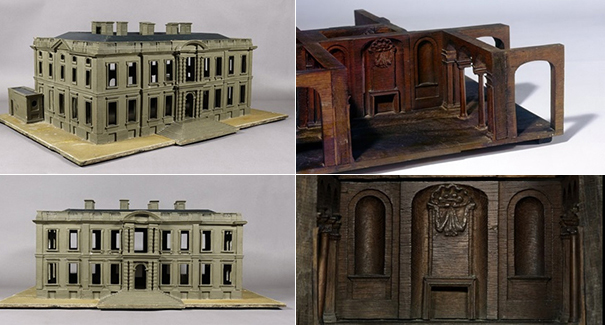
Model of Easton Neston, Northamptonshire, designed by Nicholas Hawksmoor, 1689 (Images © The Art Fund)
Model of Easton Neston, Northamptonshire, designed by Nicholas Hawksmoor, 1689 (Images © RIBA Collections)

The degree of craftsmanship which was invested in the models is perhaps best shown in the remarkable model of Nicholas Hawksmoor’s masterpiece, Easton Neston, in Northamptonshire. Dating from 1689, it is considered one of the most important models to have survived, due not only to the superb craftsmanship but also because it relates to the design of a house regarded as central to the development of the Anglo-Baroque aesthetic. The model was bought for £180,550 in 2005 when Baron Hesketh sold the contents and house and is now in the RIBA Architecture Study Rooms at the V&A in London.

Model for Tyringham, Buckinghamshire, (designed by Sir John Soane), made by Joseph Parkins, c.1793-1794, wood (© Sir John Soane Museum - number: X236)
Model for Tyringham, Buckinghamshire, (designed by Sir John Soane), made by Joseph Parkins, c.1793-1794, wood (© Sir John Soane Museum – number: X236)
Tyringham Entrance Front 3/5/13, (© Sir John Soane Museum)
Tyringham Entrance Front 3/5/13, (Image © Sir John Soane Museum)

Sir John Soane’s designs for Tyringham Hall, Buckinghamshire, are a particularly instructive example as model, drawings and house (the latter with minor later alterations) survive and can therefore be readily compared. Commissioned by the banker William Praed, the house took five years to build from 1793 to 1798, with the model being created in mahogany c.1793-1794 by Joseph Parkins, a joiner working on the project. This sophisticated approach of thoughtful, inventive but ultimately practical designs, high-quality presentation watercolours by Joseph Gandy, and equally polished miniature evocations show the exemplary professionalism of Soane and why he was one of the leading architects of the era and held in such high regard.
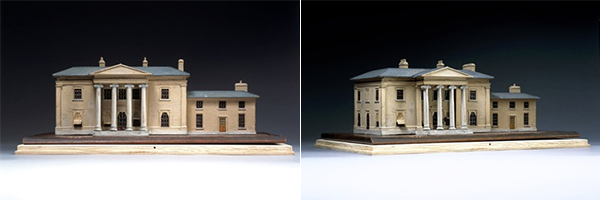
Model of Pyrgo Park, Romford, London (RIBA Collections)
Model of Pyrgo Park, Romford, London, 1851 (RIBA Collections)

A later example was the model created for Pyrgo Park, Essex (demolished c.1940). The house was built for Robert Field, who had inherited a largely derelict Tudor house and estate from his brother in 1836. The remains of the old house were demolished in 1851-52 and a new house built on the same site to a design commissioned from Thomas Allason (b.1790 – d.1852). In light of the architect’s death, in the same year as construction on the new house was due to start, the creation of the model in 1851, now held in the RIBA Collection, would have enabled the work to continue and for a house, faithful to the architect’s design, to be created.

Another architect to use models was George Devey (b.1820 – d. 1896) who produced them as a matter of course when proposing a design to a client.  The distinctive feature of Devey’s models, produced by a dedicated, in-house modeller who was ‘in constant work’, was their scale, being produced small enough to fit in custom, briefcase-sized boxes. These often beautiful models allowed Devey to dispense with creating perspective drawings, producing only elevations and plans, which were combined with the physical miniature they would see in front of them.

The Ledgers, model of proposed alterations - George Devey, c.1882 (Image © Jill Allibone)
The Ledgers, Surrey, model of proposed alterations – George Devey, c.1882 (Image © Jill Allibone)
Barton Manor, model of proposed alterations to the stables - George Devey, c.1873-74 (Image © Jill Allibone)
Barton Manor, model of proposed alterations to the stables – George Devey, c.1873-74 (Image © Jill Allibone)

Two more models are worthy of note due to their size and beautiful detailing. One of the tallest was for Fonthill Abbey, Wiltshire, the vast Gothic edifice built for William Beckford constructed between 1786-1807. The model was notable not only for its scale (built at a ratio of 1 inch to 10 feet), but also for its own evolutionary construction with the model corresponding in part to the earlier designs from 1799, but overall the composition is similar to the engravings from the 1820s. The irony is that this model, built of fragile card, survived more completely than the ill-fated abbey itself.
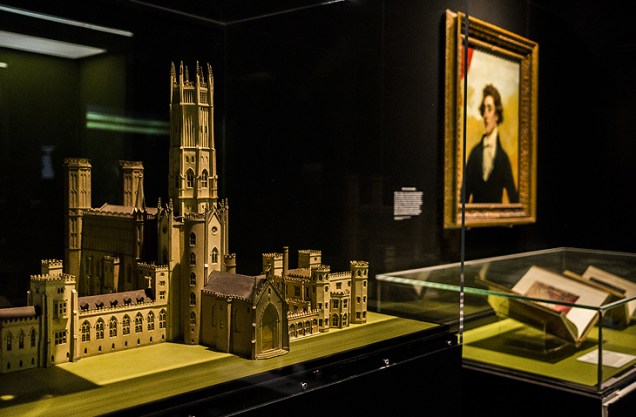
Model of Fonthill Abbey, Wiltshire, designed by James Wyatt. (Image © British Library)

Perhaps the most beautiful and largest is the proposed model for a new palace in Richmond, Surrey, designed by William Kent for King George II and Queen Caroline in 1735. Created in pearwood, the model is nearly two and half metres long and is exquisitely detailed, as one would expect of a presentation model to be shown to royalty.

Model of a proposed new palace for Richmond, 1735, designed by William Kent. (Image © The Royal Collection)

Clearly there is a long history of the use of models, with examples for houses both large and small from multiple notable architects and other evidence that these models were not an uncommon element in the design and construction of country houses. So, why are so few known to have survived? Without more primary, documentary evidence, conclusions necessarily have to be somewhat conjectural.

Some study has been made of architectural models, particularly by Professor John Wilton-Ely, who has stated that although frequently used, they were less used by the end of the eighteenth-century.  He also highlights that whilst models found favour with some architects, such as Soane, others such as William Chambers only used them occasionally, Wyatt only appears to have used it Fonthill and Longford Castle, Wiltshire, and that there are no known instances of their use by Robert Adam.

Additionally, one reason so few have survived is their role in the actual construction process; the frequent use on-site and the high-level of wear-and-tear likely to result from such treatment meant that those made from more fragile materials such as plaster or card were always at risk of being worn out and discarded.

For those which survived, their bulky nature would always be a factor in determining whether someone not only had the inclination but also the space to store them. Minutes and correspondence from within the Victoria & Albert Museum shows the ascending and waning fortunes of architectural models.  When the V&A first opened (called then, the Museum of Construction), models were given prominent billing and display space – though of the seventy-plus identified2 from the hundred known in the collection, only one is a house, surprisingly dating from 1936. The lack of country houses is stark, reflecting a level of  institutional disinterest from the outset and over the lifetime of the collection.  Cumbersome and unloved, the collection was removed from display in 1888 and put into store. After ownership was passed unenthusiastically between the various museums, the V&A reluctantly took them in 1916 (‘The items do not for the most part appear to be very desirable for us, either for exhibition or reserve‘) with some being selected for disposal, the minutes recording ‘their cremation‘.

Perhaps the most intriguing method of survival is the most charming – their use as dolls houses.  Once the model had served its purpose in design and construction, and perhaps served time as a conversation piece, one can easily imagine the children of the house being given a chance to recreate their lives in miniature. They also would serve as training for one day managing a country house of their own. So if you, or a relative, has an antique but surprisingly good quality or familiar looking dolls house in the attic, take a closer look…!

Melton Constable Hall Model (NWHCM : 1971.386) (Image © Gressenhall Farm and Workhouse - Norfolk Museums)
Melton Constable Hall Model (NWHCM : 1971.386) (Image © Gressenhall Farm and Workhouse – Norfolk Museums)

Perhaps the most impressive (and remarkable) surviving example is that of Melton Constable Hall, Norfolk, dating from the 1660s.  The architect of the now grade-I listed house is unconfirmed, particularly as there are no known drawings, but it is thought that the owner, Sir Jacob Astley, may have designed it himself. In such circumstances, the building of a model would have been a prudent step, both in confirming that his design was fit-for-purpose and for subsequent use during construction. The model of the house was then passed through generations of the Astley family children before being donated to the Norfolk Museum Service.

Another dolls house, this time at Greystoke Castle in Cumbria, was discovered to be a proposed eighteenth-century design for the enlargement of the pele tower.  Much of the work at Greystoke was completed by Anthony Salvin (b.1799 – d.1881) so it is possible that this an example of another architect using models as part of the process.

Today, the architectural model exists but as a method of celebration and display.  The model is less a functional representation of what will be and instead is a now a mechanism for the long-term appreciation of the finished building as sculpture.  It is curious to note that the model has moved from the purpose of remembrance to aspiration and back to the recreation of what has been lost. The sophistication of modern digital rendering has sadly removed the need for the model to help those commissioning a country house to visualise it.  However, in this we have have lost the physicality of the form and the sheer pleasure of the craftsmanship of a country house model; idealised but as yet unrealised.

Known complete models of houses

Do you know of any others? If so, please add a comment with details.

Summary list of examples (architect name and current location of the the model, in brackets, if either are known)


References

1 – ‘Plaster Casts: Making, Collecting and Displaying from Classical Antiquity to the Present’ – Rune Frederiksen, Eckart Marchand (Walter de Gruyter, 27 Sep 2010)

2 – Inside Outside: Changing Attitudes Towards Architectural Models in the Museums at South Kensington’ – LeslieFiona, Architectural History47 (2004), pp. 159200

Further reading

Bylaugh Hall: the hidden history to a remarkable restoration opportunity

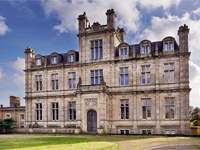
Bylaugh Hall, Norfolk (Image: Chesterton Humberts)

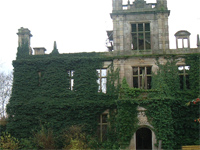
Many country houses we can visit today are innately interesting; the design, the contents, the occupants, all tell a tale.  Sometimes though there are houses with a much richer past which not only have an immediate story to tell but also a much more complex history, one fascinating for anyone with an interest in how these houses came to be created. One such house which was recently launched – and amusingly described on Rightmove as a ‘60 bedroom detached house for sale‘ – is the remarkable Bylaugh Hall in Norfolk, an engineering marvel and architectural delight, which had a forced birth through litigation, which wasn’t wanted by the first owner, and where credit for the design hasn’t truly been given to the right architect.

Bylaugh is remarkable in many ways; some obvious, others less so.  Even its genesis came from beyond the grave as the controversial inherited wish of the last owner, Sir John Lombe Bt (b. c1731 – d.1817), a man whose fortune came from the family’s silk throwing mill in Derbyshire.  The Lombe’s were established Norfolk gentry whose original estate was at Great Melton, centred around Melton Hall (built in 1611 by the Anguish family) but now a ruin having been first tenanted and then, by the end of the 19th-century, abandoned.

Allegedly won by Sir John in a skewed card game, the Lloyds had owned the Bylaugh estate for a number of years, and even if the story is false, it was legitimately Sir John’s by c1796.  The Lombe’s were unusual in that their wealth largely came from industry, and one which was located outside of the county, but they quickly used their fortune to create the fourth largest estate in Norfolk, at over 13,000-acres by 1883.

Whatever house was already at Bylaugh was insufficient for Sir John so he resolved to build an entirely new one.  However, the house he had in mind was not the house which was built.  Sir John must have had a fair idea that he would not survive to see his grand plan to fruition but he certainly wasn’t going to let mere death cheat him of his ambition.  Having placed £20,000 in trust for the express purpose of building the house – though without approving a design – he died in 1817 (unmarried and childless), leaving his estate and his firm directions to his brother Edward. Here, the family history becomes a little complicated as Edward was his half brother, the product of an affair with a Norwich doctor’s wife.  Edward adopted the Lombe surname but was reluctant to take on the grand role envisioned by his late brother – which is perhaps why Sir John’s will was so prescriptive, and which led to a quite extraordinary court case.

Edward Lombe disputed with the executors of the estate the instruction to build the new house.  However, Sir John had been quite clear, including this fascinating clause in his will:

And whereas it is my wish and intention that a mansion house and suitable offices fit for the residence of the owner of my estate shall be erected on some convenient spot in the parish of Bylaugh in the county of Norfolk either in my lifetime or after my death and that if I shall not erect the same in my lifetime then that my said trustees shall forthwith after my death erect the same according to such plan as I shall in my lifetime approve of or if I shall die before such plan shall be prepared and completed then according to such plan as the trustees or trustee for the time being under this my will with the consent of the person for the time being beneficially entitled to the immediate freehold of my said manors &c under this my will shall think proper to adopt adhering as closely as possible situation and other incidental circumstances being considered to the plan of the house now the residence of Robert Marsham esquire at Stratton Strawless in the said county of Norfolk. (source)

Yet Edward resisted, delaying the start of the build for years by arguing with the executors, Mr Mitchell and Mr Stoughton, and stating that even if they built the house he wouldn’t live in it.  Finally, in 1828, he went to the Court of Chancery and demanded that the money, now having grown to £43,000, be placed with it and a judgement made as to whether he could overturn the provisions of his brother’s will. The case was still undecided in 1839, by which time the fund had grown to over £63,500, when Edward again pressed his case, with a decision finally being made in 1841 – against him.  The Vice-Chancellor said:

It appears to me to be impossible to read this passage in the will without seeing that there is in the plainest language an express trust for the erection of the mansion house which the trustees are forthwith after his death to commence and to proceed with the erecting of. I cannot conceive any words more plain.

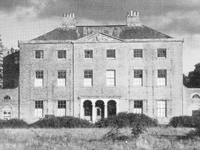
Stratton Strawless Hall, Norfolk - pre 1960 (Image: 'The Country Houses of Norfolk' by David Clarke)
Stratton Strawless Hall, Norfolk – pre 1960 (Image: ‘The Country Houses of Norfolk’ by David Clarke)

Which rather settled that. In the meantime, the executors had not been idle in their duties – but they weren’t as obedient as they might strictly have been.  Sir John had clearly stated that the house was to follow ‘as closely as possible‘ Sir Robert Masham’s house at Stratton Strawless; a three-storey (now two), strictly classical, almost Palladian house with a Tuscan-columned porch.  However, the executors ignored this provision and with possibly an eye to emphasising the esteemed family line and to help the new house blend in with the other seats in the area, they chose to create a historical ‘Jacobethan’-style house – but even that is not the one we see today.

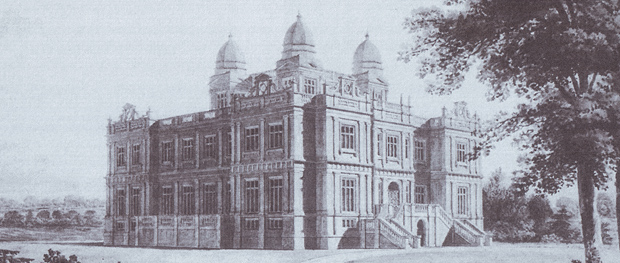
Interestingly, although the current Bylaugh is rightly described as being designed by Charles Barry the younger and his partner, Robert Robinson Banks, few are aware that in 1822 the trustees had originally asked another noted architect, William Wilkins (b.1778 – d.1839), to draw up a plan, and his design showed a remarkable stylistic similarity to the one actually built 27 years later.

Unexecuted design for Bylaugh Hall by William Wilkins, 1822 (Image: Public Record Office MPA. 66.1 / 'William Wilkins, 1778-1839' - R.W. Liscombe)
Unexecuted design for Bylaugh Hall by William Wilkins, 1822 (Image: Public Record Office MPA. 66.1 / ‘William Wilkins, 1778-1839’ – R.W. Liscombe)

Although a noted proponent of the Greek Revival, Wilkins, like many an architect, was well-educated in other styles and could turn his hand if asked. Clearly inspired by the style of ‘Prodigy‘ houses such as Burghley and Longleat, he also drew on elements of buildings he had seen and studied – for example, the polygonal domes capping the raised central hall are copied from the Porta Honoris at Gonville and Caius College, Cambridge, on which Wilkins had written a scholarly article for the esteemed ‘Vetusta Monumenta‘ in 1809. Although each façade was similar, the entrance front was enlivened by a projecting centre bay above the door which was on the piano nobile, reached by an elegant split stair.

The plan of the house was also modern, rejecting a rambling layout, and firmly following the Palladian 3×3 grid on the ground floor.  Centred around a double-return staircase, this was an innovative layout for an early Victorian design – though one Wilkins the classicist would have been entirely comfortable with.  Essentially, he had designed a Palladian villa, dressed in the architectural garb of the ‘Jacobethan’ style.

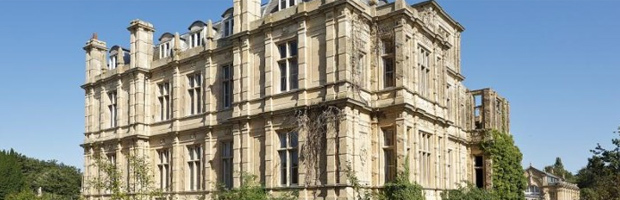
Bylaugh Hall today (Image: Chesterton Humberts)

Bylaugh Hall, as attributed to Barry and Banks in 1849, was perhaps better described as an updated version of Wilkins earlier plan – the core 3×3 layout remained, as did the external style, though some of the details such as the raised central hall and domes were removed, and the central staircase replaced by a saloon.  The construction did display some innovation, being one of the earliest steel-framed buildings and was considered a success with one rather giddy local newspaper exclaiming ‘Neither Holkham nor Houghton, those Norfolk wonders, can compare with it for either appearance or comfort‘.  Such wild exaggeration aside, this was a house at the forefront of domestic convenience and was commended in The Builder for having no corridors in the main block, which maximised the space.  It was completed in 1852 at a cost of £29,389, and by 1869 it was reported that £38,000 had been spent on the project, which would have included further works on estate buildings and landscaping (see photos of the house and grounds c1917).  An interesting aside is that during the delay in starting the money had grown to quite a considerable sum, more than enough for all the works.  Edward Lombe applied for the remainder but the Court demanded it be spent on bricks and mortar and so a 4-mile perimeter wall was constructed to satisfy this.

Ruined shell of Bylaugh Hall before restoration (Image: The Burrell Partnership)

It seems that no descendent ever loved the house.  By 1878, the then owner, Edward Henry Evans-Lombe, was renting the handsomely Classical Thickthorn Hall, before buying Marlingford Hall, whilst selling off outlying parts of the estate.  In 1917, Bylaugh Hall and the 8,150-acre estate were put up for auction in 140 lots but Edward sold it whole for £120,000, and the hall and 736-acre park were subsequently sold to the Marsh family.  Used by the RAF in WWII, it was sold in 1948 to a new owner who unsuccessfully planned to turn it into a nursing home.  At that nadir of country houses generally, a familiar pattern started; parts of the house were demolished and in June 1950 a 350-lot demolition sale was held which stripped the interiors of the house, creating a gaunt and sad shell.  So it remained until, in 1999, the house and a lodge was sold to a local sculptor who dreamt of fully restoring the house but with insufficient funds he was forced to restore just the Orangery (article by the engineers with lots of photos), intending it to be a wedding venue.  Other parts of the main house were parcelled up as investments and rebuilt but the plan faltered and then failed, leaving the partially restored house we see today.

So Bylaugh Hall is a house paid for by a man who never got to see it, with a design chosen by two men who ignored the last wishes of the patron, with credit for that design going to two men who relied heavily on another architect now obscured, for a beneficiary who really didn’t want it in the first place. A brilliant story richly illustrating the fascinating complexities of our country houses.

So what should happen to this superb house? Interestingly, the 557-acre Pavilion farm which surrounds the east and south of the house, and includes one of the original lodges, is also for sale, providing the opportunity for the right person to combine them both.  It would require real vision – the restoration work at Bylaugh Hall may be sound but the aesthetics are dire.  Given the budget, much of the existing restoration should be stripped right back and the interiors given the lavish attention they demand.  This is a house which cries out for sumptuous plasterwork and panelling, for grand rooms with fine wallpaper and filled with artworks and quality furniture. With the funds and the vision to take advantage of this rare opportunity, a restored Bylaugh Hall, combined with the farm and more land later, could once again create one of the finest estates in Norfolk.

—————————————————————————–

Property details

1917 auction catalogue:

Listing description: ‘Bylaugh Hall‘ [British Listed Buildings]

For sale: a Soanian springboard – Burnham Westgate Hall, Norfolk

Burnham Westgate Hall, Norfolk (Image: Savills)

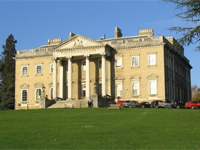
For any architect starting out, the early commissions are perhaps the most important; establishing them both in terms of not only their designs but also how they operate in the execution.  In architectural terms, the early buildings of some architects are sometimes less prized, and therefore protected, than their later works which benefit from the full measure of their developed skill and experience.  In that light, Burnham Westgate Hall deserves to be cherished as not only a fine house but also the first substantial country house project of Sir John Soane.  It provided the springboard for one of our finest architects and is important for the promise shown but also for securing one of the most important prizes in the Georgian era: patronage.

For someone who ended up a knight of the realm, with fame and a noble client list, Sir John Soane (b.1753 – d.1837) had a very ordinary start in life as the son of a bricklayer from Goring-on-Thames, near Reading.  Patronage and connections were to define Soane’s personal and professional life, providing opportunities to establish himself in a way that his competitors, often connected from birth, already enjoyed.  Almost nothing is known of his early life but his obvious talent must have been spotted as he entered the office of George Dance the Younger in 1768, though only starting as errand boy, via an introduction by James Peacock, an employee of Dance who knew Soane’s older brother.

Claremont, Surrey (Image: Claremont Fan Court School)

His talent and work ethic propelled Soane to join the Royal Academy Schools in 1772, where he quickly won the silver medal for a measured drawing of the facade of Inigo Jones’ Banqueting House.  What was particularly clear during Soane’s time at the Royal Academy was his ambition and an industriousness that was to serve him well in later periods, combined with an attention to detail which proved to be a blessing in his professional life.  In 1776, he won the Academy gold medal, which made him eligible to compete for the highly coveted King’s travelling scholarship which, for someone of Soane’s limited financial means, would be his only chance to see Italy first-hand.  Soane had heard that George III thought him a suitable candidate and so he rashly gave up his position with Henry Holland (where Soane was known to have assisted on three country house commissions: Claremont in Surrey, Benham Park in Berkshire, and Cadland in Hampshire (dem. 1953)) only to find out that Sir Joshua Reynolds had intervened to demand the winner of the scholarship be by vote from the Academicians. This delayed his departure by a year but it was put to good use completing smaller tasks for Henry Holland such as estimating bills and measuring work which exposed him to clients such as Thomas Pitt, 1st Baron Camelford; a man of noted taste and an amateur architect who was to prove particularly important in Soane’s career.  Though delayed, in 1777 Soane set off on the single most important trip of his life to Italy; one which was to establish him professionally and socially.

Arch of TItus, Rome - drawing by Sir John Soane
Arch of TItus, Rome – drawing by Sir John Soane

The Grand Tour had become an institution amongst the younger aristocrats as a way of experiencing the glories of classical art and architecture in their native environments.  It was also a fine opportunity for the wealthy to indulge their passion for art collecting but, for novice architects, days were largely spent measuring and recording the wonders of Roman architecture.  On a more practical level, Soane would have seen and experienced during his time with Dance and Holland how useful family and professional networks were in securing commissions.  In Italy, Soane worked assiduously to develop his own connections; travelling with his friend Robert Furze Brettingham (nephew of the famous architect Matthew Brettingham the Elder who had designed the original Burnham Westgate Hall, then called Polstede Hall) and visiting the English Coffee House; a central meeting point for the English nobility abroad, whom Soane courted as clients.

Soane's proposed design for Downhill, Northern Ireland (Image: Sir John Soane's Museum) - click to see full sketchbook page
Soane’s proposed design for Downhill, Northern Ireland (Image: Sir John Soane’s Museum) – click to see full sketchbook page

Patronage could also be a double-edged sword, with the ambitions of the client giving what could turn out to be false hope to an architect.  Of all those Soane met in Italy, Frederick Hervey, Bishop of Derry, later the 4th Earl of Bristol, was a prime example of the capricious client – though despite the Earl’s failure to deliver, he did introduce Soane, once again, to Thomas Pitt, Lord Camelford, and cousin of William Pitt the younger, and who became a lifelong friend, supporter, mentor and patron.  Soane had fallen under the influence of the Earl, a charming, witty aristocrat who had a growing reputation for being a difficult client.  How much Soane knew of this is unclear but after travelling through Naples and Sicily for many weeks together discussing architecture, Soane believed he would be given a handsome commission to improve Downhill (now a ruin), the Earl’s rather bleak seat, set in the coastal hills of County Derry, Northern Ireland. However, after persuading Soane to cut short his travels by a year and luring him over to Ireland in 1780, after six fruitless and frustrating weeks with the disagreeable Earl not committing to any of Soane’s designs, he left Ireland in despair, seriously out of pocket, and with the hopes of his first significant commission of his architectural career in tatters.

Rustic dairy at Hammels Park, Hertfordshire (Image: Sotheran's)
Rustic dairy at Hammels Park, Hertfordshire (Image: Sotheran’s)

Back in London, Soane’s wealthy and well-connected friends, particularly those he had made in Italy, and especially Pitt, sought to ease his plight by asking for his designs for smaller estate buildings or their own houses, such as for his friend John Stuart at Allanbank, Berwickshire.  Again, although the smaller projects were built, the larger plans failed to materialise – the only one of significance being some limited  alterations to Petersham Lodge, one of Lord Camelford’s homes.  After this, Soane took on a few smaller commissions from other clients which allowed him to develop his skills as an architect, not just in designing but the delivery of the projects, including the elegant dairy in the fashionable rustique, Rousseau-esque style at Hammels Park, Hertfordshire for the Hon. Philip Yorke, later 3rd Earl of Hardwick – another of his Italy contacts.

Proposed design for Allanbank, Berwickshire by Sir John Soane (Image: Sir John Soane Museum)

However, it was his main supporter, Lord Camelford, who provided the largest commission in 1783, the one which elevated Soane from dreamer of grand plans but only executor of small estate buildings.  Camelford’s wife had inherited Burnham Westgate Hall and now her husband wished to create a seat of suitable standing near to that other fulcrum of political influence in north Norfolk, Holkham Hall, home of the Earl of Leicester.  Burnham Westgate is curious in that it is one of the early examples of Soane’s practice of reusing his designs.  Compare Burham Westgate Hall today with the unexecuted design illustrated right which Soane completed for John Stuart at Allenbank – the overall form of the house is similar, differing only in the striking chimneys and the size of the flanking wings.  Soane seemed to do this less as he grew as an architect but it can be seen in his bow-fronted design for Saxlingham Rectory and enlarged version seen on the south front of Tendring Hall (dem. 1955), and even more directly between Shotesham Hall in Norfolk and Piercefield near Chepstow.

Burnham Westgate Hall has perhaps been a little overlooked in the literature, perhaps suffering from being overshadowed by Soane’s next project: his first solo, entirely new-build house; Letton Hall, which was started in the following year in 1784.  However, the innovation of Letton could only be created on a sound architectural foundation which Soane had spent years building; the smaller commissions of temples, kennels and interiors, before Burnham Westgate gave him the opportunity to demonstrate that he was capable of working on a project of that size.  Bar the limited and hotly contested public works, private country houses were some of the most significant commissions available to any architect and Burnham Westgate was Soane’s calling card; his proof of his ability, imagination and practical ability to deliver a fine house suitable for those in upper society.  That it is a close variation on a earlier design can be forgiven considering the nascent stage of his career; this sale offers a new owner the chance to own the project which gave Sir John Soane the springboard which helped establish this most brilliant of architects.

————————————————————————————–

Property details: ‘Burnham Westgate Hall‘ – £7m, 38-acres [Savills]

Detailed listing description: ‘Burnham Westgate Hall‘ [British Listed Buildings]

Further information:

————————————————————————————–

‘An agreeable surprise’ – the country house and garden sculpture

Statue - Castle Howard, Yorkshire (Image: Paul Barker / Country Life Picture Library)
Statue – Castle Howard, Yorkshire (Image: Paul Barker / Country Life Picture Library)

The country house has long been at a nexus of art, display and tourism with the treasures, mainly statues, collected by the owner shown in a grand gallery which often formed one of the main staterooms.  Whereas the house provided the setting for the art, outdoors, the gardens and parkland provided a setting not only for the house but also for the many sculptural works they had acquired – a trend which continues today, though often with a necessarily more commercial edge.

The first country house owners to place statues in their English gardens were the Romans.  However, as homes became castles, gardens fell from favour and with them, the ornaments to decorate them.   The trend for statuary only really returned with the Tudors and their love of the outdoor space as an extension of the symbolism they incorporated into the architecture of their houses.  One of the earliest collectors, and most acquisitive, was Thomas Howard Arundel, 2nd Earl of Arundel, who, as a youth, had been at the excavation of the Roman Forum, which had sparked a live-long passion for antiquities.  Arundel amassed one of the greatest collections of the age, rivalling that of the King, including a famed selection of Graeco-Roman statues found in Turkey, which became known as the ‘Arundel Marbles‘. These statues were then displayed at both their town and country seats, both indoors and out – though later, by the mid-17th-century, as a result of the uncertainties of the Civil War, John Evelyn found the Marbles “…miserably neglected, & scattred up & downe about the Gardens & other places of Arundell-house.”.  The statues were later donated to the Ashmolean Museum where they remain today.

The later rise and popularity of the Georgian grand tour firmly embedded the desire to purchase statues along with the requisite paintings. They provided a visual clue as to both the learning and wealth of the owner and so were displayed prominently, especially indoors where they might be shown in the entrance hall where guests would inevitably look at them as they waited. Some of the most famous dedicated indoor galleries include those at Holkham Hall, Norfolk, Chatsworth, Derbyshire, and Woburn Abbey, Bedfordshire (though sadly now not as shown in previous link as it’s now a wedding venue).  Other notable galleries, though now lost due to dispersal or demolition, were those at Clumber Park, Ickworth House and Hamilton Palace, the latter described as “…peopled with bronze statuary on Irish black marble bases polished to such a gloss that they reflected the pavement like a mirror.“.

Chiswick House, Middlesex (Image: curry15 / flickr)

Outside, the display was no less formal – symmetry and structure dominated.  However, by the 1730s, the more formal display of statues outdoors gave way to a more naturalistic style whereby they became almost secreted amongst a more informal – but no less planned – landscape.  One thing often forgotten now is that we see gardens after over 250 years of growth, but when first planted they would have been much sparser giving the ornaments greater prominence.  The return of the Roman influence can be closely linked with the rise of Palladianism and the influence of Lord Burlington and his circle; most notably, the brilliant designer William Kent. Other notable influences include Batty Langley, who published his ‘New Principles of Gardening‘ in 1728 and Stephen Switzer’s ‘Ichnographica Rustica‘, published in 1718 – the latter of which was the first to show serpentine walks and streams. Life also imitated art, with the popularity of the Arcadian visions of painters such as Claude Lorrain, Nicholas Poussin, and Salvator Rosa also inspiring those who collected the paintings to attempt to bring them to life.

Temple - Studley Royal Gardens, Yorkshire (Image: Matthew Beckett)
Temple – Studley Royal Gardens, Yorkshire (Image: Matthew Beckett)

The more secure and rising wealth of the 1730s enabled owners to create larger estates and so giving them more space to indulge their plans.  However, no stream will rival a raging river so to create a sense of theatre, the landscape was used and moulded to create a series of views which took advantage or distant landmarks or by introducing elements such as statues, temples and obelisks.  Often these gardens were designed to entertain the knowledgeable visitor with allusions to myths and noble virtues – though in one lesser known example, the owner of the famous Vauxhall Gardens in London, built a darker memento mori‘ garden at Denbies, his home in Surrey.

However, the main aim was to delight and to stimulate emotions. One of the most famous Georgian gardeners, Philip Miller, wrote in his 1739 edition of his ‘Gardener’s Dictionary’:

“In laying out these walks through woods there should be a great regard had to the neighbouring country, so as whenever there are any distant objects which appear to the sight, there should be openings to which the serpentine walks should lead, from whence objects may be viewed, which will be an agreeable surprise to strangers…”

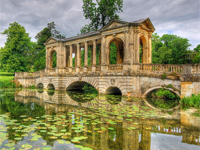
Bridge - Stowe House, Buckinghamshire (Image: Evoljo / flickr)
Bridge – Stowe House, Buckinghamshire (Image: Evoljo / flickr)

These principles were translated according to the whims and finances of owners across the country, leading from the sublime creations of Stowe, Stourhead and Studley Royal to many lesser known and private gardens.

The statuary could sometimes cause the odd drama. Dallam Towers, Cumbria was archly described by Pevsner as “…undoubtedly the finest Georgian facade in the county; but what the visitor may not realise is that, behind all the stucco, there’s the finest Queen Anne facade in the county.“. Between the facade and the landscape once stood (or perhaps still stands) a line of statues standing guard between the garden and the ha-ha. Yet this line is slightly marred by one of the statues being headless – the unfortunate outcome of a 1820s dinner which led to a very ‘well-refreshed’ Lord Milthorpe.  Thinking he had seen a poacher, he grabbed a rifle, and despite the protests of his guests, he duly dispatched the ‘poacher’/statue; a loss for the world of garden ornaments but perhaps a gain for the forces of law and order.

With such vast quantities of marble scattered out the gardens, occasionally a prized statue may slip slowly into obscurity. This can lead to discoveries in the same way that an Old Master may be found in the attic, so they can also be found in the shrubbery, such as this rare Chinese Ming tomb horse or the lucky owner of a castle somewhere in northern Europe who had a statue by the Renaissance sculptor Adriaen de Vries.

The tradition of sculpture in the gardens of country houses is certainly alive and well today and has developed beyond the more formal Roman statuary towards a decidedly more contemporary ethos – though perhaps more commercial than for simple pleasure.

'Huge Sudeley Bench' by Pablo Reinoso at Sudeley Castle (Image: Christies)
‘Huge Sudeley Bench’ by Pablo Reinoso at Sudeley Castle (Image: Christies)

At the beautiful Sudeley Castle in Gloucestershire, Christies are holding their selling exhibition of contemporary sculpture from luminaries such as Marcel Wanders, Marc Quinn and Pablo Reinoso.  Over in Sussex, the Cass Sculpture Foundation at Goodwood, hosts a regularly changing line-up with a focus on supporting emerging talent along with the more established artists such as Lynn Chadwick and Anish Kapoor.  One more recent venue is the Jupiter Artland at Bonnington House in Scotland, just outside Edinburgh.  The vision the Wilsons, who own the house, Jupiter Artland features large-scale works such as the monumental ‘Life Mounds’ by Charles Jencks’ who specialises in landscape art that I suspect would appeal to the likes of ‘Capability’ Brown if he were around today.

These are just some of the examples of contemporary schemes which are taking place across the country. Each is enlivening the grounds of a house and again maintaining that artistic thread which has been spun out over hundreds of years, linking country houses, an owners’ taste and some of the best art in the country.

————————————————————————–

More wonderful examples of works available outdoors can be seen in the Country Life Picture Library collection.

This blog post is a little off my usual patch so I’m grateful for the research of David Stuart in ‘Georgian Gardens

The Country House Revealed – Clandeboye, County Down

Clandeboye, County Down (Image: Paul Barker / Country Life Picture Library)

One of the great glories of the private incomes afforded to previous generations was the ability to indulge in their passions.  Given the opportunity, many of us would similarly be happy to devote our lives to our interests and, for some, in doing so they have created great collections – not just of art, but in the fields of anthropology, Egyptology, armour, botany…the range is endless.  In this week’s ‘The Country House Revealed‘, Dan Cruickshank visits Clandeboye in County Down, Northern Ireland; seat of a branch of the Guinness family, but also home to an impressive collection of artefacts.

Clandeboye (also sometimes known by the original name Ballyleidy) sits in a 2,000-acre estate in the heart of the Ulster countryside – a smart, elegantly Georgian seat; the design semi-Soanian (originally), part-the-owner (later additions).  The professional architect involved was a former pupil of Sir John Soane, Robert Woodgate, to whose designs the house was built in 1801-4.  Woodgate had a brief career, cut short by his early death in 1805, having joined Soane’s practice as an apprentice in 1788, before graduating in 1791 and then being sent to Ireland to Baronscourt, Co. Tyrone (note the triffid-like march of the wind turbines now marring the skyline!), to supervise the building Soane’s commission of a new house for the Marquess of Abercorn.

Clandeboye, for the 2nd Baron Dufferin, was one of Woodgate’s earliest commissions and is unusual, ignoring the more common ‘Palladian’ central block with flanking wings layout, of houses at the time.  At Clandeboye, whilst still Soanian in it’s style, the layout is focussed on two wings at right-angles to each other with the corner due south taking maximum advantage of both the setting and the sun.  All-in-all, a good, competent design by a well-trained young architect – though perhaps lacking some of the drama a more experienced architect might have brought to the plan.

What is particularly special about Clandeboye today is that it contains the remarkable and diverse collections of the wonderfully named Frederick Temple Hamilton-Temple-Blackwood, 5th Baron Dufferin and Claneboye (note the different spelling of the title).  A prominent politician and administrator, he served as Governor General of Canada  (1872-1879) and Viceroy of India (1884-1888).  The Lord Dufferin was also something of a radical social reformer and fell out with the PM, Gladstone, believing that the land ought to be owned by the farmers.  Not content with just arguing for this, he sold off much of the 18,000-acres the family had amassed, leaving the estate we see today.

Very well-educated, Lord Dufferin, as with many other wealthy Victorians, used the opportunities of his many diplomatic postings to acquire large quantities of objects – not just the usual art and furniture but curiosities from around the globe.  This led to a new programme of work in the mid-19th century to enlarge the house to display these prizes, resulting in a large west wing.  Dufferin had toyed for years with grand plans for the complete rebuilding of Clandeboye to a faux-Elizabethan nostalgic ideal.  After a few years, his tastes changed and he then sought out Benjamin Ferrey to provide a French-chateaux style house – but again this came to nothing.  In 1865, his preferences had ebbed back towards a more ‘romantic’ style and he began a long collaboration with William Henry Lynn, who then advised Dufferin on the alterations to Clandeboye which are what we see today.   One aspect of the process which probably infuriated Lynn was, as Harold Nicolson has described, that Lord Dufferin’s ‘passion for glass roofing was… uncontrolled‘, leading to the broad use of skylights.  Considering how Soane, and therefore probably Woodgate, sought to carefully manage the effects of light, this crude flooding of the interior spaces may not have met with approval from the original architect.

Today, the contents of the house can be seen as a snapshot of the passions and interests of a wealthy aristocrat at the height of the British Empire. Victorian Britain seemed to foment this type of collector with other houses similarly becoming self-indulgent museums – though often with a great intellectual rigour which helped drive forward our understanding of the world and science.

Quex Park, Kent (Image: ..george / flickr)

For example, Quex Park in Kent became the showcase of the Powell-Cotton family, who, over six generations, created a superb collection of natural history with specimens taken during Major Percy Horace Gordon Powell-Cotton’s expeditions to Africa,which has subsequently been expanded by later generations.  Another showcase was Goodrich Court (dem. 1950) which was designed by the owner Sir Samuel Rush Meyrick specifically to accommodate his world-renowned collection of arms and armour which forms an important part of the incredible Wallace Collection in London.

Didlington Hall, Norfolk - demolished 1950/52 (Image: Lost Heritage)

As at Clandeboye, Egypt has long held a fascination in Britain.  One early and noted collection was assembled by William Amherst Tyssen-Amherst (the 1st Baron Amherst) at Didlington Hall in Norfolk (dem. 1950/52).  By chance, Lord Amherst employed a Mr Samuel Carter, a well-known artist to paint at the house, and he would often bring his son, who spent many an hour in the extensive Egyptian museum in the house.  That son was Howard Carter who famously went on to discover Tutankhamun’s Mask with George Herbert, 5th Earl of Carnarvon.  Highclere Castle also holds a small but important collection of Egyptian antiquities amassed by the 5th Earl and which are now on display in a purpose-built gallery in the cellars of the house.

Waddesdon Manor, Buckinghamshire (Image: National Trust)

Perhaps the greatest example of a house built to show a collection is Wadddesdon Manor in Buckinghamshire; that slice of French architecture which enchantingly appears in the middle of the English countryside.  Funded by the vast Rothschild fortunes, the mansion, designed by Gabriel Hippolyte Destailleur, was built between 1874-1889 for Baron Ferdinand de Rothschild primarily to showcase what must easily be one of the finest collections of Dutch and English paintings and French art, tapestries and furniture.  Used only in the summer months for parties and entertaining this was the ultimate expression of the desire to use a private residence as a gallery – or was it merely a gallery with bedrooms?

So Clandeboye is part of a long and fine tradition of the wealthy owners of large houses not merely adding a scattering of objet d’art to show-off the taste of their interior decorators. These houses are true collections, in some cases museums, even monuments, to the eclectic passions of their owners.  The wide-ranging nature of these collections demonstrates one of the many benefits of single family ownership, such as at Clandeboye, where intellect and wealth can be combined over generations to create a rich and interesting tapestry that no public organisation would be likely to be imitate; and our nation would be all the poorer without it.

————————————————————————————–

Official website: ‘The Country House Revealed‘ [BBC2]

A wonderful interview (and slideshow) with the Countess of Dufferin and Ava: ‘The Marchioness‘ [wmagazine]

The Clandeboye estate: official website / history [clandeboye.co.uk]