Greeks bearing gifts: Nicholas Revett, Trafalgar Park and the Origins of UK Neo-Classicism

William Blake poetically argued that it was possible to ‘To see a World in a Grain of Sand’; in the miniature is a reflection of something much greater.  With that in mind, to look upon the manifest beauties of a house such as Trafalgar Park in Wiltshire, it could seem strange to argue that one of the most important aspects of it is, in fact, a small hallway in the north wing. Yet, this hallway is one of the earliest architectural examples which form the genesis of neo-classicism; one of the most recognisable and prolific architectural styles which has proved to be enduringly influential in the design of country houses and also has come to dominate civic architecture.

Trafalgar Park, Wiltshire (Image © Savills)

Neo-classical architecture permeates our built environment; banks, council and government buildings, and particularly country houses.  Drawing on the ancient monuments of Greece, the structured, hierarchical designs provided a convenient vocabulary that institutions, the state, and individuals could use to express their permanence and place in the natural order of society. Of course, this is the interpretation and not an objective set of laws but neo-classicism’s rationalist perspective, with its reliance on mathematical rigour, gave the impression that architecture and society both shared an underlying harmony in their precision and structure.

The Classical language of architecture had arrived in England through the widely admired and imitated Vitruvian principles as interpreted in Andrea Palladio’s I quattro libri dell’architettura. Inigo Jones had adopted this language and had created the foothold for the new style with his the Queen’s House in Greenwich (1616) and Banqueting House in Westminster (1619). However, his sources were Italian; the great monuments of Rome as measured and shown by Palladio. For some, though, this was derivative as the earliest Classical monuments were in Greece.

It ought to remembered that the fashion for the neo-classical was one which swept across Europe, not just the UK. As a rejection of the seemingly frivolous Rococo movement, it sought to instil a more high-minded set of ideals across the arts. To do this, writers such as Johann Joachim Winckelmann (regarded as one of the fathers of neo-classicism), stated that ‘The only way to become great is to imitate antiquity’. This required no mere slavish copying but a profound understanding obtained through study which enabled principled use of the Classical architectural language. Books such as Piranesi’s Le Antiquita Romane, a series of topographical views of Rome published in 1748, determined to prove the glory of Rome. However, others such as Richard Dalton (Museum Graecum et Aegyticum, 1751), le Comte de Caylus (Recueil d’Antiquities Eygyptiennes, Etrusques, Grecques et Romaines, 1752) and Julien David Le Roy (Les Ruines des plus beaux monuments de la Grece, 1758) argued for the superiority of the Hellenic originals.

Les Ruines des plus beaux monuments de la Grece (1758) - J.D. Le Roy
‘Ruines d’un Portique Dorique’ from Les Ruines des plus beaux monuments de la Grece (1758) – J.D. Le Roy

If true knowledge of Classical architecture required detailed study the options were limited unless fortunate enough to be able to undertake the arduous and expensive Grand Tour. The Society of Dilettanti, formed in the 1730s as a scholarly drinking club for aristocrats and others who had visited Italy, deliberately sought to influence fashion by sponsoring a more rigorous approach to the recording of the ancient ruins. Scholars had realised the value and fame which could be garnered from publishing books on the ruins they had visited but these were often the Roman versions of the Grecian originals and were often more decorative than accurate delineations.

Antiquities of Athens (Vol I) - James Stuart and Nicholas Revett (1762)
Antiquities of Athens (Vol I) – James Stuart and Nicholas Revett (1762)

In contrast, the most successful and influential of these publications was Antiquities of Athens by James ‘Athenian’ Stuart and Nicholas Revett, published in three folios in 1762, 1787 and 1794. Sponsored by the Society of Dilettanti, their approach produced detailed, measured architectural drawings from which other architects could accurately reproduce Grecian details. Stuart and Revett were both better known as connoisseurs of painting rather than as architects, but having lived in Rome for ten years prior to their departure in 1751 for Athens, they had a thorough knowledge of Roman artefacts.  This was crucial in establishing the authority of Antiquities of Athens when the first folio was published in 1762.

James Stuart (1713-1788) became known as James ‘Athenian’ Stuart on the reputation he established. He originally started his artistic career as a painter of fans and he was to continue with this work even after becoming an architect – the large allegorical ceiling painting in the tapestry room at Hagley Hall, painted in 1758-59, is one notable example. However, having established his fame, his drinking and erratic work habits meant that although he had a steady stream of work, patrons were sometimes reluctant to commission him, leaving his reputation somewhat diminished.  This is in contrast to his early years when having arrived in Rome in 1742, he established himself as judge of pictures, acting as a guide to aristocrats on their Grand Tour. In this manner he met Revett when he accompanied him, along with Matthew Brettingham and Gavin Hamilton, to Naples in 1748. That same year, he and Revett drafted their first Proposals for publishing an Accurate Description of the Antiquities of Athens, which, once accepted by the Society who became their sponsors, enabled them to undertake their investigation.

Nicholas Revett (1721-1804) was the second son of minor Suffolk gentry, his father being John Revett of Brandeston Hall. At the age of 21, Nicholas left Suffolk and moved to Rome to study under Marco Benefial, an important early neo-classical painter. It’s unclear where Revett was tutored in the precise skill of architectural drawing but clearly as a man of some talent and training he was undoubtedly proficient and it was he, not Stuart, who was principally responsible for the measured drawings of the monuments. According to one account in the Gentleman’s Magazine of March 1778 ‘Mr Stuart first caught the ideas of that science, in which (quitting the painter’s art) he afterwards made so conspicuous a figure.’  So why is the pupil known better than the master?

One of the key reasons is that although Revett’s name appeared on the title page, before publication he had sold his interest to Stuart after editorial differences.  Secondly, Revett, as a gentleman with a private income, wasn’t under the same financial pressure to practice and so his executed architectural commissions are scarce, primarily working for his friends. One such in his circle was Henry Dawkins; owner of Standlynch, later renamed Trafalgar Park.

Portico (added in 1766), Trafalgar Park, designed by Nicholas Revett (Image © Matthew Beckett)

This commission, in 1766, was limited but Revett drew on his knowledge and the rich seam of material he had accumulated to produce a fine portico, based on the Temple of Apollo, Delos. Revett’s skill was in being able to take the elements of the temple and extend it to create a sophisticated composition. In addition to this, Revett was tasked with creating a vestibule at the junction of the north wing.  Within this limited space, Revett chose to create a miniature six-column temple apparently based on the Establishment of the Poseidoniasts, also at Delos, representing one of the (and possibly the) earliest interior use of Greek neo-classical architectural features.
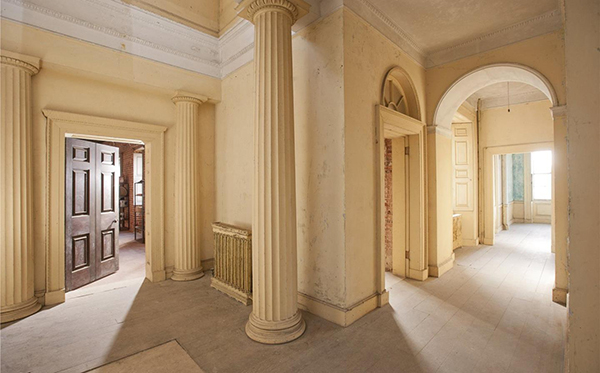
North Vestibule, Trafalgar Park, Wiltshire (Image © Savills)
North Vestibule , Trafalgar Park, Wiltshire (Image © Savills)
Detail of Trafalgar Park floorplan showing north vestibule layout (Image © Savills)

Revett contributed few other architectural examples, working mainly for friends such as Dawkins at Standlynch. Other commissions including adding a grand Ionic portico to the west front of West Wycombe Park, Buckinghamshire, for Sir Francis Dashwood in 1771, and later the Temple of Flora and the Island Temple between 1778-80.  Revett’s only other notable contribution is the church at Ayot St Lawrence, Hertfordshire, for Sir Lionel Lyde in 1778, which he designed as a temple with small, detached wings, linked with a columnar screen. James Lees-Milne thoroughly disliked it saying ‘It is stark, cold and foreign to its surroundings, in fact admittedly unsympathetic to its ostensible purpose as a christian conventicle in a small and humble parish. Quite frankly it was meant to be enjoyed as an ornamental temple of a nobleman’s park in a focal view from the mansion.’ Which is correct – and probably exactly what Revett had intended.

So if Revett has the garland for earliest neo-classical interior, who can claim the earliest exterior use? Although Antiquities of Athens was published in 1762, the drawings were at the disposal of Stuart and Revett.  The earliest Greek revival building is agreed to be the garden temple at Hagley Hall, built for Lord Lyttelton in 1758-59, which Stuart designed was based on The Hephaisteion in Athens. However, in 1985, Giles Worsley identified the earliest use of a Greek architectural element in a building as being two years earlier in 1756 when Earl Harcourt, a prominent member of the Society of Dilettanti, was rebuilding Nuneham House, Oxfordshire. Although the architect of the house is noted as Stiff Leadbetter, Lord Harcourt asserted such influence that the house can be regarded as more by the former than the latter.  Writing to a friend he stated that,

I have not placed my Venetian windows under an arch. Instead of springing the arch or compass point of the Venetian window from the cornish as other people have done, I have boldly adventured to follow a design of an old building which I have seen among Mr Stuart’s drawings of Athens, where the arch or circular part springs from the architrave itself, which, besides having a very good effect, obviates an objection which upon some occasions had been made to Venetian windows, that the light is too high in the room.

Harcourt’s inspiration for his variation on the standard Venetian window was Stuart’s drawing of the Aqueduct of Hadrian, a structure largely ruined when he visited and demolished by the end of that century. Stuart would go on to use this form of the window at only three other houses; once at The Belvedere, Kent, c.1775, once at the Prospect House, Wimpole, Cambridgeshire, c.1775, and once at Montagu House, London, c.1775-82, though unfortunately all these have now been demolished.

(left) Aqueduct of Hadrian from Antiquities of Athens (1794) (Image source: Aikaterini Laskaridis Foundation Library) | (right) Nuneham House, Oxfordshire (1754) (Image © Isisbridge on flickr)

The 1750s and 1760s saw the idea of architecture drawn from classical sources, whether Greek or Roman, become more widespread.  The birth of Greek neo-classicism in the UK can, in part, be traced to these examples and the men behind them, the wider adoption of this stylistic source was relatively slow. Neither Stuart nor Revett appeared to wish to be the figureheads for a new fashion, simply content to work as much as they wished, with Stuart taking more but his delivery tempered by his dissolute habits. Different strands of neo-classicism were being picked up by more ambitious architects such as Robert Adam, who had undertaken his own Grand Tour to Italy and Croatia and whose publication in 1764 of the Ruins of the Palace of the Emporer Diocletian at Spalatro gave his a scholarly foundation from which to launch his own style of neo-classicism which soon supplanted the previous Burlingtonian standard.

The overlooked North Vestibule at Trafalgar Park represents the quiet experimentation which was to plant seeds of the Hellenic neo-classical movement. This would find its true expression in the late-Georgian era when evangelists such as Thomas Hope would create a resurgence in interest and further burnish the reputations of both Stuart and Revett; men whose unequal fame has obscured the contribution which Revett made in enabling architects, regardless of experience or first-hand exposure, to all claim antiquity as their source.


Sales particulars: Trafalgar Park, Wiltshire – 33 acres, £12m (Savills.com)

Introduction to neo-classicism: ‘Style Guide: Neo-classicism‘ [V&A Museum]

‘On behalf of a grateful nation’: country houses given to military leaders

Nations have always found ways to reward those subjects who have rendered some greater or lesser service.  In earlier centuries, this often took the form of positions at Court which came with a salary, prestige, and unrivalled opportunities to feather one’s nest.  Titles have also always been popular, ranging from a baronetcy for those who have hosted the monarch for a weekend, to dukedoms and earldoms for the upper echelons of Court and on the battlefield – and it’s this latter category who have also enjoyed that rare gift of an entire country estate, in recognition of their services.  Such largesse is now unthinkable but the practice of rewarding military leaders in this way only fell from favour perhaps later than might be imagined.

Blenheim Palace, Oxfordshire (Image: Blenheim Palace via flickr)

The grandest and most spectacular of these gifts is Blenheim Palace in Oxfordshire – though the intrigues for both monarch, recipient, recipient’s wife, and architect make it something of a mixed blessing.  The recipient was certainly worthy of such a grand prize; John Churchill, 1st Duke of Marlborough had risen through numerous victories to elevate and secure Britain’s place in the world, defeated the ambitions of various European leaders, and created the peace which ushered in the Georgian era.  These glorious victories provoked such a feeling of patriotic pride that even his critics praised him.  So how to reward such a man for such remarkable achievements?

Great Hall and Eastern Corridor, Blenheim Palace (Image: Country Life Picture Library)

Blenheim Palace was to represent many things – explicitly a national monument to the defeat of Louis XIV’s plans for European domination at the Battle of Blindheim in 1704, the considerations of it as a house were somewhat secondary. It embodied the idea that whereas previously the glory of the nation was demonstrated through the palaces of the Monarchy, Blenheim was the first which sought to do this though a private individual.  However, Marlborough’s close ties with Queen Anne would inevitably mean the prestige would reflect onto her and the nation. Work started in 1705 and, writing in 1709, the architect of the house, Sir John Vanbrugh stated,

‘Tho’ ordered to be a Dwelling house for the Duke of Marlborough and his posterity [it was] at the same time by all the world esteemed and looked on as a publick edifice, raised for a Monument of the Queen’s glory.’

The Queen had already resolved to gift the estate at Woodstock but the agreement on paying for the construction of the house was a murkier affair.  Royal patronage could cut both ways as the Marlboroughs and Vanbrugh found out.

Vanbrugh was the ideal choice for a building of this nature.  His background in theatre design gave him an understanding of dramatic effect and his relative inexperience and lack of formal training meant his imagination was bolder than others.  The commission at Blenheim required such a mind; the resulting spectacular building was a monument to power and prestige, incorporating military forms and details to reflect the occasion, but was also one of the most complete expressions of English Baroque.  Yet despite his fabulous wealth, the Duke was determined that the state would show its gratitude by paying for the construction, though he had originally intended the budget to be no more than £40,000 (approx £5m).  Wren had estimated £90,000 – £100,000, however the final cost totalled nearly £300,000 (approx £38m) for which the Treasury eventually was liable (proving that for government projects it was ever thus!).

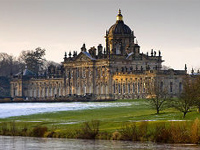
Castle Howard, Yorkshire (Image: Castle Howard)

Such overruns were to be expected where the intention had been to build something like Castle Howard – only bigger. However, the Duchess opposed such a scheme saying: ‘I never liked any building so much for the show and vanity, as for its usefulness and convenience.‘ With such an attitude, friction with Vanbrugh was inevitable. Political changes hadn’t helped; a new government and Treasurer in 1710 slowed payments to almost nothing.  In 1711, the Duchess also fell out quite acrimoniously with her childhood friend, the Queen, leading, in part, to the Duke losing his official posts and the Marlborough’s going into self-imposed exile.  The accession of George I in 1714 brought them back into favour and work progressed again, though constant conflict between the Duchess and Vanbrugh led to his resignation in November 1716, saying: “You have your end Madam, for I will never trouble you more.  Unless the Duke of Marlborough recovers so far [he had suffered a stroke in 1716], to shelter me from such intolerable Treatment.‘ Work proceeded under Vanbrugh’s right-hand man, Nicholas Hawksmoor, to the original plans, with the family taking up residence in 1719, and work largely complete by 1725. Sadly though, the Duke never got to see this, having died in 1722; his monument incomplete, his reputation assailed, and his architect grievously estranged from his masterpiece.

It seems only some of the lessons of Blenheim had been remembered by the time the next gift was proposed for an equally illustrious general, Arthur Wellesley, 1st Duke of Wellington.  Again, a superb leader who had defeated plans for European domination, Wellington – the Iron Duke – was certainly worthy of such a reward. Rather than receiving a direct gift from the monarch, it was decided that the nation would provide £600,000 (approx £38m) for the purchase of an estate and the building of a suitable house. Rather than just provide the money, in 1817, Parliamentary trustees were appointed to oversee the purchase.  The Duke knew his limitations and called upon the architect Benjamin Dean Wyatt (son of James Wyatt) who promptly, even before a site had been found, drew up plans for a ‘Waterloo Palace’ which, in his words, would have “…a very magnificent & imposing effect” without “the monstrous expense of a Fabrick extended to the dimensions of Blenheim [or] Castle Howard“.  Despite his professed aim, this would have been an enormous house; designed around three sides of a courtyard, it featured two flanking pavilions, with the main house centred on a huge domed hall, with suites of grand rooms surrounding it.  Perhaps of particular interest was the severely Neo-Classical decoration, with few of the architectural flourishes which distinguish Blenheim.  This might have reflected the notably austere Duke’s taste but even this plan was rejected.

Stratfield Saye, Hampshire (Image: Historic Houses Association)

Given the Duke’s preference to be near London, the house and estate chosen was Stratfield Saye in Hampshire, after rejecting Uppark in Sussex due to the poor land, and was bought from the Pitt family for £263,000; a significant portion of the funds available. Though this may have been a factor in the eventual rejection of the plans in 1817, another was that the Duke was in the process of spending £40,000 anonymously purchasing Apsley House in London, for the use of his almost bankrupt brother who had previously lived there with his soon-to-be-ex wife.  That house also required significant work and, faced with the need to maintain two houses, the Duke abandoned the plans for the new palace, and concentrated on updating and modernising the existing house at Stratfield Saye.  Both houses are still lived in by the Wellesley family, though Apsley is now part-owned by English Heritage and open to the public – and absolutely worth a visit if in London.

Bemersyde House, Scotland (Image: Kevin Rae / Geograph)

We may think the practice of the nation buying a country seat for a military leader was the product of the more deferential Georgian and Victorian eras when such actions by government would be less subject to widespread scrutiny, but the latest example occurred in the 1920s.   Field Marshal Douglas Haig, 1st Earl Haig, was a controversial figure as commander of British forces in WWI. Although he won, the horrendous loss of life left him with battered reputation which has only recently been revised. In the immediate aftermath of WWI, we, the victors, did feel grateful and Haig was created the 1st Earl Haig (with a subsidiary viscountcy and a subsidiary barony), given the thanks of both Houses of Parliament, plus £100,000 (though he had asked for £250,000) to enable him to live in the manner befitting a senior peer.  Haig chose Bemersyde House in the Scottish Borders, originally built in 1535 as a pele tower, to become, as it still is, the seat of the Haig family, the purchase funded by the grateful taxpayer.

Cefntilla Court, Monmouthshire (Image: Knight Frank)

It wasn’t only the ultimate leaders who could benefit from public largesse, though in the case of Cefntilla Court, Wales, the gift missed the mark by a generation.  Field Marshal FitzRoy James Henry Somerset, 1st Baron Raglan, was the Duke of Wellington’s right-hand man who was later blamed (then exonerated) for the huge losses resulting from the ill-fated Charge of the Light Brigade in the Crimean War.  Lord Raglan’s health suffered from the stress of the campaign and he died whilst on duty in June 1855.  However, such was the admiration for the man that a ‘Raglan Memorial Committee’ was formed and by 1858 was able to present Cefntilla Court, as commemorated by a plaque at the house which reads:

This house with 238 acres of land was purchased by 1623 of the friends, admirers and comrades in arms of the late Field Marshal Lord Raglan GCB and presented by them to his son and his heirs for ever in a lasting memorial of affectionate regard and respect.

Sadly, it seems that ‘for ever’ is a shorter time than they imagined as the house and estate are now for sale following a strange inheritance whereby the 5th Lord Raglan wrote his younger brother, now the 6th Lord Raglan, and the brother’s son, out of his will.  The house was instead left to another nephew, Henry van Moyland, who currently lives in Los Angeles and works as a recruitment consultant. With no deep ties to the estate, he has chosen to sell, splitting the title and estate for the first time since the gift was bestowed.  Legally, there is nothing to be done but it does seem regrettable that the whim of one Lord Raglan should lead to such an outcome, especially as it was the express intention of the donors that it should remain in the family.

That said, it is remarkable that three out of the four houses featured here are still owned by the families who were given them – a continuous link to the thanks of the nation as expressed through architecture and prestige. Though it may not happen now, or again in the future, such gifts are another part of the rich tapestry of our country house history.

——————————————————————–

Sales particulars: ‘Cefntilla Court‘ [£2m, 350-acres – Knight Frank]

More details: ‘The disinheritance of Lord Raglan’s nephew and future title holder causes split in family‘ [Wales Online]

The most expensive UK country house: Park Place, Oxfordshire

A new record price for a UK country house has just been achieved with the sale of Park Place, near Henley-on-Thames, in Oxfordshire.  One of three most notable estates on that stretch of the Thames, it was also the most expensive country house ever sold in its unrestored state in 2007.  Now, after five years and many millions of pounds, the house again has set the record having been sold to an unknown Russian billionaire for £140m.

'A view of Park Place, Henley' - artist unknown - c.1742-3 (Image: Royal Collection) - click to see full image

Park Place is, at its core, a more modest Georgian house built in 1719 for Lord Archibald Hamilton, son of the Duke of Hamilton.  The proximity to London and the beautiful setting has long attracted the wealthy to the area as a convenient escape from the city, with several riverside estates featuring a series of impressive houses.  Starting at Marlow, the first house is Bisham Abbey (now the national sports centre), then the now lost Temple House (dem. 1910), Harleyford Manor (beautiful small villa restored in 1989), Whittington House [pdf] (rebuilt by Reginald Blomfield c1897, now HQ of SAS Ltd), Danesfield House (now a hotel), Medmenham Abbey (now two houses), Culham Court (sold for £38m in 2006), Greenlands (now Henley Management College), Fawley Court (sold for £13m in 2008, possibly for conversion back to a private house), and then finally, just past Henley, lies Park Place.  Of particular interest are the architectural similarities between Fawley Court (built 1684 – reputedly to a design by Sir Christopher Wren), the original Park Place (built c1718), Culham Court (built 1771), and Reginal Blomfield’s 1897 rebuilding of Whittington House, all of which are on based on a red-brick 5- or 7-bay, two storey villa with bulls-eye window inserted into a projecting pediment.

Park Place, Henley - c1810 (Image: Thames Pilot) - click for the full image

Sadly, Park Place is no longer part of this architectural brethren having undergone a series of substantial changes.  The house was sold by Lord Hamilton in 1738 to Prince Frederick, then Prince of Wales and eldest son of King George II, who split his time between there and Cliveden. After Frederick’s death, the house was then bought by General Henry Seymour Conway in 1752 and it was he who made the first significant changes both to the house (including a library by Sanderson Miller in 1757) and, perhaps more importantly to the grounds, which are now grade-II*. His works, to designs by Thomas Pitt, 1st Baron Camelford, included the installation of an ancient stone henge given as a gift from the people of Jersey where he was Governor, the lightning-damaged steeple from St Bride’s Church as an obelisk, four more obelisks as gateposts, an underground cavern, and a bridge, using stones from Reading Abbey, which was subsequently admired by Horace Walpole.  There was also an artificial classical ruin designed by James ‘Athenian’ Stuart.

Park Place, Oxfordshire - c.1900 (Image: henleyonthames.org)

The house was sold to John Noble in 1871 but was largely gutted by fire a year later, giving Noble the opportunity to indulge something of an architectural whim.  The pattern and style of the Victorian country house was much admired around Europe and our expertise was exported widely around the continent – but it rarely flowed back (a topic already covered in an earlier post ‘The rise and fall of French taste on UK country houses‘).  Park Place is one of the few houses in the country build using the French Renaissance style, creating an impressive château in the heart of England.

The design of the rebuilt house is widely attributed to Thomas Cundy [III], the son and grandson of two previous Thomas’ who had also been country house architects. Although the latter two are given sizeable entries in Howard Colvin’s ‘Biographical Dictionary of British Architects‘, the grandson is given only a paragraph as part of his father’s, leaving us somewhat in the dark as to what, bar some London churches, he may have been involved with. However, considering his father had good form with the chateau style having built Grosvenor Gardens in London, so Thomas III would have been schooled in the style before his father’s death in 1867.

The house remained with the Noble family until 1947 when it and the 670-acre estate was parcelled up into 22 lots and sold off.  The main house was bought by Middlesex County Council who converted it into a special school, which it remained until 1988 when it closed. The house was then bought by John Latsis, the Greek shipping tycoon, but it seems unlikely that he lived there as it remained unrestored, with the vestiges of the school – gymnasium, classrooms, a woodwork studio etc – all still in situ, along with various outbuildings, as can be seen from these images of the house.

Those who had a chance to look around the house when it was for sale in 2006 all noted that beneath the shabby institutional veneer, the potential of the house was clear; glimpses of fine tiles, the original stone fireplaces, stained glass, and grand spaces with impressive views.  The house was then sold to a consortium who intended to create a superior country club – until Wokingham council said ‘no’.  Put on the market for £45m, it was finally sold for £42m to Mike Spink, a property developer who specialised in high-end houses in central London. With this experience, Spink transformed this once dilapidated house into a palace fit for a billionaire with all the requisite features such as a helipad, swimming pool, panic room etc.  Somewhat disappointingly, the house now only comes with 200-acres, with the remaining 300 with which it was sold retained by Spink for as yet unspecified ‘development’ – a phrase which will no doubt spark local concerns.

Even when it was first sold, those in the property business were predicting that Park Place would sell for possibly up to £100m, and the rising ‘super prime’ market has proven even those estimates conservative.  Sadly, this record is not for a spectacular historic house at the centre of a large estate but instead one where the location (location, location!) has elevated the price to such a stratospheric level. Nevertheless, many country houses were built as retreats for wealthy industrialists and financiers and this house is proof that the lure of the trophy country estate is as strong as ever – which can only be a good thing for those seeking to prove their desirability in modern times.

———————————————————————–

Story about the original sale: ‘Sold for £42m… still in need of renovation‘ [Daily Telegraph]

Latest sale: ‘Park Place: Britain’s most expensive home sold for record £140m‘ [Daily Telegraph]

The Royal country house honeymoon

So the happy Royal couple, our new Duke and Duchess of Cambridge, have taken just the long weekend for their honeymoon leaving an interesting question as to whether they are breaking with the tradition of spending their first days of marriage in an British country house?  With the twin demands of luxury and privacy, the country houses of the UK have often proved particularly attractive, though Royal palaces even more so.

Hampton Court Palace, Surrey (Image: Gail Johnson / flickr)

In an earlier age, the Royal family would often simply use one of their own palaces as a convenient venue.  Already secure and well-established for the great demands of catering and supporting a King or Queen, they had a natural advantage.  One often used has been Hampton Court Palace, in Surrey, one of the finest Royal residences ever built and a worthy equal to the splendour of Versailles.  Construction started in 1514 by Thomas Wolsey, an Archbishop of York, who built a palace which rivalled any that King Henry VIII then possessed.  With over a 1,000 rooms and accommodation for 280 guests, Wolsey wisely answered, when asked by the King in 1526 why he had built such a magnificent house, “To show how noble a palace a subject may offer to his sovereign.”

Having now taken ownership, Henry then embarked on his own ambitious programme, adding a third courtyard and stamping his mark on all aspects of the palace. It was in this sprawling residence which he enjoyed at least two of his honeymoons; with Jane Seymour, his third wife, in 1537, and with Kathryn Howard, his sixth, who he married at Hampton Court in 1543.  Due to his unhappiness with the looks of his fourth wife, Anne of Cleves, and the very short marriage (Jan-July 1540), it seems unlikely that he would have made any significant arrangements and so possibly used Hampton Court as his most convenient palace near London.

Henry VIII’s daughter, Mary I, also spent her honeymoon with Philip I at Hampton Court  in 1544. It was used again by King James I on his marriage to Henrietta Maria in 1625 and then by Charles II and Katherine of Braganza in 1662.

Rycote Park (Palace), Oxfordshire (Image: Thame History)

Henry VIII obviously had several opportunities to honeymoon, though his first was more a working tour as, following his marriage to Catherine of Aragon in 1501, he was sent to Ludlow Castle to preside over the Council of Wales and the Marches. His second, with Anne Boleyn in 1533, was at Shurland Hall, Isle of Sheppey in Kent, which has recently become the 70th building to be rescued by The Spitalfields Trust (and which is currently for sale).  His honeymoon with Catherine Howard, his fifth wife, in 1540, was spent at Rycote Park, in Oxfordshire. It’s not entirely clear who originally built this Tudor mansion but it certainly of a status to attract the Royal couple.  The house suffered a devastating fire in 1745, but was rebuilt before being emptied in a contents sale in 1779, and then sold for materials in 1807.

The tradition of the Royal family using their own houses has largely continued, though in more recent times they have also used suitable private houses as the retinues required have shrunk making it unnecessary to require a palace.

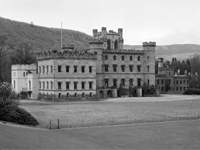
Taymouth Castle, Scotland (Image: RCAHMS)
Taymouth Castle, Scotland (Image: RCAHMS) - click for more images of interior

Queen Victoria and HRH Prince Albert enjoyed only a mini-honeymoon of three days in 1840, which was spent at Windsor Castle. The Queen, unwilling to ignore her duties and responsibilities as monarch which require frequent contact with her ministers, wished to stay close to London – even if her husband might have preferred a quieter break further away.  They did take a belated honeymoon in 1842 to Scotland where they stayed at the impressive Taymouth Castle, seat of the Marquesses of Breadalbane, owners of one of the largest estates covering 450,000-acres, which took over 40 years to build and had only recently been completed but to standard above almost any other seat in Scotland.  Designed by James Gillespie Graham, it was a convalescence home in WWII and a school but is currently unused whilst negotiations continue about turning it into a ‘seven star’ hotel.

Polesden Lacey, Surrey (Image: Matthew Beckett)

In the early part of the 20th-century, King George VI and his new bride, later the Queen Mother, stayed in 1923 with the remarkable society hostess, Mrs Ronald Greville, at her country retreat Polesden Lacey in Surrey (now National Trust).  An accomplished hostess, Mrs Greville and her staff were well used to catering for the cream of society.  Once home to Richard Brinsley Sheridan, after his death it was largely demolished and rebuilt by Thomas Cubitt in 1821 as, essentially, a neo-classical seaside villa.  After being bought by the Grevilles in 1906, she employed Mewes and Davis, architects of the Ritz, to remodel the interior.  The new opulence was matched by with an equal measure of intimacy, with rooms flowing between each other and the outside to create a fluid social space lined with portraits by Lely, Raeburn and Reynolds and cabinets full of Meissen china – a perfect venue for a Royal honeymoon.  Continuing the tradition started by Queen Victoria, they also spent time in Scotland at Glamis Castle, ancestral home of the Earls of Strathmore, and that of the future Queen Mother.

Balmoral Castle, Scotland (Image: Stuart Yeates / flickr)

On her marriage in 1947, our current monarch, Her Majesty Queen Elizabeth II, continued this practice and stayed at Broadlands in Hampshire, one of the best mid-sized Georgian houses, which largely appears to day as it was when it was finished in 1766. Elizabeth II also stayed at the family’s Scottish estates at Balmoral Castle and Birkhall, which were also destinations for the Prince and Princess of Wales in 1981 along with Birkhall which also used by Prince Edward and Sophie Wessex in 1999 and by the Prince of Wales and Camilla in 2005.

Alternatively, if they do wish to go abroad, they have the examples of the Duke and Duchess of Windsor who, in 1937, who spent three months at Castle Wasserloenburg in Austria, or Princess Anne who, in 1973, chose to spend her honeymoon cruising in the West Indies.  So, seeking peace and security, perhaps we’ll see the Duke and Duchess of Cambridge take a short break in a smaller country house before spending time in Scotland – or perhaps jetting off, but either way is in keeping with a long history of Royal honeymoons.

For sale: ‘Shurland Hall, Kent‘ [Jackson-Stops & Staff]

Thanks to Andrew for his help.

The price of progress: country houses and the High Speed 2 rail project

One of the sadly almost inevitable side-effects of urban and industrial growth is the loss of more of our countryside. Sometimes it can be on a smaller scale for residential developments and industrial units but occasionally society’s plans are much grander and require a greater sacrifice. This has been shown with the publication of the latest proposed route for the new High Speed 2 rail project to provide a fast link between London and Birmingham.  In previous generations, landowners could influence the path of developments such as roads or canals to their benefit but as their power has diminished so routes of these developments can now threaten the settings of our country houses.

The High Speed 2 railway is aiming to dramatically reduce the need for internal domestic flights in the UK by linking London to, first, the West Midlands, followed by Leeds and Manchester.  The plan has always been controversial, requiring the loss of hundreds of homes in the urban areas around the terminals and also a significant loss of farmland.  Following an initial proposal, the latest route was announced to the House of Commons on 20 December 2010 which reflected some concerns about the initial proposal.  However, 13 of the 30 sections (yes, I have been through all of them!) contain a number of country houses and manors which will still be significantly affected by the plans.

Edgcote House, Northamptonshire (Image: Bacab)

One bit of good news is that fears over the proximity of the link to the wonderfully elegant West Wycombe Park (raised in a blog post in Oct 2009) have been alleviated as the new route is further away.  However, another significant house will still be badly affected; the Georgian, grade-I listed, Edgcote House, Northamptonshire.  The proposed route now slices through the remarkably unlisted grounds with the line passing just to the east of the ornamental lake which forms one of the main axial views from the house.  Edgcote was built between 1747-1752 for London merchant Richard Chauncey by architect William Jones and featured as ‘Netherfield’ in the 1995 TV adaptation of ‘Pride and Prejudice’.  The house and grounds form the centrepiece to a 1,700-acre estate which was bought for £30m in 2005. Interestingly, this value has not deterred the planners (who moved the line from the original position cutting across the lake) so it will be interesting to see if the owner submits a claim a for ‘statutory blight‘ [.pdf]. This gives the Secretary of State the option to buy the property at the current market value if the owner can show that they have been unable to sell due to the Government proposals, or only at a substantially lower value.

Hartwell House, Buckinghamshire (Image: Giano via Wikipedia)

Amendments have also been made to protect another significant property; Hartwell House in Buckinghamshire.  A grade-I listed house, now run as a hotel, it was built in the early 17th-century for the Hampden family but was later let to the exiled King Louis XVIII of France who lived there between 1809-14.  Originally Jacobean, it was substantially enlarged and ‘Georgianised’ between 1759 and 1761 by the architect Henry Keene.  Again, following initial concerns, the route has now been moved further away from the house so that it would not be visible and will benefit from extra earth works and planting to reduce the noise.

Stoneleigh Abbey, Warwickshire (Image: PinkyVicki via Flickr)

Another grade-I house which would have been worse affected if it hadn’t been blighted already is Stoneleigh Abbey in Warwickshire.  This imposing house, now converted into apartments, is part medieval, part Georgian designed by the talented Francis Smith of Warwick, exists in a seriously compromised setting with the Stoneleigh Park exhibition and conference venue built in one half of the immediate parkland.  The proposed line will not only cut through the conference venue but also forever separate the house from the northern edge of the original park – though the massive scale of development already means this was never a house which was going to be returned to splendid isolation.

Another compromised house is Swinfen Hall in Staffordshire where the train will pass in front but quite some distance away.  The house itself, a beautiful Baroque-style Georgian mansion was built in 1757 to a design by Benjamin Wyatt and remained the home of the Swinfen family for nearly 200 years.  After the death of the last Swinfen in 1948 the land was sold and later a huge youth detention centre built to the immediate north-west with the house being left to deteriorate until it was converted into a hotel in the 1980s.  Having a railway line in the middle distance is the least of the concerns for the setting of this house.

Waddesdon Manor, Buckinghamshire (Image: National Trust)

Despite the vocal complaints of Lord Rothschild it seems that the route will be quite far from their old family seat of Waddesdon Manor.  However, Rothschild has become one of the leading opponents of the scheme – along with 16 other Conservative MPs whose constituencies will be affected.

With the rail route cutting across the countryside it was unavoidable that it would pass near to country houses, ironically which, of course, were often built to get away from the industrial blight.  Other houses which now lie close to the proposed route include:

  • The Vache (image), Buckinghamshire
  • Pollard Park House – a 1903 house built to a Lutyens design.
  • Classical Shardeloes, built between 1758-66 for William Drake MP by the architect Stiff Leadbetter would also suffer from the high speed line cutting across the main view from the house.
  • Grade-II* Doddershall House would be within a couple of hundred metres of the line on which up to 18 trains per hour are expected to rush past at speeds of up to 400kph.
  • Chetwode Manor
  • Oatley’s Hall
  • Berkswell Hall, Warwickshire – a grade-II* listed house now converted into apartments
  • Coleshill Manor, Birmingham – now offices and already suffering from being surround by motorways, the house will now have the line within metres, also necessitating the demolition of a new office complex next door.

The route also cuts across the old estate of the now demolished Hints Hall in Staffordshire – an elegant two-storey Georgian mansion with giant pilasters to enliven the facade.  It’s unlikely that if the house had survived it would have prevented the proposed route but again, without the house, an estate becomes even more vulnerable.

These are just the houses affected by the first 120 miles of the proposed 355 mile scheme.  If successful, we can expect more houses to be blighted as the route carves through the Midlands and up into Lancashire, shattering the peace and quiet that were the original reasons for the creation of these refuges from the industrial reality of the cities.  Although progress can often bring benefits, in this case the price is being paid by our country houses as their parklands and estates are judged the path of least resistance.


More information: High Speed 2 [wikipedia]