#Repton200: Humphry Repton, landscape gardener – and architect?

Although principally known as a ‘landscape gardener’ – a job title he invented even if the role was already well-defined – Humphry Repton was clearly a man who understood that an estate was a composition of many parts and that architecture had a vital role to play in the success of his schemes. The challenge in assessing Repton’s contribution to architecture is that of his collaborations; what sprang from his inventive and knowledgeable mind, and what came from those he worked with, including his sons, John and George, and also that leading proponent of the Picturesque, John Nash.

Detail from Humphry Repton by Henry Bryan Hall, published by Longman & Co, after Samuel Shelley (1839) (NPG D5801 © National Portrait Gallery)
Detail from Humphry Repton by Henry Bryan Hall, published by Longman & Co, after Samuel Shelley (1839)
(NPG D5801 © National Portrait Gallery)

Humphry Repton (b.1752 – d.1818) had a lifelong passion for gardening, but it was not his first career.  After starting in business as a general merchant in Norwich, which failed, Repton decided to retire to the countryside and live with his sister and husband in Sustead, near Aylsham, in Norfolk.  With his father’s prosperity and sister’s indulgence, he developed his interest in botany and gardening.  After a brief period in 1783 as private secretary in Ireland to his neighbour William Windham of Felbrigg (he resigned after a month), Repton took a cottage near Romford, Essex, and decided to focus on turning his interest into a career.  Fortunately, circumstances meant that he was well placed to do so with his deep horticultural knowledge, his superlative skills as a watercolourist, which he used to create his visions in his beautifully produced Red Books, plus opportune timing, with the death of Lancelot ‘Capability’ Brown in 1783 creating a gap for someone with Repton’s grand ideas.

Although the setting of a house was a key consideration for any architect of the era, few  thought of themselves as landscape gardeners (Decimus Burton (b.1800 – d.1881) was something of an exception).  However, those who were of that profession seemed to not only have an opinion on architecture but also apparently felt confident that they could also practice in this as well as their primary domain. For Repton, although not trained as an architect, he saw architecture as ‘an inseparable and indispensable auxiliary‘ to his efforts. Repton was usually brought in after the house was complete and his plans would be presented in one of his famous Red Books, leather-bound volumes of his ideas for a specific property, in which he set out his vision of the landscape as it was, including the current house.  In it, Repton would often include his criticisms of what was there and include his suggestions for sympathetic alterations which would better enable the house to fit within his vision.

Detail showing example of possible changes to example house - Plate III of Repton's 'Sketches and hints on landscape gardening' (1794)
Detail showing possible changes to example house – Plate III, State B from Repton’s ‘Sketches and hints on landscape gardening‘ (1794) – source: copy held by University of Wisconsin and kindly shared online

A measure of Repton’s boundless confidence in his own abilities can be seen in whom he felt able to criticise for their architectural efforts, including Sir John Soane, probably the leading architect of his era.  Repton was commissioned to create a landscape at several of Soane’s commissions, usually appearing a year or two after completion, including at Mulgrave Castle, Moggerhanger House, Aynhoe Park, Holwood House and Honing Hall. In the case of the latter house, Soane had made extensive alterations in 1788, and in Repton’s Red Book, produced in 1792, he criticised Soane’s work saying:

The proportions of the house are not pleasing, it appears too high for its width, even where seen at any angle presenting two fronts; and the heaviness of a dripping roof always takes away from the elegance of any building above the degree of a farm house; it would not be attended with great expence to add a blocking course to the cornice, and this with a white string course under the windows, would produce such horizontal lines as might in some measure counteract the too great height of the house. There are few cases where I should prefer a red house to a white one, but that at Honing is so evidently disproportioned, that we can only correct the defects by difference of colour, while in good Architecture all lines should depend on depths of shadow produced by proper projections in the original design. (1)

In the illustrations in the Red Book for Honing Hall, Repton boldly showed the house, not as it was, but with his suggested improvements. Repton had form for his criticisms of Soane, having been asked, in 1790, to review the newly completed Tendring Hall, Suffolk, (demolished 1955) where he wrote:

…had I been previously consulted the house would neither have been so lofty in its construction nor so exposed in its situation.

For a man with no formal architectural training to be so forthright in his judgements gives a sense of Repton’s confidence in his own abilities.  Luckily (for Repton), it’s likely that the notoriously sensitive Soane never saw these criticisms and they maintained cordial relations for many years. Repton’s comment about rarely preferring a red house to a white one is also corroborated by other Red Books, including the designs for Stansted Hall, and Rivenhall Place, in Essex and Hatchlands Park, Surrey.
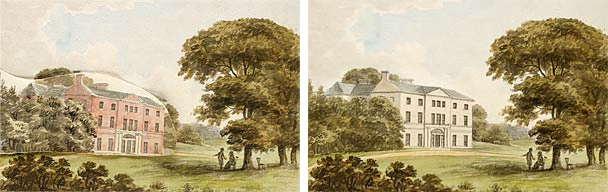
Images showing proposed exterior changes from H. Repton's Red Book for Hatchlands Park, Surrey (1800)
Images showing proposed exterior changes from H. Repton’s Red Book for Hatchlands Park, Surrey (1800) – source: The Morgan Library & Museum

Repton’s architectural contributions are often overlooked as he was never enough of an architect to be considered as one, and, in general, those primarily interested in his landscapes are insufficiently interested in his architecture.  A prime example of this (not mentioned in Colvin, or Stephen Daniels’ book, except buried in an endnote) is Repton’s vision for Port Eliot, Cornwall, the seat of Lord Eliot.  In 1792, in one of his earlier commissions, he was brought in for his advice on the estate. Repton assumed the role of architect and provided, in the Port Eliot Red Book, a broader set of broadly Gothic proposals which brought house, church, estate and even the nearby town into his remit. This expansive approach to his brief was a challenge for Sir John Soane who was asked in 1794 to contribute his ideas – but now within a Gothic framework set by Repton (a style to which Soane was hostile), whose designs had found a level of favour with Lord Eliot, and which he adapted.

One of the key questions when considering the architectural improvements suggested by Repton is to what degree they were his and what had been conceived by his eldest son John Adey Repton (b.1775 – d.1860). J.A. Repton had been a pupil to William Wilkins where he developed a profound understanding of Gothic architecture.  He had then moved in 1796 to the office of John Nash, with whom the elder Repton had established an arrangement to pass on any architectural commissions in exchange for 2.5% of the cost of the work – an agreement which Nash failed to honour, leading to the partnership being terminated in 1800.

Nash has a chequered reputation professionally and this extended to those in his office, including J.A. Repton but left to become his father’s assistant when the agreement between Nash and his father ended.  Nash was unfortunately a champion of the Picturesque but not of his assistants; he never acknowledged J.A. Repton’s significant contribution in various schemes. Unfortunately, John was to suffer the same issue to a certain extent with his father, though he was later clearly credited for his assistance ‘in the architectural department‘ for designs for a number of houses including Stratton Park, Scarisbrick, Panshanger, and others.

Detail from Port Eliot Red Book showing the house as found (© Eliots of Port Eliot)
Detail from Port Eliot Red Book showing the proposed changes to the house (© Eliots of Port Eliot)

In the Port Eliot Red Book, eighteen of the drawings are signed by the son and are probably his designs, however the scheme as a whole is attributed to the elder Repton, though he may have been angling for this to be a major commission for his son. Unfortunately for the Reptons, their grand vision for Port Eliot was never going to be realised, mainly due to financial constraints, though Soane was to provide an alternative scheme which he diplomatically managed to agree with Lord Eliot – much to Repton’s chagrin, later writing:

my beautiful plan for Port Eliot…my design for bringing together the house and the Abbey did not suit the fancy of my fanciful friend [Soane] (who knows but little about Gothic) so the plan was totally changed.

Repton’s architectural work was significant enough to merit inclusion in Howard Colvin’s seminal reference work, ‘A Biographical Dictionary of British Architects 1600-1840’.  The most important was the work at Welbeck Abbey in 1790 to remodel the east and west fronts (and the Red Book contains designs for an entirely new house) but the other entries are relatively insignificant – minor works in 1792 at Honing Hall, the enclosing of the courtyard at Sarsden House in 1795 to create a domed ‘hall of communication’, and a new entrance to Uppark in 1805. Beyond that, his association with John Nash meant he had an insight into the ‘cottage orne’ style and which Repton used in his design for a new ‘lodge of a new and singular description‘ comprising two thatched cottages on the Isle of Wight, one either side of the road.

Lodges at the entrance to Mr Simeon's grounds on the Isle of Wight, designed by H. Repton (Image from 'A New Picture of the Isle of Wight' by W. Cooke (1808)
Lodges at the entrance to Mr Simeon’s grounds on the Isle of Wight, designed by H. Repton (Image from ‘A New Picture of the Isle of Wight‘ by W. Cooke (1808)

Beyond that, his architectural contributions were mainly the designs within the books on landscape gardening.  The most important of these were ‘Sketches and hints on landscape gardening : collected from designs and observations now in the possession of the different noblemen and gentlemen, for whose use they were originally made : the whole tending to establish fixed principles in the art of laying out ground’, published early in his career in 1794, and the posthumous collection published in 1840, ‘The Landscape Gardening and Landscape Architecture of the late Humphry Repton’.

So, can Repton be considered an architect as well as a landscape gardener? On balance, his position seems to be more that of ‘frustrated architect but successful critic’. Repton doesn’t seem to have been able to establish a reputation as an expert on architecture, possibly because his commentary was often only available in the Red Books, with their naturally limited circulation. Also, his work was usually after the house was already built and often only recently finished, meaning the owner was unlikely to consider making significant changes very quickly, leaving few opportunities for him to showcase the talents he clearly thought he had.

However, his work was influential on the practices of contemporary and later architects, forcing them to acknowledge that their buildings did not exist in splendid isolation and had to be considered as whole; a three-dimensional, interactive, ever-changing landscape painting. Open, expansive parklands had the effect of placing the building on a visual plinth, majestic but with an aloof air. Repton firmly brought all the elements together, blending both Gothic with greenery and the Palladian with the planting.  His architectural contributions reflect this sensitivity and with more opportunities he may have been even more influential in the field of architecture, much as he dominated the landscapes represented so beautifully in his famous Red Books.


Further reading:


Sources:

(1) – Humphry Repton, Red Book for Honing Hall [1792], quoted in ‘The Surprising Discretion of Soane and Repton’ by Gillian Darley, in the Georgian Group Journal vol. XII 2002


Apologies for the long gap between articles – happily, just after I posted the last one in September 2017, our beautiful son was born. Mother and baby were, and remain, fine and his sister clearly loves him. However, as anyone with experience of small children knows, they’re justifiably demanding and, combined with having a day job, it’s meant I haven’t had the time to write, but as he gets a little older hopefully I should now be able to again…at least in some capacity, though they’ll remain sporadic.  Tweeting is easier to do regularly, so please do follow @thecountryseat and @lostheritage.  OK, on with the show…


Soane’s happy commission: Tyringham Hall for sale

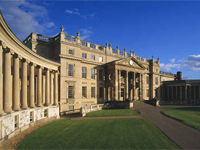
Tyringham Hall, Buckinghamshire (Image: Savills)

Six of the most happy years of my life‘ is how Sir John Soane described his commission to build what is regarded as one of his finest works: Tyringham Hall, Buckinghamshire.  Although altered, the house forms an important link in the development of both Soane’s architectural and professional skill; an ideal commission which gave full scope to his genius.  It also has the rare distinction of benefiting from another British architectural giant, Sir Edwin Lutyens, who created some of his best but also smallest work there. Now having been restored, the house is for sale; an early and clear candidate for the most important house to be sold in 2013.

Letton Hall, Norfolk (Image: Chris & Angela Pye via Flickr)

Sir John Soane built only eighteen complete country houses, mainly between 1780-1800, so each house is an important step in tracing the evolution of his distinctive style.  Burnham Westgate was Soane’s first major remodelling (covered in an earlier blog post: ‘For sale: a Soanian springboard‘ Oct 2011) but his first entirely new house was Letton Hall, Norfolk. Built between 1784-92 for B.G. Dillingham, Soane had convinced Dillingham to demolish, rather than alter, the existing Old Hall which he had inherited that year.  Soane’s early working practices, honed through smaller commissions, emphasised extensive discussions with the client at the early stages, and the creation of a wooden model to help them visualise the proposed scheme (created in 1785 – after work had started – at the cost of £6 11s).  Letton also demonstrated several of what we regard as ‘Soanian’ architectural traits: the compact villa design, pale bricks, beautiful proportions and the cantilevered, top-lit staircase.

Stowe House, Buckinghamshire (Image: e-architect)

Soane’s practice now progressed steadily with commissions for new houses at Tendring Hall and Shotesham, along with other works on varying scales.  His growing reputation for not only excellent designs but also for completing work on time and within budget led to his name being circulated amongst the right type of clients who could provide the opportunities Soane hoped for. Drawn by his friend, Lord Camelford, into increasingly political circles, he became friends with the powerful Marquis of Buckingham, who owned two great estates at Stowe and Wotton.  In August 1792, it was Buckingham who took Soane to visit the banker William Praed at his property, Tyringham, which his wife had inherited and which was conveniently close to the Marquis, in whom rested his political and business ambitions.  Needing a house to match his intended status, Praed initially commissioned Soane to remodel the existing Elizabethan manor house. However, after some Soanian persuasion, in June 1793 he decided that an entirely new house would best serve his needs – much to the architect’s undoubted relief.

Soane displayed a particular flair when designing an entirely new house.  Although at the  core of his houses was a Palladian villa, as John Summerson notes, Soane was able to ‘…twist it into something much more complicated with sequences of shaped rooms ingeniously interlocked, and lobbies introduced to effect harmonious transitions‘.  It was this imagination which Soane brought to the Tyringham commission and which created one of his early masterpieces, with flashes of brilliance, both inside and out.

One of the first is the now Grade-I listed monumental arch gateway leading from the main road; a building of such elegance and novelty that it had Pevsner in raptures, describing it as ‘a monument of European importance…it is entirely independent of period precendent, a sign of daring only matched at that moment by what Ledoux was designing in France [e.g. Hôtel Thellusson] and Gilly in Germany‘.  Leading to the house, the drive curves gently away, allowing the house to slowly come into view.  Soane designed the approach, incorporating an elegant humpbacked bridge with balustrades which curve at each end, away from the road, creating a delicate curl.  Arriving at the house, the exterior can also immediately be identified as by Soane, with typical details including the bow-front, the beautiful proportions and the superb detailing, such as the giant Ionic columns and Greek-key frieze.

The interior was to be the finest conception of the whole scheme; a dramatic, exciting series of spaces which would have delighted the visitor.  At the core of the plan was a device which Soane would re-use in later projects but on a monumental scale; the ‘tribune’, a top-lit inner hall.  To look at the plan is to understand the level of trust that William Praed displayed in Soane as, on entering the house, the first space encountered was dramatic as it was domestically redundant: a windowless ante-chamber lit only by the front door and flanking windows behind you, and through another doorway at the far end.  Passing through the room, flanked by four columns supporting a typical Soane shallow dome, you then stepped through the doorway and into the brightly lit central tribune; a Damascene moment of drama.  Forming the top of the T to the dark antechamber, the tribune then led to either the library, the drawing room or the stairs; each decorated in a typical Soane style. Though compact, the house and estate are both impressive and manageable, the perfect combination for a rising, ambitious banker who mixed in aristocratic company.

However, the house and estate today is not the same one Soane created.  Between 1907-19, a series of unfortunate changes were made to designs by the architect Ernst Eberhard von Ihne, his decorator Florian Kulikowski and another architect, Charles Rees, who implemented Von Ihne’s plans which swept away much of Soane’s interior decoration.  They also added an ill-proportioned copper dome, a tea cosy on a champagne bottle, which has the strange visual effect of elongating the columns.  With an estate of only 59-acres, it’s unfortunate that a series of 9 or 10 houses were built to the immediate north-east of the main house. Equally sad, the most important section of Soane’s considered drive to the house is now in separate ownership; the humpbacked bridge part of the public highway and worse, the road then continues down through that wonderful arch which so delighted Pevesner (how long before some careless driver seriously damages one or the other?) – follow the drive via Google StreetView.

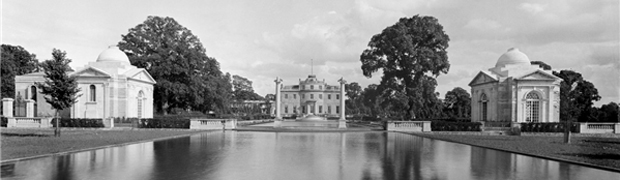
Bathing and Music Pavilions, Tyringham Hall (Image: Country Life Picture Library)

Thankfully what is still intact is one of Sir Edwin Lutyens‘ finest garden schemes.  Between 1924-28, Lutyens was commissioned by the then owners, the Koenigs, a family of Silesian bankers, to create a garden ‘for the recreation of spirit and body‘.  Standing each side of a huge 72m pool, once thought to be the largest of its type in Europe, are two temples; one a bathing pavilion, the other of Music.  Reminiscent of Thomas Archer‘s sublime Pavilion at Wrest Park (1709-11), Lutyens’ interpretation is pared back, less ornamented, but equally impressive – indeed, he himself thought it faultless and would apparently sit in there on his own.

The current vendor, Anton Bilton and family, has lavished millions on restoring the house and grounds (though, he confirms not as much as the £10m previously reported) since buying it for £2.5m in 2001.  However, the £18m asking price quoted in The Sunday Times Home section (28/04/13) seems ambitious; £10m-12m feels more appropriate considering the way the house and estate have been compromised with the now non-private approach, the small housing estate to the east of the main house and the loss of Soane’s original interiors.  Make no mistake, this is still a superb house and sets the bar high for any other house offered for sale this year to be considered as attractive or as interesting.

——————————————————————

Property details: ‘Tyringham Hall‘ – £18m, 59-acres [Savills] Strangely, there is no brochure yet and the launch, through double fold-out spread in Country Life (1 May 2013), feels a touch late.  One wonders whether the Bilton’s were offered a chance to do the Sunday Times piece before Savills were ready and took it anyway?

Excellent selection of photos:

If you wish to find out more about Sir John Soane and are in London, visit his house at Lincolns Inn Fields, which is a museum to his life and work: ‘Sir John Soane’s Museum

A silver lining to an industrial cloud; the Mersey mansions of the Victorian elite

To join the landed gentry you previously needed to have no connection with the vulgar business of actually making money. Even if you had bought a significant house and estate, to be truly accepted (and not be cast off into social Siberia) a gentleman would have to sell all his business interests and retire to live off the proceeds.  Yet, times changed and as it became acceptable to mix business and pleasure, so the requirements of the new gentry altered as they became unwilling to be too far from their sources of wealth, particularly around the great Victorian cities.  Smaller country houses and weekend villas with reduced estates sprang up to meet this new demand, with Liverpool being a prime example of these forces.  Later, as the cities grew, fortunes waned and housing pressures increased, many of these houses were lost; yet, occasionally, a rare survivor appears such as Calderstones Park Mansion House in Liverpool.

Harewood House, Yorkshire (Image: Lee Elvin via flickr)

The Georgian era truly challenged the mystique of inherited wealth and royal patronage being the primary route to social elevation (though both helped).  Money talks, and the vast wealth being created, and the men making it, could not be ignored.  No family exemplified this more than the Lascelles family of Yorkshire. Although the family had been in the county for many years, their purchase of the Harewood estate in 1739 for £63,827 (for an estate of 6000-8000 acres) was with wealth generated only relatively recently.  Henry Lascelles (b. 1690 – d. 1753) had made his fortune largely between 1715 and 1730 as a plantation owner, victualling contractor and Collector of Customs in Barbados. It was his son, Edwin, who, having inherited his father’s vast fortune, set about, between 1759-71, building the grand house we see at Harewood today, to designs by John Carr of York who had already built the stables.  The vast expense of paying Carr, plus Robert Adam for the interiors, Angelica Kauffman and Biagio Rebecca for internal decorative painting, Thomas Chippendale for the superb furniture, and ‘Capability’ Brown for the beautiful grounds hardly made any serious dent in the family fortune.  On Edwin’s death in 1795, he reportedly had an income of £50,000 per year, of which half came from the West Indies business interests.  It was this mercantile wealth which established one of the great houses of the 18th-century, elevated the family to the peerage and enabled them to become a local political force, all in the space of just 60 years – something not possible on the limited and sometimes uncertain income of an estate alone.

Picture gallery, Dawpool, Cheshire (Image: H Bedford Lemere, Bedford Lemere & Co / copyright: English Heritage/NMR)

The 19th-century only saw this trend accelerate with the great wealth of the cities now a serious challenge to the old inherited wealth of the land. This was especially true since, following political reform, land holdings were not always necessary to secure power and influence.  Now the owners could indulge their preferences, as not all of them, having been born, brought up, educated, worked and having made their fortunes in the cities, would feel a natural attachment to the countryside, beyond the social cachet it brought.  Rising land values from the mid-19th-century also would have been a factor which might have put off the hard-headed businessman – better value to invest in the most luxurious house possible.  Yet, the allure of the country seat was still strong as a recognised symbol of success so around each major Victorian city could be found these mini ‘pleasure’ estates; with Liverpool being a classic example.

Hafodunos Hall, Wales in 1954 (Image: RCAHMW) - burnt out in 2004

For some, their fortunes financed the Victorian version of the Lascelles, with the acquisition of large estates and the building of the great houses away from the dirt and noise of the cities, such as at Hafodunos Hall (sadly burnt out by morons in 2004) by George Gilbert Scott for H.R. Sandbach (son of a Liverpool West India merchant). Yet for some of these gentleman there was no shame in being near to the industrial heart which pumped their fortunes – but that didn’t mean they had to compromise on luxury or convenience. Soon, many large houses with small estates populated the edges of the city.  Writing in 1873, the journalist Patricius Walker said:

Crowds of comfortable and luxurious villas besprinkle the country for miles round Liverpool, inhabited by ship-owners, ship-insurers, corn merchants, cotton brokers, emigrant agents, etc, etc, men with “on foot on sea, and one on shore,” yet to one thing constant ever – namely, money-making – and therein duly successful.

These captains of industry and commerce were also able to take advantage of the newly developed railways; becoming early commuters, able to spend the day at the office yet still escape at the end, back to their slice of bucolic charm.

The merchant palaces of Liverpool were, broadly, either those which were built as villas with substantial gardens near the large pleasure parks such as Sefton, or, taking advantage of the rail links, based outside the city in areas such as a the Wirral, just across the Mersey.

Holmestead, Cheshire (Image: openlyJane via skyscrapercity)

One particularly fine example of ‘rural urban’ villa was Holmestead on Mossley Hill, set in its own extensive grounds just to the east of the elegant and very desirable Sefton Park.  What is remarkable is that many of the larger houses still survive, albeit in an altered form; some becoming flats or care-homes.  The house was originally built in the 1840s in a Gothic style and effectively doubled in size in 1869-70 by the then owner, Michael Belcher, a local cotton broker. Urban ‘society’ of the newly wealthy mirrored the practices of those in the countryside as shown by William Imrie, owner of the house at the turn of the 19th-century and formerly of the famous White Star line, and also a patron of the Arts-and-Crafts movement.  He held regular concerts in his music room – a grand space, decorated with William Morris’ ‘Acanthus‘ pattern wallpaper, with the imposing ‘The Tree of Forgiveness‘ by Edward Burne-Jones on one wall, and Spencer Stanhope’s ‘Why Seek Ye the Living Amongst the Dead‘ on another. Remarkably, the house has survived and is still a single family home.

Dawpool, Cheshire - dem. 1927 (Image: H Bedford Lemere, Bedford Lemere & Co / copyright: English Heritage/NMR)

One of the grandest houses of them all was also connected to the White Star Line.  Dawpool was the pet project of Thomas Henry Ismay, the man who built a company large enough to launch the Titantic. Although was not conceived as the centre of a landed estate, it was certainly designed to showcase the power of his empire.  Designed by the leading architect, Richard Norman Shaw, the house, started in 1882, was a monument to Ismay’s wealth and meant to last – the local red sandstone was finely shaped and even the screws being finest brass.  The house took four years to build at a cost of over £50,000 – equivalent to over £3.5m today, a colossal sum compared to the average £80 per year the skilled ship-worker took home. Yet, the house was to survive less than half a century. After Ismay’s death in 1899, the widowed Mrs Ismay said that the house had given her husband pleasure every day – but without that driving force, it languished before being sold, becoming an orthopaedic hospital in WWI, before being sold again, and then demolished in 1927 [more history and photos available on Lost Heritage: Dawpool].

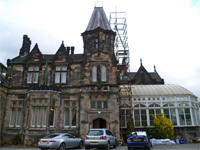
Calderstones House, Liverpool (Image: Liverpool Confidential)

Although some have been demolished and most of the houses have lost their extensive grounds, one rare survivor, Calderstones House, gives a rare insight into the once-gilded edges of Liverpool.  The now grade-II listed house was built in 1823 for Joseph Need Walker, a lead shot manufacturer, who built an elegant late-Georgian design (architect unknown) with a Doric portico which looked out over carefully tended gardens and parkland.  In 1875, the house and grounds were sold for £52,000 to Charles MacIver, a shipping magnate who had spent 35 years with the Cunard Line. The house and grounds were sold in 1902 to the Liverpool Corporation for £42,000 and became one of the city’s finest parks (John Lennon apparently used to hang about there) with the house used as offices for their Parks departments with a public tea-room and, to the rear, a stage for concerts.

Faced with severe budget cuts, Liverpool Council are now exploring what options are available, with a sale the preferred outcome.  Sadly, it is extremely unlikely to become a home again; to carve out sufficient space and access from a public space would be extremely controversial, with security a further worry.  The two most likely options are that it is taken on as a public facility with commercial aspects such as concerts and refreshments, or that it will languish, becoming progressively more dilapidated.  Sadly, local government generally has often shown a rather careless attitude to heritage assets in their care -though in recent years they have improved markedly from the 1950s and 60s when some (Derbyshire being particularly notorious) would simply demolish the historic buildings, especially country houses.

The current period of austerity is forcing councils to re-examine their assets and objectively analyse the most cost-effective way of operating – a process open to the risk of losing elements of what makes an area locally distinctive.  This is especially true when ‘heritage’ and ‘arts’ are seen (falsely) as relatively ‘high-brow’ interests – this creates a challenge for everyone to be aware of what their councils own, and to monitor whether there are any signs of them seeking to cut corners and creating conditions which threaten the heritage assets.  They hold these in trust for the local area and, if necessary, councils need to be forcefully reminded of their obligations to this generation and the ones which follow to care for the built environment which contributes so much to local identity.

Articles:

Further reading: Merchant Palaces: Liverpool and Wirral Mansions Photographed by Bedford Lemere (Photographers of Liverpool) (disclosure: this is an Amazon associates link – the price you pay is the same but I’m experimenting to see if I can help offset costs with Amazon affiliate links).

A poor prognosis: Great Barr Hall, Staffordshire

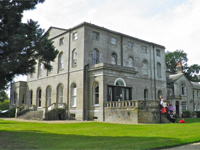
Great Barr Hall, Staffordshire (Image: English Heritage)

Many of the houses featured in this blog are shown as a celebration of the brilliance of our architects and craftsmen in creating one of the finest bodies of buildings of their type in the world.  Yet, in abundance is, perhaps inevitably, failure; where an interesting house becomes a victim of circumstance, policy, incompetence or, sometimes, all of the above.  Great Barr Hall, once outside Birmingham, now encircled by advancing urbanisation, is a sad example of where a house can languish and deteriorate whilst deliberate vandalism and institutional lethargy condemn it to its fate – and unless something is done soon, Great Barr Hall will join the already far-too-long list of the lost country houses of England.

Great Barr Hall c1800 (Image: artist known / sourced from Bill Dargue)

Despite its current sorry state, Great Barr Hall was once a sizable house – though precisely how large is unclear.  An early print in 1798 Stebbing Shaw’s ‘History and Antiquities of Staffordshire‘ shows a 11-bay castellated house with four corner turrets but the present house is 9-bays.  For comparison, it’s interesting to note the stylistic similarities with Syon House in west London, a seat of the Dukes of Northumberland, though it is also 9-bays wide and has an imposing porte cochere.

What is known is in the 1760s, Sir Joseph Scott, then head of a family line which had been in the area for 600 years, built a new house in a ‘gothick’ style.  The original architect is unknown but Stebbing Shaw describes how ‘The present possessor [Joseph Scott], about the year 1767, began to exercise his well known taste and ingenuity upon the old fabric, giving it the pleasing monastic appearance it now exhibits – and has since much improved it by the addition of a spacious dining room at the east end, and other rooms and conveniences‘. If Scott was his own architect, perhaps he was, in part, inspired by the remodelling of Syon House by Robert Adam which started in that same year.

Sir Joseph Scott’s original extensive works led to some financial difficulties and so, from 1785, he moved to the Continent and rented the house out.  The lease was taken by Samual Galton junior, a controversial Birmingham Quaker, banker,  gun manufacturer, and intellectual who hosted meetings of the Lunar Society at Great Barr Hall leading to it becoming a noted crossroads for industrial ideas, a crucible for the Midlands industrial growth and the wider Industrial Revolution.

Where Great Barr becomes particularly interesting from our point of view is with the arrival of the young architect John Nash and his business collaborator and famous landscaper, Humphrey Repton. Nash was there to provide the buildings which Repton needed to complete his  gardening visions. This worked well for both men; Nash was to pay Repton 2.5% for any work the latter passed his way so Nash charged his clients the then rather high fee of 7%, giving him a 4.5% fee. There is no record of Nash ever putting any work towards Repton – but Nash benefited with work on over one hundred estates. There seems to be some uncertainty as to exactly when Nash started working there but John Summerson gives the date as 1800 for the construction of a gothic archway to the adjacent chapel, but other works such as the gate lodges, an icehouse and a new steeple for the chapel started in 1797 and were probably also by Nash and Repton.

Corsham House, Wiltshire - copper engraved print published in The Beauties of England and Wales, 1813 (Image: Ancestry Images)

About this time, the house was also updated to create the appearance we can just make out today – but it hasn’t been confirmed that Nash was the architect.  However, there are tantalising clues that it could well be by him. Nash had been developing his particular style of Picturesque gothic during his time in Wales and had been applying it with varying degrees of success since then during alterations at Kentchurch Court, Herefordshire, (1795) and at Corsham House, Wiltshire (1797 – a disaster due to poor workmanship with Nash’s work later demolished).  Yet, some of the architectural fingerprints of each of these can be seen in Great Barr.  Externally, one such feature is the crenellations applied to both the roof and the tops of the projecting towers, another is the hooded Elizabethan-style windows. Another interesting piece of the jigsaw is a house which Nash was working on in 1800 in Buckinghamshire,  Chalfont Park, which bears not only a superficial stylistic similarity but also one of form – a long rectangular main body with a projecting 3-bay centre.  However, Chalfont Park was also altered by Anthony Salvin in 1840 so it’s not possible to tell how much of the gothic detailing is Nash’s.

The Scott’s return in 1797 prompted the works of Repton and Nash before further work in 1830 and 1848 which included moving the entrance from the west side to the north.  In 1863, a chapel was built to a design thought to be by Sir George Gilbert Scott, though it was never consecrated and so became a billiard room.

The replacement windows (Image: Simon Cornwell) - click to see 'before and after'

The house remained with the Scotts until the house became a hospital for the mentally ill in 1918 following the death of Lady Bateman-Scott in 1909.  As is usual, the institutional nature of hospital use was not kind to the house.  Beyond the extensive network of buildings which marched across Repton’s parkland (and the south eastern corner of the estate being carved up by the M6 motorway), the house itself had a modern two-storey extension added in 1925 and in 1955 the clock tower, stables and much of the east wing were demolished.  In the 1960s, some sensitive architectural ‘genius’ removed the two splendid first-floor oriel windows which flanked the main entrance and inserted a pair of non-matching government-issue casement windows.

The current plight of Great Barr Hall can largely be laid at the door of Bovis Homes and John Prescott, formerly the Deputy Prime Minister, and the one who eventually signed off on the architectural blight that now affects the house.  Considering that the hospital buildings were in two distinct campuses, one to the north west and another to the north east, if there had to be development, replacing the buildings to the NW would have placed them furthest from the house, with the advantage of creating a more complete parkland around the house, with the possibility of re-instating, to some extent, the earlier Picturesque drive.  To hope that someone of Prescott’s aesthetic insensibilities would see such a solution was always forlorn but one might hope that someone on the local council or in English Heritage might have proposed a more sensitive outcome.  Sadly it was not to be and now a large development of 445 executive-style homes has been built, the closest being scarcely a hundred metres from the back of the house.  Worse, following the sale of the house to a building preservation trust, little progress has been made, with questions now being asked about the trust’s failure to restore it as promised earlier.  It was again put up for sale in May 2011 by the Trust at the unrealistic price of £2.2m with the option to buy a further 100-acres of parkland – with the threat of even more development.

Despite some architectural uncertainties, what is clear is that those charged with its care in the recent decades have failed.  Perhaps this is a broader failure of policy, that without an explicit mandate to determine that the architectural heritage must be managed, maintained and preserved as far as is possible, it will fall to all-to-fallible councillors to look beyond their own short-term interests; sadly, an unlikely prospect.  The NHS generally has a poor record of managing historical assets once it has no further use for them e.g Sandhill Park, and Stallington Hall are just two examples and don’t forget that Soane’s Moggerhanger survived despite the NHS, not because of it. A strong national policy should provide a clear strategy for preservation of heritage assets taken over by the state rather than just relying on existing listed buildings legislation.  In Great Barr Hall’s sad circumstance, one can only hope that someone will be able to extract the money owed as part of the enabling development, which can then be devoted to restoring this interesting and significant house so that it once again can be something for the local residents to be proud of, rather than the monument to NHS, central government and local council incompetence which it is today.

————————————————————————

Still for sale? (thanks to Andrew for spotting this): Great Barr Hall might still be for sale – there is a page with details but it’s not listed on the agent’s website: ‘Great Barr Hall‘. Now listed for £3m but with 150-acres but with another 100-acres of parkland by separate negotiation.   Considering the Building Preservation Trust paid just £900,000 for the entire site this seems a little odd – perhaps someone will enlighten us.

————————————————————————

Listing description: ‘Great Barr Hall‘ [British Listed Buildings]

‘At Risk’ Register entry: ‘Great Barr Hall‘ [English Heritage]

Recent history of house and some proposals for rescue

News stories:

The most expensive UK country house: Park Place, Oxfordshire

A new record price for a UK country house has just been achieved with the sale of Park Place, near Henley-on-Thames, in Oxfordshire.  One of three most notable estates on that stretch of the Thames, it was also the most expensive country house ever sold in its unrestored state in 2007.  Now, after five years and many millions of pounds, the house again has set the record having been sold to an unknown Russian billionaire for £140m.

'A view of Park Place, Henley' - artist unknown - c.1742-3 (Image: Royal Collection) - click to see full image

Park Place is, at its core, a more modest Georgian house built in 1719 for Lord Archibald Hamilton, son of the Duke of Hamilton.  The proximity to London and the beautiful setting has long attracted the wealthy to the area as a convenient escape from the city, with several riverside estates featuring a series of impressive houses.  Starting at Marlow, the first house is Bisham Abbey (now the national sports centre), then the now lost Temple House (dem. 1910), Harleyford Manor (beautiful small villa restored in 1989), Whittington House [pdf] (rebuilt by Reginald Blomfield c1897, now HQ of SAS Ltd), Danesfield House (now a hotel), Medmenham Abbey (now two houses), Culham Court (sold for £38m in 2006), Greenlands (now Henley Management College), Fawley Court (sold for £13m in 2008, possibly for conversion back to a private house), and then finally, just past Henley, lies Park Place.  Of particular interest are the architectural similarities between Fawley Court (built 1684 – reputedly to a design by Sir Christopher Wren), the original Park Place (built c1718), Culham Court (built 1771), and Reginal Blomfield’s 1897 rebuilding of Whittington House, all of which are on based on a red-brick 5- or 7-bay, two storey villa with bulls-eye window inserted into a projecting pediment.

Park Place, Henley - c1810 (Image: Thames Pilot) - click for the full image

Sadly, Park Place is no longer part of this architectural brethren having undergone a series of substantial changes.  The house was sold by Lord Hamilton in 1738 to Prince Frederick, then Prince of Wales and eldest son of King George II, who split his time between there and Cliveden. After Frederick’s death, the house was then bought by General Henry Seymour Conway in 1752 and it was he who made the first significant changes both to the house (including a library by Sanderson Miller in 1757) and, perhaps more importantly to the grounds, which are now grade-II*. His works, to designs by Thomas Pitt, 1st Baron Camelford, included the installation of an ancient stone henge given as a gift from the people of Jersey where he was Governor, the lightning-damaged steeple from St Bride’s Church as an obelisk, four more obelisks as gateposts, an underground cavern, and a bridge, using stones from Reading Abbey, which was subsequently admired by Horace Walpole.  There was also an artificial classical ruin designed by James ‘Athenian’ Stuart.

Park Place, Oxfordshire - c.1900 (Image: henleyonthames.org)

The house was sold to John Noble in 1871 but was largely gutted by fire a year later, giving Noble the opportunity to indulge something of an architectural whim.  The pattern and style of the Victorian country house was much admired around Europe and our expertise was exported widely around the continent – but it rarely flowed back (a topic already covered in an earlier post ‘The rise and fall of French taste on UK country houses‘).  Park Place is one of the few houses in the country build using the French Renaissance style, creating an impressive château in the heart of England.

The design of the rebuilt house is widely attributed to Thomas Cundy [III], the son and grandson of two previous Thomas’ who had also been country house architects. Although the latter two are given sizeable entries in Howard Colvin’s ‘Biographical Dictionary of British Architects‘, the grandson is given only a paragraph as part of his father’s, leaving us somewhat in the dark as to what, bar some London churches, he may have been involved with. However, considering his father had good form with the chateau style having built Grosvenor Gardens in London, so Thomas III would have been schooled in the style before his father’s death in 1867.

The house remained with the Noble family until 1947 when it and the 670-acre estate was parcelled up into 22 lots and sold off.  The main house was bought by Middlesex County Council who converted it into a special school, which it remained until 1988 when it closed. The house was then bought by John Latsis, the Greek shipping tycoon, but it seems unlikely that he lived there as it remained unrestored, with the vestiges of the school – gymnasium, classrooms, a woodwork studio etc – all still in situ, along with various outbuildings, as can be seen from these images of the house.

Those who had a chance to look around the house when it was for sale in 2006 all noted that beneath the shabby institutional veneer, the potential of the house was clear; glimpses of fine tiles, the original stone fireplaces, stained glass, and grand spaces with impressive views.  The house was then sold to a consortium who intended to create a superior country club – until Wokingham council said ‘no’.  Put on the market for £45m, it was finally sold for £42m to Mike Spink, a property developer who specialised in high-end houses in central London. With this experience, Spink transformed this once dilapidated house into a palace fit for a billionaire with all the requisite features such as a helipad, swimming pool, panic room etc.  Somewhat disappointingly, the house now only comes with 200-acres, with the remaining 300 with which it was sold retained by Spink for as yet unspecified ‘development’ – a phrase which will no doubt spark local concerns.

Even when it was first sold, those in the property business were predicting that Park Place would sell for possibly up to £100m, and the rising ‘super prime’ market has proven even those estimates conservative.  Sadly, this record is not for a spectacular historic house at the centre of a large estate but instead one where the location (location, location!) has elevated the price to such a stratospheric level. Nevertheless, many country houses were built as retreats for wealthy industrialists and financiers and this house is proof that the lure of the trophy country estate is as strong as ever – which can only be a good thing for those seeking to prove their desirability in modern times.

———————————————————————–

Story about the original sale: ‘Sold for £42m… still in need of renovation‘ [Daily Telegraph]

Latest sale: ‘Park Place: Britain’s most expensive home sold for record £140m‘ [Daily Telegraph]