Reflections on the loss of Clandon Park, Surrey

Loss is mainly regret that we will never see something, or that we have known it and will never see it again.  Where the loss is of something of beauty, which embodied ideas, history, culture, it takes on many facets. Fire is a destructive, cruel enemy, consuming all in its path; caring not for the value – either great or small – simply taking whatever it can as fuel for its avaricious need to grow. On 29 April 2015, as the fire at Clandon Park took hold we hoped for the best – yet sadly, less than twelve hours later, all that remained was a gaunt, blackened shell. The loss was not just the building and its beautiful interiors and contents, but also what it represented to UK architectural history.

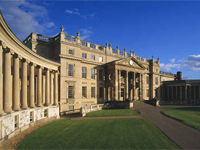
Clandon Park, Surrey (Image: Matthew Beckett)

News breaks now on social media, the first photos and reports of huge plumes of smoke spreading much as the flames did; slowly at first, rapidly growing. Quickly it became clear that the fire had reached the roof and that the rooms on the ground floor of the south side had already gone – the Green Drawing, Palladio, Hunting, Prince Regent.  Each a small gem in themselves, their contents the result of decades of collecting and curation. As the floors above collapsed, it became clear that this was a very serious situation and thoughts immediately are to hope that, first, everyone is safe, but, secondly, how far would the fire go? Sadly, it soon became clear that the entire house was to be consumed in the inferno.

Clandon Park on fire, 29 April 2015 (Image: © Andrew Blondell / BBC Surrey)

Why was Clandon Park important? It wasn’t just the history and collections.  Most importantly, the design of the house was a key transitional link between two defining periods of British architectural history; the Anglo-Baroque and the Palladian. The house, both interior and exterior, was designed by a Venetian architect, Giacomo Leoni, and built between 1723-29.  Both the architect and the dates are key to understanding why the house was so significant.

Clandon Park on fire - two-thirds of the house was now on fire (Image: © Oliver Dixon)
Clandon Park on fire – two-thirds of the house was now on fire (Image: © Oliver Dixon)

Giacomo Leoni (b.1686 – d.1746) played a key role in bringing the ideas of Palladio to the UK through the publication of that architects’ ‘I Quattro Libri dell’Architettura (which he called ‘The Architecture of A. Palladio, in Four Books’). Although not an entirely accurate recreation (Leoni wasn’t above adding his own improvements) the instalments (published between 1715-20) were a huge success, casting the ideas of the Palladian ideal deep into the aspirational hearts of the British aristocracy.  Leoni’s edition remained the primary source of the nascent Georgian Palladianism until (prompted by Lord Burlington) Issac Ware produced a more accurate translation in 1738.
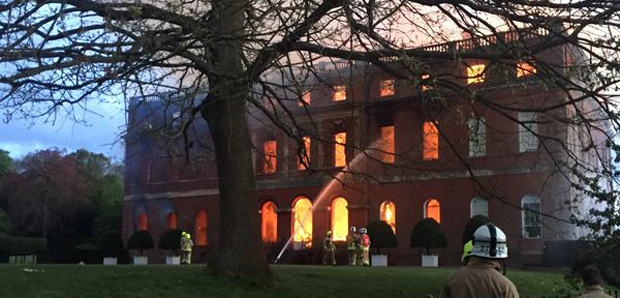
Clandon Park on fire - the flames reached the north side (Image: © Alex Greenwood)
Clandon Park on fire – the flames reached the north side (Image: © Alex Greenwood)

For all his intellectual influence, Leoni’s physical output was relatively meagre for a 45-year career – his earliest designs were for an unexecuted rebuilding of Wrest Park in August 1715 for the 1st Duke of Kent. His first completed work was in London in 1721, Queensberry House, 7 Burlington Gardens, for John Bligh, Lord Clifton, which featured an antique temple front, a reduced version of which appears on the south front of Clandon Park. Leoni’s output was mainly country houses; he designed eleven but only nine were completed (the two unfinished houses being Carshalton Park and Thorndon Hall) of which four have been lost already (Moulsham Hall – dem. 1809, Bold Hall – dem. 1901, Burton (or Bodecton) Park – fire 1826, and Lathom House – dem. 1929/1955).

Comparison of Leoni's 7 Burlington Gardens and south front of Clandon Park (Image: 7BG: Wikipedia / Clandon: Matthew Beckett)
Comparison of Leoni’s 7 Burlington Gardens and south front of Clandon Park (Image: 7BG: Wikipedia / Clandon: Matthew Beckett)

This left just four completed house which survived into the 21st-century; Lyme Park (c.1725-35), Alkrington Hall (1735-36), Wortley Hall (1743)- and Clandon Park (1723-29).

The brilliance of Leoni’s design for Clandon had survived almost unchanged as it had remained in the Onslow family until being handed to the National Trust in 1956. Where Clandon excelled was that the exterior was early-Anglo-Palladian; chaste, restrained decoration, subtle temple motif, but this was married with one of the greatest of the Anglo-Baroque rooms, the Marble Hall (the plasterwork of which Sir Simon Jenkins thought better than the similar room at Houghton Hall), and other rooms rich in beauty. This contrast between the quiet exterior and the exuberant interior is what made Clandon so important as the link between two of the most significant trends in British architectural history.

Marble Hall, Clandon Park (Image: Matthew Beckett)

So, what next? The incredible staff and volunteers of the National Trust swiftly put into place the plans they never hoped to have to use and clearly, the efforts are being directed to the care of the salvaged contents and an examination of what can be recovered from the debris.   Investigations will be undertaken and conclusions reached as to the cause but looking to the future the options are the same as ever; rebuild, re-use, or ruin.
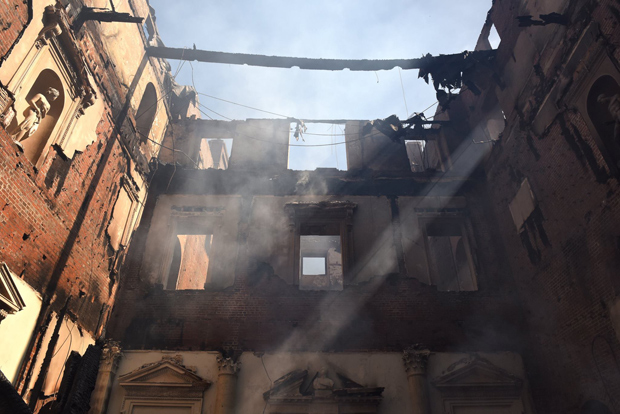
Marble Hall, after the fire (Image: © John Millar / NT Picture Library)

As a nation, we have fetishised ruins for centuries with castles, abbeys, fortifications and now factories celebrated for their managed decay. We have enough derelict country houses (far too many, truth be told), so to consign another to that sad, lonely fate would miss the chance to grasp a recoverable beauty and miss the opportunity to demonstrate and inspire through an educational process around the reconstruction.

The Landmark Trust’s inspired recent work at Astley Castle, Warwickshire, to create a modern living space in a shell created by a fire in 1978, shows that ruins can be re-used intelligently and with great aesthetic success.  However, Astley Castle was a smaller house and also without the spectacular interiors which once graced Clandon Park.
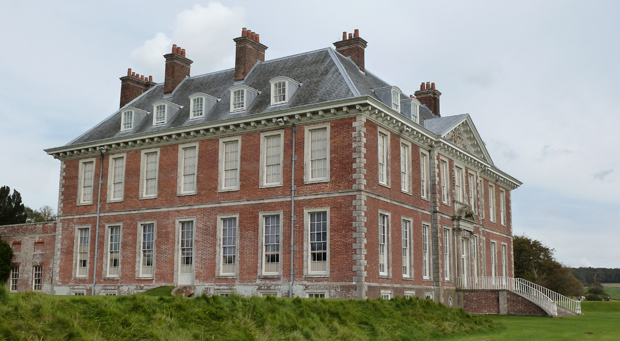
Uppark, Sussex (Image: © Matthew Beckett)

So the remaining option is rebuilding and restoration.  As has been shown at Uppark, Sussex, which also suffered a serious (though not quite as devastating) fire in August 1989, it is possible to restore the house back to as it was before.  This is not pastiche as it’s not conjectural – we have extensive, detailed records of the interiors and, combined with salvaged fabric, it is possible to recreate what was there.  As Sir Simon Jenkins argued in the Sunday Times (03/05/2015), it would be unthinkable not the reinstate the great Marble Hall – because we can.

Modern care and conservation means that the rate of losses of country houses has dropped from the hundreds each year in the 1950s to barely a handful and these are almost always due to fire. All those we have – that which survived this far – are fragile and it’s an uncomfortable truth to understand that they will not last forever.  As the painter Salvator Rosa once wrote:

All our works is fallen and sicken
Nothing is eternal
The Colossei die, the Baths
The worlds are dust, their pomp a nothing…

Rather than despair, we should celebrate and enjoy the architectural heritage which is still available to us and care for it for future generations. The original Clandon Park is lost; that patina of age, the individual details which only it knew are no more. Although the contents have been largely lost, resurrection is the most appropriate option as the main shell of the house has survived – the sterling work of the fire service has saved at least one half of Leoni’s vision. Modern craftsmen with ancient crafts, honed at Uppark, Hampton Court, and Windsor Castle, can recreate the beauty of the interior.  It won’t be the original but from our shock at the loss can come awe at the artistic skills that can recreate such wonders as the Marble Hall.

———————————————————————————

Gallery of images of the aftermath: ‘Clandon Park fire 2015‘ [National Trust Picture Library]

Statement: ‘Fire breaks out at Clandon Park, Surrey‘ [National Trust]

The finest SAVE, now for sale: Barlaston Hall, Staffordshire

Barlaston Hall, Staffordshire (Image: Knight Frank)

The wholesale destruction of UK country houses in the 1930s and 1950s was undoubtedly a tragic waste; not only of materials but also the embodied beauty and history of the hundreds of houses lost. Barlaston Hall, recently launched on the market for sale, and which was so valiantly fought for by SAVE Britain’s Heritage who famously bought it for £1, provides a case study which shows what might have been possible if circumstances had been different. How many more of our country houses might have survived to still be found nestled at the end of a tree-lined drive?

Collapse of Hague Hall, Yorkshire, due to mining subsidence, 1910 (Image: Lost Heritage)

The plight of the country house in the 20th-century struck at both the large and the small, the grand and the intimate.  A financial crisis could, in a generation, take a family from a secure status enjoying thousands of acres to one of ruin and a forced retreat from the family seat.  For some houses the demise was swift – for sale intact one year but the following year could see sales of contents, then fixtures and fittings, and finally the materials. The alternative fate for a number of houses was a lingering demise – abandoned, at risk from thieves and the weather, to an increasingly hostile environment with threats coming from every angle, even from below.

The elegant Barlaston Hall in Staffordshire was one house which fell firmly into the latter category. A remarkable house, it represented an important development of the Palladian tradition; the moment it moved from ‘copying’ to evolving.  The house was built c.1756-58 for Thomas Mills, a local lawyer, with the design convincingly attributed to Sir Robert Taylor (b.1714-1788).

Architecture was not his first choice of career. Taylor was the son of a master mason and sculptor, also called Robert, who was successful enough to build a villa in Woodford, Essex, but who was also rather profligate.  The father managed to get his son apprenticed to the sculptor Henry Cheere and on completing his time, found his father had just enough to send him on to Rome to study.  Whilst there, his father died so he came back to find his inheritance was no more than debts, but friends enabled him to set up as a sculptor and by 1744 he was sufficiently accomplished to be commissioned by Parliament and to carve the pediment of the Mansion House in the City of London.  It became clear that he paled in the shadow of his contemporaries – Roubiliac, Rysbrack and Scheemakers – so at the age of 40 he turned to architecture.

Outside influences often act as catalysts for development. In the same way that Blenheim Palace was enriched by Vanbrugh‘s theatrical experience, so Taylor had the advantage of his earlier, if unsuccessful, sculptural career which brought a more developed sense of shape, form, and movement to his architecture.  Colvin praises him as an architect of ‘considerable originality‘ and that ‘his villas…represented a new departure in country-house architecture‘. What Taylor provided was an evolution of the strict Palladian designs of the previous generation, marrying them to a more tolerant approach that allowed the interiors to be more Rococo, with decorative plasterwork and patterns, drawing on his knowledge of the original sources in Italy. Taylor created wonderfully elegant villas for his clientèle of bankers and merchants, who needed smaller houses for entertaining rather than seats for a rural family empire.

Braxted Park, Essex - note the octagonal window frames (Image: Braxted Park)
Braxted Park, Essex – note the octagonal window frames (Image: Braxted Park)

Although Taylor undoubtedly designed many buildings, he seems to have almost conspired to make it impossible to attribute them as he left no record of his practice and also apparently never signed his drawings.  There are, therefore, large gaps in both his chronological and stylistic history but starting with his first country house, Braxted Park, Essex in 1753-6, it is clear that his skill and legendary capacity for hard graft meant a sizeable output.

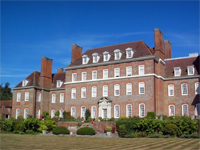
Harleyford Manor, Buckinghamshire (Image: Stephen Richards via Geograph)

Of particular note, in relation to Barlaston Hall, is Taylor’s design for Harleyford Manor, Buckinghamshire, in 1755. Part of a group of second-generation Palladians – along with Flitcroft, Keene, Paine, Ware, and Wright – Taylor saw Palladio as an inspiration but was not a slavish disciple.  The core principles relating to proportion and preserving a necessary elegance were respected but it was in the interpretation that they introduced variety.  At Harleyford, Taylor took a more vernacular style to the idea of the Villa Rotonda (a standalone villa with four equal fronts, allied with its landscape) but also combined with a sculptors appreciation that it should be attractive from all angles.

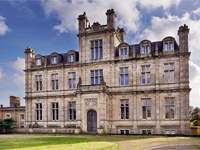
Asgill House, Richmond, Surrey (Image: Matthew Beckett)

Built between 1756-58, the layout and style of Barlaston Hall clearly shows the kinship with Harleyford. The elegant simplicity of the ground floor layout with the four principal rooms pushing out into the arms of the cross with a double-height central hall clearly can be derived from the Villa Rotonda but rotated on the axis to create more interior space, as opposed to the Rotonda’s open loggias.  One of the most distinctive features is the pleasing ‘chinese’-style woodwork, with octagonal window tracery on the exterior, a pattern mirrored in the library in the bookcase doors.  For one so early in his career, Taylor was showing remarkable invention, elegance and practicality, all of which served to launch his practice, which continued for 35 years. After Barlaston, further commissions such as Asgill House (1761-64) on the riverside at Richmond, Surrey, for his friend Sir Charles Asgill, also helped establish Taylor’s reputation.

Not that any of this innovation and elegance mattered to the Wedgwood company who applied twice in the early 1980s to demolish Barlaston Hall.  The house and estate had been bought by the famous pottery firm in 1937 as part of a scheme to create a new factory and model village for their workers.  These were built some distance away but the now grade-I listed house was badly neglected with serious water damage causing it to become increasingly derelict, with ceilings and the staircase collapsing, and the structure affected by subsidence caused by coal-mining.  The house also sat across a geological fault and future mining plans risked the whole area sinking by about 40 feet.  Clearly, this was a house very much at risk.

Entrance front, Barlaston Hall, Staffordshire (Image: SAVE Britain's Heritage)
Entrance front, Barlaston Hall, Staffordshire (Image: SAVE Britain’s Heritage)

In 1981, the second application to demolish was called to public inquiry, due to the importance of the house, where the architectural conservation charity SAVE Britain’s Heritage argued the case for the preservation and restoration of the house. As Barlaston Hall had been designated as ‘outstanding’ this placed certain obligations on the National Coal Board who would be required to pay for not only repairs but also preventative measures, such as the huge concrete raft they devised to prevent further movement.  After a few days of arguments, Wedgwood decided that they would make a bold move and offer the house to SAVE for £1 on the condition that it was restored within five years or they could buy it back for £1 (after which the house would no doubt be swiftly demolished).  The then Secretary of SAVE, Sophie Andreae, immediately phoned the President, Marcus Binney (who was in the USA) with the news.  Conscious that he had to make a decision there and then, Marcus called Wedgwood’s bluff and bought Barlaston Hall.

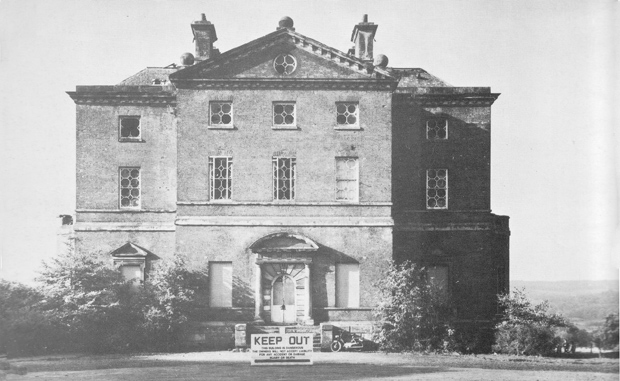
Dining Room, Barlaston Hall, Staffordshire - 1981 (Image: SAVE Britain's Heritage)
Dining Room, Barlaston Hall, Staffordshire – 1981 (Image: SAVE Britain’s Heritage)

A few days later when Marcus was able to visit the house for the first time, the scale of the challenge became starkly apparent.  Stepping into the debris-strewn hallways, light shone through all three floors from gaping holes in the collapsed roof and 4″ cracks indicated where the subsidence was taking hold.  Although most of the fireplaces had been stolen, the good news was that much of the original plasterwork on the walls and the distinctive woodwork had survived.  SAVE immediately organised a temporary roof, after which, the house took nearly 2 years to fully dry out.  Specialist heritage builders and professionals swiftly set to work on both the structural and conservation issues.

East front, Barlaston Hall - 1981 / 2014 (Images: SAVE Britain's Heritage / Knight Frank)
East front, Barlaston Hall – 1981 / 2014 (Images: SAVE Britain’s Heritage / Knight Frank)

Although work had started well, delays in securing the necessary certificates from the Secretary of State meant that the National Coal Board then decided to try and renege on their agreement to fund the work.  SAVE sought leave for a judicial review which prompted the Secretary of State to immediately fulfil his promises, which ultimately forced the National Coal Board to capitulate from their shameful position and fund the repair and preventative works – and SAVE’s legal fees too.  With immediate funding secured, which was followed by further grants, the conservation work continued.  It was put up for sale in 1992 and bought by the current owners who have sensitively completed the restoration of this captivating and fascinating house.

That the value of a house can go from £1 to £2.3m in the space of 30 years shows that the fortunes of country houses can rise as swiftly as they fall.  Barlaston Hall not only represents an important link in our understanding of the domestic Anglo-Palladian tradition, but is also a testament to how determined action can succeed even against larger opponents.  Today, the house still stands proudly displayed from the road, a bold statement of hope and preserved beauty.

——————————————————————

If you would like to support the fight to preserve our architectural heritage, please do become a Friend of SAVE Britain’s Heritage.  You will receive a regular newsletter plus access to the online database of ‘buildings at risk’.  You can also follow them on Twitter: ‘@SAVEBrit‘.  I am on the Committee of SAVE.

——————————————————————

The sale was announced in Country Life magazine: ‘A Country House Reborn‘ [16 April 2014]

Sales particulars: ‘Barlaston Hall‘ [Knight Frank]

A more detailed account of SAVE’s fight: ‘Barlaston Hall‘ – the Wedgwood Museum also has a brief history of the house on their website but which skips over the bit where Wedgwood tried to have it demolished. For historical images, see ‘Neville Melkin’s Grand Tour of the Potteries‘.

Soane’s happy commission: Tyringham Hall for sale

Tyringham Hall, Buckinghamshire (Image: Savills)

Six of the most happy years of my life‘ is how Sir John Soane described his commission to build what is regarded as one of his finest works: Tyringham Hall, Buckinghamshire.  Although altered, the house forms an important link in the development of both Soane’s architectural and professional skill; an ideal commission which gave full scope to his genius.  It also has the rare distinction of benefiting from another British architectural giant, Sir Edwin Lutyens, who created some of his best but also smallest work there. Now having been restored, the house is for sale; an early and clear candidate for the most important house to be sold in 2013.

Letton Hall, Norfolk (Image: Chris & Angela Pye via Flickr)

Sir John Soane built only eighteen complete country houses, mainly between 1780-1800, so each house is an important step in tracing the evolution of his distinctive style.  Burnham Westgate was Soane’s first major remodelling (covered in an earlier blog post: ‘For sale: a Soanian springboard‘ Oct 2011) but his first entirely new house was Letton Hall, Norfolk. Built between 1784-92 for B.G. Dillingham, Soane had convinced Dillingham to demolish, rather than alter, the existing Old Hall which he had inherited that year.  Soane’s early working practices, honed through smaller commissions, emphasised extensive discussions with the client at the early stages, and the creation of a wooden model to help them visualise the proposed scheme (created in 1785 – after work had started – at the cost of £6 11s).  Letton also demonstrated several of what we regard as ‘Soanian’ architectural traits: the compact villa design, pale bricks, beautiful proportions and the cantilevered, top-lit staircase.

Stowe House, Buckinghamshire (Image: e-architect)

Soane’s practice now progressed steadily with commissions for new houses at Tendring Hall and Shotesham, along with other works on varying scales.  His growing reputation for not only excellent designs but also for completing work on time and within budget led to his name being circulated amongst the right type of clients who could provide the opportunities Soane hoped for. Drawn by his friend, Lord Camelford, into increasingly political circles, he became friends with the powerful Marquis of Buckingham, who owned two great estates at Stowe and Wotton.  In August 1792, it was Buckingham who took Soane to visit the banker William Praed at his property, Tyringham, which his wife had inherited and which was conveniently close to the Marquis, in whom rested his political and business ambitions.  Needing a house to match his intended status, Praed initially commissioned Soane to remodel the existing Elizabethan manor house. However, after some Soanian persuasion, in June 1793 he decided that an entirely new house would best serve his needs – much to the architect’s undoubted relief.

Soane displayed a particular flair when designing an entirely new house.  Although at the  core of his houses was a Palladian villa, as John Summerson notes, Soane was able to ‘…twist it into something much more complicated with sequences of shaped rooms ingeniously interlocked, and lobbies introduced to effect harmonious transitions‘.  It was this imagination which Soane brought to the Tyringham commission and which created one of his early masterpieces, with flashes of brilliance, both inside and out.

One of the first is the now Grade-I listed monumental arch gateway leading from the main road; a building of such elegance and novelty that it had Pevsner in raptures, describing it as ‘a monument of European importance…it is entirely independent of period precendent, a sign of daring only matched at that moment by what Ledoux was designing in France [e.g. Hôtel Thellusson] and Gilly in Germany‘.  Leading to the house, the drive curves gently away, allowing the house to slowly come into view.  Soane designed the approach, incorporating an elegant humpbacked bridge with balustrades which curve at each end, away from the road, creating a delicate curl.  Arriving at the house, the exterior can also immediately be identified as by Soane, with typical details including the bow-front, the beautiful proportions and the superb detailing, such as the giant Ionic columns and Greek-key frieze.

The interior was to be the finest conception of the whole scheme; a dramatic, exciting series of spaces which would have delighted the visitor.  At the core of the plan was a device which Soane would re-use in later projects but on a monumental scale; the ‘tribune’, a top-lit inner hall.  To look at the plan is to understand the level of trust that William Praed displayed in Soane as, on entering the house, the first space encountered was dramatic as it was domestically redundant: a windowless ante-chamber lit only by the front door and flanking windows behind you, and through another doorway at the far end.  Passing through the room, flanked by four columns supporting a typical Soane shallow dome, you then stepped through the doorway and into the brightly lit central tribune; a Damascene moment of drama.  Forming the top of the T to the dark antechamber, the tribune then led to either the library, the drawing room or the stairs; each decorated in a typical Soane style. Though compact, the house and estate are both impressive and manageable, the perfect combination for a rising, ambitious banker who mixed in aristocratic company.

However, the house and estate today is not the same one Soane created.  Between 1907-19, a series of unfortunate changes were made to designs by the architect Ernst Eberhard von Ihne, his decorator Florian Kulikowski and another architect, Charles Rees, who implemented Von Ihne’s plans which swept away much of Soane’s interior decoration.  They also added an ill-proportioned copper dome, a tea cosy on a champagne bottle, which has the strange visual effect of elongating the columns.  With an estate of only 59-acres, it’s unfortunate that a series of 9 or 10 houses were built to the immediate north-east of the main house. Equally sad, the most important section of Soane’s considered drive to the house is now in separate ownership; the humpbacked bridge part of the public highway and worse, the road then continues down through that wonderful arch which so delighted Pevesner (how long before some careless driver seriously damages one or the other?) – follow the drive via Google StreetView.

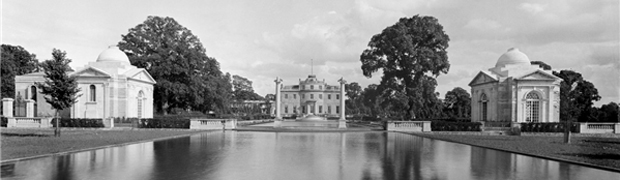
Bathing and Music Pavilions, Tyringham Hall (Image: Country Life Picture Library)

Thankfully what is still intact is one of Sir Edwin Lutyens‘ finest garden schemes.  Between 1924-28, Lutyens was commissioned by the then owners, the Koenigs, a family of Silesian bankers, to create a garden ‘for the recreation of spirit and body‘.  Standing each side of a huge 72m pool, once thought to be the largest of its type in Europe, are two temples; one a bathing pavilion, the other of Music.  Reminiscent of Thomas Archer‘s sublime Pavilion at Wrest Park (1709-11), Lutyens’ interpretation is pared back, less ornamented, but equally impressive – indeed, he himself thought it faultless and would apparently sit in there on his own.

The current vendor, Anton Bilton and family, has lavished millions on restoring the house and grounds (though, he confirms not as much as the £10m previously reported) since buying it for £2.5m in 2001.  However, the £18m asking price quoted in The Sunday Times Home section (28/04/13) seems ambitious; £10m-12m feels more appropriate considering the way the house and estate have been compromised with the now non-private approach, the small housing estate to the east of the main house and the loss of Soane’s original interiors.  Make no mistake, this is still a superb house and sets the bar high for any other house offered for sale this year to be considered as attractive or as interesting.

——————————————————————

Property details: ‘Tyringham Hall‘ – £18m, 59-acres [Savills] Strangely, there is no brochure yet and the launch, through double fold-out spread in Country Life (1 May 2013), feels a touch late.  One wonders whether the Bilton’s were offered a chance to do the Sunday Times piece before Savills were ready and took it anyway?

Excellent selection of photos:

If you wish to find out more about Sir John Soane and are in London, visit his house at Lincolns Inn Fields, which is a museum to his life and work: ‘Sir John Soane’s Museum

Welcome to the market: Lutyens’ The Salutation, Kent

The Salutation, Kent (Image: Knight Frank)

The analogy between language and architecture is one that has often been made, particularly as fluency is the key measure of success in both fields.  An immature architect can make elementary mistakes with the grammar of a building style as much as any tourist abroad can when ordering dinner. In most cases, both novice architect and linguist can be understood but when compared to the more experienced practitioner, skill and mastery come sharply into relief.  Such a lesson by a master architectural linguist has just been launched on the market; The Salutation, in Sandwich, Kent; a beautiful piece of poetry which demonstrates the fluency of the architect in the language of Classicism.

Heathcote, Ilkley (Image: Thursday Dave via Flickr)

Lutyens’ career can largely be seen in three phases; the early years of the ‘Surrey-Tudor’, which evolved into the middle ‘Arts & Crafts’, and then the divergence into the bold ‘Classical’, and its particular variant, ‘Edwardian Baroque’.  That last switch can be seen quite dramatically in the brilliant Heathcote, Yorkshire, built 1906, where Lutyens playfully adopted and adapted the Classical motifs and style of Palladio and Scammozzi to create a wonderfully detailed villa, rich in style and quite unlike his previous work.  After the exuberance of Heathcote (which annoyed Pevsner, who although he commented that it was ‘Only a villa, but how grand the treatment!‘, also dismissed features such as the pilasters which ‘disappear’ into the continuous rustication (see ground floor either side of the windows) as ‘silly tricks‘). On a side note; Heathcote recently sold having previously been bought by a developer/vandal who wished to split the house into two, thus ruining Lutyens’ interior planning – fingers crossed the new owner is sympathetic to this wonderful house.

Lutyens was, of course, part of a longer tradition starting with the first English classical architects practising around the time of Sir Christopher Wren in the mid-17th Century including Hugh May, William Samwell, and Roger Pratt. These pioneers displayed a similar skill in Anglo-Classicism producing buildings such as Cassiobury House (May), the first Eaton Hall (Samwell) and the revolutionary Coleshill (Pratt).  Classicism has long had a place in British architecture, despite other fashions, and has shown its versatility in being used for all sizes of house, from palaces to the smaller country retreat – and it was in this latter requirement that Lutyens was commissioned to build The Salutation.

Located on the site of an old inn of the same name, it was built in 1911-12 in the Queen Anne style as a retreat for Gaspard Farrer, a partner in Barings Bank, and his two bachelor brothers. Lutyens’ clients were typically those who had made money in the decades either side of 1900; that high-point of the country-house lifestyle when staff, materials and labour were relatively cheap. If there is a ‘criticism’ of Lutyens it’s his generosity with regards to space with hallways, alcoves, and large staircases, such as at The Salutation where an extended landing serves as an overflow from the library.  Yet, each space serves a purpose in the plan, typically framing views along axes or as part of a route to the principal rooms which Lutyens often incorporated into houses.

Great Maytham, Kent (Image: Stephen Nunney via Geograph)

The exterior of the house is a smaller derivation of his earlier and much grander Great Maytham, built 1910, for the Liberal MP, H.J. Tennant.  Following the exuberance of Heathcote (which most commentators seem to think came very close to pomposity), Lutyens took a more restrained path through Classicism (compared say, to Richard Norman Shaw at Bryanston House for Viscount Portman) and Great Maytham can be seen as a larger version of Samwell’s Eaton Hall, built 1675, or the smaller Puslinch in Devon, built 1720, with the latter showing clear similarities with The Salutation.

East terrace, The Salutation, Kent (Image: Country Life Picture Library)

The plan of The Salutation is based on the Palladian 3×3 grid but, importantly, Lutyens is able to adapt and amend this without losing the beauty of the proportions.  Gavin Stamp comments that, for Lutyens, his houses were ‘essentially romantic creations; that is, their form is determined by a picture in the architect’s mind‘ and another writer H.S. Goodhart-Rendel compared his ability to that of Wren in that they both had ‘the sculptor’s capacity of making beautiful shapes‘.  Country Life magazine said that it was a ‘dazzlingly suave yet restrained reinterpretation of the old Georgian idiom‘. It was this ability to combine a profound understanding of the Classical rules of architecture with originality which marked Lutyens out as one of the great architects.

To be given a measure of the importance the house, in 1950, it was the first 20th-century building to be given a Grade-I listing.  However, The Salutation suffered in the later 20th-century with the 1980s a particularly difficult time. Repeated attempts by developers were made to either split those graceful internal spaces into apartments or simply demolish it entirely and build on the 3-acre site, over which Lutyens (and possibly his long-term collaborator Gertrude Jekyll) had spent so much time and care crafting.

The Salutation from the garden (Image: Knight Frank)

Salvation for The Salutation came in the form of Dominic and Stephanie Parker who bought it in 2004 for £2.6m and have subsequently spent £3m on its restoration and who now run it as a luxury B&B. Now for sale at £4.5m, for someone with the budget, this could again be a superb home; combining the finest elements of the last boom of the country villa, designed by one of the greatest architects Britain has produced.  For the rest of us, if you’d like to see and experience staying in one of Lutyens finest small houses, I’d suggest booking soon.

———————————————————-

Sale particulars: ‘The Salutation‘ [Knight Frank]

If you’d like to stay; you can book through their website: ‘The Salutation

Video of Mr Parker talking about his decision to buy: ‘The Salutation was ‘like finding a diamond in a river‘ [2009, Kent Online]

Watch the Parker’s competing in a B&B TV competition: ‘Four in a bed‘ [Channel 4]

For more on Lutyens, I recommend Gavin Stamp’s ‘Edwin Lutyens Country Houses‘ [Amazon]

Support the legacy: ‘Lutyens Trust

Listing description: ‘The Salutation‘ [British Listed Buildings]

Bylaugh Hall: the hidden history to a remarkable restoration opportunity

Bylaugh Hall, Norfolk (Image: Chesterton Humberts)

Many country houses we can visit today are innately interesting; the design, the contents, the occupants, all tell a tale.  Sometimes though there are houses with a much richer past which not only have an immediate story to tell but also a much more complex history, one fascinating for anyone with an interest in how these houses came to be created. One such house which was recently launched – and amusingly described on Rightmove as a ‘60 bedroom detached house for sale‘ – is the remarkable Bylaugh Hall in Norfolk, an engineering marvel and architectural delight, which had a forced birth through litigation, which wasn’t wanted by the first owner, and where credit for the design hasn’t truly been given to the right architect.

Bylaugh is remarkable in many ways; some obvious, others less so.  Even its genesis came from beyond the grave as the controversial inherited wish of the last owner, Sir John Lombe Bt (b. c1731 – d.1817), a man whose fortune came from the family’s silk throwing mill in Derbyshire.  The Lombe’s were established Norfolk gentry whose original estate was at Great Melton, centred around Melton Hall (built in 1611 by the Anguish family) but now a ruin having been first tenanted and then, by the end of the 19th-century, abandoned.

Allegedly won by Sir John in a skewed card game, the Lloyds had owned the Bylaugh estate for a number of years, and even if the story is false, it was legitimately Sir John’s by c1796.  The Lombe’s were unusual in that their wealth largely came from industry, and one which was located outside of the county, but they quickly used their fortune to create the fourth largest estate in Norfolk, at over 13,000-acres by 1883.

Whatever house was already at Bylaugh was insufficient for Sir John so he resolved to build an entirely new one.  However, the house he had in mind was not the house which was built.  Sir John must have had a fair idea that he would not survive to see his grand plan to fruition but he certainly wasn’t going to let mere death cheat him of his ambition.  Having placed £20,000 in trust for the express purpose of building the house – though without approving a design – he died in 1817 (unmarried and childless), leaving his estate and his firm directions to his brother Edward. Here, the family history becomes a little complicated as Edward was his half brother, the product of an affair with a Norwich doctor’s wife.  Edward adopted the Lombe surname but was reluctant to take on the grand role envisioned by his late brother – which is perhaps why Sir John’s will was so prescriptive, and which led to a quite extraordinary court case.

Edward Lombe disputed with the executors of the estate the instruction to build the new house.  However, Sir John had been quite clear, including this fascinating clause in his will:

And whereas it is my wish and intention that a mansion house and suitable offices fit for the residence of the owner of my estate shall be erected on some convenient spot in the parish of Bylaugh in the county of Norfolk either in my lifetime or after my death and that if I shall not erect the same in my lifetime then that my said trustees shall forthwith after my death erect the same according to such plan as I shall in my lifetime approve of or if I shall die before such plan shall be prepared and completed then according to such plan as the trustees or trustee for the time being under this my will with the consent of the person for the time being beneficially entitled to the immediate freehold of my said manors &c under this my will shall think proper to adopt adhering as closely as possible situation and other incidental circumstances being considered to the plan of the house now the residence of Robert Marsham esquire at Stratton Strawless in the said county of Norfolk. (source)

Yet Edward resisted, delaying the start of the build for years by arguing with the executors, Mr Mitchell and Mr Stoughton, and stating that even if they built the house he wouldn’t live in it.  Finally, in 1828, he went to the Court of Chancery and demanded that the money, now having grown to £43,000, be placed with it and a judgement made as to whether he could overturn the provisions of his brother’s will. The case was still undecided in 1839, by which time the fund had grown to over £63,500, when Edward again pressed his case, with a decision finally being made in 1841 – against him.  The Vice-Chancellor said:

It appears to me to be impossible to read this passage in the will without seeing that there is in the plainest language an express trust for the erection of the mansion house which the trustees are forthwith after his death to commence and to proceed with the erecting of. I cannot conceive any words more plain.

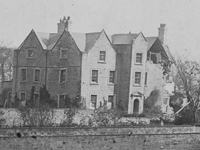
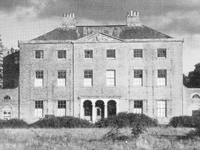
Stratton Strawless Hall, Norfolk - pre 1960 (Image: 'The Country Houses of Norfolk' by David Clarke)
Stratton Strawless Hall, Norfolk – pre 1960 (Image: ‘The Country Houses of Norfolk’ by David Clarke)

Which rather settled that. In the meantime, the executors had not been idle in their duties – but they weren’t as obedient as they might strictly have been.  Sir John had clearly stated that the house was to follow ‘as closely as possible‘ Sir Robert Masham’s house at Stratton Strawless; a three-storey (now two), strictly classical, almost Palladian house with a Tuscan-columned porch.  However, the executors ignored this provision and with possibly an eye to emphasising the esteemed family line and to help the new house blend in with the other seats in the area, they chose to create a historical ‘Jacobethan’-style house – but even that is not the one we see today.

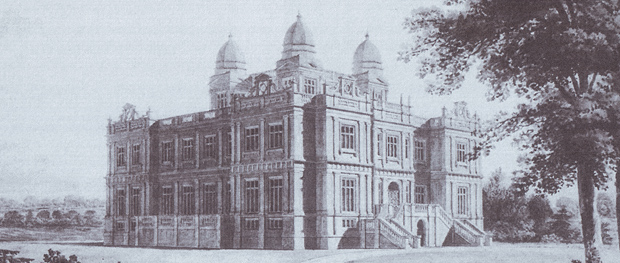
Interestingly, although the current Bylaugh is rightly described as being designed by Charles Barry the younger and his partner, Robert Robinson Banks, few are aware that in 1822 the trustees had originally asked another noted architect, William Wilkins (b.1778 – d.1839), to draw up a plan, and his design showed a remarkable stylistic similarity to the one actually built 27 years later.

Unexecuted design for Bylaugh Hall by William Wilkins, 1822 (Image: Public Record Office MPA. 66.1 / 'William Wilkins, 1778-1839' - R.W. Liscombe)
Unexecuted design for Bylaugh Hall by William Wilkins, 1822 (Image: Public Record Office MPA. 66.1 / ‘William Wilkins, 1778-1839’ – R.W. Liscombe)

Although a noted proponent of the Greek Revival, Wilkins, like many an architect, was well-educated in other styles and could turn his hand if asked. Clearly inspired by the style of ‘Prodigy‘ houses such as Burghley and Longleat, he also drew on elements of buildings he had seen and studied – for example, the polygonal domes capping the raised central hall are copied from the Porta Honoris at Gonville and Caius College, Cambridge, on which Wilkins had written a scholarly article for the esteemed ‘Vetusta Monumenta‘ in 1809. Although each façade was similar, the entrance front was enlivened by a projecting centre bay above the door which was on the piano nobile, reached by an elegant split stair.

The plan of the house was also modern, rejecting a rambling layout, and firmly following the Palladian 3×3 grid on the ground floor.  Centred around a double-return staircase, this was an innovative layout for an early Victorian design – though one Wilkins the classicist would have been entirely comfortable with.  Essentially, he had designed a Palladian villa, dressed in the architectural garb of the ‘Jacobethan’ style.

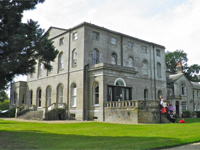
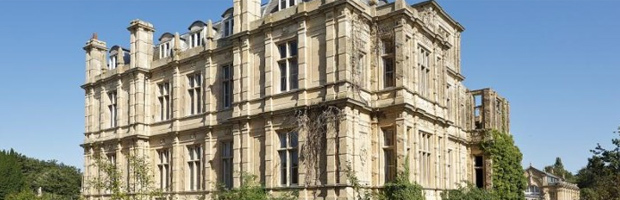
Bylaugh Hall today (Image: Chesterton Humberts)

Bylaugh Hall, as attributed to Barry and Banks in 1849, was perhaps better described as an updated version of Wilkins earlier plan – the core 3×3 layout remained, as did the external style, though some of the details such as the raised central hall and domes were removed, and the central staircase replaced by a saloon.  The construction did display some innovation, being one of the earliest steel-framed buildings and was considered a success with one rather giddy local newspaper exclaiming ‘Neither Holkham nor Houghton, those Norfolk wonders, can compare with it for either appearance or comfort‘.  Such wild exaggeration aside, this was a house at the forefront of domestic convenience and was commended in The Builder for having no corridors in the main block, which maximised the space.  It was completed in 1852 at a cost of £29,389, and by 1869 it was reported that £38,000 had been spent on the project, which would have included further works on estate buildings and landscaping (see photos of the house and grounds c1917).  An interesting aside is that during the delay in starting the money had grown to quite a considerable sum, more than enough for all the works.  Edward Lombe applied for the remainder but the Court demanded it be spent on bricks and mortar and so a 4-mile perimeter wall was constructed to satisfy this.

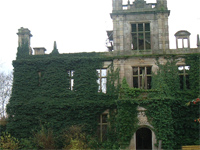
Ruined shell of Bylaugh Hall before restoration (Image: The Burrell Partnership)

It seems that no descendent ever loved the house.  By 1878, the then owner, Edward Henry Evans-Lombe, was renting the handsomely Classical Thickthorn Hall, before buying Marlingford Hall, whilst selling off outlying parts of the estate.  In 1917, Bylaugh Hall and the 8,150-acre estate were put up for auction in 140 lots but Edward sold it whole for £120,000, and the hall and 736-acre park were subsequently sold to the Marsh family.  Used by the RAF in WWII, it was sold in 1948 to a new owner who unsuccessfully planned to turn it into a nursing home.  At that nadir of country houses generally, a familiar pattern started; parts of the house were demolished and in June 1950 a 350-lot demolition sale was held which stripped the interiors of the house, creating a gaunt and sad shell.  So it remained until, in 1999, the house and a lodge was sold to a local sculptor who dreamt of fully restoring the house but with insufficient funds he was forced to restore just the Orangery (article by the engineers with lots of photos), intending it to be a wedding venue.  Other parts of the main house were parcelled up as investments and rebuilt but the plan faltered and then failed, leaving the partially restored house we see today.

So Bylaugh Hall is a house paid for by a man who never got to see it, with a design chosen by two men who ignored the last wishes of the patron, with credit for that design going to two men who relied heavily on another architect now obscured, for a beneficiary who really didn’t want it in the first place. A brilliant story richly illustrating the fascinating complexities of our country houses.

So what should happen to this superb house? Interestingly, the 557-acre Pavilion farm which surrounds the east and south of the house, and includes one of the original lodges, is also for sale, providing the opportunity for the right person to combine them both.  It would require real vision – the restoration work at Bylaugh Hall may be sound but the aesthetics are dire.  Given the budget, much of the existing restoration should be stripped right back and the interiors given the lavish attention they demand.  This is a house which cries out for sumptuous plasterwork and panelling, for grand rooms with fine wallpaper and filled with artworks and quality furniture. With the funds and the vision to take advantage of this rare opportunity, a restored Bylaugh Hall, combined with the farm and more land later, could once again create one of the finest estates in Norfolk.

—————————————————————————–

Property details

1917 auction catalogue:

Listing description: ‘Bylaugh Hall‘ [British Listed Buildings]