A labour of love: the restoration of Hammerwood Park

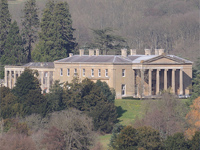
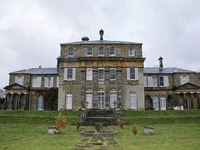
Hammerwood Park, Sussex (Image: South Downs Living)

Once a house has sunk to such a level of dereliction that even the developers won’t take it on, this can easily lead to an application for demolition and the loss of another piece of our architectural heritage.  Yet, as we see in the media, there are often people willing to commit themselves and their money towards saving these beautiful homes – Hammerwood Park is one which certainly falls into this category.

The house was built in 1792 for Benjamin Sperling and is particularly important as the design of the house was the first commission of Benjamin Latrobe (b.1764 – d.1820) who was later to be hugely influential in the direction of American architecture.   Latrobe had studied architecture privately and served for a year from 1789 as an architectural draughtsman in the office of neo-Classical architect S.P. Cockerell. Howard Colvin suggests that Latrobe was also strongly influenced by the work of French architects such as Étienne-Louis Boullée whose own strictly neo-Classical style emphasised the paring back of unnecessary ornamentation and the use of grand scale with repetitive elements.  Through Hammerwood Park it’s possible to see this philosophy in practice with the giant pilasters on the garden front and the miniature temples on the flanking wings.

The early death of Latrobe’s wife in 1793 caused him to abandon Britain and head to America where he made friend’s with President George Washington’s nephew.  It was these contacts which enabled him to obtain further commissions including the Bank of Pennsylvania in Philadelphia which has been described as the ‘first monument of the Greek Revival in America’ (dem. 1867).  It was this and his later work designing the first Capitol building in Washington which so greatly influenced the future of American architecture towards the ne0-Classical which is so evident even today.

That a building as interesting as Hammerwood Park was ever allowed to deteriorate to that extent was unfortunately all too common in the post-WWII era. It is only the dedication of it’s current owner, David Pinnegar, that has probably saved the house from conversion or even demolition.  After various owners it was requisitioned during WWII for use by the Army who left it in their usual poor condition.  Post-war, the Chattell family, who then owned the house, sub-divided the house into flats but as dry rot took hold, the residents moved out and the house was sold in 1973 to the rock group Led Zeppelin for use as a country retreat to work on their music. However, touring commitments meant they never moved in (and rumour has it they even forgot they owned it) and whilst empty, thieves took the roof lead leading to massive wet rot outbreaks.  The house was boarded up in 1976 before finally being offered for sale in 1982 in Country Life magazine with the marvellous understatement that it was ‘in need of modernisation’.

David Pinnegar, then only 21, bought the now grade-I listed house and has since dedicated his life to its restoration.  The vast house has revealed many interesting architectural nuances as he and many volunteers have worked through the vast catalogue of repairs. Although he has secured some grants from English Heritage, the vast majority of the work has been financed through day visitors, B&B guests, and its use as location for a wide variety of films and music video shoots.  In many ways, David’s dedication is proof that all houses, no matter how poor their condition, can find a saviour.

Full story: ‘Hammerwood Park, East Grinstead: Whole Lotta Love‘ [South Downs Living]

House website: ‘Hammerwood Park

A problem shared? Whitbourne Hall visited by Country House Rescue

Whitbourne Hall, Herefordshire (Image: David Cronin on flickr)

The great wealth generated by the Victorians led to the creation of some of our grandest country houses.  Designed to impress guests and provide a showcase for the collections and taste of the owners, these houses were remarkable and beautiful expressions of the power and preferences of the age.  However, in the more straitened circumstances of the 20th-century, this left owners with running costs which far outstripped their wealth and which unfortunately led to hundreds of our country houses being demolished.

Some escaped the wreckers pickaxe through conversion into apartments – but this doesn’t always solve the questions about the long term sustainability of a house, as shown by the visit of the TV programme Country House Rescue to Whitbourne Hall in Herefordshire.

The grade-II* listed house was built for vinegar magnate Edward Bickerton Evans whose father founded the Hill Evans Vinegar works in Worcester in 1830, which was, by 1905, the biggest vinegar producer in the world.  As was standard practice for the discerning Victorian millionaire he decided to build a grand country house and chose a cornfield in Whitbourne as the perfect location.

Despite its Georgian appearance, it was built between 1860 and 1862 to a design by Edmund Wallace Elmslie and inspired by the Erectheum on the Acropolis in Greece. The house was a lavish example of neo-Palladian architecture with a six-column portico, whilst on the south front a huge orangery, now known as the palm house, was added in 1875 and was thought to be the tallest in Europe.  The interior features a fine pillared main Hall with a rare blue and white glass ceiling, and the main reception rooms retain many original features.  At it’s height in 1876, the estate extended to over 2,500 acres with the classically beautiful Whitbourne Hall sitting proudly at the centre.

Remarkably, the Hall remained in the Evans family until 1980, when it was purchased by Whitbourne Hall Community Ltd to be run as a communal housing project with individual apartments and set in eight acres of gardens.  This original arrangement floundered and a commercial company was created to run the house as a more conventional managed community of 23 apartments.  The main rooms have been preserved much as they were with the Morning and Drawing Rooms retaining their original wall coverings.  However the sheer scale of the house means that the average annual maintenance bill is about £42,000 – and due to extensive and significant work required to maintain a house of this quality, that bill is expected to double in 2011, posing serious problems for the residents.  Extensive restoration is now required as the house is now suffering from a catalogue of issues including failing plasterwork as water penetrates through the coffered ceiling of the main hall.    Curiously Whitbourne Hall doesn’t seem to be on the English Heritage Buildings at Risk Register – it would be interesting to know why not.

One of the perennial difficulties of owning a country house is not just the huge costs such as heating but also the ongoing maintenance (as demonstrated by the Earl Spencer’s sale), the costs of which, rise significantly the higher the classification.   With the paucity of public grants for maintenance it falls to the owners to seek innovative ways to make these wonderful houses financially self-sufficient if possible.  However, as Country House Rescue often shows, it’s the owners who can sometimes be the problem who need to be convinced before they become part of the solution.

More details: ‘Country House Rescue‘ [Channel 4]

Minister ignores good advice: Scraptoft Hall

Scraptoft Hall (Image: wikipedia)

John Denham, the Secretary of State for Communities, has overruled the experts at English Heritage and approved the view of a local planning inspector which will see Scraptoft Hall forever compromised as a country house and reduced to a mere architectural footnote of a massive retirement village.

As had been previously reported (‘Scraptoft Hall at risk from ‘rescue’‘) a developer had used the standard excuse of ‘enabling development’ to propose building a massive 103-unit retirement village with the restoration of the house as a ‘reward’ to the council for this vandalism.  The house, although in a serious state of disrepair, is an important local house largely built in the 1720s but with a core dating from the 1500s.  A period as accommodation for Leicester University ensured that, although not ideal, the house was in use and maintained.  Once the university had left, the vandals and thieves moved in leaving the house as a juicy target for the developers.

It seems that the entire concept of ‘enabling development’ has been seriously compromised to allow councils (sometimes with the connivance of central government as in this case) to get around inconvenient restrictions on building houses.  Although it’s obviously of some social value to provide housing, it seems crass that the price to be paid for new homes is the irrevocable loss of important local buildings, and particularly country houses which are designed to stand proud in their settings.  Consider the English Heritage guidance on the appropriate extent of ‘enabling development’:

“English Heritage believes that ‘enabling development’ to secure the future of a heritage asset is unacceptable unless …it is demonstrated that the amount of enabling development is the minimum necessary to secure the future of the heritage asset, and that its form minimises harm to other public interests.” – emphasis mine – quoted from pg 9-10 of ‘Enabling development and the conservation of heritage assets‘ [PDF])

Reading that it seems incredible that the minister thinks a 103-apartment residential development is the ‘minimum necessary’.  I imagine that if there was a comprehensive review of the use of the ‘enabling development’ excuse many councils would be found to have waived through inappropriate schemes to meet ulterior motives.

So unfortunately Scraptoft Hall is to be sacrificed with the acquiescence of not only the local planning department, the local council, the local MP but also the minister who should ultimately be the last line of defence against these highly damaging schemes.  A further problem is that each time one of these schemes is approved it creates a damaging precedent which is then used against other houses which sadly find themselves the target of the rampaging developers.  If only English Heritage had a legal right to veto schemes which, in its expert opinion, were a gross abuse of the spirit and letter of the planning legislation.

More details: ‘Villagers hail ‘yes’ to plans for historic Scraptoft hall‘ [Leicester Mercury]

Despite objections, Forty Hall renovation to proceed as planned

Forty Hall, Enfield (Image: Enfield Independent)

Despite objections from the Victorian Society, the plans for the extensive works at Forty Hall planned and then self-approved by Enfield Council will start later this year.  As reported earlier (‘Forty Hall ‘renovation’ gets approval from council but probably not from everyone else‘) the council proposed to make some significant alterations to the Grade-I listed house which seem to threaten the interiors but the latest story gives a very rosy view of the plans.

It seems that little has been changed from the original plans and the council will proceed with the plans despite the various concerns about the proposals.   Official bodies have a long history of believing themselves to be right despite credible evidence to the contrary so this determined attitude is not unsurprising.  It does seem a shame that heritage protection has now been superseded by a belief that the ends justify the means – with one of the most used phrases being that the changes will promote ‘community access’.  However, any plans should always bear in mind that the house is not simply a resource to be used but a vital part of local heritage which is not simply for this generation to (mis-)use as they might see fit.  It will be interesting to see whether the council can deliver an architecturally sensitive project or whether the warnings and concerns of others will be proved valid.

More details: ‘Enfield’s crown jewel, Forty Hall, to be restored from next year‘ [This is Local London]

How did Bessingham Manor get into this state?

Bessingham Manor, Norfolk (Image: Eastern Daily Press)

Norfolk has suffered the loss of many of it’s larger country houses but the smaller houses often not only survived but were much cherished as manageable but beautiful examples of local architecture.  Yet, even today it’s possible for one of these lovely red-brick homes to slip into dereliction, at risk from the weather and criminals; Bessingham Manor has become another of these sad examples.

Built in 1870 for the Spurrell family, who had farming connections in Suffolk going back over 500 years, the house originally had 52-acres but this has now been reduced to a more manageable five.  The house remained in the Spurrell family until the last member died in 1952.  It was then bought by Robert Gamble who eventually found maintenance a significant challenge which was compounded by a poor quality roof repair which failed leading to massive water damage to part of the house, including the collapse of sections of the second floor.  The near derelict state of the interior is mirrored in the exterior which is partially supported by scaffolding or probably held together by the extensive ivy.  Perhaps questions should be asked as to why this gradual decay was not spotted by the local conservation department who may have been able to force repairs before the damage became so extensive?

It was in this sorry state that the house was finally put up for auction in September 2009 with the agents, William H Brown, who optimistically thought it might go for around £900,000 – despite a likely £1m bill to fully restore the house.  Unsurprisingly, it failed to reach even the reserve of £640,000 from a starting price of £400,000.  To compound the problems, thieves also broke in and stole a fireplace from one of the ground floor rooms.  Despite this the agents have continued to try to find a buyer but with only limited success.

By the beginning of 2010, there were three offers on the table.  Two were from individuals looking to create family homes but worryingly, one of the offers still in the table was from a developer looking for a commercial project – which is probably an inappropriate enabling development.  With all the wealth still available and our nation’s ostensible love of older buildings, it is sad and mystifying as to it’s been so difficult to find a sympathetic owner.   Once restored the house would probably be worth several million – so if someone has approximately £1.5m needing a profitable use then this would be the ideal opportunity; just please do it sensitively.

Estate agent: William H Brown

—————————————————–

Good news

Despite the initially pessimistic outlook and the subsequent challenges, Bessingham Manor has survived, and more than that, is nearing completion of the restoration – see this comment left on another Country Seat article by William Hickey. This shows that the analysis of developers should often be taken with a measure of scepticism, especially where heritage assets are involved.  The rescue/restoration of Bessingham Manor is to welcomed and the owners congratulated for their success.