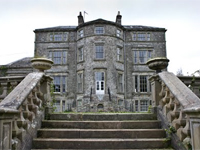
Monreith House, Scotland (Image: Mike Harrison / UK Wildlife Photography)
Country House Rescue heads from Tapeley Park in Devon to the other end of the country to Monreith House in Galloway, Scotland. A dignified house, it has suffered from a classic problem for those that inherit, as the current owner Sir Michael Maxwell did in 1987, that: “…to put it politely, my relatives’ expenditure exceeded their income by many times.”. The necessary economies forced on Sir Michael have meant some cut corners which Ruth Watson quickly identifies as hindering his attempts to move upmarket.
The Maxwells of Monreith were certainly aristocratic with their baronetcy granted by Charles II in 1681 and various family members marrying well including the 8th Baronet’s wife, Lady Mary, who was a daughter of the Duke of Northumberland, one of the richest and largest landowners in England. The Maxwells had been based at Myrton Castle since they bought it in 1685, obviously needing a house to match their newly elevated status.
Leuchie House, Scotland (Image: John Small - 1883 / buildings fan on flickr)
Monreith House was built in 1791 by Sir William Maxwell, 4th Baronet, to replace Myrton, which was partially demolished to provide building materials for the new one. The architect was the Edinburgh-based Alexander Stevens, son of a better known Alexander Stevens who specialised in designing and building bridges. His design at Monreith shows that he was well versed in the Palladian vocabulary but is in contrast to his other principal design; the impressive Raehills in Dumfriesshire, built for the 3rd Earl of Hopetoun in 1786, which is an imitation of Robert Adam‘s castle style. Monreith shows closer similarities with Leuchie House in Lothian, built for Sir William Dalrymple between 1779-1785, to designs by the little known Alexander Peacock who was also based in Edinburgh. By the 1790s, the first wave of Palladianism had long ago swept through the country and much provincial design can be traced back to the many architectural pattern books which had been produced. Stevens’ limited but varied output could indicate he used also used them, though perhaps more competently than most.
The Maxwells of Monreith became one of the most important families in the area with a substantial estate which totalled 17,000-acres. The house has passed down through the Maxwells, though it never went to the most famous of the family, the writer Gavin Maxwell, heir to the 8th Baronet, Aymer Maxwell, but who died of cancer in 1968. Gavin’s books were best-sellers, with his most famous being the autobiographical ‘A Bright Ring of Water‘ about his pet otter, the profits of which might have helped the estate but for his profligate ways. His father also faced financial difficulties and, lacking funds to maintain the house, apparently felt it easier – and cheaper – to let the house deteriorate rather than pay to have it demolished.
When Sir Michael inherited the house from his uncle it was in a seriously neglected state, saying he remembers that “When it rained hard the water would run down the stairs and land in puddles on the floor.”. Sir Michael had trained as a surveyor so he was able to approach much of the work himself – though this also appears to be part of the problem. One money-making scheme was to convert the top floor into holiday flats but these, and the rest of the house, all show signs of his major flaw – a determination to do things as cheaply as possible leading to various poor choices which compromise his aspirations.
Sir Michael displays an admirable duty towards maintaining the house – a contrast to that displayed initially by Hector Christie of Tapeley Park in the previous episode. Sir Michael says “It would be too easy if your great-grandfather dropped dead and left you money to end up a drunk in the gutter – so it’s a challenge. Essentially, you’re not given much choice when you inherit a house like this.”. Thankfully he does appear to want to listen to Ruth Watson’s advice and one hopes that this will put him on the path to a sustainably prosperous future which will ensure the Maxwells remain at Monreith.
One of the main satisfactions of having a house built is that, as it’s your money, you get to decide the style, design, scale and detail according to your whims. With many of the stranger flights of fancy now curtailed by cost or planning controls it’s interesting to look at earlier houses built without such restraints and, in particular, those which incorporated horological elements creating the phenomena of the ‘calendar house’; that is, where the architecture was influenced according to the number of days, weeks or months in a year.
The genesis of the calendar house appears to have been in the intellectually fertile Elizabethan period when the elite of society revelled in the advances of science, mathematics and astronomy. They also had a great love of the ‘device’ which in the 16th-century meant any ingenious or original shape or concept. Mark Girouard, in his excellent book ‘Elizabethan Architecture – Its Rise and Fall, 1540 – 1640‘, states that although there are precursors to the idea of an entire building as a device – which can be seen in the designs of Henry VIII’s forts and and contemporaries’ gatehouses – this was its extent.
Under the Elizabethans, this idea can be seen to grow – from gatehouses to entrance fronts to courtyards (before they disappear) and the whole house is the device. Yet for all the intellectual attraction, the idea of the form of a house being dictated by the calendar is actually quite rare. In fact, Girouard’s book doesn’t mention the idea at all, as technically the first house to incorporate these principles, Knole in Kent, was built in 1604 by one of her courtiers, Thomas Sackville, 1st Earl of Dorset, a year after Elizabeth I‘s death.
The principle of the calendar house is that the number of external doors, windows or panes of glass, chimneys, or staircases etc should total either 4 (the number seasons), 7 (days in a week), 12 (months in a year), or 365 (days in a year). So in Knole’s case, the calendar is represented through the 365 rooms, 52 staircases and 7 courtyards. It is this choice of the number of which elements that provides the variation to the theme and can lead to the creation of palaces such as Knole. It also helps explain the relative scarcity of these houses as they require a certain commitment from the owner to complete the build and not compromise on the plans for fear of spoiling the totals.
One of the most compact of the calendar houses was built in 1681 – Scout Hall in Yorkshire. This wonderful house – which would give Hardwick Hall a run for its money for the phrase ‘more glass than wall’ – was built for a local silk merchant, John Mitchell, by an unknown designer and includes 365 panes of glass and 52 doors. Considering the rarity of calendar houses, it’s interesting to consider how this concept suddenly appeared over 70 years after the first and several hundred miles north. Perhaps Mitchell’s trade had taken him south and he had been to, or heard of, Knole. Who knows? What we do know is that this grade-II* house has been on the ‘buildings at risk register‘ for many years and has been derelict since the 1980s.
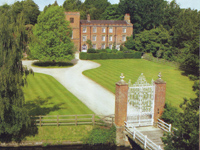
Cairness House, Aberdeenshire
The next appearance of a calendar house is in the far north at Cairness House in Aberdeenshire, designed by the renowned architect James Playfair and built between 1791-97 for Charles Gordon of Cairness and Buthlaw as the centrepiece of his 9,000-acre estate. What’s particularly remarkable about the house is that it resolutely neo-classical in design – a very unlikely style to marry with such a whim. Yet Charles Gordon had something of the Elizabethan love of the ‘device’ as the design contains numerous Masonic and pagan symbols with even the overall layout of the house making the initials ‘CH’.
Holme Eden Hall, Cumbria (Image: Smiths Gore estate agents)
It would be another forty years before the idea would be used again – this time in Cumbria in the construction of Holme Eden Hall in 1837. Built in a Tudor gothic style for a local cotton mill owner, Peter Dixon, to designs by John Dobson, a prolific local architect responsible for the remodelling of Newcastle-upon-Tyne and who worked on over one hundred country houses. Dobson had the rare facility of being able to competently design in many styles so it’s possible that the idea of the calendar house came from the owner; this time featuring 365 panes of glass, 52 chimneys, 12 passageways, 7 entrances and 4 storeys. The choice of the number of which elements was probably dictated by the budget as Dixon couldn’t have afforded to construct a house on the scale of Knole. After becoming a convent, the house fell into some decay but was converted by intelligent developers who kept the theme going and created 12 apartments, each named after a month.
Balfour Castle, Isle of Shapinsay, Scotland (Image: Balfour Castle)
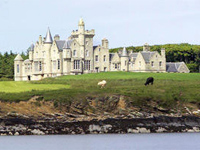
The next house appears in Scotland again; Balfour Castle on the Isle of Shapinsay. This was a remodelling of an existing house by the famous Scottish architect David Bryce, who did so much to popularise the ‘Scots Baronial’ style we now associate with the country. The owner was David Balfour whose grandfather had originally purchased the house and estate in 1782. The Bryce alterations were completed in just two years from 1847 and the calendar theme this time produced 365 panes of glass, 52 rooms, 12 exterior doors, and 7 turrets.
Bradgate House, Leicestershire - dem. 1925 (Image: Lost Heritage)
Bradgate House, Leicestershire was built in 1854 for the extravagant George Harry Grey, the 7th Earl of Stamford, though it was only to survive 70 years before being demolished in 1925. A gentleman sportsman with a liking for the Turf, the 7th Earl was probably inspired by the contemporary Victorian fashion of connecting families with their real (or sometimes imagined) ancestral past and building an Elizabethan style house would remind everyone that the Grey family had first been elevated to the peerage by Queen Elizabeth I. Exactly why he chose a calendar scheme is unknown but the house included 365 windows, 52 rooms and 12 main chimneys.
The Towers, Didsbury, Lancashire (Image: Paul F Hamlyn)
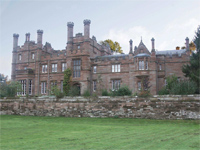
Although perhaps not strictly a country seat, The Towers, in Didsbury, Lancashire was built between 1868-72 as a rural escape for the proprietor and editor of the Manchester Guardian, John Edward Taylor. Designed by Thomas Worthington in a bold gothic style, it was reputed to have cost £50,000 to build – equivalent to around £3.3m today, and features 365 windows, 52 rooms and 12 towers. Pevsner appears conflicted about it describing it as both ‘…grossly picturesque in red brick and red terra cotta’ but also as ‘the grandest of all Manchester mansions’. It was subsequently purchased in 1920 for just £10,000 and became the headquarters for the British Cotton Industry Research Association and became known as the Shirley Institute, before becoming rental offices sadly surrounded by bland office blocks.
Bedstone Court, Shropshire was designed in a completely different style – mock Elizabethan – but again followed the pattern with 365 windows, 52 rooms, 12 chimneys and 7 external doors. The house was designed for Sir Henry Ripley by Thomas Harris, and had survived largely intact despite changing from use as a home to a school, until a serious fire in 1996 severely damaged large sections of the house necessitating extensive restoration.
Avon Tyrrell, Hampshire, completed in 1891 and now grade-I listed, was, as far as is known, the last calendar house to be built in the UK and incorporates 365 windows, 52 rooms, 12 chimneys, and 7 external entrances. Designed by the distinguished Arts & Crafts architect W.R. Lethaby, a founding member of the architectural conservation charity the Society for the Protection of Ancient Buildings, he was also particularly interested in architectural theory and design, so it is likely that he would have suggested the idea of the calendar house to Lord Manners. The client was a wealthy racehorse owner who built the house on the back of his winnings from a famous bet he made in 1881, that he could buy, train and ride the winner of the 1882 Grand National – which he did. Lord Manners donated the house to the “Youth of the Nation” and it is now an activity centre.
Considering that the idea of the calendar house was essentially Elizabethan in conception, it’s interesting to note that only one was built in that time, with the next in the late 17th-century, one in the 18th-century, but that it was the Victorians who produced the most. Perhaps this was a reflection of their interest in time, order and structure but also a revival in the Elizabethan delight in science and challenges. As a distinct group of houses they deserve to be better known – and in the case of Scout Hall, it deserves to be treated as a priority for rescue and restoration before it runs out of time.
—————————————————————————————–
Two other houses may also be calendar houses but I haven’t been able to reliably confirm this:
Kinmel Hall, north Wales – said to have 365 windows on the front elevation, 52 chimneys and 12 external doors.
Welcombe House, Warwickshire – now a hotel and has undergone significant alterations but is supposed to have 365 windows, 52 chimneys, 12 fireplaces and 7 entrances.
Country houses are often launched on the market to catch either bonus money early in the year or those looking to move before the summer. However, circumstances or owner preference can lead to some interesting houses being given a promotional push in the autumn (usually through Country Life magazine) to catch those who fancy Christmas in front a different log fire. So, here’s a quick round-up of some of the better country houses currently for sale.
Upton Pynes, Devon (Image: Upton Pynes website)
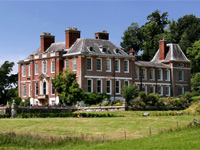
Easily one of the most impressive houses is one that has always been a sign for me that I’m nearly home when travelling back to Devon on the train. Just outside Exeter is the beautiful grade-II* listed Upton Pynes, which, despite the very English sounding name, bears a striking resemblance to a French chateau. Built c.1700 by Hugh Stafford with very sympathetic later additions, this large but elegant house sits in a commanding position in the Exe Valley, perfectly positioned to catch the sun throughout the day, giving the red-brick façades a warm glow. Described by Pevsner as “…an excellent example of the stately double-pile house that became popular after the Restoration but is relatively rare in Devon.”, the interior features a particularly grand entrance hall created as part of alterations in 1852 by the architect Ambrose Poynter for Sir Stafford Henry Northcote (later the Earl of Iddesleigh). The main interiors of the house, including an enfilade of rooms on the south front and a notable library, largely dates from 1700. The house also has the claim that it was the one Jane Austen had in mind when describing ‘Barton House’ in ‘Sense & Sensibility’. The house still requires some restoration but will definitely reward whoever completes this grand project.
Sometimes a grand house designed by an interesting architect can remarkably remain unlisted, as is the case with the Edwardian Crendle Court in Dorset which was designed by Walter H. Brierley (b.1862 – d.1926) who has been described as ‘the Yorkshire Lutyens’. A prolific architect, he designed over 300 buildings including schools, churches and several country houses including the elegant neo-Georgian Sion Hill Hall in Yorkshire. Brierley was a versatile architect able to work successfully in various styles though with a preference for ‘Wrenaissance’ – a modern re-working of the architectural language of Sir Christopher Wren. Crendle Court was built in 1909 and features elaborate ornamental plasterwork in the main reception rooms by George Bankart, and sits, well, more luxuriates, in 270-acres of grounds. Considering the architect and the quality English Heritage ought to send someone round to evaluate and spot list it before it gets ruined by someone with more money than taste.
Other significant houses available were launched earlier but are now being promoted following price cuts. One such house is the grade-II* listed Rudby Hall in Yorkshire, which was originally given a guide price of £3.5m but now is offered at £2.75m. Designed by Anthony Salvin in 1838 for the 10th Viscount Falkland, who originally called it Leven Grove, but by the late 19th-century it was known as Skutterskelfe Hall before being given its present name by the company which owned it in the 1990s. The house was restored in the 1980s and comprises the main house but with the ancillary buildings converted into let accommodation bringing in a handy £50,000 p/a – so long as you don’t mind sharing your gardens, grounds and woodlands with them.
For those who fancy something more baronial, then Blairquhan Castle in Ayrshire, Scotland may be perfect. The core of the property is a tower house built in 1346 but was later given a new front by William Burn in 1820-24 to provide the imposing if slightly stern façade we see today. The estate was noted for it beauty with Lord Cockburn writing in 1844: “I rose early…and surveyed the beauties of Blairquhan. It deserves its usual praises. A most gentleman-like place rich in all sorts of attractions – of wood, lawn, river, gardens, hill, agriculture and pasture.”. What more could a squire desire?
Most of these houses seem to be with Savills so to even things up, and to include a house I’m surprised hasn’t sold already, is Beaurepaire in Hampshire. The house was featured on the blog in more detail (‘Phoenix for sale: Beaurepaire House, Hampshire‘) when it was first launched in June this year. The house is what remains after a devastating fire in 1942 destroyed the main block of the house, leaving the current service wing which was extensively refurbished and remodelled after WWII to give the elegant house which is for sale today. Approached down a long drive, what guest couldn’t fail to be impressed by the wonderful gates designed by Sir John Soane which guard the entrance over the moat? Sitting in a 250-acre estate, the £8m price tag is probably justified for the area – and the owner is apparently in no rush to sell so don’t expect any big price cut soon.
Wrest Park, Bedfordshire (Image: English Heritage)
For all the traditional antipathy towards the French, the influence of their architecture has been felt throughout Britain’s country houses. Although initially the use of the French architectural vocabulary was a sign of wealth and education only available to the best families, the style was regarded as sullied by the later, more energetic, constructions of the Victorians – an association which still sadly lingers today.
The first wave of Anglo-French design started in the Elizabethan period; a time when it was acceptable to display one’s knowledge conspicuously. The French style, with its dramatic rooflines, dovetailed with the traditional English manor house and its own profusion of gables and chimneys. Houses such as Burghley in Northamptonshire made dramatic use of the style with the central, three-storey pavilion, dated 1585, based on the French triumphal arch but oddly includes a traditional mullioned window on the third floor. Burghley was the product of the owner, Lord Burghley, an architectural enthusiast who as far back as 1568 was known to have been writing to France to obtain specific architectural books.
This early use of the French style was relatively restrained – probably more by the conservatism of the ruling gentry who were most likely to be building these houses. Yet, our impressions now are more strongly influenced by the bolder, more assertive French style which was so popular during the Victorian era – though this same popularity was to also lead to it being derided.
The first of the Victorian nouveau-riche were keen to be accepted by society and so built houses which largely followed the same designs used by the local families. The end of the Napoleonic wars in 1815 led to a rush across the Channel leading to a revival of interest in French design, particularly in relation to interiors, such as the Elizabeth Saloon at Belvoir Castle, Rutland, built c.1825. By the mid-nineteenth century this was being more confidently expressed in dramatic houses which sought to boldly make their mark.
The second French Renaissance was influenced by lavish works such as the new block at the Louvre in Paris, built between 1852-70. However, there were earlier examples such as the complete Louis XV chateau at Wrest Park in Bedfordshire, designed by the owner Earl de Grey, built in 1834-39, and Anthony Salvin’s French roofs added to Oxonhoath in Kent in 1846-47. Yet, after the Louvre, the fashion gathered pace with designs such as R.C. Carpenter’s redesign of Bedgebury in Kent in 1854-55, and Salvin’s work at Marbury Hall in Cheshire in 1856-8. Less successfully, the architect Benjamin Ferrey built Wynnstay in Denbighshire for Sir Watkin Williams-Wynn which, for all its dramatic high roofs and pavilions, was thought rather gloomy. Another dramatic, albeit slightly awkward, design was that of Plas Rhianfa, Wales, built in 1849, which seems to mix both Scots baronial and French, whilst Sir Charles Barry completed a more successful use of the two styles at Dunrobin Castle for the Dukes of Sutherland in 1845. Also of note was Nesfield’s design for Kinmel Hall, described as a Welsh ‘Versailles’.
These houses were largely for the existing gentry who found the impressive skylines met their needs for a dramatic statement as was fashionable at the time. With the fashion spreading into London and being used for luxury hotels, clubs and offices it was inevitable that the newly wealthy would wish to emulate in the country the world they already enjoyed. The last burst of ‘aristocratic French’ could be seen in the designs for Hedsor House in Buckinghamshire, 1865-68 for Lord Boston, Alfred Waterhouse’s Eaton Hall in Cheshire, 1870-72 for the Duke of Westminster, and T.H. Wyatt’s Nuneham Paddox in Warwickshire for the Earl of Denbigh, built in 1875. From around this time, its fashionability declined.
One of the earliest of this new wave was Normanhurst in Sussex, built in 1867 for Thomas Brassey, son of the famous railway contractor. Reputedly, Lady Ashburnham from nearby Ashburnham Place (note the very different architectural style of house) would snootily refer to him as ‘that train driver over the hill’. In Worcestershire, the equally dramatic red-brick Impney Hall – later Chateau Impney – was built in 1869-75 for local salt tycoon John Corbett, who employed Auguste Tonquois, who had extensive experience around Paris. In County Durham, the foundation stone of the Bowes Museum, originally designed to be part-home also, was laid in 1869 for John and Josephine Bowes. Designed by Jules Pellechet with J.E. Watson of Newcastle-upon-Tyne, the house reflected their love of France but also made a statement as to their wealth – and possibly sought to hide their less-than-solid social position as illegitimate son of an Earl and an actress. In Yorkshire, the additions to Warter Priory were considered unsuccessful, either due to the strange proportions or because the style had simply fallen out of favour. More successfully, St Leonard’s Hill, Berkshire, was transformed from a Georgian house in the mid-1870s to create a dramatic chateau visible from Windsor Castle.
Waddesdon Manor, Buckinghamshire (Image: National Trust)
Interestingly though, perhaps the most famous of the English chateau was also one of the latest. Waddesdon Manor in Buckinghamshire was built in 1889 for Baron Ferdinand de Rothschild to a design by French architect Gabriel-Hippolyte Destailleur, mixing elements from various famous French chateaux such as Blois, Chambord and Anet. The last of these grand French imports was Halton House, designed by William R. Rogers and built in 1882-88, also in Buckinghamshire and also for a Rothschild, Alfred Charles; Baron Ferdinand’s cousin. Equally grand, this house also featured a wonderful winter garden, though this was sadly demolished to make way for an accommodation block for the RAF who bought the house and turned it into an officer’s mess.
Perhaps one of the final straws as to the desirability of the French style was the spectacular collapse of the Victorian financier Baron Grant who, in 1875, spent over £270,000 (approx. £20m) building a huge house in Kensington before his crimes were exposed in 1879 with the subsequent public disgrace, and the demolition the house in 1883. Such a high-profile scandal and its flash monument would have been felt in society and tarnished the style for no-one would wish to be associated with such disgrace. However, fashion would have played a more significant role, with taste moving on to new styles, leaving these extravagant mementos to an earlier, brasher architectural exuberance which now give us an unexpected glimpse of France in the British countryside.
Throughout September, the increasing weight of each week’s ‘Country Life‘ magazine heralds the starts of one of the busy periods for launches of country houses. As an relatively unscientific barometer it would appear that the market is doing well with some impressive estates and houses being offered up to tantalise the armchair enthusiast and serious purchaser alike – but a few houses are still proving difficult to shift.
The September 1 magazine provided a summary of the successes of the year-to-date with glowing reports from estate agents who, despite some fears in January about an uncertain year ahead, are happy to highlight their successes. The article quotes Crispin Holborow of Savills who rightly points out that ‘best in class‘ houses will always sell quickly and for above their guide price if the right buyers start competing. He cites Ropley House in Hampshire which sold at over it’s guide price of £4.25m, as did the grade-I listed Shanks House in Somerset which was offered with 70-acres for £5.5m, but their biggest success was the coveted Chadacre estate in Suffolk with 680-acres which reputedly sold for more than double it’s £10m asking price. Other houses such as the elegant grade-I Worlingham Hall – regarded by Norman Scarfe as ‘the most beautiful house of manageable size in Suffolk’ – also sold over it’s guide price of £3.9m.
Other houses sold close to their guide include Peatling Hall in Leicestershire (mentioned on this blog in July) which was offered at £4.75m, whilst the stunning Compton Pauncefoot Castle in Somerset suffered from an unfortunately timed launch in September 2008 at £17m which knocked buyer confidence meaning that it hung around until Febuary 2010 before selling at £15m. Others had to drop their prices or accept being sold in lots with Kiddington Hall in Oxfordshire selling for £15m to Jemima Khan once the rest of the 2,000-acre estate had been sold (originally offered as one for £42m), whilst Fillongley Hall in Warwickshire has yet to find a buyer even after selling 400- out of the original 500-acres originally offered when it went on the market in 2005 (£3.5m, Savills). Pusey House in Oxfordshire, which was originally launched with 643-acres but when featured as the lead property advert in the September 15 magazine it was offered with just 67.
So who are the awkward squad? Grade-I listed Noseley Hall in Leicestershire is still with Knight Frank with the same acreage; though now at £12m rather than the original £14m asking price, and Iver Grove in Buckinghamshire, a pocket Palladian gem, is still being offered (again with Knight Frank) – though mysteriously with no price, so probably less that the £4.5m guide in February 2010; and way down from it’s original price of £6.5m when it was first launched in 2007. Up country, Yester House in Scotland is still available despite having had it’s price halved from £15m to £8m since the original launch in August 2008.
So, although the property market does seem buoyant, it does seem that some are struggling. Perhaps the flurry of launches will bring an influx of new buyers who may take a renewed interest in the harder-to-sell properties, but they equally may well wonder why they are still available and pass them over. It seems that some owners who are keen to sell are being flexible, either dropping the price or selling in lots, but for owners who refuse to budge the market may take a very long time to rise to meet what they think their property is worth. It seems flexibility is still a vital attribute whatever rung of the property ladder you are on.








 The Country Seat