How tourism split a house from the estate: Warwick Castle, Warwickshire

Warwick Castle, Warwickshire (Image: Gernot Keller/Wikipedia)

A small advert tucked away in a recent Country Life marks the final split of a house from it’s estate. With the sale of the parkland associated with Warwick Castle in Warwickshire, another house loses control over an important asset – though this separation is very much tied up with the history of the opening of country houses to tourists, and this castle in particular.

Country house visiting is perhaps thought of as a more modern phenomenon but Warwick Castle was one of the first houses to be truly exploited as a tourist attraction with visitors coming in significant numbers from 1815 onwards. The growth of the industrial Midlands in the Victorian era and consequently a growing middle class seeking excursions, shifted the pattern of ‘show-houses’ (that is, ones regularly open to the public when the family were absent or on specific days) northwards, away from the more aristocratic 18th-century London-Bath axis.  The Midlands were particularly well provided for with many houses open to the public from the 1850s including Eaton Hall, Chatsworth House, Haddon Hall, Newstead Abbey, and Belvoir Castle amongst perhaps a hundred.  This reached a peak in the 1880s when the most popular houses would receive tens of thousands of visitors a year, reflecting a popular interest in the houses of ‘Olden Time‘ as popularised by writers such as Joseph Nash and Sir Walter Scott.

Warwick Castle, with it’s prized medieval origins, was particularly popular – to the extent that not opening it was considered unthinkable.  That the public expected to be allowed to see inside these houses could be shown in a comment in the Daily Telegraph in 1871 which said:

An Earl of Warwick who would make his whole castle his own in the spirit of an inhospitable curmudgeon, who would shut out all eyes but his own from the feast within those walls, is a being so opposed to every English tradition that it is difficult to realise him.

For the aristocratic owners, economics certainly played a stronger role than any sense of public generosity.  For some, having a popular house in the country was no inconvenience as, such as at Dunster Castle in Somerset, it was remarked in 1845; ‘The owner, an inveterate Bachelor, lives in London and hardly ever comes here‘.

Especially convenient for trippers from Birmingham and the nearby resort of Leamington Spa, Warwick Castle was hosting as many as 6,000 visitors per year in 1825-26 and when the Earl of Warwick’s housekeeper died in 1834 she was said to have left £30,000 earned from tips.  Yet it was the devastating fire of December 1871 which firmly moved the castle from being simply a home to a business. The fire destroyed the family apartments but luckily left the oldest parts of the castle untouched.  The Earl of Warwick’s financial situation meant that he simply could not afford to restore the house to its former glory, a prospect which scared the local tradespeople, fearing the loss of the tourist trade and so a restoration fund was created.  However, to ensure the Earl’s pride was not dented it was presented as recognition of the burden he bore as owner of a national treasure.

However, a furious response from no lesser figure than John Ruskin marked the start of a backlash, saying ‘If a noble family cannot rebuild their own castle, in God’s name let them live in the nearest ditch till they can‘.  Behind this was the growing social democratic movement which moved from support of national treasures privately-owned towards a more socialist belief that national assets ought to be owned by the ‘people’.  The purchase of Aston Hall by Birmingham Council in 1864 as a public museum and park was no doubt playing on the minds of both certain radical sections of society and Lord Warwick – though for different reasons.  The appeal eventually raised £9,000 which paid for restoration by Anthony Salvin but the importance of opening the house as an attraction was highlighted as a way of not only funding costs but also as a way of keeping the public happy that they had ‘access’ to what they now felt of as ‘theirs’.

From this point, the house was never really a private home again.  The Earl and his son embraced the tourist industry but in 1885 closed the castle for a year to re-organise the showing on a more commercial basis.  Gone were the old servants acting as guides; in came professionals paid for by the one shilling admission tickets.  The new system was a success, with 20,000 visitors in the first full year of the new regime.  The new domestic arrangements were confirmed by the 5th Earl who inherited in 1893 and preferred to live at his wife’s estate Easton Lodge in Essex.  In the same year, the castle staged its first historical pageant, which was repeated on a grander scale in 1906.  The 6th Earl, who took over in 1924, further promoted the tourist business, pushing visitors to a peak in 1930 of over 80,000.  Even during the war years, there were over 10,000 visitors in 1943-44, and numbers had recovered to their pre-war peak by 1949-50.

All this increasingly showed that the wider estate, for all its charms – landscaped by Capability Brown in 1747 and much admired by Horace Walpole, it was considered secondary to the primary purpose of the enterprise; to get people into the castle. When the 8th Earl decided to abandon Warwick Castle once and for all in 1978, selling it to the Madame Tussauds group which underlined just how much a tourist attraction it had become, the estate was included but farmed by tenant farmers leaving the grounds as a mere sideshow.  The 679-acres now under offer (guide price: £3m) is the bulk of the estate bar a few acres around the castle.  Land and house have been separated as assets and are unlikely to be reunited. This leaves a house without control of the setting which, although sidelined, has been an important part of what made it into such a popular tourist attraction, and leaving fans of our country houses sad that another has been split up in this way.

Property details: ‘Warwick Castle Park, Warwickshire‘ [John Shepherd]

For more history on country house tourism I can strongly recommend ‘The Fall and Rise of the Stately Home’ by Peter Mandler which proved very useful in relation to this article.
A restoration or a recreation: Knightshayes Court, Devon

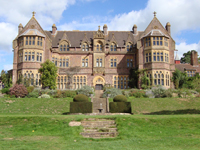
Knightshayes Court, Devon (Image: Matthew Beckett)

For all the wonderful work the National Trust has done over the last hundred years saving numerous country houses from demolition, one criticism that has been levelled at it is the almost artificial atmosphere it has created inside.  A recent visit to Knightshayes Court in Devon has also highlighted an interesting series of judgements as to how far an interior should be restored, even to the point of creating a room which was planned but never executed.

Knightshayes Court sits in an elevated and enviable position above the market town of Tiverton where the Heathcoat Amory family had the factory which generated their wealth.  The family fortune was created by the Loughborough-based John Heathcoat (b.1783 – d.1861) inventor of a revolutionary industrial lace-making machine who moved to Tiverton in 1816 after all 55 machines were smashed by drunken Luddites.  A caring man, he ensured the workers were well-housed and the children educated, and the factory became the largest lace-making factory in the world, employing 1,100 workers.

Knightshayes Court, however, was built by his grandson, John Heathcoat Amory (b.1829 – d.1914), whose father had married the only daughter of John Heathcoat, and had added his father-in-laws surname on inheriting. Although politically active, being knighted in 1874, he had sufficient time to indulge the usual pastimes of the wealthy Victorian aristocrat, particularly hunting.   So why would a provincial hunting gent commission a house from an eccentric medievalist, such as William Burges?

Burges (b.1827 – d.1881) has been described by Mark Girouard as ‘one of the most Gothic of the Gothicists‘.  His spectacular remodelling of Cardiff Castle, and the creation of the fantastical Castell Coch, both for the immensely wealthy 3rd Marquess of Bute, allowed him free reign to indulge his bold and imaginative decorative schemes.  Burges worked to a relatively simple philosophy that “No rule can be deduced except the golden one; whatever looks best is best‘ which combined with his other aphorism ‘Money is only a secondary concern in the production of first rate works…There are no bargains in art‘, meant that his work was never going to be cheap.  Yet Heathcoat Amory chose him – but the suspicion is that it was his wife Henrietta who made the choice, perhaps on the back of family connections which included the 2nd Lord Carrington for whom Burges had remodelled Gayhurst in Buckinghamshire (now flats), in the late 1850s-early 1860s.

Perhaps John Heathcoat Amory had only given broad instructions as to what he wanted and had left his wife to chose the aesthetics – either way, as paymaster, Sir John would later regret not taking perhaps a closer interest in the choice of architect.   Construction of the house started in 1869 and the exterior of the house was built almost exactly to Burges’ original design, with the exception of the reduced height of the great tower and a re-orientation of the billiard room.  With the shell completed in July 1870, at a cost of £14,080 (approx. £1m today), the Architect magazine observed that for completion ‘…the actual cost will be something more.‘ – a classic in the canon of architectural understatements as Burges had reserved his most incredible work for the interior.

In 1873, Burges presented the family with a 57-page album of detailed drawings which depicted everything from floor to ceiling.  Faced with such a grand and lavish scheme the Heathcoat Amorys abandoned Burges’ scheme, apart from the stone and wood carving, and, in 1874, brought in the cheaper but very talented John Diblee Crace.  Crace was the fifth generation of architectural decorators and between 1875 and 1882 he completed the interior of the house in his own more restrained but still colourful designs. The last additions to the house were an extra floor to the service wing in 1885 and a Smoking Room in 1902.

However, in the 1930s and 1950s, when appreciation for Victorian exuberance was at its lowest, the Heathcoat Amorys retreated from the bold colour schemes, removing fireplaces, screen and bookcases and covering or repainting ceilings and walls.  So when the National Trust took over in 1973 the house was very different, and less architecturally interesting, than the one of a century earlier.  The guide book, to its credit, does an admirable job of spelling out what is original, what was originally planned, what Burges executed, what Crace did, and what the National Trust has restored – and, perhaps more controversially, has recreated.

The obvious question when deciding on restoration is what particular period you pick as the ‘authentic’ period.  The National Trust took over Kedleston Hall in Derbyshire in 1987, easily one of the finest Adam houses in the country, but by 1994 the then Lord Scarsdale was complaining that the NT had decided that anything post-1760 had to go.  This led to the emptying of rooms, the repainting of others to how they thought Adam had painted them, and the removal in the grounds of anything not thought to have been put there by the first Lord Scarsdale and Robert Adam.

This is in contrast to the principles of the Society for the Protection of Ancient Buildings (SPAB) who state: “In the architectural context “restoration” means work intended to return an old building to a perfect state. It can be the unnecessary renewal of worn features or the hypothetical reconstruction of whole or missing elements; in either case tidy reproduction is achieved at the expense of genuine but imperfect work.“[source].

The Burges Room - Knightshayes Court, Devon (Image: Britain's Finest)

So was the National Trust wrong to strip back the layers of changes?  In view of the fascinating end result and the relative rarity of Burges country houses it can be argued that this work rescued what remained and cleverly exposed the earlier work.  But whose earlier work?  The guidebook explains that most of the interior is by Crace, and it’s his work which has been restored.  Yet upstairs in ‘The Burges Room’, the National Trust took it a step further and took Burges unexecuted plan for that room and created it as it imagined it would have looked.

So is this mere architectural theme park-ism?  Perhaps as it has be made clear what has been created from scratch there is less risk of confusion, but considering how few read the guidebook in detail (or at all), the National Trust has the unenviable choice between respecting all the changes or presenting a more visually interesting house but with necessary compromises in architectural integrity. On balance, there has to be a very strong case to take such a course of action otherwise we risk seeing recreations of idealised or imagined versions of houses rather than the rich and varied buildings which have honestly adapted and changed as family homes over time.

Visitor information: ‘Knightshayes Court, Devon‘ [National Trust]

Houses as hospitals: the country houses in medical service

Hatfield House, Hertfordshire (Image: Amy Lloyd/flickr)

Our country houses have always been adaptable as changing fashions or functions required they accommodate new ways of living or roles.  One role which quite a few houses have taken on is that of hospital – either privately or as a fully-fledged part of the NHS – though this use has not always been sympathetic.  However, as the modern health service centralises to larger sites it seems some country houses are re-emerging to become homes again.

Hospitals were traditionally monastic, centred on the abbeys and convents but these were obviously scarce.  The ill were treated in large dormitories although some established houses in the country away from the main abbey to care for the mentally ill.  However the dismantling of the religious orders during the Reformation from 1536, meant that increasingly the burden for care of the pauper sick fell to secular civic bodies, with towns creating their own hospitals.  This model persisted until the 17th-century when private benefactors became increasingly prominent, donating funds and buildings for the care of the ill.

One of the earliest country houses to be converted was the partially completed Greenwich Palace. Originally a Tudor royal house, it had become derelict during the English Civil War, so in 1664 Charles II commissioned John Webb to design a replacement but which was only partially completed.  It was this building which Queen Mary II, who had been affected by the sight of the wounded sailors returning from the Battle of La Hogue in 1692, ordered to be converted to a navel hospital in 1694, to the designs of Sir Christopher Wren and Nicholas Hawksmoor and later Sir John Vanbrugh.

Possibly inspired by the royal example, other country houses were donated or converted for use as hospitals.  However, it quickly became apparent that they weren’t particularly suitable with one Irish physician, Edward Foster, complaining in 1768 that ‘In general, Houses have been rented for Hospitals, which are as fit for the Purposes, as Newgate for a Palace‘.  By the 1850s hospital design was beginning to emerge as a distinct branch of architecture -Florence Nightingale wrote to an officer of the Swansea Infirmary in 1864 saying that a hospital was a difficult to construct as a watch; no building ‘requires more special knowledge‘.  From this time, the country houses themselves became less important than the space they offered with the house itself being used as accommodation or offices. However, for the treatment of respiratory illness the clear country air was considered part of the cure with houses being acquired as tuberculosis sanatoria such as at Moggerhanger Park in Bedfordshire originally designed by Sir John Soane for the Thornton family.

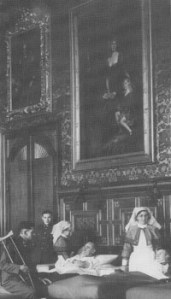
The First World War necessarily required country houses to come back into medical use due to the terrible consequences of the strategy of attrition through trench warfare in WWI which created large numbers of wounded.  Without a national health service there were fewer hospitals able to cope with the seriously disabled or even those simply convalescing.  Many country houses were pressed into service, their clean country air and fine grounds considered most helpful to rest and recuperation. During WWII, fewer houses were used as military hospitals as changes in military tactics led to many fewer casualties than expected.  However, a significant number were used either by the military or as civilian replacements for urban hospitals which it was feared would be bombed.

Hatfield House, Herts - King James Drawing Room as a hospital ward in WWII

For country house owners, given the possible options of who might take over their house, the bed-ridden were infinitely preferable to the bored squaddies who wreaked such havoc at other houses (apparently housing art treasures was first preference, evacuated schools second, hospitals third).  This reality plus a genuine sense of wanting to help led to many owners voluntarily turning over their houses as hospitals including the Earl of Harewood offering Harewood House, Lord Howard of Glossop Carlton Towers, Lady Baillie lent Leeds Castle and the 4th Marquess of Salisbury offering Hatfield House as he had done during WWI.  On the civilian side, Brocket Hall in Hertfordshire became a maternity hospital as was Battlesden Abbey in Bedfordshire, Stockeld Park and Farnley Hall, both in Yorkshire. Cholmondeley Castle in Cheshire became a Royal Navy Auxiliary Hospital, treating ‘cases of good morale, who are suffering from nervous breakdown usually as the result of operational stresses’.

After the war many houses were returned to their owners in such terrible disrepair that unfortunately hundreds were demolished.  Others continued in their wartime roles with some such a Poltimore House in Devon becoming hospitals after the war when two local GPs recognised the need for more bedspaces and so took over the old seat of the Bampfyldes until it was nationalised after the creation of the NHS in 1948.  There were also many War Memorial hospitals, founded by public subscription after WWI, which often made use of a country house. The nationalisation of these hospitals gave the NHS many of the country houses it has today – although it is relatively few overall as less than 5% of all their buildings are grade II* or grade I listed.  Of the historic ‘therapeutic’ landscapes it manages, seven are included on the English Heritage Register of Parks and Gardens of Special Historic Interest in England.

However, sometimes these country houses and their settings can escape and revert to being homes, either through conversion or, if the houses has been lost, replacement.   Bretby Hall in Derbyshire, built between 1813-15 by Sir Jeffry Wyatville for the Earl of Chesterfield, was an orthopaedic hospital until the 1990s when the main house was converted into flats, as was the High Victorian Wyfold Court in Berkshire.  Harewood Park in Hertfordshire was demolished in 1959 after use as hospital in WWII but the estate has been bought by the Duchy of Cornwall with proposals for an elegant and very impressive new Classical house by Craig Hamilton Architects.  A similar plan has been put forward for the 57-acre site of the former Middleton Hospital in Yorkshire with the permission requiring the demolition of various redundant buildings from its former use to restore the site.

Sadly though, sometimes the NHS fails to adequately look after the houses it has in its care.  As the trend has moved towards large, new hospitals so the historic elements have been overlooked or abandoned as new hospitals are built elsewhere. As funding for new hospitals is not dependent on the sale of the old site and the house, sadly they can be neglected or subject to inappropriate development as has been the case with the grade-II listed Stallington Hall in Staffordshire, which became a home for the mentally ill in 1928, but after it closed has been vandalised and neglected with a housing development built inappropriately close to the house across the lawn, forever ruining it as a country house –  a poor payback for years of public service.

Related story: ‘Developers draw up plan for country house‘ [Ilkley Gazette]

Background information: ‘Reusing historic hospitals‘ [Institute of Historic Building Conservation]

The ‘artocracy’ expands: West Acre High House, Norfolk

West Acre High House, Norfolk (Image: Strutt & Parker)

In any age, once someone is successful they often seek the traditional status symbols – with a country house being high on the list.  For footballers it seems that the modern, bling-laden mansions are the favoured style but for an increasing number of modern artists it’s the historic houses which are finding favour.  The news that Anthony Gormley has bought West Acre High House in Norfolk adds him to a distinguished roll-call of artists who are forming what has been glibly named, the ‘artocracy’.

Artists moving to the country to help their work has a long history including  Peter Paul Rubens buying the Castle of Steen Manor House in the Netherlands in 1635 which led to some of his finest landscape paintings. West Acre High House was regarded as one of the prize estates when it came up for sale in 2008 for £9.5m with 1,000-acres.  Yet, it languished on the market despite the nearby 1,600-acre Kelling estate being sold which was listed at the same time.

West Acre High House was built in 1756 by Edward Spelman (d. 1767), a writer and translator and known eccentric, who had inherited the estate from the Barkhams.  The design raised eyebrows, particularly for that part of the world, with its novel piano nobile arrangement which was also being used around that time in the construction of Holkham Hall and Houghton Hall.  A visitor in that year, Caroline Girle, reported:

“I paid a droll visit to see an odd house, of a still odder Mr Spelman, a most strange bachelor of vaste fortune but indeed I’ll not fall in love with him.  We were introduced to him in the library where he seemed deep in study (for they say he’s really clever) sitting in a Jockey Cap in stiff white Dog’s Gloves. On seeing Mr Spelman one no longer wonders at the oddity of the edifice he has just finished.”

The house is also unusual in that the south front is 7 bays with the central 5 deeply recessed, but the north front is 13 bays due to the flanking wings being built level with the main block.  The wings were built by Anthony Hamond (b.1742 – d. 1822), a nephew of Richard Hamond who had bought the estate from Spelman in 1761.  The next major change was put in effect by Anthony’s second son, another Anthony, who, in c.1829, employed the well-known country house architect, W.J. Donthorn, who refaced the whole house in pale oatmeal Holkham brick, crenellated it and created the spectacular internal double-flight staircase.  The staircase leads to a picture gallery modelled on the one in Buckingham Palace and is formed of five perfect cubes of 18ft.

The house was bought by Henry Birkbeck in 1897 who might have inherited it having  married Anthony Hamond’s daughter in 1849 but, for reasons unknown, purchased it instead.  It remained in the Birkbeck family until the sale to Gormley, who has bought the house plus 100-acres for just £3m having had the price reduced by wanting less land and after factoring in the £1.5m cost of restoration.

Toddington Manor, Gloucestershire (Image: Images of England/Heritage Gateway)

The restoration costs may well turn out to be much higher – as Damien Hirst, another of the ‘artocrats’, has found out.  He has admitted recently that he has been affected by the recent economic turmoil and in addition to closing down his studios, he has paused the vast, £10m restoration programme he is undertaking at his equally vast country house, Toddington Manor in Gloucestershire, which he bought in 2005 for £3m.  Built in 1819-35 for Charles Hanbury-Tracy, later 1st Baron Sudeley, using his own very accomplished designs. He drew his inspiration from the Perpendicular architecture of Oxford and Pugin‘s work, to create an important Gothic-revival building at a cost of £150,000 (equivalent to £15m in today terms).  The design clearly influenced Sir Charles Barry in his design for Highclere Castle in Berkshire (built between 1838-78) and the Houses of Parliament (started in 1840) – but perhaps Barry was playing to the audience with the latter as Hanbury-Tracy was also on the committee which chose the design for the new Parliament.  After being empty for 20 years until Hirst bought it, the house was a cause for serious concern with outbreaks of dry-rot and a pressing need to replace the acres of roof.  After being saved from becoming a hotel, Hirst bought the grade-I listed house as both a home but also to eventually become a gallery for his work.

Another artist seeking the country life is Anish Kapoor who was apparently interested in taking the lease on Ashdown House in Berkshire – though it eventually went to Pete Townshend of The Who.  One of our prettiest country houses, and now owned by the National Trust, leasing it would have given him the status without the huge restoration costs.

One of the most encouraging aspects of both Gormley and Hirst’s purchases has been the willingness and ability to finance the necessary huge restoration projects.  For Hirst, this has involved covering the whole of Toddington Manor in some ‘Christo’-esque scaffolding with the expectation that the restoration will be a lifetime’s work.  Any restoration has an element of being a labour of love but, in exchange, their houses will give them status, but most importantly, a home – these are houses to be lived in, albeit on a much grander scale than most.

Property listing: ‘West Acre High House‘ [Strutt & Parker] – marked as ‘Sold’ so may not be on the website for long.

Detailed architectural listing: ‘West Acre High House‘ [British Listed Buildings]

More images: ‘Toddington Manor‘ [aerial-cam photography]

When bling attacks: Ollerton Grange, Cheshire

Ollerton Grange, Cheshire (Image: Knight Frank)

A constant danger for smaller, less historic – but no less attractive – country houses is when the local area becomes more fashionable with an influx of newer, brasher ideas which can be unsympathetic to the original designs. Ollerton Grange in Cheshire, now for sale for an eye-watering £30m with Knight Frank, could be seen as a example of what happens when a small country house meets a large amount of money.

From the picture the house has echoes of the early East Anglian Prodigy houses such Blicking Hall with the neat gables and rambling roofline, built in 1619-27.  Yet Ollerton Grange is a fairly modern construction, built in 1901 by the Manchester architect John Brooke for Cyril Lowcock.  The neo-Tudor style was popular in the Arts & Crafts period with it’s evocation of ancient history which the newly rich were keen to adopt.  The octagonal tower with its ogee cap is the main feature of the entrance front with the gables, mullioned windows, and tall, diagonally-set chimneys following its lead.

The house, plus 141 acres, was bought in 2000 by the heir to the Matalan empire, Jamey Hargreaves for between £5m-10m and he has since spent an estimated £20m over the last ten years.  To his credit he has spared no expense on restoring the main house with fine quality Arts & Crafts panelling set off by some excellent quality antiques.  This reflects the fact that he confesses to having been a reader of Country Life magazine since the age of eight – despite the inevitable joking from his family in the terrace house where he grew up.

Plunge pool, Ollerton Grange, Cheshire (Image: Knight Frank)

Yet if this was the only work to have taken place all would be well.  However, the house is situated in the area of Cheshire known as the ‘Golden Triangle’ inhabited by footballers and their girlfriends.  The prevailing interior style is brash and flashy with an emphasis on gadgets and gimmicks.  At Ollerton Grange this has manifested itself in a huge pleasure complex to the north of the house which more than doubles the original size of the house. This features a full spa, a pool with retractable roof, a red-tiled plunge pool with sculpted aluminium ceiling [pictured], sauna, steam room – with the ability to seal all this off from the main house with a steel shutter during the big house parties.

Credit to Mr Hargreaves for not butchering the original house to fit it in these facilities but is it right that now fully half the space of the new extended house is this modern ‘pleasure-dome’? The photos of the exterior of the house all focus on the original house because, I suspect, the exterior of the new wing will not match the careful architectural composition of John Brooke’s original.  This is not to be snobby but merely to highlight that although a house can be restored to within an inch of it’s life, that doesn’t mean that other alterations may not compromise the overall setting.  Planners have to tread a fine line between allowing necessary and hoped for alterations but perhaps there should be a greater emphasis on ensuring that any new extension continues using the architectural vocabulary of the original house to harmonise the overall look of the property.

Property details: ‘Ollerton Grange‘ [Knight Frank]

Source credit: original story ‘Tangerine Dream’ in the Home section of The Sunday Times – 27 June 2010.