If you thought ‘The Restoration Man’ projects a bit small-fry; try Overstone House

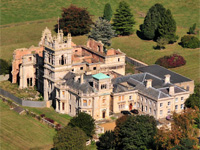
Overstone Hall, Northamptonshire (Image: Martin Sutton on flickr)

Although hated by Samuel Loyd who commissioned it, Overstone House is fondly remembered by the generations of girls who were taught there after it became a school.  A vast, rambling property, it was sold to an obscure evangelical religious group who lived there until a devastating fire in April 2001 destroyed the main part of the house – although Loyd might have been quite relieved.

Overstone House replaced the earlier Overstone Hall and was built in 1862 for the banker Samuel Loyd, who became Lord Overstone for services to finance.  His wife  was keen to have a property commensurate with their status and so her husband decided to rebuild on a grand scale.  However, he inexplicably picked the unknown architect William Milford Teulon (brother of the more famous Gothic revivalist Samuel Sanders Teulon) who was instructed to design with a mixture of Elizabethan and Renaissance features.  This choice led to the creation of one of the most derided houses created in the Victorian era.

Both Girouard and Pevsner were uncomplimentary with the latter describing it as ‘drearily asymmetrical’.  However, the most damning verdict  came from Samuel Loyd himself, who, in what could be regarded as a wonderfully amusing piece of architectural criticism, said:

“The New House I regret to say, is the cause of unmitigated disappointment and vexation.  It is an utter failure – We have fallen into the hands of an architect in whom incapacity is his smallest fault.  The House tho’ very large and full of pretension – has neither taste, comfort nor convenience.  I am utterly ashamed of it … the principal rooms are literally uninhabitable – I shall never fit them up … I grieve to think that I shall hand such an abortion to my successors.”

As if this wasn’t enough, Loyd’s wife died before the project was finished leaving him with this rather large problem – which he promptly ignored by going and living with his daughter at Lockinge house in Berkshire where she had become Lady Wantage. Loyd must have eventually finished it as, on his death in 1883, it passed to Lady Wantage who, along with her husband, used it regularly during the hunting season until 1901.  After her death it was tenanted until sold to become a girls school in 1929.

It remained a girls school until 1979 when the pressures of looking after such a vast pile became too much and it was eventually sold to the New Testament Church of God for £100,000 in 1980 who are the current vendors.  The devastating fire in 2001 destroyed approximately 60% of the building including all the principal rooms and the impressive carved staircase.  Parts of the grade-II listed house remained in use as an old people’s home but the rest became a concern, leading to it being added to the ‘Buildings at Risk’ register.

However, the house is now for sale as a grand project with the opportunity to create a truly palatial home – the original house contained 119 rooms totalling around 20,000 sq ft.  The local council’s preference is that it become a single house – but to do so would require someone with big ideas and very deep pockets, willing to spend at least £5-10m on restoration on top of the £1.5m to buy the house and 50-acres.  However, as the main cause of Loyd’s distress has now been destroyed, this is great opportunity for someone to perhaps create a house which might meet with greater approval.

For anyone with the necessary funds and Kevin McCloud on speed-dial, please call Robert Godfrey of Bidwells (01604 605050).

A detailed history of the house is available on the Overstone School for Girls website.

More details: ‘Property restoration project: Overstone Hall, Northampton‘ [Daily Telegraph]
Lodges to lost houses: Thorington Hall Gate Lodge, Suffolk

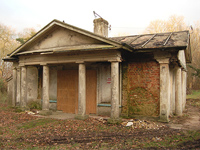
Thorington Hall Lodge, Suffolk (Image: buildings_fan on Flickr)

Often the only visible sign of  a grand estate is the lodge house seen as we drive past; their varied size and designs indicating the wealth and aspirations of the owners.  Although still a integral part of the functioning of some estates, providing security and accommodation, sometimes these beautiful buildings lie abandoned, intriguing those who go past them everyday.  ‘The Restoration Man’ series on Channel 4 has been showing people who have been willing to take on abandoned listed buildings and bringing them back to life. The episode to be shown on Sunday 25 April features Thorington Hall Gate Lodge, a forlorn reminder of Thorington Hall, one of the many elegant demolished Suffolk country houses.

Although their main function was to provide shelter for the estate worker who opened the gates, lodges were often designed by the same pre-eminent architects who were working on the main house.  Far from being an afterthought, these houses were often strongly imbued with the overall architectural style of the estate and were seen as an important way of announcing the status of the estate and owner.  Alternatively they gave scope for the owner to indulge in some architectural experimentation.  The styles of the lodges are as varied as the many houses they protected, from Victorian Gothic follies to small thatched cottage orne to minature Greek temples, such as at Thorington Hall.  The publication of ‘pattern books’ such as Joseph Gandy’s ‘Designs for Cottages, Cottage Farms and other Rural Buildings, Including Entrance Gates and Lodges‘ (1805) also enabled the discerning owner to select particular buildings from an established design without the need for an architect.

Many of these lodge cottages are now no longer part of the estate and have been turned into interesting family homes.  Their smaller, more domestic, scale also ensured that they often survived the demolition of the main house.  One example is Clumber Park in Nottinghamshire where all nine lodges at each of the estate entrances survive despite the palatial mansion being demolished in 1938.  Increasingly, the modern estate owner is buying back these buildings to reintegrate them with the overall estate.  However, some still survive as neglected shells and these can prove to be an exciting opportunity to create a home.  One important factor bear in mind is that these houses are often very small (sometimes only two rooms) and their listed status means it’s not always possible to add significant new extensions.  One of the joys of these houses is their diminutive size and that should be respected when considering restoration, but completed sensitively, these houses can be an interesting feature of your local heritage.

To find lodge houses which may be available for sale, join SAVE Britain’s Heritage and access their ‘Buildings at Risk Register’ where you can search for these properties plus many others.  Their latest ‘Buildings at Risk’ report – ‘Live or Let Die’ – will be published on 1 June 2010 and can be pre-ordered now.

To find out more about the many country houses which have been demolished in Suffolk there is a superb book which has been recently published called ‘The Lost Country Houses of Suffolk’ by W.M. Roberts [amazon.co.uk].

Programme details: ‘The Restoration Man‘ [Channel 4]

A shock return: Abbey Dore Court

Abbey Dore Court, Herefordshire (Image: Sykes Cottages)

Memories of a happy childhood can seem all the stronger as time passes, yet when confronted with the reality when revisiting once familiar haunts it can make any changes seem all the more jarring.  For Clare Sage, her return aged 27 to her grandmother’s home, Abbey Dore Court in Herefordshire, was a particularly hard welcome as the house had been effectively abandoned by her grandmother for several years so she could concentrate on the garden.  Despite Clare’s determination she needed some help and so her family’s home is the subject of Ruth Watson’s Country House Rescue.

After coming back from years living away, walking through her former childhood home, Clare was shocked to discover the many leaks, falling ceilings, holes in the floors, and a general air of neglect.  Built in the 1870s, the house, although comparatively large with 11-bedrooms and 6 acres of gardens, is only a minor country house and much smaller than those usually featured in Country House Rescue.  However, it shows that even the smaller houses can be as problematic as the much larger ones. Again, it’s a familiar pattern of ageing owner with insufficient income to employ full-time staff for maintenance, who does what she can but then find it’s has become just too much. These houses can then deteriorate quick rapidly if the problems are ignored – and with country houses being naturally isolated this is all too easy.

Thankfully, in this case, it appears that Clare’s dedication has enabled the restoration of the house and it is now available for rent which will not only create an income but, perhaps most importantly, will ensure that the house is lived in, keeping it warm and ensuring any problems will be spotted quickly and dealt with.  Here’s hoping that one day, Clare’s hard work with be rewarded with her being able to move back in and live in her family’s home.

Official website: ‘Abbey Dore Court

Rental details: ‘Abbey Dore Court‘ [Sykes Cottages]

Programme to be broadcast at 20:00 on 15 April 2010 on Channel 4.

A problem shared? Whitbourne Hall visited by Country House Rescue

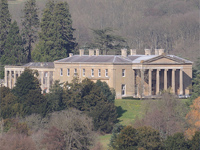
Whitbourne Hall, Herefordshire (Image: David Cronin on flickr)

The great wealth generated by the Victorians led to the creation of some of our grandest country houses.  Designed to impress guests and provide a showcase for the collections and taste of the owners, these houses were remarkable and beautiful expressions of the power and preferences of the age.  However, in the more straitened circumstances of the 20th-century, this left owners with running costs which far outstripped their wealth and which unfortunately led to hundreds of our country houses being demolished.

Some escaped the wreckers pickaxe through conversion into apartments – but this doesn’t always solve the questions about the long term sustainability of a house, as shown by the visit of the TV programme Country House Rescue to Whitbourne Hall in Herefordshire.

The grade-II* listed house was built for vinegar magnate Edward Bickerton Evans whose father founded the Hill Evans Vinegar works in Worcester in 1830, which was, by 1905, the biggest vinegar producer in the world.  As was standard practice for the discerning Victorian millionaire he decided to build a grand country house and chose a cornfield in Whitbourne as the perfect location.

Despite its Georgian appearance, it was built between 1860 and 1862 to a design by Edmund Wallace Elmslie and inspired by the Erectheum on the Acropolis in Greece. The house was a lavish example of neo-Palladian architecture with a six-column portico, whilst on the south front a huge orangery, now known as the palm house, was added in 1875 and was thought to be the tallest in Europe.  The interior features a fine pillared main Hall with a rare blue and white glass ceiling, and the main reception rooms retain many original features.  At it’s height in 1876, the estate extended to over 2,500 acres with the classically beautiful Whitbourne Hall sitting proudly at the centre.

Remarkably, the Hall remained in the Evans family until 1980, when it was purchased by Whitbourne Hall Community Ltd to be run as a communal housing project with individual apartments and set in eight acres of gardens.  This original arrangement floundered and a commercial company was created to run the house as a more conventional managed community of 23 apartments.  The main rooms have been preserved much as they were with the Morning and Drawing Rooms retaining their original wall coverings.  However the sheer scale of the house means that the average annual maintenance bill is about £42,000 – and due to extensive and significant work required to maintain a house of this quality, that bill is expected to double in 2011, posing serious problems for the residents.  Extensive restoration is now required as the house is now suffering from a catalogue of issues including failing plasterwork as water penetrates through the coffered ceiling of the main hall.    Curiously Whitbourne Hall doesn’t seem to be on the English Heritage Buildings at Risk Register – it would be interesting to know why not.

One of the perennial difficulties of owning a country house is not just the huge costs such as heating but also the ongoing maintenance (as demonstrated by the Earl Spencer’s sale), the costs of which, rise significantly the higher the classification.   With the paucity of public grants for maintenance it falls to the owners to seek innovative ways to make these wonderful houses financially self-sufficient if possible.  However, as Country House Rescue often shows, it’s the owners who can sometimes be the problem who need to be convinced before they become part of the solution.

More details: ‘Country House Rescue‘ [Channel 4]

What’s to happen to Mentmore Towers?

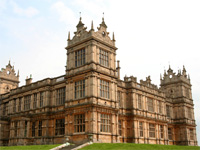
Mentmore Towers, Buckinghamshire (Image: wikipedia)

Running  a country house is always going to require a certain level of wealth with larger houses easily costing six figures a year in basic running costs and maintenance.  When funds are lacking it can be the house which shows the physical consequences as it becomes difficult to fund the ongoing care. Mentmore Towers in Buckinghamshire is one of the largest and impressive houses in the UK and the latest reports that its owner, Simon Halabi, has been declared bankrupt raise some worrying concerns about the future of this grand house.

The grade-I listed Mentmore Towers (known locally and to staff as just ‘Mentmore’) was originally built between 1852-54 by Baron Mayer de Rothschild of the famous banking family.  Designed by Joseph Paxton (of Crystal Palace fame) the neo-Renaissance style echoed houses as Wollaton Hall in Nottinghamshire and following Sir Charles Barry’s work at Highclere Castle in 1838.  The interiors are considered to be some of the finest Victorian designs and workmanship in the country.

Mr Halabi’s original plan was to convert Mentmore into a six-star country club with a London equivalent based at the ‘In and Out’ Club on Piccadilly which was also part of his property empire.  The global financial crises appeared to put these plans on hold before the collapse in property values caused a default on the bond secured on these properties which led to the bankruptcy.  Both properties are on the English Heritage ‘Buildings at Risk’ Register – indeed, Mentmore has been on for over 8 years with particular concern about the elegant stonework and the roofs with the danger of serious leaks increasing with each month goes by.  An earlier story on this blog (‘Simon Halabi and Mentmore Towers‘) produced a series of comments that indicated that a lack of maintenance was already taking it’s toll on the house.

So what’s to happen next?  Although Mr Halabi’s fortune is much reduced it is expected that the sale of various properties from his White Tower property empire will cover the £56m required to clear the debt which led to bankruptcy.  Ownership of Mentmore is also thought to be obscured through a web of companies but, if the report in The Times is correct, it is likely to be last property Mr Halabi would want to sell as his young son Samuel who tragically drowned in France is buried on the estate.  Hopefully, the bankruptcy will provide the opportunity for Mr Halabi to re-organise his empire, free up some capital and undertake not only the urgent basic repairs but also secure the long-term future of one of the most important country houses in the UK.

More details: ‘Hunt for Simon Halabi after tycoon is made bankrupt‘ [The Times]