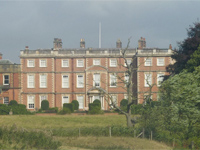
Monumental follies: current large country houses in the UK

Hampton Court Palace, Surrey (Image: Andreas Tille/Wikipedia)

In previous centuries the country house was primarily a home, but also included other functions such as storehouse, dormitory, dairy, bakery, laundry.  This inevitably led to their size increasing to the point where they could be regarded as small villages – but despite the scale of houses such as Knole or palaces such as Hampton Court we still admire their elegance and charm.   So what’s changed now that the modern ‘palaces’ so lack the beauty of those which went before?  Is it because so many have been demolished that we have no sense of how to design the largest of country houses?

The size of a country house has always been used as a simple measure of the owner’s wealth – and subsequent owners could also argue it would equally symbolise the size of their burden.  In the UK, traditionally the name ‘palace’ was reserved for the homes of the monarchy or bishops with few landowners being bold enough to take the name for their own houses – regardless of size.  One of the few to do so were the Dukes of Hamilton, whose home – Hamilton Palace in Scotland – could truly be said to justify the name.  A vast Classical edifice with a north front stretching over 260-ft long, the interiors and collections were easily a match for any other house in Europe.  Yet, financial circumstances, wartime damage and apparent mining subsidence condemned the house and it was demolished in 1921.
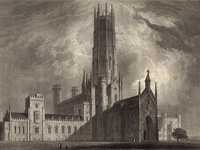
Fonthill Abbey, Wiltshire (Image: Wikipedia)

Other houses were conceived on an even grander scale.  Perhaps the most famous is Fonthill Abbey in Wiltshire, designed by James Wyatt for the immensely wealthy William Beckford. Inspired by a love of the Gothic, Beckford set out to create what was effectively a residential cathedral.  The vast 300-ft tower and huge 35-ft tall doors all contributed to an awe-inspiring impression for the few visitors able to see it before it collapsed under its own ambition in 1825.  Wanstead House in Essex, built in 1715, was also conceived on a similar scale to the later Hamilton Palace but again was lost – this time when creditors tore it down so the materials could be sold to pay debts in 1825.  The roll call of other huge houses includes Eaton Hall in Cheshire, Worksop Manor and Clumber House in Nottinghamshire, Nonsuch Palace in Surrey, and Haggerston Castle in Northumberland.  Yet what distinguishes all these houses in that they have been demolished – their very size eventually condemning them as later economic circumstances rendered them unsupportable.  However, each was architecturally an interesting house, one that, if it still survived, would be admired today (well, perhaps less so the bulky Haggerston Castle).

No modern palace has yet matched the beauty of the UK’s largest private country house still standing – Wentworth Woodhouse in Yorkshire.  From the end of one dome-capped wing to the other, the house, built largely in the 1730s, runs for over 600-ft but is an object lesson in Classical elegance.  The huge and imposing portico towers over the façade provide balance and a natural harmony with the scale of the flanking wings. Other large house still in existence which were built on a similar scale include Blenheim Palace and Castle Howard.

Updown Court, Surrey (Image: Savills)

So what have lost that means that the houses built to a similar scale today are so poor architecturally?  Perhaps one of the best (worst?) examples of this problem is Updown Court in Surrey. Completed at the end of 2006, this vast mansion is described on the official sales website as symbolising “the grand and imposing presence of the Great Houses of England.” (stop sniggering at the back!).  Although the ‘in excess of £70m’ price tag will naturally limit the pool of potential buyers, is it just the size or the price causing the problem? Perhaps it is the curse of the American ‘McMansion’ which leaves it to languish?  The derogatory term ‘McMansion’ was coined in the US in the 1980s to describe the huge houses being constructed which valued sheer size over architectural merit.  The architect of Updown, the American John B Scholz, can truly be said to pay fervent homage to such excess.  Extending to over 50,000 sq ft – bigger than Hampton Court or Buckingham Palace – the house is a exemplar of the type of house which simply is built with little thought to design beyond the ill-considered use of architectural elements to just decorate the house.

However, is no design better than too much? At Hamilton Palace in Surrey the owner, the notorious Nicholas van Hoogstraten, has taken great pains to ensure the design reflects his character.  Over-bearing and rather menacing, it was designed by Anthony Browne Architects (who are no longer involved), with work starting in 1985 and still ongoing though so far it includes a huge copper dome and a massive floor reserved for Hoogstraten’s art collection. The east wing is designed as a mausoleum where he can be hubristically entombed after death with his art collection in the manner of the Pharoahs. Yet for all the attention which has been lavished on the design and a reputed £30m spent so far, it has none of the grace and elegance of the earlier palaces.  Perhaps this is the ultimate expression of ‘self’ – a shameless design, built without a care as to what others think.  Which is probably a good things as it has been described by The Observer as “a cross between Ceausescu’s palace and a new civic crematorium” and by John Martin Robinson in The Independent Magazine (October 1988) as “Post-Modern Classical with a touch of meglomania”.

One final example, which although not strictly a country house, exemplifies this rush for scale over beauty is the proposed replacement for Athlone House in Hampstead, north London.  Owned by a Middle Eastern billionaire, this 50,000 sq ft pile is being designed by Robert Adam, a pre-eminent neo-Classical architect.  Despite this he has managed to produce a design described by one local critic as a ‘cross between a Stalinist palace and a Victorian lunatic asylum’ – and yet Mr Adam is responsible for some elegant examples of country houses such as the proposed Grafton Hall, Cheshire.

Obviously the scale of a modern palace is way beyond the realm of normal domesticity – and that’s fine.  The house has long been an expression of power and prestige but it was also one of taste, a refined justification as to the choice of a particular architect or style.  The modern ‘palace’ (and I use the word simply to suggest scale not beauty) is sometimes just the product of an architect interpreting vague notions from clients who seem unwilling to invest the time to become educated.  The end results are over-sized houses which lack the intellectual justification which underpinned the Fonthills and Eaton Halls of their day.  Nowadays, the need to spend the budget on a sad checklist of gimmicks seems to be pushing houses away from architecture and simply into a form of ‘decorated construction’ – a largely functional building given a variety of architectural fig leaves to hide its naked purpose as simply a Corbusier-esque ‘machine for living’ – but on a monumental and unpalatable scale.

Original story: ‘Hot property: Palaces‘ [ft.com]

Official website: ‘Updown Court, Surrey

Property details: ‘Updown Court, Surrey‘ [savills.com]

More criticism of Athlone House by Simon Jenkins ‘Greed, egos and yet another blot on the horizon‘ [thisislondon.com]
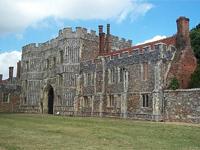
Looking for a saviour: St Osyth Priory, Essex

St Osyth Priory, Essex (Image: Stephen Dawson/geograph.co.uk)

Of the phrases most likely to cause concern for those who love our country houses, up there with ‘dry rot’, ‘water leak’ and ‘death duties’ has to be ‘enabling development’.  Originally designed to protect heritage assets by permitting limited development to fund repairs, it appears to now be used to circumvent local and national planning guidelines to facilitate inappropriate development where it otherwise ought to be refused.

In Essex, perhaps one of the largest examples of its kind was submitted by the Sargeant family who bought St Osyth Priory in 1999 through their development company ‘City and Country Group‘ (CCG) .  The company applied to build 190 houses as part of an enabling development to fund repairs to the main house and the other 22 listed buildings in the complex claiming that some £30m-worth of repairs were required (and personally I doubt the cost would be that high – happy to be proved wrong by an independent survey from a SPAB scholar).   This number would naturally bolster the calculation for the total conservation deficit (that is, the amount by which the cost of repair (and conversion to optimum beneficial use if appropriate) of a significant place exceeds its market value on completion of repair and conversion, allowing for all appropriate development costs, but assuming a nil or nominal land value).  But is this a case of a developer using the provisions of enabling development to gain permission regardless of the consequences for the house – and the local area?

After passing through various Royal hands, it was sold to Lord Darcy in 1553 and remained the home of various Earls, Viscounts, Lords and Baronets until it was eventually bought in 1954 by author Somerset de Chair who, in 1974, married Lady Juliet Wentworth-Fitzwilliam, daughter of the 8th Earl Fitzwilliam of Wentworth Woodhouse. The couple lived in the gatehouse, with much of the valuable Wentworth Woodhouse art collection, but de Chair died in 1995, so in 1999 Juliet married Dr. Christopher Tadgell and sold St Osyth to CCG and went to live in Bourne Park, near Canterbury.

CCG have a track record of taking on historic houses and have recently restored Balls Park, Hertfordshire and Herringswell Manor, Suffolk and previously Cheverells and Gilston Park – but these were easier to convert as they had all been used for other institutional or commercial purposes rather than as a family home.  St Osyth Priory and related buildings have sad recent history of insufficient maintenance over many years and have been included on the various buildings at risk registers and undoubtedly needs significant work – but can the repair bill really be £30m (by comparison, the whole of St Paul’s Cathedral was recently restored for £40m)?

To play Devil’s advocate, perhaps this figure might be explained by the provisions of ‘enabling development’ which require that;

It is demonstrated that the amount of enabling development is the minimum necessary to secure the future of the place”
– ‘Enabling development and the conservation of significant places‘ English Heritage (2008)

…so to secure a development of sufficient size to make it profitable for CCG, it would need a suitably large repair bill to justify this (see letter from local resident).  It has been suggested on the St Osyth Parish Council website that offering the house for sale (with just 20-acres rather than the full estate) is merely part of the process of proving that no-one is willing to take on the house and restore it and therefore the enabling development is the only option.  In reality, for someone to invest that much in a house (purchase+restoration) they would expect an estate of at least 100-acres, if not two or three times that.  The plans also seem inappropriate with regard to other provisions of the English Heritage guidance:

  • It will not materially harm the heritage values of the place or setting.
  • It avoids detrimental fragmentation of management of the place.

This all seems depressingly familiar where a developer ignores what’s best for the house, and, in this case, what seems to be determined to bloat the size of the local village in pursuit of this unpopular and out-sized scheme.  An active and well-supported local campaign has been highlighting the various flaws of the scheme and the potential damage to the setting and the village if the scheme were to go ahead, but of course, it’s the house which is continuing to suffer.

In an ideal world, the house would be restored for much less than £30m thus showing that the scale of development proposed was unjustifiably large. This again would show that ‘enabling development’ is apparently being used as a means to try and circumvent the usual planning restrictions which are there to protect our heritage and countryside. Then perhaps one day the house with the full estate (hopefully once CCG realise they won’t get permission) will be offered for sale and someone will get the chance to take care of this important house and estate without sacrificing it for housing.

Property details: ‘St Osyth Priory, Essex‘ – Bidwells

More details:  ‘Priory battle gathers pace‘ [Daily Gazette]

Rent a doll’s house: Gunby Hall, Lincolnshire

Gunby Hall, Lincolnshire (Image: Gardens-Guide)

Sitting on a small rise, just off the A158 on the road to Skegness in Lincolnshire sits one of the prettiest of the National Trust’s many country houses; Gunby Hall. However, unlike the others, where we can only ever dream of moving in, Gunby is currently available to rent for the bargain rate of £10,000 per year – but do remember to add an estimated £100,000 for the annual running costs.

Gunby Hall was built in 1700 (commemorated with the date on the rainwater heads) for Sir William Massingberd by an unknown architect but one who was obviously familiar with the work of Sir Christopher Wren.  Built of warm plum-red bricks the sophisticated 3-storey exterior shows the elegant use of stone dressings which elevates this grade-I listed house to being one of the finest of the smaller country houses.  Although showing stylistic links with Wren it was almost certainly by a skilled provincial imitator or local builder.  Wren designed very few country houses – Tring Park in Hertfordshire, Winslow Hall and, according to John Harris, contributed designs for Wimpole Hall in Cambridgeshire, and Houghton Hall in Norfolk – all for patrons who were somehow connected to Wren.  So unless someone discovers a link between Sir William and Sir Christopher it is likely that the local ‘architect’ had only been shown Wren’s designs.

Newby Hall, Yorkshire (Image: johnet/flickr)

When Gunby Hall was built it would have been regarded as very fashionable as Baroque style houses had only become popular in the 1680s.  Newby Hall in Yorkshire is one of the best examples and was rated as the finest house in Yorkshire when it was completed c.1690 (remember the houses we regard as the finest today in Yorkshire such as Castle Howard, Wentworth Castle, and Wentworth Woodhouse amongst others hadn’t yet been built).  In many ways, Gunby Hall and Newby Hall are architectural ‘cousins’ – closely stylistically related but distinct, particularly in size; reflecting the relative wealth of the owners .  Similarities can also be seen with other Yorkshire houses such as the earlier Ribston Hall, built in 1674, and the wonderful but now sadly demolished Wheatley Hall built in 1680, and the later Bolton Hall.

Gunby Hall was later altered c.1730 and extended in 1873 and 1900 to very successfully add a Dining Room, Servants’ Hall and Service Wing.  The later additions blend very neatly with the existing building creating the harmonious look which is so attractive today.  Gunby has long been admired with the famous poet Lord Alfred Tennyson reputedly using it as his inspiration when he wrote during one visit:

. . . an English home – gray twilight

On dewy pastures, dewy trees

Softer than sleep – all things in order stored,

A haunt of ancient peace.

The house was also admired by James Lees-Milne who described it as ‘an Augustan squire’s domain, robust, unostentatious, dignified and a little prim.’.  Lees-Milne was a regular visitor and was instrumental in not only bringing the house to the National Trust, as he did many other houses, but also saving it from outright demolition during WWII.  This terrible prospect came about in 1943 when the Air Ministry wished to extend the airfield they had built at Great Steeping only later discovering that Gunby Hall inconveniently blocked the proposed path of the longer runway.  Luckily the combined forces of James Lees-Milne and the impressively named owner, Field Marshal Sir Archibald Montgomery-Massingberd, persuaded them to re-route the runway thus saving the house.  In thanks, the family immediately made over the house to the National Trust becoming one of the few houses to be taken on during the war.

So if you fancy living in one of the prettiest stately homes in the country and don’t mind a few tourists having a look round occasionally, get in contact with the Savills Lincoln office.

More details: ‘Stately home can be yours for just £10k a year… plus another £100k for the staff‘ [This is Lincolnshire]

Property details: ‘Gunby Hall‘ [Savills]

If in doubt, rent: Faringdon House, Oxfordshire

Faringdon House, Oxfordshire (Image: Knight Frank)

Renting a property has long been associated with those starting out on the property ladder but there is a long history of country houses, large and small, being tenanted for long periods of time.  Now the focus is very much on the sale of country houses with rentals being in the shade of their high-spending counterparts but there are still many fine houses available to those wishing to experiment with the country life or as a short-term solution.

Jane Austen was well-known for reflecting the social conventions of the aristocracy in her work and it’s interesting that one of the main characters in ‘Pride and Prejudice’, the wealthy Mr Bingley, rents ‘Netherfield House’ whilst he considered which house and estate he would establish himself in.  This again is a pattern that still holds true today with those seeking to move to either a new area or out of town, renting to get a better understanding of an area.  These opportunities are available today where houses such as Puddletown Manor in Dorset are available for rent (£9,000 pcm) but also for sale (£6m) at the same time.

Country houses have been let for a variety of reasons.  One of the most common was simply that it might be a subsidiary seat and rather than simply leave it empty it was often let as a source of income.  Sometimes this included the entire working estate so that the new occupant could fully assume the role and responsibilities of the country gent.  Increasingly though in the Victorian era the house was let separately from the estate which would continue to be managed and run by the original family.  This was often the preferred option for the newly wealthy who aspired to the status and amenity of a ‘country seat’ but did not require the estate to generate an income.

This is why houses such as the Faringdon House in Oxfordshire [pictured above] are attractive as they allow someone else to simply move in (albeit for a significant monthly rent of £10,000) and enjoy a grade-I listed Palladian villa without the added burdens of ownership.

Letting was a handy solution when the family finances were insufficient for they themselves to live there.  The Marquess of Lansdowne became first Governor General of Canada and then Viceroy of India from 1883-1894 specifically to improve his financial position and keep hold of his estates.  These jobs came with benefit of government accommodation which freed up the family seat for letting.  In a letter to his mother he explained,

“India means saving Lansdowne House for the family.  I should be able while there not only to live on my official income, but to save something every year.  If I can let Lansdowne House, I might by the time  I come home have materially reduced the load of debt which has become so terrible an incubus to us all…”.

(n.b. when the Marquess refers to Lansdowne House, he is referring to Bowood House rather than their London townhouse of the same name which was sold by the family in 1783.)

The Second World War also offered a convenient escape route for some owners as country houses were taken over by evacuated schools who then stayed on such as at Motcombe House in Dorset.  Although the use of country houses as schools had been an established practice for many years (the 1920s saw Stowe, Canford and Bryanston all become schools) the widespread use during wartime meant that it gained even greater acceptability.   For the Earl Fitzwilliam at Wentworth Woodhouse who had seen his spectacular house vandalised by troops and a vindictive Minister for Fuel and Power, Manny Shinwell, ordering the needless open cast mining of the gardens right up to the house, it was all too much and he let the house to become a training college for female PE teachers.

The letting of country houses has a long and varied history but it has mostly been driven by the need for country house owners to maximise their incomes.  Once the country house had ceased to be the physical embodiment of local political power following the reforms of the early 20th-century it became easier for families to simply move out and bring in tenants turning a costly extravagance into revenue.

Property details: ‘Faringdon House, Oxfordshire‘ [Knight Frank]

The greatest country house you’ve never heard of: Wentworth Woodhouse

Wentworth Woodhouse, Yorkshire (Image: geograph.co.uk)

Although Britain is a relatively small island it still has the capacity to hide some spectacular buildings which, unless opened to the public, can remain a secret.  One such house, featured this week in Country Life magazine (February 17) is Wentworth Woodhouse in Yorkshire, thought to be the largest private residence in Europe and for Marcus Binney “unquestionably the finest Georgian house in England”.

Built over a 25 year period from 1724 for Thomas Watson-Wentworth, Marquess of Rockingham, it is twice as wide as Buckingham Palace and boasts over a 1,000 windows, 365 rooms and five miles of underground passageways.  The stable block appears to be a large country house but is merely the lodging for up to 100 horses. Inside the main house, the Earls FitzWilliam enjoyed a priceless art collection which included works by Titian, Van Dyck, Guido, and Raphael.

Yet this was a house to be blighted by the bitter class-war hatred of the post-war Labour government and questions of inheritance. In April 1946, heavy machinery moved into Wentworth Park to pointlessly mine low-grade coal right up to the back door of the house on the express instruction of Manny Shinwell, the minister of fuel and power.  A old-school left-winger, Shinwell was given options to save the parkland and gardens but was determined to press on despite representations from the local miners who had been very well treated by successive generations of FitzWilliams.

Once mining finished the FitzWilliams leased the house as a training college and retreated to 40-rooms but even then lived mostly elsewhere. Questions about the legitimacy of the inheritance led the last Earl to order a vast bonfire in 1972 of 16 tons of family papers, some dating back to medieval times, which burnt for three weeks.

Yet, despite its size the house escaped the fate of so many large houses in England and merely languished in obscurity.  Sold with just 30-acres in 1988 by the daughter of the last Earl it was bought by Wensley Haydon-Baillie who promised investment but in 1998 it was repossessed. It was then sold for the unbelievably low price of £1.5m (equivalent to just £7 per sq ft) to the architect Clifford Newbold whose careful restoration work has been praised and beautifully photographed in this weeks Country Life.

—————————————————————————–

*Update* May 2011 – I have written a more extensive write-up on the architectural history of the house in response to the episode of ‘The Country House Revealed

—————————————————————————–

More information: ‘Wentworth Woodhouse’ (Wikipedia)