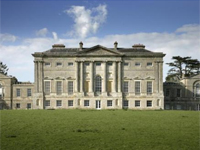
A justifiable replacement? Parkwood House, Surrey

Parkwood House, Surrey (Image: Peter Lind & Co)

There is a long tradition of replacing country houses going back hundreds of years ever since the first non-fortified mansions were built in the early Tudor period. Since 1974 when the V&A exhibition ‘The Destruction of the Country House’ did so much to highlight the hundreds which had already been lost across the UK and particularly in England the presumption has rightly been against the demolition of country houses – a position which this blog very firmly supports.  Yet to stop the replacement entirely could be seen as preventing the improvement of existing estates and seems to presume that no modern architect could match the skill of those who went before.  The case of Parkwood House in Surrey could be a useful case study in showing that replacement can be ‘creative destruction’.

Since 1800, of the nearly 1,800 English country houses which have been lost, over 150 have been replaced by a new house.  In the austere times of the post-WWII era, the new house was often smaller and easier to manage.  However, before 1930, houses which were demolished were often replaced by much larger houses to reflect the newly established status of the modern captains of industry and finance or to mark an inheritance.

Fonthill Splendens, Wiltshire (Image: RIBA)

This process of renewal could strike again and again – I think the record is held by the Fonthill estate in Wiltshire which has had seven principal houses of varying sizes including the infamous Fonthill Abbey which replaced the superb Fonthill Splendens. James Wyatt’s Fonthill Abbey is widely regarded as one of the most interesting (if ultimately unsuccessful) houses ever built in the UK – yet its creation led to the destruction of the old house.  Do we deny country house architects the ability to develop and improve just to preserve every older country house regardless of its merits?  Is it worse to stagnate estates with unsuitable (or unsightly) houses or must new houses only be built where a house has already been lost or on greenfield sites?

Parkwood House in Surrey is unlisted – and probably rightly so.  Built in the late nineteenth-century, it is, in the words of the architects of the new house “…an unremarkable and diluted essay in the ‘Old English’ or ‘Arts and Crafts’ style of the time” – but of course they would say that.  However, looking at it architecturally, there does seem little to recommend it – a rambling house, pebble-dashed, with an unexciting entrance front with an only slightly more interesting garden front.  The house is not connected with any noted architect, nor any particularly notable family (the only one of interest is the Australian 1st Baron Ballieu who was living there in the 1950s). The house then became the Rank Hovis conference and training centre with all that damage that entails during institutional conversion.

Proposed Parkwood House, Surrey (Image: Candy & Candy)

Planning permission was originally submitted in September 2007 and approved in November 2007 – a remarkably quick approval which might indicate that the planners had few qualms about the loss of the house.  In fact it might be said that Parkwood is simply a big house a countryside setting – and ‘big’ does not automatically mean it is of merit.  However, if the new house designed by the eminent Robert Adam Architects was not of such a high quality would the presumption fall on the side of retaining the old house?  The new house is an elegant essay in the use of the Palladian vocabulary to create a design which obviously provides the space and comfort that someone who would live in such a house would demand but is also architecturally interesting.  This is no mere cobbling together of a few weak ideas – this is a house which would rightly enter the list of good country houses in Surrey.  Robert Adam Architects are one of the leading practices in the country working in the Classical style and have completed other similar projects such as this house in Surrey which also replaced an earlier country house or this house in Sussex.

So if we can be confident that the new house would be high quality replacement is it justified to demolish the existing house?  In this case, as the earlier property is so unremarkable it would seem that the 91-acre estate would be better served through the keeping alive of the tradition of country house replacement – but this can only be justified where the original house is unlisted and of a poor design and the new house would be of the highest quality.  Demanding the destruction of one house to provide another has a long tradition but is a very risky path and any such application must be open closely scrutinised to ensure that we are not simply throwing away architecturally interesting houses just to build hideous ‘McMansions‘ where bigger is automatically assumed to be better.

Credit: thanks to Andrew for flagging this up.

More details and images: ‘Parkwood Estate, Surrey‘ [Candy & Candy]

More work by Robert Adam Architects: Residential portfolio

Cash in the attic: Chatsworth House sale

Chatsworth House, Derbyshire (Image: Rob Rendell/Wikipedia)

Usually during times of economic hardship all areas of life suffer as disposable income is held rather than spent.  However, paradoxically the art market is currently on something of a high which has produced record prices at recent auctions.  For the country house owner faced with ever higher bills there has rarely been a better time to re-evaluate collections and contents and see if they too can raise some much needed funds or, as in the case of Chatsworth House in Derbyshire, to make space.

The Dukes of Devonshire have always enjoyed a privileged position as one of the UK’s premier aristocratic families.  Their fortune was set with the four advantageous marriages of Bess of Hardwick (b. 1527 – d. 1608) following the early deaths of her rich husbands. OF particular note was her second husband, the 6th Duke of Devonshire, who in 1811 had inherited not only the title but eight major houses and estates including Chatsworth, Hardwick Hall (now National Trust), Devonshire House in London (demolished 1924), Chiswick House (now English Heritage), Lismore Castle (still owned by the Devonshires) and Bolton Abbey (owned by Devonshire family trust), Burlington House (now the Royal Academy of Arts), and Londesborough Hall in Yorkshire (demolished in 1819), totalling some 200,000 acres.  Chatsworth was considered her principal seat and has been for the Devonshire family ever since.  This meant that when earlier economically austere times led to the selling of other family properties such as Chiswick House and Devonshire House in London the contents of these houses were largely packed up and brought back to Chatsworth.

The current, 12th, Duke has now decided to follow the recently well-trodden path of the asset-rich aristocracy and clear out some of the accumulated contents of the storage areas and raise some welcome capital which will be ploughed back into the running of the estate.  The 20,000 items include a rare William Kent mantelpiece which is expected to go for around £300,000.  Recently up to £100m of art has been sold including an earlier sale by the Duke of Devonshire for £10m of a bronze statue, Ugolino Imprisoned with his Sons and Grandsons (around 1549), by Leonardo’s nephew Pierino da Vincia, a record-breaking Turner watercolour, Modern Rome—Campo Vaccino, from the Earl of Rosebury which made £29.7m, a 1.3-metre long, 81kg wine cooler from the Marquis of Lothian, a variety of works including a Rubens from Earl Spencer, and other sales by the Earl of Wemyss and March, the Earl of Jersey, and Lord Northbrook.

Whilst the current situation continues with rising costs not being met by investment income or from the revenue from opening up houses and estates it’s likely that we will continue to see a steady trickle of art flowing from the galleries of our stately homes into the private collections of the billionaires currently willing to pay record-breaking prices for the finest works.  Although this is in some respects regrettable, as long as the money is spent on the restoration and maintenance of our wonderful country houses then there is little cause for concern.  However, once the attics are empty or all the ‘non-core’ pictures have been sold then we may need to be worried as to what will be sold next. The worst outcome would be to have houses without estates or that we have a fine collection of stately homes in which visitor’s footsteps merely echo around empty state rooms.

More about the Chatsworth sale: ‘Chatsworth’s ‘lost’ treasures up for sale‘ [BBC News]

More about recent art sales: ‘Who is behind the great stately home art sell-off‘ [The Art Newspaper]

Bargains from difficult circumstances: country house reposessions

Sheriff Hutton Hall, Yorkshire (Image: Savills)

An article in the Sunday Times Home section (11 June 2010) includes two houses featured on this blog; one recently and one back in November 2009.  The story this week exposes that both are for sale as some of the grandest repossessions in the country with lenders forcing the sale.

Each of these houses when bought was probably the realisation of an aspiration many have to own a grand country house.  Yet, what goes up can come down and each owner has now been forced out of their dream.  The first house, Sheriff Hutton Hall in Yorkshire is a grade-I listed gem surrounded by 170-acres and indeed featured on this blog entitled ‘If I won the lottery…‘.  Originally built in the early 1600s as a hunting lodge before being remodelled in a lighter brick in 1732.  The outbuildings were constructed using quantities of stone and panelling from nearby Sheriff Hutton Castle, it also features richly decorated ceilings with plasterwork by John Burridge and Francis Gunby, who is also thought to have worked on the Dining Room at Temple Newsam in Leeds.

Sheriff Hutton Hall was sold in 1998 and became the northern branch of the East 15 acting school.  Today however, despite strenuous efforts by the owner, a secondary lender has called in their loan forcing the sale.  Originally for sale, through Savills, at offers over £5m (nearer £6m was apparently hoped for) the price has now dropped to £4.5m.

Sale details: ‘Sheriff Hutton Hall‘ [Savills]

Detailed architectural description: ‘Sheriff Hutton Hall‘ [British Listed Buildings]

Wardour Castle, Wiltshire (Image: Strutt & Parker)

The second property, Apartment One in Wardour Castle, Wiltshire, was only launched in Country Life magazine a few weeks ago and was featured here with the idea that it might be used as a starting point for the conversion of the house back to a single home (‘Conversion reversion: Wardour Castle‘).  Yet it now appears that it was the original project to convert this Georgian gem that has caused the current vendor’s difficulties.  The house, designed by James Paine, was built in the 1770s for the eighth Baron Arundell and was (and in some ways still is) the grandest and largest house of it’s era in Wiltshire.

After use as a school for thirty years until 1990 it had an uncertain future.  Nigel Tuersley then bought the grade-I listed house for £1m in 1992 and decided to convert the house into ten large apartments with Nigel retaining the largest in the centre of the house for himself.  However with property boom turning to bust the bank was unwilling to continue funding the project.  This first manifested itself when the same apartment, all 23,000 sq ft of it, was put on the market for £7m in 2008 – possibly a bit ambitious even at the time.  With the contents now removed (not that you can really tell as the interior was designed by the famous Minimalist architect John Pawson) the apartment now waits for someone with a more reasonable £2.75m through Strutt & Parker.

The house is another in a small but sadly growing list of ‘posh repossessions’ (those valued at over £1m) which show that dreams, however big, can still be brought down and that perhaps the hardest part of reaching the top is staying there.

Sale details: ‘Apartment One – Wardour Castle‘ [Strutt & Parker]


Credit: original story in the Sunday Times Home section – 11 July 2010.  Story only available online to subscribers.

How to get depressed quickly: the English Heritage Buildings at Risk Register 2010

Winstanley Hall, Lancashire (Image: English Heritage)

This blog has highlighted several country houses which are at risk but the true scale of the issue is unfortunately much larger, as the publication of the 2010 English Heritage Buildings at Risk Register shows.

Country houses all too easily can move from being secure, watertight buildings to having minor problems to becoming seriously at risk due to their size and the high standards required to repair them necessarily making even simple tasks much more expensive.  For the owners this can mean that the burden of looking after their ancestral family home becomes a daily challenge which, rather than facing, can be easier to ignore – especially if they are able to simply shut the door to a wing and forget the damp and leaks.

One of the greatest enemies of the country house is obscurity – particularly when combined with negligent or incapable owners. For some the house is merely an obstacle to redevelopment and so it is in their interest to forgo maintenance and hope that the house quickly and quietly deteriorates to the point where they can apply for permission to demolish.  Unfortunately under-resourced councils are rarely able to regularly survey all the listed buildings in the area meaning that houses can slip through the cracks.  The current economic climate means that it is even more unlikely that councils will be able to fully fund the heritage teams to ensure that they are able to ensure owners meet their obligations.

Melton Constable Hall, Norfolk (Image: English Heritage)

Although English Heritage have had some limited successes (e.g. Sockburn Hall, County Durham) there are still far too many houses at risk – I counted nearly 100 in a couple of searches.  It should be noted that houses are included even where works are planned or under way such as at Clarendon House, Wiltshire which was recently sold (with estate) for a reputed £30m and where restoration is expected to be completed by the end of 2010).  However, other examples include:

Others on the list include:

The head of English Heritage, Simon Thurley, said at the launch:

“Neglect is a slow, insidious process whose costly damage takes time to become clearly visible. Cuts in both private and public spending are currently inevitable but armed with our Heritage at Risk Register, English Heritage is well-equipped to guard against the loss of the nation’s greatest treasures and to suggest effective and economical strategies to protect our national heritage.”

One can only hope that this proves to be the case and that EH are able to fully fulfil their role particularly in relation to country houses and ensure that these beautiful buildings aren’t allowed to quietly slip into dereliction, depriving future generations of wonder of these grand houses.

More details: English Heritage Buildings at Risk 2010 or you can search the 2010 Register

For those who like their houses with pedigree: Plumpton Place, Sussex

Plumpton Place, Sussex (Image: Knight Frank)

One of the greatest of the UK’s country house architects was Sir Edwin Lutyens – a man with undoubted talent who was also able to use thoroughly modern techniques of collaboration and media exposure to boost his career and win business.  His main media connection was the tireless promotion of his work by Country Life magazine which was, in no small part, due to his close friendship with the founder and editor Edward Hudson.  So when Hudson needed to restore and modernise a manor house he’d bought it was inevitable who he would call on.   Plumpton Place in Sussex is now considered to be one of Lutyens’ best country houses and it’s for sale.

Lutyens (b. 1869 – d. 1944) was a master at the creation of houses which evoked what many would have in their minds as the ‘ideal’ country house.  He was able to marry the romanticism of the Arts & Crafts movement to his own clear ideas as to how a house should look both inside and out.  A strong proponent of using local materials he, more importantly, was able to use them in innovative ways which made his houses distinctive.

Marsh Court, Hampshire (Image: Clicks_1000 @ flickr)

A classic example of this was his use of chalk at Marsh Court in Hampshire which gave this house a brilliant white appearance, and which contrasted with small tiles of knapped flint set into the walls and the red-brick chimneys.  Marsh Court (finished in 1904 and for sale in 2007 for around £13m) was the last of Lutyens’ ‘Tudor’ style houses but it would never be considered an old house – again showing his genius of matching local materials with an assured architectural design.

Much of Lutyens’ fame can be attributed to the unstinting support he received from Edward Hudson who had cleverly exploited the growing urban middle-classes interest in a nostalgic view of ‘olde’ England and the country lifestyle.  Founded in 1897 it chronicled not only the best of the grand old country seats but also sought to keep the tradition alive at a time when the lifestyle was beginning to come under threat. One of his writers was the renowned garden designer Gertrude Jekyll who had met Lutyens in 1889 and had collaborated with him to create some of the best regarded house-and-garden compositions in the country.  Jeykll introduced Lutyens to Edward Hudson in 1899 thus creating a life-long friendship between the two.  To Hudson, Lutyens’ ability to create these idealistic visions of country life were the perfect material for his magazine.  Coupled with the extensive use of their distinctive, high-quality black & white photos it provided an unrivalled opportunity for Lutyens to built fame with the middle-classes but also advertise his talents to the aspirational wealthy or the existing gentry.

Hudson was a man to put his money where his magazine was and commissioned Lutyens to work on three houses; Deanery Gardens, Lindisfarne Castle and Plumpton Place – all now considered to be Lutyens’ best work.  Hudson had bought Plumpton, a derelict, moated manor house, in 1928 for £3,300, to be used as a weekend retreat and a place to entertain.  In some ways Lutyens’ work there was a surprising contrast to the grand Classical-style banks and corporate work he was engaged with in London and elsewhere.  Lutyens created a new route to the house which used a theatrical sense of surprise to hide the house except for glimpses through arches and trees.  Inside the most notable addition was that of a music room with huge, almost mullioned, windows with small panes of glasses set into wooden frames rather than the then fashionable steel, flooding the room with light.

The house was bought in 1983 for £800,000 by an American venture capitalist called Tom Perkins who has since lavished ‘millions’ on careful restoration.   So if you have £8m, this is a rare opportunity to live in a genuine Lutyens masterpiece which has played its own part in shaping our national impression as to what a country house should look like.

Property details: ‘Plumpton Place, Sussex‘ [Knight Frank]