Shaw House was built in 1581 for Thomas Dolman, a local cloth maker, whose family lived in the house for six generations until 1728. It was subsequently the country retreat of the Duke of Chandos, before being being home to the Andrews and Farquhar families until it eventually requisitioned for use by troops in WWII, before it then became a school.
The £6m project rescued the house from disuse and neglect after it ceased to be a school in 1985. As part of the project, inappropriate modern additions to the house were removed, and repairs made using traditional materials. The house is now open for visitors and events giving new life to this beautiful house.
Perhaps it’s reading too much into a story but when a journalist says that “…despite its magnificence the former stately home, built in 1653, is impractical as a hospice – haemorrhaging money, which could, and should, be spent on patient care.” does this indicate an intention to sell this important Grade-I listed house? And “…Thorpe Hall, however beautiful, is not an ideal site”. Perhaps the fact that the Sue Ryder Foundation, who own the house, have also launched an £8m appeal for a new hospice in the city is related?
Thorpe Hall has the rare distinction of being one of the few houses built during the dark years of the Commonwealth when there was little building activity in England. Although an undoubtably beautiful house the “principal staircase with heavily carved foliated open panels to broad balustrade” is probably not suitable for a stairlift.
Hopefully, the discussion and consultation process will be open as possible – the worst scenario would be for the hospice to move to a new location leaving this important building in a disused limbo. Here’s a thought though; rather than passing to another institutional use, it would be interesting to explore the possibility of it becoming a home again. This would be the least impact option in terms of long-term day-to-day use but would probably entail some covenants regarding the long-established access to the grounds and gardens. Anyway, it’s just a thought.
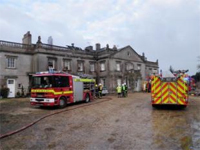
Holnest Park House, Dorset (Image: Bournemouth Echo)
Earlier today, the Grade-II listed Holnest Park House in Dorset suffered a serious fire which has gutted the central section of the house leaving the core at risk of collapse. The fire started in one of the seven flats through the careless use of an electric blanket which lacked a thermostat and simply heated up until it caught fire. The fire destroyed the two flats in the central section but the 60 firemen in attendance were able to prevent the blaze spreading to the wings.
The Georgian house was built in 1768, and rebuilt in the 1830s, on land formerly owned by the Bishops of Salisbury. It became a secondary seat of the Sawbridge-Erle-Drax family through marriage, and so was regularly tenented as the family were mainly based at Charborough Park (a large house also in Dorset) and Olantigh Towers in Kent.
The house was sold in 1919 and then used as military hospital for injured servicemen during WWII. It was subsequently sold to timber merchants who stripped the park of it’s fine trees even felling the avenue to the house, and then selling the land off for agriculture. The house then became an island in the middle of the fields, neglected until someone decided to ill-advisedly convert this remote house into a nightclub. The left-hand side was divided up and much damage done to the interior during this process. The right-hand side became (or was) houses. After the inevitable failure of the nightclub the rest of the house was converted into further apartments.
Fire is one of the most worrying dangers faced by country houses as they can be started so easily, especially during renovations, and due to the materials used in construction the fire can spread quickly. Of course, this danger is increased where a house has been split into multiple apartments as there are now more sources of ignition such as kitchens. Older houses are usually not fitted with many of the modern fire safety features as this would compromise the historic fabric of the building meaning there is a extra responsibility for the owners to be vigilant.
Although the intial reports indicate that the fire-damaged section of the house has been declared structurally unsafe, it’s hoped that restoration will be possible. Insurance can cover the cost of re-instatement but it can’t bring back the historical aspect of what’s been lost.
If an almost perfect example of a Grade-I listed, Charles II house set in beautiful protected parkland but only an hour from London was available for £4.5m you might think there was a typo. However, it’s true but there are one or two minor catches.
Firstly, Ashdown House , built in 1661, is owned by the National Trust so your £4.5m only gets you a 60-year lease (or £205 a day if that’s easier). Secondly, because it’s National Trust, the house is also open to visitors every weekend April to October (approx 2,000 last year) so that they can see the impressive staircase and ascend the 100 stairs to the viewing platform with it’s fine views over the Berkshire Downs.
So, basically, this is possibly the finest second home in the country – although rather than use it at weekends you may wish to be there during the week. The current owner, Mr Max Ulfane, a businessman and well-known philanthropist, has hosted such high-profile events as fund-raising receptions for the Ashmolean Museum. Alternatively it might be possible to vary the lease to at least exclude some weekends – especially as the lease was offered with the same terms at the same price in May 2009.
*Update* The Sunday Times today (24 January) says that a 83-year lease is available for £5.3m (£175 per day for anyone putting it on expenses) and that the famous artist Anish Kapoor is planning to take a look and it has already been seen by several others including a top executive at Puma.
The financial pressures of owning a country house usually mean that the priority always has to be the main building with little left over for the kinds of follies, garden buildings and ‘eye-catchers’ which were a common enhancement in previous centuries.
Over the last few decades there have only be a few notable additions to parklands including the strikingly modern garden pavilion designed by I.M. Pei for the Keswicks in Wiltshire. However even this has a practical use but in the spirit of landscapers such as ‘Capability’ Brown, a proposal has been submitted for a new pyramid to be built as an ‘eye-catcher’ at the end of a 1km walk at Doddington Hall in Lincolnshire. Doddington is a beautiful, symmetrical, red-brick house designed by the celebrated Elizabethan architect Robert Smythson. It also has the rare distinction of being one of the few houses to have never been sold since it was completed in 1600.
Fingers crossed that this interesting proposal will be approved and completed to continue an important tradition of folly building in English gardens.




 The Country Seat