Phoenix for sale: Beaurepaire House, Hampshire

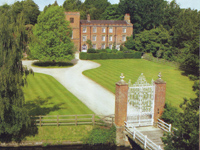
Beaurepaire House, Hampshire (Image: Knight Frank)

Launched this week ( 23 June 2010) in Country Life magazine is a fine, grade-II* listed, moated manor house set in nearly 250 acres of Hampshire.  Open the first set of impressive wrought iron gates and follow the drive down to the ancient moat and through the second, equally impressive, set of white painted gates over the wooden bridge. Before you stands a beautiful red-brick manor house – but why is the house set in one small corner of the island? Why does the drive lead over the moat but unusually not to the middle of the house?  And why does that tower look a bit new?

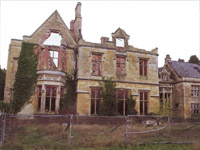
The answer to all these questions is that Beaurepaire House, as it now stands, is what remains of an important and beautiful manor house which burnt down in 1942 after a chimney fire.    What happened subsequently is an interesting example of how disaster need not lead to the loss of the whole house or the estate.

Beaurepaire House, Hampshire before the fire (Image: Lost Heritage: England's Lost Country Houses)

Beaurepaire House has royal connections having been visited twice, once by Henry VIII in 1531 and then by his daughter Elizabeth I during her visit to The Vyne.  The moat itself dates from 1369 but the original house was built in the 16th-century but was badly damaged during the Civil War and was only rebuilt in 1777.  The design of the new Georgian ‘Gothick’ house followed the rare structure of having a square core with castellated corner turrets.  There are relatively few examples of these houses – and the ones we have today are all ruined to some degree (Ruperra Castle, Wales / Lulworth Castle, Dorset) or lost entirely (Compton Bassett House, Wiltshire).

At the time of the fire the house was owned by one of the richest men in the country, Sir Strati Ralli, but wartime building restrictions prevented restoration. After the war the estate was owned by Lady Sherfield and in 1965 she decided to restore the remaining servant’s wing as a house and commissioned the well-known architect Tom Bird, who had restored many other country houses, to make the house habitable.  Bird decided to add a sympathetic tower, which continued the existing architectural style, to the fire-damaged southern flank of the remaining wing to not only provide structure but also to improve the proportions of what was left.  The addition was less than 10% of what remained but successfully ensured that the house was able to rise again from the ashes of the fire to retain the role it had enjoyed for hundreds of years as the centrepiece to an impressive country estate.

_____________________

Property details: Knight Frank seem to have forgotten to put the details on their website.   Nevermind, here’s a link to all the Hampshire houses they’re selling in the hope that they soon add it in: Knight Frank: Hampshire

The relative cost of your English country house

Great Hockham Hall, Norfolk (Image: Savills)

So you’ve decided you really want a country house.  Nothing too big; more a residential estate than a working or sporting one so perhaps just 48 acres. Luckily your four-bed house in the best part of Fulham is worth £1.75m so you can sell up and surely move straight into your dream rural arcadia? Unfortunately a recent survey by upmarket estate agents Savills has shown that you might need just a bit more money than that.

As always, proximity to London is the key factor in determining how far your money will stretch.  With the Russians and Middle Eastern families not willing to be too far from the cultural delights of Bond Street the price of a decent country house with 48 acres in Surrey tops the table.  To secure a decent small estate in the nicest parts would require between £15m-£20m but a similar property in Hampshire would set you back just £10m on average.

So with the those two counties ruled out, where next?  The Cotswolds have always been popular with the corresponding effect on prices but if Hampshire is too expensive then unfortunately you’re also out of luck in Gloucestershire with the average there hitting £12m – but north Oxfordshire might look attractive with the average of between £7m-£8m.

Distance from London reduces prices but with broadband making working from your country home on Friday possible Dorset or Wiltshire are still very attractive but more affordable – but you’ll still have to expect to pay between £4.5m-£5m.  Fewer transport options make East Anglia even cheaper with a country house in Norfolk going for around £3.25m – which makes the pretty Great Hockham Hall [pictured above], a grade-II listed Queen Anne house built in 1702 and with 47.66 acres, almost a bargain at £2.95m.

So where could you trade in your Fulham house for a small country estate? Step forward Lincolnshire where the average is the lowest in England at ‘just’ £1.75m-£2.25m. So proving that everything is relative it seems that even the high prices of London don’t always directly translate into a ticket to the country life unless you’re willing to go where the market takes you.

______________________

Source: research by Savills (but listed not on their website) and reported in The Times ‘Bricks & Mortar’ property supplement on Friday 18 June (but their website doesn’t allow access so no link there either).

If you are interested in the rest of the report or the averages for other counties I’m guessing the best contact is Alex Lawson at Savills (Rural Research) on +44 (0) 20 7409 8882 or email alawson@savills.com.

Conversion reversion? Wardour Castle, Wiltshire

Wardour Castle, Wiltshire (Image: Strutt & Parker)

With so many country houses lost in the twentieth century, almost any alternative which saved them from the demolition crew was to be welcomed; no matter how drastic.  For some this meant institutional use but for many others of all sizes the solution was conversion into flats and apartments – though with varying degrees of success.  However, as these properties come on to the market, is it perhaps time to consider converting them back into the single, glorious houses they were intended to be?

Launched this week (16 June 2010) in Country Life magazine is the principal apartment in what is considered James Paine’s finest creation; Wardour Castle, a supremely elegant essay in Palladian architecture.

Central stairwell and gallery, Wardour Castle, Wiltshire (Image: Strutt & Parker)

Built from 1770 – 76, for the eighth Lord Arundell the most impressive feature is a breath-taking central stairwell with first-floor gallery which Pevsner called ‘the most glorious Georgian interior of Wiltshire’ and which forms the core of Apartment One which is now for sale.  Wardour Castle house has proved to be adaptable becoming Cranborne Chase School in 1960 until it closed in 1990 when it was then converted into ten apartments.  As the divisions appear to have respected the natural sections of the house this seems to be a good example of where someone could convert the house back to a single home.

There are many examples of houses being rescued by conversion.  SAVE Britain’s Heritage have long campaigned to protect these houses and have worked in conjunction with one of the leading architects, Kit Martin, in supporting conversion.  A 1983 SAVE report entitled ‘The Country House: to be or not to be’, written by Kit Martin and Marcus Binney, includes particularly interesting studies of how these houses could be sensitively converted.  These show that although almost any country house could be sensitively adapted some are naturally more suitable particularly where the overall layout of the house is symmetrical, shallow and long.

The study was an important milestone in the practice of country house conversion and saved many houses from complete loss or inappropriate use including The Hazells in Bedfordshire, the grade-I Northwick Park in Gloucesterhire, Dingley Hall in Northamptonshire.  The sensitive approach they championed now means that it should be possible to consider converting a house back if the right opportunity arose.  It should be said that some houses are never going to be converted back due to a variety of factors including there being too many apartments involved such as at Thorndon Hall in Essex which contains 37 flats, or where not enough land has been retained to make the unified house valuable enough to justify reversion.

Perhaps the idea of reversion becomes more realistic where more than one part of the same house comes on the market at the same time such as recently happened with grade II*-listed Ampthill Park House, Bedfordshire.  Built by the Cambridge architect Robert Grumbold in 1687-9 and completed by John Lumley of Northampton in 1704-6, with major additions by Sir William Chambers in 1769 it is certainly one of the most impressive houses in the county. It was rescued from dereliction by conversion into just four large houses; two of which were put on the market in April 2010, the largest of which includes most of the principal rooms.

Although it’s nice to dream about these houses becoming single homes probably the biggest obstacles are not only being able to secure the other apartments but also that the value of the individual properties may be greater than the value of the unified house.  However, it’s not entirely beyond the bounds of possibility that someone with deep pockets and a desire to restore a house could take on one of these conversion reversions and recreate a superb country house.

Property details: ‘Apartment One – Wardour Castle, Wiltshire‘ [Strutt & Parker] – £2.75m

Detailed architectural description: ‘Wardour Castle, Wiltshire‘ [English Heritage: Images of England]

Orphan seeks new carers: Plas Gwynfryn, Gwynedd

Plas Gwynfryn, Wales (Image: SAVE Britain's Heritage)

It’s often been said that there are no problem buildings, just problem owners.  However, an even more difficult situation is where the house is ‘orphaned’ because no legitimate owner can be found.  This can make it doubly frustrating for those looking to buy and restore a property who are forced to sit by and watch a building deteriorate as the search goes on to find the owner.  This also highlights something of a legislative loophole as having no known owner also prevents the council serving an ‘Urgent Works Notice’ to force repairs thus ensuring that the house will continue to deteriorate. Which brings us to Plas Gwynfryn; an orphan with good prospects if adoption takes place quickly.

The grade-II listed Plas Gwynfryn is another of the many Welsh country houses built to serve the minor gentry, with their increased wealth from the Victorian industrial boom.  The estate had been inherited from a childless uncle by Owen Jones Ellis-Nanney in 1819, and he hugely increased the size of his lands by purchasing the neighbouring Plas Hen estate. On his death it passed to his son, Hugh John Ellis-Nanney.  Having been educated at Eton and Oxford and, on his 21st birthday, now owner of a huge estate, Hugh was the epitome of the eligible bachelor and wanted a house to reflect his status.

The old house was demolished in 1866 and the new house was completed by 1876 at the then astronomical cost of £70,000 (approximately £3m in today’s money).   The design, by architect George Williams, was regarded as very fashionable to the extent that the house was featured in ‘The Builder’ magazine in June 1877.  Hugh was very active in local politics and in 1895 almost beat the local Liberal candidate, the future Prime Minister David Lloyd George, losing by only 194 votes.  Almost by way of consolation Hugh was given a baronetcy and happily lived out his days at Plas Gwynfryn, dying in 1925, with his wife following in 1928.  As their only son had died aged just eight, the house was inherited by their daughter who moved out to Plas Hen.  The house was then let to the Church of Wales before being sold off in 1959 when the estate was broken up.

It then became a hospital and then a hotel before a mysterious fire entirely gutted it in 1982.  Since then it has stood as an empty shell, slowly deteriorating, and is now in serious danger of collapse with the tower a particular risk.  Almost no work has been done on the house except for a brief period when a conservation-minded squatter moved in and started work.  This prompted the only known appearance by the apparently Canadian owner who appeared in a local court during eviction proceedings.   Since then nothing has been heard of the owner and the local council, though aware of the situation, seem powerless to act unless the owner can be found.  A local developer, Aaron Hill, who has completed other historic restorations, is keen to find the owner and buy Plas Gwynfryn with a view to fully restoring it as a family home – which would surely be the best outcome.

Although rare, this example shows that despite the combined efforts of the local Council and a potential buyer an owner can remain a mystery, thwarting well-intentioned efforts to rescue a house before it deteriorates beyond the point of repair.  If there is a legislative loophole it must be closed to prevent any other houses languishing in such a way.

Perhaps councils could be given the legal power to compulsorily purchase when a house is at risk of complete loss, with the money held in escrow in case the owner should appear. Councils are often reluctant to use their powers of compulsory purchase as they become legally responsible for repairs but surely in cases like this with an owner desperate to take the house on, the risk to the public purse is very low. The power would have to only be used in extremis when all other avenues had been exhausted but at least it would give a tool of last resort to ensure that more of our heritage is not lost just because a problem owner can’t be located and forced to honour their responsibilities.

If you are the owner and you happen to read this, please do get in contact with either me or the Council or SAVE Britain’s Heritage who would be more than happy to help get the process of rescuing this house under way.

Anyone with deep pockets? Country houses at risk today

It seems remarkable that between the popularity of country houses as tourist attractions or business or simply as homes that any would be at risk.  Yet as the 2010 SAVE Britain’s Heritage Building’s at Risk Register shows there are still a broad selection of fine houses which, for various reasons, are in need of someone with a desire to restore part of our heritage, lots of dedication, and pretty deep pockets.

Nocton Hall, Lincolnshire (photo copyright: Tom Vaughan)

One of the saddest is the case of Nocton Hall in Lincolnshire – a county which has lost so many of it’s fine old country houses already.  Fire is still one of the main reasons a house can quickly go from being a secure home to an ‘at risk’ shell.  Grade-II listed Nocton Hall is a warm honey-coloured stone house built for the 1st Earl of Ripon in 1841 to replace the original Jacobean house which burnt down in 1834.  After a stint as an RAF hospital in WWII it became a residential home before being bought by a property developer.  Unfortunately no development took place and the house was allowed to slowly deteriorate before a serious fire severely damaged what had been a perfectly good house.  Still sitting in its own gardens and parkland and near the village Nocton Hall cries out to be restored either as a h,otel or ideally as a grand family home.

Barmoor Castle, Northumberland (Photo: SAVE Britain's Heritage)

To look at the photo, Barmoor Castle in Northumberland looks in pretty good shape – but a picture can hide as much as it shows.  The first issue with Barmoor is that it actually is unused and sits in the middle of a caravan park which has been established in the grounds. Inside, there is some water damage as the roof has been leaking – although recent work, part funded by English Heritage, has alleviated this for the moment. Barmoor was built in 1801 around an older tower by the architect John Patterson of Edinburgh in a castellated Gothic Revival style for Francis Sitwell, in whose family it remained until 1979 when it was sold along with 200-acres.  The current owners have operated the caravan park since then but didn’t live in the house or use it leading to it’s current neglected state.  This is a classic example of where a house could be rescued from an inappropriate use, restored and enjoyed as a fine country house as was intended.

St Botolph's Mansion, Wales (Image: SAVE Britain's Heritage)

St Botolphs Mansion in Pembrokeshire was built in the early 1800’s for General Richard Le Hunt is a house in need of a use rather than repair.  The Doric porch and neat window architraves create an interesting facade which would normally ensure that such a house would be jealously fought over if it came to market.  However it is now owned by the nearby oil refinery (the proximity probably ruling out residential use) but they are exploring options as to how to make use of this elegant Georgian house – perhaps as a conference facility might be more appropriate.  Either way, this is a house which shouldn’t be forgotten.

Other country houses of note in the report include the Grade-II* listed Plas Machen nr Newport, the surviving portion of the 15th-century house of the Morgans who moved up in the world to Tredegar House, which is for sale. Also for sale, since 2007, is Benwell Towers in Newcastle which was a country house when built but is now suburban, achieving fame in later life as the set for the kid’s TV series ‘Byker Grove’.

Even if your pockets can’t stretch to a country house there are many other buildings seeking a saviour so do order your copy of ‘Live or Let Die‘ and certainly consider joining SAVE Britain’s Heritage to help to preserve our architectural legacy for future generations.