Rothschild-shire: the lost, the ‘cottage’, and the home (3/3)

Having seen the glories of the prodigiously grand Mentmore Towers and Waddesdon Manor in the previous article on ‘Rothschild-shire’, that part of Buckinghamshire which became the domain of the Rothschild family from the 1850s, this final one looks at the remaining three: the lost Aston Clinton House, the ‘cottage’, Ascott House, and the family home, Eythrope.

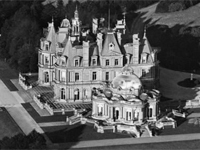
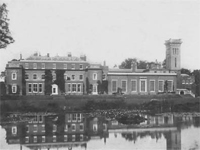
Aston Clinton House, Buckinghamshire (Image: Lost Heritage) - Click for more images
Aston Clinton House, Buckinghamshire (Image: Lost Heritage) – Click for more images

One of the tragedies of the history of the UK’s country houses has been the wholesale destruction of so many, mainly between 1930-1960.  Often, as a family fell on financial hard times, the house contents would be sold, followed later by the building itself, in the hope they could retain the estate.  Although, wealth was clearly not an issue for the Rothschilds, one of their houses, Aston Clinton House, has since been demolished – though, admittedly, long after they had left.

Possibly one of the (relatively) smaller of the Rothschild’s houses, Aston Clinton House was also unusual in that it grew from a smaller one, through a series of additions, to be a substantial home, rather than being a new build.  The original house was built sometime between 1770-1789 for General Gerard Lake, who laboured under the geographically diverse title of 1st Viscount of Delhi and Laswary and of Aston Clinton in the County of Buckingham. Never a grand seat, it was built in the style of a small hunting lodge, and passed through the Lake family until 1838 when the house and the accompanying 1,055-acres were sold for £23,426 to the 2nd Duke of Buckingham and Chandos, who saw the productive estate as a good investment.

Aston Clinton House Bucks, just before demolition (Image: Lost Heritage)

After the Duke’s death, it was initially put up for auction, largely unaltered, by the Duke’s son in 1848 but was withdrawn – but not before it had attracted the attention of the Rothschilds. Though “It is not like a fancy place”, it was bought for £26,000 as more of an investment but Sir Anthony Rothschild and his family moved in in 1853. Lady de Rothschild immediately took against the ‘small’ size and so Sir Anthony commissioned G.H. Stokes (Sir Joseph Paxton’s son-in-law, and who had previously worked at Mentmore) to significantly enlarge it, with works completed by the early 1860s.  The architect George Devey, who was to build his career around the Rothschilds, undertook more work between 1864-1877, on both the house and estate.

The house and estate passed through the family until it was sold in 1923, having served in WWI as the HQ for the Commanding Officer of the Twenty-First Division, then based at the nearby Halton estate (c.f. Halton House in part 1). Sold for just £15,000, it became a school – where Evelyn Waugh started his teaching career – before serving as a corporate HQ, then as a hotel in various guises before being bought by Buckinghamshire County Council and demolished c.1960. A training centre was built in its place, with only a few buildings remaining as a reminder of grander days.

Outcome: commercial use, demolished as surplus to requirements.

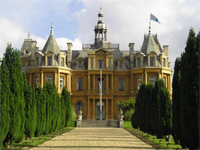
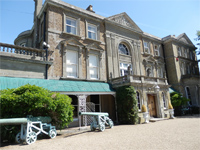
Ascott House, Buckinghamshire (Image: Peter J Dean via flickr)

George Devey was to play an important role in the Rothschilds’ architectural plans, as were the family central to his own success.  One of his most successful designs was for Ascott House, for Leopold de Rothschild, for whom he extended a small house dating from 1606 to create a rambling, many-gabled ‘cottage’ (though one with 30 bedrooms) as a more rural retreat than Leopold’s other seat at Gunnersbury Park (see Part 1). Although initially used just for hunting and recreation (with an emphasis on the outdoors as the house was built without a library, though one was later added), Leopold quickly realised that he needed more space for entertaining and so, in 1874, started a program of extensions which would continue until c.1888 with Devey, but also beyond, into the 1930s.
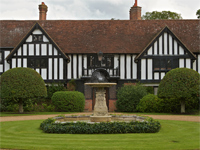
Ascott House, main door (Image: Peter J Dean via flickr)

Devey was an unusual Victorian architect in that he never exhibited his work or allowed his designs to be published, so secure was he in a bubble of aristocratic and wealthy clients who kept him constantly employed.  Mark Girouard regarded the houses Devey designed as the most interesting outside of the ShawNesfieldWebb circle, especially as he was regarded as having successfully developed a way of incorporating vernacular styles into his work.  He particularly favoured the idea of making houses look as though they had developed over time – and ideally that they be covered in ivy. Mary Gladstone (daughter of the Prime Minister) visiting in 1880, approvingly described Ascott as ‘a palace-like cottage, the most luxurious and lovely I ever saw‘. The flip-side to the accretive approach is that some of the layouts for his houses seem to stretch for long distances; at Goldings, Hertfordshire, it covered approximately 350ft from end-to-end (the house is now flats with sprawling, unimaginative development in the immediate grounds).

Ascott was inherited by Anthony Gustav de Rothschild from his mother in 1937 (Leopold having died in 1917) and he and his wife made further additions, including converting the billiard room into a library.  Although Anthony was very much involved with the family business he was also a renowned collector and the house is a treasure trove of fine paintings (including works by Gainsborough, Romney, Reynolds and Cuyp), 18th-century English furniture, books and over 400 pieces of Chinese ceramics. The house, gardens, and a small part of estate were donated by Anthony to the National Trust in 1947.  Much of the collection and the surrounding 3,200-acre estate is still owned by the family, and Sir Anthony’s son, Sir Evelyn de Rothschild still lives in part of the house, keeping the connection to the original creator alive.

Outcome: owned by the National Trust, family still partially in residence
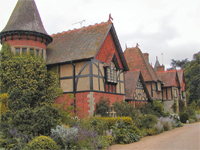
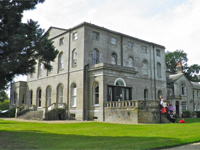
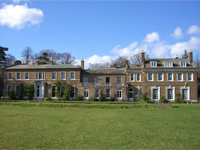
Eythrope, Buckinghamshire (Image: John S. Pipkin via flickr)

And so to Eythrope, in Waddesdon, a house strangely  built without bedrooms as it was primarily intended as the daytime retreat for Alice de Rothschild, sister of  Baron Ferdinand de Rothschild, with whom she came to live.  Alice was independently wealthy (having inherited a large estate in Germany), strong-willed, and opinionated – all useful qualities, but less so to her brother, who was very similar. To reduce familial friction, Ferdinand suggested she build somewhere to while away the days and Eythrope was the solution. Alice bought the estate for £180,000 in 1875, and chose to build her ‘Pavilion’, as it was called, in a curve in the river.  As Alice had suffered from rheumatic fever, the damp of the river might have been dangerous had she been tempted to spend too long there so the design included no bedrooms. Problem solved.

The original house on the site had been built in the 1500s and was eventually inherited by Philip Stanhope, 3rd Earl of Chesterfield (d. 1726), but had been demolished in 1810—11 by Philip Stanhope, 5th Earl of Chesterfield.

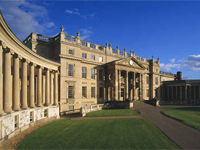
Eythrope, Bucks - garden front (Image: crazybiker via flickr)
Eythrope, Bucks – garden front (Image: crazybiker via flickr)

As if to emphasise that this was Alice’s project, she chose not to use Gabriel-Hippolyte Destailleur, who was then working for her brother at Waddesdon. Instead, the new house at Eythrope was another commission for George Devey who had worked at various Rothschild houses including Mentmore, Ascott, Aston Clinton, and Tring Park – but Eythorpe is his most complete work for the family.  In rejecting her brother’s grandiose French style (though not totally as there are flashes of the French Renaissance), Alice opted for what Pevsner described as a ‘free neo-Tudor style’ creating a delightful rambling house framed by the river. Passed down from Alice de Rothschild (who inherited and also became the forthright guardian of Waddesdon after the death of her brother), it was inherited, along with Waddesdon, in 1922 by Dorothy and James A. de Rothschild, who added a large wing with bedrooms and bathrooms. After James’ death in 1957, and having given Waddesdon Manor to the National Trust, Dorothy moved to Eythrope and lived there for forty years.  On her death, the house and estate were inherited by her husband’s great nephew, Jacob Rothschild, 4th Baron Rothschild, whose home it remains today.

Outcome: the only house built by the Rothschilds and still wholly owned, and lived in, by them

——————————————

Although slightly off the usual ‘patch’, the Exbury estate, Hampshire, was another house where a Rothschild, Lionel Nathan de Rothschild, could give full rein to a passion; this time it was plants, specifically, rhododendrons and azaleas.  With a passion from an early age, the garden was always going to be spectacular, but Exbury House is also impressive and perhaps to be included in a future article.

——————————————

Previous articles in the series on the Rothschild’s houses:

——————————————

Fascinating ‘Lunch with the FT’ with Lord Rothschild at Eythrope

Visit Ascott House [National Trust]

Rothschild-shire: the wider fate of UK country houses mirrored in a family (1/3)

The landscape of the UK is one rich in our heritage of country houses.  Each tells a tale of wealth, ambition and family life, yet, although each was built as a home, for many of them this is no longer the case.  These houses can be grouped in many ways – by architect, region, style, size, etc – but there are very few that can be grouped together simply by family ownership.  To acquire one country house is a mark of achievement, yet for an elite group of families, their success allowed them to amass a collection of houses.  The Rothschilds were one such family and so effectively did they colonise an area of Buckinghamshire that it became known as ‘Rothschild-shire’.  In this two-part article, we can look at the fortunes of their houses, and in them, see a snapshot of the fates of country houses across the country. This first part features Gunnersbury Park, Tring Park, Champneys and Halton House.

The Rothschilds are one of the most successful family businesses in the world; financiers to companies, countries and the considerably wealthy.  Having become well-established in Frankfurt, the five sons of Mayer Amschel Rothschild set out for five European cities – London, Paris, Frankfurt, Naples and Vienna – in 1809-10 to expand the firm.  By working closely together they flourished, creating a pan-European network which not only handled money but also information, making them the best informed and giving them a competitive advantage.  Their business achievements naturally made the family exceptionally wealthy and, as was the pattern, their success translated into property, with the family building over 40 houses in the 19th and early 20th centuries across Europe.

Gunnersbury Park (Large Mansion), Middlesex (Image: Magnus Manske / Wikipedia)

In the UK, the Rothschilds waited until 1835 before acquiring their first country house, Gunnersbury Park, Middlesex. The estate had been home to Princess Amelia, daughter of George II, in the first Gunnersbury Park, designed by John Webb but inspired by Palladio’s Villa Badoer.  After Amelia’s death in 1786, the house and estate were eventually bought by a speculator who demolished the house and sold the land in 13 lots. All bar two were bought by Alexander Copeland (10 lots in 1802 and a further 2 in 1806), business partner to the architect Henry Holland, who probably designed it.  Unfortunately, the remaining two lots sold were immediately to the side of the new house and a second mansion was built, leading to the houses being imaginatively labelled the Small Mansion and Large Mansion.  It was the latter which was bought by Nathan Meyer Rothschild, only a year before he died in July 1836.  The house then passed down the Rothschilds until 1925 when Maria, recently widowed wife of Nathan’s grandson, Leopold de Rothschild, decided to sell the house and now 200-acre estate to Ealing and Action Borough Councils for just £130,000, for use as a public park – far less than if sold for development.  Despite some local resistance, the park opened to great acclaim with the Large Mansion now the Gunnersbury Park Museum.

Outcome: municipal ownership; house a museum, estate a public park

Tring Park, Hertfordshire (Image: Tring Park School for the Performing Arts)

Although Gunnersbury Park was a country house, Nathan Mayer Rothschild had also rented Tring Park, Hertfordshire from 1838 as a more rural retreat. When the owners decided to sell, it was purchased with 3,643-acres (14.74 km sq) by Lionel Rothschild,  (b. 1808 – d.1879), Nathan’s eldest son, in May 1872 for £230,000.  He promptly gave it to his son Nathaniel Mayer Rothschild (Baron Rothschild from 1885), as a belated wedding present.  The house is notable as one of the very few designed by Sir Christopher Wren and was built in c.1680 though later remodelled in 1786 by Sir Drummond Smith and again between 1874-78 by Lord Rothschild, who inserted a third story, added a new Smoking Room extension (which replaced the original conservatory and orangery) and generally gave a ‘French’ air to the house, under the plans of the architect George Devey (b.1820 – d.1886).

It was Lord Rothschild’s son, Walter (later 2nd Lord Rothschild), who perhaps made Tring Park notable through his obsession with natural history, and specifically, zoology.  The Rothschilds have often fallen into preferring either ‘arts/sciences’ or ‘business’ and Walter was the former.  Over the course of his life, he amassed one of the greatest natural history collections in the world; a vast array of specimens (including 2.5m butterflies – all mounted) which became the Walter Rothschild Zoological Museum, and which was eventually donated to the British Museum in 1937.  Walter’s inability to manage his finances – mainly through overspending on the museum – meant that although he inherited the title, the house and estate went to his brother, but only after the death of his mother, who Walter continued to live with at Tring until her death in 1935.  Walter died in 1937 and his nephew decided to break up the estate, but kept the house, which was used by the family bank in WWII to store documents.  After the war, Lord Rothschild decided not to live at Tring and so sold it to become a performing arts school.  Though the landscape remains, in 1975 in a particularly crass act of planning vandalism, the A41 Tring Bypass was built straight through the parkland, splitting it in two.

Outcome: house became a school

Champneys, Hertfordshire (Image: Hertfordshire Genealogy)

Another house related to Tring Park, though never a main family seat, was Champneys, in Wigginton, which served as the dower house for the main estate.  This sizeable house had originally been built in 1874 in a French Second Empire style by Arthur Sutton Valpy, before being bought by Walter Rothschild’s parents in 1902.  However, Walter’s mother, Emma Louise von Rothschild (b.1844 – d.1935), realising that her son wouldn’t marry, sold the house in 1925 to Stanley Lief, who created his first ‘Nature Cure Resort’, forming a brand which is still well known for its spas today.

Outcome: house became a health spa

Lionel Rothschild had also bought the Halton estate from Sir George Henry Dashwood in 1853, further extending the Rothschild domain in the Aylesbury Vale.  The first house on the estate was a smaller, Palladian affair which had latterly been little used by the Dashwoods and fell into decay. The remnants of the house were finally demolished in early 1880 after Alfred Charles (b.1842 – d.1918), middle son of Lionel, inherited the 1,400-acre Halton estate in 1879.  Over his lifetime he expanded the estate until it covered around 3,250-acres – but any aspiring landed gent requires a fine house as well as land; and the wealthy, educated Alfred was determined to live up to the family tradition.

Halton House, Buckinghamshire - detail of photo taken in 1921 (Image: Britain from Above / English Heritage)
Halton House, Buckinghamshire – detail of photo taken in 1921 (Image: Britain from Above / English Heritage) Click to see the RAF camp in the background.

A site for the new Halton House was swiftly chosen and work started in 1880.  The architect is not confirmed but Mark Girouard believes it to have been William R. Rogers, the design partner of  the builders, William Cubitt & Co. As was popular with the Rothschilds, Alfred decided that his house would be another in the French chateau-style – though perhaps more rigorously closer to the originals but with his own special additions, including a spectacular winter garden.  The house was completed by July 1883, Alfred having employed a veritable army of labour to ensure swift progress, but the final interior fittings took another year. No expense was spared to ensure visitors impressed by the grand exterior could only be equally dazzled by the interior; every room a lavish statement of his wealth and fine taste, silk wallpaper, embellished by his superb art collection – every detail thought of, even down to the door knobs emblazoned with the Rothschild family crest.

Reaction was mixed to this luxurious new home, exemplified by Algernon West who described it as “an exaggerated nightmare of gorgeousness and senseless and ill-applied magnificence” but who later admitted that “lighted up and full of well-dressed people, it appeared quite tolerable“.  Even his nephew Lionel de Rothschild described it as ‘looking like a huge wedding cake‘. Most of the objections appeared to sniff more at the lavish expense than real architectural criticism.  Mark Girouard, writing in 1979, was far more generous, describing it as ‘splendidly Louise Seize with another sumptuous winter garden…a tour de force of Rothschild extravagance‘.

Halton House, Buckinghamshire (Image: Green Baron via Wikipedia)

Sadly, this was a house built for the age of grand entertaining, one which WWI ended.  Alfred was deeply patriotic and having frequently used his political connections in the service of the government, wanted to help further.  He offered the Halton estate to his friend Lord Kitchener and so the house became first an infantry camp, then for the engineers, then, once created, the Royal Air Force.  With the house shuttered and neglected, the gardens and house declined, mirroring Alfred’s own failing health.  After his death in 1918, the house was inherited by his nephew, Lionel, as “he was the only Rothschild without a country house” but he didn’t like it and so sold it to the RAF for a bargain £112,000. They quickly expanded the facilities and, in 1919, Halton House became the Officers’ Mess of RAF Halton; a role it still performs today.

Outcome: house and estate taken over for military use

——————————————————————–

Part 2 of this article will appear soon…

——————————————————————–

Other links of interest:

Soane’s happy commission: Tyringham Hall for sale

Tyringham Hall, Buckinghamshire (Image: Savills)

Six of the most happy years of my life‘ is how Sir John Soane described his commission to build what is regarded as one of his finest works: Tyringham Hall, Buckinghamshire.  Although altered, the house forms an important link in the development of both Soane’s architectural and professional skill; an ideal commission which gave full scope to his genius.  It also has the rare distinction of benefiting from another British architectural giant, Sir Edwin Lutyens, who created some of his best but also smallest work there. Now having been restored, the house is for sale; an early and clear candidate for the most important house to be sold in 2013.

Letton Hall, Norfolk (Image: Chris & Angela Pye via Flickr)

Sir John Soane built only eighteen complete country houses, mainly between 1780-1800, so each house is an important step in tracing the evolution of his distinctive style.  Burnham Westgate was Soane’s first major remodelling (covered in an earlier blog post: ‘For sale: a Soanian springboard‘ Oct 2011) but his first entirely new house was Letton Hall, Norfolk. Built between 1784-92 for B.G. Dillingham, Soane had convinced Dillingham to demolish, rather than alter, the existing Old Hall which he had inherited that year.  Soane’s early working practices, honed through smaller commissions, emphasised extensive discussions with the client at the early stages, and the creation of a wooden model to help them visualise the proposed scheme (created in 1785 – after work had started – at the cost of £6 11s).  Letton also demonstrated several of what we regard as ‘Soanian’ architectural traits: the compact villa design, pale bricks, beautiful proportions and the cantilevered, top-lit staircase.

Stowe House, Buckinghamshire (Image: e-architect)

Soane’s practice now progressed steadily with commissions for new houses at Tendring Hall and Shotesham, along with other works on varying scales.  His growing reputation for not only excellent designs but also for completing work on time and within budget led to his name being circulated amongst the right type of clients who could provide the opportunities Soane hoped for. Drawn by his friend, Lord Camelford, into increasingly political circles, he became friends with the powerful Marquis of Buckingham, who owned two great estates at Stowe and Wotton.  In August 1792, it was Buckingham who took Soane to visit the banker William Praed at his property, Tyringham, which his wife had inherited and which was conveniently close to the Marquis, in whom rested his political and business ambitions.  Needing a house to match his intended status, Praed initially commissioned Soane to remodel the existing Elizabethan manor house. However, after some Soanian persuasion, in June 1793 he decided that an entirely new house would best serve his needs – much to the architect’s undoubted relief.

Soane displayed a particular flair when designing an entirely new house.  Although at the  core of his houses was a Palladian villa, as John Summerson notes, Soane was able to ‘…twist it into something much more complicated with sequences of shaped rooms ingeniously interlocked, and lobbies introduced to effect harmonious transitions‘.  It was this imagination which Soane brought to the Tyringham commission and which created one of his early masterpieces, with flashes of brilliance, both inside and out.

One of the first is the now Grade-I listed monumental arch gateway leading from the main road; a building of such elegance and novelty that it had Pevsner in raptures, describing it as ‘a monument of European importance…it is entirely independent of period precendent, a sign of daring only matched at that moment by what Ledoux was designing in France [e.g. Hôtel Thellusson] and Gilly in Germany‘.  Leading to the house, the drive curves gently away, allowing the house to slowly come into view.  Soane designed the approach, incorporating an elegant humpbacked bridge with balustrades which curve at each end, away from the road, creating a delicate curl.  Arriving at the house, the exterior can also immediately be identified as by Soane, with typical details including the bow-front, the beautiful proportions and the superb detailing, such as the giant Ionic columns and Greek-key frieze.

The interior was to be the finest conception of the whole scheme; a dramatic, exciting series of spaces which would have delighted the visitor.  At the core of the plan was a device which Soane would re-use in later projects but on a monumental scale; the ‘tribune’, a top-lit inner hall.  To look at the plan is to understand the level of trust that William Praed displayed in Soane as, on entering the house, the first space encountered was dramatic as it was domestically redundant: a windowless ante-chamber lit only by the front door and flanking windows behind you, and through another doorway at the far end.  Passing through the room, flanked by four columns supporting a typical Soane shallow dome, you then stepped through the doorway and into the brightly lit central tribune; a Damascene moment of drama.  Forming the top of the T to the dark antechamber, the tribune then led to either the library, the drawing room or the stairs; each decorated in a typical Soane style. Though compact, the house and estate are both impressive and manageable, the perfect combination for a rising, ambitious banker who mixed in aristocratic company.

However, the house and estate today is not the same one Soane created.  Between 1907-19, a series of unfortunate changes were made to designs by the architect Ernst Eberhard von Ihne, his decorator Florian Kulikowski and another architect, Charles Rees, who implemented Von Ihne’s plans which swept away much of Soane’s interior decoration.  They also added an ill-proportioned copper dome, a tea cosy on a champagne bottle, which has the strange visual effect of elongating the columns.  With an estate of only 59-acres, it’s unfortunate that a series of 9 or 10 houses were built to the immediate north-east of the main house. Equally sad, the most important section of Soane’s considered drive to the house is now in separate ownership; the humpbacked bridge part of the public highway and worse, the road then continues down through that wonderful arch which so delighted Pevesner (how long before some careless driver seriously damages one or the other?) – follow the drive via Google StreetView.

Bathing and Music Pavilions, Tyringham Hall (Image: Country Life Picture Library)

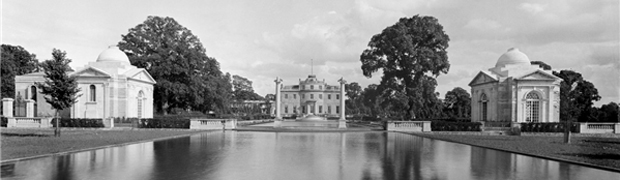
Thankfully what is still intact is one of Sir Edwin Lutyens‘ finest garden schemes.  Between 1924-28, Lutyens was commissioned by the then owners, the Koenigs, a family of Silesian bankers, to create a garden ‘for the recreation of spirit and body‘.  Standing each side of a huge 72m pool, once thought to be the largest of its type in Europe, are two temples; one a bathing pavilion, the other of Music.  Reminiscent of Thomas Archer‘s sublime Pavilion at Wrest Park (1709-11), Lutyens’ interpretation is pared back, less ornamented, but equally impressive – indeed, he himself thought it faultless and would apparently sit in there on his own.

The current vendor, Anton Bilton and family, has lavished millions on restoring the house and grounds (though, he confirms not as much as the £10m previously reported) since buying it for £2.5m in 2001.  However, the £18m asking price quoted in The Sunday Times Home section (28/04/13) seems ambitious; £10m-12m feels more appropriate considering the way the house and estate have been compromised with the now non-private approach, the small housing estate to the east of the main house and the loss of Soane’s original interiors.  Make no mistake, this is still a superb house and sets the bar high for any other house offered for sale this year to be considered as attractive or as interesting.

——————————————————————

Property details: ‘Tyringham Hall‘ – £18m, 59-acres [Savills] Strangely, there is no brochure yet and the launch, through double fold-out spread in Country Life (1 May 2013), feels a touch late.  One wonders whether the Bilton’s were offered a chance to do the Sunday Times piece before Savills were ready and took it anyway?

Excellent selection of photos:

If you wish to find out more about Sir John Soane and are in London, visit his house at Lincolns Inn Fields, which is a museum to his life and work: ‘Sir John Soane’s Museum

The Country House Revealed – Clandeboye, County Down

Clandeboye, County Down (Image: Paul Barker / Country Life Picture Library)

One of the great glories of the private incomes afforded to previous generations was the ability to indulge in their passions.  Given the opportunity, many of us would similarly be happy to devote our lives to our interests and, for some, in doing so they have created great collections – not just of art, but in the fields of anthropology, Egyptology, armour, botany…the range is endless.  In this week’s ‘The Country House Revealed‘, Dan Cruickshank visits Clandeboye in County Down, Northern Ireland; seat of a branch of the Guinness family, but also home to an impressive collection of artefacts.

Clandeboye (also sometimes known by the original name Ballyleidy) sits in a 2,000-acre estate in the heart of the Ulster countryside – a smart, elegantly Georgian seat; the design semi-Soanian (originally), part-the-owner (later additions).  The professional architect involved was a former pupil of Sir John Soane, Robert Woodgate, to whose designs the house was built in 1801-4.  Woodgate had a brief career, cut short by his early death in 1805, having joined Soane’s practice as an apprentice in 1788, before graduating in 1791 and then being sent to Ireland to Baronscourt, Co. Tyrone (note the triffid-like march of the wind turbines now marring the skyline!), to supervise the building Soane’s commission of a new house for the Marquess of Abercorn.

Clandeboye, for the 2nd Baron Dufferin, was one of Woodgate’s earliest commissions and is unusual, ignoring the more common ‘Palladian’ central block with flanking wings layout, of houses at the time.  At Clandeboye, whilst still Soanian in it’s style, the layout is focussed on two wings at right-angles to each other with the corner due south taking maximum advantage of both the setting and the sun.  All-in-all, a good, competent design by a well-trained young architect – though perhaps lacking some of the drama a more experienced architect might have brought to the plan.

What is particularly special about Clandeboye today is that it contains the remarkable and diverse collections of the wonderfully named Frederick Temple Hamilton-Temple-Blackwood, 5th Baron Dufferin and Claneboye (note the different spelling of the title).  A prominent politician and administrator, he served as Governor General of Canada  (1872-1879) and Viceroy of India (1884-1888).  The Lord Dufferin was also something of a radical social reformer and fell out with the PM, Gladstone, believing that the land ought to be owned by the farmers.  Not content with just arguing for this, he sold off much of the 18,000-acres the family had amassed, leaving the estate we see today.

Very well-educated, Lord Dufferin, as with many other wealthy Victorians, used the opportunities of his many diplomatic postings to acquire large quantities of objects – not just the usual art and furniture but curiosities from around the globe.  This led to a new programme of work in the mid-19th century to enlarge the house to display these prizes, resulting in a large west wing.  Dufferin had toyed for years with grand plans for the complete rebuilding of Clandeboye to a faux-Elizabethan nostalgic ideal.  After a few years, his tastes changed and he then sought out Benjamin Ferrey to provide a French-chateaux style house – but again this came to nothing.  In 1865, his preferences had ebbed back towards a more ‘romantic’ style and he began a long collaboration with William Henry Lynn, who then advised Dufferin on the alterations to Clandeboye which are what we see today.   One aspect of the process which probably infuriated Lynn was, as Harold Nicolson has described, that Lord Dufferin’s ‘passion for glass roofing was… uncontrolled‘, leading to the broad use of skylights.  Considering how Soane, and therefore probably Woodgate, sought to carefully manage the effects of light, this crude flooding of the interior spaces may not have met with approval from the original architect.

Today, the contents of the house can be seen as a snapshot of the passions and interests of a wealthy aristocrat at the height of the British Empire. Victorian Britain seemed to foment this type of collector with other houses similarly becoming self-indulgent museums – though often with a great intellectual rigour which helped drive forward our understanding of the world and science.

Quex Park, Kent (Image: ..george / flickr)

For example, Quex Park in Kent became the showcase of the Powell-Cotton family, who, over six generations, created a superb collection of natural history with specimens taken during Major Percy Horace Gordon Powell-Cotton’s expeditions to Africa,which has subsequently been expanded by later generations.  Another showcase was Goodrich Court (dem. 1950) which was designed by the owner Sir Samuel Rush Meyrick specifically to accommodate his world-renowned collection of arms and armour which forms an important part of the incredible Wallace Collection in London.

Didlington Hall, Norfolk - demolished 1950/52 (Image: Lost Heritage)

As at Clandeboye, Egypt has long held a fascination in Britain.  One early and noted collection was assembled by William Amherst Tyssen-Amherst (the 1st Baron Amherst) at Didlington Hall in Norfolk (dem. 1950/52).  By chance, Lord Amherst employed a Mr Samuel Carter, a well-known artist to paint at the house, and he would often bring his son, who spent many an hour in the extensive Egyptian museum in the house.  That son was Howard Carter who famously went on to discover Tutankhamun’s Mask with George Herbert, 5th Earl of Carnarvon.  Highclere Castle also holds a small but important collection of Egyptian antiquities amassed by the 5th Earl and which are now on display in a purpose-built gallery in the cellars of the house.

Waddesdon Manor, Buckinghamshire (Image: National Trust)

Perhaps the greatest example of a house built to show a collection is Wadddesdon Manor in Buckinghamshire; that slice of French architecture which enchantingly appears in the middle of the English countryside.  Funded by the vast Rothschild fortunes, the mansion, designed by Gabriel Hippolyte Destailleur, was built between 1874-1889 for Baron Ferdinand de Rothschild primarily to showcase what must easily be one of the finest collections of Dutch and English paintings and French art, tapestries and furniture.  Used only in the summer months for parties and entertaining this was the ultimate expression of the desire to use a private residence as a gallery – or was it merely a gallery with bedrooms?

So Clandeboye is part of a long and fine tradition of the wealthy owners of large houses not merely adding a scattering of objet d’art to show-off the taste of their interior decorators. These houses are true collections, in some cases museums, even monuments, to the eclectic passions of their owners.  The wide-ranging nature of these collections demonstrates one of the many benefits of single family ownership, such as at Clandeboye, where intellect and wealth can be combined over generations to create a rich and interesting tapestry that no public organisation would be likely to be imitate; and our nation would be all the poorer without it.

————————————————————————————–

Official website: ‘The Country House Revealed‘ [BBC2]

A wonderful interview (and slideshow) with the Countess of Dufferin and Ava: ‘The Marchioness‘ [wmagazine]

The Clandeboye estate: official website / history [clandeboye.co.uk]

Country House Rescue: school’s out – High Elms Manor, Herts

High Elms Manor, Hertfordshire (Image: Ishin Ryu)

If there was a prize for commitment above and beyond financial sense then the owner of High Elms Manor/Garston Manor could probably win ‘Highly Commended’ for her determination to rescue this once-derelict country house on the edge of Watford, Hertfordshire, which is the next destination of Ruth Watson and Country House Rescue. The house is an interesting example of the various pressures which can affect country houses and the solutions having experienced almost the complete range over the last century with the new owners adding a few more.

Built sometime before 1813 and once the centre of a 500-acre estate, High Elms Manor originally enjoyed fine rural seclusion, its nearest neighbours the St Pancras Industrial School and Metropolitan District Asylum to the west (now demolished and built over) and Bucknalls, a Victorian manor house now home to the Buildings Research Establishment, to the east.  Originally known as High Elms Manor, it was changed to Garston Manor in 1895, though the current owner has apparently decided to go back to using the original name; even if it’s not the one used by Channel 4.

Relentless urban growth over the last 100 years pushed housing estates and industry right up to the boundaries of many country estates – and usually then overwhelmed them.  The sad pattern was often industry moving closer and blighting the views, then the air, ruining the very attributes which had been their reason for being built in the first place.  As workers followed industry so more land was needed for housing and so estates on the edges of towns were particularly vulnerable (as they still unfortunately are today).

Cassiobury House, Hertfordshire (Image: Lost Heritage)

Watford has already lost one major house – Cassiobury – to just these pressures, though this was much closer to the centre of the modern town and was lost back in 1927. The long-time seat of the Capel family, Earls of Essex, who built a fine house which was altered by Hugh May c.1674-80 and which boasted superb interiors, with carvings by Grinling Gibbons, and which was later ‘Gothicised’ by James Wyatt (c.1800).  Visited by Country Life magazine in 1910 it was still rural:

“‘…set in great and delightful grounds and surrounded by a grandly timbered park. Therein is peace and quiet; the aloofness of the old-country home far from the haunts of men reigns there still, and Watford and its rows of villas and its busy streets is forgotten as soon as the lodge gates are passed’.”

Yet by 1922 the house and 458-acre park were for sale and were bought in 1927 by a consortium of local businessmen who stripped the house for materials, sold the carvings to museums and private collectors and then demolished the house, with residential estates over-running that once rural idyll.  Sadly this was the case for so many of our demolished country houses.

High Elms Manor, being further north, escaped these immediate pressures.  The house became home to the Watney brewing family around 1870, who commissioned alterations which enlarged the house.  The house was then sold to the Benskins, another family of brewers, before it was bought in 1911 by Walter Bourne, co-founder of the Oxford Street department store Bourne & Hollingsworth (now split into retail units and offices – history (scroll past the odd photos at top of the page)), who made further changes around 1920, shortly before his death in 1921.  Stafford Bourne, one of the sons of the founder, described High Elms as:

“…one of the finest and most dignified medium-sized estates in the county of Hertfordshire.”

With fine and interesting interiors, this was a house built for entertaining and accommodating large numbers of guests and visitors.  This was to perhaps save the house from demolition as the house was sold once again after Walter Bourne’s death and took on another of the many uses our country houses have been adapted for and became a medical rehabilitation unit, still known as Garston Manor.  It remained in this role until the 1990s when the council, faced with rising maintenance costs, abandoned it and left it to decay.

Sadly, although boarded up, the house suffered from repeated vandalism and theft, with roof lead and floorboards proving particularly attractive.  When the now-owner Sheila O’Neill came to view the house it was a daunting prospect:

‘It had been empty for years when I came to see it,’ says the present owner. ‘It was more or less derelict. Ceilings had fallen in, all the floors had been damaged, the wood panelling had turned green, chimneys had collapsed, lead had been stripped off the roof by vandals, there were 100 broken windows, the garden was a jungle, it was in a terrible state…”

Stowe House, Buckinghamshire (Image: e-architect)

Thankfully, as many other country houses have discovered, they can be rescued from such a parlous state.  High Elms was now adapted to that familiar role for a country house; that of being a school.  There is a long and fine tradition of our country houses educating future generations in grand adapted ballrooms and dining rooms.  In cases such as the spectacular Stowe House in Buckinghamshire, (now being wonderfully restored by the Stowe House Preservation Trust with backing from the World Monuments Fund) it almost certainly saved it from demolition.  Stowe is an especially grand example of the country house as a school but there are hundreds across the UK, each doing their bit to preserve our architectural heritage – though sadly the necessary ancillary buildings can sometimes detract from the setting.

Thankfully though, in the case of High Elms Manor, the needs of the school have been accommodated within the 80-odd rooms of the house with, for example, the ballroom serving as a gymnasium.  However, a house of this size requires significant funding not only in terms of capital investments in the house but also just to meet the £75,000 per year running costs.  Having bought it for £500,000, Sheila O’Neill estimates she has poured at least that much again in her quest to restore the house.  Faced with her own need for a replacement hip, and the relatively low profits from running her Montessori school, Mrs O’Neill has turned to Ruth to provide guidance as to how to make more from the not-very-successful wedding hire business and for any other tips. With strong local competition from the incredibly pretty Hunton Park, it seems that it is the posse of daughters who appear to hold the key to maintaining and improving their situation.

Country House Rescue: ‘Garston Manor‘ [Channel 4]

Country House Rescue: see complete previous episodes

Interview with Sheila O’Neill: ‘Country House Rescue in Garston‘ [Hertfordshire Life]