Phoenix for sale: Beaurepaire House, Hampshire

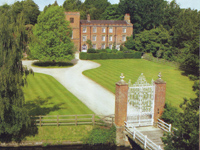
Beaurepaire House, Hampshire (Image: Knight Frank)

Launched this week ( 23 June 2010) in Country Life magazine is a fine, grade-II* listed, moated manor house set in nearly 250 acres of Hampshire.  Open the first set of impressive wrought iron gates and follow the drive down to the ancient moat and through the second, equally impressive, set of white painted gates over the wooden bridge. Before you stands a beautiful red-brick manor house – but why is the house set in one small corner of the island? Why does the drive lead over the moat but unusually not to the middle of the house?  And why does that tower look a bit new?

The answer to all these questions is that Beaurepaire House, as it now stands, is what remains of an important and beautiful manor house which burnt down in 1942 after a chimney fire.    What happened subsequently is an interesting example of how disaster need not lead to the loss of the whole house or the estate.

Beaurepaire House, Hampshire before the fire (Image: Lost Heritage: England's Lost Country Houses)

Beaurepaire House has royal connections having been visited twice, once by Henry VIII in 1531 and then by his daughter Elizabeth I during her visit to The Vyne.  The moat itself dates from 1369 but the original house was built in the 16th-century but was badly damaged during the Civil War and was only rebuilt in 1777.  The design of the new Georgian ‘Gothick’ house followed the rare structure of having a square core with castellated corner turrets.  There are relatively few examples of these houses – and the ones we have today are all ruined to some degree (Ruperra Castle, Wales / Lulworth Castle, Dorset) or lost entirely (Compton Bassett House, Wiltshire).

At the time of the fire the house was owned by one of the richest men in the country, Sir Strati Ralli, but wartime building restrictions prevented restoration. After the war the estate was owned by Lady Sherfield and in 1965 she decided to restore the remaining servant’s wing as a house and commissioned the well-known architect Tom Bird, who had restored many other country houses, to make the house habitable.  Bird decided to add a sympathetic tower, which continued the existing architectural style, to the fire-damaged southern flank of the remaining wing to not only provide structure but also to improve the proportions of what was left.  The addition was less than 10% of what remained but successfully ensured that the house was able to rise again from the ashes of the fire to retain the role it had enjoyed for hundreds of years as the centrepiece to an impressive country estate.

_____________________

Property details: Knight Frank seem to have forgotten to put the details on their website.   Nevermind, here’s a link to all the Hampshire houses they’re selling in the hope that they soon add it in: Knight Frank: Hampshire
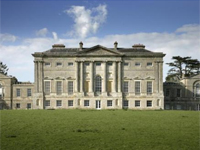
Conversion reversion? Wardour Castle, Wiltshire

Wardour Castle, Wiltshire (Image: Strutt & Parker)

With so many country houses lost in the twentieth century, almost any alternative which saved them from the demolition crew was to be welcomed; no matter how drastic.  For some this meant institutional use but for many others of all sizes the solution was conversion into flats and apartments – though with varying degrees of success.  However, as these properties come on to the market, is it perhaps time to consider converting them back into the single, glorious houses they were intended to be?

Launched this week (16 June 2010) in Country Life magazine is the principal apartment in what is considered James Paine’s finest creation; Wardour Castle, a supremely elegant essay in Palladian architecture.

Central stairwell and gallery, Wardour Castle, Wiltshire (Image: Strutt & Parker)

Built from 1770 – 76, for the eighth Lord Arundell the most impressive feature is a breath-taking central stairwell with first-floor gallery which Pevsner called ‘the most glorious Georgian interior of Wiltshire’ and which forms the core of Apartment One which is now for sale.  Wardour Castle house has proved to be adaptable becoming Cranborne Chase School in 1960 until it closed in 1990 when it was then converted into ten apartments.  As the divisions appear to have respected the natural sections of the house this seems to be a good example of where someone could convert the house back to a single home.

There are many examples of houses being rescued by conversion.  SAVE Britain’s Heritage have long campaigned to protect these houses and have worked in conjunction with one of the leading architects, Kit Martin, in supporting conversion.  A 1983 SAVE report entitled ‘The Country House: to be or not to be’, written by Kit Martin and Marcus Binney, includes particularly interesting studies of how these houses could be sensitively converted.  These show that although almost any country house could be sensitively adapted some are naturally more suitable particularly where the overall layout of the house is symmetrical, shallow and long.

The study was an important milestone in the practice of country house conversion and saved many houses from complete loss or inappropriate use including The Hazells in Bedfordshire, the grade-I Northwick Park in Gloucesterhire, Dingley Hall in Northamptonshire.  The sensitive approach they championed now means that it should be possible to consider converting a house back if the right opportunity arose.  It should be said that some houses are never going to be converted back due to a variety of factors including there being too many apartments involved such as at Thorndon Hall in Essex which contains 37 flats, or where not enough land has been retained to make the unified house valuable enough to justify reversion.

Perhaps the idea of reversion becomes more realistic where more than one part of the same house comes on the market at the same time such as recently happened with grade II*-listed Ampthill Park House, Bedfordshire.  Built by the Cambridge architect Robert Grumbold in 1687-9 and completed by John Lumley of Northampton in 1704-6, with major additions by Sir William Chambers in 1769 it is certainly one of the most impressive houses in the county. It was rescued from dereliction by conversion into just four large houses; two of which were put on the market in April 2010, the largest of which includes most of the principal rooms.

Although it’s nice to dream about these houses becoming single homes probably the biggest obstacles are not only being able to secure the other apartments but also that the value of the individual properties may be greater than the value of the unified house.  However, it’s not entirely beyond the bounds of possibility that someone with deep pockets and a desire to restore a house could take on one of these conversion reversions and recreate a superb country house.

Property details: ‘Apartment One – Wardour Castle, Wiltshire‘ [Strutt & Parker] – £2.75m

Detailed architectural description: ‘Wardour Castle, Wiltshire‘ [English Heritage: Images of England]

A labour of love: the restoration of Hammerwood Park

Hammerwood Park, Sussex (Image: South Downs Living)

Once a house has sunk to such a level of dereliction that even the developers won’t take it on, this can easily lead to an application for demolition and the loss of another piece of our architectural heritage.  Yet, as we see in the media, there are often people willing to commit themselves and their money towards saving these beautiful homes – Hammerwood Park is one which certainly falls into this category.

The house was built in 1792 for Benjamin Sperling and is particularly important as the design of the house was the first commission of Benjamin Latrobe (b.1764 – d.1820) who was later to be hugely influential in the direction of American architecture.   Latrobe had studied architecture privately and served for a year from 1789 as an architectural draughtsman in the office of neo-Classical architect S.P. Cockerell. Howard Colvin suggests that Latrobe was also strongly influenced by the work of French architects such as Étienne-Louis Boullée whose own strictly neo-Classical style emphasised the paring back of unnecessary ornamentation and the use of grand scale with repetitive elements.  Through Hammerwood Park it’s possible to see this philosophy in practice with the giant pilasters on the garden front and the miniature temples on the flanking wings.

The early death of Latrobe’s wife in 1793 caused him to abandon Britain and head to America where he made friend’s with President George Washington’s nephew.  It was these contacts which enabled him to obtain further commissions including the Bank of Pennsylvania in Philadelphia which has been described as the ‘first monument of the Greek Revival in America’ (dem. 1867).  It was this and his later work designing the first Capitol building in Washington which so greatly influenced the future of American architecture towards the ne0-Classical which is so evident even today.

That a building as interesting as Hammerwood Park was ever allowed to deteriorate to that extent was unfortunately all too common in the post-WWII era. It is only the dedication of it’s current owner, David Pinnegar, that has probably saved the house from conversion or even demolition.  After various owners it was requisitioned during WWII for use by the Army who left it in their usual poor condition.  Post-war, the Chattell family, who then owned the house, sub-divided the house into flats but as dry rot took hold, the residents moved out and the house was sold in 1973 to the rock group Led Zeppelin for use as a country retreat to work on their music. However, touring commitments meant they never moved in (and rumour has it they even forgot they owned it) and whilst empty, thieves took the roof lead leading to massive wet rot outbreaks.  The house was boarded up in 1976 before finally being offered for sale in 1982 in Country Life magazine with the marvellous understatement that it was ‘in need of modernisation’.

David Pinnegar, then only 21, bought the now grade-I listed house and has since dedicated his life to its restoration.  The vast house has revealed many interesting architectural nuances as he and many volunteers have worked through the vast catalogue of repairs. Although he has secured some grants from English Heritage, the vast majority of the work has been financed through day visitors, B&B guests, and its use as location for a wide variety of films and music video shoots.  In many ways, David’s dedication is proof that all houses, no matter how poor their condition, can find a saviour.

Full story: ‘Hammerwood Park, East Grinstead: Whole Lotta Love‘ [South Downs Living]

House website: ‘Hammerwood Park

A glimmer of hope: ‘Country House Rescue’ visits Kelly House

Kelly House, Devon (Image: English Heritage)

Kelly House has a series of long associations; there has been a house there for over 900 years, it has been the seat of the Kelly family for that entire time, and, sadly, has been on the English Heritage Buildings at Risk Register for over five years.  Now the latest twist in the tale is that the house will feature in Channel 4’s ‘Country House Rescue’ on Thursday 1 April when expert Ruth Watson offer possible solutions which will help the Kelly family remain in their ancestral home.

The Kelly’s are one of the very rare families able to trace their lineage back to pre-Conquest times.  Warin Kelly is the 31st squire of the family to live in a house which has been passed down since 1100 through fathers, grandfathers, and brothers.  Described as being ‘in a class of its own’ by Marcus Binney*, the elegant Palladian house was built in 1743 -45 for Arthur Kelly by Abraham Rundle (d.1750), a joiner and provincial but obviously skilled architect who lived in Tavistock.  The house is grade-I listed and features a Portland stone doorcase, sash windows glazed with Crown glass and made in London, with local slat stone walls with moorstone quoins. Inside, the extensive high quality woodwork  features superb carving including panelling, chair rails, and a particularly good staircase with chunky corkscrew balusters.

However, the fine panelling hides serious issues such as the periodic bouts of dry rot which break out. Mr Kelly, as a conservation architect advocating minimal intervention, admirably refuses to treat it with chemicals or by stripping out the panelling.  This ongoing damage is largely the fault of death duties, with two demands being levied in swift succession which have severely limited the family’s ability to maintain the house.  Kelly House is exactly the sort of house which the Historic Buildings Councils would have provided grants for when they were set up in the 1950s.  Today, with English Heritage’s budgets under severe pressure, Mr Kelly was told in 2005 that they were unable to provide funds as the increase in the value of the restored house would be greater than the grant – meaning that they force owners towards the sale of their ancestral homes.

Much as it would appear difficult to argue for the provision of public money to preserve private residences, there has to be a better solution than just letting them slowly grow more derelict despite the often heroic efforts of the family involved.  The current generation doesn’t want to be the one which is remembered for having to sell the family seat, leading to a battle against the elements of decay which saps finances and families and often doesn’t provide a long-term solution.  Outside expertise is to be welcomed as it may show the way to a sustainable future for these beautiful homes. Hopefully Ruth’s suggestions can be taken on by the Kellys and other families to ensure their homes are self-financing and not a burden to either the state or the owners who are then able to look forward to the prospect of handing a home and not a liability to their descendants.

Programme details: ‘Country House Rescue‘ (Channel 4)

More information: ‘TV show could help manor restoration‘ [Western Morning News]

Official Kelly House website: ‘Kelly House

* – ‘Houses to Save’ – article by Marcus Binney in Country Life magazine (8 September 2005)

Still available for sale – the country houses proving difficult to sell

Despite the enthusiasm of the estate agents, it seems that some of the most impressive houses featured in the glossy adverts at the front of Country Life magazine are proving difficult to sell.  Whether this is due to a poor local market or unreasonable prices, or just bad luck, here are a few stunning country houses which are still looking for buyers.

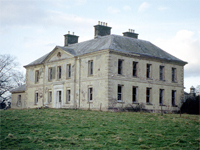
Noseley Hall, Leicestershire (Image: Knight Frank)

Noseley Hall in Leicestershire has been in the family of the present Lord Hazelrigg for nearly 300 years but was put up for sale in April 2009 at a guide price of £14m for the grade-II* listed house plus the 1,200-acre estate.  Built in 1728 on the back of Northumberland coal mining wealth, the house is decorated with works of art (though fewer now following several auctions), and fine plasterwork.  However, Lord Hazelrigg admitted that the estate doesn’t cover the costs of running the house, and so he decided to sell, but it’s still listed on the Knight Frank website – and still with a guide price of £14m.   More details: ‘The last of the romantics‘ [Sunday Times]

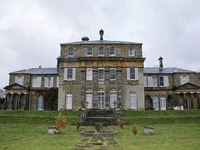
Dowdeswell Court (Image from Savills)

Another house which has been for sale is Dowdeswell Court in Gloucestershire which was first advertised in 2005 and then sold for £4.75 but then came back on the market in summer 2009 with a guide price of £7.9m (and was featured in this blog).  When serial restorer James Perkins took on the house it had been a 46-room nursing home resulting in a huge restoration project and since he sold in 2005 has moved on to restoring other country houses including Aynhoe Park.  The grade-II house was built between 1833-35 by local architect Charles Paul of Cheltenham and was originally three storeys but during the 1920s the top storey was neatly removed.  The more manageable house is a beautiful example of neo-Classical detailing combined with modern comforts. The house is available through either Knight Frank or Savills.

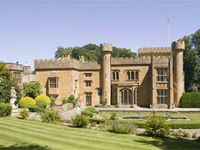
Compton Pauncefoot Castle - Somerset (Image: Bidwells)

The final property for this list is the impossibly beautiful Compton Pauncefoot Castle in Somerset which has been for sale since 2006.   Built in 182o, the grade-II listed house sits in a 1,278-acre estate with 40-acres of stunning gardens and lakes.  Originally on the market for £22m, it failed to sell even during the boom years of 2007-8 and despite 20 buying agents being invited to a launch event, and being featured in the The Sunday Times, it’s now being sold at auction – though I suspect the reserve would be near the current price advertised on the agents websites of in excess of £17m.  Perhaps the fact that it’s only for sale as a whole may have put off those who might just want the house and immediate grounds – but this would deny the owner the certainty of privacy that the surrounding estate would bring.  The house is available through Bidwells and Knight Frank (who despite putting it as their lead advert in Country Life this week fail to have it on their website).