After the fire, the difficult choices: Raasay House, Scotland

Raasay House, Scotland (Image: BBC News)

When Raasay House on the Isle of Skye Raasay was largely destroyed by a huge fire in January 2009 just days before it was due to reopen following a £4m refurbishment, the locals and owners vowed to quickly rebuild the house as it was.  Fire has always been one of the major threats to our country houses and when it strikes the responses to the destruction can vary greatly – particularly in the modern era.

For many country house owners in the 16th-19th-centuries immediate rebuilding was the favoured response if funds allowed – either to re-create the original house or sometimes to build an entirely new one.  Raasay House was built in 1746 for the clan Macleod after the previous house, built in the 1500s, was deliberately burnt down in 1745 in the wave of retribution which followed the Battle of Culloden.  The house, extended in the 1870s, was run as an outdoor pursuits centre and was an important part of the economy on the Isle of Skye Raasay.  This meant the response was largely on the basis of local economics which required the house to be rebuild to support the business, apparently not for its intrinsic architectural value.  However, the Scottish grade-A listing (equivalent to the English grade-I) means that the ‘new’ Raasay will be a faithful recreation of the original house as it was before the fire.

Although country house owners have long rebuilt, the principle that the house will be strictly rebuilt exactly as it was is, in some ways, a modern response as heritage legislation requires full salvage of any architectural fragments with the presumption of restoration.  Insurance companies also pay out for recreation of the old building, not the construction of a new one.  So responses now are sometimes based on the architectural or heritage value, and sometimes due to the constraints placed on the owners.  The wishes of the owners also play an important part with some looking to recreate whilst others follow the principles of the Society for the Protection of Ancient Buildings who state:

Although no building can withstand decay, neglect and depredation entirely, neither can aesthetic judgement nor archaeological proof justify the reproduction of worn or missing parts. Only as a practical expedient on a small scale can a case for restoration be argued.

– SPAB manifesto

The 1992 fire at Windsor Castle destroyed large sections of the State Apartments including the Crimson and Green Drawing Rooms, the Queen’s Private Chapel and St George’s Hall.  It was quickly decided by the Restoration Committee (headed by Prince Philip) that many of the rooms would be restored to as close as possible their original state with only a few modern rooms and the Queen’s Private Chapel to be restored in a modern style.

However, no lesser organisation than the National Trust also has firmly followed the faithful re-creation approach, particularly following the devastating 1989 fire at Uppark, Sussex.  Although the dramatic pictures of the fire would suggest total loss, brave efforts by staff saved the majority of the contents of the house and the fire was found to have only destroyed the attic and first floors whilst severely damaging the ground floor.  It was then announced by Martin Sekers, the National Trust’s Regional Director for the Southern Region, that “We feel that enough survives to justify total restoration.”.  So how much has to survive to warrant re-creation?  A spirited public debate at the time brought forward opposing views such as that expressed by the respected architecture critic Deyan Sudjic who argued in an article in the Sunday Correspondent (17 Sept 1989) that:

“…it won’t actually be Uppark no matter how skilful the work of the 20th Century craftsman who seek to recreate it. What tourists come to see will, in fact, be a replica, one which could be said to diminish those fragments which actually are authentic…”

However, other eminent architectural historians such as Dan Cruikshank came out strongly in favour of recreation principally from the point that it provided the opportunity to re-learn old techniques and provide a model in their use.  Andor Gomme argued that a recreated Uppark would be the only appropriate way to show the rescued contents in an appropriate setting.  Gomme also highlighted that in previous cases where a house owned by the National Trust had burnt down (the incomparable Coleshill, Berkshire in 1953 and Dunsland House, Devon in 1967) the decision at the time to demolish what remained was later deeply regretted.

So for public organisations the clear preference is strongly in favour of re-creation despite the claims of the modernist and the SPAB that such an approach is to miss an opportunity or is simply fake.  Yet, for private country house owners, their long-held preference has been to simply restore as much as possible – even if just the walls were left standing.

When Knepp Castle, Sussex was gutted by fire in 1904, work started in 1905 to recreate John Nash’s original design.  Similarly after fires at Bramham Park in 1828, Duncombe Park in 1879, Stourhead in 1902, Monzie Castle in 1903 and Sledmere in 1911, the owners all worked to faithfully recreate the houses to the state as they had been.  For houses such as Lees Court in Kent which was almost completely destroyed in 1911 (scroll to last image) the house was just rebuilt using what remained of the outer walls.

So is restoration the best approach?  Although there is danger that the new work might be a poor pastiche of the earlier work, to just discard what has been salvaged and what remains and to only allow modern work would seem to be overly dogmatic.  However, it will only work if any restoration is of the highest quality to avoid any chance that what is produced is merely a lifeless reproduction.  Owners over the last 400-years when faced with a greater or lesser degree of loss have often sought to restore and to continue that tradition today is to draw on a much longer history than to rely only on the intellectual restrictions of the later purists.

Full story: ‘Fire damaged Raasay House to rise from ashes‘ [BBC News]

A justifiable replacement? Parkwood House, Surrey

Parkwood House, Surrey (Image: Peter Lind & Co)

There is a long tradition of replacing country houses going back hundreds of years ever since the first non-fortified mansions were built in the early Tudor period. Since 1974 when the V&A exhibition ‘The Destruction of the Country House’ did so much to highlight the hundreds which had already been lost across the UK and particularly in England the presumption has rightly been against the demolition of country houses – a position which this blog very firmly supports.  Yet to stop the replacement entirely could be seen as preventing the improvement of existing estates and seems to presume that no modern architect could match the skill of those who went before.  The case of Parkwood House in Surrey could be a useful case study in showing that replacement can be ‘creative destruction’.

Since 1800, of the nearly 1,800 English country houses which have been lost, over 150 have been replaced by a new house.  In the austere times of the post-WWII era, the new house was often smaller and easier to manage.  However, before 1930, houses which were demolished were often replaced by much larger houses to reflect the newly established status of the modern captains of industry and finance or to mark an inheritance.

Fonthill Splendens, Wiltshire (Image: RIBA)

This process of renewal could strike again and again – I think the record is held by the Fonthill estate in Wiltshire which has had seven principal houses of varying sizes including the infamous Fonthill Abbey which replaced the superb Fonthill Splendens. James Wyatt’s Fonthill Abbey is widely regarded as one of the most interesting (if ultimately unsuccessful) houses ever built in the UK – yet its creation led to the destruction of the old house.  Do we deny country house architects the ability to develop and improve just to preserve every older country house regardless of its merits?  Is it worse to stagnate estates with unsuitable (or unsightly) houses or must new houses only be built where a house has already been lost or on greenfield sites?

Parkwood House in Surrey is unlisted – and probably rightly so.  Built in the late nineteenth-century, it is, in the words of the architects of the new house “…an unremarkable and diluted essay in the ‘Old English’ or ‘Arts and Crafts’ style of the time” – but of course they would say that.  However, looking at it architecturally, there does seem little to recommend it – a rambling house, pebble-dashed, with an unexciting entrance front with an only slightly more interesting garden front.  The house is not connected with any noted architect, nor any particularly notable family (the only one of interest is the Australian 1st Baron Ballieu who was living there in the 1950s). The house then became the Rank Hovis conference and training centre with all that damage that entails during institutional conversion.

Proposed Parkwood House, Surrey (Image: Candy & Candy)

Planning permission was originally submitted in September 2007 and approved in November 2007 – a remarkably quick approval which might indicate that the planners had few qualms about the loss of the house.  In fact it might be said that Parkwood is simply a big house a countryside setting – and ‘big’ does not automatically mean it is of merit.  However, if the new house designed by the eminent Robert Adam Architects was not of such a high quality would the presumption fall on the side of retaining the old house?  The new house is an elegant essay in the use of the Palladian vocabulary to create a design which obviously provides the space and comfort that someone who would live in such a house would demand but is also architecturally interesting.  This is no mere cobbling together of a few weak ideas – this is a house which would rightly enter the list of good country houses in Surrey.  Robert Adam Architects are one of the leading practices in the country working in the Classical style and have completed other similar projects such as this house in Surrey which also replaced an earlier country house or this house in Sussex.

So if we can be confident that the new house would be high quality replacement is it justified to demolish the existing house?  In this case, as the earlier property is so unremarkable it would seem that the 91-acre estate would be better served through the keeping alive of the tradition of country house replacement – but this can only be justified where the original house is unlisted and of a poor design and the new house would be of the highest quality.  Demanding the destruction of one house to provide another has a long tradition but is a very risky path and any such application must be open closely scrutinised to ensure that we are not simply throwing away architecturally interesting houses just to build hideous ‘McMansions‘ where bigger is automatically assumed to be better.

Credit: thanks to Andrew for flagging this up.

More details and images: ‘Parkwood Estate, Surrey‘ [Candy & Candy]

More work by Robert Adam Architects: Residential portfolio

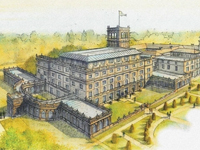
Proposal for Trentham Hall to be rebuilt as a hotel

Trentham Hall proposal, Staffordshire (Image: Property Week)

One of the greatest losses in the many country houses demolished in the 20th-century was that of Trentham Hall, the Staffordshire seat of the Dukes of Sutherland.  Originally a large Georgian house, it was rebuilt and greatly extended for the second Duke in the 1830s by the famous architect Sir Charles Barry, who was also responsible for the rebuilding of the Houses of Parliament.  The house became a celebrated venue for entertaining and was filled with fine works of art and sculpture.

Unfortunately the relentless expansion of the nearby Potteries areas of Staffordshire led to increasing amounts of pollution entering the rivers which fed the lakes and gardens designed by Capability Brown. By 1898 the smell was so bad that the house was effectively abandoned by 1907.  The Duke tried to donate the house and estate to the local council  in 1905 but was rejected so in 1912 the house was demolished.

The gardens were eventually opened to the public with the remaining outbuildings sitting rather forlornly around the blank space which marked out the site of the now lost house.  The gardens had been maintained and delighted generations of locals who would walk through the extensive terraces which led down to the now clean lake.  Now the 750-acre Trentham Gardens are part of a £100m project to bring back the glory of the earlier eras, with the centrepiece being the £35m recreation of the house as a 150-room luxury hotel following Barry’s original designs.

Despite the economic turmoil, the developers, who originally planned for completion by 2011, are still hopeful that they will be able to proceed with the project.   Although the hotel will not bring back the history and unique architecture of the house, the idea of recreating a lost country house is one to be encouraged.  Although many houses were demolished, the parkland and gardens were often simply abandoned and are still visible today.  Perhaps other estates might be encouraged to look at whether a new house might be the most appropriate use of the estate – after all, this was the purpose of their creation.

Full story: ‘Trentham rebuilt‘ [Property Week]

Another house at risk from a developer: Brook House, Tiptree, Essex

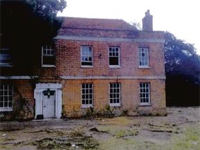
Brook House, Essex (Image: Daily Gazette)

It’s such a depressingly familiar pattern; a beautiful old house with grounds, falls into a state of neglect and is then bought by a developer.  With absolutely no incentive to maintain the house it slowly slips into a downward spiral of decay and vandalism until the inevitable request for demolition is presented to the council.  And it’s happening again.

Brook House in Tiptree, Essex is a classic, grade-II listed, red-brick Georgian village house  lacked an owner after the last member of the family died and now after being owned by a developer it has unsurprisingly reached a rather sad state.  The developer might be disappointed that no-one has yet burnt it down but nonetheless he had requested permission to demolish and replace it with several new houses saying that the house is beyond repair – all backed up by a survey which was commissioned by…the developer!   What’s perhaps worse is that English Heritage have also sided with the developer and agreed.  I despair. What is the point of EH if they fail to stand up when buildings are threatened like this?

Anyway, if you live within the area, please contact Colchester Council and ask them to not only refuse this vandalism but also to serve an enforcement notice to repair this lovely part of Tiptree’s heritage.

Full story: ‘Facing demolition: The Grade II listed building‘ [Daily Gazette]