The most expensive UK country house: Park Place, Oxfordshire

A new record price for a UK country house has just been achieved with the sale of Park Place, near Henley-on-Thames, in Oxfordshire.  One of three most notable estates on that stretch of the Thames, it was also the most expensive country house ever sold in its unrestored state in 2007.  Now, after five years and many millions of pounds, the house again has set the record having been sold to an unknown Russian billionaire for £140m.

'A view of Park Place, Henley' - artist unknown - c.1742-3 (Image: Royal Collection) - click to see full image

Park Place is, at its core, a more modest Georgian house built in 1719 for Lord Archibald Hamilton, son of the Duke of Hamilton.  The proximity to London and the beautiful setting has long attracted the wealthy to the area as a convenient escape from the city, with several riverside estates featuring a series of impressive houses.  Starting at Marlow, the first house is Bisham Abbey (now the national sports centre), then the now lost Temple House (dem. 1910), Harleyford Manor (beautiful small villa restored in 1989), Whittington House [pdf] (rebuilt by Reginald Blomfield c1897, now HQ of SAS Ltd), Danesfield House (now a hotel), Medmenham Abbey (now two houses), Culham Court (sold for £38m in 2006), Greenlands (now Henley Management College), Fawley Court (sold for £13m in 2008, possibly for conversion back to a private house), and then finally, just past Henley, lies Park Place.  Of particular interest are the architectural similarities between Fawley Court (built 1684 – reputedly to a design by Sir Christopher Wren), the original Park Place (built c1718), Culham Court (built 1771), and Reginal Blomfield’s 1897 rebuilding of Whittington House, all of which are on based on a red-brick 5- or 7-bay, two storey villa with bulls-eye window inserted into a projecting pediment.

Park Place, Henley - c1810 (Image: Thames Pilot) - click for the full image

Sadly, Park Place is no longer part of this architectural brethren having undergone a series of substantial changes.  The house was sold by Lord Hamilton in 1738 to Prince Frederick, then Prince of Wales and eldest son of King George II, who split his time between there and Cliveden. After Frederick’s death, the house was then bought by General Henry Seymour Conway in 1752 and it was he who made the first significant changes both to the house (including a library by Sanderson Miller in 1757) and, perhaps more importantly to the grounds, which are now grade-II*. His works, to designs by Thomas Pitt, 1st Baron Camelford, included the installation of an ancient stone henge given as a gift from the people of Jersey where he was Governor, the lightning-damaged steeple from St Bride’s Church as an obelisk, four more obelisks as gateposts, an underground cavern, and a bridge, using stones from Reading Abbey, which was subsequently admired by Horace Walpole.  There was also an artificial classical ruin designed by James ‘Athenian’ Stuart.

Park Place, Oxfordshire - c.1900 (Image: henleyonthames.org)

The house was sold to John Noble in 1871 but was largely gutted by fire a year later, giving Noble the opportunity to indulge something of an architectural whim.  The pattern and style of the Victorian country house was much admired around Europe and our expertise was exported widely around the continent – but it rarely flowed back (a topic already covered in an earlier post ‘The rise and fall of French taste on UK country houses‘).  Park Place is one of the few houses in the country build using the French Renaissance style, creating an impressive château in the heart of England.

The design of the rebuilt house is widely attributed to Thomas Cundy [III], the son and grandson of two previous Thomas’ who had also been country house architects. Although the latter two are given sizeable entries in Howard Colvin’s ‘Biographical Dictionary of British Architects‘, the grandson is given only a paragraph as part of his father’s, leaving us somewhat in the dark as to what, bar some London churches, he may have been involved with. However, considering his father had good form with the chateau style having built Grosvenor Gardens in London, so Thomas III would have been schooled in the style before his father’s death in 1867.

The house remained with the Noble family until 1947 when it and the 670-acre estate was parcelled up into 22 lots and sold off.  The main house was bought by Middlesex County Council who converted it into a special school, which it remained until 1988 when it closed. The house was then bought by John Latsis, the Greek shipping tycoon, but it seems unlikely that he lived there as it remained unrestored, with the vestiges of the school – gymnasium, classrooms, a woodwork studio etc – all still in situ, along with various outbuildings, as can be seen from these images of the house.

Those who had a chance to look around the house when it was for sale in 2006 all noted that beneath the shabby institutional veneer, the potential of the house was clear; glimpses of fine tiles, the original stone fireplaces, stained glass, and grand spaces with impressive views.  The house was then sold to a consortium who intended to create a superior country club – until Wokingham council said ‘no’.  Put on the market for £45m, it was finally sold for £42m to Mike Spink, a property developer who specialised in high-end houses in central London. With this experience, Spink transformed this once dilapidated house into a palace fit for a billionaire with all the requisite features such as a helipad, swimming pool, panic room etc.  Somewhat disappointingly, the house now only comes with 200-acres, with the remaining 300 with which it was sold retained by Spink for as yet unspecified ‘development’ – a phrase which will no doubt spark local concerns.

Even when it was first sold, those in the property business were predicting that Park Place would sell for possibly up to £100m, and the rising ‘super prime’ market has proven even those estimates conservative.  Sadly, this record is not for a spectacular historic house at the centre of a large estate but instead one where the location (location, location!) has elevated the price to such a stratospheric level. Nevertheless, many country houses were built as retreats for wealthy industrialists and financiers and this house is proof that the lure of the trophy country estate is as strong as ever – which can only be a good thing for those seeking to prove their desirability in modern times.

———————————————————————–

Story about the original sale: ‘Sold for £42m… still in need of renovation‘ [Daily Telegraph]

Latest sale: ‘Park Place: Britain’s most expensive home sold for record £140m‘ [Daily Telegraph]

PPS7 – the saviour of the new build country house

Grafton New Hall, Cheshire (Image: Robert Adam Architects)

The nature of our country houses is one of evolution in design, form, and function.  As society has changed, so too have the requirements of the wealthy and, as their houses have been a direct expression of their wishes, these changes can be traced through the architectural record.  Much as we love the many beautiful houses we have already there will always be the desire to build anew, which will constantly reinvigorate this branch of architecture.  As always, some designs will not stand the test of time and will be replaced but the best houses of today will be appreciated by generations to come.  Estate agents often have sites with planning permission for sale and the most interesting come with a design already approved – and in an interesting trend, they are almost all classical, rejecting the avant-garde in favour of brick, stone and Palladian proportions.

Longleat House, Wiltshire (Image: wikipedia)

Once Britain became a more domestically peaceful land under Elizabeth I, the form of our country houses changed from defensive, to one of show as exemplified by the Prodigy houses such as Longleat, Wollaton and Hardwick.  Gone was the need for walls, keeps and battlements and instead the requirements of the aristocracy became focused on courtly entertainments, sport and the display of one’s level of taste and education. This largely set the pattern which can still be seen today, with only the architectural choices as to style varying according to fashion and whim.

Yet it seems that for the wealthy who commission these houses, the overall exterior style has evolved as far as necessary because, despite the efforts of the last Labour government to promote the bold and radical as the only appropriate response, a majority of the houses designed and built today are in a form that your average 18th-century gentry would broadly recognise.  Although most construction in the countryside is largely forbidden, rules introduced by the Conservative government in 1997 – known as PPG7 section 3.21 – allowed for planners to approve houses where:

“An isolated new house in the countryside may … exceptionally be justified if it is clearly of the highest quality, is truly outstanding in terms of architecture and landscape design, and would significantly enhance its immediate setting and wider surroundings.”

In 2004 the Labour government sought to drop this, ostensibly because they thought it a loophole, but many suspected an undercurrent of class warfare (an early day motion put down that year by the former Member for Denton and Reddish, Andrew Bennett, stated that “this House … further believes that if the countryside is to be preserved by not building ordinary houses, it is even more important that is should not be polluted with big houses for the arrogant, vulgar and rich.“).  After a strong backlash with MPs (well worth reading is Alan Howarth’s spirited defence of the country house) and architects leading the charge, the rules were amended to become PPS7 which largely retained the status quo giving owners the opportunity to continue the fine tradition of new country houses but with a distorting preference for houses which would reflect “the highest standards in contemporary architecture.“. In fact, the market proved that clients know what they want more than misguided politicians and civil servants.

In response to the proposed changes the RIBA put on an exhibition called ‘The New English Country House‘ which looked at houses commissioned between 1997-2004 under PPG7.  Of the 24 houses included, 15 were in a historical style and only 9 contemporary, with a majority of the former being seen through to completion.  Interestingly, of the houses listed, at least half (by my reckoning) are replacements for previously demolished  country houses perhaps providing an object lesson in the folly of their original loss.

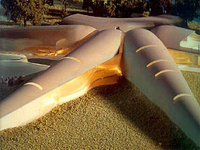
Proposed Grafton New Hall, Cheshire (Image: Ushida Finlay Architects)

The poster child for the new ‘modernist’ country house was the design produced by Ushida Finlay in response to the 2001 RIBA competition to build “the country estate of the future”.  The original Tudor Grafton Hall in Cheshire had been demolished in 1963 after becoming derelict but the 200-acres of parkland offered the ideal opportunity to create an excellent smaller country estate. Yet for the limited pool of those wishing to spend the estimated £20m to build this vision the design ticked none of their boxes. After 7 years of marketing by the estate agents, it was decided to commission a new design from one of our best Classicists, Robert Adam, whose new proposal was described as “an exceptionally outstanding design“. However, the opportunity to create this new house is still being marketed with Jackson-Stops for £5m – so the argument hasn’t been decisively won in this instance just yet.

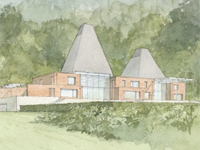
Proposed Alderbrook Park, Surrey (Image: PRS Architects)

In much the same way as those in previous centuries wished to express themselves through their architecture, so it is the case today.  Houses such as the proposed Alderbrook Park in Surrey for the billionaire Lakshmi Mittal are a radical re-interpretation of the country house but driven by the particular requirements of the client.  Also of particular note is  Ferne Park in Wiltshire for Lady Rothermere – easily one of the finest country houses to be completed in the last 100-years and very much the product of the client working in conjunction with her architect, the brilliant Quinlan Terry.  Speculative developments seem less likely to find buyers as they become more an expression of the ego of the architect rather than the reflecting the personality of the buyer. The prime example of this is the poorly designed Updown Court in Surrey, once the most expensive house for sale in the UK at £70m, which now faces being carved up into flats or becoming a hotel.

Nyn Park, Hertfordshire (proposed) (Image: Julian Bicknell & Associates)

So what other architecturally attractive opportunities are out there? One quite close to London is Nyn Park, Hertfordshire to replace a house which burnt down in 1963 with a design by another icon of the Classicists, Julian Bicknell, who designed the brilliant Henbury Rotunda in Cheshire. The proposed plan bears no relation to the former house and shows the type of new design allowed under PPS7. Just to underline the level of wealth required for these projects, the estate is being marketed at £10m, built costs could easily be £1m-2m, and the buyer must lodge £3m with the local council as a Landscape Bond that they will fulfil their obligations with regards to restoration which will be returned in tranches as the work is completed.

The Ridge, Gloucestershire (proposed) (Image: Yiangou Architects / Knight Frank)

Another house which has featured before in this blog is the impressive ‘The Ridge’ in Gloucestershire; another replacement for a lost house designed by Humphrey Repton and demolished in 1934.  Designed by Ross Sharpe (who also designed the Icomb Grange), this 33,000 sq.ft. design takes the form of the original house but adds an extra level of architectural flair.  As expected, this is £5m for the opportunity with build costs on top.  Interestingly, the Knight Frank website also says that alternative plans for a smaller 15,000 sq.ft. house have been drawn up, hoping to draw in a wider pool of potential owners.

The Parkwood Estate in Surrey, designed again by Robert Adam, has also been featured previously on this blog back in July 2010 as part of the discussion around justifiable replacement.

For some, a new build will never be a substitute for a historic country house but for those with specific requirements or where there is a shortage of suitable houses, then the option of creating from scratch will always be enticing.  It is also important that the tradition of country house building is allowed to continue as it is only through development that it is shown that these fine buildings can contribute to, and enhance, the much-loved countryside.  PPS7 provides an important legal support for the principle that architecture should be allowed to flourish where it is justified and supportable and should be defended against any narrow-minded interests who would deny our history and diminish the future.

———————————————————–

The websites of the leading country house architects show the broad range of fascinating projects they are involved with, and that, fingers crossed, will one day be built:

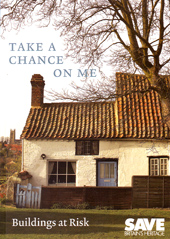
‘Take a Chance on Me’ – Buildings at Risk Register 2011

'Take a Chance on Me' - 2011 SAVE Buildings at Risk Register

Despite the obvious deep and passionate interest society has with historic buildings every year the SAVE Britain’s Heritage Buildings at Risk Register highlights just how many properties are still under threat from neglect and those in power who believe the only good building is a new one with their name on the opening ceremony plaque.  The 2011 BaR register – ‘Take a Chance on Me‘ – has just been published and sadly, as always, it contains some country houses which really deserve a better fate.

Perhaps the one of the most attractive, both architecturally and in terms of being a  case for restoration is Blackborough Hall, near Cullompton in Devon. This elegant, if thoroughly dilapidated grade-II house, is a remnant of the grand building plans of the Earl of Egremont whose many-columned main house, Silverton Park, was demolished in 1902.  The house is actually two, as when built in 1838, it formed one house at the front and a second at the rear for the local rector.  In recent years it became a car scrap yard which covers most of the immediate grounds and would obviously need clearing first – though I suspect the costs could be made back through selling some of the classic cars. The house is currently for sale for a nice round £1m and has been listed with Winkworths who, after an initially poor showing, have now managed to put a few more photos and a floor-plan online.

Elvaston Castle, Derbyshire (Image: Steve Tomkinson / Friends of Elvaston Castle)

Elvaston Castle in Derbyshire has a grade-II* listing putting it in the top 4% of buildings nationally but that hasn’t stopped it making an entry into the Register this year.  Originally built in 1633 for the Earls of Harrington it was largely rebuilt in a ‘Gothick’ style c.1817 to designs by James Wyatt.  Now owned and managed by Derbyshire County Council (who had a fairly poor record in the 20th-century of demolishing country houses in their ‘care’) it is today mostly vacant and with the Council now claiming it can’t afford to maintain it they are seeking a developer to get them out of a hole of their own making.  Luckily an active local campaigning group – the Friends of Elvaston Castle – have been objecting to these plans and trying to force the Council to face up to their responsibilities – though perhaps there is an opportunity for someone else to come up with a viable plan.

Stone Cross Mansion, Cumbria (Image: HiddenShadow / 28dayslater)
Stone Cross Mansion, Cumbria (Image: HiddenShadow / 28dayslater) - click for more images of the house today

Stone Cross Mansion, Cumbria presents the interesting confusion of a Scots Baronial design in England.  Built in the 1870s by a stubborn man, one Myles Kennedy, who wanted to buy Conishead Priory for £30,000, but who met an equally stubborn vendor who wouldn’t accept less than £35,000.  Mr Kennedy may have come to regret his obstinacy when presented with the final bill which totalled nearly £45,000.  The sum reflected the high quality of the workmanship, particularly the impressive High Victorian Gothic grand hall (scroll down) which originally had a fine staircase which was later removed when the house became a special school to make it easier to play indoor football (seriously, where do they find these people?!).  The house then became a corporate headquarters during which it time it was restored to a high-standard before falling into neglect.  Repeated enabling development proposals have been rejected (not that the council is against it) so this house either needs someone willing to restore the house on the back of a sensitive ED proposal – or, ideally, someone to rescue this house and make it a home again.

Plas Gwynfryn, Wales (Image: SAVE Britain's Heritage)

Another house which would make a fantastic home is Plas Gwynfryn in south Wales.  This house has been featured before on this blog (‘Orphan seeks new carers: Plas Gwynfryn, Gwynedd‘) which sparked some passionate debate in the comments about who the owner is – and that same unresolved question is why the house makes an appearance in the BaR this year. Built in 1866 to replace an earlier one, this distinctive house – described in the listing description as ‘romantically assymetrical’ – was a hospital in WWII, before becoming an orphanage and then a hotel before a serious fire in 1982 gutted it.  Although in a derelict condition this house can be restored and would once again be a fine part of the local architectural heritage.

The Register is available from 1 June 2011 priced at £15 (£13 to Friends of SAVE) and can be ordered from the SAVE website. The BaR contains many other types of property so even if your budgets are less lavish than these house might require it is well worth having a look.  Of course, SAVE does superb work across the country to protect our architectural heritage and I would strongly urge everyone to become a Friend to help support their efforts (well, I would say that as I’m on the Committee – but I’d also say it anyway!) which will also give you access to the online version of the BaR register which contains hundreds of other potential future success stories.

——————————————————————————–

A more comprehensive list of country houses currently at risk can be found on my Lost Heritage website: ‘Houses at Risk

The future of the country house? Alderbrook Park, Surrey

Proposed Alderbrook Park, Surrey (Image: PRS Architects)

Within any established pattern there is always the shock of the new. Most people when asked to imagine an English country house will usually think of red-brick Jacobean or light-stone Georgian but the design of new country houses is always in flux and what has gone before is no guarantee of what will come. Following World War II, the aftermath of which led to the demise of many large houses, the fashion changed to have a smaller but more modern house – one which required fewer staff and perhaps used more contemporary architectural language; however much it was derided by others.

Queen's House, Greenwich (Image: Bill Bertram / wikipedia)

The nature of architectural innovation has usually been one of gradual change – subtle at first and then growing bolder.  For example, Palladianism is widely seen to have arrived rather dramatically with the building of the Queen’s House in Greenwich in 1616 to a design by Inigo Jones.  Jones had recently studied Palladian architecture in Rome for three years and this commission was his chance to put this into practice.  One can imagine the surprise of Londoners, long used to timber, gables, and red-brick, to the square, stuccoed, and very white, Queen’s House.  Yet Sir John Summerson argues that there is evidence of Palladianism in the plan of Hardwick Hall in Derbyshire, built in the 1590s by Robert Smythson.  Here, the placing of the hall on the central axis of the main entrance and the colonnades between towers front and back, echo the layout of Palladio’s Villa Valmarana featured in his Second Book of Architecture, making Hardwick the first known use of Palladio by an English architect.  This quiet use would have meant that visitors would have become accustomed to a symmetrical, regularised interior, paving the way for the same style to appear externally.

As much as the role of ‘architect’ took time to develop, so to did the responses to their work.  In 1624, Sir Henry Wotton, writing in his ‘Elements of Architecture‘, bemoaned the lack of ‘artificiale tearmes’ – that is, language with which to describe architecture.  Yet William Webb, writing in 1622, managed to praise the then new Crewe Hall in Cheshire, saying that the owner, Sir Randolph Crew;

“…hath brought into these remote parts a modell of that most excellent for of building which is now grown to a degree beyond the building of old times for loftiness, sightlines and pleasant habitation…”

So, ever since we’ve had architects, we’ve had critics (who were also sometimes architects); Jones, Wren, Ruskin, Pugin, Morris, Lutyens, Pevsner, etc have all made their opinions known.  Overseas visitors were also apt to compare what they had seen.  Jean Barnard le Blanc, visiting in 1737-8, was well educated and travelled and critical of the emerging use of Italian designs in England saying;

“These models have not made the English architects more expert; for whenever they attempt to do anything more than barely to copy, they erect nothing but heavy masses of stone, like of Blenheim Palace…”

As the language developed and architecture became more academic it became more rigorous and perhaps dry, with light relief afforded by more waspish commentators such Sacheverell Sitwell.

So why are some houses criticised more than others?  It seems that houses which appear without the ground being prepared before them suffer most.  The shock of the new is unmitigated and particularly where there is a strong local vernacular, the language of the new house will be a greater change.  More broadly, where a house is seen to be breaking with old traditions and what is seen as the ‘appropriate’ style for a family or an area, criticism can be swift and strong.

Eaton Hall by John Dennys for the Duke of Westminster (Image: Kathryn Gammon)

One example of this is Eaton Hall in Cheshire following the unfortunate demolition between 1961-63 of the vast Victorian masterpiece designed by Alfred Waterhouse.  The loss of the house left a gaping hole at the centre of the estate with large gardens and long tree-lined avenues leading to nowhere.  The 5th Duke decided to rebuild and commissioned his brother-in-law, the architect John Dennys, to design a very modern replacement.  The resulting house, although striking, was regarded as unsuccessful, with John Martin Robinson saying,

“The sad fact is that, while from a distance the new Eaton has some of the classic Modern impact of the Corbusier dream…close up it is rather disappointing…”

Yet rather than criticising the house for not being in the traditional language of the English country house, Robinson is saying that it’s not Modern enough.  Others disagreed, with perhaps the most amusing response coming from the Duke of Bedford before it was even built.  Writing in 1970 after the unveiling of the design, he wrote;

“I was interested to see…a sketch model of Eaton Hall.  It seems to me one of the virtues of the Grosvenor family is that they frequently demolish their stately home [Waterhouse’s being the third on the site]. I trust future generations will continue this tradition if this present edifice, that would make a fine office block for a factory on a by-pass, is constructed.”

Proposed Grafton New Hall, Cheshire (Image: Ushida Finlay Architects)

In more recent times, one design which met with critical acclaim but was perhaps a step too far was the Ushida Findlay design for Grafton New Hall, Cheshire.  Their house was a response to a 2001 RIBA competition to ‘design a country house for the 21st century’.  In creating their radical ‘star-fish’ layout they were rejecting the established patterns and trying to create a new response to the same requirements for the functions of a country house.  Yet the house never found a patron and, tellingly, the house now being constructed is a classic of modern Palladianism, designed by the pre-eminent Classical architect, Robert Adam.

There are, of course, many other examples of intelligent but unpopular designs for modern country houses – for example, Wadhurst Park in Sussex for TetraPak billionaire Hans Rausing.  And it’s in this constant stylistic flux into which Lakshmi Mittal has pitched the very radical designs for his new house on the 340-acre Alderbrook Park estate which he bought four years ago for £5.25m.  The original house by Richard Norman Shaw for the Ralli family was demolished in 1956 as too large, with a poor, inadequate substitute built in the 1960s.  The estate was sold with the express intention of demolishing this house and in its place Mittal is proposing a £25m, carbon neutral ‘eco-home’.  To help achieve this, the design of the house is driven by the functional requirements to minimise heat loss, to be cooled by natural ventilation, and have hot water provided by pyramid chimneys which incorporate solar thermal collectors which will help also vent heat in summer.  This house is a rejection of the idea of the house as an aesthetic construct in a particular architectural style but is more Corbusier-like; a ‘machine for living’ – a somewhat depressing prospect.

Grafton New Hall, Cheshire (Image: Robert Adam Architects)

So what does the future hold?  The natural course of the development of the country house has been its adaptation to the whims and preferences of the owners.  As younger generations have taken the reins they’ve chosen different and perhaps more fashionable styles – and without change we wouldn’t have the Georgian mansions or Lutyens to love. However, each of the previous styles could be seen as natural evolution which reused a broad architectural vocabulary which was instantly recognisable as distinctively rural.  What seems to jar with the very modern designs is that they seem to use a more urban, industrial language to interpret the form of the country house.  This seems to sit somewhat uneasily with our preconceived notions as to what a country house should look like – but who knows, perhaps in 50 years maybe it’ll be accepted and appreciated and we’ll be concerned about the next stylistic evolution.  I still prefer Georgian Palladian.

The price of progress: country houses and the High Speed 2 rail project

One of the sadly almost inevitable side-effects of urban and industrial growth is the loss of more of our countryside. Sometimes it can be on a smaller scale for residential developments and industrial units but occasionally society’s plans are much grander and require a greater sacrifice. This has been shown with the publication of the latest proposed route for the new High Speed 2 rail project to provide a fast link between London and Birmingham.  In previous generations, landowners could influence the path of developments such as roads or canals to their benefit but as their power has diminished so routes of these developments can now threaten the settings of our country houses.

The High Speed 2 railway is aiming to dramatically reduce the need for internal domestic flights in the UK by linking London to, first, the West Midlands, followed by Leeds and Manchester.  The plan has always been controversial, requiring the loss of hundreds of homes in the urban areas around the terminals and also a significant loss of farmland.  Following an initial proposal, the latest route was announced to the House of Commons on 20 December 2010 which reflected some concerns about the initial proposal.  However, 13 of the 30 sections (yes, I have been through all of them!) contain a number of country houses and manors which will still be significantly affected by the plans.

Edgcote House, Northamptonshire (Image: Bacab)

One bit of good news is that fears over the proximity of the link to the wonderfully elegant West Wycombe Park (raised in a blog post in Oct 2009) have been alleviated as the new route is further away.  However, another significant house will still be badly affected; the Georgian, grade-I listed, Edgcote House, Northamptonshire.  The proposed route now slices through the remarkably unlisted grounds with the line passing just to the east of the ornamental lake which forms one of the main axial views from the house.  Edgcote was built between 1747-1752 for London merchant Richard Chauncey by architect William Jones and featured as ‘Netherfield’ in the 1995 TV adaptation of ‘Pride and Prejudice’.  The house and grounds form the centrepiece to a 1,700-acre estate which was bought for £30m in 2005. Interestingly, this value has not deterred the planners (who moved the line from the original position cutting across the lake) so it will be interesting to see if the owner submits a claim a for ‘statutory blight‘ [.pdf]. This gives the Secretary of State the option to buy the property at the current market value if the owner can show that they have been unable to sell due to the Government proposals, or only at a substantially lower value.

Hartwell House, Buckinghamshire (Image: Giano via Wikipedia)

Amendments have also been made to protect another significant property; Hartwell House in Buckinghamshire.  A grade-I listed house, now run as a hotel, it was built in the early 17th-century for the Hampden family but was later let to the exiled King Louis XVIII of France who lived there between 1809-14.  Originally Jacobean, it was substantially enlarged and ‘Georgianised’ between 1759 and 1761 by the architect Henry Keene.  Again, following initial concerns, the route has now been moved further away from the house so that it would not be visible and will benefit from extra earth works and planting to reduce the noise.

Stoneleigh Abbey, Warwickshire (Image: PinkyVicki via Flickr)

Another grade-I house which would have been worse affected if it hadn’t been blighted already is Stoneleigh Abbey in Warwickshire.  This imposing house, now converted into apartments, is part medieval, part Georgian designed by the talented Francis Smith of Warwick, exists in a seriously compromised setting with the Stoneleigh Park exhibition and conference venue built in one half of the immediate parkland.  The proposed line will not only cut through the conference venue but also forever separate the house from the northern edge of the original park – though the massive scale of development already means this was never a house which was going to be returned to splendid isolation.

Another compromised house is Swinfen Hall in Staffordshire where the train will pass in front but quite some distance away.  The house itself, a beautiful Baroque-style Georgian mansion was built in 1757 to a design by Benjamin Wyatt and remained the home of the Swinfen family for nearly 200 years.  After the death of the last Swinfen in 1948 the land was sold and later a huge youth detention centre built to the immediate north-west with the house being left to deteriorate until it was converted into a hotel in the 1980s.  Having a railway line in the middle distance is the least of the concerns for the setting of this house.

Waddesdon Manor, Buckinghamshire (Image: National Trust)

Despite the vocal complaints of Lord Rothschild it seems that the route will be quite far from their old family seat of Waddesdon Manor.  However, Rothschild has become one of the leading opponents of the scheme – along with 16 other Conservative MPs whose constituencies will be affected.

With the rail route cutting across the countryside it was unavoidable that it would pass near to country houses, ironically which, of course, were often built to get away from the industrial blight.  Other houses which now lie close to the proposed route include:

  • The Vache (image), Buckinghamshire
  • Pollard Park House – a 1903 house built to a Lutyens design.
  • Classical Shardeloes, built between 1758-66 for William Drake MP by the architect Stiff Leadbetter would also suffer from the high speed line cutting across the main view from the house.
  • Grade-II* Doddershall House would be within a couple of hundred metres of the line on which up to 18 trains per hour are expected to rush past at speeds of up to 400kph.
  • Chetwode Manor
  • Oatley’s Hall
  • Berkswell Hall, Warwickshire – a grade-II* listed house now converted into apartments
  • Coleshill Manor, Birmingham – now offices and already suffering from being surround by motorways, the house will now have the line within metres, also necessitating the demolition of a new office complex next door.

The route also cuts across the old estate of the now demolished Hints Hall in Staffordshire – an elegant two-storey Georgian mansion with giant pilasters to enliven the facade.  It’s unlikely that if the house had survived it would have prevented the proposed route but again, without the house, an estate becomes even more vulnerable.

These are just the houses affected by the first 120 miles of the proposed 355 mile scheme.  If successful, we can expect more houses to be blighted as the route carves through the Midlands and up into Lancashire, shattering the peace and quiet that were the original reasons for the creation of these refuges from the industrial reality of the cities.  Although progress can often bring benefits, in this case the price is being paid by our country houses as their parklands and estates are judged the path of least resistance.


More information: High Speed 2 [wikipedia]