Converting country houses from commercial to residential: a sound investment?

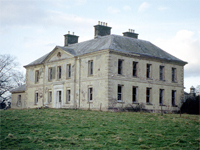
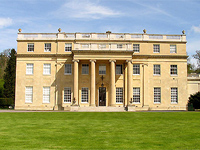
Benham Valence, Berkshire (Image: wikipedia)

As the pressures of the twentieth century forced more country houses owners to face the reality that they could no longer live as they had and would have to move out of their homes they then had to decide what to do with it.  Unfortunately this meant demolition of hundreds of large houses but some owners were more creative and many houses became commercial premises, either as hotels, schools or institutions, and others became some of the grandest office buildings in the country.  However, recent pressures of this century have now seen some of these offices being converted back into homes or being offered for sale as an opportunity to do so.

In many ways the country house has always had an element of the commercial to it with the estate offices usually being based either in a part of the main house or in a nearby building to enable the owner to deal with business without having to travel far from home. The changes of the twentieth century were on an altogether more comprehensive scale with the entire house being changed to accommodate the demands of business.  This not only meant the conversion of the main house with all that entailed for the interiors but also the building of further offices in the grounds.

Sometimes the development was kept a good distance from the main house such as at Ditton Park in Berkshire.  This became the office of the Admiralty Compass Observatory from 1917 until it was sold in the 1990s to Computer Associates who built a huge office building to the west of the main house (which became a conference centre) leaving the setting intact.

Sometimes though it’s possible for smaller businesses to be accommodated just within the main house such as at Gaddesden Place in Hertfordshire.  The house, built in 1768, is a elegant Palladian villa (similar to the White Lodge in Richmond Park) and was James Wyatt’s first country work.  The site is said to have some of the best views in the home counties and the sensitive use of the house has allowed to remain in splendid seclusion.

However, modern concerns mean that a country house has lost some of it’s appeal as offices.  One key issue is that by their nature the houses are isolated meaning that employees must have cars to reach it leading to more cars on the roads and the need to provide huge areas of parking.  Stronger heritage legislation now also means it’s much harder to alter the houses to meet modern business requirements such as air conditioning and computer networking.  The nature of the houses also means that maintenance costs are higher than for a purpose built office.

This has led to some houses which were formerly offices to be converted back into homes.  Mamhead House in Devon, built between 1827-33 and regarded as one of Anthony Salvin‘s finest designs, it was, for many years, a school before becoming offices for a local building company.  It was bought by a businessman who converted the main part of the house back into being a home whilst still letting out part of the house to the Forestry Commission.

Perhaps the grandest and largest opportunity for many years to restore a house into a home is the mansion at Benham Valence in Berkshire.  This superb house was built in 1772-75 for the 6th Earl of Craven and was designed by Henry Holland in collaboration with his father-in-law, Lancelot (Capability) Brown, the famous landscape architect.  The south front features a grand tetrastyle Ionic portico which looks out over a large lake with views into the parkland.  Inside, there are many fine chimney-pieces bought from the sale at Stowe in 1922, including one from the State Dining Room.  It also features a small circular double-height vestibule adjoining the inner hall, a design later adopted by Sir John Soane.

The house was empty in 1946 and remained so until it was sold in 1983 and converted to use as offices with a large wing to the north east of the house being demolished and replaced, in part, by an ugly 80’s complex providing over 100,000 sq ft of space.  Luckily though the main house was largely spared and remains Grade II* with the 100-acres of Grade-II parkland. Now offered for sale at £6m this is a rare opportunity to create a wonderful country house – providing it’s possible to obtain planning permission to convert it back – which, once restored, could be worth £10-12m.  One key requirement would be the demolition of the office complex and the ripping up of the huge car park – but give me a pickaxe and I’ll be happy to lend a hand.

Full property details: ‘Benham Valance, Berkshire‘ [Strutt & Parker]
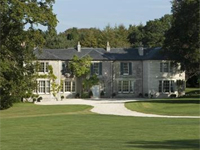
The start of the rush? Country houses for sale in the Sunday Times Home section

Sandley, Dorset (Image: Knight Frank)

The usual spring rush of country houses coming to market has been later this year – a combination of the hangover from the uncertainty in the market of the last couple of years along with that of the General Election.  That traditional shop-window of the country house – the Home section of the Sunday Times – has this week (16 May 2010) heralded what it sees at the start of the rush by including three pages of those for sale.

For those who like their country houses to look traditional from the outside but prefer a more modern interior then the Grade-II listed, six-bedroom Sandley in Dorset, set in 178-acres, might be perfect – if you have the necessary £9m.  The owners decided that the rather ‘quaint’ style of the house was not for them and so they spent ‘a couple of million pounds’ and over two years to strip it back and then make it look very ‘London’.  Personal taste is the final arbiter for whether you think this is a good thing – but not all tastes are the same and it can mean that the appeal of the country house is taken to new markets.

Ebberly House, Devon (Image: Savills)

However, if your tastes are more usual and traditional then there are other options. Holt Manor in Wiltshire, set in 94-acres, mixes both old and new with a more traditional interior cleverly concealing the latest in sound, television and security systems.  With parts dating back to the 12-th century, the Grade-II listed house has been thoroughly modernised whilst still being a recognisably English country house. £5.95m [Holt Manor: Knight Frank]

If, however, you are looking for a more architecturally impressive house, the Ebberly House, near Winkleigh in Devon, could well be the house for you.   Designed by Thomas Lee, a student of Sir John Soane, Ebberly was described by Pevsner as an ‘unusual and attractive house’ and was the first to sell in Devon for over £1m when it sold in 1997.  The Grade-II* listed house possibly benefited from Soane’s personal influence as he was working nearby at Castle Hill which may explain the elegant, and very Soanian, top-lit oval stair hall with its fine cantilevered wooden staircase and curved doors, or the drawing room divided using three shallow arches. Set in  250-acres it has a wonderful estate featuring 20-acres of woodland, estate cottages generating £20,000 p/a in rental income, and spectacular views across to Dartmoor. It was also given an excellent and detailed write-up in Country Life – always a good seal of approval.  [Ebberly House: Savills]

Chapel Cleeve Manor, Somerset (Image: Webbers)

Perhaps one of the most interesting of the houses featured is unfortunately only given a photo and no details is Chapel Cleeve Manor in Minehead, Somerset. Perhaps now not strictly a country house as it only has 7-acres, at £1.695m for 17+ bedrooms, it may seem a bargain for someone who wants to live in a country house but doesn’t want the responsibility of an estate. Although such a situation a hundred years ago could have led to the demolition of the house as happened to so many others. Yet, with so much wealth now generated without the need for a large estate to support the house, it’s now entirely reasonable for someone to take on and enjoy such a pleasing Gothic-Revival house. The house has been used as a conference venue for a number of years but with careful restoration this could be rescued from commercial use and be a spectacular home for someone who requires a lot of space. [Chapel Cleeve Manor: Webbers]

So has the rush started?  Nobody really knows and asking estate agents is never an exact science.  Several house which have been launched recently are still waiting to find new owners but the right house launched at the right time for the right price usually does find the right buyer.

Full story: ‘The landscape has changed‘ [The Sunday Times: Home section]

A glimmer of hope: ‘Country House Rescue’ visits Kelly House

Kelly House, Devon (Image: English Heritage)

Kelly House has a series of long associations; there has been a house there for over 900 years, it has been the seat of the Kelly family for that entire time, and, sadly, has been on the English Heritage Buildings at Risk Register for over five years.  Now the latest twist in the tale is that the house will feature in Channel 4’s ‘Country House Rescue’ on Thursday 1 April when expert Ruth Watson offer possible solutions which will help the Kelly family remain in their ancestral home.

The Kelly’s are one of the very rare families able to trace their lineage back to pre-Conquest times.  Warin Kelly is the 31st squire of the family to live in a house which has been passed down since 1100 through fathers, grandfathers, and brothers.  Described as being ‘in a class of its own’ by Marcus Binney*, the elegant Palladian house was built in 1743 -45 for Arthur Kelly by Abraham Rundle (d.1750), a joiner and provincial but obviously skilled architect who lived in Tavistock.  The house is grade-I listed and features a Portland stone doorcase, sash windows glazed with Crown glass and made in London, with local slat stone walls with moorstone quoins. Inside, the extensive high quality woodwork  features superb carving including panelling, chair rails, and a particularly good staircase with chunky corkscrew balusters.

However, the fine panelling hides serious issues such as the periodic bouts of dry rot which break out. Mr Kelly, as a conservation architect advocating minimal intervention, admirably refuses to treat it with chemicals or by stripping out the panelling.  This ongoing damage is largely the fault of death duties, with two demands being levied in swift succession which have severely limited the family’s ability to maintain the house.  Kelly House is exactly the sort of house which the Historic Buildings Councils would have provided grants for when they were set up in the 1950s.  Today, with English Heritage’s budgets under severe pressure, Mr Kelly was told in 2005 that they were unable to provide funds as the increase in the value of the restored house would be greater than the grant – meaning that they force owners towards the sale of their ancestral homes.

Much as it would appear difficult to argue for the provision of public money to preserve private residences, there has to be a better solution than just letting them slowly grow more derelict despite the often heroic efforts of the family involved.  The current generation doesn’t want to be the one which is remembered for having to sell the family seat, leading to a battle against the elements of decay which saps finances and families and often doesn’t provide a long-term solution.  Outside expertise is to be welcomed as it may show the way to a sustainable future for these beautiful homes. Hopefully Ruth’s suggestions can be taken on by the Kellys and other families to ensure their homes are self-financing and not a burden to either the state or the owners who are then able to look forward to the prospect of handing a home and not a liability to their descendants.

Programme details: ‘Country House Rescue‘ (Channel 4)

More information: ‘TV show could help manor restoration‘ [Western Morning News]

Official Kelly House website: ‘Kelly House

* – ‘Houses to Save’ – article by Marcus Binney in Country Life magazine (8 September 2005)

Restoration of Poltimore House receives boost

Poltimore House, Devon

The project to restore an important Devon country house, which is finally being rescued after being neglected since the 1970s, has received a significant boost.  English Heritage has awarded a £500,000 grant which will allow major work to continue on making Poltimore House watertight and safe for the ongoing  restoration work.

The grade-II*-listed house has been a familiar sight to anyone who has driven on the M5 near Exeter who would have seen it slowly deteriorating since it ceased being a hospital in 1975.  Originally the Bampfylde family seat, Poltimore was originally built in the 1550s with this part now forming a still visible core section of the house.  It was greatly extended in 18th-century with the work including a Rococo-style saloon and then again in the 19th-century with the addition of a grand imperial staircase.

The decline started when the Bampfyldes finally left the house in 1921 after the death of the third Baron Poltimore, and put it up for sale.  For many houses this was a prelude to demolition but Poltimore escaped by becoming a boarding school for until 1939 when it then became temporary home for Dover College during WWII.  After the war the house became a nursing home and remained in use as a hospital until 1975.  Once empty, the decline accelerated rapidly with thefts of lead, fireplaces and other fittings including the entire balustrade from the staircase. The damage was compounded by serious arson attack which destroyed the roof.

The journey back from total dereliction started in 1997 when the house was acquired by the Buildings at Risk Trust before being taken over by the Poltimore House Trust in 1999.  Their intention is fully restore the house for mixed use with commercial aspects combined with community and arts use.  A large and active group of Friends of the house have tirelessly campaigned to save this important piece of Devon’s heritage and English Heritage are to be congratulated for such a large contribution towards the estimated £5.5m restoration bill.

More information including details of the planned restoration: ‘Poltimore House

Castle Drogo under seige – from rain

Castle Drogo, Devon (Image: wikipedia)

The last castle to be built in the UK, Castle Drogo, occupies a commanding position far up the Teign Gorge in Devon.  Designed by Sir Edwin Lutyens and built in the 1910s and 1920s and finally finished in 1931 for the wealthy businessman Julius Drewe, the Grade-I listed house is a brilliant modern interpretation of a castle combined with the comforts of a country house.

It was also one of the last houses to be built entirely in granite, the local stone of the area.  The grey stone and the clever massing of towers and wings give the house a solid, impregnable air but the house is under attack from the elements, with rain penetration causing serious concern.  The many flat roofs hidden behind the battlements started causing problems only two years after the house was finished and ever since it has been a constant battle to keep the house watertight.

House manager Bryher Mason told BBC News: “I wouldn’t be surprised to walk into a room one morning and find a section of the ceiling having fallen in because the metalwork in the ceiling has failed.”

The National Trust, who have cared for it since it was handed to them in 1974, have instigated a restoration and repair programme on the many roofs, which will include the replacement of all 13,000 window panes, and has been estimated to cost £10m, and will be completed by 2016.

Full story: ‘Leaking castle needs £10m repairs‘ [bbc.co.uk]