The front line: the campaigners for country houses

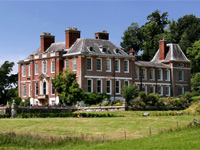
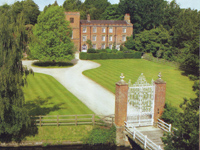
Apethorpe Hall, Northamptonshire (Image: English Heritage)

Despite the image of wealth and power a country house might create, in reality their existence is far more precarious – as can be seen with nearly 1,800 houses lost over the last two centuries.  A house facing the threats of being uninhabited without a concerned, well-funded owner with an inclination to keep it in good repair can quickly deteriorate leaving another gap in the tapestry of the countryside.  Sometimes it requires someone other than concerned locals and architectural historians to highlight and campaign on behalf of those ‘at risk’ so here’s a quick round-up of the main English organisations fighting on behalf of country houses and who are very worthy of support.

English Heritage inhabits a prime position in view of its role in defining and, in conjunction with local authorities, implementing the statutory protection of our built heritage.  Its role can be traced back to the Ancient Monuments Act of 1882 – though the legislation specifically excluded privately owned houses. The responsibilities were exercised through various government departments until it became a quango in 1984.  As well as being responsible for the listing system and the annual production of the various ‘at risk’ registers (focussing mainly on grade-I and -II* properties), EH is also directly responsible for various country houses including Brodsworth Hall (Yorkshire), Rufford Abbey (Nottinghamshire), Hill Hall and Audley End (Essex), Kirby Hall (Northamptonshire), Witley Court (Worcestershire), Stokesay Castle (Shropshire), and Apethorpe Hall (Northamptonshire).   It’s at the grade-I listed Apethorpe where EH has done some of it’s most interesting work; taking a direct role in the restoration of one of the finest Elizabethan/Jacobean houses in the country following a long period of neglect. Since 2008, the house has been for sale for around £5m – though there is a compulsory £4m list of renovations, and if you want complete privacy expect to pay another £8m to fully reimburse EH otherwise you have to open it for 28 days a year; so a nice round £20m to restore, furnish and keep as your own. However, this is a role that I fully support them in taking on – they should be there as owner and restorer of last resort for threatened grade-I houses.  Now perhaps we can interest them in the sadly deriorating Melton Constable Hall in Norfolk…?

Another important group of campaigners are recognised in the 1968 Town and Country Planning Act which formalised the role of what are known as ‘amenity societies‘; that is, well-established voluntary societies who are experts in their areas, who must, by law, be informed of any applications for listed building consent to demolish listed buildings in whole or in part in England and Wales.

One of the best known is the Georgian Group who cover a period broadly from 1700-1837.  The society was established in 1937 and has long campaigned for the sensitive restoration and retention of not only the buildings but the many important, and sometimes sadly overlooked, internal features which are a key part of the character of a building.  Current active campaigns and cases they are involved in include Bank Hall in Lancashire and Trewarthenick House in Cornwall and many others. They also produce a scholarly annual research journal which provides a much more in-depth view of aspects of Georgian architecture.  Access for the wonderful trips to houses not normally open to the public are worth joining for alone.
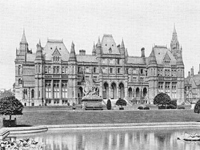
Eaton Hall, Cheshire (by Alfred Waterhouse - dem. 1961) (Image: Lost Heritage)

The Victorian Society (which also covers Edwardian buildings too) was formed in 1958 at a time when almost all things Victorian were disliked and an easy target for demolition.  Founded at the suggestion of Anne, Lady Rosse, along with her influential friends such as Sir John Betjeman and Sir Nicklaus Pevsner, the Society has fought some notable battles; losing some such as Euston Station but winning others, such as the soon-to-reopen St Pancras Midland Grand Hotel building.  Victorian country houses have suffered badly as, although designed by eminent architects such as Richard Norman Shaw and Alfred Waterhouse, they were often built on a much grander and therefore less economically sustainable scale and at the times of greatest threat (the 1930s and 1950s) had few friends to argue on their behalf.  Luckily though this has changed – but with the predominant ‘gothic-revival’ style being quite polarising, threats to houses from this period will always be present. Again, well worth joining.

Perhaps more controversially for this blog, it’s also worth bearing in mind the Twentieth Century Society.  Although the focus of the houses usually covered is before 1900, there has been a growing recognition that some of the country houses built in the 20th-century were well-planned and architecturally pleasing, even if they sometimes replaced a much more attractive Georgian or Victorian house.  It does seem to take about 50 years after a style has passed from being fashionable for it to be appreciated, so I suspect there will be a growing realisation that we need to protect the work of those such as Francis Johnson, Craig Hamilton, Quinlan Terry, and Robert Adam (amongst many others) in the future.

The Society for the Protection of Ancient Buildings (SPAB) is, as its name makes clear, not usually concerned with country houses as they are relatively ‘modern’ in terms of its remit.  However, they do immensely important work in promoting good repair practice to all buildings and their courses have taught generations of owners and craftsmen to respect the country houses and to approach any work required with a more ‘heritage’ mindset.

Although not ‘amenity societies’, two other organisations deserve a mention. The first is the Historic Houses Association which acts on behalf of the private owners of country houses and often lobby government to make them aware of the immense work done by the individual owners to maintain their slice of the national architectural heritage.  It may seem unfashionable in wider society to support the wealthy but they are the ones not only maintaining their homes to the exacting standards of English Heritage, but also restoring and rescuing houses and converting them back into homes again – and for that they deserve our thanks.

The Grange, Hampshire (Image: mpntod / Wikipedia)

The other organisation is one in which I have an interest having worked with them for several years: SAVE Britain’s Heritage.  Founded in 1974, SAVE have taken a very active stance on campaigning, willing to create media interest at short notice, but also to take time to produce some excellent research on houses at risk with thoughtful proposals for their re-use.  These campaigns have saved houses such as Calke Abbey in Derbyshire, The Grange in Hampshire, Barlaston Hall in Staffordshire (where SAVE bravely took on the house for £1!), and, working with Kit Martin, have acted as a catalyst for the saving of other houses through conversion into apartments.  Supporting SAVE’s work and becoming a Friend also gives access to their extensive ‘Buildings at Risk Register’ which features over 800 properties, including several country houses, which are in need of rescue – could it be you?

It is also worth keeping an eye out for local activists and campaigns which can also be remarkably successful at highlighting buildings at risk but can also sometimes take a more direct role; see the wonderful work at Poltimore, Devon, Bank Hall, Lancashire, and Copped Hall, Essex.  These are just three examples where concerned locals have organised themselves and presented a credible alternative and prevented the complete loss of the house.

All of these organisations are worth joining but economics being what they are it can be best to join a national organisation and then another to focus on the period which you prefer.  Joining up means that you are helping to support research but also active campaigns to ensure that as much of our built heritage is passed on to future generations.

———————————————————

I realise this selection is not comprehensive and is quite national in focus and deficient in regional organisations but this will be remedied in another post once I’ve had time to learn a bit more about who’s out there.

– Matthew

———————————————————
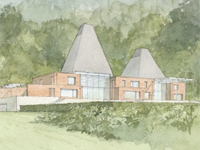
The future of the country house? Alderbrook Park, Surrey

Proposed Alderbrook Park, Surrey (Image: PRS Architects)

Within any established pattern there is always the shock of the new. Most people when asked to imagine an English country house will usually think of red-brick Jacobean or light-stone Georgian but the design of new country houses is always in flux and what has gone before is no guarantee of what will come. Following World War II, the aftermath of which led to the demise of many large houses, the fashion changed to have a smaller but more modern house – one which required fewer staff and perhaps used more contemporary architectural language; however much it was derided by others.

Queen's House, Greenwich (Image: Bill Bertram / wikipedia)

The nature of architectural innovation has usually been one of gradual change – subtle at first and then growing bolder.  For example, Palladianism is widely seen to have arrived rather dramatically with the building of the Queen’s House in Greenwich in 1616 to a design by Inigo Jones.  Jones had recently studied Palladian architecture in Rome for three years and this commission was his chance to put this into practice.  One can imagine the surprise of Londoners, long used to timber, gables, and red-brick, to the square, stuccoed, and very white, Queen’s House.  Yet Sir John Summerson argues that there is evidence of Palladianism in the plan of Hardwick Hall in Derbyshire, built in the 1590s by Robert Smythson.  Here, the placing of the hall on the central axis of the main entrance and the colonnades between towers front and back, echo the layout of Palladio’s Villa Valmarana featured in his Second Book of Architecture, making Hardwick the first known use of Palladio by an English architect.  This quiet use would have meant that visitors would have become accustomed to a symmetrical, regularised interior, paving the way for the same style to appear externally.

As much as the role of ‘architect’ took time to develop, so to did the responses to their work.  In 1624, Sir Henry Wotton, writing in his ‘Elements of Architecture‘, bemoaned the lack of ‘artificiale tearmes’ – that is, language with which to describe architecture.  Yet William Webb, writing in 1622, managed to praise the then new Crewe Hall in Cheshire, saying that the owner, Sir Randolph Crew;

“…hath brought into these remote parts a modell of that most excellent for of building which is now grown to a degree beyond the building of old times for loftiness, sightlines and pleasant habitation…”

So, ever since we’ve had architects, we’ve had critics (who were also sometimes architects); Jones, Wren, Ruskin, Pugin, Morris, Lutyens, Pevsner, etc have all made their opinions known.  Overseas visitors were also apt to compare what they had seen.  Jean Barnard le Blanc, visiting in 1737-8, was well educated and travelled and critical of the emerging use of Italian designs in England saying;

“These models have not made the English architects more expert; for whenever they attempt to do anything more than barely to copy, they erect nothing but heavy masses of stone, like of Blenheim Palace…”

As the language developed and architecture became more academic it became more rigorous and perhaps dry, with light relief afforded by more waspish commentators such Sacheverell Sitwell.

So why are some houses criticised more than others?  It seems that houses which appear without the ground being prepared before them suffer most.  The shock of the new is unmitigated and particularly where there is a strong local vernacular, the language of the new house will be a greater change.  More broadly, where a house is seen to be breaking with old traditions and what is seen as the ‘appropriate’ style for a family or an area, criticism can be swift and strong.

Eaton Hall by John Dennys for the Duke of Westminster (Image: Kathryn Gammon)

One example of this is Eaton Hall in Cheshire following the unfortunate demolition between 1961-63 of the vast Victorian masterpiece designed by Alfred Waterhouse.  The loss of the house left a gaping hole at the centre of the estate with large gardens and long tree-lined avenues leading to nowhere.  The 5th Duke decided to rebuild and commissioned his brother-in-law, the architect John Dennys, to design a very modern replacement.  The resulting house, although striking, was regarded as unsuccessful, with John Martin Robinson saying,

“The sad fact is that, while from a distance the new Eaton has some of the classic Modern impact of the Corbusier dream…close up it is rather disappointing…”

Yet rather than criticising the house for not being in the traditional language of the English country house, Robinson is saying that it’s not Modern enough.  Others disagreed, with perhaps the most amusing response coming from the Duke of Bedford before it was even built.  Writing in 1970 after the unveiling of the design, he wrote;

“I was interested to see…a sketch model of Eaton Hall.  It seems to me one of the virtues of the Grosvenor family is that they frequently demolish their stately home [Waterhouse’s being the third on the site]. I trust future generations will continue this tradition if this present edifice, that would make a fine office block for a factory on a by-pass, is constructed.”

Proposed Grafton New Hall, Cheshire (Image: Ushida Finlay Architects)

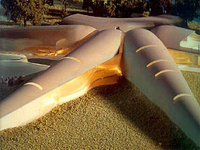
In more recent times, one design which met with critical acclaim but was perhaps a step too far was the Ushida Findlay design for Grafton New Hall, Cheshire.  Their house was a response to a 2001 RIBA competition to ‘design a country house for the 21st century’.  In creating their radical ‘star-fish’ layout they were rejecting the established patterns and trying to create a new response to the same requirements for the functions of a country house.  Yet the house never found a patron and, tellingly, the house now being constructed is a classic of modern Palladianism, designed by the pre-eminent Classical architect, Robert Adam.

There are, of course, many other examples of intelligent but unpopular designs for modern country houses – for example, Wadhurst Park in Sussex for TetraPak billionaire Hans Rausing.  And it’s in this constant stylistic flux into which Lakshmi Mittal has pitched the very radical designs for his new house on the 340-acre Alderbrook Park estate which he bought four years ago for £5.25m.  The original house by Richard Norman Shaw for the Ralli family was demolished in 1956 as too large, with a poor, inadequate substitute built in the 1960s.  The estate was sold with the express intention of demolishing this house and in its place Mittal is proposing a £25m, carbon neutral ‘eco-home’.  To help achieve this, the design of the house is driven by the functional requirements to minimise heat loss, to be cooled by natural ventilation, and have hot water provided by pyramid chimneys which incorporate solar thermal collectors which will help also vent heat in summer.  This house is a rejection of the idea of the house as an aesthetic construct in a particular architectural style but is more Corbusier-like; a ‘machine for living’ – a somewhat depressing prospect.

Grafton New Hall, Cheshire (Image: Robert Adam Architects)

So what does the future hold?  The natural course of the development of the country house has been its adaptation to the whims and preferences of the owners.  As younger generations have taken the reins they’ve chosen different and perhaps more fashionable styles – and without change we wouldn’t have the Georgian mansions or Lutyens to love. However, each of the previous styles could be seen as natural evolution which reused a broad architectural vocabulary which was instantly recognisable as distinctively rural.  What seems to jar with the very modern designs is that they seem to use a more urban, industrial language to interpret the form of the country house.  This seems to sit somewhat uneasily with our preconceived notions as to what a country house should look like – but who knows, perhaps in 50 years maybe it’ll be accepted and appreciated and we’ll be concerned about the next stylistic evolution.  I still prefer Georgian Palladian.

The growth of smaller country houses: Harewood Park, Herefordshire

The size of a country house was traditionally the physical embodiment of the wealth (or aspirations) of the owner.  Yet as the role of the country house changed and the emblems of power altered, new, smaller forms of houses to emerge for both the aristocracy and minor gentry.  The acceptability of a smaller house was to prove valuable in the financial crises of the 20th-century – though this is not to say that the later houses lacked anything in terms of quality of interiors or the richness of the architectural language used outside.

Puslinch House, Devon (Image: Devon Rural Archive)

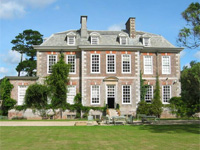
Wealth was obviously the most important consideration when deciding on the size of the house.  However, the learned sophistication of many of the lesser aristocracy meant that although their funds may not be able to provide a palace, they were well-versed in the aesthetics of good (often Classical) architecture. This meant they were able to commission or design for themselves coherent and elegant smaller houses, giving us the much-coveted Queen Anne or Georgian smaller houses we see today up and down the country, such as Puslinch House in Devon.

The considerations in the 20th-century were also financial but driven by a different set of demands.  The financial pressures of the early part of the century, particularly the agricultural slump and the Wall Street crash, naturally limited the size of the houses built (though not all e.g. Gledstone Hall by Sir Edwin Lutyens built in 1926). Yet, the changing social climate also meant that not only was it considered somewhat insensitive to build such large palaces, it was also unnecessary as the houses no longer required so many bedrooms to accommodate the now vanished armies of staff and house guests who used to turn up for the large weekend parties.

Hurtwood Edge, Surrey

Yet smaller didn’t have to mean less interesting as architects faced up to the new challenges with intelligent interpretations of Georgian, whilst others sought to experiment with different styles, such as at the now grade-II listed Hurtwood Edge in Surrey, where the builder/architect Arthur Bolton created an Italian villa in the English countryside.

In the immediate period following World War II, many larger houses, having been requisitioned and mistreated, were demolished, but the families often retained the ancestral estate but now required a new seat.  The tight restrictions on materials, particularly for ‘luxury building’ under the Socialist Attlee government, naturally limited the ambitions of the owners.  Yet the election of Conservatives in 1951 ushered in the gradual lifting of the restrictions until their abolition in 1954 which allowed a new wave of construction.  The war seemed to have had a lasting effect – or maybe fear of a future Socialist government enacting a tax based on house size – as many of the houses were significantly smaller than those in previous eras.

Eaton Hall by John Dennys for Duke of Westminster (Image: Kathryn Gammon)

An example of this is Eaton Hall, seat of the Dukes of Westminster, where, following the demolition between 1961-63 of Sir Alfred Waterhouse’s high Gothic-Revival masterpiece, it was decided that a new house should be built.  The commission went to John Dennys, who happened to be the Duke’s brother-in-law, for a starkly modern house which sat cross-wise on the main axis of the old house.  Unfortunately in this case the new house was overwhelmed by the grandeur of the setting, appearing too small against the remaining buildings and the as the focus for the grand gardens.  Worse, the house was unsuccessfully remodelled again in the late 1980s in an almost French chateau-style to create a larger house.

In recent years, planning restrictions have usually limited the size of new houses (though not always; see my recent post on large houses).  The lack of architecturally educated clients has naturally led to a growth in crass, ugly smaller country houses, but all is not lost as determined clients are still able to demand and produce good designs, such as the one proposed for Harewood Park in Herefordshire, now mooted as the potential marital home for Prince William and Kate Middleton.

Harewood Park (proposed), Herefordshire (Image: Craig Hamilton Architects)

Ever since the Harewood Park estate was bought by the Duchy of Cornwall in 2000 as part of a larger purchase of 12,000 acres, rumours had been circulating that it would be for one of the Princes.  The original house had been demolished in 1959 so the expectation was that another would have to be built if it was to have such a role.  Considering the views of the Prince of Wales on modern architecture there was little surprise when a planning application was submitted in 2006 for a strongly Classical small country house by Craig Hamilton Architects.

Craig Hamilton originally prepared three designs but the final design (shown above) complements the existing stables and is perhaps the most interesting and the one successfully submitted for approval.

The house is based around the motif of the triumphal arch but, apparently drawing on the influence of Sir John Soane, it presents a simplified version rather than the more decorated versions often seen.  Soane was schooled in the Classical style but re-invented the language to create a new direction for Neo-Classicalism; a much simpler version with an emphasis on the effective use of space and most importantly, light.  Soane spent several years in Italy and was well-versed in Roman architecture and incorporated the three-arch motif into his designs, notably the entrance front to his own house at Pitzhanger Manor, Ealing, west London, and in one of his most impressive commissions for the old Bank of England (scandalously demolished in the the 1920s) as seen in the internal Lothbury Court.

The new Harewood Park is an inventive extension of this Soanian language and it’s encouraging that the planners had the courage to approve what will surely be one of the most interesting smaller country houses built in the UK.  Sadly, I suspect that for security reasons, we won’t see the house featured in Country Life but I keep my fingers crossed.


Competition: nominate your choice for ‘England’s Favourite House’

Competition: 'England's Favourite House'

This seems a good moment to mention the competition to find the best smaller country house (i.e. with less than seven bedrooms).  Most people have a favourite and usually it’s not so much the grand palaces of Chatsworth or Blenheim but the smaller houses of our local areas which form part of our local heritage.  The competition is being run by Country Life magazine and Savills the estate agents and the house should be in private ownership and not currently for sale. The deadline is Wednesday 24 November 2010 so submit your suggestions as soon as possible.

To nominate a house simply either print this form [pdf] and send it in or email favourite_house@ipcmedia.com

More information: ‘England’s Favourite House‘ [Country Life]


An autumn flutter: country houses currently for sale

Country houses are often launched on the market to catch either bonus money early in the year or those looking to move before the summer.  However, circumstances or owner preference can lead to some interesting houses being given a promotional push in the autumn (usually through Country Life magazine) to catch those who fancy Christmas in front a different log fire.  So, here’s a quick round-up of some of the better country houses currently for sale.

Upton Pynes, Devon (Image: Upton Pynes website)

Easily one of the most impressive houses is one that has always been a sign for me that I’m nearly home when travelling back to Devon on the train.  Just outside Exeter is the beautiful grade-II* listed Upton Pynes, which, despite the very English sounding name, bears a striking resemblance to a French chateau.  Built c.1700 by Hugh Stafford with very sympathetic later additions, this large but elegant house sits in a commanding position in the Exe Valley, perfectly positioned to catch the sun throughout the day, giving the red-brick façades a warm glow.  Described by Pevsner as “…an excellent example of the stately double-pile house that became popular after the Restoration but is relatively rare in Devon.”, the interior features a particularly grand entrance hall created as part of alterations in 1852 by the architect Ambrose Poynter for Sir Stafford Henry Northcote (later the Earl of Iddesleigh).  The main interiors of the house, including an enfilade of rooms on the south front and a notable library, largely dates from 1700.  The house also has the claim that it was the one Jane Austen had in mind when describing ‘Barton House’ in ‘Sense & Sensibility’.  The house still requires some restoration but will definitely reward whoever completes this grand project.

> More information: ‘Upton Pynes, Devon‘ £3.25m, 37-acres [Savills]

Crendle Court, Dorset (Image: Savills)

Sometimes a grand house designed by an interesting architect can remarkably remain unlisted, as is the case with the Edwardian Crendle Court in Dorset which was designed by Walter H. Brierley (b.1862 – d.1926) who has been described as ‘the Yorkshire Lutyens’.  A prolific architect, he designed over 300 buildings including schools, churches and several country houses including the elegant neo-Georgian Sion Hill Hall in Yorkshire.  Brierley was a versatile architect able to work successfully in various styles though with a preference for ‘Wrenaissance’ – a modern re-working of the architectural language of Sir Christopher Wren.  Crendle Court was built in 1909 and features elaborate ornamental plasterwork in the main reception rooms by George Bankart, and sits, well, more luxuriates, in 270-acres of grounds.  Considering the architect and the quality English Heritage ought to send someone round to evaluate and spot list it before it gets ruined by someone with more money than taste.

> More information: ‘Crendle Court, Dorset‘ £6.95m, 270-acres [Savills]

Rudby Hall, Yorkshire (Image: Carter Jonas)

Other significant houses available were launched earlier but are now being promoted following price cuts.  One such house is the grade-II* listed Rudby Hall in Yorkshire, which was originally given a guide price of £3.5m but now is offered at £2.75m.  Designed by Anthony Salvin in 1838 for the 10th Viscount Falkland, who originally called it Leven Grove, but by the late 19th-century it was known as Skutterskelfe Hall before being given its present name by the company which owned it in the 1990s.  The house was restored in the 1980s and comprises the main house but with the ancillary buildings converted into let accommodation bringing in a handy £50,000 p/a – so long as you don’t mind sharing your gardens, grounds and woodlands with them.

> More information: ‘Rudby Hall, Yorkshire‘ £2.75m, 10-acres [Carter Jonas]

Blairquhan Castle, Ayrshire, Scotland (Image: Blairquhan Castle website)

For those who fancy something more baronial, then Blairquhan Castle in Ayrshire, Scotland may be perfect.  The core of the property is a tower house built in 1346 but was later given a new front by William Burn in 1820-24 to provide the imposing if slightly stern façade we see today.  The estate was noted for it beauty with Lord Cockburn writing in 1844: “I rose early…and surveyed the beauties of Blairquhan. It deserves its usual praises. A most gentleman-like place rich in all sorts of attractions – of wood, lawn, river, gardens, hill, agriculture and pasture.”.  What more could a squire desire?

> More information: ‘Blairquhan Castle, Scotland‘ £4.85m, 670-acres [Savills]

Beaurepaire House, Hampshire (Image: Knight Frank)

Most of these houses seem to be with Savills so to even things up, and to include a house I’m surprised hasn’t sold already, is Beaurepaire in Hampshire.  The house was featured on the blog in more detail (‘Phoenix for sale: Beaurepaire House, Hampshire‘) when it was first launched in June this year.  The house is what remains after a devastating fire in 1942 destroyed the main block of the house, leaving the current service wing which was extensively refurbished and remodelled after WWII to give the elegant house which is for sale today.  Approached down a long drive, what guest couldn’t fail to be impressed by the wonderful gates designed by Sir John Soane which guard the entrance over the moat?  Sitting in a 250-acre estate, the £8m price tag is probably justified for the area – and the owner is apparently in no rush to sell so don’t expect any big price cut soon.

> More information: ‘Beaurepaire, Hampshire‘ £8m, 250-acres [Knight Frank]

‘The National Trust can have it’: why the NT can’t accept all offers

Seaton Delaval Hall, Northumberland

In an ideal world no country house would ever be at risk but poor finances, often caused by pernicious death duties, and insufficient income from the estate or investments leaves families facing the reality of being unable to stay in their ancestral home.  When this situation arises the cry has often been for the National Trust to step in and ‘save’ the house.  Yet the financial complexities of taking on a house and the responsibilities of the many others they already care for mean that it’s unlikely the National Trust would be able to unless it meets their necessarily strict conditions – a marked contrast to the rather more ad hoc approach of the early years of country house acquisitions.

The National Trust owns over 330 houses though only about half would be considered true country houses.  The first, Barrington Court, Somerset was acquired in 1907, though it wasn’t until the 1940s that the National Trust began to acquire houses in any significant numbers.  Instrumental in the early acquisitions was James Lees-Milne, the Secretary of the Country Houses Committee between 1936-51 (see also this fascinating reflection on JLM and the NT).  A complex man from a well-to-do family who got progressively poorer, but with his good looks and manners, and a certain charm, he was able to lay the ground for many of the later acquisitions through his aristocratic contacts.

The National Trust was initially focussed on the countryside with any houses being taken on as rescue missions to save them from demolition.  This changed after an impassioned speech in 1934 by Philip Kerr, Lord Lothian, who argued that our country houses were a unique and valuable heritage and worthy of being saved. Following this, the Trust established the Country Houses Committee with James Lees-Milne at the important first Secretary who set the tone for years to come.  In the early years, Lees-Milne would travel the country meeting the many owners and starting a gentle conversation leading to more hard-headed negotiations – though some would approach the NT begging for them to take their houses such were their financial straits.

For many owners faced with the dramatic social changes after the wars, and their own impoverishment, the options were fairly stark; soldier on in an increasingly dilapidated house, rent or sell to a new resident owner, sell for demolition, or hand it over to the National Trust.  For many owners who were the latest in a line stretching back over hundreds of years the latter option was often the most appealing (especially as they could often continue living there), though many chose to take the other options leading to mass demolitions, particularly in the 1930s and 1950s.  Yet, as Lees-Milne acknowledged, his own enthusiasm meant, “I have to guard against a collector’s acquisitiveness.  It isn’t always to the advantage of a property to be swallowed by our capacious, if benevolent, maw.” (Diaries, 1 June 1945).  However, it was never an easy task as the rest of his entry for that day notes, “The lengths to which I have gone, the depths which I have plumbed, the concessions which I have (once most reluctantly) granted to acquire properties for the National Trust, will not all be known by that ungrateful body.  It might be shocked by the extreme zeal of its servant if it did.  Yet I like to think that the interest of the property, or building, rather than the Trust has been my objective.“. (Amusingly he finishes with “These pious reflections came to me in the bath this morning.“)

The troubled acquisition of Barrington Court had a profound impact on how the National Trust dealt with later offers.  Merlin Waterson in ‘The National Trust – The First Hundred Years‘ highlights that even thirty years later those with fears about unexpected costs for repairs and maintenance were citing Barrington Court in evidence.  Caught between the rock of their own very high standards and the hard place of not having limitless funds, the National Trust began insisting that any house they took on came with a sufficient endowment.  This was formalised in 1968 as the ‘Chorley formula’ (after Roger Chorley who created it and later served as chairman from 1991-1995) which calculates the endowment required, taking in to account expected high-level maintenance and repairs, likely revenues, workers wages and many other factors.

Initially though this meant that a strange paradox developed whereby the NT would only be able to accept houses from wealthy owners – who were unlikely to want or need to hand them over.  However, in 1937, Parliament enabled the National Trust to make money from its properties by allowing it to accept additional property, cash or securities to provide income producing endowments.  One of the first to do so was Philip Kerr himself who, in 1941, bequeathed Blicking Hall in Norfolk along with its content, more than one hundred other houses and cottages, and over 4,700-acres of woodland.  By the end of WWII, the NT owned 23 houses including West Wycombe Park and Cliveden in Buckinghamshire, and Polesden Lacey in Surrey, each of which had come with generous endowments.

Kedleston Hall, Derbyshire

However, where owners didn’t have the money other sources had to be found, as the protracted negotiations around Kedleston Hall in Derbyshire proved.  This stunning neo-classical mansion of the Curzon family was designed by Robert Adam in the 1760s and has one of the finest collections of Chippendale furniture in the world.  Faced with crippling death duties and a need to pay the grandson a ten-percent inheritance (which he demanded regardless of the threat this posed to the house and estate), the 3rd Viscount Scarsdale opened negotiations with the Trust who determined that it would need a £6m endowment plus another £2.5m for immediate repairs.  Faced with the breakup and sale of the house and its collections, English Heritage, the National Trust, American donors, and the Curzon’s themselves all contributed. This neatly demonstrated the broad spectrum of public and private sources that now had to be called upon to meet obligations such as this – and the difficulties of marshalling such a diverse range each time an opportunity presented itself.

The Trust has been consistent in this policy even when offered fine houses such Heveningham Hall, designed by Sir Robert Taylor with interiors by Wyatt, which had been accepted by the Goverment from the Vanneck family in lieu of inheritance tax in 1970.  Without endowment the Trust refused to take ownership but were happy to manage it for five years whilst the Government found a buyer.  Conversely, when the Dryden family were looking to offload the 16th-century Canons Ashby in 1981 the newly established National Heritage Memorial Fund was able to provide the endowment to fund the family’s gift.

These cases have now formed the model for subsequent campaigns such as the impressive Tyntesfield in Somerset and recently Seaton Delaval Hall in Northumberland where a combination of grants and generous local support enabled them to raise £7m to repair and endow the property.

For many within the National Trust the thinking is now that they have enough houses – for them, current campaigns are mostly around the protection of landscape.  Yet, their obvious financial and political power means that when the need arises they are able to step up to ‘save’ a house.  However, as it is usually preferable that a house remain with the family, hopefully the careful trust arrangements many now have in place mean that increasingly they are able to stay in their home.  Perhaps more houses could have been saved if the National Trust had accepted more of those offered to it, but in reality it is difficult to see how they would have been able to fund so many, especially where the existing owners had proved just how difficult it was to stay financially afloat.  Rather than just saying ‘the National Trust can have it’ we all must be aware that it is not a simple solution and that the long-term care of our country houses requires exceptional planning and commitment – and, ideally, very deep pockets.

The National Trust’s policy on acquisitions [National Trust]