Perfect for a family of five: Knole, Kent

Knole, Kent (Image: Matthew Beckett)

The Sunday Times ‘Home’ section (9 May 2010) features an article which gives some insight into the concerns that might naturally arise when you inherit a huge house in this day and age.  When the 7th Baron Sackville inherited the vast Elizabethan Knole house in Kent in 2004 he and his wife had to decide whether they even wished to move from a four-bedroom cottage on the estate into one of the treasure houses of England with its 365 rooms, 52 staircases, 12 entrances, and 7 courtyards. Luckily shared with the National Trust since 1946 it is still a huge responsibility.

Despite having to share the house with the 80,000 annual visitors, with a house this size it’s quite possible to still hide the several members of the Sackville family who have apartments in the house or estate.  The Baron occupies the south wing whilst his mother lives in the north wing within a building with a footprint of approximately 4-acres with an exotic roofline which gives the impression of a small medieval town.  Even in these restricted quarters the family enjoys nine bedrooms and multiple reception rooms including a room known as the colonnade with superb trompe l’oeil decoration and a huge library along with the more domestic kitchen and ‘flower’ room.

The Sackvilles have long  opened Knole to the public starting in the early 1800s and had it’s first guidebook in 1819.  The fortunes of the town of Sevenoaks, which sits on the edge of the park, was increasingly dependent on the tourists, much as Leamington Spa and Warwick became on the success of Warwick Castle.  However, after the last of the male line of Sackvilles died in 1843, taking the Dukedom of Dorset with it, a series of inheritances left it, after various family challenges, with Lord Buckhurst in 1870, the eldest son of one of the last Duke’s daughters.  Although the house had remained open in the 1874 season, however he decided, for reasons which are not entirely clear, to close the house in October of that year.  He then removed the various access privileges which had been afforded to the people of Sevenoaks.  This prompted first local grumblings, then letters to the paper, then letters to Lord Sackville (as he had now become), until in 1883 it spilled over into the now infamous ‘Knole Disturbances’ where the locals, roused by stirring speeches,  tore up the gates and chains which had blocked their access, before marching to the door of the house.  However, all this left the cantankerous Lord Sackville unmoved and the house and grounds remained closed until after his death in 1888.

One side effect however of this was the raising of questions nationally as to the levels and rights of access to these parks and estates which were increasingly seen as something the public could enjoy at their leisure.  These sort of questions and the resulting answers, which were clearly in favour of the preservation of these open spaces – and later the houses – eventually led to the creation of the National Trust, which is now the current owner of Knole, and very unlikely to ever close the gates again.

Full story: ‘Living it large with 365 rooms‘ [The Sunday Times]

National Trust: ‘Knole, Kent

Ferne Park, Wiltshire: the building of a modern Classical masterpiece

Ferne House, Wiltshire (Image: Q&F Terry, Architects)

The English country house is considered our greatest contribution to the field of architecture – the unified vision of house and landscape combined with fine interiors, superb furnishings and exceptional art collections.  Yet in the 20th-century, it seemed that after Lutyens we largely lost our ability to excel in their creation – the new country houses seemed shadows of our earlier confidence, lacking the grand flair, and certainly the detailing, which had so defined the Georgian Classical house.  This was partially due to financial circumstances but also due to the influence of modernism which sought to re-interpret the country house in a new language – and it often didn’t translate well.

Yet, there are signs that given the right client and the right architect, we can again create the sort of country houses which will be admired in 200 years. Country Life magazine this week (5 May 2010) features one of the best country houses to be built in the last 70 years; Ferne Park in Wiltshire, winner of the Georgian Group award for the Best Modern Classical House in 2003.

This is a house built in the finest traditions of the English country house – with its clear use of the Palladian vocabulary but skilfully reinterpreted for the location and the needs of the client, Lady Rothermere.  The architect responsible, Quinlan Terry, has been responsible for some excellent buildings but this may well be his best.  The new house, built in 2000-2, was on the site of a previous Georgian mansion called Ferne House which was demolished in 1965 having fallen into a poor condition.  By rebuilding on the same site, Terry had a setting which was simply waiting for a new house to be created.

The local authority had already set the requirement that the new house must be Classical so both client and architect drew on other houses they knew such as Came House (Dorset) and Castletown Cox (Ireland), and were able to develop a distinctive plan for the site.  The house also cleverly has contrasting fronts with the dramatic views to the north matched by the stately columns and pediment, whilst the south, with the gentler views into Dorset, using a simpler facade.

Ferne Park has revived hope that it is possible to build a successful Classical house which is recognisably a continuation of the the glorious Georgian traditions which have created so many of the houses we love today.

More pictures of the house: Ferne House, Wiltshire [Quinlan & Francis Terry, Architects]


Part II of the article will be published in the 12 May 2010 edition of Country Life.

What’s to happen to Mentmore Towers?

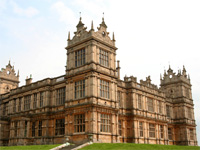
Mentmore Towers, Buckinghamshire (Image: wikipedia)

Running  a country house is always going to require a certain level of wealth with larger houses easily costing six figures a year in basic running costs and maintenance.  When funds are lacking it can be the house which shows the physical consequences as it becomes difficult to fund the ongoing care. Mentmore Towers in Buckinghamshire is one of the largest and impressive houses in the UK and the latest reports that its owner, Simon Halabi, has been declared bankrupt raise some worrying concerns about the future of this grand house.

The grade-I listed Mentmore Towers (known locally and to staff as just ‘Mentmore’) was originally built between 1852-54 by Baron Mayer de Rothschild of the famous banking family.  Designed by Joseph Paxton (of Crystal Palace fame) the neo-Renaissance style echoed houses as Wollaton Hall in Nottinghamshire and following Sir Charles Barry’s work at Highclere Castle in 1838.  The interiors are considered to be some of the finest Victorian designs and workmanship in the country.

Mr Halabi’s original plan was to convert Mentmore into a six-star country club with a London equivalent based at the ‘In and Out’ Club on Piccadilly which was also part of his property empire.  The global financial crises appeared to put these plans on hold before the collapse in property values caused a default on the bond secured on these properties which led to the bankruptcy.  Both properties are on the English Heritage ‘Buildings at Risk’ Register – indeed, Mentmore has been on for over 8 years with particular concern about the elegant stonework and the roofs with the danger of serious leaks increasing with each month goes by.  An earlier story on this blog (‘Simon Halabi and Mentmore Towers‘) produced a series of comments that indicated that a lack of maintenance was already taking it’s toll on the house.

So what’s to happen next?  Although Mr Halabi’s fortune is much reduced it is expected that the sale of various properties from his White Tower property empire will cover the £56m required to clear the debt which led to bankruptcy.  Ownership of Mentmore is also thought to be obscured through a web of companies but, if the report in The Times is correct, it is likely to be last property Mr Halabi would want to sell as his young son Samuel who tragically drowned in France is buried on the estate.  Hopefully, the bankruptcy will provide the opportunity for Mr Halabi to re-organise his empire, free up some capital and undertake not only the urgent basic repairs but also secure the long-term future of one of the most important country houses in the UK.

More details: ‘Hunt for Simon Halabi after tycoon is made bankrupt‘ [The Times]

The glory that is Chatsworth House today

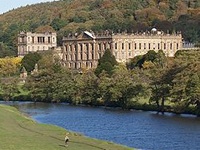
Chatsworth House, Derbyshire (Image: Wikipedia)

The modern era has, in many ways, not been kind to our country houses.  Faced with massive social changes in the early part of the 20th-century staff became harder to find leading to reduced maintainence.  Often this started a spiral of decline which led to the demolition of hundreds of our largest and finest country houses.  Even today, faced with the costs of conservation standard repairs, it can be a struggle for owners to keep their houses looking at their best.   This is why the recently completed £14m restoration of possibly England’s finest country house, Chatsworth, is such an achievement.

Chatsworth House exemplifies the best in the fine tradition of the development of our country houses.  Passed down through generations of the Dukes of Devonshire, the south and east fronts of the house we see today were built for the 1st Duke by the architect William Talman in 1696 in a grand Baroque style around the origianal Elizabethan courtyard.   The west and west fronts are thought to be the work of another great architect Thomas Archer, with further work in the 19th-century by Jeffry Wyattville to modernise the house for the 6th Duke.  Within the fine exterior the Devonshires also had acquired one of the finest art collections in the world.  Unfortunately many have been sold off in the 20-th century to meet the rapacious demands of death duties but the house still holds works by some of the finest artists of the day.

With its spectacular interiors, grand exteriors and palatial grounds, the responsibilities are immense for the 12th Duke.  Happily for this wonderful example of the glory of the English country house, the wealth of the Devonshires allows them to maintain the house in a way many other owners can only dream of, and is allied with his own determination to ensure that the house and estate is maintained in the best possible condition.  Considering the ravages that economics and circumstance have visited on so many of our houses, it’s a remarkable testament to the care of the Devonshires that this house looks as fine as it does, as the covers come off and the house opens again to the curious public this weekend for another season.

More details: ‘Chatsworth reopens to public with exhibition amid £14m restoration‘ [The Times]

Townhead House, untouched since 1939, to be restored

Townhead House, Lancashire (Image: SAVE Britain's Heritage)

Townhead House is a rare thing indeed – a house which has not been altered since before the last people to use it left in 1939 but also is not in a dire state of dereliction.  Its unoccupied status was a cause for concern and although parts of the house required attention, overall the house was in remarkable condition.

Built in 1729 for Henry Wiglesworth using parts of a 17th-century building, the architect is unknown but achieved an elegant if somewhat austere house using large blocks of coursed limestone.  Inside, the main rooms with their fine Georgian panelling and particularly the staircase indicated the architect was influenced by other such as Wren, Jones and Gibbs.  This can be seen with the use of certain architectural elements before they became widely known through pattern books such as Batty Langleys.

The grade-II listed house was used just a shooting lodge between the 1890s and 1930s.  Now finally, a local man, semi-retired businessman Robert Staples, has bought the house and has promised to sensitively restore it to use as his home:

“The works will ensure that the integrity and longevity of Townhead is not compromised and that the building has a continued and long future.”

All this bodes well for this important part of the local architectural heritage. Also encouraging is Mr Staples’ professed desire to return the house to being the centre of a ‘gentleman’s estate’ – a welcome reversal of the pattern of the last 50 years when small estates were increasingly broken up and lost.

Full story: ‘Historic Slaidburn house set to become a home again after 100 years‘ [Lancashire Telegraph]