How to lose money on a country house: Compton Bassett, Wiltshire

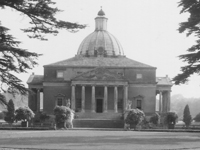
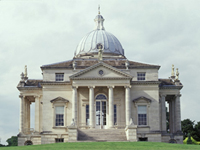
Compton Bassett House, Wiltshire (demolished 1929)

[This article was originally published in 2010]

The news that Robbie Williams is to sell his country house, Compton Bassett in Wiltshire, for a potential £1m loss shows that with the wrong property it is still possible to buck the generally rising trend in prices by overpaying in the first place.

The Basset family (after whom the village was named) had first built a timber-framed house in the 13th-century. By 1553, the new owner of the manor, Sir John Mervyn (d. 1566) rebuilt the house using a reported 260 oaks, which gives some indication of the size of the house. It was still standing in 1659 and was recorded as being on a U-shaped plan, open to the south east. In 1663, the house and estate were sold to Sir John Weld, of the ancient Dorset family. He made significant changes, spending the colossal sum of £10,000 between 1663-1672 to build the sides up to 130ft and 110ft to create a large rectangle and to then cover over the courtyard. Originally, the house was in a soft, white stone but this renewed in brick in 1814, with the rest of the house following in the late 19th-century, during which it also gained the battlements. 

Sir John also added the distinctive corner turrets; a stylistic device which echoed the form of a castle which bears some similarity to the Weld family’s main country seat, Lulworth Castle in Dorset,. This was built as a hunting lodge in 1610 by Thomas Howard, 3rd Lord Bindon, and bought by Humphrey Weld (John’s elder brother) in 1641, but sadly gutted in a devastating fire in 1929. As Humphrey Weld died (in 1684) without a male heir, Lulworth Castle passed to John’s son William who seems to have chosen it as his family seat and sold Compton Bassett in 1700.  

The house passed through various owners until it was inherited by George Walker Heneage (d. 1875) who, by 1828 had established an estate covering 1,813 acres in the area. It was Walker Heneage’s grandson, Godfrey, who eventually inherited the estate in 1901 but then sold it in 1918 to the Co-Operative Wholesale Society who sold it again in 1929.  It was bought by one E.G. Harding who then parcelled up the estate and sold it off piecemeal. 

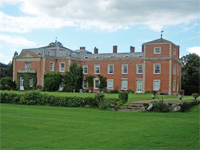
That period was a dark time for the country house in the UK with many being demolished. The house was bought by Captain Sir Guy Benson who sadly decided that he would rather live in the stables and so this wonderful house was levelled in the early 1930s and the stables converted in 1935 into the new Compton Bassett House.  Unlike other successful conversions of stables, this one was obviously designed as a functional building and lacked the grace of so many of the stable buildings we can still see today and so did not lend itself to being the main house.   Not that it has stopped various owners over the years trying.

Compton Bassett, Wiltshire (former stables) (Image: Panoramio)

The latest project was started in 1998 by the then owner Paul Cripps and was to take six months and cost £500,000 but ended up taking three years and costing £3m.  The house was then launched on the property market in 2007 at an eye-watering £8.5m (no doubt to try and recover some of the lavish overspending on the interior) for the house plus 71-acres.  After languishing for many months Robbie finally bought it for £8.1m but never really settled here, preferring his life in the US.  So now it is back on the market with Savills (but not listed on their website) for a reported asking price of £7.5m – but once you factor in all the costs involved from buying and selling, Robbie should be about a million down from when he bought it.  This also assumes he’d get that price – losses could rise if, remarkably, there was someone else out there who liked the look of the house but decided that it was still too expensive and drove the price down further.  To be honest, when compared with some of the other properties Savills have available in Wiltshire for around £6m (e.g. Langley House or Midway Manor) why anyone would chose this one is beyond me.

n.b. the interior and floor plans can be seen in this article in Variety magazine in 2013 when it was again on the market for £5.5m: In Case You Missed It: Robbie Williams

*Update* 2010

Savills have added Compton Bassett to their website so if you have £7.5m and really feel that this house is the best way to spend it, then have a look at the details: Savills: Compton Bassett

*Update* February 2021

So, it turns out that Mr Williams was not able to sell the house in 2010 or 2013 or 2016 when it was variously reporting as being relisted. Again, in 2021, there is renewed interest as he plans to move with his family to a new house in Switzerland and has no plans to stay in a house he (and his daughter) now feel is ‘creepy’.

Robbie Williams selling £9 million ‘haunted’ Wiltshire mansion in Switzerland move (Evening Standard)


25/02/2021: article updated with further details on the history of the house and the current situation regarding Mr Williams.

A suburban survival at risk: Braunstone Hall, Leicestershire

Braunstone Hall, Leicestershire (Image: East Midlands Oral History Archive))
Braunstone Hall, Leicestershire (Image: East Midlands Oral History Archive)

Two of the most important aspects of campaigning to save country houses are vigilance and visibility – and yet sometimes even this doesn’t always seem to bring about restoration any quicker when faced with a slow-moving owner. Braunstone Hall, a Georgian gem still with significant grounds but now swallowed up in the sprawl of Leicester, has been empty for over ten years but despite a vigorous campaign both in the media and online it still remains very much at risk.

Braunstone Hall, now grade-II listed, was built in 1776 (date on rainwater head) for the Winstanley family by the architect William Oldham (b. 1737 – d. 1814) who also designed an early Leicester racecourse grandstand (1770), Master’s House at Alderman Newton’s School (1789) and the New House of Correction (1803) – all though now demolished.  The red-brick house is two and a half storeys tall by five bays wide with a cornice and hipped roof.  The relatively simple front is enlivened with stone bands marking the ground and first floors with an impressive tripartite doorway with fluted columns, a small pediment and an elegant fanlight with arched glazing bars.  One further very distinctive feature is the giant blind recessed arch in the central bay – an architectural device which seems quite popular in Leicestershire with examples in Burbage, Belgrave House (also 1776), and the beautiful rectory at Church Langton (by William Henderson – 1760).  The interior is largely complete with some impressive detailing.

The Winstanley family bought the estate from the Hastings family in 1650 and remained there until forced out in the 1920’s by the pressure to build houses following the First World War.  Estates on the edge of existing towns and cities were eagerly eyed-up by local councils.  For some families, already facing financial hardships following the war this was a perfect opportunity to sell the family seat and relocate.  Others, including the Winstanleys in the shape of Major Richard Norman Winstanley, fought the prospect of compulsory purchase arguing that this was still a family home and the building work would undermine the value of his recently modernised house.  However, he was unsuccessful and so the house, gardens, parkland and further 949-acres were compulsorily purchased in 1925 for £116,500 (equivalent to £5.2m – 2008).  Most of the land was built over except for the house and 168-acres surrounding it which became a public park.  The house remained in council ownership and was first a secondary school, opening in 1932, before becoming a primary school a year later until it closed in 1996.

Since then the Leicester City Council has failed to either find a viable long-term use or adequately protect Braunstone Hall with the house falling victim to repeated acts of vandalism and arson.  The latter is the most worrying as the incidents have not only included fires outside the building but also now inside.  Over the last few years the Council have been making very slow progress towards finding a solution but, as always, they are claiming poverty when it comes to heritage projects.  A very active campaigning group has been set up on Facebook with the members regularly corresponding with councillors and reporting any damage or deterioration at the hall – effectively a dedicated ‘Neighbourhood Watch’ for the house.

The Council put the house up for sale on a 125-year lease in 2007 and had recently been negotiating to sell the house to a local businessman for conversion to a hotel, conference centre and wedding venue. However this has been delayed by changes to what’s being offered in relation to the land for enabling development.  Each delay increases the risk that the local yobs will finally succeed in their mindless vandalism and burn down this elegant and important part of Leicester’s heritage.  If this happens the blame can be laid firmly at the feet of Leicester City Council and their apathy and indecisiveness over the last 14 years.

Join the Facebook campaign group: ‘Restore Braunstone Hall

Detailed history of the house: ‘Braunstone Hall‘ [Leicester City Council]

Detailed description of the house: ‘Braunstone Hall‘ [English Heritage]

The modern smaller country house: Home Farm, Yorkshire

Home Farm, Yorkshire (Image: Francis Johnson & Partners)

Despite the rather understated name, Home Farm in Hartforth, Yorkshire is a classic example of the long tradition of grand downsizing which has been a hallmark of UK country house owners, particularly since 1900.  The pressures on the large country house in the 1930s and then again from the late 1940s until 1960s sparked a surge in the construction of new, smaller country houses which reflected the financial reality of the times.  Yet today smaller country homes are a deliberate choice for the discerning owner reflecting their own wishes and desires which has led to some very successful designs.

In previous eras (and particularly before the restrictions of the 1970s heritage legislation), a country house owner faced with a house which was too big could simply remove wings (as the 12th Duke of Bedford did at Woburn Abbey in the late 1940s) or floors of the house to make them more manageable (as happened at Hodnet Hall in Shropshire). Unfortunately for many owners it was simply easier to demolish the house entirely giving them the option to convert the stables into a home (the choice of the Earls of Lansdowne at Bowood in 1955) or rebuild either on the site of the old house or in a new location on the estate.  It was this latter course of action which offered the best opportunities for an owner to preserve their estate but dramatically reduce their expenses by building a new house.  John Martin Robinson in his 1983 book ‘The Latest Country Houses’ estimated that over 200 new country houses were built between 1950s-1980s.

The new country houses today are largely either grand statements but there are also examples of smaller houses which quietly succeed in delivering an important contribution to the traditions of the UK country house.  Winner of the 2009 award for ‘New building in a Georgian context‘, Home Farm was a carefully considered response to a particular location and circumstances.

The client behind the commission was Sir Josslyn Gore-Booth Bt. who had inherited the Hartforth estate but unfortunately not the main house, the early Georgian classical Hartforth Hall, which had been divorced from the estate and become a hotel.   The Gore-Booth’s family seat had traditionally been Lissadell in County Sligo, Ireland, built for the 4th Baronet in the 1830s.  In 2003, Sir Josslyn put the house on the market for €3m and was determined that the new house would be very different from the sombre and severe Neo-Classical house he had just left.

Home Farm, Yorkshire (Image: Francis Johnson & Partners)

Home Farm is a clever response to a number of challenges.  Firstly, both the new house and Hartforth Hall would be visible simultaneously due to their proximity and so had to make their own architectural statements without competing, ruling out a classical design.  Secondly, the new house was to replace an old estate farmhouse and would join the group of existing Georgian farm buildings.  The architect, Digby Harris, came up with a novel solution – a two-faced house which projected an elegant classical facade to complement the farm buildings but a Gothick facade contrasting to the classical Hartforth Hall.  Usually a client seeks a unified design so these type of buildings are rare in the UK and feel somewhat disconcerting; two examples are Castle Ward in Northern Ireland (Classical front / Gothick front) and Castle Goring in Sussex (Classical front / Gothick front).

The ‘classical’ front draws on a draft design by the late Francis Johnson but also historically the compact Georgian villas of Sir Robert Taylor (1714–1788), James Paine (1717-1789) and John Carr (1723-1807).   The Gothick facade mirrors the style applied to some estate buildings in the 19th-century and features an elegant ogee window on one side looking out on a small canal-type pond with the main front boasting a full height bow bringing to mind other older houses such as Corngreaves Hall with other elements taken from Batty Langley (1696-1751), specifically his ‘Gothic Architecture, improved by Rules and Proportions‘ (pub. 1747)

Home Farm proves that a modern classical country house can be both practical and architecturally interesting without needing to be physically large.  The long tradition of country house building in the UK seems to be alive and pushing forward the architectural boundaries which should prove inspiring to anyone contemplating the building of a new home of any size as the centrepiece of an estate.

More details and photos: ‘Home Farm, Yorkshire‘ [Francis Johnson & Partners]

Credits: thanks to Austen Redman of Francis Johnson & Partners for the photo and information on the house.

The start of the rush? Country houses for sale in the Sunday Times Home section

Sandley, Dorset (Image: Knight Frank)

The usual spring rush of country houses coming to market has been later this year – a combination of the hangover from the uncertainty in the market of the last couple of years along with that of the General Election.  That traditional shop-window of the country house – the Home section of the Sunday Times – has this week (16 May 2010) heralded what it sees at the start of the rush by including three pages of those for sale.

For those who like their country houses to look traditional from the outside but prefer a more modern interior then the Grade-II listed, six-bedroom Sandley in Dorset, set in 178-acres, might be perfect – if you have the necessary £9m.  The owners decided that the rather ‘quaint’ style of the house was not for them and so they spent ‘a couple of million pounds’ and over two years to strip it back and then make it look very ‘London’.  Personal taste is the final arbiter for whether you think this is a good thing – but not all tastes are the same and it can mean that the appeal of the country house is taken to new markets.

Ebberly House, Devon (Image: Savills)

However, if your tastes are more usual and traditional then there are other options. Holt Manor in Wiltshire, set in 94-acres, mixes both old and new with a more traditional interior cleverly concealing the latest in sound, television and security systems.  With parts dating back to the 12-th century, the Grade-II listed house has been thoroughly modernised whilst still being a recognisably English country house. £5.95m [Holt Manor: Knight Frank]

If, however, you are looking for a more architecturally impressive house, the Ebberly House, near Winkleigh in Devon, could well be the house for you.   Designed by Thomas Lee, a student of Sir John Soane, Ebberly was described by Pevsner as an ‘unusual and attractive house’ and was the first to sell in Devon for over £1m when it sold in 1997.  The Grade-II* listed house possibly benefited from Soane’s personal influence as he was working nearby at Castle Hill which may explain the elegant, and very Soanian, top-lit oval stair hall with its fine cantilevered wooden staircase and curved doors, or the drawing room divided using three shallow arches. Set in  250-acres it has a wonderful estate featuring 20-acres of woodland, estate cottages generating £20,000 p/a in rental income, and spectacular views across to Dartmoor. It was also given an excellent and detailed write-up in Country Life – always a good seal of approval.  [Ebberly House: Savills]

Chapel Cleeve Manor, Somerset (Image: Webbers)

Perhaps one of the most interesting of the houses featured is unfortunately only given a photo and no details is Chapel Cleeve Manor in Minehead, Somerset. Perhaps now not strictly a country house as it only has 7-acres, at £1.695m for 17+ bedrooms, it may seem a bargain for someone who wants to live in a country house but doesn’t want the responsibility of an estate. Although such a situation a hundred years ago could have led to the demolition of the house as happened to so many others. Yet, with so much wealth now generated without the need for a large estate to support the house, it’s now entirely reasonable for someone to take on and enjoy such a pleasing Gothic-Revival house. The house has been used as a conference venue for a number of years but with careful restoration this could be rescued from commercial use and be a spectacular home for someone who requires a lot of space. [Chapel Cleeve Manor: Webbers]

So has the rush started?  Nobody really knows and asking estate agents is never an exact science.  Several house which have been launched recently are still waiting to find new owners but the right house launched at the right time for the right price usually does find the right buyer.

Full story: ‘The landscape has changed‘ [The Sunday Times: Home section]

Lodges to lost houses: Thorington Hall Gate Lodge, Suffolk

Thorington Hall Lodge, Suffolk (Image: buildings_fan on Flickr)

Often the only visible sign of  a grand estate is the lodge house seen as we drive past; their varied size and designs indicating the wealth and aspirations of the owners.  Although still a integral part of the functioning of some estates, providing security and accommodation, sometimes these beautiful buildings lie abandoned, intriguing those who go past them everyday.  ‘The Restoration Man’ series on Channel 4 has been showing people who have been willing to take on abandoned listed buildings and bringing them back to life. The episode to be shown on Sunday 25 April features Thorington Hall Gate Lodge, a forlorn reminder of Thorington Hall, one of the many elegant demolished Suffolk country houses.

Although their main function was to provide shelter for the estate worker who opened the gates, lodges were often designed by the same pre-eminent architects who were working on the main house.  Far from being an afterthought, these houses were often strongly imbued with the overall architectural style of the estate and were seen as an important way of announcing the status of the estate and owner.  Alternatively they gave scope for the owner to indulge in some architectural experimentation.  The styles of the lodges are as varied as the many houses they protected, from Victorian Gothic follies to small thatched cottage orne to minature Greek temples, such as at Thorington Hall.  The publication of ‘pattern books’ such as Joseph Gandy’s ‘Designs for Cottages, Cottage Farms and other Rural Buildings, Including Entrance Gates and Lodges‘ (1805) also enabled the discerning owner to select particular buildings from an established design without the need for an architect.

Many of these lodge cottages are now no longer part of the estate and have been turned into interesting family homes.  Their smaller, more domestic, scale also ensured that they often survived the demolition of the main house.  One example is Clumber Park in Nottinghamshire where all nine lodges at each of the estate entrances survive despite the palatial mansion being demolished in 1938.  Increasingly, the modern estate owner is buying back these buildings to reintegrate them with the overall estate.  However, some still survive as neglected shells and these can prove to be an exciting opportunity to create a home.  One important factor bear in mind is that these houses are often very small (sometimes only two rooms) and their listed status means it’s not always possible to add significant new extensions.  One of the joys of these houses is their diminutive size and that should be respected when considering restoration, but completed sensitively, these houses can be an interesting feature of your local heritage.

To find lodge houses which may be available for sale, join SAVE Britain’s Heritage and access their ‘Buildings at Risk Register’ where you can search for these properties plus many others.  Their latest ‘Buildings at Risk’ report – ‘Live or Let Die’ – will be published on 1 June 2010 and can be pre-ordered now.

To find out more about the many country houses which have been demolished in Suffolk there is a superb book which has been recently published called ‘The Lost Country Houses of Suffolk’ by W.M. Roberts [amazon.co.uk].

Programme details: ‘The Restoration Man‘ [Channel 4]

A labour of love: the restoration of Hammerwood Park

Hammerwood Park, Sussex (Image: South Downs Living)

Once a house has sunk to such a level of dereliction that even the developers won’t take it on, this can easily lead to an application for demolition and the loss of another piece of our architectural heritage.  Yet, as we see in the media, there are often people willing to commit themselves and their money towards saving these beautiful homes – Hammerwood Park is one which certainly falls into this category.

The house was built in 1792 for Benjamin Sperling and is particularly important as the design of the house was the first commission of Benjamin Latrobe (b.1764 – d.1820) who was later to be hugely influential in the direction of American architecture.   Latrobe had studied architecture privately and served for a year from 1789 as an architectural draughtsman in the office of neo-Classical architect S.P. Cockerell. Howard Colvin suggests that Latrobe was also strongly influenced by the work of French architects such as Étienne-Louis Boullée whose own strictly neo-Classical style emphasised the paring back of unnecessary ornamentation and the use of grand scale with repetitive elements.  Through Hammerwood Park it’s possible to see this philosophy in practice with the giant pilasters on the garden front and the miniature temples on the flanking wings.

The early death of Latrobe’s wife in 1793 caused him to abandon Britain and head to America where he made friend’s with President George Washington’s nephew.  It was these contacts which enabled him to obtain further commissions including the Bank of Pennsylvania in Philadelphia which has been described as the ‘first monument of the Greek Revival in America’ (dem. 1867).  It was this and his later work designing the first Capitol building in Washington which so greatly influenced the future of American architecture towards the ne0-Classical which is so evident even today.

That a building as interesting as Hammerwood Park was ever allowed to deteriorate to that extent was unfortunately all too common in the post-WWII era. It is only the dedication of it’s current owner, David Pinnegar, that has probably saved the house from conversion or even demolition.  After various owners it was requisitioned during WWII for use by the Army who left it in their usual poor condition.  Post-war, the Chattell family, who then owned the house, sub-divided the house into flats but as dry rot took hold, the residents moved out and the house was sold in 1973 to the rock group Led Zeppelin for use as a country retreat to work on their music. However, touring commitments meant they never moved in (and rumour has it they even forgot they owned it) and whilst empty, thieves took the roof lead leading to massive wet rot outbreaks.  The house was boarded up in 1976 before finally being offered for sale in 1982 in Country Life magazine with the marvellous understatement that it was ‘in need of modernisation’.

David Pinnegar, then only 21, bought the now grade-I listed house and has since dedicated his life to its restoration.  The vast house has revealed many interesting architectural nuances as he and many volunteers have worked through the vast catalogue of repairs. Although he has secured some grants from English Heritage, the vast majority of the work has been financed through day visitors, B&B guests, and its use as location for a wide variety of films and music video shoots.  In many ways, David’s dedication is proof that all houses, no matter how poor their condition, can find a saviour.

Full story: ‘Hammerwood Park, East Grinstead: Whole Lotta Love‘ [South Downs Living]

House website: ‘Hammerwood Park

Empty walls? The sale of contents to fund the house – Althorp House

Althorp House, Northamptonshire (Image: Andrew Walker @ wikipedia)

For hundreds of years the political power of a country house was in the ownership of the house, and most importantly the estate – acreage equated with power even if the land was mortgaged to the hilt.  The paintings or furniture which furnish these houses were not only decorative but assets which were easy to sell off when financial circumstances demanded that money be raised.  An upcoming sale at Christies highlights how this is still the case today – even if the strength of the art market means that fewer works now need to be sold to raise the totals required.

Althorp House in Northamptonshire has famously been the home of the Spencer family since the 16th-century and sits in a 14,000-acre estate.  The family fortune was founded in livestock and commodities which enabled John Spencer to purchase the red-brick Tudor house at Althorp in 1522.  It was this house which the 2nd Earl Spencer commissioned the architect Henry Holland to modernise in 1787-89, encasing it in white brick and tiles and remodelling the interior to create the grade-I listed house we see today.  The Spencer family then built up their connections becoming politically influential but also extensive art collectors.

Today, Althorp is in the middle of a £10m project to put the house on a sound structural footing.  One major task, along with repairing the ornate stonework and the external tiles, is to fix the roof – an undertaking which is taking nine months and requires over 50-tonnes of lead.  Globalisation means that commodity prices have been rising strongly on the back of growing demand from countries such as China meaning the cost of the project has proved too great to be borne through income.  So the 9th Earl Spencer has been forced to put a selection of art, considered ‘non-core’ to the collection by the trustees, up for auction.  However, the flip side to globalisation is the massive wealth creation and more well-funded collectors chasing the best works.  In this case, the quality of the paintings and the robust prices being achieved at recent auctions, it is possible to raise enough money with just a few works.

The highlight is ‘A Commander Being Armed for Battle‘ by Sir Peter Paul Rubens which is expected to fetch between £8-12m which should cover the restoration bill for the house with the other works, including ‘King David‘ by the Italian Giovanni Francesco Barbieri, known as Il Guercino, providing some financial breathing space.  Ironically, the current Earl publicly criticised his stepmother for selling off four van Dycks and a Stubbs in the 1970s and 80s but this time the difference is that the proceeds will be re-invested in the house and estate rather than just simply for running costs.  It’s a fact of life that ownership of a country house is a constant battle against physical deterioration and with grant aid from the public bodies in such short supply it is unfortunately the artistic heritage which is once again being sacrificed to ensure that the family seat remains intact.

Full story: ‘On their uppers: The great aristocratic art sell-off‘ [The Independent]

Auctioneers: Christies – The Spencer House sale will be on 8 July 2010.

A glimmer of hope: ‘Country House Rescue’ visits Kelly House

Kelly House, Devon (Image: English Heritage)

Kelly House has a series of long associations; there has been a house there for over 900 years, it has been the seat of the Kelly family for that entire time, and, sadly, has been on the English Heritage Buildings at Risk Register for over five years.  Now the latest twist in the tale is that the house will feature in Channel 4’s ‘Country House Rescue’ on Thursday 1 April when expert Ruth Watson offer possible solutions which will help the Kelly family remain in their ancestral home.

The Kelly’s are one of the very rare families able to trace their lineage back to pre-Conquest times.  Warin Kelly is the 31st squire of the family to live in a house which has been passed down since 1100 through fathers, grandfathers, and brothers.  Described as being ‘in a class of its own’ by Marcus Binney*, the elegant Palladian house was built in 1743 -45 for Arthur Kelly by Abraham Rundle (d.1750), a joiner and provincial but obviously skilled architect who lived in Tavistock.  The house is grade-I listed and features a Portland stone doorcase, sash windows glazed with Crown glass and made in London, with local slat stone walls with moorstone quoins. Inside, the extensive high quality woodwork  features superb carving including panelling, chair rails, and a particularly good staircase with chunky corkscrew balusters.

However, the fine panelling hides serious issues such as the periodic bouts of dry rot which break out. Mr Kelly, as a conservation architect advocating minimal intervention, admirably refuses to treat it with chemicals or by stripping out the panelling.  This ongoing damage is largely the fault of death duties, with two demands being levied in swift succession which have severely limited the family’s ability to maintain the house.  Kelly House is exactly the sort of house which the Historic Buildings Councils would have provided grants for when they were set up in the 1950s.  Today, with English Heritage’s budgets under severe pressure, Mr Kelly was told in 2005 that they were unable to provide funds as the increase in the value of the restored house would be greater than the grant – meaning that they force owners towards the sale of their ancestral homes.

Much as it would appear difficult to argue for the provision of public money to preserve private residences, there has to be a better solution than just letting them slowly grow more derelict despite the often heroic efforts of the family involved.  The current generation doesn’t want to be the one which is remembered for having to sell the family seat, leading to a battle against the elements of decay which saps finances and families and often doesn’t provide a long-term solution.  Outside expertise is to be welcomed as it may show the way to a sustainable future for these beautiful homes. Hopefully Ruth’s suggestions can be taken on by the Kellys and other families to ensure their homes are self-financing and not a burden to either the state or the owners who are then able to look forward to the prospect of handing a home and not a liability to their descendants.

Programme details: ‘Country House Rescue‘ (Channel 4)

More information: ‘TV show could help manor restoration‘ [Western Morning News]

Official Kelly House website: ‘Kelly House

* – ‘Houses to Save’ – article by Marcus Binney in Country Life magazine (8 September 2005)

If I won the lottery…Fillongley Hall

Fillongley Hall, Warwickshire (Image: Weddington Castle website)

Considering the difficulties faced by country house owners with death duties and a changed society, it’s always remarkable when a house is passed down through the generations; particularly so when it’s the same family for nearly 200 years.  Fillongley Hall designed by George Woolcott and was built in 1824-25 for the uncle of the 1st Lord Norton, extended in 1840-1, and now for sale again by the 8th Lord Norton after an unsuccessful attempt to sell in 2005.

The grade-II listed house is considered to be one of the best examples of smaller scale Greek Revival architecture which demonstrated the good taste of the Grand tourist with it’s fine interiors and classical exterior with recessed Corinthian columns on the main entrance front.    Bearing some resemblance to the now-demolished Thirkleby Park in Yorkshire, the house is a compact essay in elegant classicism with a restraint all too often lacking in modern country house architecture.  The house was inherited by Lord Norton in 1993 since when he and his wife have lovingly maintained and updated the house.  More images of the interior and exterior can be seen either on this fascinating local history website or on the Savills website.

When Fillongley Hall was put up for sale in 2005 the guide price was £5m but this included 400-acres as opposed to the 114 plus the house which are available now for £4.5m.  [The house subsequently sold in 2006]

This is a beautiful house and deserves and owner who understands the house and is sympathetic to its status as one of the best houses of its type in the region.

Property details: ‘Fillongley Hall‘ [Savills]

The glory that is Chatsworth House today

Chatsworth House, Derbyshire (Image: Wikipedia)

The modern era has, in many ways, not been kind to our country houses.  Faced with massive social changes in the early part of the 20th-century staff became harder to find leading to reduced maintainence.  Often this started a spiral of decline which led to the demolition of hundreds of our largest and finest country houses.  Even today, faced with the costs of conservation standard repairs, it can be a struggle for owners to keep their houses looking at their best.   This is why the recently completed £14m restoration of possibly England’s finest country house, Chatsworth, is such an achievement.

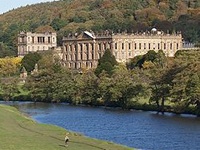
Chatsworth House exemplifies the best in the fine tradition of the development of our country houses.  Passed down through generations of the Dukes of Devonshire, the south and east fronts of the house we see today were built for the 1st Duke by the architect William Talman in 1696 in a grand Baroque style around the origianal Elizabethan courtyard.   The west and west fronts are thought to be the work of another great architect Thomas Archer, with further work in the 19th-century by Jeffry Wyattville to modernise the house for the 6th Duke.  Within the fine exterior the Devonshires also had acquired one of the finest art collections in the world.  Unfortunately many have been sold off in the 20-th century to meet the rapacious demands of death duties but the house still holds works by some of the finest artists of the day.

With its spectacular interiors, grand exteriors and palatial grounds, the responsibilities are immense for the 12th Duke.  Happily for this wonderful example of the glory of the English country house, the wealth of the Devonshires allows them to maintain the house in a way many other owners can only dream of, and is allied with his own determination to ensure that the house and estate is maintained in the best possible condition.  Considering the ravages that economics and circumstance have visited on so many of our houses, it’s a remarkable testament to the care of the Devonshires that this house looks as fine as it does, as the covers come off and the house opens again to the curious public this weekend for another season.

More details: ‘Chatsworth reopens to public with exhibition amid £14m restoration‘ [The Times]