A religious conversion: Rempstone Hall

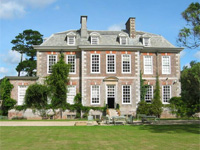
Rempstone Hall, Leicestershire (Image: Country Life)

In the early part of the 20th-century one option for a country house to avoid demolition was to be converted to institutional use.  In this way, many houses became schools, hospitals or offices, but also some became religious institutions – for example, in the 1940s and 50s, Gloucestershire lost seven houses but twenty-two were converted to institutional use.  Now with property prices rising but membership of convents falling, houses used for holy purposes are now being sold – and could once again be homes.  Rempstone Hall in Leicestershire, currently the Holy Cross Convent, is on the market for £2.5m, as the nuns move to a purpose-built home nearby.

Rempstone Hall is a classically beautiful Georgian red-brick house, originally built in 1792 for William Gregory Williams, a major local landowner.   Various families passed though the house usually keeping it as a secondary house to much grander seats elsewhere.  By the beginning of the 20th-century it was unoccupied as probably, as with many other houses, at risk of demolition as the houses became surplus to requirements and a drain on finances already under pressure.  Rempstone Hall was saved in 1909 when P.W. Carr moved in and made significant additions including a new north wing and a fine stable block before selling it in 1920 to the Derbyshire family from whom the Convent bought it in 1979 for just £110,000.

During their time at Rempstone, the nuns have removed the exterior stucco to expose the warm red-bricks giving the house a bold appearance, the two red blocks framing an elegant loggia which faces the gently sloping lawn.  At 21,000sqft this is undeniably a large house with 20 bedrooms, a large entrance hall with possibly Jacobean staircase, a sizable chapel and many other rooms.  One downside of institutional use is the rather functional decor and Rempstone is no exception, with lino, acres of red carpet and various partitions which the new owner would need to remove; total renovation costs are estimated to be in the region of £500,000.

This fine and beautiful house, well-located in the Midlands, with 60-acres and several estate buildings, cries out for someone with taste to restore this house back to being a family home – which is helpfully the outcome favoured by the local planners.

More details: ‘Your prayers have been answered‘ [Sunday Times: Home]

Lytham Hall restoration to secure future

Lytham Hall, Lancashire (Image: Lytham Hall blog)

To secure the future of what is considered to be one of the finest Georgian houses in Lancashire, the owners of  Lytham Hall have unveiled an ambitious £5m restoration plan.

The house was built for Thomas Clifton by the famous architect John Carr of York between 1752-64 and incorporated elements of the existing Jacobean house.  It remained the Clifton family home until the 1960s when it was finally sold to Guardian Royal Exchange Insurance who owned it until 1997, and is now run by Heritage Trust for the North West on a 99-year lease on behealf of the owners, Lytham Town Trust.

The £5m plans are the first part of an eventual £10m plan to upgrade every aspect of the house and estate to provide holiday accomodation, a tea room and conference facilities.  Although a shame that the house is no longer a home, it’s encouraging to find plans which respect the history and architectural importance of the house as they seek ways to ensure a secure future.

Full story: ‘New lease of life for historic hall‘ [Lytham St Anne’s Express]

The greatest country house you’ve never heard of: Wentworth Woodhouse

Wentworth Woodhouse, Yorkshire (Image: geograph.co.uk)

Although Britain is a relatively small island it still has the capacity to hide some spectacular buildings which, unless opened to the public, can remain a secret.  One such house, featured this week in Country Life magazine (February 17) is Wentworth Woodhouse in Yorkshire, thought to be the largest private residence in Europe and for Marcus Binney “unquestionably the finest Georgian house in England”.

Built over a 25 year period from 1724 for Thomas Watson-Wentworth, Marquess of Rockingham, it is twice as wide as Buckingham Palace and boasts over a 1,000 windows, 365 rooms and five miles of underground passageways.  The stable block appears to be a large country house but is merely the lodging for up to 100 horses. Inside the main house, the Earls FitzWilliam enjoyed a priceless art collection which included works by Titian, Van Dyck, Guido, and Raphael.

Yet this was a house to be blighted by the bitter class-war hatred of the post-war Labour government and questions of inheritance. In April 1946, heavy machinery moved into Wentworth Park to pointlessly mine low-grade coal right up to the back door of the house on the express instruction of Manny Shinwell, the minister of fuel and power.  A old-school left-winger, Shinwell was given options to save the parkland and gardens but was determined to press on despite representations from the local miners who had been very well treated by successive generations of FitzWilliams.

Once mining finished the FitzWilliams leased the house as a training college and retreated to 40-rooms but even then lived mostly elsewhere. Questions about the legitimacy of the inheritance led the last Earl to order a vast bonfire in 1972 of 16 tons of family papers, some dating back to medieval times, which burnt for three weeks.

Yet, despite its size the house escaped the fate of so many large houses in England and merely languished in obscurity.  Sold with just 30-acres in 1988 by the daughter of the last Earl it was bought by Wensley Haydon-Baillie who promised investment but in 1998 it was repossessed. It was then sold for the unbelievably low price of £1.5m (equivalent to just £7 per sq ft) to the architect Clifford Newbold whose careful restoration work has been praised and beautifully photographed in this weeks Country Life.

—————————————————————————–

*Update* May 2011 – I have written a more extensive write-up on the architectural history of the house in response to the episode of ‘The Country House Revealed

—————————————————————————–

More information: ‘Wentworth Woodhouse’ (Wikipedia)

Restoration of Poltimore House receives boost

Poltimore House, Devon

The project to restore an important Devon country house, which is finally being rescued after being neglected since the 1970s, has received a significant boost.  English Heritage has awarded a £500,000 grant which will allow major work to continue on making Poltimore House watertight and safe for the ongoing  restoration work.

The grade-II*-listed house has been a familiar sight to anyone who has driven on the M5 near Exeter who would have seen it slowly deteriorating since it ceased being a hospital in 1975.  Originally the Bampfylde family seat, Poltimore was originally built in the 1550s with this part now forming a still visible core section of the house.  It was greatly extended in 18th-century with the work including a Rococo-style saloon and then again in the 19th-century with the addition of a grand imperial staircase.

The decline started when the Bampfyldes finally left the house in 1921 after the death of the third Baron Poltimore, and put it up for sale.  For many houses this was a prelude to demolition but Poltimore escaped by becoming a boarding school for until 1939 when it then became temporary home for Dover College during WWII.  After the war the house became a nursing home and remained in use as a hospital until 1975.  Once empty, the decline accelerated rapidly with thefts of lead, fireplaces and other fittings including the entire balustrade from the staircase. The damage was compounded by serious arson attack which destroyed the roof.

The journey back from total dereliction started in 1997 when the house was acquired by the Buildings at Risk Trust before being taken over by the Poltimore House Trust in 1999.  Their intention is fully restore the house for mixed use with commercial aspects combined with community and arts use.  A large and active group of Friends of the house have tirelessly campaigned to save this important piece of Devon’s heritage and English Heritage are to be congratulated for such a large contribution towards the estimated £5.5m restoration bill.

More information including details of the planned restoration: ‘Poltimore House

An architectural gem – but still slow to sell: Iver Grove

Iver Grove, Buckinghamshire (Image: The Listed Property Owners Club)

When it was completed in 1724, Iver Grove was one of the first houses in Britain built using the then radical Palladian styling; pre-dating even Lord Burlington’s famous Chiswick House.  Iver Grove is a beautiful and compact red brick essay in the use of the Classical elements with a Doric portico and topped with an elegant pediment.  Although originally attributed to either Sir Christopher Wren or Nicholas Hawksmoor, it’s now more widely accepted to be the work of John James who worked with Wren on St Paul’s Cathedral and succeeded him as the surveyor of the Commissioners’ Churches.  The front steps lead into a spacious and light entrance hall featuring the original oak staircase.

That the house is here today is remarkable in itself as after WWII it was in a parlous state and at risk of becoming one of the many hundreds of country houses demolished in the 1950s.  The house was smothered in ivy, riddled with dry rot and had been subject to various thefts of lead and fixtures and vandals who had smashed all but one of the Wedgewood stained-glass panels in window over the staircase.  The house was one of the first to be bought by the Government in an effort to save it – although this led to angry questions in the House of Commons from philistine MPs who demanded to know why we had spent more saving an “extremely beautiful house” (Lord John Hope) than we had sent to aid the Congo.  Such amazing short-sightedness still prevails today with those asking why we spend any money on heritage with similarly spurious justifications.

Anyway, thanks to the Government, the house was rescued through a programme of works which included demolishing the collapsed Victorian wing – and in so doing bring the house back to it original scale, and conveniently making it more manageable.  So when the this grade-I listed house was first launched in 2007 with much press coverage including a glowing write-up by Marcus Binney in The Times (‘A fast track to perfection‘) and later in Country Life (‘Georgian estate for sale‘) it was thought it would sell quickly.  However, £6.5m price tag was probably boosted by its architectural importance above the fact that it was a six-bedroom house with just 17-acres near to the M25.  The price was probably quickly identified as the issue as in The Times article in May the price is £6.5m, by the time the Country Life article was published in December the price was given as ‘offers over £5m’.  Now, two and half years later the price has dropped to a more reasonable £4.25m, and hopefully this will entice a new sympathetic purchaser with a desire to live in an important country house with manageable grounds but who will appreciate being just 17 miles from Hyde Park corner.  Actually, if I win the lottery, I’ll probably go for it.

Full details: ‘Iver Grove, Buckinghamshire‘ [Knight Frank]

Holnest Park House to be restored

Holnest Park House, Dorset (Image: Greenslade Taylor Hunt)

Following the devastating fire which brought down the roof of the central section of the house, one of the other residents has said that although serious, the house would be restored – but he estimated that it would cost around £500,000.  Guy Wadsworth, whose son Freddy discovered the fire, has been forced to move out of the house temporarily but said “It’s repairable but it is a big job — it’s not a write-off by any means.”.  It has been confirmed by fire investigators that the blaze was caused by an electric blanket which had been tuned on but that without a thermostat it simply kept heating up until it caught fire.

Unfortunately fire is one of the greatest risks facing country houses today and although in this case the house can be restored, it still won’t bring back the historical fabric which has been lost.

Full story: ‘Exeter Castle home for Guy after fire‘ [Express & Echo]

Holnest Park House seriously damaged by fire – may collapse

Holnest Park House, Dorset (Image: Bournemouth Echo)

Earlier today, the Grade-II listed Holnest Park House in Dorset suffered a serious fire which has gutted the central section of the house leaving the core at risk of collapse.  The fire started in one of the seven flats through the careless use of an electric blanket which lacked a thermostat and simply heated up until it caught fire.  The fire destroyed the two flats in the central section but the 60 firemen in attendance were able to prevent the blaze spreading to the wings.

The Georgian house was built in 1768, and rebuilt in the 1830s, on land formerly owned by the Bishops of Salisbury. It became a secondary seat of the Sawbridge-Erle-Drax family through marriage, and so was regularly tenented as the family were mainly based at Charborough Park (a large house also in Dorset) and Olantigh Towers in Kent.

The house was sold in 1919 and then used as military hospital for injured servicemen during WWII.  It was subsequently sold to timber merchants who stripped the park of it’s fine trees even felling the avenue to the house, and then selling the land off for agriculture.  The house then became an island in the middle of the fields, neglected until someone decided to ill-advisedly convert this remote house into a nightclub.  The left-hand side was divided up and much damage done to the interior during this process.  The right-hand side became (or was) houses.  After the inevitable failure of the nightclub the rest of the house was converted into further apartments.

Fire is one of the most worrying dangers faced by country houses as they can be started so easily, especially during renovations, and due to the materials used in construction the fire can spread quickly.  Of course, this danger is increased where a house has been split into multiple apartments as there are now more sources of ignition such as kitchens.  Older houses are usually not fitted with many of the modern fire safety features as this would compromise the historic fabric of the building meaning there is a extra responsibility for the owners to be vigilant.

Although the intial reports indicate that the fire-damaged section of the house has been declared structurally unsafe,  it’s hoped that restoration will be possible.  Insurance can cover the cost of re-instatement but it can’t bring back the historical aspect of what’s been lost.

Full story: ‘Fire hit Dorset stately home at risk of collapsing‘ [BBC News] / ‘Fire at stately home caused by electric blanket‘ [Bournemouth Echo]

Georgian Group Architectural Awards: Cairness House

aberdeenshire-cairnesshouse
Cairness House, Aberdeenshire

The 7th Annual Georgian Group Architectural Awards have again highlighted that there are still those who will take on a neglected house and breathe new life into it.  Of particular interest is the winner of the ‘Restoration of a Georgian Country House‘ category, Cairness House in Aberdeenshire.

This interesting and elegant house was originally built in the 1790s as the centrepiece of a 9000-acre estate by the architect James Playfair for Charles Gordon.  The house remained with the family until 1938 after which it unfortunately experience a prolonged period of decline over the next 70 years including use as a farmhouse and even bedsits, and was riddled with dry rot.  Julio Soriano-Ruiz and Khalil Hafiz Khairallah are to be loudly applauded for showing that these houses can be restored and that the excuses of the developers, whose claims of dry rot has resulted in the demolition of other houses up and down the country, should never be accepted at face value.

Full story: ‘Georgian Group Architectural Awards‘ [Country Life]