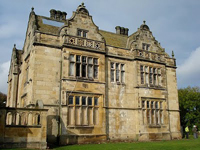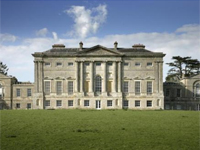
Conversion reversion? Wardour Castle, Wiltshire

Wardour Castle, Wiltshire (Image: Strutt & Parker)

With so many country houses lost in the twentieth century, almost any alternative which saved them from the demolition crew was to be welcomed; no matter how drastic.  For some this meant institutional use but for many others of all sizes the solution was conversion into flats and apartments – though with varying degrees of success.  However, as these properties come on to the market, is it perhaps time to consider converting them back into the single, glorious houses they were intended to be?

Launched this week (16 June 2010) in Country Life magazine is the principal apartment in what is considered James Paine’s finest creation; Wardour Castle, a supremely elegant essay in Palladian architecture.

Central stairwell and gallery, Wardour Castle, Wiltshire (Image: Strutt & Parker)

Built from 1770 – 76, for the eighth Lord Arundell the most impressive feature is a breath-taking central stairwell with first-floor gallery which Pevsner called ‘the most glorious Georgian interior of Wiltshire’ and which forms the core of Apartment One which is now for sale.  Wardour Castle house has proved to be adaptable becoming Cranborne Chase School in 1960 until it closed in 1990 when it was then converted into ten apartments.  As the divisions appear to have respected the natural sections of the house this seems to be a good example of where someone could convert the house back to a single home.

There are many examples of houses being rescued by conversion.  SAVE Britain’s Heritage have long campaigned to protect these houses and have worked in conjunction with one of the leading architects, Kit Martin, in supporting conversion.  A 1983 SAVE report entitled ‘The Country House: to be or not to be’, written by Kit Martin and Marcus Binney, includes particularly interesting studies of how these houses could be sensitively converted.  These show that although almost any country house could be sensitively adapted some are naturally more suitable particularly where the overall layout of the house is symmetrical, shallow and long.

The study was an important milestone in the practice of country house conversion and saved many houses from complete loss or inappropriate use including The Hazells in Bedfordshire, the grade-I Northwick Park in Gloucesterhire, Dingley Hall in Northamptonshire.  The sensitive approach they championed now means that it should be possible to consider converting a house back if the right opportunity arose.  It should be said that some houses are never going to be converted back due to a variety of factors including there being too many apartments involved such as at Thorndon Hall in Essex which contains 37 flats, or where not enough land has been retained to make the unified house valuable enough to justify reversion.

Perhaps the idea of reversion becomes more realistic where more than one part of the same house comes on the market at the same time such as recently happened with grade II*-listed Ampthill Park House, Bedfordshire.  Built by the Cambridge architect Robert Grumbold in 1687-9 and completed by John Lumley of Northampton in 1704-6, with major additions by Sir William Chambers in 1769 it is certainly one of the most impressive houses in the county. It was rescued from dereliction by conversion into just four large houses; two of which were put on the market in April 2010, the largest of which includes most of the principal rooms.

Although it’s nice to dream about these houses becoming single homes probably the biggest obstacles are not only being able to secure the other apartments but also that the value of the individual properties may be greater than the value of the unified house.  However, it’s not entirely beyond the bounds of possibility that someone with deep pockets and a desire to restore a house could take on one of these conversion reversions and recreate a superb country house.

Property details: ‘Apartment One – Wardour Castle, Wiltshire‘ [Strutt & Parker] – £2.75m

Detailed architectural description: ‘Wardour Castle, Wiltshire‘ [English Heritage: Images of England]
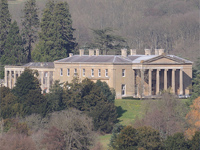
A problem shared? Whitbourne Hall visited by Country House Rescue

Whitbourne Hall, Herefordshire (Image: David Cronin on flickr)

The great wealth generated by the Victorians led to the creation of some of our grandest country houses.  Designed to impress guests and provide a showcase for the collections and taste of the owners, these houses were remarkable and beautiful expressions of the power and preferences of the age.  However, in the more straitened circumstances of the 20th-century, this left owners with running costs which far outstripped their wealth and which unfortunately led to hundreds of our country houses being demolished.

Some escaped the wreckers pickaxe through conversion into apartments – but this doesn’t always solve the questions about the long term sustainability of a house, as shown by the visit of the TV programme Country House Rescue to Whitbourne Hall in Herefordshire.

The grade-II* listed house was built for vinegar magnate Edward Bickerton Evans whose father founded the Hill Evans Vinegar works in Worcester in 1830, which was, by 1905, the biggest vinegar producer in the world.  As was standard practice for the discerning Victorian millionaire he decided to build a grand country house and chose a cornfield in Whitbourne as the perfect location.

Despite its Georgian appearance, it was built between 1860 and 1862 to a design by Edmund Wallace Elmslie and inspired by the Erectheum on the Acropolis in Greece. The house was a lavish example of neo-Palladian architecture with a six-column portico, whilst on the south front a huge orangery, now known as the palm house, was added in 1875 and was thought to be the tallest in Europe.  The interior features a fine pillared main Hall with a rare blue and white glass ceiling, and the main reception rooms retain many original features.  At it’s height in 1876, the estate extended to over 2,500 acres with the classically beautiful Whitbourne Hall sitting proudly at the centre.

Remarkably, the Hall remained in the Evans family until 1980, when it was purchased by Whitbourne Hall Community Ltd to be run as a communal housing project with individual apartments and set in eight acres of gardens.  This original arrangement floundered and a commercial company was created to run the house as a more conventional managed community of 23 apartments.  The main rooms have been preserved much as they were with the Morning and Drawing Rooms retaining their original wall coverings.  However the sheer scale of the house means that the average annual maintenance bill is about £42,000 – and due to extensive and significant work required to maintain a house of this quality, that bill is expected to double in 2011, posing serious problems for the residents.  Extensive restoration is now required as the house is now suffering from a catalogue of issues including failing plasterwork as water penetrates through the coffered ceiling of the main hall.    Curiously Whitbourne Hall doesn’t seem to be on the English Heritage Buildings at Risk Register – it would be interesting to know why not.

One of the perennial difficulties of owning a country house is not just the huge costs such as heating but also the ongoing maintenance (as demonstrated by the Earl Spencer’s sale), the costs of which, rise significantly the higher the classification.   With the paucity of public grants for maintenance it falls to the owners to seek innovative ways to make these wonderful houses financially self-sufficient if possible.  However, as Country House Rescue often shows, it’s the owners who can sometimes be the problem who need to be convinced before they become part of the solution.

More details: ‘Country House Rescue‘ [Channel 4]

Astley Castle rises from the ashes

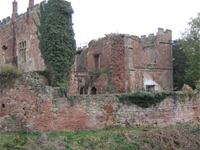
Astley Castle, Warwickshire

The devastating fire which tore through Astley Castle not only ended it’s use as a hotel but also seemed to mark the end as a building.  However, a remarkable project by the Landmark Trust is seeking to once again restore life to this battered shell.

Although never a proper ‘castle’, Astley was designed as a fortified manor house (see also the beautiful Compton Wynyates nearby). This original house was built largely by the Grey family but it was slighted following the execution of Lady Jane in 1554.  The house was rebuilt in 1600 by a new owner, Edward Chamberlain, and it eventually became part of the Newdigate family’s Arbury Hall estate, with a new ‘Gothick’ stable block added in the 18th-century – but with little done to the house itself.  The grade-II* listed castle was leased out as home for most of in the 20th-century until the 1960s when it became a hotel until the fire destroyed it, leaving it as a deteriorating ruin for the next 30 years.

The Landmark Trust has been attempting to find a solution to this situation since the 1990s, originally looking at plans for a full restoration, but which unfortunately proved too costly.  The continued decline of the building fabric gave fresh impetus to their efforts as it was realised that without urgent work the house as a structure would be lost forever.  In 2005, the Trust held a competition to find a design for accommodation to be created within the shell as sensitively as possible, which could then be used as a holiday let.  The winning design from the architects Witherford Watson Mann will create a modern two-storey structure in the oldest part of the castle, with the first-floor living spaces enjoyed spectacular views across the parkland.  A £500,000 £1.47m grant from the Heritage Lottery Fund, plus earlier fund-raising, has taken the Trust to within just £134,000 of the total project cost of £2.3m, and great progress has been made on the scheme. What’s particularly impressive about this project is that it has enabled a full architectural survey of the house, which has revealed many fascinating features as the rubble has been cleared and the later Victorian additions are removed.

The Landmark Trust has a strong record of taking on derelict listed buildings, converting them, and finding a long-term sustainable use for them – usually as unusual holiday accomodation.  Although it’s not been possible to fully restore Astley Castle as a home it is encouraging to see it being consolidated and enhanced with a sensitive modern addition which will provide the opportunity for others to experience this amazing part of our architectural heritage which was so nearly lost.

More details: ‘Astley Castle‘ [The Landmark Trust]

English Heritage grant helps towards Sockburn Hall restoration

Sockburn Hall, County Durham (Image: Sockburn Hall Project)

A project to restore the long-neglected Sockburn Hall has received a boost with a grant for £37,000 from English Heritage.  This is in addition to the £38,000 it was also awarded last year as part of a long-term project to make the house watertight, eliminate the dry rot and then restore the interiors.

The grade-II* listed Sockburn Hall was originally built in 1834 in a neo-Jacobean style for the Blackett family on the site of a lost Jacobean house built for the Conyers family which had vanished by 1823.  The house became notorious in 2000 when the sisters who lived there were prosecuted for keeping animals in squalid conditions in the various rooms of the house. Listed on the English Heritage ‘Buildings at Risk’ Register it had long been a cause for concern as water penetration and vegetation growth threatened the structure of the house.

The family have taken on the house as a restoration project to avoid selling it and risking it being developed and have created a small group of volunteers who are valiantly clearing the grounds and restoring features whilst specialist firms are working on the house. The grant in 2009 enabled emergency repair work to be undertaken on the roofs and guttering to remove the temporary tin sheeting and to ensure good drainage to help stop water ingress into the building.  This project will take years but hopefully, one day, the family will be able to move back into this house and make it a home again.

You can follow the progress of the work either on their website or via the Sockburn Hall Facebook group where you can also volunteer to help out.