Purchasing the picturesque: Hampton Court and Lasborough Park for sale

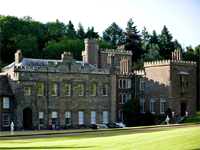
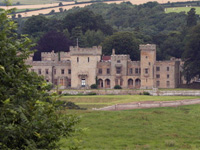
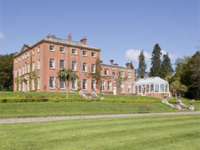
Hampton Court, Herefordshire - £12m, 935-acres (Image: Knight Frank)
Hampton Court, Herefordshire – £12m, 935-acres (Image: Knight Frank)

What is beauty? Though it is often in the eye of the beholder, some have attempted to define just what it is. In architecture, this can be seen in the development of the Picturesque ideal which sought to combine natural and man-made elements to compose a vision which would delight the eye and uplift the soul. Hampton Court in Herefordshire, and another house launched this week, Lasborough Park in Gloucestershire, can both be considered part of the Picturesque movement, even though the former took shape before the theory of the sublime and beautiful was brought to life and the latter was built just before the revival took hold.
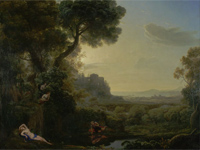
'Landscape with Narcissus and Echo' - Claude Lorrain, 1644 (Image: National Gallery)
‘Landscape with Narcissus and Echo’ – Claude Lorrain, 1644 (Image: National Gallery)

The origin of the Picturesque movement can, in part, be found in the philosophical writings of a much under-rated figure of the 17th-century, Anthony Ashley Cooper, the third Earl of Shaftesbury.  To him, nature ought to be imperfect and that, in turn, we ought to celebrate the untamed trees and serpentine rivers, those dark glades and tumbling crags. Unsurprisingly, the Earl found that the early Italian landscape paintings by Nicolas Poussin, Gaspard DughetClaude Lorrain and Salvator Rosa, reflected best this vision of a wilder natural world.  Landscapes had been unfashionable when Lord Shaftesbury first arrived in Italy in 1686, but by the turn of the century, they were in high demand amongst the grand tourists who carried these canvases back to the UK and into the popular taste of the nation.  These views married with Vanbrugh‘s early call in 1705 for a more natural approach to landscaping at Blenheim Palace, but found its true champion in William Kent in the 1730s, especially in his work at Rousham, Claremont and Stowe. The ideas were then developed further in 1757 in Edmund Burke’s ‘The Origin of our Ideas about the Sublime and the Beautiful‘ which, in its musing on aesthetics, distinguished between the latter, which was all about smooth lines and bold colours, whereas the former is about an awesome beauty on an almost fearful scale.

The death of Lancelot ‘Capability’ Brown in 1783 created a vacuum which led to the revival of the debate as to the most tasteful approach to landscaping.  The arguments were largely between Humphry Repton (who defended Brown’s ‘contrived natural’ approach of smooth curved borders and sweeping lawns which ran right up to the house) versus Sir Uvedale Price, 1st Baronet (b.1747 – d.1829), author of the ‘Essay on the Picturesque, As Compared with the Sublime and The Beautiful’ (1794), who, along with Richard Payne Knight, sought to create a more ‘robustly natural’ approach, where blasted tree stumps and ruins were also important.  This mirrored the first wave of the Picturesque to some extent, but this later flourish created a new passion to rediscover the beauty of the same painters whom Lord Shaftesbury had admired decades earlier.  Although neither Price or Knight worked on any gardens other than their own, their ideas were to have a dramatic impact on the settings of country houses, which were now considered as part of the overall composition rather than separate from it; formal gardens were swept away and snaking carriage drives now swept visitors through glades and past vistas before their arrival.

Detail from 'The Southeast Prospect of Hampton Court, Herefordshire' by Leonard Knyff, c1699 (Image: Wikimedia)
Detail from ‘The Southeast Prospect of Hampton Court, Herefordshire’ by Leonard Knyff, c1699 (Image: Wikimedia)

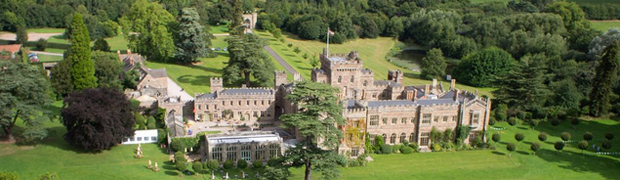
The grand formalism of the gardens of Hampton Court c1699 (above) contrasted with the asymmetrical grouping of the house. ‘The Southeast Prospect of Hampton Court, Herefordshire‘ by Leonard Knyff, shows how the grounds were a vision of control; of formal avenues and canals (see also the companion North prospect view). The house was, at this time, owned by the Coningsby family, having been bought by Sir Humphrey Coningsby in 1510 from a fellow courtier. His son became the first Earl of Coningsby and it remained in their family for 300 years.  Sir Richard Arkwright (1732-1792), who famously made his fortune from bringing the industrial revolution to the cotton industry, bought the house and 6,220-acres in 1810 for £226,325 (approx. £6.2m). His son, also Richard (1755-1843), made another fortune, before inheriting from his father in 1792, and invested in significant country houses, one for each of his five sons. However, the most significant changes came under his (fourth) son, John, who decided that ‘…of all the situations I know, there is none which suits my taste so well as Hampton Court‘ (funny that). After John’s marriage, the requirements of a growing family persuaded his father that the house needed to be enlarged.

The man chosen to design the work was Charles Hanbury-Tracy, a gentleman architect who had built his own home, Toddington Manor, between 1819-40, in his favoured ‘gothic collegiate’ style at a cost of £150,000 .  Though the style was sympathetic to Hampton Court, the relationship between architect and client became difficult. Another architect, John Atkinson, had pleaded with Hanbury-Tracy not to ‘make Hampton Court a cell to the Abbey of Toddington‘ but his determined views were at odds with Arkwright’s wife, who fell out with Hanbury-Tracy over the nursery arrangements, which led to nearly a decade of alterations and disagreements, especially as the costs mounted to eventually total over £30,000. John certainly preferred working with Joseph Paxton, who created the new conservatory, which was added in 1845-46. That said, the end result is one which successfully married old and new, creating a successful interpretation of domestic gothic and the picturesque.

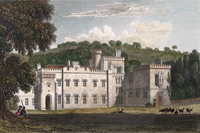
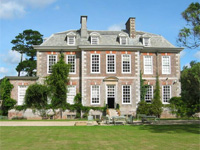
Lasborough Park, Gloucestershire - £12m, 55-acres (Image: Savills)
Lasborough Park, Gloucestershire – £12m, 55-acres (Image: Savills)

The Picturesque was a constant presence throughout the 18th-century but enjoyed a revival of interest in the 1790s and Lasborough Park represented the style just at the cusp of this.  Built in 1794 for Edmund Estcourt, his architect was James Wyatt, who enjoyed a rare skill in being able to master a number of different architectural styles – something which led later to his being unjustifiably underrated.  At Lasborough, Wyatt provided a continuation of the theme which John Martin Robinson in his book on the architect called a ‘toy-fort model‘; that is, a symmetrical house with battlements and corner turrets.  Wyatt had been using this pattern when working on various schemes for remodelling the interiors of Slane Castle since 1773 but it was only over ten years later that he was able to remodel the exterior, taking an irregular L-shape and bringing symmetry by adding matching towers.

Slane Castle, Co. Meath (Image: Slane Castle)

Wyatt’s design developed the tradition of the castellated residence; houses which had been either adapted from an older fortification or made to look like they might have done. Six decades before Wyatts’ work at Slane Castle, earlier versions, such as Howth Castle, Co. Dublin, which was altered significantly in 1738, are evidence that the style was already favoured and also incorporated an effort to create symmetry with the original keep on the left, mirrored in a new tower on the right.

The Picturesque style was popular in Ireland but initially as an import of the Protestant aristocracy and was viewed by some as an attempt to import a ‘little England’, a form of architectural and landscape colonialism. However, Ireland was particularly suited to the forms of the Picturesque which often worked in harmony with its natural beauty to form a unified creation which led the eye of the visitor from the grounds near the house, towards the middle distance, and then out to the wider landscape – much as a painter would structure their picture.
Hampton Court from south west (Image: Knight Frank)

Hampton Court is one of the most important and impressive country houses to come to the market this year.  As part of our heritage, it embodies architectural developments which brought the country house from fortification to domestication, with a landscape which started with formal terraces but finished with flowing lawns.  The genesis of the more structured medieval revival form of Lasborough Park can be seen in the core of Hampton Court and in each of the subsequent alterations.  Both houses are valuable pieces of the nation’s architectural record and deserve owners who will appreciate them and hopefully both will remain as single family homes, enjoyed as they have for generations, for their Picturesque beauty.

——————————————————————-

For a more in-depth history of the Arkwrights and their time at Hampton Court, I recommend: ‘Champagne & Shambles – The Arkwrights and the Country House in Crisis‘ by Catherine Beale [Amazon]

Sales details:

Articles:

Country House Rescue: the weight of history – Kentchurch Court, Herefordshire

Kentchurch Court, Herefordshire (Image: mhaswell / flickr)

For some who inherit, the weight of family history can easily overcome the burden of running a historic home on a limited budget.  As we saw in the previous episode of Country House Rescue at Trereife House in Cornwall, the desire to not be the generation which loses the ancestral home, a prospect which faced the Le Grice family who had been there since 1799.  So imagine the weight of responsibility facing the Lucas-Scudamore family who have lived for ten centuries at Kentchurch Court in Herefordshire.

The house itself was originally a Saxon tower with further additions in the 14th-century.  However, the main style of the house as it stands today is due to work commissioned from the famous Regency architect John Nash (b.1752 – d.1835).  More importantly, Kentchurch is a significant as one of a number of houses built in the area around that time which were a visible expression of a new wave of architectural fashion; the Picturesque.

Strawberry Hill, London (Image: D Kendall / EH Viewfinder)

When thinking of Georgian architecture many think of the symmetrical classical façades and strictly proportioned Palladian designs which were so prevalent in that era.  Yet one house, Strawberry Hill in Twickenham, south London, was to be the catalyst for a new way of thinking, breaking these patterns and ushering in a more organic way of viewing architecture. This saw the house as part of a landscape with the design playing its part in the beauty of the view as much as the lakes, gardens and parkland. Originally an unremarkable house, it was bought in 1747 by the wealthy Horace Walpole, 4th Earl of Orford and fourth son of Walpole the Prime Minister, who was an astute observer of society, art, and architecture. Walpole contributed little to art but was particularly well read and as he pursued his academic studies decided to start experimenting with alterations to his house.

Fonthill Abbey, Wiltshire (Image: John Rutter (1823) / RIBA)

His original changes from about 1749 were uncontroversial and, importantly, followed the convention for symmetry.  However, from 1753 onwards the interiors were fashioned in a gothic style with the help of what he called his ‘Committee of Taste’ comprising a few of his equally well-read friends.  This experimentation was confined to the interiors until, in 1759, he broke with architectural convention and had a great circular tower constructed but which, radically, had no matching pair.  The house was to continue to grow in a rather free fashion which can still be admired today (particularly so following the completion of phase one of a fantastic restoration by the Strawberry Hill Trust, the Heritage Lottery Fund and the World Monuments Fund). The house became famous, attracting day trippers in large numbers and spawned imitators; though it was James Wyatt’s Lee Priory (built 1785-90 – dem. 1955) which was said to the be first ‘child of Strawberry’.  Also considered worthy, and also designed by Wyatt were the fantastical Fonthill Abbey (collapsed in 1825) for William Beckford, and Ashridge Park for the 7th Earl of Bridgewater.

Downton Castle, Herefordshire (Image: gardenvisit.com)

One man particularly taken with this new style was Richard Payne Knight, a Herefordshire MP and intellectual with a large inheritance.  Using his wealth, in 1774 Payne Knight started the construction of a new home, Downton Castle, which bore similarities to Strawberry Hill, with the asymmetry and a large circular tower, and an irregular plan which was quite radical for the time.  This house was a prototype for a new ‘castellated’ style of house which was to be popular for fifty years from about 1790.  Driving this new style was the publication of three key books, the first two in 1794; ‘The Landscape, a Didactic Poem‘ by Payne Knight, and ‘Essay on the Picturesque‘, a brilliant reply in support by Uvedale Price (another local landowner), and, in 1795, ‘Sketches and Hints on Landscape Gardening‘ by the landscape-gardener, Humphrey Repton, who formed a successful and highly influential partnership with the architect John Nash that same year.

Nash had moved to Aberystwyth after his bankruptcy following a failed speculative buildings scheme in Bloomsbury in London.  Yet, the contacts he was to make in Wales led to Nash becoming one of the leading architects of the Picturesque.  The early development of his interest in the ideas of the movement can be seen when he designed a castellated triangular lodge for Uvedale Price sometime between 1791-4.  He also worked for Thomas Johnes at the spectacular Hafod estate where Johnes had planted 3 million trees to paradoxically create a more ‘natural’ looking Picturesque landscape.

For Nash, the ideas he developed in that short period from 1790 until he left to go back to London in 1796, were what made him one of the most significant architects of the period. The influence of Downton Castle and Nash also created a strong regional collection of these mock castles – Garnons (dem. 1957), Saltmarshe Castle (dem. 1955), Goodrich Court (dem. 1950), Garnstone Castle (by Nash, built 1806-10 – dem. 1958) Hampton Court Castle (alterations 1830s-40s) and extending down to Devon where Nash designed perhaps one of his best creations; Luscombe Castle (built 1800-4), and into Cornwall, where he designed Caerhays Castle (built 1807-10).

Kentchurch Court from "Views of the Seats, Mansions, Castles, etc. of Noblemen and Gentlemen" (London : 1829-1831)

By their very nature these were large houses and often a little impractical which sadly meant many were demolished.  This is why Kentchurch Court is important – not only is an early work by Nash in the style of house which was to become his trademark, but it’s also one of the survivors of the tragedy of the many demolished country houses.

Perhaps the current Mrs Lucas-Scudamore should be grateful, in some ways, that their branch only inherited some fine carvings from the sale of the other much grander family seat, the grade-I Holme Lacy House (now a hotel) rather than the house itself with its 9 fine rooms with plaster ceilings which Pevsner though to be some of the best in the county.  The story of Kentchurch Court today is a familiar one of a family with an incredible history and a fine house and estate struggling with the usual demands for maintenance and £120,000 per year running costs.  Mrs Lucas-Scudamore and her two children (Mr Lucas-Scudamore being estranged and living away) battle on with determination but managing a house like this requires a money tree not a family tree – but this house is too important to be neglected.

Country House Rescue: ‘Kentchurch Court‘ [Channel 4]

Country House Rescue returns for Series 3: Wyresdale Park, Lancashire

Wyresdale Park, Lancashire (Image: Channel 4)

The history of the country house is sadly often a cycle of rise and fall with the main variable being the speed of each respectively.  The old phrase was ‘one generation made the wealth, the second enjoyed it, and the third lost it’. Over recent decades the trend has changed slightly in that, with longer life expectancies prolonging the older generations, the houses have had fewer chances for the rejuvenation which inheritance often brought.  As an alternative, Ruth Watson uses Country House Rescue as a catalyst for the type of entrepreneurial change which is the only way for these houses to survive – if only the owners would listen!

The first episode in Series 3, to be broadcast at on Channel 4 at 21:00 on 6 March 2011, takes us to Wyresdale Park in Lancashire to meet a father and son who don’t agree on the best way to maximise the obvious potential of the beautiful estate.

Wyresdale Hall was built between 1856-65 for Bolton cotton-magnate-turned-banker, Peter Ormrod, who bought 6,000-acres from the Duke of Hamilton to create his estate.  The house, which cost £50,000 (about £4m at today’s value) at the time, was designed by noted local architect Edward Graham Paley (b.1823 – d.1895) who had an extensive practice, partnering first with his mentor Edmund Sharpe, then, following Sharpe’s retirement, Hubert Austin, before being joined by his son, Henry Paley. The work of Paley & Austin in particular was well-regarded with Pevsner  saying they “did more outstanding work than any other in the county” and was “outstanding in the national as well as the regional context”.

Paley worked on relatively few country houses, being much better known for his ecclesiastical output, with included the design of Lancaster Cathedral.  Paley was brought up in deeply religious home and, working with Edmund Sharpe, who was heavily influenced by Pugin, it was unsurprising that Paley adopted the strict ecclesiastical style with the ‘correct’ use of Gothic elements.  Perhaps looking a little too much like a convent rather than a home, the house is, nonetheless, still a good example of the type of regional interpretations of Pugin’s architectural theories which gained ground in the 19th-century.

The grade-II listed house and estate passed through the Ormrod family before the land was bought by the Whewell family in the 1920s who then bought the house in 1967.  Now the family are facing the usual struggles of a listed house, an extensive list of improvements, and the need to make the changes which sometimes sit uncomfortably with the more traditional older generation.

———————————

Country House Rescue – Series 3

My usual powers have slightly failed me and I haven’t a verified list of all the houses in Series 3 but here are the ones I have identified so far:

See also:

A bad omen: the spring country house relaunch

One rather unscientific barometer of the health of the country house market is the thickness of Country Life magazine as it comes through the letterbox each week.  After the thinning of the issue in the run-up to Christmas it’s always pleasing to feel the first weighty edition of the new year.  Yet, though this week’s issue (2 March) boasts ’70 pages of property for sale’ it’s remarkable that the estate agents have so few significant country houses to offer and of those that are there, it seems, along with last week’s issue, the largest houses are relaunches.

Pyrford Court, Surrey (Image: Savills)

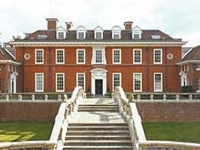
One of the most interesting is grade-II listed Pyrford Court, Surrey.  Originally built in 1910 for the 2nd Lord Iveagh, of the Guinness brewing family, it was one of a group of houses built around that time on the profits of beer (along with Polesden Lacey, Elveden Hall, and Bailliffscourt). The land was sold to Lord Iveagh by his father-in-law, Lord Onslow, whose family had owned the area since the 17th-century.  The house was designed by Clyde Young who had also worked at Elveden, another seat of the Guinness family, though the sensitively designed wings were added in 1927-29 by J.A. Hale of Woking to designs by Lord Iveagh.  The stylish neo-Georgian house is an elegant red-brick composition which originally sat in a 1,000-acre estate – though sadly now reduced to just 21-acres.  Lord Iveagh died in 1967 and the house sat empty until sold in 1977 – apart from a brief burst of fame as a location in the 1976 film ‘The Omen’.  The house then became an old people’s home with all the attendant damage until the current owners started their seven-figure restoration.

Pyrford Court was originally launched on the market in January 2010 for an ambitious £20m, a staggering rise in valuation from the £3.25m paid in 2000 and from the £8m asking price when it was offered for sale in 2002 (reduced, a year later, to £6.5m).  Yet this proved too much for the market to take; even for a ‘super-prime’ house within 25 miles of central London, and despite the high-quality restoration of the impressive interiors.  It subsequently languished and has now been promoted with a double-page advert – though the price is ‘on application’ meaning we won’t yet know quite how far the price has dropped.  However, looking at the other houses Savills have for sale in the area this is by far the most interesting and attractive house.

Brockhampton Park, Herefordshire (Image: Jackson-Stops & Staffs)

Another impressive house is the classically elegant, red-brick Brockhampton Park, Herefordshire.  Although the architect hasn’t been confirmed, the fact that it is virtually identical to Hatton Grange in Shropshire by Thomas Farnolls Pritchard, means it can probably be attributed to him.  The house was built in the late 1750s for Bartholomew Richard Barneby, probably using the £3,000 brought to him through his marriage in 1756 to one Betty Freeman. The Barneby family had owned the estate since the 15th-century and were to own it until 1946 when John Talbot Lutley (who was a descendent of the  Barneby family) left the house and 1,200-acre estate to the National Trust. Col. Lutley was a no-nonsense man who, on hearing of the NT country houses scheme, wrote them a short letter in 1938 saying that as he was a bachelor whose heirs were rather distant, would they be interested?

James Lees-Milne was duly dispatched – and almost rejected it on sight as it wasn’t pure Georgian due to some relatively small Victorian alterations.  However, after a tour of the estate and on seeing the beautiful Lower Brockhampton Manor, he felt that the latter two would be fine additions for the Trust – even if the big house would be a drain. It was duly left to the NT in 1946 following the Colonel’s death. Neither the house nor the contents were of sufficient quality to justify retaining or opening to the public so they sought to let it.  Unfortunately no private tenant wished to take it on, usually citing its remoteness, however in 1985 an insurance company let the house as offices and undertook a comprehensive restoration programme.  After they moved out in 1996 it was again restored as a private home and is now available with just 8-acres but surrounded by the rest of the NT-owned estate.  Interestingly the house is listed under the ‘Sales’ section of the Jackson-Stops & Staff website but I suspect this is due to it being leasehold – again ‘price on application’ so the price of the privilege is unknown, but the house has been advertised since last summer so it may be cheaper than before.

Ebberly House, Devon (Image: Savills)

Perhaps the most surprising house to still be available is the grand Ebberly House, Devon.  Rather than the expected provincial house, this is a house which displays remarkable architectural sophistication. Described by Pevsner as ‘unusual and attractive’, whose distinctive rounded ends ‘hint at the variety of room shapes inside; a provisional echo of the interest of contemporary architects such as Nash and Soane’.  Designed by Thomas Lee of Barnstaple, a pupil of Sir John Soane, the grade-II* house compensates for it’s remoteness with a fantastic house set in a fine 250-acre estate.  Offers in excess of £4m on the back of a postcard to Savills in Exeter.

Perhaps there are some clever marketing plans being hatched at the estate agents which means that rather than pushing their best properties in the first big property edition of Country Life of 2011 they’re saving them for…when?  Bonuses have just been announced and those looking to buy are probably active so perhaps there is just a general scarcity of significant country houses coming to the market.  Does this indicate 2011 will be rather thin for the agents as uncertainty limits buyers to the super-rich looking for somewhere in London or will the market pick up and a slew of new houses soon be released to whet our appetites?

The growth of smaller country houses: Harewood Park, Herefordshire

The size of a country house was traditionally the physical embodiment of the wealth (or aspirations) of the owner.  Yet as the role of the country house changed and the emblems of power altered, new, smaller forms of houses to emerge for both the aristocracy and minor gentry.  The acceptability of a smaller house was to prove valuable in the financial crises of the 20th-century – though this is not to say that the later houses lacked anything in terms of quality of interiors or the richness of the architectural language used outside.

Puslinch House, Devon (Image: Devon Rural Archive)

Wealth was obviously the most important consideration when deciding on the size of the house.  However, the learned sophistication of many of the lesser aristocracy meant that although their funds may not be able to provide a palace, they were well-versed in the aesthetics of good (often Classical) architecture. This meant they were able to commission or design for themselves coherent and elegant smaller houses, giving us the much-coveted Queen Anne or Georgian smaller houses we see today up and down the country, such as Puslinch House in Devon.

The considerations in the 20th-century were also financial but driven by a different set of demands.  The financial pressures of the early part of the century, particularly the agricultural slump and the Wall Street crash, naturally limited the size of the houses built (though not all e.g. Gledstone Hall by Sir Edwin Lutyens built in 1926). Yet, the changing social climate also meant that not only was it considered somewhat insensitive to build such large palaces, it was also unnecessary as the houses no longer required so many bedrooms to accommodate the now vanished armies of staff and house guests who used to turn up for the large weekend parties.

Hurtwood Edge, Surrey

Yet smaller didn’t have to mean less interesting as architects faced up to the new challenges with intelligent interpretations of Georgian, whilst others sought to experiment with different styles, such as at the now grade-II listed Hurtwood Edge in Surrey, where the builder/architect Arthur Bolton created an Italian villa in the English countryside.

In the immediate period following World War II, many larger houses, having been requisitioned and mistreated, were demolished, but the families often retained the ancestral estate but now required a new seat.  The tight restrictions on materials, particularly for ‘luxury building’ under the Socialist Attlee government, naturally limited the ambitions of the owners.  Yet the election of Conservatives in 1951 ushered in the gradual lifting of the restrictions until their abolition in 1954 which allowed a new wave of construction.  The war seemed to have had a lasting effect – or maybe fear of a future Socialist government enacting a tax based on house size – as many of the houses were significantly smaller than those in previous eras.

Eaton Hall by John Dennys for Duke of Westminster (Image: Kathryn Gammon)

An example of this is Eaton Hall, seat of the Dukes of Westminster, where, following the demolition between 1961-63 of Sir Alfred Waterhouse’s high Gothic-Revival masterpiece, it was decided that a new house should be built.  The commission went to John Dennys, who happened to be the Duke’s brother-in-law, for a starkly modern house which sat cross-wise on the main axis of the old house.  Unfortunately in this case the new house was overwhelmed by the grandeur of the setting, appearing too small against the remaining buildings and the as the focus for the grand gardens.  Worse, the house was unsuccessfully remodelled again in the late 1980s in an almost French chateau-style to create a larger house.

In recent years, planning restrictions have usually limited the size of new houses (though not always; see my recent post on large houses).  The lack of architecturally educated clients has naturally led to a growth in crass, ugly smaller country houses, but all is not lost as determined clients are still able to demand and produce good designs, such as the one proposed for Harewood Park in Herefordshire, now mooted as the potential marital home for Prince William and Kate Middleton.

Harewood Park (proposed), Herefordshire (Image: Craig Hamilton Architects)

Ever since the Harewood Park estate was bought by the Duchy of Cornwall in 2000 as part of a larger purchase of 12,000 acres, rumours had been circulating that it would be for one of the Princes.  The original house had been demolished in 1959 so the expectation was that another would have to be built if it was to have such a role.  Considering the views of the Prince of Wales on modern architecture there was little surprise when a planning application was submitted in 2006 for a strongly Classical small country house by Craig Hamilton Architects.

Craig Hamilton originally prepared three designs but the final design (shown above) complements the existing stables and is perhaps the most interesting and the one successfully submitted for approval.

The house is based around the motif of the triumphal arch but, apparently drawing on the influence of Sir John Soane, it presents a simplified version rather than the more decorated versions often seen.  Soane was schooled in the Classical style but re-invented the language to create a new direction for Neo-Classicalism; a much simpler version with an emphasis on the effective use of space and most importantly, light.  Soane spent several years in Italy and was well-versed in Roman architecture and incorporated the three-arch motif into his designs, notably the entrance front to his own house at Pitzhanger Manor, Ealing, west London, and in one of his most impressive commissions for the old Bank of England (scandalously demolished in the the 1920s) as seen in the internal Lothbury Court.

The new Harewood Park is an inventive extension of this Soanian language and it’s encouraging that the planners had the courage to approve what will surely be one of the most interesting smaller country houses built in the UK.  Sadly, I suspect that for security reasons, we won’t see the house featured in Country Life but I keep my fingers crossed.


Competition: nominate your choice for ‘England’s Favourite House’

Competition: 'England's Favourite House'

This seems a good moment to mention the competition to find the best smaller country house (i.e. with less than seven bedrooms).  Most people have a favourite and usually it’s not so much the grand palaces of Chatsworth or Blenheim but the smaller houses of our local areas which form part of our local heritage.  The competition is being run by Country Life magazine and Savills the estate agents and the house should be in private ownership and not currently for sale. The deadline is Wednesday 24 November 2010 so submit your suggestions as soon as possible.

To nominate a house simply either print this form [pdf] and send it in or email favourite_house@ipcmedia.com

More information: ‘England’s Favourite House‘ [Country Life]