The modern smaller country house: Home Farm, Yorkshire

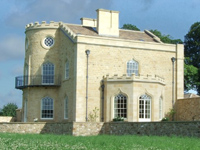
Home Farm, Yorkshire (Image: Francis Johnson & Partners)

Despite the rather understated name, Home Farm in Hartforth, Yorkshire is a classic example of the long tradition of grand downsizing which has been a hallmark of UK country house owners, particularly since 1900.  The pressures on the large country house in the 1930s and then again from the late 1940s until 1960s sparked a surge in the construction of new, smaller country houses which reflected the financial reality of the times.  Yet today smaller country homes are a deliberate choice for the discerning owner reflecting their own wishes and desires which has led to some very successful designs.

In previous eras (and particularly before the restrictions of the 1970s heritage legislation), a country house owner faced with a house which was too big could simply remove wings (as the 12th Duke of Bedford did at Woburn Abbey in the late 1940s) or floors of the house to make them more manageable (as happened at Hodnet Hall in Shropshire). Unfortunately for many owners it was simply easier to demolish the house entirely giving them the option to convert the stables into a home (the choice of the Earls of Lansdowne at Bowood in 1955) or rebuild either on the site of the old house or in a new location on the estate.  It was this latter course of action which offered the best opportunities for an owner to preserve their estate but dramatically reduce their expenses by building a new house.  John Martin Robinson in his 1983 book ‘The Latest Country Houses’ estimated that over 200 new country houses were built between 1950s-1980s.

The new country houses today are largely either grand statements but there are also examples of smaller houses which quietly succeed in delivering an important contribution to the traditions of the UK country house.  Winner of the 2009 award for ‘New building in a Georgian context‘, Home Farm was a carefully considered response to a particular location and circumstances.

The client behind the commission was Sir Josslyn Gore-Booth Bt. who had inherited the Hartforth estate but unfortunately not the main house, the early Georgian classical Hartforth Hall, which had been divorced from the estate and become a hotel.   The Gore-Booth’s family seat had traditionally been Lissadell in County Sligo, Ireland, built for the 4th Baronet in the 1830s.  In 2003, Sir Josslyn put the house on the market for €3m and was determined that the new house would be very different from the sombre and severe Neo-Classical house he had just left.

Home Farm, Yorkshire (Image: Francis Johnson & Partners)

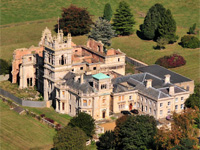
Home Farm is a clever response to a number of challenges.  Firstly, both the new house and Hartforth Hall would be visible simultaneously due to their proximity and so had to make their own architectural statements without competing, ruling out a classical design.  Secondly, the new house was to replace an old estate farmhouse and would join the group of existing Georgian farm buildings.  The architect, Digby Harris, came up with a novel solution – a two-faced house which projected an elegant classical facade to complement the farm buildings but a Gothick facade contrasting to the classical Hartforth Hall.  Usually a client seeks a unified design so these type of buildings are rare in the UK and feel somewhat disconcerting; two examples are Castle Ward in Northern Ireland (Classical front / Gothick front) and Castle Goring in Sussex (Classical front / Gothick front).

The ‘classical’ front draws on a draft design by the late Francis Johnson but also historically the compact Georgian villas of Sir Robert Taylor (1714–1788), James Paine (1717-1789) and John Carr (1723-1807).   The Gothick facade mirrors the style applied to some estate buildings in the 19th-century and features an elegant ogee window on one side looking out on a small canal-type pond with the main front boasting a full height bow bringing to mind other older houses such as Corngreaves Hall with other elements taken from Batty Langley (1696-1751), specifically his ‘Gothic Architecture, improved by Rules and Proportions‘ (pub. 1747)

Home Farm proves that a modern classical country house can be both practical and architecturally interesting without needing to be physically large.  The long tradition of country house building in the UK seems to be alive and pushing forward the architectural boundaries which should prove inspiring to anyone contemplating the building of a new home of any size as the centrepiece of an estate.

More details and photos: ‘Home Farm, Yorkshire‘ [Francis Johnson & Partners]

Credits: thanks to Austen Redman of Francis Johnson & Partners for the photo and information on the house.
The start of the rush? Country houses for sale in the Sunday Times Home section

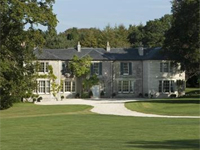
Sandley, Dorset (Image: Knight Frank)

The usual spring rush of country houses coming to market has been later this year – a combination of the hangover from the uncertainty in the market of the last couple of years along with that of the General Election.  That traditional shop-window of the country house – the Home section of the Sunday Times – has this week (16 May 2010) heralded what it sees at the start of the rush by including three pages of those for sale.

For those who like their country houses to look traditional from the outside but prefer a more modern interior then the Grade-II listed, six-bedroom Sandley in Dorset, set in 178-acres, might be perfect – if you have the necessary £9m.  The owners decided that the rather ‘quaint’ style of the house was not for them and so they spent ‘a couple of million pounds’ and over two years to strip it back and then make it look very ‘London’.  Personal taste is the final arbiter for whether you think this is a good thing – but not all tastes are the same and it can mean that the appeal of the country house is taken to new markets.

Ebberly House, Devon (Image: Savills)

However, if your tastes are more usual and traditional then there are other options. Holt Manor in Wiltshire, set in 94-acres, mixes both old and new with a more traditional interior cleverly concealing the latest in sound, television and security systems.  With parts dating back to the 12-th century, the Grade-II listed house has been thoroughly modernised whilst still being a recognisably English country house. £5.95m [Holt Manor: Knight Frank]

If, however, you are looking for a more architecturally impressive house, the Ebberly House, near Winkleigh in Devon, could well be the house for you.   Designed by Thomas Lee, a student of Sir John Soane, Ebberly was described by Pevsner as an ‘unusual and attractive house’ and was the first to sell in Devon for over £1m when it sold in 1997.  The Grade-II* listed house possibly benefited from Soane’s personal influence as he was working nearby at Castle Hill which may explain the elegant, and very Soanian, top-lit oval stair hall with its fine cantilevered wooden staircase and curved doors, or the drawing room divided using three shallow arches. Set in  250-acres it has a wonderful estate featuring 20-acres of woodland, estate cottages generating £20,000 p/a in rental income, and spectacular views across to Dartmoor. It was also given an excellent and detailed write-up in Country Life – always a good seal of approval.  [Ebberly House: Savills]

Chapel Cleeve Manor, Somerset (Image: Webbers)

Perhaps one of the most interesting of the houses featured is unfortunately only given a photo and no details is Chapel Cleeve Manor in Minehead, Somerset. Perhaps now not strictly a country house as it only has 7-acres, at £1.695m for 17+ bedrooms, it may seem a bargain for someone who wants to live in a country house but doesn’t want the responsibility of an estate. Although such a situation a hundred years ago could have led to the demolition of the house as happened to so many others. Yet, with so much wealth now generated without the need for a large estate to support the house, it’s now entirely reasonable for someone to take on and enjoy such a pleasing Gothic-Revival house. The house has been used as a conference venue for a number of years but with careful restoration this could be rescued from commercial use and be a spectacular home for someone who requires a lot of space. [Chapel Cleeve Manor: Webbers]

So has the rush started?  Nobody really knows and asking estate agents is never an exact science.  Several house which have been launched recently are still waiting to find new owners but the right house launched at the right time for the right price usually does find the right buyer.

Full story: ‘The landscape has changed‘ [The Sunday Times: Home section]

Perfect for a family of five: Knole, Kent

Knole, Kent (Image: Matthew Beckett)

The Sunday Times ‘Home’ section (9 May 2010) features an article which gives some insight into the concerns that might naturally arise when you inherit a huge house in this day and age.  When the 7th Baron Sackville inherited the vast Elizabethan Knole house in Kent in 2004 he and his wife had to decide whether they even wished to move from a four-bedroom cottage on the estate into one of the treasure houses of England with its 365 rooms, 52 staircases, 12 entrances, and 7 courtyards. Luckily shared with the National Trust since 1946 it is still a huge responsibility.

Despite having to share the house with the 80,000 annual visitors, with a house this size it’s quite possible to still hide the several members of the Sackville family who have apartments in the house or estate.  The Baron occupies the south wing whilst his mother lives in the north wing within a building with a footprint of approximately 4-acres with an exotic roofline which gives the impression of a small medieval town.  Even in these restricted quarters the family enjoys nine bedrooms and multiple reception rooms including a room known as the colonnade with superb trompe l’oeil decoration and a huge library along with the more domestic kitchen and ‘flower’ room.

The Sackvilles have long  opened Knole to the public starting in the early 1800s and had it’s first guidebook in 1819.  The fortunes of the town of Sevenoaks, which sits on the edge of the park, was increasingly dependent on the tourists, much as Leamington Spa and Warwick became on the success of Warwick Castle.  However, after the last of the male line of Sackvilles died in 1843, taking the Dukedom of Dorset with it, a series of inheritances left it, after various family challenges, with Lord Buckhurst in 1870, the eldest son of one of the last Duke’s daughters.  Although the house had remained open in the 1874 season, however he decided, for reasons which are not entirely clear, to close the house in October of that year.  He then removed the various access privileges which had been afforded to the people of Sevenoaks.  This prompted first local grumblings, then letters to the paper, then letters to Lord Sackville (as he had now become), until in 1883 it spilled over into the now infamous ‘Knole Disturbances’ where the locals, roused by stirring speeches,  tore up the gates and chains which had blocked their access, before marching to the door of the house.  However, all this left the cantankerous Lord Sackville unmoved and the house and grounds remained closed until after his death in 1888.

One side effect however of this was the raising of questions nationally as to the levels and rights of access to these parks and estates which were increasingly seen as something the public could enjoy at their leisure.  These sort of questions and the resulting answers, which were clearly in favour of the preservation of these open spaces – and later the houses – eventually led to the creation of the National Trust, which is now the current owner of Knole, and very unlikely to ever close the gates again.

Full story: ‘Living it large with 365 rooms‘ [The Sunday Times]

National Trust: ‘Knole, Kent

If you thought ‘The Restoration Man’ projects a bit small-fry; try Overstone House

Overstone Hall, Northamptonshire (Image: Martin Sutton on flickr)

Although hated by Samuel Loyd who commissioned it, Overstone House is fondly remembered by the generations of girls who were taught there after it became a school.  A vast, rambling property, it was sold to an obscure evangelical religious group who lived there until a devastating fire in April 2001 destroyed the main part of the house – although Loyd might have been quite relieved.

Overstone House replaced the earlier Overstone Hall and was built in 1862 for the banker Samuel Loyd, who became Lord Overstone for services to finance.  His wife  was keen to have a property commensurate with their status and so her husband decided to rebuild on a grand scale.  However, he inexplicably picked the unknown architect William Milford Teulon (brother of the more famous Gothic revivalist Samuel Sanders Teulon) who was instructed to design with a mixture of Elizabethan and Renaissance features.  This choice led to the creation of one of the most derided houses created in the Victorian era.

Both Girouard and Pevsner were uncomplimentary with the latter describing it as ‘drearily asymmetrical’.  However, the most damning verdict  came from Samuel Loyd himself, who, in what could be regarded as a wonderfully amusing piece of architectural criticism, said:

“The New House I regret to say, is the cause of unmitigated disappointment and vexation.  It is an utter failure – We have fallen into the hands of an architect in whom incapacity is his smallest fault.  The House tho’ very large and full of pretension – has neither taste, comfort nor convenience.  I am utterly ashamed of it … the principal rooms are literally uninhabitable – I shall never fit them up … I grieve to think that I shall hand such an abortion to my successors.”

As if this wasn’t enough, Loyd’s wife died before the project was finished leaving him with this rather large problem – which he promptly ignored by going and living with his daughter at Lockinge house in Berkshire where she had become Lady Wantage. Loyd must have eventually finished it as, on his death in 1883, it passed to Lady Wantage who, along with her husband, used it regularly during the hunting season until 1901.  After her death it was tenanted until sold to become a girls school in 1929.

It remained a girls school until 1979 when the pressures of looking after such a vast pile became too much and it was eventually sold to the New Testament Church of God for £100,000 in 1980 who are the current vendors.  The devastating fire in 2001 destroyed approximately 60% of the building including all the principal rooms and the impressive carved staircase.  Parts of the grade-II listed house remained in use as an old people’s home but the rest became a concern, leading to it being added to the ‘Buildings at Risk’ register.

However, the house is now for sale as a grand project with the opportunity to create a truly palatial home – the original house contained 119 rooms totalling around 20,000 sq ft.  The local council’s preference is that it become a single house – but to do so would require someone with big ideas and very deep pockets, willing to spend at least £5-10m on restoration on top of the £1.5m to buy the house and 50-acres.  However, as the main cause of Loyd’s distress has now been destroyed, this is great opportunity for someone to perhaps create a house which might meet with greater approval.

For anyone with the necessary funds and Kevin McCloud on speed-dial, please call Robert Godfrey of Bidwells (01604 605050).

A detailed history of the house is available on the Overstone School for Girls website.

More details: ‘Property restoration project: Overstone Hall, Northampton‘ [Daily Telegraph]

Lifting the curse of Hampton Gay manor house


Hampton Gay Manor House, Oxfordshire
Hampton Gay Manor House, Oxfordshire (Image: Robert Silverwood on flickr)


The fire which gutted the largely unaltered Elizabethan Hampton Gay manor house in 1887 was seen as the retribution of a curse said to have been put on the house when the inhabitants refused to offer help and shelter when the Paddington-to-Birkenhead Express crashed nearby in 1874.  The fire tore through the building leaving nothing but a shell which has stood for nearly 150 years.  However, with continuing structural deterioration threatening its very survival, an application has been submitted to restore it as a new home.

Even ten years ago the idea of restoring a historic ruin would have probably been immediately refused by English Heritage but over the last decade a series of interesting restorations have shown that ruins need not always remain that way.  This re-evaluation was probably a result of the realisation that it is almost impossible to fully arrest deterioration to a building which is not in use.  However, there is a strong incentive for an owner to ensure that his home remains secure and watertight.

One example of this new permissiveness is Eggesford House in Devon.  Formerly the home of the Earls of Portsmouth, this house, built between 1820-30, was abandoned in preference for their Hampshire estates in 1911 and put up for sale in 1913. It was eventually bought by a local man who slowly stripped it of anything usable in the 1920s leaving a derelict shell.  In the early 1980s it was expected that within a few years the last remaining walls would collapse leaving no sign of the grand house.  However it (plus 80-acres) was sold in the 1990s for around £300,000 to the architect Edward Howell who created a huge new house within the existing walls which successfully uses the old room heights to create Regency-style proportions in a very modern house.

Another project which was driven forward by sheer determination was that of Hellifield Peel in Yorkshire whose story was told as part of a 90-minute special edition of Grand Designs.  At it’s core a 14th-century fortified tower, it had been modernised in the Georgian period but abandoned in the 1950s until it was a roofless shell.  With dereliction threatening total loss, English Heritage decided to allow conversion – albeit with some serious stipulations regarding the archaeology. Architect Francis Shaw had always wanted to live in a castle and this was a labour of love – certainly only someone very dedicated would continue after seeing the central spine wall collapse into hundreds of tons of rubble.  However, anyone who sees the house today would probably agree that English Heritage made the right choice.

Astley Castle in Warwickshire was another ancient home ravaged by a fire in 1978 and a fast deteriorating ruin which the Landmark Trust, with grant support from English Heritage, are in the process of rescuing.  Their plan involves the insertion of a smaller house into the shell of the castle to support the walls and provide holiday accommodation thus ensuring an income to provide a secure future for this historic house.

So the plans for Hampton Gay aren’t as radical as some might believe. However, the 18th-century passion for the ‘Picturesque’ – an appreciation for natural environments and particularly for ruins – is still influential today and some may object to this interference in what is considered one of the most beautiful views in Oxfordshire.  However, without significant intervention there is a real risk that the ruin would simply collapse and be lost forever.  So if the choice is between losing an atmospheric ruin or allowing restoration it seems that the current preference from the official bodies is that the latter is to be allowed – although the heavy restrictions will hopefully ensure that only well-funded restorers with a sympathetic understanding of the building will undertake these projects.  This raises some tantalising prospects; perhaps one day we may even see Kirby Hall in Northamptonshire as a home once again?

Story: ‘Grand design for ruins‘ [Witney Gazette]