Astley Castle rises from the ashes

Astley Castle, Warwickshire

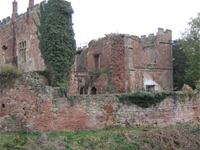
The devastating fire which tore through Astley Castle not only ended it’s use as a hotel but also seemed to mark the end as a building.  However, a remarkable project by the Landmark Trust is seeking to once again restore life to this battered shell.

Although never a proper ‘castle’, Astley was designed as a fortified manor house (see also the beautiful Compton Wynyates nearby). This original house was built largely by the Grey family but it was slighted following the execution of Lady Jane in 1554.  The house was rebuilt in 1600 by a new owner, Edward Chamberlain, and it eventually became part of the Newdigate family’s Arbury Hall estate, with a new ‘Gothick’ stable block added in the 18th-century – but with little done to the house itself.  The grade-II* listed castle was leased out as home for most of in the 20th-century until the 1960s when it became a hotel until the fire destroyed it, leaving it as a deteriorating ruin for the next 30 years.

The Landmark Trust has been attempting to find a solution to this situation since the 1990s, originally looking at plans for a full restoration, but which unfortunately proved too costly.  The continued decline of the building fabric gave fresh impetus to their efforts as it was realised that without urgent work the house as a structure would be lost forever.  In 2005, the Trust held a competition to find a design for accommodation to be created within the shell as sensitively as possible, which could then be used as a holiday let.  The winning design from the architects Witherford Watson Mann will create a modern two-storey structure in the oldest part of the castle, with the first-floor living spaces enjoyed spectacular views across the parkland.  A £500,000 £1.47m grant from the Heritage Lottery Fund, plus earlier fund-raising, has taken the Trust to within just £134,000 of the total project cost of £2.3m, and great progress has been made on the scheme. What’s particularly impressive about this project is that it has enabled a full architectural survey of the house, which has revealed many fascinating features as the rubble has been cleared and the later Victorian additions are removed.

The Landmark Trust has a strong record of taking on derelict listed buildings, converting them, and finding a long-term sustainable use for them – usually as unusual holiday accomodation.  Although it’s not been possible to fully restore Astley Castle as a home it is encouraging to see it being consolidated and enhanced with a sensitive modern addition which will provide the opportunity for others to experience this amazing part of our architectural heritage which was so nearly lost.

More details: ‘Astley Castle‘ [The Landmark Trust]

If I won the lottery…Fillongley Hall

Fillongley Hall, Warwickshire (Image: Weddington Castle website)

Considering the difficulties faced by country house owners with death duties and a changed society, it’s always remarkable when a house is passed down through the generations; particularly so when it’s the same family for nearly 200 years.  Fillongley Hall designed by George Woolcott and was built in 1824-25 for the uncle of the 1st Lord Norton, extended in 1840-1, and now for sale again by the 8th Lord Norton after an unsuccessful attempt to sell in 2005.

The grade-II listed house is considered to be one of the best examples of smaller scale Greek Revival architecture which demonstrated the good taste of the Grand tourist with it’s fine interiors and classical exterior with recessed Corinthian columns on the main entrance front.    Bearing some resemblance to the now-demolished Thirkleby Park in Yorkshire, the house is a compact essay in elegant classicism with a restraint all too often lacking in modern country house architecture.  The house was inherited by Lord Norton in 1993 since when he and his wife have lovingly maintained and updated the house.  More images of the interior and exterior can be seen either on this fascinating local history website or on the Savills website.

When Fillongley Hall was put up for sale in 2005 the guide price was £5m but this included 400-acres as opposed to the 114 plus the house which are available now for £4.5m.  [The house subsequently sold in 2006]

This is a beautiful house and deserves and owner who understands the house and is sympathetic to its status as one of the best houses of its type in the region.

Property details: ‘Fillongley Hall‘ [Savills]

National Trust launches iPhone app and a free weekend to explore

National Trust iPhone application

The National Trust has just made it easier to visit their many properties with the launch of a new app for the iPhone and has announced it will be free entry during their ‘Bonus Time Weekend‘ on 20/21 March 2010.

The free application not only gives information about all the National Trust’s 350-plus properties and 600,000 acres of countryside but also other local attractions, routes and stop-offs.  Using location awareness, the app will let you know what properties are within 20-, 30-, and 40-miles of your current position but you can also just browse a complete list of all properties.

So how best to use their app?  Well, if you’re not one of their 3.8m members already, this coming weekend – 20/21 March – you can use this voucher to gain free entry to any of their properties which you would normally have to pay for.  See the full list of participating venues to see what’s close to you.

More details: The National Trust

Kiddington Hall sold – but as a home or an investment?

Kiddington Manor, Oxfordshire (Image: Country Life)

After many viewings and some speculation, the Sunday Times is reporting that Kiddington Hall has finally been sold for £15m to Jemima Goldsmith, the wealthy socialite.  The grade-II listed house, originally built in 1673 but largely rebuilt to designs by Sir Charles Barry, comes with 466-acres of gardens and parkland designed by ‘Capability’ Brown.  The Sunday Times quotes a ‘property source’ as saying “It was a romance. She just fell in love with it.”.

The sale was ordered by the court to fund the divorce settlement of the owner, Erik Maurice Robson, who needed to raise £8m to provide for his ex-wife (for a detailed estimation of the likely proceeds see the comments on a previous post: ‘The economics of selling a country house‘).  The estate, described as a ‘jewel in the heart of Oxfordshire’, was one of the most important estates to be launched onto the market last year as rarely do prime estates with a manageable house, fine gardens and a productive estate, come up for sale in the prime Home Counties and this was reflected in the original asking price of £42m for the entire 2,000-acres and house.

However, considering Jemima’s previous successful forays into property development, is Kiddington Hall to be a family home or will she take the advice of some who say that if she spends a couple of million on refurbishment the property could be worth £20m?  It will certainly be one to watch as if it is relaunched in a year or two, it will provide a useful barometer as to the recovery of prime country property.

The sale of the main house will also mean that the sale of the remainder of the estate, encompassing 1,600-acres plus several farms and houses can proceed.  These sales were contingent on the main sale as without the sale of the main house the rest of the estate could not be sold.  The Sunday Times is reporting that Alec Reed, founder of the Reed recruitment agency, is the purchaser.

More details: ‘Jemima Goldsmith jumps on £15m stately home‘ [The Sunday Times]

The glory that is Chatsworth House today

Chatsworth House, Derbyshire (Image: Wikipedia)

The modern era has, in many ways, not been kind to our country houses.  Faced with massive social changes in the early part of the 20th-century staff became harder to find leading to reduced maintainence.  Often this started a spiral of decline which led to the demolition of hundreds of our largest and finest country houses.  Even today, faced with the costs of conservation standard repairs, it can be a struggle for owners to keep their houses looking at their best.   This is why the recently completed £14m restoration of possibly England’s finest country house, Chatsworth, is such an achievement.

Chatsworth House exemplifies the best in the fine tradition of the development of our country houses.  Passed down through generations of the Dukes of Devonshire, the south and east fronts of the house we see today were built for the 1st Duke by the architect William Talman in 1696 in a grand Baroque style around the origianal Elizabethan courtyard.   The west and west fronts are thought to be the work of another great architect Thomas Archer, with further work in the 19th-century by Jeffry Wyattville to modernise the house for the 6th Duke.  Within the fine exterior the Devonshires also had acquired one of the finest art collections in the world.  Unfortunately many have been sold off in the 20-th century to meet the rapacious demands of death duties but the house still holds works by some of the finest artists of the day.

With its spectacular interiors, grand exteriors and palatial grounds, the responsibilities are immense for the 12th Duke.  Happily for this wonderful example of the glory of the English country house, the wealth of the Devonshires allows them to maintain the house in a way many other owners can only dream of, and is allied with his own determination to ensure that the house and estate is maintained in the best possible condition.  Considering the ravages that economics and circumstance have visited on so many of our houses, it’s a remarkable testament to the care of the Devonshires that this house looks as fine as it does, as the covers come off and the house opens again to the curious public this weekend for another season.

More details: ‘Chatsworth reopens to public with exhibition amid £14m restoration‘ [The Times]