
Our country houses have always been adaptable as changing fashions or functions required they accommodate new ways of living or roles. One role which quite a few houses have taken on is that of hospital – either privately or as a fully-fledged part of the NHS – though this use has not always been sympathetic. However, as the modern health service centralises to larger sites it seems some country houses are re-emerging to become homes again.
Hospitals were traditionally monastic, centred on the abbeys and convents but these were obviously scarce. The ill were treated in large dormitories although some established houses in the country away from the main abbey to care for the mentally ill. However the dismantling of the religious orders during the Reformation from 1536, meant that increasingly the burden for care of the pauper sick fell to secular civic bodies, with towns creating their own hospitals. This model persisted until the 17th-century when private benefactors became increasingly prominent, donating funds and buildings for the care of the ill.
One of the earliest country houses to be converted was the partially completed Greenwich Palace. Originally a Tudor royal house, it had become derelict during the English Civil War, so in 1664 Charles II commissioned John Webb to design a replacement but which was only partially completed. It was this building which Queen Mary II, who had been affected by the sight of the wounded sailors returning from the Battle of La Hogue in 1692, ordered to be converted to a navel hospital in 1694, to the designs of Sir Christopher Wren and Nicholas Hawksmoor and later Sir John Vanbrugh.
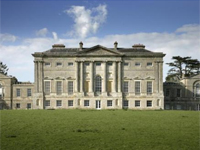
Possibly inspired by the royal example, other country houses were donated or converted for use as hospitals. However, it quickly became apparent that they weren’t particularly suitable with one Irish physician, Edward Foster, complaining in 1768 that ‘In general, Houses have been rented for Hospitals, which are as fit for the Purposes, as Newgate for a Palace‘. By the 1850s hospital design was beginning to emerge as a distinct branch of architecture -Florence Nightingale wrote to an officer of the Swansea Infirmary in 1864 saying that a hospital was a difficult to construct as a watch; no building ‘requires more special knowledge‘. From this time, the country houses themselves became less important than the space they offered with the house itself being used as accommodation or offices. However, for the treatment of respiratory illness the clear country air was considered part of the cure with houses being acquired as tuberculosis sanatoria such as at Moggerhanger Park in Bedfordshire originally designed by Sir John Soane for the Thornton family.
The First World War necessarily required country houses to come back into medical use due to the terrible consequences of the strategy of attrition through trench warfare in WWI which created large numbers of wounded. Without a national health service there were fewer hospitals able to cope with the seriously disabled or even those simply convalescing. Many country houses were pressed into service, their clean country air and fine grounds considered most helpful to rest and recuperation. During WWII, fewer houses were used as military hospitals as changes in military tactics led to many fewer casualties than expected. However, a significant number were used either by the military or as civilian replacements for urban hospitals which it was feared would be bombed.
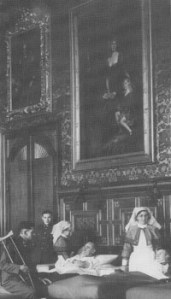
For country house owners, given the possible options of who might take over their house, the bed-ridden were infinitely preferable to the bored squaddies who wreaked such havoc at other houses (apparently housing art treasures was first preference, evacuated schools second, hospitals third). This reality plus a genuine sense of wanting to help led to many owners voluntarily turning over their houses as hospitals including the Earl of Harewood offering Harewood House, Lord Howard of Glossop Carlton Towers, Lady Baillie lent Leeds Castle and the 4th Marquess of Salisbury offering Hatfield House as he had done during WWI. On the civilian side, Brocket Hall in Hertfordshire became a maternity hospital as was Battlesden Abbey in Bedfordshire, Stockeld Park and Farnley Hall, both in Yorkshire. Cholmondeley Castle in Cheshire became a Royal Navy Auxiliary Hospital, treating ‘cases of good morale, who are suffering from nervous breakdown usually as the result of operational stresses’.
After the war many houses were returned to their owners in such terrible disrepair that unfortunately hundreds were demolished. Others continued in their wartime roles with some such a Poltimore House in Devon becoming hospitals after the war when two local GPs recognised the need for more bedspaces and so took over the old seat of the Bampfyldes until it was nationalised after the creation of the NHS in 1948. There were also many War Memorial hospitals, founded by public subscription after WWI, which often made use of a country house. The nationalisation of these hospitals gave the NHS many of the country houses it has today – although it is relatively few overall as less than 5% of all their buildings are grade II* or grade I listed. Of the historic ‘therapeutic’ landscapes it manages, seven are included on the English Heritage Register of Parks and Gardens of Special Historic Interest in England.
However, sometimes these country houses and their settings can escape and revert to being homes, either through conversion or, if the houses has been lost, replacement. Bretby Hall in Derbyshire, built between 1813-15 by Sir Jeffry Wyatville for the Earl of Chesterfield, was an orthopaedic hospital until the 1990s when the main house was converted into flats, as was the High Victorian Wyfold Court in Berkshire. Harewood Park in Hertfordshire was demolished in 1959 after use as hospital in WWII but the estate has been bought by the Duchy of Cornwall with proposals for an elegant and very impressive new Classical house by Craig Hamilton Architects. A similar plan has been put forward for the 57-acre site of the former Middleton Hospital in Yorkshire with the permission requiring the demolition of various redundant buildings from its former use to restore the site.
Sadly though, sometimes the NHS fails to adequately look after the houses it has in its care. As the trend has moved towards large, new hospitals so the historic elements have been overlooked or abandoned as new hospitals are built elsewhere. As funding for new hospitals is not dependent on the sale of the old site and the house, sadly they can be neglected or subject to inappropriate development as has been the case with the grade-II listed Stallington Hall in Staffordshire, which became a home for the mentally ill in 1928, but after it closed has been vandalised and neglected with a housing development built inappropriately close to the house across the lawn, forever ruining it as a country house – a poor payback for years of public service.
Related story: ‘Developers draw up plan for country house‘ [Ilkley Gazette]
Background information: ‘Reusing historic hospitals‘ [Institute of Historic Building Conservation]
 The Country Seat