The finest SAVE, now for sale: Barlaston Hall, Staffordshire

Barlaston Hall, Staffordshire (Image: Knight Frank)

The wholesale destruction of UK country houses in the 1930s and 1950s was undoubtedly a tragic waste; not only of materials but also the embodied beauty and history of the hundreds of houses lost. Barlaston Hall, recently launched on the market for sale, and which was so valiantly fought for by SAVE Britain’s Heritage who famously bought it for £1, provides a case study which shows what might have been possible if circumstances had been different. How many more of our country houses might have survived to still be found nestled at the end of a tree-lined drive?
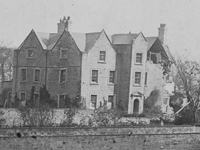
Collapse of Hague Hall, Yorkshire, due to mining subsidence, 1910 (Image: Lost Heritage)

The plight of the country house in the 20th-century struck at both the large and the small, the grand and the intimate.  A financial crisis could, in a generation, take a family from a secure status enjoying thousands of acres to one of ruin and a forced retreat from the family seat.  For some houses the demise was swift – for sale intact one year but the following year could see sales of contents, then fixtures and fittings, and finally the materials. The alternative fate for a number of houses was a lingering demise – abandoned, at risk from thieves and the weather, to an increasingly hostile environment with threats coming from every angle, even from below.

The elegant Barlaston Hall in Staffordshire was one house which fell firmly into the latter category. A remarkable house, it represented an important development of the Palladian tradition; the moment it moved from ‘copying’ to evolving.  The house was built c.1756-58 for Thomas Mills, a local lawyer, with the design convincingly attributed to Sir Robert Taylor (b.1714-1788).

Architecture was not his first choice of career. Taylor was the son of a master mason and sculptor, also called Robert, who was successful enough to build a villa in Woodford, Essex, but who was also rather profligate.  The father managed to get his son apprenticed to the sculptor Henry Cheere and on completing his time, found his father had just enough to send him on to Rome to study.  Whilst there, his father died so he came back to find his inheritance was no more than debts, but friends enabled him to set up as a sculptor and by 1744 he was sufficiently accomplished to be commissioned by Parliament and to carve the pediment of the Mansion House in the City of London.  It became clear that he paled in the shadow of his contemporaries – Roubiliac, Rysbrack and Scheemakers – so at the age of 40 he turned to architecture.

Outside influences often act as catalysts for development. In the same way that Blenheim Palace was enriched by Vanbrugh‘s theatrical experience, so Taylor had the advantage of his earlier, if unsuccessful, sculptural career which brought a more developed sense of shape, form, and movement to his architecture.  Colvin praises him as an architect of ‘considerable originality‘ and that ‘his villas…represented a new departure in country-house architecture‘. What Taylor provided was an evolution of the strict Palladian designs of the previous generation, marrying them to a more tolerant approach that allowed the interiors to be more Rococo, with decorative plasterwork and patterns, drawing on his knowledge of the original sources in Italy. Taylor created wonderfully elegant villas for his clientèle of bankers and merchants, who needed smaller houses for entertaining rather than seats for a rural family empire.

Braxted Park, Essex - note the octagonal window frames (Image: Braxted Park)
Braxted Park, Essex – note the octagonal window frames (Image: Braxted Park)

Although Taylor undoubtedly designed many buildings, he seems to have almost conspired to make it impossible to attribute them as he left no record of his practice and also apparently never signed his drawings.  There are, therefore, large gaps in both his chronological and stylistic history but starting with his first country house, Braxted Park, Essex in 1753-6, it is clear that his skill and legendary capacity for hard graft meant a sizeable output.

Harleyford Manor, Buckinghamshire (Image: Stephen Richards via Geograph)

Of particular note, in relation to Barlaston Hall, is Taylor’s design for Harleyford Manor, Buckinghamshire, in 1755. Part of a group of second-generation Palladians – along with Flitcroft, Keene, Paine, Ware, and Wright – Taylor saw Palladio as an inspiration but was not a slavish disciple.  The core principles relating to proportion and preserving a necessary elegance were respected but it was in the interpretation that they introduced variety.  At Harleyford, Taylor took a more vernacular style to the idea of the Villa Rotonda (a standalone villa with four equal fronts, allied with its landscape) but also combined with a sculptors appreciation that it should be attractive from all angles.

Asgill House, Richmond, Surrey (Image: Matthew Beckett)

Built between 1756-58, the layout and style of Barlaston Hall clearly shows the kinship with Harleyford. The elegant simplicity of the ground floor layout with the four principal rooms pushing out into the arms of the cross with a double-height central hall clearly can be derived from the Villa Rotonda but rotated on the axis to create more interior space, as opposed to the Rotonda’s open loggias.  One of the most distinctive features is the pleasing ‘chinese’-style woodwork, with octagonal window tracery on the exterior, a pattern mirrored in the library in the bookcase doors.  For one so early in his career, Taylor was showing remarkable invention, elegance and practicality, all of which served to launch his practice, which continued for 35 years. After Barlaston, further commissions such as Asgill House (1761-64) on the riverside at Richmond, Surrey, for his friend Sir Charles Asgill, also helped establish Taylor’s reputation.

Not that any of this innovation and elegance mattered to the Wedgwood company who applied twice in the early 1980s to demolish Barlaston Hall.  The house and estate had been bought by the famous pottery firm in 1937 as part of a scheme to create a new factory and model village for their workers.  These were built some distance away but the now grade-I listed house was badly neglected with serious water damage causing it to become increasingly derelict, with ceilings and the staircase collapsing, and the structure affected by subsidence caused by coal-mining.  The house also sat across a geological fault and future mining plans risked the whole area sinking by about 40 feet.  Clearly, this was a house very much at risk.
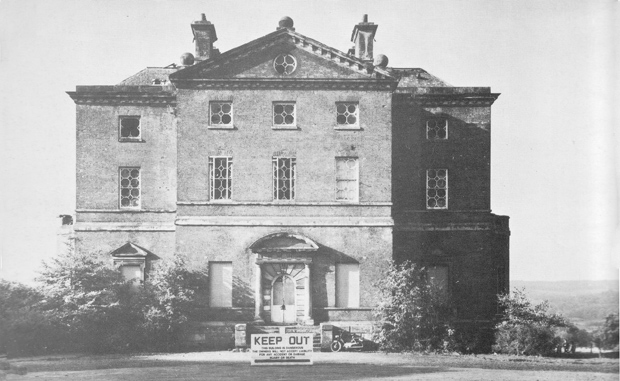
Entrance front, Barlaston Hall, Staffordshire (Image: SAVE Britain's Heritage)
Entrance front, Barlaston Hall, Staffordshire (Image: SAVE Britain’s Heritage)

In 1981, the second application to demolish was called to public inquiry, due to the importance of the house, where the architectural conservation charity SAVE Britain’s Heritage argued the case for the preservation and restoration of the house. As Barlaston Hall had been designated as ‘outstanding’ this placed certain obligations on the National Coal Board who would be required to pay for not only repairs but also preventative measures, such as the huge concrete raft they devised to prevent further movement.  After a few days of arguments, Wedgwood decided that they would make a bold move and offer the house to SAVE for £1 on the condition that it was restored within five years or they could buy it back for £1 (after which the house would no doubt be swiftly demolished).  The then Secretary of SAVE, Sophie Andreae, immediately phoned the President, Marcus Binney (who was in the USA) with the news.  Conscious that he had to make a decision there and then, Marcus called Wedgwood’s bluff and bought Barlaston Hall.

Dining Room, Barlaston Hall, Staffordshire - 1981 (Image: SAVE Britain's Heritage)
Dining Room, Barlaston Hall, Staffordshire – 1981 (Image: SAVE Britain’s Heritage)

A few days later when Marcus was able to visit the house for the first time, the scale of the challenge became starkly apparent.  Stepping into the debris-strewn hallways, light shone through all three floors from gaping holes in the collapsed roof and 4″ cracks indicated where the subsidence was taking hold.  Although most of the fireplaces had been stolen, the good news was that much of the original plasterwork on the walls and the distinctive woodwork had survived.  SAVE immediately organised a temporary roof, after which, the house took nearly 2 years to fully dry out.  Specialist heritage builders and professionals swiftly set to work on both the structural and conservation issues.

East front, Barlaston Hall - 1981 / 2014 (Images: SAVE Britain's Heritage / Knight Frank)
East front, Barlaston Hall – 1981 / 2014 (Images: SAVE Britain’s Heritage / Knight Frank)

Although work had started well, delays in securing the necessary certificates from the Secretary of State meant that the National Coal Board then decided to try and renege on their agreement to fund the work.  SAVE sought leave for a judicial review which prompted the Secretary of State to immediately fulfil his promises, which ultimately forced the National Coal Board to capitulate from their shameful position and fund the repair and preventative works – and SAVE’s legal fees too.  With immediate funding secured, which was followed by further grants, the conservation work continued.  It was put up for sale in 1992 and bought by the current owners who have sensitively completed the restoration of this captivating and fascinating house.

That the value of a house can go from £1 to £2.3m in the space of 30 years shows that the fortunes of country houses can rise as swiftly as they fall.  Barlaston Hall not only represents an important link in our understanding of the domestic Anglo-Palladian tradition, but is also a testament to how determined action can succeed even against larger opponents.  Today, the house still stands proudly displayed from the road, a bold statement of hope and preserved beauty.

——————————————————————

If you would like to support the fight to preserve our architectural heritage, please do become a Friend of SAVE Britain’s Heritage.  You will receive a regular newsletter plus access to the online database of ‘buildings at risk’.  You can also follow them on Twitter: ‘@SAVEBrit‘.  I am on the Committee of SAVE.

——————————————————————

The sale was announced in Country Life magazine: ‘A Country House Reborn‘ [16 April 2014]

Sales particulars: ‘Barlaston Hall‘ [Knight Frank]

A more detailed account of SAVE’s fight: ‘Barlaston Hall‘ – the Wedgwood Museum also has a brief history of the house on their website but which skips over the bit where Wedgwood tried to have it demolished. For historical images, see ‘Neville Melkin’s Grand Tour of the Potteries‘.

William Kent, the reluctant Gothick

If asked what style of architecture one would associate with William Kent, one of the leading designers of the Georgian era, most would say Palladian and, if pushed, they might argue that his interiors are distinctly Baroque.  Yet Kent is also regarded as the creator of the ‘Gothick’ style of architecture; a blend of historical Gothic elements but applied, initially, within the structure of classical rules. This quickly evolved to have greater historical rigour, laying the groundwork for the more zealous interpretation by Victorians such as A.W.N. Pugin.  However, it could be argued that Kent was merely satisfying the stylistic whims of a patron and in his use of ‘Gothic’ elements, was actually continuing the Elizabethan practice of creating ‘symmetrical Gothic’, a visually impressive approach built on Renaissance principles.

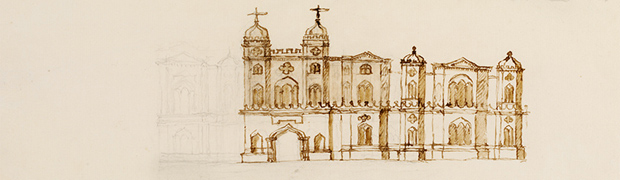
Design for the east front of Esher Place, c1732 (copyright: Merton Heritage & Local Studies Centre)

William Kent was born in 1685 in Bridlington, North Yorkshire, and displayed an early talent for drawing. Despite his parent’s modest means, he ‘had the good fortune to find some Gentlemen…to promote his studyes‘ who paid for him to travel to Italy in 1709, along with another talented young artist, John Talman.  Whilst there, Kent developed his skills in painting, but also in business as an agent for various young aristocrats on the Grand Tour, including Thomas Coke, later 1st Earl of Leicester, and Richard Boyle, 3rd Earl of Burlington, for whom Kent would help purchase paintings and other works of art. The latter connection with Lord Burlington, first professional, then as a friend, was to launch Kent’s career when they both returned to London in 1719, with Kent as the draughtsman of Burlington’s dream of a Palladian Britain.

It was the need for patronage which kept Kent in the thrall of Burlington and the circle of Palladians. Where Kent was given greater freedom, particularly in designing interiors and furniture, his natural inclination seems to have been towards a more Baroque style; a rich, florid escape from the strictures of the pure and elegant Roman style which Burlington so enthusiastically promoted.  So how did Kent become the father of ‘Gothick’, an architectural style characterised by the playful, historically-inaccurate application of medieval Gothic, the language of the cathedrals?

Hampton Court Palace east front of Clock Court - detail of capriccio landscape by William Kent, 1732 (copyright: British Museum)
Hampton Court Palace east front of Clock Court – detail of capriccio landscape by William Kent, 1732 (copyright: British Museum)

Kent’s first documented use of Gothick was in 1732-34 at Hampton Court Palace where he was commissioned to rebuild the east front of the Clock Court as accommodation for the Duke of Cumberland.  As a good Palladian, Kent originally proposed a classical scheme but Sir Robert Walpole, who had final approval over the design as First Lord of the Treasury, required that it be in keeping with the existing Tudor Gothic. Although originally there was only a much simpler door, Kent developed this and created a full gatehouse as a central focus of the front. Though now altered, Kent’s design drew on the existing architectural features, using ogee-domed octagonal turrets and a Gothick Venetian window. The interiors were also remodelled but here Kent’s enthusiasm for Gothick waned and he reverted to a more classical style of decoration.

On a side note, there is a suggestion that Kent’s actual first Gothick design was for a church tower at St Martin’s, Houghton in 1727.  Although the drawings in the Houghton archives are by Thomas Ripley, Kent had been involved with designs at Houghton since 1725 for the owner, Sir Robert Walpole, who, as previously mentioned, also instigated the use of Gothick at Hampton Court.

The most complete early use of this novel Gothick for a country house was at Esher Place, Surrey.  Having bought a 14th-century gatehouse, Wayneflete Tower (the only surviving part of a much larger quadrangular mansion) Henry Pelham, Prime Minister from 1743-54, lacked a house on his estate. Again, Kent proposed a Palladian solution – a compact villa which (minus dome and projecting portico) bears similarities with Lord Burlington’s Chiswick House, completed in 1729. Again, Kent was to be over-ruled by the client who wished for Wayneflete Tower to be more than a grand garden ornament – it had to be the centrepiece of the new house and this dictated the style.

Sketch design for the east front of Esher Place, William Kent, c1732 (copyright: Victoria & Albert Museum)

One can imagine Kent sitting down with pen and paper and, much as if learning a new language, started drawing out his new vocabulary.  Though the initial sketches show two classical wings grafted onto the tower, he also, importantly, was experimenting with a more varied facade, one which pushed forward and receded with canted windows and recessed bays. This movement was to be a key influence in the future, breaking down the more formal, flatter approaches which had previously dominated.  This experimentation also extended to the interiors with rooms taking on greater variety; octagons or rectangular rooms ending in canted bays.

Esher Place, Surrey - John Vardy, after William Kent, c1744 (copyright: London Borough of Lambeth)
Esher Place, Surrey – John Vardy, after William Kent, c1744 (copyright: London Borough of Lambeth)

Kent’s final design (see at the top of the article) was an elegant solution and created a charming composition of a symmetrical house with the wings dominated by full-height canted bays and grand ogee-capped domes on the central tower. Unfortunately the scheme was watered-down in the execution – John Vardy‘s c.1744 engravings showing more austere wings without the bays and the tower without the domes. Even these were not to last as the new owner of the estate in 1805 pulled down the wings, leaving just the historic tower, before building a new house (the 1805 house is the south wing of the 1895 house) on the hill above – just as Kent had originally proposed to Pelham.

Proposed alterations to Honingham Hall, Norfolk, 1737, by William Kent (copyright: RIBA British Architectural Library)

After Esher Place, in the next of Kent’s Gothick experiments, in 1737 he produced a design for the remodelling of Honingham Hall, Norfolk, for the second son of Viscount Townshend. A year later, Kent came back with a more detailed plan which removed much of the Jacobean character of the house, which had originally been build c.1605, to dramatically alter the front with a mixture of the bays and recessions. Sadly neither of the designs where executed and the house itself was demolished in 1966.  However, this exercise gave Kent an opportunity to gain greater familiarity with Gothick detailing and elevations.

Rousham House, Oxfordshire (Image: Country Life Picture Library)

The only other significant house Kent was to design in this style was Rousham House, Oxfordshire, for Lieutenant General James Dormer in 1737 (note the same year as the first proposed design for Honingham Hall). This was a remodelling of a small, H-plan house built in the 1630s and so Kent’s design had to accommodate the inevitable compromises of an existing building.  This he did by taking elements of the Honingham design, including the crenellations and a central ogee-capped dome, and combining them with classical elements such as the two pavilions which flanked each side. The interiors were a mix of styles; the parlour was purely classical but the library (a drawing room since 1764) was Gothick (or oriental, or Moorish, depending on who you ask). The gardens are the celebrated delight of Rousham and the buildings were designed by Kent at the same time as the house but are almost all classical, bar a Gothick Corn Mill.

North front of Rousham House, Oxfordshire, 1739 (copyright: private collection)

Other Gothick projects by Kent such as the screens for Westminster and Gloucester Cathedrals, the Choir Fittings at York Minster, and various garden buildings all show a facility but not a fluency with the Gothic language. The same elements are used repeatedly within a variety of layouts and plans but without the detailed study of the original source buildings Kent seemed bound to his limitations.

Mount Edgcumbe, Devon - print drawn by T. Allom, engraved by C. Mottram. 1830
Mount Edgcumbe, Devon – print drawn by T. Allom, engraved by C. Mottram. 1830

Did Kent ‘create’ Gothick? Yes – and no.  The Elizabethans had long been creating houses which deployed the language of historical Gothic to their houses.  An article by Mark Girouard on ‘Elizabethan Architecture and the Gothic Tradition‘ (SAHGB, 1963) cites Burghley, Lincolnshire, where the house features a west front (built 1577-78) of towers and a turreted gatehouse, a north front (1585) dominated by Tudor-Gothic windows with a Gothic parapet, and the clock tower (1587) has an almost Gothic spire.  The Elizabethan ‘Prodigy’ houses featured an emphasis on the vertical with towers and squared-off bay windows such as Robert Smythson’s Worksop Manor.  Finally, the symmetry that underlies Kent’s work, can be seen in the Renaissance-influenced Elizabethan houses such as Longleat or Mount Edgcumbe.

What Kent did do was apply his natural love of a more lively baroque interpretation of Gothic design to create a style which, although it mainly influenced those he worked with, was an inspiration to a later group of designers such as John Vardy and Batty Langley.  Overall, Kent’s Gothick houses and interiors lack the commitment and historical rigour he displayed to the Palladian style or the verve and passion which characterised his Baroque efforts. Certainly a measure of his success is that Kent did create a new architectural language which fed the wider Georgian passion for the Picturesque. Here, at last, was a style which could break strict Classical regularity and substitute it with a rambling vision of finials and tracery.

——————————————————————————-

This article was clearly inspired by the superb exhibition: ‘William Kent: Designing Georgian Britain‘ (22 March – 13 July 2014). Definitely worth a visit if you are in London.

A brilliant tome (it’s huge) has been produced to coincide with the exhibition but easily works as a standalone reference: ‘William Kent: Designing Georgian Britain‘ by Susan Weber.

The Victoria & Albert Museum has an extensive collection of William Kent drawings

Ripples of Palladio: Forcett Hall, Yorkshire for sale

Forcett Hall, Yorkshire (Image: GSC Chartered Surveyors)

For those of us who love our country houses, the weekly delight of the new Country Life magazine are the many pages of houses for sale.  Although the space is usually dominated by the major players such as Knight Frank, Savills etc, a particular joy is when you discover, tucked away with a smaller agent, an especially good house which deserves to be better known.

One recent house which falls neatly into this category is Forcett Hall, near Richmond in North Yorkshire.  Grade-I listed, this house forms part of the spread northwards of the fashionable ideas of Lord Burlington and the Palladians. ‘Palladianism’ (as it became known) formed a new movement and became the dominant architectural taste from around 1710 until around 1750 but which is still very popular and influential today.

The Palladians were largely influenced by the work of the Italian architect Andrea Palladio (b.1508 – d.1580) whose work, particularly around Vicenza, drew heavily on the ancient classical form of Roman architecture.  The ideas were spread to Britain initially through the work of Inigo Jones, a multi-talented theatrical designer to the Court who also became the Royal Surveyor of Works which gave him the platform to spread the ideas of Italian Renaissance architectural classicism to these shores, starting with the Queen’s House in Greenwich, London.

Wanstead House, Essex

Key to the spread of these new ideas were two books, volumes 1 & 2 of ‘Vitruvius Britannicus‘, which took the form of a folio of one hundred classical buildings, published by the architect Colen Campbell.  Campbell also created one of the most important buildings of early Palladianism, Wanstead House in Essex, (dem. 1824) which re-interpreted the form of Vanbrugh‘s Baroque Castle Howard but in a new, more austere architectural language.  This was then followed by Wilbury House, Wiltshire, designed and built in 1710 by William Benson who succeeded Sir Christopher Wren as Surveyor of Works.  Wanstead inspired several derivatives in the years following its completion including Moor Park, Hertfordshire (1720s by Thornhill and Leoni), Wentworth Woodhouse, Yorkshire (alterations of 1733 by Flitcroft), Nostell Priory, Yorkshire (1733 by Paine) and Prior Park, Wiltshire (1735 by John Wood I).

Chiswick House, Middlesex (Image: curry15 / flickr)

Richard Boyle (b.1694 – d.1753), the 3rd Lord Burlington and 4th Earl of Cork, played a  significant role in firmly establishing Palladianism as a movement through his own influence, patronage and his circle of followers.  Burlington employed Colen Campbell to remodel his London house (taking over the work started by his rival James Gibbs) but Burlington was also a skilled architect, building the beautiful Chiswick House, in west London, in 1729, not so much as a home (it contains only state rooms) but as an architectural statement of his new principles.

One of Burlington’s protégés who assisted him as clerk of works on some of his earlier projects was Daniel Garrett (b.? – d.1753).  A measure of his competency can be seen in a letter sent in 1737 by Sir Thomas Robinson to Lord Carlisle regarding proposed works to complete the Mausoleum at Castle Howard:

“My Lord Burlington has a much better opinion of Mr Garrett’s knowledge and judgement than of Mr Flitcroft’s or any person whatever, except Mr [William] Kent…”

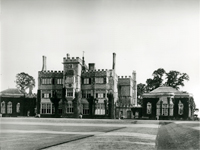
Stanwick Park, Yorkshire - dem. 1923 (Image: Lost Heritage)

However, despite his skill, Garrett was dismissed from his role in the Office of Works in 1737 for ‘not attending his duty’.  This was probably related to his absences caused by his own growing architectural practice in the north of England.  In 1735 he was remodelling Wallington Hall, Northumberland for Sir Walter Blackett, in 1736 he was at Castle Howard, and in 1737 he was working for Lord Derby, and between 1739-40 working for Sir Hugh Smithson, Bart, (later 1st Duke of Northumberland) on the rebuilding of Stanwick Park, Yorkshire (sadly demolished in 1923). He was later to work at other distinguished houses including Raby Castle in Co. Durham, Warwick Castle, Northumberland House in London (dem. 1874), Horton House in Northamptonshire (dem. 1936), Uppark in Sussex, Kippax Park in Yorkshire (dem. 1956-59) and most notably Foots Cray Place in Kent (dem. 1950).

This gives a measure of Garrett’s skill and his client list.  It was following his work at Stanwick that he started work at Forcett Hall in 1740 – though there does seem to be some debate as to what he did.  A list at Alnwick Castle says that the house is by ‘Mr Garrett for Mr Shuttleworth’, the latter being Richard Shuttleworth, the local MP who commissioned the house, whose family owned the estate between 1582-1785.  Although the estate agents state that the design of the house can be attributed to him as a rebuild following a fire in 1726, Howard Colvin thought him an unoriginal architect but skilled in providing handsome houses and instead only gives him a now demolished part of the east wing, the lodges and park entrance, the ceiling of the saloon (copied from the dining room at Chiswick House), and the grotto.

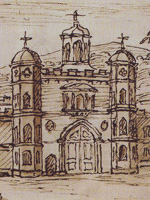
Forcett Hall, Yorkshire - as drawn by Samuel Buck

So if he didn’t design the main block, here’s an alternative theory; the house wasn’t completely burnt down in 1726 but was just seriously damaged, and Garrett gave a Palladian flavour to the house as part of the restoration.  The south front of the original house was drawn by Samuel Buck in his usual technically flawed idiosyncratic style (see right).  This is the same view in the picture of the house at the top of the post but the current house lacks the projecting wings but it does share the exact same form of three storeys over a semi-sunken basement.  Looking at the main house now (there’s an excellent picture on flickr: Forcett Hall – and also see the paintings in the comments), it could be argued that the elements of Palladianism – Ionic pilasters, quoins, external staircase have merely been applied to the house rather than forming a fundamental part of the design.  By excavating the semi-sunken basement (note the level of the lawn to the left), Garrett creates not only the appearance of a piano nobile, but also creates the space to add the staircase which is also in a typical Palladian style (and appears to be a modified form of the one at Stourhead as shown in ‘Vitruvius Britannicus) – but which seems to be an addition rather than a focus.  Elements such as the pilasters with their Scamozzi Ionic capitals almost seem to be copied from the entrance front of Marble Hill House in Twickenham (built 1724-29 by Roger Morris). Conversely, the north (entrance) front of Forcett is almost a different house; looking far more like an Italian villa than a Yorkshire country house (and I’m sure I recognise it from somewhere…).  Or perhaps I’m completely wrong and it is a new house, the design of which exposed the limitations of the architect.

This is a fascinating house, well worthy of it’s grade-I listing, though the photos on flickr show it’s in need of some care and restoration to fully bring out the beauty of this wonderful house.  The interior boasts some fine plasterwork and the house is set in a perfect small park which includes a 17-acre lake, no public footpaths and a grotto.  If someone is looking for a house with privacy but also a history to be explored there are few better houses available.

Property details: ‘Forcett Hall‘ [GSC Chartered Surveyors] – comes with over 230-acres, guide price £5.5m.

Property brochure [PDF]: ‘Forcett Hall‘ [GSC Chartered Surveyors]

——————————————————————————

British and Irish Stately Homes blog – more property for sale

This is also a good point to highlight another blog you should find interesting.  British and Irish Stately Homes is written by Andrew who is a frequent contributor to the comments in this parish.   Featuring houses for sale, TV programmes involving country houses, books on the topic plus much more it covers some more of the areas I just don’t have time to!  Do bookmark it, subscribe and let Andrew know if you spot anything you think ought to be added.

Country House Rescue: a matter of taste – Monreith House, Galloway

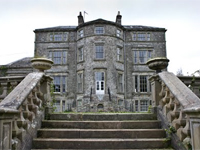
Monreith House, Scotland (Image: Mike Harrison / UK Wildlife Photography)

Country House Rescue heads from Tapeley Park in Devon to the other end of the country to Monreith House in Galloway, Scotland.  A dignified house, it has suffered from a classic problem for those that inherit, as the current owner Sir Michael Maxwell did in 1987, that: “…to put it politely, my relatives’ expenditure exceeded their income by many times.”. The necessary economies forced on Sir Michael have meant some cut corners which Ruth Watson quickly identifies as hindering his attempts to move upmarket.

The Maxwells of Monreith were certainly aristocratic with their baronetcy granted by Charles II in 1681 and various family members marrying well including the 8th Baronet’s wife, Lady Mary, who was a daughter of the Duke of Northumberland, one of the richest and largest landowners in England. The Maxwells had been based at Myrton Castle since they bought it in 1685, obviously needing a house to match their newly elevated status.

Leuchie House, Scotland (Image: John Small - 1883 / buildings fan on flickr)

Monreith House was built in 1791 by Sir William Maxwell, 4th Baronet, to replace Myrton, which was partially demolished to provide building materials for the new one.  The architect was the Edinburgh-based Alexander Stevens, son of a better known Alexander Stevens who specialised in designing and building bridges.  His design at Monreith shows that he was well versed in the Palladian vocabulary but is in contrast to his other principal design; the impressive Raehills in Dumfriesshire, built for the 3rd Earl of Hopetoun in 1786, which is an imitation of Robert Adam‘s castle style.  Monreith shows closer similarities with Leuchie House in Lothian, built for Sir William Dalrymple between 1779-1785, to designs by the little known Alexander Peacock who was also based in Edinburgh.  By the 1790s, the first wave of Palladianism had long ago swept through the country and much provincial design can be traced back to the many architectural pattern books which had been produced.  Stevens’ limited but varied output could indicate he used also used them, though perhaps more competently than most.

The Maxwells of Monreith became one of the most important families in the area with a substantial estate which totalled 17,000-acres.  The house has passed down through the Maxwells, though it never went to the most famous of the family, the writer Gavin Maxwell, heir to the 8th Baronet, Aymer Maxwell, but who died of cancer in 1968.  Gavin’s books were best-sellers, with his most famous being the autobiographical ‘A Bright Ring of Water‘ about his pet otter, the profits of which might have helped the estate but for his profligate ways.  His father also faced financial difficulties and, lacking funds to maintain the house, apparently felt it easier – and cheaper – to let the house deteriorate rather than pay to have it demolished.

When Sir Michael inherited the house from his uncle it was in a seriously neglected state, saying he remembers that “When it rained hard the water would run down the stairs and land in puddles on the floor.”.  Sir Michael had trained as a surveyor so he was able to approach much of the work himself – though this also appears to be part of the problem. One money-making scheme was to convert the top floor into holiday flats but these, and the rest of the house, all show signs of his major flaw – a determination to do things as cheaply as possible leading to various poor choices which compromise his aspirations.

Sir Michael displays an admirable duty towards maintaining the house – a contrast to that displayed initially by Hector Christie of Tapeley Park in the previous episode.  Sir Michael says “It would be too easy if your great-grandfather dropped dead and left you money to end up a drunk in the gutter – so it’s a challenge. Essentially, you’re not given much choice when you inherit a house like this.”.  Thankfully he does appear to want to listen to Ruth Watson’s advice and one hopes that this will put him on the path to a sustainably prosperous future which will ensure the Maxwells remain at Monreith.

Official website: Monreith House, Galloway

Programme website: Country House Rescue: Monreith House [Channel 4]

The future of the country house? Alderbrook Park, Surrey

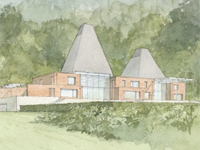
Proposed Alderbrook Park, Surrey (Image: PRS Architects)

Within any established pattern there is always the shock of the new. Most people when asked to imagine an English country house will usually think of red-brick Jacobean or light-stone Georgian but the design of new country houses is always in flux and what has gone before is no guarantee of what will come. Following World War II, the aftermath of which led to the demise of many large houses, the fashion changed to have a smaller but more modern house – one which required fewer staff and perhaps used more contemporary architectural language; however much it was derided by others.

Queen's House, Greenwich (Image: Bill Bertram / wikipedia)

The nature of architectural innovation has usually been one of gradual change – subtle at first and then growing bolder.  For example, Palladianism is widely seen to have arrived rather dramatically with the building of the Queen’s House in Greenwich in 1616 to a design by Inigo Jones.  Jones had recently studied Palladian architecture in Rome for three years and this commission was his chance to put this into practice.  One can imagine the surprise of Londoners, long used to timber, gables, and red-brick, to the square, stuccoed, and very white, Queen’s House.  Yet Sir John Summerson argues that there is evidence of Palladianism in the plan of Hardwick Hall in Derbyshire, built in the 1590s by Robert Smythson.  Here, the placing of the hall on the central axis of the main entrance and the colonnades between towers front and back, echo the layout of Palladio’s Villa Valmarana featured in his Second Book of Architecture, making Hardwick the first known use of Palladio by an English architect.  This quiet use would have meant that visitors would have become accustomed to a symmetrical, regularised interior, paving the way for the same style to appear externally.

As much as the role of ‘architect’ took time to develop, so to did the responses to their work.  In 1624, Sir Henry Wotton, writing in his ‘Elements of Architecture‘, bemoaned the lack of ‘artificiale tearmes’ – that is, language with which to describe architecture.  Yet William Webb, writing in 1622, managed to praise the then new Crewe Hall in Cheshire, saying that the owner, Sir Randolph Crew;

“…hath brought into these remote parts a modell of that most excellent for of building which is now grown to a degree beyond the building of old times for loftiness, sightlines and pleasant habitation…”

So, ever since we’ve had architects, we’ve had critics (who were also sometimes architects); Jones, Wren, Ruskin, Pugin, Morris, Lutyens, Pevsner, etc have all made their opinions known.  Overseas visitors were also apt to compare what they had seen.  Jean Barnard le Blanc, visiting in 1737-8, was well educated and travelled and critical of the emerging use of Italian designs in England saying;

“These models have not made the English architects more expert; for whenever they attempt to do anything more than barely to copy, they erect nothing but heavy masses of stone, like of Blenheim Palace…”

As the language developed and architecture became more academic it became more rigorous and perhaps dry, with light relief afforded by more waspish commentators such Sacheverell Sitwell.

So why are some houses criticised more than others?  It seems that houses which appear without the ground being prepared before them suffer most.  The shock of the new is unmitigated and particularly where there is a strong local vernacular, the language of the new house will be a greater change.  More broadly, where a house is seen to be breaking with old traditions and what is seen as the ‘appropriate’ style for a family or an area, criticism can be swift and strong.

Eaton Hall by John Dennys for the Duke of Westminster (Image: Kathryn Gammon)

One example of this is Eaton Hall in Cheshire following the unfortunate demolition between 1961-63 of the vast Victorian masterpiece designed by Alfred Waterhouse.  The loss of the house left a gaping hole at the centre of the estate with large gardens and long tree-lined avenues leading to nowhere.  The 5th Duke decided to rebuild and commissioned his brother-in-law, the architect John Dennys, to design a very modern replacement.  The resulting house, although striking, was regarded as unsuccessful, with John Martin Robinson saying,

“The sad fact is that, while from a distance the new Eaton has some of the classic Modern impact of the Corbusier dream…close up it is rather disappointing…”

Yet rather than criticising the house for not being in the traditional language of the English country house, Robinson is saying that it’s not Modern enough.  Others disagreed, with perhaps the most amusing response coming from the Duke of Bedford before it was even built.  Writing in 1970 after the unveiling of the design, he wrote;

“I was interested to see…a sketch model of Eaton Hall.  It seems to me one of the virtues of the Grosvenor family is that they frequently demolish their stately home [Waterhouse’s being the third on the site]. I trust future generations will continue this tradition if this present edifice, that would make a fine office block for a factory on a by-pass, is constructed.”

Proposed Grafton New Hall, Cheshire (Image: Ushida Finlay Architects)

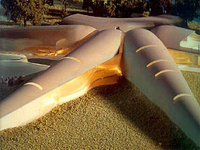
In more recent times, one design which met with critical acclaim but was perhaps a step too far was the Ushida Findlay design for Grafton New Hall, Cheshire.  Their house was a response to a 2001 RIBA competition to ‘design a country house for the 21st century’.  In creating their radical ‘star-fish’ layout they were rejecting the established patterns and trying to create a new response to the same requirements for the functions of a country house.  Yet the house never found a patron and, tellingly, the house now being constructed is a classic of modern Palladianism, designed by the pre-eminent Classical architect, Robert Adam.

There are, of course, many other examples of intelligent but unpopular designs for modern country houses – for example, Wadhurst Park in Sussex for TetraPak billionaire Hans Rausing.  And it’s in this constant stylistic flux into which Lakshmi Mittal has pitched the very radical designs for his new house on the 340-acre Alderbrook Park estate which he bought four years ago for £5.25m.  The original house by Richard Norman Shaw for the Ralli family was demolished in 1956 as too large, with a poor, inadequate substitute built in the 1960s.  The estate was sold with the express intention of demolishing this house and in its place Mittal is proposing a £25m, carbon neutral ‘eco-home’.  To help achieve this, the design of the house is driven by the functional requirements to minimise heat loss, to be cooled by natural ventilation, and have hot water provided by pyramid chimneys which incorporate solar thermal collectors which will help also vent heat in summer.  This house is a rejection of the idea of the house as an aesthetic construct in a particular architectural style but is more Corbusier-like; a ‘machine for living’ – a somewhat depressing prospect.

Grafton New Hall, Cheshire (Image: Robert Adam Architects)

So what does the future hold?  The natural course of the development of the country house has been its adaptation to the whims and preferences of the owners.  As younger generations have taken the reins they’ve chosen different and perhaps more fashionable styles – and without change we wouldn’t have the Georgian mansions or Lutyens to love. However, each of the previous styles could be seen as natural evolution which reused a broad architectural vocabulary which was instantly recognisable as distinctively rural.  What seems to jar with the very modern designs is that they seem to use a more urban, industrial language to interpret the form of the country house.  This seems to sit somewhat uneasily with our preconceived notions as to what a country house should look like – but who knows, perhaps in 50 years maybe it’ll be accepted and appreciated and we’ll be concerned about the next stylistic evolution.  I still prefer Georgian Palladian.