Country House Rescue: a matter of taste – Monreith House, Galloway

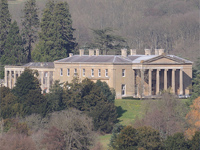
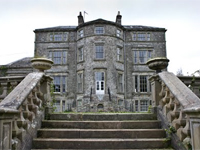
Monreith House, Scotland (Image: Mike Harrison / UK Wildlife Photography)

Country House Rescue heads from Tapeley Park in Devon to the other end of the country to Monreith House in Galloway, Scotland.  A dignified house, it has suffered from a classic problem for those that inherit, as the current owner Sir Michael Maxwell did in 1987, that: “…to put it politely, my relatives’ expenditure exceeded their income by many times.”. The necessary economies forced on Sir Michael have meant some cut corners which Ruth Watson quickly identifies as hindering his attempts to move upmarket.

The Maxwells of Monreith were certainly aristocratic with their baronetcy granted by Charles II in 1681 and various family members marrying well including the 8th Baronet’s wife, Lady Mary, who was a daughter of the Duke of Northumberland, one of the richest and largest landowners in England. The Maxwells had been based at Myrton Castle since they bought it in 1685, obviously needing a house to match their newly elevated status.

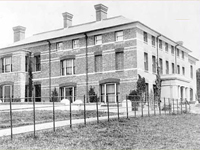
Leuchie House, Scotland (Image: John Small - 1883 / buildings fan on flickr)

Monreith House was built in 1791 by Sir William Maxwell, 4th Baronet, to replace Myrton, which was partially demolished to provide building materials for the new one.  The architect was the Edinburgh-based Alexander Stevens, son of a better known Alexander Stevens who specialised in designing and building bridges.  His design at Monreith shows that he was well versed in the Palladian vocabulary but is in contrast to his other principal design; the impressive Raehills in Dumfriesshire, built for the 3rd Earl of Hopetoun in 1786, which is an imitation of Robert Adam‘s castle style.  Monreith shows closer similarities with Leuchie House in Lothian, built for Sir William Dalrymple between 1779-1785, to designs by the little known Alexander Peacock who was also based in Edinburgh.  By the 1790s, the first wave of Palladianism had long ago swept through the country and much provincial design can be traced back to the many architectural pattern books which had been produced.  Stevens’ limited but varied output could indicate he used also used them, though perhaps more competently than most.

The Maxwells of Monreith became one of the most important families in the area with a substantial estate which totalled 17,000-acres.  The house has passed down through the Maxwells, though it never went to the most famous of the family, the writer Gavin Maxwell, heir to the 8th Baronet, Aymer Maxwell, but who died of cancer in 1968.  Gavin’s books were best-sellers, with his most famous being the autobiographical ‘A Bright Ring of Water‘ about his pet otter, the profits of which might have helped the estate but for his profligate ways.  His father also faced financial difficulties and, lacking funds to maintain the house, apparently felt it easier – and cheaper – to let the house deteriorate rather than pay to have it demolished.

When Sir Michael inherited the house from his uncle it was in a seriously neglected state, saying he remembers that “When it rained hard the water would run down the stairs and land in puddles on the floor.”.  Sir Michael had trained as a surveyor so he was able to approach much of the work himself – though this also appears to be part of the problem. One money-making scheme was to convert the top floor into holiday flats but these, and the rest of the house, all show signs of his major flaw – a determination to do things as cheaply as possible leading to various poor choices which compromise his aspirations.

Sir Michael displays an admirable duty towards maintaining the house – a contrast to that displayed initially by Hector Christie of Tapeley Park in the previous episode.  Sir Michael says “It would be too easy if your great-grandfather dropped dead and left you money to end up a drunk in the gutter – so it’s a challenge. Essentially, you’re not given much choice when you inherit a house like this.”.  Thankfully he does appear to want to listen to Ruth Watson’s advice and one hopes that this will put him on the path to a sustainably prosperous future which will ensure the Maxwells remain at Monreith.

Official website: Monreith House, Galloway

Programme website: Country House Rescue: Monreith House [Channel 4]

Country House Rescue: Tapeley Park, Devon

Tapeley Park, Devon (Image: chatoul / flickr)

The subject of the 13 March episode of Country House Rescue, Tapeley Park in Devon, carries on the wonderful tradition for country house eccentricities – and eccentrics.  From how the site was chosen to the manner of the inheritance, this beautiful house has a fascinating history – though more recently it’s been a little neglected.

According to Simon Jenkins, “Few Devon houses have so spectacular an outlook” – and few would disagree.  Situated above the pretty seaside town of Bideford, the site of the house was apparently chosen by the builder, Captain William Clevland, who apparently spotted the location through his telescope as he sailed up the Torridge in 1702.  He made good on his wish, rebuilding the existing manor house in an austere and somewhat uninspiring style but which took full advantage of the fine views from its elevated position – though this was later largely negated by an enthusiastic blocking up of windows to avoid the window tax.

Tapeley Park, Devon - before Belcher alterations (Image: tapeleygardens.com)

The house eventually passed to the Christie family through marriage when Agnes Clevland married William Langham Christie in 1855.  The Christie fortune was made when one Daniel Christie joined the East India Company and was later given a fortune in gems by a Sultan in thanks for having prevented troops from pillaging a harem.  On his return he married the daughter of Sir Purbeck Langham of Glyndebourne in East Sussex and Saunton Court in Devon.  His grandson, Augustus Langham Christie, inherited both estates and now being a very eligible and wealthy man was able, in 1882, to marry the daughter of the Earl of Portsmouth, Lady Rosamund, whose family seat was the nearby Eggesford House (demolished in 1917).  Coming from such a grand house she was fairly unimpressed with Tapeley, writing in her diary:

“When I first saw Tapeley it was in the winter of 1881 before my marriage to Augustus Langham Christie. It was a Georgian stucco house, very plain and rather dreary in appearance, for many of the front windows had been blocked and the sunk apertures painted black with halfdrawn paint blinds, cords and tassells, looked very dull. The terrace walk and garden did not exist and the drive approached between iron railings.”

The marriage was not a particularly happy one with Lady Rosamund eventually banishing Augustus to the other Christie estate, the nearby Saughton Court, for his ‘eccentricities’ which apparently included ‘childish behaviour’ such as kicking the furniture repeatedly to annoy her.  In his absence, Lady Rosamund poured her energies into rebuilding Tapeley and engaged one of the leading neo-baroque architects, John Belcher (b.1841 – d.1913).  Due to limited finance, the work was to last from 1896 until 1916 but the professional relationship between client and architect was a happy one – so much so that on his death she had a plaque added to a wall in his memory.

Belcher is not as widely known as perhaps he should be, though his work is well regarded. He worked mainly on commercial buildings and institutions including the Whiteleys department store in London, and the brilliant Mappin & Webb building in the City of London which was scandalously demolished in 1994 to build No.1 Poultry (the only good view is looking out from the top of it!). More prominently, Belcher also designed in 1907  the imposing Ashton Memorial in Lancaster for Baron Ashton.

Belcher transformed the ‘dreary’ house to create an imposing but elegant ‘Queen Anne’ style Georgian villa of brick with stone pilasters, parapet and a pediment, sitting above the impressive terraced gardens. The interiors are also of note, featuring a grand staircase hall and also several good fireplaces and plaster ceilings from the original house.  Lady Rosamund had to fight to keep hold of her creation as, in an act of revenge, Augustus left the house in his will on his death in 1930 to a distant cousin in Canada, forcing her to have to go to court to argue, successfully, that Augustus was obviously insane.

The house and estate were inherited by her son, John Christie, who founded the famous opera at Glyndebourne, where he spent the other half of his time when he wasn’t at Tapeley.  Tapeley was then inherited by his daughter, another Rosamund, who frugally ran the house until her death in 1988 and was known for conducting the tours with a parrot on her head.

The current owner is one Hector Christie, Rosamund’s nephew, who apparently decided with his brother which was to inherit Glyndebourne and Tapeley by flipping a coin whilst in a Brighton nightclub.  Hector, though Eton-educated, is something of a rebel, once sneaking into a Labour party conference to heckle Tony Blair about the Iraq war, and also extending a fairly broad invitation to various hippies to create something of an eco-commune at Tapeley.

Though almost all the hippies have now left, Hector has now decided that he should focus on managing the house and estate on a more commercial basis, and not a moment too soon judging by the deteriorating condition of the grade-II* listed house, where part of the dining room ceiling fell in shortly before Ruth Watson’s first visit.  Fingers crossed her advice can provide a means for the family to stay in their ancestral seat without compromising either the architecture or setting or his principles.

Official site: Tapeley Park, Devon

Country House Rescue: Tapeley Park

Country House Rescue returns for Series 3: Wyresdale Park, Lancashire

Wyresdale Park, Lancashire (Image: Channel 4)

The history of the country house is sadly often a cycle of rise and fall with the main variable being the speed of each respectively.  The old phrase was ‘one generation made the wealth, the second enjoyed it, and the third lost it’. Over recent decades the trend has changed slightly in that, with longer life expectancies prolonging the older generations, the houses have had fewer chances for the rejuvenation which inheritance often brought.  As an alternative, Ruth Watson uses Country House Rescue as a catalyst for the type of entrepreneurial change which is the only way for these houses to survive – if only the owners would listen!

The first episode in Series 3, to be broadcast at on Channel 4 at 21:00 on 6 March 2011, takes us to Wyresdale Park in Lancashire to meet a father and son who don’t agree on the best way to maximise the obvious potential of the beautiful estate.

Wyresdale Hall was built between 1856-65 for Bolton cotton-magnate-turned-banker, Peter Ormrod, who bought 6,000-acres from the Duke of Hamilton to create his estate.  The house, which cost £50,000 (about £4m at today’s value) at the time, was designed by noted local architect Edward Graham Paley (b.1823 – d.1895) who had an extensive practice, partnering first with his mentor Edmund Sharpe, then, following Sharpe’s retirement, Hubert Austin, before being joined by his son, Henry Paley. The work of Paley & Austin in particular was well-regarded with Pevsner  saying they “did more outstanding work than any other in the county” and was “outstanding in the national as well as the regional context”.

Paley worked on relatively few country houses, being much better known for his ecclesiastical output, with included the design of Lancaster Cathedral.  Paley was brought up in deeply religious home and, working with Edmund Sharpe, who was heavily influenced by Pugin, it was unsurprising that Paley adopted the strict ecclesiastical style with the ‘correct’ use of Gothic elements.  Perhaps looking a little too much like a convent rather than a home, the house is, nonetheless, still a good example of the type of regional interpretations of Pugin’s architectural theories which gained ground in the 19th-century.

The grade-II listed house and estate passed through the Ormrod family before the land was bought by the Whewell family in the 1920s who then bought the house in 1967.  Now the family are facing the usual struggles of a listed house, an extensive list of improvements, and the need to make the changes which sometimes sit uncomfortably with the more traditional older generation.

———————————

Country House Rescue – Series 3

My usual powers have slightly failed me and I haven’t a verified list of all the houses in Series 3 but here are the ones I have identified so far:

See also:

A shock return: Abbey Dore Court

Abbey Dore Court, Herefordshire (Image: Sykes Cottages)

Memories of a happy childhood can seem all the stronger as time passes, yet when confronted with the reality when revisiting once familiar haunts it can make any changes seem all the more jarring.  For Clare Sage, her return aged 27 to her grandmother’s home, Abbey Dore Court in Herefordshire, was a particularly hard welcome as the house had been effectively abandoned by her grandmother for several years so she could concentrate on the garden.  Despite Clare’s determination she needed some help and so her family’s home is the subject of Ruth Watson’s Country House Rescue.

After coming back from years living away, walking through her former childhood home, Clare was shocked to discover the many leaks, falling ceilings, holes in the floors, and a general air of neglect.  Built in the 1870s, the house, although comparatively large with 11-bedrooms and 6 acres of gardens, is only a minor country house and much smaller than those usually featured in Country House Rescue.  However, it shows that even the smaller houses can be as problematic as the much larger ones. Again, it’s a familiar pattern of ageing owner with insufficient income to employ full-time staff for maintenance, who does what she can but then find it’s has become just too much. These houses can then deteriorate quick rapidly if the problems are ignored – and with country houses being naturally isolated this is all too easy.

Thankfully, in this case, it appears that Clare’s dedication has enabled the restoration of the house and it is now available for rent which will not only create an income but, perhaps most importantly, will ensure that the house is lived in, keeping it warm and ensuring any problems will be spotted quickly and dealt with.  Here’s hoping that one day, Clare’s hard work with be rewarded with her being able to move back in and live in her family’s home.

Official website: ‘Abbey Dore Court

Rental details: ‘Abbey Dore Court‘ [Sykes Cottages]

Programme to be broadcast at 20:00 on 15 April 2010 on Channel 4.

A problem shared? Whitbourne Hall visited by Country House Rescue

Whitbourne Hall, Herefordshire (Image: David Cronin on flickr)

The great wealth generated by the Victorians led to the creation of some of our grandest country houses.  Designed to impress guests and provide a showcase for the collections and taste of the owners, these houses were remarkable and beautiful expressions of the power and preferences of the age.  However, in the more straitened circumstances of the 20th-century, this left owners with running costs which far outstripped their wealth and which unfortunately led to hundreds of our country houses being demolished.

Some escaped the wreckers pickaxe through conversion into apartments – but this doesn’t always solve the questions about the long term sustainability of a house, as shown by the visit of the TV programme Country House Rescue to Whitbourne Hall in Herefordshire.

The grade-II* listed house was built for vinegar magnate Edward Bickerton Evans whose father founded the Hill Evans Vinegar works in Worcester in 1830, which was, by 1905, the biggest vinegar producer in the world.  As was standard practice for the discerning Victorian millionaire he decided to build a grand country house and chose a cornfield in Whitbourne as the perfect location.

Despite its Georgian appearance, it was built between 1860 and 1862 to a design by Edmund Wallace Elmslie and inspired by the Erectheum on the Acropolis in Greece. The house was a lavish example of neo-Palladian architecture with a six-column portico, whilst on the south front a huge orangery, now known as the palm house, was added in 1875 and was thought to be the tallest in Europe.  The interior features a fine pillared main Hall with a rare blue and white glass ceiling, and the main reception rooms retain many original features.  At it’s height in 1876, the estate extended to over 2,500 acres with the classically beautiful Whitbourne Hall sitting proudly at the centre.

Remarkably, the Hall remained in the Evans family until 1980, when it was purchased by Whitbourne Hall Community Ltd to be run as a communal housing project with individual apartments and set in eight acres of gardens.  This original arrangement floundered and a commercial company was created to run the house as a more conventional managed community of 23 apartments.  The main rooms have been preserved much as they were with the Morning and Drawing Rooms retaining their original wall coverings.  However the sheer scale of the house means that the average annual maintenance bill is about £42,000 – and due to extensive and significant work required to maintain a house of this quality, that bill is expected to double in 2011, posing serious problems for the residents.  Extensive restoration is now required as the house is now suffering from a catalogue of issues including failing plasterwork as water penetrates through the coffered ceiling of the main hall.    Curiously Whitbourne Hall doesn’t seem to be on the English Heritage Buildings at Risk Register – it would be interesting to know why not.

One of the perennial difficulties of owning a country house is not just the huge costs such as heating but also the ongoing maintenance (as demonstrated by the Earl Spencer’s sale), the costs of which, rise significantly the higher the classification.   With the paucity of public grants for maintenance it falls to the owners to seek innovative ways to make these wonderful houses financially self-sufficient if possible.  However, as Country House Rescue often shows, it’s the owners who can sometimes be the problem who need to be convinced before they become part of the solution.

More details: ‘Country House Rescue‘ [Channel 4]