#Repton200: Humphry Repton, landscape gardener – and architect?

Although principally known as a ‘landscape gardener’ – a job title he invented even if the role was already well-defined – Humphry Repton was clearly a man who understood that an estate was a composition of many parts and that architecture had a vital role to play in the success of his schemes. The challenge in assessing Repton’s contribution to architecture is that of his collaborations; what sprang from his inventive and knowledgeable mind, and what came from those he worked with, including his sons, John and George, and also that leading proponent of the Picturesque, John Nash.

Detail from Humphry Repton by Henry Bryan Hall, published by Longman & Co, after Samuel Shelley (1839) (NPG D5801 © National Portrait Gallery)
Detail from Humphry Repton by Henry Bryan Hall, published by Longman & Co, after Samuel Shelley (1839)
(NPG D5801 © National Portrait Gallery)

Humphry Repton (b.1752 – d.1818) had a lifelong passion for gardening, but it was not his first career.  After starting in business as a general merchant in Norwich, which failed, Repton decided to retire to the countryside and live with his sister and husband in Sustead, near Aylsham, in Norfolk.  With his father’s prosperity and sister’s indulgence, he developed his interest in botany and gardening.  After a brief period in 1783 as private secretary in Ireland to his neighbour William Windham of Felbrigg (he resigned after a month), Repton took a cottage near Romford, Essex, and decided to focus on turning his interest into a career.  Fortunately, circumstances meant that he was well placed to do so with his deep horticultural knowledge, his superlative skills as a watercolourist, which he used to create his visions in his beautifully produced Red Books, plus opportune timing, with the death of Lancelot ‘Capability’ Brown in 1783 creating a gap for someone with Repton’s grand ideas.

Although the setting of a house was a key consideration for any architect of the era, few  thought of themselves as landscape gardeners (Decimus Burton (b.1800 – d.1881) was something of an exception).  However, those who were of that profession seemed to not only have an opinion on architecture but also apparently felt confident that they could also practice in this as well as their primary domain. For Repton, although not trained as an architect, he saw architecture as ‘an inseparable and indispensable auxiliary‘ to his efforts. Repton was usually brought in after the house was complete and his plans would be presented in one of his famous Red Books, leather-bound volumes of his ideas for a specific property, in which he set out his vision of the landscape as it was, including the current house.  In it, Repton would often include his criticisms of what was there and include his suggestions for sympathetic alterations which would better enable the house to fit within his vision.

Detail showing example of possible changes to example house - Plate III of Repton's 'Sketches and hints on landscape gardening' (1794)
Detail showing possible changes to example house – Plate III, State B from Repton’s ‘Sketches and hints on landscape gardening‘ (1794) – source: copy held by University of Wisconsin and kindly shared online

A measure of Repton’s boundless confidence in his own abilities can be seen in whom he felt able to criticise for their architectural efforts, including Sir John Soane, probably the leading architect of his era.  Repton was commissioned to create a landscape at several of Soane’s commissions, usually appearing a year or two after completion, including at Mulgrave Castle, Moggerhanger House, Aynhoe Park, Holwood House and Honing Hall. In the case of the latter house, Soane had made extensive alterations in 1788, and in Repton’s Red Book, produced in 1792, he criticised Soane’s work saying:

The proportions of the house are not pleasing, it appears too high for its width, even where seen at any angle presenting two fronts; and the heaviness of a dripping roof always takes away from the elegance of any building above the degree of a farm house; it would not be attended with great expence to add a blocking course to the cornice, and this with a white string course under the windows, would produce such horizontal lines as might in some measure counteract the too great height of the house. There are few cases where I should prefer a red house to a white one, but that at Honing is so evidently disproportioned, that we can only correct the defects by difference of colour, while in good Architecture all lines should depend on depths of shadow produced by proper projections in the original design. (1)

In the illustrations in the Red Book for Honing Hall, Repton boldly showed the house, not as it was, but with his suggested improvements. Repton had form for his criticisms of Soane, having been asked, in 1790, to review the newly completed Tendring Hall, Suffolk, (demolished 1955) where he wrote:

…had I been previously consulted the house would neither have been so lofty in its construction nor so exposed in its situation.

For a man with no formal architectural training to be so forthright in his judgements gives a sense of Repton’s confidence in his own abilities.  Luckily (for Repton), it’s likely that the notoriously sensitive Soane never saw these criticisms and they maintained cordial relations for many years. Repton’s comment about rarely preferring a red house to a white one is also corroborated by other Red Books, including the designs for Stansted Hall, and Rivenhall Place, in Essex and Hatchlands Park, Surrey.
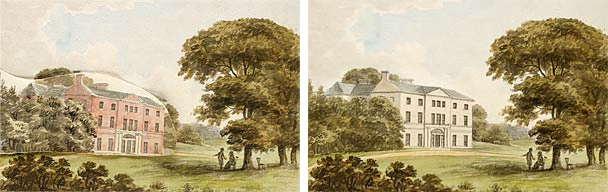
Images showing proposed exterior changes from H. Repton's Red Book for Hatchlands Park, Surrey (1800)
Images showing proposed exterior changes from H. Repton’s Red Book for Hatchlands Park, Surrey (1800) – source: The Morgan Library & Museum

Repton’s architectural contributions are often overlooked as he was never enough of an architect to be considered as one, and, in general, those primarily interested in his landscapes are insufficiently interested in his architecture.  A prime example of this (not mentioned in Colvin, or Stephen Daniels’ book, except buried in an endnote) is Repton’s vision for Port Eliot, Cornwall, the seat of Lord Eliot.  In 1792, in one of his earlier commissions, he was brought in for his advice on the estate. Repton assumed the role of architect and provided, in the Port Eliot Red Book, a broader set of broadly Gothic proposals which brought house, church, estate and even the nearby town into his remit. This expansive approach to his brief was a challenge for Sir John Soane who was asked in 1794 to contribute his ideas – but now within a Gothic framework set by Repton (a style to which Soane was hostile), whose designs had found a level of favour with Lord Eliot, and which he adapted.

One of the key questions when considering the architectural improvements suggested by Repton is to what degree they were his and what had been conceived by his eldest son John Adey Repton (b.1775 – d.1860). J.A. Repton had been a pupil to William Wilkins where he developed a profound understanding of Gothic architecture.  He had then moved in 1796 to the office of John Nash, with whom the elder Repton had established an arrangement to pass on any architectural commissions in exchange for 2.5% of the cost of the work – an agreement which Nash failed to honour, leading to the partnership being terminated in 1800.

Nash has a chequered reputation professionally and this extended to those in his office, including J.A. Repton but left to become his father’s assistant when the agreement between Nash and his father ended.  Nash was unfortunately a champion of the Picturesque but not of his assistants; he never acknowledged J.A. Repton’s significant contribution in various schemes. Unfortunately, John was to suffer the same issue to a certain extent with his father, though he was later clearly credited for his assistance ‘in the architectural department‘ for designs for a number of houses including Stratton Park, Scarisbrick, Panshanger, and others.

Detail from Port Eliot Red Book showing the house as found (© Eliots of Port Eliot)
Detail from Port Eliot Red Book showing the proposed changes to the house (© Eliots of Port Eliot)

In the Port Eliot Red Book, eighteen of the drawings are signed by the son and are probably his designs, however the scheme as a whole is attributed to the elder Repton, though he may have been angling for this to be a major commission for his son. Unfortunately for the Reptons, their grand vision for Port Eliot was never going to be realised, mainly due to financial constraints, though Soane was to provide an alternative scheme which he diplomatically managed to agree with Lord Eliot – much to Repton’s chagrin, later writing:

my beautiful plan for Port Eliot…my design for bringing together the house and the Abbey did not suit the fancy of my fanciful friend [Soane] (who knows but little about Gothic) so the plan was totally changed.

Repton’s architectural work was significant enough to merit inclusion in Howard Colvin’s seminal reference work, ‘A Biographical Dictionary of British Architects 1600-1840’.  The most important was the work at Welbeck Abbey in 1790 to remodel the east and west fronts (and the Red Book contains designs for an entirely new house) but the other entries are relatively insignificant – minor works in 1792 at Honing Hall, the enclosing of the courtyard at Sarsden House in 1795 to create a domed ‘hall of communication’, and a new entrance to Uppark in 1805. Beyond that, his association with John Nash meant he had an insight into the ‘cottage orne’ style and which Repton used in his design for a new ‘lodge of a new and singular description‘ comprising two thatched cottages on the Isle of Wight, one either side of the road.

Lodges at the entrance to Mr Simeon's grounds on the Isle of Wight, designed by H. Repton (Image from 'A New Picture of the Isle of Wight' by W. Cooke (1808)
Lodges at the entrance to Mr Simeon’s grounds on the Isle of Wight, designed by H. Repton (Image from ‘A New Picture of the Isle of Wight‘ by W. Cooke (1808)

Beyond that, his architectural contributions were mainly the designs within the books on landscape gardening.  The most important of these were ‘Sketches and hints on landscape gardening : collected from designs and observations now in the possession of the different noblemen and gentlemen, for whose use they were originally made : the whole tending to establish fixed principles in the art of laying out ground’, published early in his career in 1794, and the posthumous collection published in 1840, ‘The Landscape Gardening and Landscape Architecture of the late Humphry Repton’.

So, can Repton be considered an architect as well as a landscape gardener? On balance, his position seems to be more that of ‘frustrated architect but successful critic’. Repton doesn’t seem to have been able to establish a reputation as an expert on architecture, possibly because his commentary was often only available in the Red Books, with their naturally limited circulation. Also, his work was usually after the house was already built and often only recently finished, meaning the owner was unlikely to consider making significant changes very quickly, leaving few opportunities for him to showcase the talents he clearly thought he had.

However, his work was influential on the practices of contemporary and later architects, forcing them to acknowledge that their buildings did not exist in splendid isolation and had to be considered as whole; a three-dimensional, interactive, ever-changing landscape painting. Open, expansive parklands had the effect of placing the building on a visual plinth, majestic but with an aloof air. Repton firmly brought all the elements together, blending both Gothic with greenery and the Palladian with the planting.  His architectural contributions reflect this sensitivity and with more opportunities he may have been even more influential in the field of architecture, much as he dominated the landscapes represented so beautifully in his famous Red Books.


Further reading:


Sources:

(1) – Humphry Repton, Red Book for Honing Hall [1792], quoted in ‘The Surprising Discretion of Soane and Repton’ by Gillian Darley, in the Georgian Group Journal vol. XII 2002


Apologies for the long gap between articles – happily, just after I posted the last one in September 2017, our beautiful son was born. Mother and baby were, and remain, fine and his sister clearly loves him. However, as anyone with experience of small children knows, they’re justifiably demanding and, combined with having a day job, it’s meant I haven’t had the time to write, but as he gets a little older hopefully I should now be able to again…at least in some capacity, though they’ll remain sporadic.  Tweeting is easier to do regularly, so please do follow @thecountryseat and @lostheritage.  OK, on with the show…


A Hollandaise Source: Henry Holland’s Benham Park, Berkshire

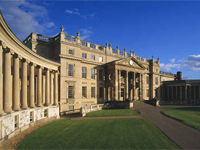
As the costs of owning a country house mounted in the early-twentieth-century and eventually overwhelmed the finances of many families, so they sought alternative uses for their houses. Whether as a care home, school, or any of other myriad uses, few houses or their estates endured the experience unscathed. For those used as offices, the particular indignity of large, modern additions obliterated the immediate setting of a house, occasionally driving it into obscurity. Few who suffered this fate have ever escaped, yet a rare and beautiful survival – Benham Park in Berkshire – has not only escaped, but been wonderfully (partly) restored and is now offered for sale.  What is most remarkable though about this house are its connections to some of the most famous names of Georgian architecture, including Lancelot ‘Capability’ Brown, a young Henry Holland, and an even younger John Soane.

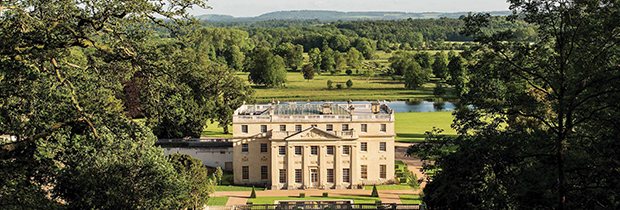
Benham Park, Berkshire (Image © Savills)

Nestled in a lush parkland, Benham Park is significant as a formative experience, in different ways, for both Holland and Soane; a house where the two would each contribute in different ways, each gaining experience which would serve them well in the future. The noted architectural historian Dorothy Stroud declared Holland ‘a designer of perception and originality’. Her tireless research underpins much of what is known about Holland and his work.

Detail of Henry Holland (1745-1806) Image © National Portrait Gallery

Henry Holland (b.1745 – d.1806) was one of the leading architects during the reign of George III. Today, his reputation has been overshadowed by his contemporaries who were more willing to engage in courting public notice, such as by exhibiting their work at the Royal Academy, which Holland never did. Chiding a friend in 1789, he stated ‘Pray no more public compliments to me. I began the world a very independent man and wish to hold it at arms length…I find myself already more the object of public notice than suits my disposition or plan of life’.

Henry Holland was the son of Henry Holland (1712-1785 – to avoid confusion, the father will be referred to as ‘the elder Holland’, any other mentions of Holland are the son) of Fulham. A successful master builder, he built many important houses in the middle years of the eighteenth-century and worked with architects such as Robert Adam, executing his alterations to Bowood in Wiltshire in 1761 and, in the same year, working at Ashridge House, Hertfordshire.  It was this latter commission which was to prove singularly important as it established a professional relationship between Holland senior and Lancelot ‘Capability’ Brown (b.1716 – d.1783), a landscape architect still revered today for his skill and imaginativeness. Brown’s particular ability was to be able to envision a whole landscape as it would be after the planting had reached maturity – to see its ‘capabilities’.

He was also noted architect, with even his rival Humphrey Repton praising the ‘comfort, convenience, taste, and propriety of design in the several mansions and other buildings which he planned’. The houses include Croome Court, Worcestershire (though the design may have been provided by Sanderson Miller), Corsham Court in Wiltshire (1761-64), Broadlands in Hampshire (1766-68), Fisherwick Park in Staffordshire (1766-74 – dem. 1814-16), Redgrave Hall in Suffolk (c.1770 – dem. 1946), Claremont House in Surrey (1771-74), and Cadland in Hampshire (1775-78 – later much enlarged – dem. c.1955).

Fisherwick Park, Staffordshire, painted by John Spyders (1786)

Although the initial connection was with the elder Holland, Brown would become central to both the professional and personal life of the younger Holland.  Although he never undertook a Grand Tour, his education was more practical, working with his father in the family business. Holland displayed aptitude and skill, taking on more responsibility but also his talent for design was becoming clear.  With his father’s connections, Holland was taken on as architectural assistant in 1771 by ‘Capability’ Brown who would, in time, hand over much of his design work to Holland, who would use these earlier designs as inspiration.  The closeness and respect between the two can be gauged by the marriage of Henry Holland to Brown’s daughter, Bridget, in 1773. Professionally, a measure of the level of joint enterprise between Colvin notes that Claremont and subsequent houses are jointly attributed to Holland.

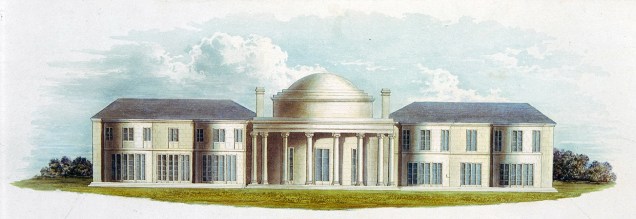
Benham Park was an easy commission of Brown to secure, though it was likely that he was primarily thinking of his new partner when doing so. The probability that Brown would be commissioned was high as he was already working for the owner of the estate, William Craven, 6th Baron Craven (b. 1738 – d.1791), on another country house for him, Coombe Abbey, Warwickshire. Apparently under pressure from his wife, Elizabeth Berkeley, Lord Craven wrote to Brown saying ‘Lady Craven wishes to make some alterations here and to begin immediately’. Holland and Brown submitted their designs for a house in September 1773 using a similar pattern to Brown’s previous work with a neoclassical, two-storey main house with grand central portico.

Benham Park, Berkshire (Image © Savills)

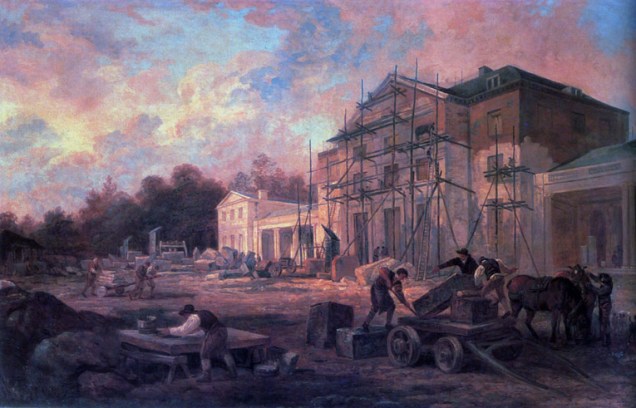
The house was built between 1774-75, the final result a sympathetic marriage between an elegant yet imposing house and the Arcadian pleasures of a sculpted landscape.  Despite these fine attributes, Benham has been rather overlooked in the histories of both Brown and Holland with the latter clearly learning important lessons from one who designed with practicality in mind, but not to the exclusion of an element of drama. However, Holland was not without his own influence as Stroud notes that from the time he joined Brown’s office, the interior design evolved from a more robust Palladian character to the more restrained yet elegant style which was Holland’s hallmark. Claremont, Cadland, and Benham all display this style, indicating that although the shell of the house was more the work of Brown, the interiors were to Holland’s designs.

What’s remarkable about Holland was his almost precocious drive to build on a grand scale. Backed by his father’s capital and expertise, Holland leased in 1771, aged 26, eighty-nine acres of what is now Chelsea and Knightsbridge, including what is now Cadogan Place, and proceeded to speculatively design and build houses based around a miniature park or garden square. This high profile activity brought Holland his first major solo design for Brook’s club in Mayfair, London, a haunt of the Prince Regent and Whig aristocracy. This would lead to the Prince commissioning two major buildings from Holland; Carlton House and Brighton Pavilion. These two commissions plus Holland’s speculative building cemented his position within the highest social strata, creating future opportunities.

Undated print of Henry Holland's Brighton Marine Pavilion of 1786-87 (Image source Khan Academy)
Undated print of Henry Holland’s Brighton Marine Pavilion of 1786-87 (Image source Khan Academy)

Other significant commissions included the the refurbishment in 1787 of Althrop, Northamptonshire, for the 2nd Earl Spencer, including a full re-casing of the red-brick house in white mathematical tiles with stone dressings, a re-design of the gardens, and inside, a re-ordering of the accommodation including the creation of the noble triple libary, divided into sections by screens of Ionic columns. Another Whig patron was Francis, 5th Duke of Bedford, who had Holland complete some minor works to Bedford House before commissioning more extensive work, also in 1787, at his main house at Woburn Abbey. Holland was back at Broadlands in 1788 creating a new vestibule and inner hallway, the entrance marked by a new grand portico. In 1795, after a sojourn into theatres, Holland returned to grand country houses, with the rebuilding of Southill Park in Bedfordshire for Samuel Whitbread, of brewing fame. Again, as with Althorp, this was a refurbishment to the point of rebuild; the house encased, the accommodation extended and a new portico added. His last commission was again from Lord Spencer in 1801 to rebuilt his Wimbledon house, which had earlier burnt down, with a sophisticated villa in a severely plain style both inside and out. Sadly, this was demolished in 1949.

'Rebuilding of Southill' (1797) by George Garrard (Image © University of Texas)
‘Rebuilding of Southill’ (1797) by George Garrard (Image © University of Texas)

Benham Park was also important for another young, aspiring architect, Sir John Soane. As a young apprentice, Soane had joined Holland’s office in 1772 as a junior. At Benham, Soane was given the task of measuring up to create the final bills, a task he was to repeat at other locations, giving him a valuable insight into not only the process of building but also the business aspects. Although, sadly, almost all Holland’s papers and drawings were posthumously destroyed by his nephew, one of Holland’s account books is preserved in the Soane collection. Soane seems to have retained it as a valuable record and tool when setting up his independent practice. Benham therefore provided practical, aesthetic and business training to the young architect who no doubt admired Holland’s neo-classical approach before evolving his own distinctive response and style, which was to establish him as one of the leading architects of his age.

Benham Park in 1904 (detail) - note the large servants wing to the left, now demolished (Image source Stockcross History via Wikipedia)
Benham Park in 1904 (detail) – note the large servants wing to the left, now demolished (Image source Stockcross History via Wikipedia)

Benham survived largely unaltered into the twentieth-century until 1914 when the pediment was removed from the portico and replaced by a balustrade. This was echoed at the roof level where the pitch was lowered and obscured  by a pierced stone balustrade. The servants quarters were removed at the same time due to their poor condition. The house and estate remained with the Sutton baronets until 1982 when it as bought and converted into offices in 1983, with additional office blocks built next to the house. These were thankfully demolished as part of the latest restoration of the house and estate.

Benham Park - looking out over the lake (Image © Savills)
Benham Park – looking out over the lake (Image © Savills)

Benham Park, (Grade II*), is now offered for sale with 130 glorious acres for £26m. Inevitably for a house of such grandeur situated so close to London, there are approved plans for the house to become a ‘wellness’ centre with a huge (though thoughtfully designed) extension to the side and rear.  For me, as ever, this is a house which would be best served by being returned to it’s original purpose, that of a family home. For a new owner, they could revel in the knowledge that the house and landscape had been conceived by one of the great Georgian partnerships of Brown and Holland.  Standing under the portico today, much as where they and the young John Soane must have once stood, the latter on the cusp of his era-defining career, looking out at Brown’s landscape, they can appreciate this rare combination of architectural genius – truly a prize worth such a princely sum.


Estate agent particulars: ‘Benham Park, Berkshire‘ [Savills]

Brochure (PDF): ‘Benham Park, Berkshire‘ [Savills]

Listing description: ‘Benham Park‘ [Historic England]


Please note: Savills very kindly provided the images and brochure but had no input into the text.

Soane’s happy commission: Tyringham Hall for sale

Tyringham Hall, Buckinghamshire (Image: Savills)

Six of the most happy years of my life‘ is how Sir John Soane described his commission to build what is regarded as one of his finest works: Tyringham Hall, Buckinghamshire.  Although altered, the house forms an important link in the development of both Soane’s architectural and professional skill; an ideal commission which gave full scope to his genius.  It also has the rare distinction of benefiting from another British architectural giant, Sir Edwin Lutyens, who created some of his best but also smallest work there. Now having been restored, the house is for sale; an early and clear candidate for the most important house to be sold in 2013.

Letton Hall, Norfolk (Image: Chris & Angela Pye via Flickr)

Sir John Soane built only eighteen complete country houses, mainly between 1780-1800, so each house is an important step in tracing the evolution of his distinctive style.  Burnham Westgate was Soane’s first major remodelling (covered in an earlier blog post: ‘For sale: a Soanian springboard‘ Oct 2011) but his first entirely new house was Letton Hall, Norfolk. Built between 1784-92 for B.G. Dillingham, Soane had convinced Dillingham to demolish, rather than alter, the existing Old Hall which he had inherited that year.  Soane’s early working practices, honed through smaller commissions, emphasised extensive discussions with the client at the early stages, and the creation of a wooden model to help them visualise the proposed scheme (created in 1785 – after work had started – at the cost of £6 11s).  Letton also demonstrated several of what we regard as ‘Soanian’ architectural traits: the compact villa design, pale bricks, beautiful proportions and the cantilevered, top-lit staircase.

Stowe House, Buckinghamshire (Image: e-architect)

Soane’s practice now progressed steadily with commissions for new houses at Tendring Hall and Shotesham, along with other works on varying scales.  His growing reputation for not only excellent designs but also for completing work on time and within budget led to his name being circulated amongst the right type of clients who could provide the opportunities Soane hoped for. Drawn by his friend, Lord Camelford, into increasingly political circles, he became friends with the powerful Marquis of Buckingham, who owned two great estates at Stowe and Wotton.  In August 1792, it was Buckingham who took Soane to visit the banker William Praed at his property, Tyringham, which his wife had inherited and which was conveniently close to the Marquis, in whom rested his political and business ambitions.  Needing a house to match his intended status, Praed initially commissioned Soane to remodel the existing Elizabethan manor house. However, after some Soanian persuasion, in June 1793 he decided that an entirely new house would best serve his needs – much to the architect’s undoubted relief.

Soane displayed a particular flair when designing an entirely new house.  Although at the  core of his houses was a Palladian villa, as John Summerson notes, Soane was able to ‘…twist it into something much more complicated with sequences of shaped rooms ingeniously interlocked, and lobbies introduced to effect harmonious transitions‘.  It was this imagination which Soane brought to the Tyringham commission and which created one of his early masterpieces, with flashes of brilliance, both inside and out.

One of the first is the now Grade-I listed monumental arch gateway leading from the main road; a building of such elegance and novelty that it had Pevsner in raptures, describing it as ‘a monument of European importance…it is entirely independent of period precendent, a sign of daring only matched at that moment by what Ledoux was designing in France [e.g. Hôtel Thellusson] and Gilly in Germany‘.  Leading to the house, the drive curves gently away, allowing the house to slowly come into view.  Soane designed the approach, incorporating an elegant humpbacked bridge with balustrades which curve at each end, away from the road, creating a delicate curl.  Arriving at the house, the exterior can also immediately be identified as by Soane, with typical details including the bow-front, the beautiful proportions and the superb detailing, such as the giant Ionic columns and Greek-key frieze.

The interior was to be the finest conception of the whole scheme; a dramatic, exciting series of spaces which would have delighted the visitor.  At the core of the plan was a device which Soane would re-use in later projects but on a monumental scale; the ‘tribune’, a top-lit inner hall.  To look at the plan is to understand the level of trust that William Praed displayed in Soane as, on entering the house, the first space encountered was dramatic as it was domestically redundant: a windowless ante-chamber lit only by the front door and flanking windows behind you, and through another doorway at the far end.  Passing through the room, flanked by four columns supporting a typical Soane shallow dome, you then stepped through the doorway and into the brightly lit central tribune; a Damascene moment of drama.  Forming the top of the T to the dark antechamber, the tribune then led to either the library, the drawing room or the stairs; each decorated in a typical Soane style. Though compact, the house and estate are both impressive and manageable, the perfect combination for a rising, ambitious banker who mixed in aristocratic company.

However, the house and estate today is not the same one Soane created.  Between 1907-19, a series of unfortunate changes were made to designs by the architect Ernst Eberhard von Ihne, his decorator Florian Kulikowski and another architect, Charles Rees, who implemented Von Ihne’s plans which swept away much of Soane’s interior decoration.  They also added an ill-proportioned copper dome, a tea cosy on a champagne bottle, which has the strange visual effect of elongating the columns.  With an estate of only 59-acres, it’s unfortunate that a series of 9 or 10 houses were built to the immediate north-east of the main house. Equally sad, the most important section of Soane’s considered drive to the house is now in separate ownership; the humpbacked bridge part of the public highway and worse, the road then continues down through that wonderful arch which so delighted Pevesner (how long before some careless driver seriously damages one or the other?) – follow the drive via Google StreetView.

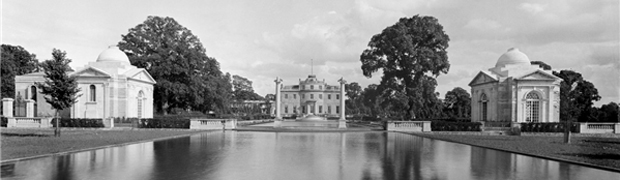
Bathing and Music Pavilions, Tyringham Hall (Image: Country Life Picture Library)

Thankfully what is still intact is one of Sir Edwin Lutyens‘ finest garden schemes.  Between 1924-28, Lutyens was commissioned by the then owners, the Koenigs, a family of Silesian bankers, to create a garden ‘for the recreation of spirit and body‘.  Standing each side of a huge 72m pool, once thought to be the largest of its type in Europe, are two temples; one a bathing pavilion, the other of Music.  Reminiscent of Thomas Archer‘s sublime Pavilion at Wrest Park (1709-11), Lutyens’ interpretation is pared back, less ornamented, but equally impressive – indeed, he himself thought it faultless and would apparently sit in there on his own.

The current vendor, Anton Bilton and family, has lavished millions on restoring the house and grounds (though, he confirms not as much as the £10m previously reported) since buying it for £2.5m in 2001.  However, the £18m asking price quoted in The Sunday Times Home section (28/04/13) seems ambitious; £10m-12m feels more appropriate considering the way the house and estate have been compromised with the now non-private approach, the small housing estate to the east of the main house and the loss of Soane’s original interiors.  Make no mistake, this is still a superb house and sets the bar high for any other house offered for sale this year to be considered as attractive or as interesting.

——————————————————————

Property details: ‘Tyringham Hall‘ – £18m, 59-acres [Savills] Strangely, there is no brochure yet and the launch, through double fold-out spread in Country Life (1 May 2013), feels a touch late.  One wonders whether the Bilton’s were offered a chance to do the Sunday Times piece before Savills were ready and took it anyway?

Excellent selection of photos:

If you wish to find out more about Sir John Soane and are in London, visit his house at Lincolns Inn Fields, which is a museum to his life and work: ‘Sir John Soane’s Museum

For sale: a Soanian springboard – Burnham Westgate Hall, Norfolk

Burnham Westgate Hall, Norfolk (Image: Savills)

For any architect starting out, the early commissions are perhaps the most important; establishing them both in terms of not only their designs but also how they operate in the execution.  In architectural terms, the early buildings of some architects are sometimes less prized, and therefore protected, than their later works which benefit from the full measure of their developed skill and experience.  In that light, Burnham Westgate Hall deserves to be cherished as not only a fine house but also the first substantial country house project of Sir John Soane.  It provided the springboard for one of our finest architects and is important for the promise shown but also for securing one of the most important prizes in the Georgian era: patronage.

For someone who ended up a knight of the realm, with fame and a noble client list, Sir John Soane (b.1753 – d.1837) had a very ordinary start in life as the son of a bricklayer from Goring-on-Thames, near Reading.  Patronage and connections were to define Soane’s personal and professional life, providing opportunities to establish himself in a way that his competitors, often connected from birth, already enjoyed.  Almost nothing is known of his early life but his obvious talent must have been spotted as he entered the office of George Dance the Younger in 1768, though only starting as errand boy, via an introduction by James Peacock, an employee of Dance who knew Soane’s older brother.

Claremont, Surrey (Image: Claremont Fan Court School)

His talent and work ethic propelled Soane to join the Royal Academy Schools in 1772, where he quickly won the silver medal for a measured drawing of the facade of Inigo Jones’ Banqueting House.  What was particularly clear during Soane’s time at the Royal Academy was his ambition and an industriousness that was to serve him well in later periods, combined with an attention to detail which proved to be a blessing in his professional life.  In 1776, he won the Academy gold medal, which made him eligible to compete for the highly coveted King’s travelling scholarship which, for someone of Soane’s limited financial means, would be his only chance to see Italy first-hand.  Soane had heard that George III thought him a suitable candidate and so he rashly gave up his position with Henry Holland (where Soane was known to have assisted on three country house commissions: Claremont in Surrey, Benham Park in Berkshire, and Cadland in Hampshire (dem. 1953)) only to find out that Sir Joshua Reynolds had intervened to demand the winner of the scholarship be by vote from the Academicians. This delayed his departure by a year but it was put to good use completing smaller tasks for Henry Holland such as estimating bills and measuring work which exposed him to clients such as Thomas Pitt, 1st Baron Camelford; a man of noted taste and an amateur architect who was to prove particularly important in Soane’s career.  Though delayed, in 1777 Soane set off on the single most important trip of his life to Italy; one which was to establish him professionally and socially.

Arch of TItus, Rome - drawing by Sir John Soane
Arch of TItus, Rome – drawing by Sir John Soane

The Grand Tour had become an institution amongst the younger aristocrats as a way of experiencing the glories of classical art and architecture in their native environments.  It was also a fine opportunity for the wealthy to indulge their passion for art collecting but, for novice architects, days were largely spent measuring and recording the wonders of Roman architecture.  On a more practical level, Soane would have seen and experienced during his time with Dance and Holland how useful family and professional networks were in securing commissions.  In Italy, Soane worked assiduously to develop his own connections; travelling with his friend Robert Furze Brettingham (nephew of the famous architect Matthew Brettingham the Elder who had designed the original Burnham Westgate Hall, then called Polstede Hall) and visiting the English Coffee House; a central meeting point for the English nobility abroad, whom Soane courted as clients.

Soane's proposed design for Downhill, Northern Ireland (Image: Sir John Soane's Museum) - click to see full sketchbook page
Soane’s proposed design for Downhill, Northern Ireland (Image: Sir John Soane’s Museum) – click to see full sketchbook page

Patronage could also be a double-edged sword, with the ambitions of the client giving what could turn out to be false hope to an architect.  Of all those Soane met in Italy, Frederick Hervey, Bishop of Derry, later the 4th Earl of Bristol, was a prime example of the capricious client – though despite the Earl’s failure to deliver, he did introduce Soane, once again, to Thomas Pitt, Lord Camelford, and cousin of William Pitt the younger, and who became a lifelong friend, supporter, mentor and patron.  Soane had fallen under the influence of the Earl, a charming, witty aristocrat who had a growing reputation for being a difficult client.  How much Soane knew of this is unclear but after travelling through Naples and Sicily for many weeks together discussing architecture, Soane believed he would be given a handsome commission to improve Downhill (now a ruin), the Earl’s rather bleak seat, set in the coastal hills of County Derry, Northern Ireland. However, after persuading Soane to cut short his travels by a year and luring him over to Ireland in 1780, after six fruitless and frustrating weeks with the disagreeable Earl not committing to any of Soane’s designs, he left Ireland in despair, seriously out of pocket, and with the hopes of his first significant commission of his architectural career in tatters.

Rustic dairy at Hammels Park, Hertfordshire (Image: Sotheran's)
Rustic dairy at Hammels Park, Hertfordshire (Image: Sotheran’s)

Back in London, Soane’s wealthy and well-connected friends, particularly those he had made in Italy, and especially Pitt, sought to ease his plight by asking for his designs for smaller estate buildings or their own houses, such as for his friend John Stuart at Allanbank, Berwickshire.  Again, although the smaller projects were built, the larger plans failed to materialise – the only one of significance being some limited  alterations to Petersham Lodge, one of Lord Camelford’s homes.  After this, Soane took on a few smaller commissions from other clients which allowed him to develop his skills as an architect, not just in designing but the delivery of the projects, including the elegant dairy in the fashionable rustique, Rousseau-esque style at Hammels Park, Hertfordshire for the Hon. Philip Yorke, later 3rd Earl of Hardwick – another of his Italy contacts.

Proposed design for Allanbank, Berwickshire by Sir John Soane (Image: Sir John Soane Museum)

However, it was his main supporter, Lord Camelford, who provided the largest commission in 1783, the one which elevated Soane from dreamer of grand plans but only executor of small estate buildings.  Camelford’s wife had inherited Burnham Westgate Hall and now her husband wished to create a seat of suitable standing near to that other fulcrum of political influence in north Norfolk, Holkham Hall, home of the Earl of Leicester.  Burnham Westgate is curious in that it is one of the early examples of Soane’s practice of reusing his designs.  Compare Burham Westgate Hall today with the unexecuted design illustrated right which Soane completed for John Stuart at Allenbank – the overall form of the house is similar, differing only in the striking chimneys and the size of the flanking wings.  Soane seemed to do this less as he grew as an architect but it can be seen in his bow-fronted design for Saxlingham Rectory and enlarged version seen on the south front of Tendring Hall (dem. 1955), and even more directly between Shotesham Hall in Norfolk and Piercefield near Chepstow.

Burnham Westgate Hall has perhaps been a little overlooked in the literature, perhaps suffering from being overshadowed by Soane’s next project: his first solo, entirely new-build house; Letton Hall, which was started in the following year in 1784.  However, the innovation of Letton could only be created on a sound architectural foundation which Soane had spent years building; the smaller commissions of temples, kennels and interiors, before Burnham Westgate gave him the opportunity to demonstrate that he was capable of working on a project of that size.  Bar the limited and hotly contested public works, private country houses were some of the most significant commissions available to any architect and Burnham Westgate was Soane’s calling card; his proof of his ability, imagination and practical ability to deliver a fine house suitable for those in upper society.  That it is a close variation on a earlier design can be forgiven considering the nascent stage of his career; this sale offers a new owner the chance to own the project which gave Sir John Soane the springboard which helped establish this most brilliant of architects.

————————————————————————————–

Property details: ‘Burnham Westgate Hall‘ – £7m, 38-acres [Savills]

Detailed listing description: ‘Burnham Westgate Hall‘ [British Listed Buildings]

Further information:

————————————————————————————–

Inspired by Park Place? Other country houses for sale to restore

The recent restoration and sale of Park Place was certainly on an epic scale – £42m to buy, a further £100m to complete – but thankfully not all projects need be so expensive (though they’ll never be cheap).  The story of the country house has, for many, featured a cycle of ascendency, enlargement, and enjoyment, followed by neglect but – hopefully – rescue. As the annual SAVE Britain’s Heritage ‘Building’s at Risk’ Register sadly makes all too clear there are any number of country houses which have reached quite a serious state of disrepair, even dereliction. Yet even for these there may be someone who is willing to step up and rescue part of the nation’s architectural heritage. Houses in need of a saviour are often for sale, their forlorn state in Country Life magazine a stark contrast to their better loved brethren.

The UK generally has a much more positive attitude towards restoration than many other countries.  The Victorians would often be tempted to restore an ancient seat due to the contemporary popularity of the romantic notions of ‘Ye Olde England’.  Living in an Elizabethan or Jacobean house gave the owner associations with older family lines (not necessarily their own) and was a short-cut to perceived greater respectability.  Today, those who take on a restoration of one of our beautiful older houses are rightly lauded over those who simply buy a super-sized Barrett home.  Yet, restoration requires sensitivity and a willingness to submit an individual’s grand designs to work within the boundaries of the listed building regulations and the character of the house.

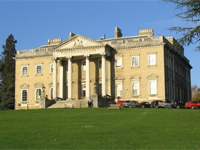
Marske Hall, Yorkshire (Image: Carter Jonas)

One house with hidden character and which will require careful planning is Maerske Hall, Yorkshire.  Originally built by the Hutton family in 1597, they were still in residence in 1730 when the house was rebuilt and extended in a Classical style. The grade-II* house was mainly used for shooting parties by the family in the 19th-century saving it from alteration but in the 20th it was threatened with requisition by the Army in WWII.  Luckily the family were able to arrange for pupils from Scarborough College to take up residence instead which saved it from the worst damage.  After the war, it again came near to destruction, as it was sold in 1947 to local builders George Shaw and his son George William who intended to demolish it for the materials.  However, they baulked at taking down such a lovely house and so sympathetically converted it into 10 apartments.  Still divided but now empty it is for sale at £2.5m with 19-acres of beautiful, mature gardens, and presents a fascinating opportunity to recreate a single family home. For more on the history, there’s a brochure: ‘Marske Hall‘ PDF [Carter Jonas].

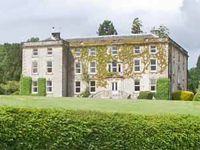
Walton Hall, Derbyshire (Image: Knight Frank)

For those wanting a more straight-forward restoration, Walton Hall, Derbyshire perhaps offers a more appealing option.  This fine and elegant grade-II* house, prominently sited above Walton on Trent, was built between 1724 -1729 to designs by the architect Richard Jackson. The most striking feature are the full-height pilasters, giving dignity to a slowly deteriorating house which has become such a concern as to be listed on the English Heritage ‘At Risk’ register.  Inside, the most impressive feature is the grand staircase, reputedly copied from a building in The Hague.  The house is basically habitable but requires significant sensitive restoration, hence the price; £1.5m for the house plus just 7.5-acres.  That said, once restored this will be a quintessential Georgian  house to be enjoyed for generations.

Felix Hall, Essex (Image: Savills)

For those who prefer a real challenge then the next two houses could be ideal.  The first is Felix Hall, situated just outside Kelvedon, Essex – the picture (right) immediately showing the scale of the challenge.  At its core, this house is firmly in the tradition of the Palladian villa with a compact footprint but featuring wonderful architectural flourishes such a fine portico (added in 1825) and, to the rear, four engaged columns and a pediment.  Originally built between 1760-2, it was purchased by the Weston family of Rivenhall Place in 1793 and was significantly extended with flanking wings in the early 19th-century, possibly on the occasion of Charles Callis Weston’s  ennoblement as Lord Weston of Rivenhall in 1833.  However, as with many larger houses, a reduction in  size was thought prudent and so in 1939 the two wings were removed, leaving just a 7-bay central section.  Sadly, during the course of renovations it caught fire, completely gutting the fine interiors leaving the gaunt shell with the proud Ionic columns we can see today.  The remains were bought in 1953 and the basement rooms restored as an occasional country retreat but this is a house crying out for a full restoration (for which there is planning permission).  However, the estate buildings such as the nearby stables have been separately converted and there is only a small amount of land – it would be lovely if the new owner could also purchase the buildings and gardens and if they could also acquire the field in front, they could create a superb small parkland in which to truly display the house.

Piercefield House, Monmouthshire (Image: darkcell / flickr)

Another shell available is the one I would be heading for: Piercefield, near Chepstow, Wales.  Designed by the peerless Sir John Soane in 1785 for George Smith, the actual completion of the house was delayed until 1793.  Of particular interest  here is that the design is not entirely unique – Soane appears to have used very similar plans for Shotesham Park in Norfolk which was also built in 1785, although that house was brick with stone dressings, whilst Piercefield is faced entirely with stone. The house was sold 1794 as Mr Smith had run into some financial difficulties and it was bought by Sir Mark Wood who employed Joseph Bonomi to add a saloon and a winding staircase – though not the two pavilions as has been suggested.  The house was sold in 1926 by the Clay family, who had bought it in 1861, to Chepstow Racecourse who abandoned it, leaving it become increasingly derelict, apparently helped by American troops stationed nearby in WWII who used the house for target practice.  After 90 years of neglect, the house still has the power to impress with its refined façade and elegant temple pavilions.  Although on the market for over six years the price has remained at a rather ambitious £2m (although it does include 129 grade-I listed acres of parkland). However, recent comments by the director of the race course have indicated that they might entertain offers of around £1m; though, of course, the restoration bill would be many times that – but what a prize at the end!

Ruperra Castle, Wales (Image: Jeffrey Ross - Estate Agent)

Even further down the scale of dereliction is another important house, also in Wales, which has been stubbornly mis-priced.  Ruperra Castle near Newport is one of the few ‘mock’ castles designed for pleasure and not as defensive installations – a subject examined in more detail in an earlier blog post related to Ruperra: ‘Developer shows sense; Ruperra Castle for sale‘ (Sept 2010).  Few of these style of houses were built and Ruperra’s importance derives from it being one of the earliest of the country houses of this type, having been built in 1626.  Sadly, many of the other examples have been lost (most recently, fire gutting the interior of Lulworth Castle in 1929) so for someone Ruperra offers the opportunity to not only restore an architectural gem but also to be able to enjoy the same stunning views which attracted Thomas Morgan to build there in the first place.  Unfortunately, although the owner has now switched agents, the price is still ambitious at £1.5m – especially considering the immense challenges and costs of restoration and the location.  Hopefully, as with Piercefield, the owner ought to be willing to entertain realistic offers and allow the house to be saved before it is lost forever.

Perhaps the last is stretching it to call it a restoration opportunity as Bellamour Hall, Staffordshire now exists only as two walls and a few piles of stones!

Restoration is never a cheap or easy approach but the satisfaction and pride in knowing that the work has saved another part of our architectural heritage must be immense.  For too long our country houses have been under threat from neglect, vandalism and poor maintenance and the selection above (and there are more) show that the degrees of restoration and commitment required can vary dramatically.  That said, I can only hope someone is out there with the wealth and sensitivity to take on these houses and bring them back to life.