Ripples of Palladio: Forcett Hall, Yorkshire for sale

Forcett Hall, Yorkshire (Image: GSC Chartered Surveyors)

For those of us who love our country houses, the weekly delight of the new Country Life magazine are the many pages of houses for sale.  Although the space is usually dominated by the major players such as Knight Frank, Savills etc, a particular joy is when you discover, tucked away with a smaller agent, an especially good house which deserves to be better known.

One recent house which falls neatly into this category is Forcett Hall, near Richmond in North Yorkshire.  Grade-I listed, this house forms part of the spread northwards of the fashionable ideas of Lord Burlington and the Palladians. ‘Palladianism’ (as it became known) formed a new movement and became the dominant architectural taste from around 1710 until around 1750 but which is still very popular and influential today.

The Palladians were largely influenced by the work of the Italian architect Andrea Palladio (b.1508 – d.1580) whose work, particularly around Vicenza, drew heavily on the ancient classical form of Roman architecture.  The ideas were spread to Britain initially through the work of Inigo Jones, a multi-talented theatrical designer to the Court who also became the Royal Surveyor of Works which gave him the platform to spread the ideas of Italian Renaissance architectural classicism to these shores, starting with the Queen’s House in Greenwich, London.

Wanstead House, Essex

Key to the spread of these new ideas were two books, volumes 1 & 2 of ‘Vitruvius Britannicus‘, which took the form of a folio of one hundred classical buildings, published by the architect Colen Campbell.  Campbell also created one of the most important buildings of early Palladianism, Wanstead House in Essex, (dem. 1824) which re-interpreted the form of Vanbrugh‘s Baroque Castle Howard but in a new, more austere architectural language.  This was then followed by Wilbury House, Wiltshire, designed and built in 1710 by William Benson who succeeded Sir Christopher Wren as Surveyor of Works.  Wanstead inspired several derivatives in the years following its completion including Moor Park, Hertfordshire (1720s by Thornhill and Leoni), Wentworth Woodhouse, Yorkshire (alterations of 1733 by Flitcroft), Nostell Priory, Yorkshire (1733 by Paine) and Prior Park, Wiltshire (1735 by John Wood I).

Chiswick House, Middlesex (Image: curry15 / flickr)

Richard Boyle (b.1694 – d.1753), the 3rd Lord Burlington and 4th Earl of Cork, played a  significant role in firmly establishing Palladianism as a movement through his own influence, patronage and his circle of followers.  Burlington employed Colen Campbell to remodel his London house (taking over the work started by his rival James Gibbs) but Burlington was also a skilled architect, building the beautiful Chiswick House, in west London, in 1729, not so much as a home (it contains only state rooms) but as an architectural statement of his new principles.

One of Burlington’s protégés who assisted him as clerk of works on some of his earlier projects was Daniel Garrett (b.? – d.1753).  A measure of his competency can be seen in a letter sent in 1737 by Sir Thomas Robinson to Lord Carlisle regarding proposed works to complete the Mausoleum at Castle Howard:

“My Lord Burlington has a much better opinion of Mr Garrett’s knowledge and judgement than of Mr Flitcroft’s or any person whatever, except Mr [William] Kent…”

Stanwick Park, Yorkshire - dem. 1923 (Image: Lost Heritage)

However, despite his skill, Garrett was dismissed from his role in the Office of Works in 1737 for ‘not attending his duty’.  This was probably related to his absences caused by his own growing architectural practice in the north of England.  In 1735 he was remodelling Wallington Hall, Northumberland for Sir Walter Blackett, in 1736 he was at Castle Howard, and in 1737 he was working for Lord Derby, and between 1739-40 working for Sir Hugh Smithson, Bart, (later 1st Duke of Northumberland) on the rebuilding of Stanwick Park, Yorkshire (sadly demolished in 1923). He was later to work at other distinguished houses including Raby Castle in Co. Durham, Warwick Castle, Northumberland House in London (dem. 1874), Horton House in Northamptonshire (dem. 1936), Uppark in Sussex, Kippax Park in Yorkshire (dem. 1956-59) and most notably Foots Cray Place in Kent (dem. 1950).

This gives a measure of Garrett’s skill and his client list.  It was following his work at Stanwick that he started work at Forcett Hall in 1740 – though there does seem to be some debate as to what he did.  A list at Alnwick Castle says that the house is by ‘Mr Garrett for Mr Shuttleworth’, the latter being Richard Shuttleworth, the local MP who commissioned the house, whose family owned the estate between 1582-1785.  Although the estate agents state that the design of the house can be attributed to him as a rebuild following a fire in 1726, Howard Colvin thought him an unoriginal architect but skilled in providing handsome houses and instead only gives him a now demolished part of the east wing, the lodges and park entrance, the ceiling of the saloon (copied from the dining room at Chiswick House), and the grotto.

Forcett Hall, Yorkshire - as drawn by Samuel Buck

So if he didn’t design the main block, here’s an alternative theory; the house wasn’t completely burnt down in 1726 but was just seriously damaged, and Garrett gave a Palladian flavour to the house as part of the restoration.  The south front of the original house was drawn by Samuel Buck in his usual technically flawed idiosyncratic style (see right).  This is the same view in the picture of the house at the top of the post but the current house lacks the projecting wings but it does share the exact same form of three storeys over a semi-sunken basement.  Looking at the main house now (there’s an excellent picture on flickr: Forcett Hall – and also see the paintings in the comments), it could be argued that the elements of Palladianism – Ionic pilasters, quoins, external staircase have merely been applied to the house rather than forming a fundamental part of the design.  By excavating the semi-sunken basement (note the level of the lawn to the left), Garrett creates not only the appearance of a piano nobile, but also creates the space to add the staircase which is also in a typical Palladian style (and appears to be a modified form of the one at Stourhead as shown in ‘Vitruvius Britannicus) – but which seems to be an addition rather than a focus.  Elements such as the pilasters with their Scamozzi Ionic capitals almost seem to be copied from the entrance front of Marble Hill House in Twickenham (built 1724-29 by Roger Morris). Conversely, the north (entrance) front of Forcett is almost a different house; looking far more like an Italian villa than a Yorkshire country house (and I’m sure I recognise it from somewhere…).  Or perhaps I’m completely wrong and it is a new house, the design of which exposed the limitations of the architect.

This is a fascinating house, well worthy of it’s grade-I listing, though the photos on flickr show it’s in need of some care and restoration to fully bring out the beauty of this wonderful house.  The interior boasts some fine plasterwork and the house is set in a perfect small park which includes a 17-acre lake, no public footpaths and a grotto.  If someone is looking for a house with privacy but also a history to be explored there are few better houses available.

Property details: ‘Forcett Hall‘ [GSC Chartered Surveyors] – comes with over 230-acres, guide price £5.5m.

Property brochure [PDF]: ‘Forcett Hall‘ [GSC Chartered Surveyors]

——————————————————————————

British and Irish Stately Homes blog – more property for sale

This is also a good point to highlight another blog you should find interesting.  British and Irish Stately Homes is written by Andrew who is a frequent contributor to the comments in this parish.   Featuring houses for sale, TV programmes involving country houses, books on the topic plus much more it covers some more of the areas I just don’t have time to!  Do bookmark it, subscribe and let Andrew know if you spot anything you think ought to be added.

Guest blogger: Jeremy Musson – ‘English Ruins: an odyssey in English history’

Having written all nearly 200 posts since I started writing this blog I now thought it would be interesting to try and broaden the voices involved.  So as the first post in this new direction/experiment, I am delighted and honoured that one of our leading architectural historians, Jeremy Musson, kindly agreed to write a piece on country house ruins linked to his new book published this month, ‘English Ruins‘, a fascinating look at their role in shaping our perceptions of the past and our architecture.

——————————————————————————————-

Jeremy Musson
Jeremy Musson

The English landscape is a landscape of ruins. Fragmentary or sometimes only roofless and windowless, these part dismantled buildings stand out to mark our national history in a number of different ways, and above all, provide a sense of historic scenery for our journeys, physical and imagined – and glimpsed from motorways and footpath alike. In this new book, photographer Paul Barker and I wanted to explore something of this particular cultural landscape and through this exploration trace something of how the English see themselves and their past.

I feel that we live in an old country, and the past is always there, to paraphrase T.S.Eliot, “pressing on the future”. Some love the past, some hate it, many are indifferent to it, happy enough to take pleasure in a good day out, with a dash of historic scenery. But the whole process of our encounter with ruins, is somewhat special – a deeply subjective, and in effect, an almost artistic experience. It is personal and often emotional, while it is also formed and shaped by a whole series of sometimes opposing cultural inheritances: Romanticism, anti-establishment, veneration for the classical, veneration for the Gothic, history seen through the very shape of the landscape.

There is something that seems to appeal about ruins to the English imagination over the centuries. Think of how John Aubrey, for instance, the late seventeenth antiquary and author of that amusing volume of English biography Brief Lives, observed that

“the eie and mind is no less affected with these stately ruines than they would be if they were standing and entire. They breed in generous mindes a kind of pittie; and set the thoughts aworke to make out their magnificence as they were in perfection.”

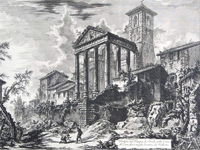
Piranesi: 'Temple of Hercules, at Cori' - 1769 (Image: Mattia Jona Gallery)

During the 18th century, the Grand Tour, part of the expected education of a gentleman or aristocrat, consisted of a journey through Holland and France to visit the great monuments of the Roman world, excited the aesthetic and cultural awareness of the 18th-century English gentleman, who was in turn the patron of artists and architects following the same path in trying to import the drama and excitement of great classical ruins to an English audience. Walk through any major house built in the 18th century, with anything of its original collections still in situ and the ruin is visible in painting after painting, and then echoed in the classical temples of the park.

The phenomenon of creating artificial ruins, in which the English seem to be pioneers, belongs to this period, and while the earliest garden temples seem to be classical, the contrivance of designing ‘ruined’ structures, was largely sourced in England’s own Gothic past. Horace Walpole the 18th-century diarist, who designed his own Gothic style house, Strawberry Hill, hugely admired the work of Sanderson Miller who designed a ruined tower at Hagley Park, with the perhaps slightly teasing phrase that it had “the true rust of the barons’ wars” referring to the Wars of the Roses.

When making this tour of England in tandem with photographer Paul Barker, I could not help noticing that we were often treading in the footsteps of the great landscape painter, J.M.W.Turner, for whom the evocative power of the ruin played a central role in his career, although we perhaps think of him most naturally as a landscape painter, and a painter of skies.

In the last years of the 18th century he exhibited numerous studies of great historical ruins in landscapes, appealing to the Romantic spirit of his audience – characteristically these are the foil for dramatic expositions of sky or sea. He continued to make special studies of ancient ruins, castles and abbeys on tours around the whole of England, for his ambitious Liber Studiorum project, and many were published in different histories, especially in Charles Heath’s Picturesque Views in England and Wales.

Turner looked principally at abbeys and castles, but abandoned country houses have come to be a feature of our landscape too. The dramatic changing status of the country house from the first world war, into the great depression of the late 20s and early 30s, becomes even more intense after the second world war – think of John Harris’s memoir, No Voice from the Hall. This was a period which resulted in so much change in English life, that it is easy to overlook the symbolic collapse of the world of the English country house. This was a feature of interwar life too, with the rise of income tax and death duties, but the upheaval of the Second World War, the widespread institutional use of country houses for military and other government purposes often hastened their subsequent abandonment.

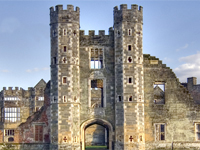
Cowdray House, Sussex (Image: Cowdray Heritage Trust)

Inevitably, given my interest, the country house looms large in our new book. We focus on the story of buildings from different themes and for the ruins of country house, beginning with Cowdray House, in Sussex, a substantial Elizabethan mansion damaged by a fire in the late eighteenth century, and then abandoned, partly as a result of complications over inheritance; but quickly becoming a destination for artists, for instance, Turner visited the ruins while staying at Petworth – it is now looked after by a newly formed trust, and feels like the sets left over from a Grand Opera, standing amongst the meadows and paddocks on the edge of Midhurst.

We also visited the ruin of an elegant early-seventeenth-century lodge at Wothorpe Towers, a lodge once part of the Burghley estate, which was used as a dower house and then, apparently, part dismantled to provide an eye-catcher in the new landscaped park. It was falling into serious decay and has recently been taken on by the Griffin family, who putting the main house into a trust, which is restoring the gardens, are converting the ancillary seventeenth century buildings into a new home.

Seaton Delaval Hall, Northumberland (Image: Alan J. White / wikipedia)

The classical country house tradition is represented in our book, by 1720s Seaton Delaval Hall, near Newcastle – one of the finest houses by Sir John Vanbrugh, re-roofed after a major fire, the interiors are otherwise the very picture of a ruin. In Derbyshire, we encountered the memorable and mournful spectacle of Sutton Scarsdale Hall in Derbyshire, also built in the early 18th century. The latter, partly due to its proximity to mine-works, acquired in 1919, by businessman out to profit from its materials and fittings. The panelling was sold United States collectors, and some at least found its way into the Museum of Fine Arts in Philadelphia. Its demolition was in fact prevented by local landowner Sir Reresby Sitwell, whose family later presented it to the state.

James Lees Milne, looked at the Sutton Scarsdale ruins for the National Trust, but said that “classical ruins in England are much satisfactory than Gothic ones, the lack picturesque gloom.” English Heritage look after it now, as they do Witley Court, a multi-layered great house and former seat of the Earl of Dudley, a splendid Italianiate palace with a vast portico by John Nash, was burnt out in 1937, and by some chance was not demolished during the 1950s, like so many abandoned houses, and it was subject to preservation order in the 1970s, and in the early 70s taken into state protection. Christopher Hussey thought that it conjured the beauties of the classical ruins visited by the Grand Tourist in the 18th century, as much as anything else.

Lowther Castle, Cumbria

Forgotten Victorian Gothic mansions such as Lowther Castle in Cumbria, possibly become more Romantic in their ruined state. Lowther, the historic seat of the Earls of Lonsdale, designed by Smirke in Gothic baronial style was not re-occupied after the second world war, and in 1957, de-roofed and only the exterior walls preserved. A haunting presence in the beautiful Cumbrian landscape, a new trust has been created to protect the runs and open them and the overgrown Edwardian gardens to the public, in the course of 2011.

For myself, as a historian of the English country house, there is no doubt that the ruin occupies a special place in English culture; the castle, the abbot’s lodgings, the country houses of the sixteenth century onwards, when they stand open to the elements, draw us in to a dialogue with our history and the mutability of fortune.

Jeremy Musson’s ‘English Ruins‘ with photographer Paul Barker, is published by Merrell publishers.

Text by Jeremy Musson, choice of links and images by Matthew Beckett.

——————————————————————————————-

Dear Readers – as always I welcome your comments and feedback.

Going to the country: the country houses of UK Prime Ministers – Part 1

Houghton Hall, Norfolk (Image: Dennis Smith / Geograph)

Those in important political roles have often sought to escape the pressures of office by escaping to the calm and tranquillity of the countryside.  This has been particularly true of the holder of the most important role; that of Prime Minister.  With early PMs drawn from the aristocracy, their backgrounds provided them with a seat which became a natural refuge but was also an important part of their political identity.  However, as their origins changed, so too did the nature of the country retreat.  However, for all PMs the country retreat has been a fairly constant feature – though not all aspired to live in grandeur.

To make this broad survey more digestible I’ve split this into PMs by ruling monarch, starting from when the role of Prime Minister was first recognised in 1721 under King George I.

The first holder of the office, Robert Walpole, 1st Earl of Orford, was the epitome of the aristocratic leader.  Walpole was born at Houghton Hall in Norfolk – though the house was a more modest one before Sir Robert engaged Colen Campbell in 1722 to rebuild it, creating one of the finest Palladian houses in the country.  The second PM was Spencer Compton, 1st Earl of Wilmington, who also employed Colen Campbell in 1726 to create a more modest home; Compton Place in Sussex.

The seat of Henry Pelham, who became the 3rd PM in 1743, was (according to Howard Colvin) Esher Place in Surrey which he bough in 1729. In 1733, he commissioned William Kent, who was also to create some garden buildings for Claremont for the Duke of Newcastle (see below), to add wings to the original house, Wolsey’s Tower, in a Gothic style.  The wings and garden buildings at Esher have now been demolished but drawings survive in the Victoria & Albert Museum in London.

Pelham was succeeded as PM by his older brother, Thomas Pelham-Holles, the 1st Duke of Newcastle, whose main seat was Claremont in Esher, Surrey which he had bought from Sir John Vanbrugh who had built a ‘very small box’ as his own home.  The Duke then commissioned Vanbrugh to extend the house, adding two large wings.  This house was subsequently demolished as unfashionable by Clive of India who had bought the estate in 1768 following the Duke’s death, before being rebuilt in the Palladian style we see today.   The Duke also had other homes including in Halland, Sussex, an area the Pelham family had dominated since 1595 when they first bought land there.  Halland Place was also sold in 1768 and later demolished for materials.  [Originally I gave Welbeck Abbey as his seat but it was, in fact, inherited by the Holles Earls of Clare branch of the family creating a bitter feud.  A more detailed history of the feud is given by dennis in this comment below (thank you for the correction).]

One of the most fascinating houses in the country, particularly due to the extensive tunnelling work commissioned by the 5th Duke, but also one of the least known due to the reclusiveness of the Bentinck family and then later due to its role as the Army Sixth Form college which ensured military-level privacy. The house was largely the work of Sir Charles Cavendish who was given the house and estate by his mother, the remarkable Bess of Hardwick. [Corrected in response to comment below]

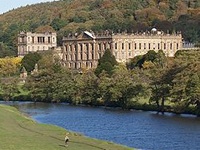
To complete the list of aristocratic PMs during the reign of George I (1714–1727) and George II (1727–1760), the last was William Cavendish, 4th Duke of Devonshire who lived in the peerless Chatsworth in Derbyshire – then, as now, one of the finest of our large country houses.  Interestingly, at the same time as he took on the role of PM in 1756, he also engaged in building at Chatsworth employing James Paine to add a new office wing and court (later replaced by Sir Jeffry Wyatville), a stable block, a bridge in the park, a bridge at Beeley, a water mill and also alterations to interiors of the house – though this work was not to be completed until 1767, long after his time as PM finished in 1757.

One notable feature of all the first PMs was they were all Whigs, a party nicknamed the ‘Country Party’ for their support was strongest in the shires and amongst the great landowners.  Unsurprisingly, these leaders were already managing vast estates which naturally came with sizeable houses which reflected their status – which then gave them the authority to aspire to be PM.  At this time, elections were rather crude affairs with the major landowners having MPs in their pockets due to ‘rotten boroughs‘ which gave the landowner a disproportionate, not to mention undemocratic, influence in the Houses of Commons.  Their country houses were therefore not a symptomatic trapping of power, something that they had aspired to and then acquired, but, in fact, were the foundation of the power which had secured them the position in the first place.

Chatsworth House, Derbyshire

Architecturally, the apparently only acceptable styles were either Palladian or Classical which reflected the political nature of the landowners – symmetry, structure, proportion and the use of the correct orders would have appealed to those who were against monarchical absolutism (which would have challenged their own power) but also reflected a societal structure which ensured their wealth and status.  The Whigs were also closely associated with the Church of England and, as such, would not have entertained the idea of building their houses in the ‘Catholic’ Gothic style, and anyway, with the neo-Gothic movement only really starting in the 1740s it would be several decades before it gained real influence.

So the early years of the role of PM was dominated by the existing ruling class; the great landowners who now shifted from trying to solely influence events through the levers of Royal favouritism (though their support of the Hanoverian succession and therefore King George wasn’t overlooked) to the use of Parliament – though on their terms.  The houses which had often been built to attract and impress a visiting monarch in the hope of securing influence now shifted to helping build alliances with other landowners – and what better way than creating a home they would feel comfortable in? Architecture had become a key part of the political landscape; a physical expression of certain values but also part of a supporting cast which would build the alliances which elevated men to be Prime Minister.

Next: a change of King, and a new PM.

List of UK Prime Ministers

Thanks to Andrew for the original suggestion for this survey

Houses as hospitals: the country houses in medical service

Hatfield House, Hertfordshire (Image: Amy Lloyd/flickr)

Our country houses have always been adaptable as changing fashions or functions required they accommodate new ways of living or roles.  One role which quite a few houses have taken on is that of hospital – either privately or as a fully-fledged part of the NHS – though this use has not always been sympathetic.  However, as the modern health service centralises to larger sites it seems some country houses are re-emerging to become homes again.

Hospitals were traditionally monastic, centred on the abbeys and convents but these were obviously scarce.  The ill were treated in large dormitories although some established houses in the country away from the main abbey to care for the mentally ill.  However the dismantling of the religious orders during the Reformation from 1536, meant that increasingly the burden for care of the pauper sick fell to secular civic bodies, with towns creating their own hospitals.  This model persisted until the 17th-century when private benefactors became increasingly prominent, donating funds and buildings for the care of the ill.

One of the earliest country houses to be converted was the partially completed Greenwich Palace. Originally a Tudor royal house, it had become derelict during the English Civil War, so in 1664 Charles II commissioned John Webb to design a replacement but which was only partially completed.  It was this building which Queen Mary II, who had been affected by the sight of the wounded sailors returning from the Battle of La Hogue in 1692, ordered to be converted to a navel hospital in 1694, to the designs of Sir Christopher Wren and Nicholas Hawksmoor and later Sir John Vanbrugh.

Possibly inspired by the royal example, other country houses were donated or converted for use as hospitals.  However, it quickly became apparent that they weren’t particularly suitable with one Irish physician, Edward Foster, complaining in 1768 that ‘In general, Houses have been rented for Hospitals, which are as fit for the Purposes, as Newgate for a Palace‘.  By the 1850s hospital design was beginning to emerge as a distinct branch of architecture -Florence Nightingale wrote to an officer of the Swansea Infirmary in 1864 saying that a hospital was a difficult to construct as a watch; no building ‘requires more special knowledge‘.  From this time, the country houses themselves became less important than the space they offered with the house itself being used as accommodation or offices. However, for the treatment of respiratory illness the clear country air was considered part of the cure with houses being acquired as tuberculosis sanatoria such as at Moggerhanger Park in Bedfordshire originally designed by Sir John Soane for the Thornton family.

The First World War necessarily required country houses to come back into medical use due to the terrible consequences of the strategy of attrition through trench warfare in WWI which created large numbers of wounded.  Without a national health service there were fewer hospitals able to cope with the seriously disabled or even those simply convalescing.  Many country houses were pressed into service, their clean country air and fine grounds considered most helpful to rest and recuperation. During WWII, fewer houses were used as military hospitals as changes in military tactics led to many fewer casualties than expected.  However, a significant number were used either by the military or as civilian replacements for urban hospitals which it was feared would be bombed.

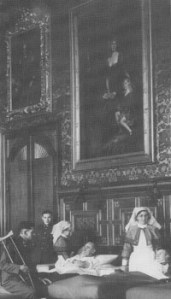
Hatfield House, Herts - King James Drawing Room as a hospital ward in WWII

For country house owners, given the possible options of who might take over their house, the bed-ridden were infinitely preferable to the bored squaddies who wreaked such havoc at other houses (apparently housing art treasures was first preference, evacuated schools second, hospitals third).  This reality plus a genuine sense of wanting to help led to many owners voluntarily turning over their houses as hospitals including the Earl of Harewood offering Harewood House, Lord Howard of Glossop Carlton Towers, Lady Baillie lent Leeds Castle and the 4th Marquess of Salisbury offering Hatfield House as he had done during WWI.  On the civilian side, Brocket Hall in Hertfordshire became a maternity hospital as was Battlesden Abbey in Bedfordshire, Stockeld Park and Farnley Hall, both in Yorkshire. Cholmondeley Castle in Cheshire became a Royal Navy Auxiliary Hospital, treating ‘cases of good morale, who are suffering from nervous breakdown usually as the result of operational stresses’.

After the war many houses were returned to their owners in such terrible disrepair that unfortunately hundreds were demolished.  Others continued in their wartime roles with some such a Poltimore House in Devon becoming hospitals after the war when two local GPs recognised the need for more bedspaces and so took over the old seat of the Bampfyldes until it was nationalised after the creation of the NHS in 1948.  There were also many War Memorial hospitals, founded by public subscription after WWI, which often made use of a country house. The nationalisation of these hospitals gave the NHS many of the country houses it has today – although it is relatively few overall as less than 5% of all their buildings are grade II* or grade I listed.  Of the historic ‘therapeutic’ landscapes it manages, seven are included on the English Heritage Register of Parks and Gardens of Special Historic Interest in England.

However, sometimes these country houses and their settings can escape and revert to being homes, either through conversion or, if the houses has been lost, replacement.   Bretby Hall in Derbyshire, built between 1813-15 by Sir Jeffry Wyatville for the Earl of Chesterfield, was an orthopaedic hospital until the 1990s when the main house was converted into flats, as was the High Victorian Wyfold Court in Berkshire.  Harewood Park in Hertfordshire was demolished in 1959 after use as hospital in WWII but the estate has been bought by the Duchy of Cornwall with proposals for an elegant and very impressive new Classical house by Craig Hamilton Architects.  A similar plan has been put forward for the 57-acre site of the former Middleton Hospital in Yorkshire with the permission requiring the demolition of various redundant buildings from its former use to restore the site.

Sadly though, sometimes the NHS fails to adequately look after the houses it has in its care.  As the trend has moved towards large, new hospitals so the historic elements have been overlooked or abandoned as new hospitals are built elsewhere. As funding for new hospitals is not dependent on the sale of the old site and the house, sadly they can be neglected or subject to inappropriate development as has been the case with the grade-II listed Stallington Hall in Staffordshire, which became a home for the mentally ill in 1928, but after it closed has been vandalised and neglected with a housing development built inappropriately close to the house across the lawn, forever ruining it as a country house –  a poor payback for years of public service.

Related story: ‘Developers draw up plan for country house‘ [Ilkley Gazette]

Background information: ‘Reusing historic hospitals‘ [Institute of Historic Building Conservation]

Seaton Deleval Hall nationalised

Seaton Deleval Hall

It’s been announced that the National Trust has today succeeded in it’s campaign to acquire Seaton Deleval Hall, regarded as one of the finest Baroque houses in England.  However, the success in securing the future of the hall has again come about as a result the damage caused by inheritage tax leading to treasures – usually art or antiques, but sometimes buildings – being taken into ‘national’ ownership rather than remaining in private hands.

Seaton Deleval Hall was built for Admiral George Deleval by Sir John Vanbrugh and was completed in 1871.  Vanbrugh’s other notable commissions included Castle Howard and Blenheim Palace.  However the house suffered a devastating fire in 1822 which gutted the central block which remained as a shell until 1980 when the 22nd Baron Hastings (Edward Delaval Henry Astley) partially restored it.

The 22nd Baron and his wife both died in 2007 triggering a significant inheritance tax bill.  It was this that led to the house being put up for sale and the start of  a fund-raising campaign to save it for the nation.  The house and 400 surrounding acres have now been accepted in lieu of £1.7m of tax (the first time since Calke Abbey in 1984) with the contents covering a further £3.2m.

The National Trust have generously contributed £6.9m to the endowment with a further £3m raised to cover other costs associated with opening it to the public.  The first visitors are expected to arrive in April 2010, part of an estimated 50,000 a year who will be able to see one of Vanbrugh’s masterpieces.

So whilst there is a success in that the house will now be secure and not carved up into flats, it’s still a shame that another part of our national architectural heritage is denied its primary function of being a home.  Inheritance tax has a pernicious creep – it can’t be avoided and just results in each generation selling off more historic artefacts to fund government budgets.  Give it a few hundred years and one conclusion could be that a majority of the crowning jewels of our artistic heritage including buildings, art and antiques could well end up being owned by a national organisation, be it the National Trust or the galleries.  For me, the art treasures of a nation are best located in the houses and families for whom they were produced or bought for, rather than part of a vast national archive, only brought out once a decade or less.  Inheritance tax makes a relatively small contribution to the national budget but it does have a disproportionate impact on our cultural heritage.

Full story: ‘National Trust saves stately home‘ [BBC News]

National Trust takes control of Seaton Delaval Hall‘ [The Art Newspaper]