A salute to determination: Goldsborough Hall, Yorkshire

Goldsborough Hall, Yorkshire (Image: Goldsborough Hall)

Love is a strange emotion which by chance can leave a person very attached to something.  For Clare and Mark Oglesby the object of their affections is the elegant Goldsborough Hall in Yorkshire, which, after five years hard work and a substantial budget has been rescued from dereliction and possible development.

Goldsborough Hall was built between 1601-1625 for Sir Richard Hutton, a London judge who used his wealth to establish himself in Yorkshire and was High Sheriff in 1623.  The internal plan of the house is interesting as it features a lateral corridor on all three floors and originally included fashionable features Sir Richard probably learnt of from his London friends such as a long gallery which useful for exercise in the inclement weather. Slightly unusually it was on the first floor (though not uniquely as Beaudesert, Condover Hall, and Treowen House also have this) when they were normally on the upper floors as, high up, their excess of glass gave visitors the most impressive view of the house – see, most famously, ‘Hardwick Hall, more glass than wall’.

The house was then rebuilt in the mid 18th-century for Richard Byerley before being bought by the Earls of Harewood, the Lascelles family, who employed the famous architect John Carr of York to remodel the interior in 1764-5, whilst he was also working on their main house, Harewood.  Goldsborough features numerous mementos of the family with their crest embedded in rainwater heads and in stained glass.  The house remained in the Lascelles family until 1965 when it was sold to pay death duties.  It then became a school, a private home, a hotel and then nursing home before being put up for sale in 2003 when the Oglesby’s first saw it but had their offer rejected.  At that time the house was still in good condition but this had changed dramatically when the estate agent contacted them again in 2005 to say it was between them and a developer. They successfully bid but now, just two years later, water was running down the 17th-century oak staircase and the panelling in the library, and the house lacked heating or working plumbing.  Undaunted, over the last five years they have spent around £2m on the restoration which has now rescued this wonderful house from ruin and is back to being a family home which pays it way by hosting weddings.

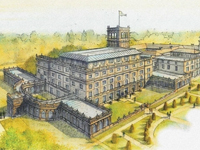
Rise Hall, Yorkshire (Image: Pastscape)

Another house which needed work and has now been restored explicitly as a wedding venue and family home is Rise Hall, also in Yorkshire.  Set in a beautiful small park laid in the 1770s, the grade-II* listed seat of the Bethell family was rebuilt between 1815-25, though the architect is disputed with some claiming it’s by Robert Abraham (whose eldest daughter was conveniently married to the owner, Baron Westbury) but more likely, as given by Howard Colvin, it was by Watson & Pritchard who also designed a Doric lodge for the house in 1818.  The slightly austere, 9-bay ashlar Georgian facade is dramatically enlivened by a full-height, tetra-style Ionic portico.  Inside the house features a top-lit staircase hall and some neoclassical decoration with an Adam-style dining room.  The house remained in the Bethell family until 1946 when they moved into the former rectory, now Rise Park, and let the house to the Canonesses Regular of St. Augustine, who ran a Catholic boarding school there until 1998.

The house was then bought as a second home by Sarah Beeny, star of many property restoration TV shows.  She and her husband used the house for many years but realised that the 97-room house was simply too large to function as just a weekend retreat and it also needed to pay for its own restoration. Beeny seems to take a rather hard-headed approach – unsurprisingly given her background – but is committed to achieving the right result. The location ruled out use as a hotel so they decided that they would convert it into a wedding venue in just eight months as part of a TV show called ‘Beeny’s Folly‘ which will be broadcast in Autumn 2010 on Channel 4.  This will be a chance for the wider public to get a real insight into just how much work is required to restore and maintain a stately home.  Who knows, it might even inspire someone with deep pockets and hopefully a sympathetic attitude, to find and fall in love with a one of our other country houses at risk and bring it back to life as a home.

Full story on Goldsborough Hall: ‘We’ve moved from our 4-bed detached to an 80-room stately home‘ [Daily Express]

Official website: ‘Goldsborough Hall

Detailed architectural description: ‘Rise Hall, Yorkshire

More buildings at risk: ‘Live and Let Die – 2010 Buildings at Risk Register‘ [SAVE Britain’s Heritage]

Views of seats; the mixed relationship between houses and motorways

Hardwick Hall, Derbyshire (Image: Bolsover Online)

Our best motorways draw us through beautiful landscapes, by turns revealing hills, valleys, broad vistas and narrow glimpses, sometimes punctuated with a country house.  Yet, country house owners have long fought many battles to keep the roads from carving up their precious parks and ruining the Arcadian views.

A recent article in the Guardian (‘Britain’s best views: motorway mansions‘) highlighted three great houses of Derbyshire each visible from the M1 motorway: Bolsover Castle, Sutton Scarsdale, and Hardwick Hall.  In our haste to get to destinations it’s easy to forget that where we drive was once part of great estates and previous owners would have wielded sufficient political power to ensure roads were routed away from their domains.  The echoes of this power can still be seen today if you look at aerial views of some of the great houses – major roads circle the gardens and immediate parkland such as at Chatsworth, Eaton Hall, and Clumber Park (though for the latter the house was demolished in 1938).

Yet, in other cases, officials either due to sheer bureaucratic efficiency, malice, or philistinism have carved roads through some historic parklands, cutting off the house from its setting, sometimes playing their part in step towards the eventual demise of the house. Sometimes the motorway is the gravestone; tarmac lies across the original sites of two lost houses so spare a thought for Tong Castle as you drive northbound just past junction 3 on the M54, or for Nuthall Temple, just north of junction 26 on the M1.

For planners, bypasses naturally need space and the obvious choice would be through the convenient estate which often borders a town.  From their perspective, taking on just single owner seems the easiest option, especially as it can be difficult to muster public support to defend a private landowners personal paradise.

One country house owner who has had several run-ins with roads is the National Trust, with varying degrees of success.  When they accepted Saltram House in Devon in 1957 they knew that a road was proposed which would cut across the parkland to the east of the house.  However, as a matter of principle they had to fight when finally earmarked for action in 1968, particularly as the road was much wider than originally proposed – though ultimately they were unsuccessful. For the private owners of Levens Hall in Cumbria, it was their research which prevented a link road to the M6 cutting across an avenue by proving it was originally planted in 1694 by garden designer Guillaume de Beaumont.  Yet other battles were lost; Capability Brown’s work at Chillington, Staffordshire was butchered by the M54, with the road now running just 35 yards from the grade-I listed Greek Temple.  At Tring Park in Hertfordshire the A41 slashes through the original tree-lined avenue.

The longest running, and most successful battle has been by the National Trust at Petworth House in Sussex.  The Trust has long accepted evolutionary changes but opposes drastic alterations regardless of the possible benefits to the local area – convenience does not trump heritage.  The village of Petworth suffers from heavy traffic so in the 1970s a four-lane bypass was approved which would run through the middle of the 700-acre, Capability Brown parkland, forever destroying the celebrated views painted by J.M.W. Turner in the early 1800s.  After objections were raised, an alternative, but equally damaging plan was suggested which used a ‘cut and cover’ tunnel – causing just as much destruction, particularly to the gardens, but then hiding their vandalism.  However, after a spirited public campaign, which included a dramatic poster showing the house with tyre tracks rolling over it (designed by David Gentleman for SAVE Britain’s Heritage), the plan was blocked and has almost certainly been killed off permanently.

So although the motorway has helped us to visit our wonderful country houses they also have, and continue to, pose a threat to them.  Thanksfully, stronger planning legislation which recognises the value of historic parkland has made it harder for the planners to simply draw a line between A and B without regard for the beautiful and important landscapes they would destroy.

Article: ‘Britain’s best views: motorway mansions‘ [The Guardian]

Aristocratic tenants of the National Trust; Shugborough House, Staffordshire

Shugborough Hall, Staffordshire (Image: Neilsvrx via flickr)

The news that the area of Shugborough House open to the public is to ‘double in size’ with the inclusion of the Lichfield family apartment, is a reminder of just how advantageous some of the deals were for the owners who gave their houses to the National Trust.  The Trust today is perhaps almost best known for its country houses which form an important part of its work.  However the houses were not simply museums but, due to the often very generous terms under which the families ‘gifted’ the houses, they were often able to stay on in private apartments.

When founded in 1895, the original aims of the National Trust were very much focussed on the preservation of countryside with houses only coming later. The first house the NT acquired was Barrington Court, Somerset in 1907 but the unexpectedly high cost of maintenance and repairs meant that another wasn’t acquired for over 30 years.  With the first crisis period of the country house in the 1930s, leading to many demolitions, there was a growing realisation that the National Trust was well placed to rescue some of the threatened homes.  In 1936 they set up a ‘Country House Committee’ in response to the suggestion of Philip Kerr, the 11th Marquess of Lothian at the 1934 AGM that the NT should be able to accept the gift of country houses, with endowments in land or capital, free of tax. This new regime was then given legislative powers through the National Trust Act of 1937 with Lothian then providing the first donation of one of his four great houses, Blickling Hall with its 4,760 acres, in 1940. To help guide them, Country Life magazine was asked to draw up a list of those properties (which totalled 60 larger and 600 smaller houses) which ought to be saved for the nation.

Having created the legislative backing the NT was well placed in the second period of crisis in the immediate post-war period when the tireless, if not faultless, Secretary of the Committee, James Lees-Milne, travelled up and down the country persuading owners to part with their inheritance.  He was helped by the pernicious, and still highly damaging, death duties which, since 1904 had risen from 8% (for estates valued at over £1m) to 50% by 1934, leading to massive sales of land and contents to fund the demands of the ever-grasping Exchequer.  The multiple sets of duties levelled against the aristocratic families who had sometimes lost father and then son in WWI (and who had been particularly vulnerable as they were often officers and so first over the top) meant estates were inherited by an uncle with no deep connection to a house and estate who would happily sell up.  However, for some who were loathe to simply sell, the National Trust seemed to offer an attractive alternative where someone else would pay the maintenance bills whilst they were still able to live in the house.

The degree to which the family remained in the house was sometimes simply down to how well the family had negotiated with the NT and dependent on the chips they had to bargain with.  For some such as Lord Faringdon at Buscot Park where he retains ownership of the contents, this is powerful position as the house would be severely diminished without the collection of furniture and art.  For others such as Throckmorton family at Coughton Court and the Dashwoods at the glorious West Wycombe Park, long leases (250-300 years) ensure their continued presence.  For some, the pre-eminent importance of the house gave them the edge with Sackvilles at Knole, an Elizabethan treasure-house, living in a large section of the house and still owning vital parts of the house and the entire 1000-acre parkland.  At other houses, the family remain living in the almost the whole house but with almost all the rooms open to the public such as at Anthony where the Carew-Pole family have just a small kitchen and sitting room as their own.  For others such as the Hyde-Parkers at Melford Hall they were retained by the NT as the paid administrators of their own family home which is almost completely open.  Other families like the Lucy’s at Charlecote Park have just a private wing or simply a flat in a wing such as the Drewe’s at Castle Drogo.

For the grade-I listed Shugborough House, begun in 1695, the elegant enlargement and magnificent plasterwork and decoration by James ‘Athenian’ Stuart between 1760-70, ensured that the house would always be on the list of ‘major’ houses to be saved.  When the then Lord Lichfield gave the house and 900-acre estate to the NT in 1966 in lieu of death duties the agreement regarding the house only included the state rooms on the ground floor and a small section of the first floor with the rest was leased as private apartment for the family.  The rooms to now be opened include the Boudoir with original real silver leaf wallpaper dating from 1794, and the impressive Bird room which was Lord Lichfield’s private drawing room.  The 6th Earl of Lichfield has now surrendered the lease allowing Staffordshire County Council, who run the house on behalf of the NT, to include the rest of the ground and entire upper floors.

It may seem like a strange anachronism to have the donor family still living and enjoying the family seat (although they pay rent) whilst having the National Trust pick up most of the bills for maintenance. However, the family add a rich layer of history and their commitment to the care of the houses is second-to-none with their residence helping the houses avoid the awful fate highlighted by Philip Kerr that ‘nothing is more melancholy than to visit these ancient houses after they have been turned into public museums’.

Full press release: ‘Shugborough mansion is set to double in size‘ [Shugborough Hall]

Superb post by Fugitive Ink on ‘James Lees-Milne and the National Trust‘ [fugitiveink.wordpress.com]

Thanks to Andrew for original link.

Proposal for Trentham Hall to be rebuilt as a hotel

Trentham Hall proposal, Staffordshire (Image: Property Week)

One of the greatest losses in the many country houses demolished in the 20th-century was that of Trentham Hall, the Staffordshire seat of the Dukes of Sutherland.  Originally a large Georgian house, it was rebuilt and greatly extended for the second Duke in the 1830s by the famous architect Sir Charles Barry, who was also responsible for the rebuilding of the Houses of Parliament.  The house became a celebrated venue for entertaining and was filled with fine works of art and sculpture.

Unfortunately the relentless expansion of the nearby Potteries areas of Staffordshire led to increasing amounts of pollution entering the rivers which fed the lakes and gardens designed by Capability Brown. By 1898 the smell was so bad that the house was effectively abandoned by 1907.  The Duke tried to donate the house and estate to the local council  in 1905 but was rejected so in 1912 the house was demolished.

The gardens were eventually opened to the public with the remaining outbuildings sitting rather forlornly around the blank space which marked out the site of the now lost house.  The gardens had been maintained and delighted generations of locals who would walk through the extensive terraces which led down to the now clean lake.  Now the 750-acre Trentham Gardens are part of a £100m project to bring back the glory of the earlier eras, with the centrepiece being the £35m recreation of the house as a 150-room luxury hotel following Barry’s original designs.

Despite the economic turmoil, the developers, who originally planned for completion by 2011, are still hopeful that they will be able to proceed with the project.   Although the hotel will not bring back the history and unique architecture of the house, the idea of recreating a lost country house is one to be encouraged.  Although many houses were demolished, the parkland and gardens were often simply abandoned and are still visible today.  Perhaps other estates might be encouraged to look at whether a new house might be the most appropriate use of the estate – after all, this was the purpose of their creation.

Full story: ‘Trentham rebuilt‘ [Property Week]

Ranton Abbey to be resurrected – or replaced?

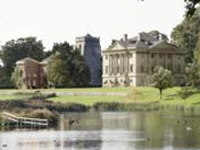
Ranton Abbey, Staffordshire (Image: Knight Frank)

When the historic Ranton Abbey was accidentally set alight and gutted in 1942 by the Dutch troops stationed there, it was likely that it would go the way of many other houses and simply be demolished. Yet the Earls of Lichfield, who owned the 300-acre estate, simply left it and focused on turning the land into a first-class shoot, allowing the house to slowly collapse, leaving just the ivy-clad walls visible today.

The death of the 5th Earl, the famous photographer Patrick Lichfield, in 2005, prompted the family to look again at the estate.  However, rather than simply sell it they decided to obtain planning permission for the building of a new house and have now put both for sale at £3.5m.  Although an obvious course of action, the choices made seem a bit odd.  The new house is strongly Palladian in design but the projections produced so far have it sited so close to the red-brick shell of the old house, and the grey stone of the church, that it seems to have almost landed there by accident.  It certainly does not seem to appear at home in this location and appears almost arbitrary, resulting in three large architectural elements fighting for prominence in a small area.

As the respected architectural writer Marcus Binney says in the ‘Bricks and Mortar’ supplement of Friday’s Times newspaper, surely the better option would be to restore the original house.  This would bring back the balance which existed before and remove at once the obvious difficulties of leaving the old house as a giant garden ornament to compete with the new house.  Whoever buys the estate and planning permission will hopefully think again about this scheme and look seriously at restoration.

Full story: ‘Historic homes: restoration dilemma‘ [The Times]

Property details: ‘Ranton Abbey, Staffordshire‘ [Knight Frank]