An architectural adventurer: Richard Norman Shaw

What hideous drawings! Did anyone ever see such Vulgar looking things
– I am quite ashamed of them!

Richard Norman Shaw‘s vehement criticism, annotating a set of drawings created by a clerk in his own office, shows the passion and perfection with which this exacting architect imbued his work and that of his office.  One of the greatest of the Victorian architects, Shaw exemplified the ideals of the age; the ability to create beauty in many architectural forms, but also in the high standards of production and construction. His work helped shape the modern concept of what the Victorian age created, not only through his many urban projects but through the creativity he brought to his country house commissions, including new builds such as Leyswood, East Sussex, or grand additions such as at Chesters, Northumberland.
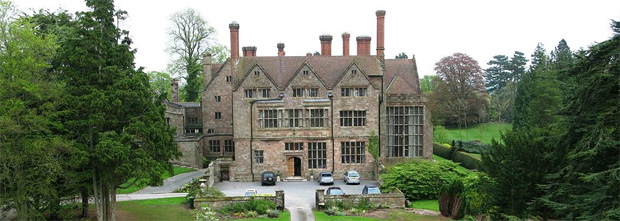
Adcote House, Shropshire (Image: Gary Wright / wikipedia)

Despite his lofty reputation during his lifetime, Shaw’s eclectic use of styles, combined with his own resolute disinterest in letting anyone produce books on his work, meant that by the 1950s, the man and his work had been somewhat forgotten in the then prevailing Modernist fervour.  Thankfully, other architects recognised the singular influence he’d had through his practice and which deserved to be better remembered and appreciated. Shaw was born in 1831, an exciting time at the cusp of the Georgian period as it moved into the variety of the Victorian age.

It has been said that there is no ‘Victorian’ style as what we think of from that age was often derived from earlier forms. For a versatile and thoughtful architect such as Shaw, it was this flexibility which was to give him the scope to develop a skilled yet playful understanding of architectural vocabulary.  Shaw’s work can be broadly categorised as working in ‘Old English’, ‘Gothic, ‘Queen Anne’ and the reformed classicism of his later works.

What Shaw offered his clients was all part of an intelligent English Vernacular, a distinct style which flourished in the Victorian era, which combined local building traditions with skilful use of earlier traditions of English architecture, though primarily influenced by Gothic Revival. Although this movement dominated the latter half of the 19th-century and the first decades of the 20th-century, it was largely ended by the domestic impact of the First World War.  After that, the influence of the Continental movements such as the Bauhaus heralded the ascendancy of Modernism.

Glen Andred, Sussex - designed 1867 (Image: Courtauld Institute of Art)
Glen Andred, Sussex – designed 1867 (Image: Courtauld Institute of Art)

His first new house was a development of the local Sussex vernacular with an intelligent and thoughtful response to the dramatic hilltop site.  Glen Andred, Groombridge, East Sussex (designed 1866-68) was an important influence for the ‘Old English’ Arts & Crafts style, as later practised and developed further by Voysey and Lutyens, in Sussex and Surrey.  One house does not a movement make and it was two related houses nearby which helped push the aesthetic which was to become so widely adopted not only within these counties but across south east England.
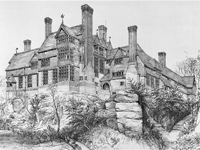
Leyswood, Sussex (Image: Country Life Picture Library)

Leyswood was designed and built contemporaneously with Glen Andred for a related site in Groombridge, close to Shaw’s first project.  Taking the ideas he had started to develop, Shaw took full advantage of the prominent hill-side site and created a bold re-imagination of the Elizabethan courtyard house, tailored for the needs of the modern Victorian gentleman.  Perched over a rocky incline, Leyswood combined vernacular elements of the English castle, such as the gatehouse, with more domestic features such as the full-height, half-timbered entrance front.  Shaw also indulged what was to be a trademark (and one that can be seen in Lutyens’ work too), that of multiple, tall, finely executed brick chimneys.  These chimneys punctuated the roofline, creating a clear rhythm and emphasis to the house.

Cloverley Hall, Shropshire - demolished 1950s (Image: Lost Heritage)
Cloverley Hall, Shropshire – demolished 1950s (Image: Lost Heritage)

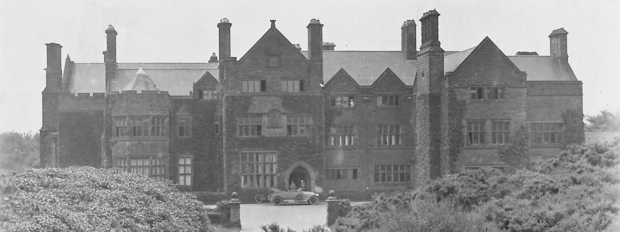
Shaw had clearly been sharing ideas with his fellow student and partner, William Eden Nesfield, who was building Cloverley Hall, Shropshire, between 1866-68, and which was architecturally kin.  Sadly, both Leyswood and Cloverley were both dramatically reduced in size, both losing the principal sections of the house, leaving only the entrance towers and service wings to suggest what was there before.

Still standing in all its glory, thanks to the National Trust, is Shaw’s next commission, Cragside, Northumberland, built 1869-85.  Although technically a rebuilding of an existing lodge, this house was to give Shaw the scope to work at a larger scale for an ambitious and very wealthy client.  For more on this remarkable house, see my earlier article: ‘A theatre of innovation: Cragside, Northumberland

Further houses in this now well developed ‘Old English’ style followed, including Preen Manor, Preen, Shropshire (1869), Hillside, Groombridge, Shropshire (1870-71), and Grims Dyke, Harrow Weald, Middlesex (1870-72).  The latter was praised by John Betjeman in ‘Metroland’ (1972) as ‘a prototype of all suburban houses in southern England‘ – it’s now a hotel so you can appreciate Shaw’s work over a drink.
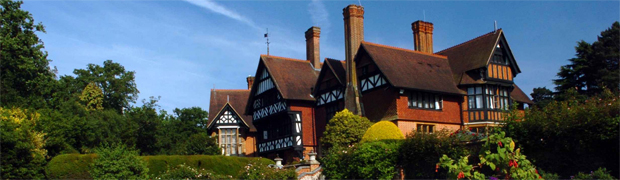
Grim's Dyke, Middlesex (Image: Grim's Dyke Hotel)
Grim’s Dyke, Middlesex (Image: Grim’s Dyke Hotel)

Other houses in the ‘Old English’ style:

  • Boldre Grange, Boldre, Hampshire (1872)
  • Wispers, Stedham, West Sussex (1874-76)
  • Pierrepont, Frensham, Surrey (1875)
  • Piccards Rough, Guildford, Surrey (1877)
  • Allerton Beeches, Allerton, Liverpool (1883-84)
  • The Hallams, Shamley Green, Surrey (1894-95)

As Shaw explored the use of vernacular, one variation was a more ‘manorial’ interpretation of the ‘Old English’; designs which used a more austere style, primarily of plainer brick elevations, omitting the tile-hanging and half-timbers. These houses took what his biographer Andrew Saint described as drawing on ‘Haddon Hall‘, to create a more castellated, almost defensive style. An early version of this can be seen at Adcote, Shropshire, designed in 1875.  Buttressed walls, punctuated with mullioned windows of various sizes, created the impression of a more medieval property which had grown into a modern country house.

Flete, Devon (Image: Country Life Picture Library)

Perhaps the closest to visually look related to Haddon was Flete House, Devon.  Designed in 1877, the house was commissioned by the wealthiest of Shaw’s clients, H.B. Mildmay, a partner in Barings bank who was determined to emphasise his long Devonian family heritage with a suitably historic house.  Although constrained by having to work with the original 1620s house along with various other restrictions (including the use of battlements, thwarting his usual gables), Shaw was partially successful, though it lacks the assured handling and confidence of equivalent castles by Anthony Salvin such as Peckforton.  Interestingly, Shaw’s pupil, Lutyens, achieved far greater success with Castle Drogo, built four decades later.

In the same vein, Dawpool, Cheshire (1882-86) was built on an exposed site on the Wirral, overlooking the River Dee.  Again, the exterior suffers from Shaw’s attempt to create a gabled castle, but as large sections were in his more familiar style, this felt more effective – though it was the interiors which were the greater success with the impressive picture gallery. Sadly, the house was to last just over 40 years, being demolished in 1927 – a history of the house is on my Lost Heritage website: ‘Dawpool

Dawpool, Cheshire - demolished 1927 (Image: Lost Heritage)
Dawpool, Cheshire – demolished 1927 (Image: Lost Heritage)

The 1870s was a decade in which the fashion for Gothic Revival started to wane with clients looking for a new style.  Shaw’s versatility meant that although he continued to use and develop his ‘Old English’ style, he also explored the use of a more Classical or ‘Queen Anne’ style (aka ‘free-classic’, ‘Re-Renaissance’ or ‘classical freestyle’ – Dr Simon Thurley). Although other architects used it specifically for smaller-scale domestic houses, Shaw adopted and adapted it for both his larger public buildings but also some of the larger private country house commissions.

Shavington Hall, Shropshire (1885-86) shows how quickly the clients taste can change.  The owner, A.P. Heywood-Lonsdale, already owned Cloverley Hall, designed by Shaw’s partner William Eden Nesfield in 1866, and yet just 20-years later, was asking Shaw to rebuild Shavington as a main seat but in the new ‘Queen Anne’ style.  Sadly, again the larger Victorian houses suffered in the austerity of the mid-20th-century and Shavington was demolished c.1960.

Bryanston, Dorset (Image: Bryanston School)

Another significant commission was a monumental new house, Bryanston, Dorset (1889-94), for Viscount Portman, to replace an existing fine house by James Wyatt at the then vast cost of £200,000 (approx £20m).  In some ways, this was an odd brief from the client; to build a house twice the size of the existing one and in a fashion which was as much about public statement as domestic practicalities. The new Bryanston would not have looked out of place on the Continent, taking on the aspect of a grand French château or German palace, despite the age of aristocratic living on this scale already fraying at the edges.  For all this, Shaw certainly met the challenge, delivering a house that stands as testament to his skill, even if in 1928 the 4th Viscount Portman was forced by death duties to sell the house and 450-acres for just £35,000 for use as a school, which it has successfully done since then.

Other large Classical commissions include Chesters, Northumberland (1890) and Haggerston Castle, Northumberland (1892-97, demolished 1933).

At the core of the success of Shaw’s architectural style was not only his bold imagination and understanding of internal planning but also his keen understanding of self-promotion.  In the days before the internet and Twitter could furnish images of an architect’s work, Shaw ensured that his designs where regularly published in The Building News, the hugely influential weekly magazine which featured plans, layouts and beautiful woodcut impressions of the houses now springing up at that time.  This constant publicity, both in the UK, and internationally, ensured that Shaw’s trademark ‘Old English’ style became almost a standard for the southern home counties and popular even further afield.

Shaw’s fame and reputation were based on a profoundly inventive handling and development of the English Vernacular styles combined with a very astute understanding of how to ensure the widest publicity for his work. Although his fame may have dimmed for a time, it is right that his work be brought firmly into the light.


Exhibition at the Royal Academy of Arts, London:

Dream, Draw, Work
Architectural Drawings by Norman Shaw RA
30 May — 14 September 2014


The RIBA hold a notable collection of Shaw’s drawings which can be seen online: ‘Richard Norman Shaw‘ [RIBA]


Other major commissions (chronological order):

  • Jesmond Dene House, Newcastle, Northumberland (1870-85)
  • Bannow, St Leonards, Sussex (1877-79)
  • Greenham Lodge, Greenham, Berkshire (1878)
  • Alderbrook, Cranleigh, Surrey (1879)
  • Baldslow Place, Baldslow, East Sussex (1879-82)
  • Holme Grange, Holme Green, Berkshire (1882-8)
  • The Rookery, Bromley Common, Kent (1882)
  • Didlington Hall, Didlington, Norfolk (1882)
  • Walhampton House, Lymington, Hampshire (1883)
  • Banstead Wood, Banstead, Surrey (1884-86)
  • Overbury Court, Overbury, Worcestershire (1887-1900)
  • Addington Park, Addington, Surrey (1898-1900)

Further reading
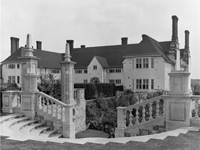
The Country House Revealed – Marsh Court, Hampshire

Marsh Court, Hampshire (Image: Country Life Picture Library)

As with artists, some architects start well and then just get better, culminating in masterpieces which are rightly praised.  With buildings, and particularly the usually distant country house, it can be difficult to truly appreciate them; their beauty a pleasure reserved for those invited.  Thus one of the delights of ‘The Country House Revealed‘ series has been to elevate us mere viewers into guests of some lesser known, but wonderful houses – and Dan Cruickshanks’ visit to Marsh Court in Hampshire proves just what gems are nestled in the countryside.

The house is the work of one of the best architects to have been produced by this country; Sir Edwin Landseer Lutyens.  A master at the re-interpretation of traditional building forms and styles, his work is, in many cases, instantly recognisable. Yet, in others, his sensitive updating of existing historic buildings blends so seamlessly it’s hard to distinguish between old and new (one of the best examples of this is Great Dixter, Sussex).  Lutyens was working at the end of the Victorian era and his work grew into the perfect response to the glory days of the Edwardian period; those long summers of country house entertaining from the turn of the 19th-century which were so firmly ended by the horrors of WWI.  Yet this was also a time of a confident nation, with fortunes being made (and lost) in an increasingly mercantile world, in which wealth was not related to the land. This fact was reflected in a new style of country house which required the trappings of the traditional entertainments and accommodation but which didn’t require a vast estate to support it.

Deanery Garden, Berkshire (Image: Country Life Picture Library)

Lutyens was the right man at the right time – and with the right connections.  His rise coincided with a new interest in the countryside, which was now being opened up to the new middle class with their leisure time and the rail network.  Spotting an opportunity, Edward Hudson started ‘Country Life‘ magazine in 1897, which quickly became the publication of the country set – and, more importantly, those who aspired to join them.  Hudson had been impressed with Lutyens’ work, to the extent that he had him design his own house, the brilliant Deanery Garden in Berkshire.  The distinguished architectural writer (and Country Life writer) Christopher Hussey said that it:

“…may be called without overstatement a perfect architectural sonnet, compounded of brick and tile and timber forms, in which his handling of the masses and spaces serve as a rhythm: it’s theme, a romantic bachelor’s idyllic afternoons beside a Thames backwater.”

Replace ‘Thames’ with ‘Hampshire’ and this praise might equally, and perhaps more so, be applied to Marsh Court. However, one other key difference would be the material used in the construction of Marsh Court; clunch, the local hard chalk stone; used for centuries in churches and cottages but never for an entire country house.  It’s a mark of Lutyens’ mastery of materials and style that he would even consider it – and the effect is what helps elevate this house to being one of the finest in the country.

Marsh Court echoes something of the character of the client, Herbert Johnson, who was as an “adventurer, stockjobber, and sportsman” who made a fortune, lost it, and made another.  Lutyens came to the attention of Johnson through the regular articles in Country Life featuring his various commissions which Hudson was only to happy to publicise.  In many ways, Johnson was an ideal Lutyens client – willing to think big, with a suitable budget and, although wishing to join the country life, not excessively bound by tradition.  This suited Lutyens as he was able to develop his ideas around the ‘Tudor’ style house, but marry them with a modern take which dramatically elevated the design to ensure no-one could ever call it ‘pastiche’.

West front - Marsh Court, Hampshire (Image: Country Life Picture Library)

The house, built between 1901 and 1904 with later additions also by Lutyens, is essentially an ‘H-plan’, though without the south-east leg, and goes back to his earlier interest in historic English architecture.  As the architectural writer Lawrence Weaver highlights, this house only works because Lutyens has perfected the balance of local materials through clever groupings of shapes and elevations, combined with contrasts in size and stone.  But even a good design might become too dominant in such an exposed location, sitting on a rise above the river Test.  Again, Lutyens has the ideal answer in his use of the sloped site to create terraces which ease the house into the landscape – note the change from two-storey on the north front to three on the south.  The stark white stone is also softened through the introduction of slates, flint and red-brick into the walls to create a mix of regular and irregular patterns, such as on the west front which gives the impression of tiles sliding down the walls like rain to pool at the bottom.  Only someone of Lutyens’ skill could attempt and succeed with such an architectural fancy.  The interiors are similarly impressive, with grand, almost Baroque, plasterwork in the hallway, combined with the fine panelling elsewhere.

Herbert Johnson moved out in sometime after 1940 and the house became home to evacuated children, and then, in 1948, a prep school.  It remained in this role for nearly 50 years before it was bought, for £800,000, in 1994, by Sir Geoffrey Robinson; industrialist, Labour MP but, most importantly, a heritage-minded multi-millionaire. Working with Michael Edwards, Sir Geoffrey and his wife Marie Elena undertook a comprehensive, yet sensitive, restoration of the house; removing partitions, restoring the ceiling plasterwork and updating the services. It was then sold for £6m in 1999 and then offered at £13m in 2007, before being relaunched in June 2008 at £10m before selling at £11m later that year.

Lutyens’ brilliant output was somewhat overlooked by the wider contemporary architectural world which was more interested in the developing Modern movement. Hudson’s constant championing of this visionary architect ensured that Lutyens’ work and reputation were assured even if he had never gone on to his later, much grander, projects designing the Viceroy’s Palace in New Dehli. In 1909, G. Lloyd Morris, although talking specifically about Marsh Court, provided an elegant summary of the essence of Lutyens’ skill in that the;

‘ unity’ which ‘…is the pre-eminent quality underlying the orderly and tranquil beauty manifest in [his] houses.  He never fails in this respect; one may cavil at certain details, or question the use and treatment of a material, but in the handling of the general conception there is always a breadth and a certainty in the composition that remains in the memory long after the details may have been forgotten.’

Certainly, Marsh Court succeeds overwhelmingly in this respect and is a worthy inclusion in any series looking at the finest country houses in the UK.

————————————————————————————-

Official website: ‘The Country House Revealed‘ [BBC2]

Superb photos of the house and gardens: ‘Marsh Court, Hampshire‘ [Country Life Picture Library]

More on the house and Lutyens:

Guest blogger: Jeremy Musson – ‘English Ruins: an odyssey in English history’

Having written all nearly 200 posts since I started writing this blog I now thought it would be interesting to try and broaden the voices involved.  So as the first post in this new direction/experiment, I am delighted and honoured that one of our leading architectural historians, Jeremy Musson, kindly agreed to write a piece on country house ruins linked to his new book published this month, ‘English Ruins‘, a fascinating look at their role in shaping our perceptions of the past and our architecture.

——————————————————————————————-

Jeremy Musson
Jeremy Musson

The English landscape is a landscape of ruins. Fragmentary or sometimes only roofless and windowless, these part dismantled buildings stand out to mark our national history in a number of different ways, and above all, provide a sense of historic scenery for our journeys, physical and imagined – and glimpsed from motorways and footpath alike. In this new book, photographer Paul Barker and I wanted to explore something of this particular cultural landscape and through this exploration trace something of how the English see themselves and their past.

I feel that we live in an old country, and the past is always there, to paraphrase T.S.Eliot, “pressing on the future”. Some love the past, some hate it, many are indifferent to it, happy enough to take pleasure in a good day out, with a dash of historic scenery. But the whole process of our encounter with ruins, is somewhat special – a deeply subjective, and in effect, an almost artistic experience. It is personal and often emotional, while it is also formed and shaped by a whole series of sometimes opposing cultural inheritances: Romanticism, anti-establishment, veneration for the classical, veneration for the Gothic, history seen through the very shape of the landscape.

There is something that seems to appeal about ruins to the English imagination over the centuries. Think of how John Aubrey, for instance, the late seventeenth antiquary and author of that amusing volume of English biography Brief Lives, observed that

“the eie and mind is no less affected with these stately ruines than they would be if they were standing and entire. They breed in generous mindes a kind of pittie; and set the thoughts aworke to make out their magnificence as they were in perfection.”

Piranesi: 'Temple of Hercules, at Cori' - 1769 (Image: Mattia Jona Gallery)

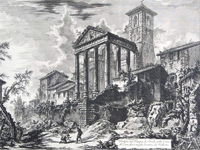
During the 18th century, the Grand Tour, part of the expected education of a gentleman or aristocrat, consisted of a journey through Holland and France to visit the great monuments of the Roman world, excited the aesthetic and cultural awareness of the 18th-century English gentleman, who was in turn the patron of artists and architects following the same path in trying to import the drama and excitement of great classical ruins to an English audience. Walk through any major house built in the 18th century, with anything of its original collections still in situ and the ruin is visible in painting after painting, and then echoed in the classical temples of the park.

The phenomenon of creating artificial ruins, in which the English seem to be pioneers, belongs to this period, and while the earliest garden temples seem to be classical, the contrivance of designing ‘ruined’ structures, was largely sourced in England’s own Gothic past. Horace Walpole the 18th-century diarist, who designed his own Gothic style house, Strawberry Hill, hugely admired the work of Sanderson Miller who designed a ruined tower at Hagley Park, with the perhaps slightly teasing phrase that it had “the true rust of the barons’ wars” referring to the Wars of the Roses.

When making this tour of England in tandem with photographer Paul Barker, I could not help noticing that we were often treading in the footsteps of the great landscape painter, J.M.W.Turner, for whom the evocative power of the ruin played a central role in his career, although we perhaps think of him most naturally as a landscape painter, and a painter of skies.

In the last years of the 18th century he exhibited numerous studies of great historical ruins in landscapes, appealing to the Romantic spirit of his audience – characteristically these are the foil for dramatic expositions of sky or sea. He continued to make special studies of ancient ruins, castles and abbeys on tours around the whole of England, for his ambitious Liber Studiorum project, and many were published in different histories, especially in Charles Heath’s Picturesque Views in England and Wales.

Turner looked principally at abbeys and castles, but abandoned country houses have come to be a feature of our landscape too. The dramatic changing status of the country house from the first world war, into the great depression of the late 20s and early 30s, becomes even more intense after the second world war – think of John Harris’s memoir, No Voice from the Hall. This was a period which resulted in so much change in English life, that it is easy to overlook the symbolic collapse of the world of the English country house. This was a feature of interwar life too, with the rise of income tax and death duties, but the upheaval of the Second World War, the widespread institutional use of country houses for military and other government purposes often hastened their subsequent abandonment.

Cowdray House, Sussex (Image: Cowdray Heritage Trust)

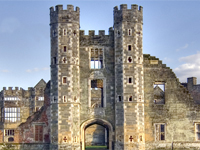
Inevitably, given my interest, the country house looms large in our new book. We focus on the story of buildings from different themes and for the ruins of country house, beginning with Cowdray House, in Sussex, a substantial Elizabethan mansion damaged by a fire in the late eighteenth century, and then abandoned, partly as a result of complications over inheritance; but quickly becoming a destination for artists, for instance, Turner visited the ruins while staying at Petworth – it is now looked after by a newly formed trust, and feels like the sets left over from a Grand Opera, standing amongst the meadows and paddocks on the edge of Midhurst.

We also visited the ruin of an elegant early-seventeenth-century lodge at Wothorpe Towers, a lodge once part of the Burghley estate, which was used as a dower house and then, apparently, part dismantled to provide an eye-catcher in the new landscaped park. It was falling into serious decay and has recently been taken on by the Griffin family, who putting the main house into a trust, which is restoring the gardens, are converting the ancillary seventeenth century buildings into a new home.

Seaton Delaval Hall, Northumberland (Image: Alan J. White / wikipedia)

The classical country house tradition is represented in our book, by 1720s Seaton Delaval Hall, near Newcastle – one of the finest houses by Sir John Vanbrugh, re-roofed after a major fire, the interiors are otherwise the very picture of a ruin. In Derbyshire, we encountered the memorable and mournful spectacle of Sutton Scarsdale Hall in Derbyshire, also built in the early 18th century. The latter, partly due to its proximity to mine-works, acquired in 1919, by businessman out to profit from its materials and fittings. The panelling was sold United States collectors, and some at least found its way into the Museum of Fine Arts in Philadelphia. Its demolition was in fact prevented by local landowner Sir Reresby Sitwell, whose family later presented it to the state.

James Lees Milne, looked at the Sutton Scarsdale ruins for the National Trust, but said that “classical ruins in England are much satisfactory than Gothic ones, the lack picturesque gloom.” English Heritage look after it now, as they do Witley Court, a multi-layered great house and former seat of the Earl of Dudley, a splendid Italianiate palace with a vast portico by John Nash, was burnt out in 1937, and by some chance was not demolished during the 1950s, like so many abandoned houses, and it was subject to preservation order in the 1970s, and in the early 70s taken into state protection. Christopher Hussey thought that it conjured the beauties of the classical ruins visited by the Grand Tourist in the 18th century, as much as anything else.

Lowther Castle, Cumbria

Forgotten Victorian Gothic mansions such as Lowther Castle in Cumbria, possibly become more Romantic in their ruined state. Lowther, the historic seat of the Earls of Lonsdale, designed by Smirke in Gothic baronial style was not re-occupied after the second world war, and in 1957, de-roofed and only the exterior walls preserved. A haunting presence in the beautiful Cumbrian landscape, a new trust has been created to protect the runs and open them and the overgrown Edwardian gardens to the public, in the course of 2011.

For myself, as a historian of the English country house, there is no doubt that the ruin occupies a special place in English culture; the castle, the abbot’s lodgings, the country houses of the sixteenth century onwards, when they stand open to the elements, draw us in to a dialogue with our history and the mutability of fortune.

Jeremy Musson’s ‘English Ruins‘ with photographer Paul Barker, is published by Merrell publishers.

Text by Jeremy Musson, choice of links and images by Matthew Beckett.

——————————————————————————————-

Dear Readers – as always I welcome your comments and feedback.

If a moat floats your boat: for sale; Playford Hall and Giffords Hall, Suffolk

Baddesley Clinton, Warwickshire (Image: Nala Rewop / flickr)

Moated houses are an architectural short cut to a more functional time when where a family lived had to be defensible and not simply a place of relaxation.  Today, of course, we admire them for their ancient charm, the weathered bricks reflected in gently rippling waters.  These houses are an older expression of our love of the natural, which found a more formal form in the later Picturesque movement, their more organic outlines in contrast with the more rigid classicism which followed.

Though once numerous, time has taken its toll and excellent examples are less common – and especially appealing when they come to market, as two have recently. The moated manor house was a result of many factors; the decline of the traditional castle, a more peaceful society, and increased wealth, but still with a need to provide some defence against thieves and attackers.  The latter category was increasingly rare but a moat with gatehouse and even drawbridge had a practical advantage.  However, for families which wished to visually bolster the perceptions of the grandeur of their lineage, a moated house was very evocative of permanence and status, drawing on their architectural ancestry with castles.  As each manor required somewhere for the local owner to stay (sometimes only occasionally if they owned many) each had a house of varying size and status depending on the wealth of the owner.  As each manor often covered a relatively small area this led to the building of thousands of these houses (though not all with moats), particularly in England.

Groombridge Place, Kent (Image: Hans Bernhard / wikipedia)

The organic growth of a moated house often created a pleasing historical collage of styles, such as at Ightham Mote, Kent, though this was sometimes swept away to be replaced by a new house such as at Groombridge Place, also in Kent.  This beautiful house was build in 1662 though in a traditional Jacobean/Elizabethan ‘H’ plan on the footprint of the older, more fortified house – though the diarist John Evelyn thought, following his visit in August 1674, that “…a far better situation had been on the south of the wood, on a graceful ascent.” indicating not everyone found a moat romantic.

Yet not every grand family felt the need to abandon the old house.  The Lygon family (Earls Beauchamp between 1815-1979) have lived at the evocative Madresfield Court, Worcestershire for 28 generations.  At its core, a 15th-century moated manor house, the current building is largely the work of the architect Philip Hardwick in 1865 for the 6th Earl Beauchamp.  The house is a prime example of late Victorian taste; a clever blend of Anglo-Catholic Pugin gothick with extensive Arts-and-Crafts interiors including a wonderful library by C.R. Ashbee of the Cotswold Guild of Handicraft (to read more about this remarkable family and house I can recommend ‘Madresfield: the Real Brideshead‘ by Jane Mulvagh).

Ightham Mote, Kent (Image: Matthew Beckett)

The physical security of a moated house was also a factor in its decline as it limited the space available for expansion as either the family, wealth or ambition of the owner grew. Many a grand country house was constructed elsewhere to replace a smaller manor with the old house either being abandoned, demolished (sometimes for building materials), or used as a secondary or dower house.  Yet, as a harsher economic reality came to pass from the 1880s, and as these smaller houses were lauded in magazines such as Country Life, so their attractiveness grew with many rescued from neglect and sometimes reinstated as a principle house on the estate.

H. Avray Tipping, one of the most influential of the Country Life writers, was a prime supporter of the smaller houses as reflected in his choice of house for the weekly ‘Country Houses and Gardens’ section – nearly a fifth of them in 1910, for example.  This was also a time when John Ruskin was arguing for more honesty in architecture and against the over-enthusiastic renovations of the Victorians which he regarded as ‘ignorant’. This regret at the neglect of manor houses in general can be seen even in the earliest Country Life articles.  Writing in 1897 (the year it was founded), John Leyland writing about Swinford Old Manor, Oxfordshire, said;

“There are manor houses through the length and breadth of the land as charming, it may be, as this, but awaiting, like sleeping beauties, the kiss that is to arouse them to fresh and unsuspected charm, the needed touch of the loving hand invested with creative skill.”

Plumpton Place, Sussex (Image: Knight Frank)

Perhaps one of the best examples of this loving restoration can be seen at Plumpton Place, Sussex for Country Life proprietor Edward Hudson by the architect Sir Edwin Lutyens.  When Hudson bought the it in 1928 the house was semi-derelict though with an intrinsic beauty from its setting on an island in the middle of the uppermost of three lakes.  Lutyens successfully restored and adapted the house to create one of the best current examples of a moated manor house – which was also offered for sale in July 2010 for £8m (and featured in another post: ‘For those who like their houses with pedigree: Plumpton Place, Sussex‘)

So having whetted our collective appetites, those with £3.5m to spare currently have a choice of two historic moated manor houses in Suffolk; Playford Hall, near Ipswich (£3.25m), and Giffords Hall, in Wickhambrook (£3.5m).

Playford Hall, Suffolk (Image: Savills)

Playford Hall has the beauty of the warm red-brick with two wings placed off-centre, hinting at the further wing demolished in the 1750s after a devastating storm in 1721 blew holes in the roof and following a long period of dereliction from 1709 following the death of the owner, Sir Thomas Felton, who had remodelled the house in its current style.  The house then passed by marriage into the estate of the Earls of Bristol, in which it remained until sold after WWII.  The house has been restored and updated – though whoever buys it will probably want to re-do the eye-wateringly pink dining room.

Giffords Hall, Suffolk (Image: Savills)

No such concerns about the wonderful interiors of Giffords Hall – the house abounds with historic woodwork, from the masses of exposed beams to the extensive panelling.  The exterior, in contrast to Playford, is almost entirely timber-framed, with an Arts-and-Crafts style north wing added in 1908 by the owner Mr A. H. Fass who also carefully restored the house following a period of neglect.   Now cleverly brought up-to-date, in co-operation with English Heritage, the house now has a full suite of reception rooms, a new kitchen and a full quota of bathrooms.

So, proving the folly of those who allowed these romantic houses to decay and the wisdom of those who restored them – with thanks to the evangelism of Country Life – another important branch of the nation’s architectural history has been redeemed and now, once again, attracts high valuations which reflect the immediate attraction these houses can exert on us all.

—————————————————————————-

For further reading, the excellent ‘The English Manor House – from the archives of Country Life’ by Jeremy Musson – though unfortunately this appears to be out of print and surprisingly expensive. One for the second-hand bookshop search, I think.

For those looking to visit, a handy list: ‘Manors in England‘ [Britain Express]

Country House Rescue: Tapeley Park, Devon

Tapeley Park, Devon (Image: chatoul / flickr)

The subject of the 13 March episode of Country House Rescue, Tapeley Park in Devon, carries on the wonderful tradition for country house eccentricities – and eccentrics.  From how the site was chosen to the manner of the inheritance, this beautiful house has a fascinating history – though more recently it’s been a little neglected.

According to Simon Jenkins, “Few Devon houses have so spectacular an outlook” – and few would disagree.  Situated above the pretty seaside town of Bideford, the site of the house was apparently chosen by the builder, Captain William Clevland, who apparently spotted the location through his telescope as he sailed up the Torridge in 1702.  He made good on his wish, rebuilding the existing manor house in an austere and somewhat uninspiring style but which took full advantage of the fine views from its elevated position – though this was later largely negated by an enthusiastic blocking up of windows to avoid the window tax.

Tapeley Park, Devon - before Belcher alterations (Image: tapeleygardens.com)

The house eventually passed to the Christie family through marriage when Agnes Clevland married William Langham Christie in 1855.  The Christie fortune was made when one Daniel Christie joined the East India Company and was later given a fortune in gems by a Sultan in thanks for having prevented troops from pillaging a harem.  On his return he married the daughter of Sir Purbeck Langham of Glyndebourne in East Sussex and Saunton Court in Devon.  His grandson, Augustus Langham Christie, inherited both estates and now being a very eligible and wealthy man was able, in 1882, to marry the daughter of the Earl of Portsmouth, Lady Rosamund, whose family seat was the nearby Eggesford House (demolished in 1917).  Coming from such a grand house she was fairly unimpressed with Tapeley, writing in her diary:

“When I first saw Tapeley it was in the winter of 1881 before my marriage to Augustus Langham Christie. It was a Georgian stucco house, very plain and rather dreary in appearance, for many of the front windows had been blocked and the sunk apertures painted black with halfdrawn paint blinds, cords and tassells, looked very dull. The terrace walk and garden did not exist and the drive approached between iron railings.”

The marriage was not a particularly happy one with Lady Rosamund eventually banishing Augustus to the other Christie estate, the nearby Saughton Court, for his ‘eccentricities’ which apparently included ‘childish behaviour’ such as kicking the furniture repeatedly to annoy her.  In his absence, Lady Rosamund poured her energies into rebuilding Tapeley and engaged one of the leading neo-baroque architects, John Belcher (b.1841 – d.1913).  Due to limited finance, the work was to last from 1896 until 1916 but the professional relationship between client and architect was a happy one – so much so that on his death she had a plaque added to a wall in his memory.

Belcher is not as widely known as perhaps he should be, though his work is well regarded. He worked mainly on commercial buildings and institutions including the Whiteleys department store in London, and the brilliant Mappin & Webb building in the City of London which was scandalously demolished in 1994 to build No.1 Poultry (the only good view is looking out from the top of it!). More prominently, Belcher also designed in 1907  the imposing Ashton Memorial in Lancaster for Baron Ashton.

Belcher transformed the ‘dreary’ house to create an imposing but elegant ‘Queen Anne’ style Georgian villa of brick with stone pilasters, parapet and a pediment, sitting above the impressive terraced gardens. The interiors are also of note, featuring a grand staircase hall and also several good fireplaces and plaster ceilings from the original house.  Lady Rosamund had to fight to keep hold of her creation as, in an act of revenge, Augustus left the house in his will on his death in 1930 to a distant cousin in Canada, forcing her to have to go to court to argue, successfully, that Augustus was obviously insane.

The house and estate were inherited by her son, John Christie, who founded the famous opera at Glyndebourne, where he spent the other half of his time when he wasn’t at Tapeley.  Tapeley was then inherited by his daughter, another Rosamund, who frugally ran the house until her death in 1988 and was known for conducting the tours with a parrot on her head.

The current owner is one Hector Christie, Rosamund’s nephew, who apparently decided with his brother which was to inherit Glyndebourne and Tapeley by flipping a coin whilst in a Brighton nightclub.  Hector, though Eton-educated, is something of a rebel, once sneaking into a Labour party conference to heckle Tony Blair about the Iraq war, and also extending a fairly broad invitation to various hippies to create something of an eco-commune at Tapeley.

Though almost all the hippies have now left, Hector has now decided that he should focus on managing the house and estate on a more commercial basis, and not a moment too soon judging by the deteriorating condition of the grade-II* listed house, where part of the dining room ceiling fell in shortly before Ruth Watson’s first visit.  Fingers crossed her advice can provide a means for the family to stay in their ancestral seat without compromising either the architecture or setting or his principles.

Official site: Tapeley Park, Devon

Country House Rescue: Tapeley Park