Greeks bearing gifts: Nicholas Revett, Trafalgar Park and the Origins of UK Neo-Classicism

William Blake poetically argued that it was possible to ‘To see a World in a Grain of Sand’; in the miniature is a reflection of something much greater.  With that in mind, to look upon the manifest beauties of a house such as Trafalgar Park in Wiltshire, it could seem strange to argue that one of the most important aspects of it is, in fact, a small hallway in the north wing. Yet, this hallway is one of the earliest architectural examples which form the genesis of neo-classicism; one of the most recognisable and prolific architectural styles which has proved to be enduringly influential in the design of country houses and also has come to dominate civic architecture.

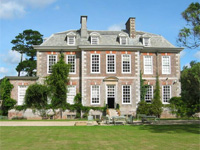
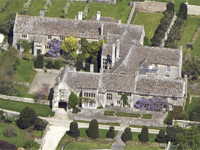
Trafalgar Park, Wiltshire (Image © Savills)

Neo-classical architecture permeates our built environment; banks, council and government buildings, and particularly country houses.  Drawing on the ancient monuments of Greece, the structured, hierarchical designs provided a convenient vocabulary that institutions, the state, and individuals could use to express their permanence and place in the natural order of society. Of course, this is the interpretation and not an objective set of laws but neo-classicism’s rationalist perspective, with its reliance on mathematical rigour, gave the impression that architecture and society both shared an underlying harmony in their precision and structure.

The Classical language of architecture had arrived in England through the widely admired and imitated Vitruvian principles as interpreted in Andrea Palladio’s I quattro libri dell’architettura. Inigo Jones had adopted this language and had created the foothold for the new style with his the Queen’s House in Greenwich (1616) and Banqueting House in Westminster (1619). However, his sources were Italian; the great monuments of Rome as measured and shown by Palladio. For some, though, this was derivative as the earliest Classical monuments were in Greece.

It ought to remembered that the fashion for the neo-classical was one which swept across Europe, not just the UK. As a rejection of the seemingly frivolous Rococo movement, it sought to instil a more high-minded set of ideals across the arts. To do this, writers such as Johann Joachim Winckelmann (regarded as one of the fathers of neo-classicism), stated that ‘The only way to become great is to imitate antiquity’. This required no mere slavish copying but a profound understanding obtained through study which enabled principled use of the Classical architectural language. Books such as Piranesi’s Le Antiquita Romane, a series of topographical views of Rome published in 1748, determined to prove the glory of Rome. However, others such as Richard Dalton (Museum Graecum et Aegyticum, 1751), le Comte de Caylus (Recueil d’Antiquities Eygyptiennes, Etrusques, Grecques et Romaines, 1752) and Julien David Le Roy (Les Ruines des plus beaux monuments de la Grece, 1758) argued for the superiority of the Hellenic originals.

Les Ruines des plus beaux monuments de la Grece (1758) - J.D. Le Roy
‘Ruines d’un Portique Dorique’ from Les Ruines des plus beaux monuments de la Grece (1758) – J.D. Le Roy

If true knowledge of Classical architecture required detailed study the options were limited unless fortunate enough to be able to undertake the arduous and expensive Grand Tour. The Society of Dilettanti, formed in the 1730s as a scholarly drinking club for aristocrats and others who had visited Italy, deliberately sought to influence fashion by sponsoring a more rigorous approach to the recording of the ancient ruins. Scholars had realised the value and fame which could be garnered from publishing books on the ruins they had visited but these were often the Roman versions of the Grecian originals and were often more decorative than accurate delineations.

Antiquities of Athens (Vol I) - James Stuart and Nicholas Revett (1762)
Antiquities of Athens (Vol I) – James Stuart and Nicholas Revett (1762)

In contrast, the most successful and influential of these publications was Antiquities of Athens by James ‘Athenian’ Stuart and Nicholas Revett, published in three folios in 1762, 1787 and 1794. Sponsored by the Society of Dilettanti, their approach produced detailed, measured architectural drawings from which other architects could accurately reproduce Grecian details. Stuart and Revett were both better known as connoisseurs of painting rather than as architects, but having lived in Rome for ten years prior to their departure in 1751 for Athens, they had a thorough knowledge of Roman artefacts.  This was crucial in establishing the authority of Antiquities of Athens when the first folio was published in 1762.

James Stuart (1713-1788) became known as James ‘Athenian’ Stuart on the reputation he established. He originally started his artistic career as a painter of fans and he was to continue with this work even after becoming an architect – the large allegorical ceiling painting in the tapestry room at Hagley Hall, painted in 1758-59, is one notable example. However, having established his fame, his drinking and erratic work habits meant that although he had a steady stream of work, patrons were sometimes reluctant to commission him, leaving his reputation somewhat diminished.  This is in contrast to his early years when having arrived in Rome in 1742, he established himself as judge of pictures, acting as a guide to aristocrats on their Grand Tour. In this manner he met Revett when he accompanied him, along with Matthew Brettingham and Gavin Hamilton, to Naples in 1748. That same year, he and Revett drafted their first Proposals for publishing an Accurate Description of the Antiquities of Athens, which, once accepted by the Society who became their sponsors, enabled them to undertake their investigation.

Nicholas Revett (1721-1804) was the second son of minor Suffolk gentry, his father being John Revett of Brandeston Hall. At the age of 21, Nicholas left Suffolk and moved to Rome to study under Marco Benefial, an important early neo-classical painter. It’s unclear where Revett was tutored in the precise skill of architectural drawing but clearly as a man of some talent and training he was undoubtedly proficient and it was he, not Stuart, who was principally responsible for the measured drawings of the monuments. According to one account in the Gentleman’s Magazine of March 1778 ‘Mr Stuart first caught the ideas of that science, in which (quitting the painter’s art) he afterwards made so conspicuous a figure.’  So why is the pupil known better than the master?

One of the key reasons is that although Revett’s name appeared on the title page, before publication he had sold his interest to Stuart after editorial differences.  Secondly, Revett, as a gentleman with a private income, wasn’t under the same financial pressure to practice and so his executed architectural commissions are scarce, primarily working for his friends. One such in his circle was Henry Dawkins; owner of Standlynch, later renamed Trafalgar Park.

Portico (added in 1766), Trafalgar Park, designed by Nicholas Revett (Image © Matthew Beckett)

This commission, in 1766, was limited but Revett drew on his knowledge and the rich seam of material he had accumulated to produce a fine portico, based on the Temple of Apollo, Delos. Revett’s skill was in being able to take the elements of the temple and extend it to create a sophisticated composition. In addition to this, Revett was tasked with creating a vestibule at the junction of the north wing.  Within this limited space, Revett chose to create a miniature six-column temple apparently based on the Establishment of the Poseidoniasts, also at Delos, representing one of the (and possibly the) earliest interior use of Greek neo-classical architectural features.
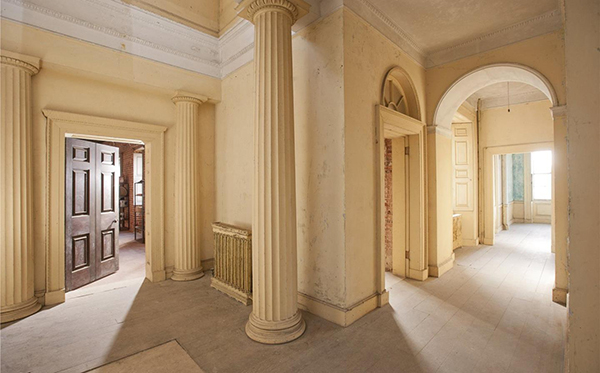
North Vestibule, Trafalgar Park, Wiltshire (Image © Savills)
North Vestibule , Trafalgar Park, Wiltshire (Image © Savills)
Detail of Trafalgar Park floorplan showing north vestibule layout (Image © Savills)

Revett contributed few other architectural examples, working mainly for friends such as Dawkins at Standlynch. Other commissions including adding a grand Ionic portico to the west front of West Wycombe Park, Buckinghamshire, for Sir Francis Dashwood in 1771, and later the Temple of Flora and the Island Temple between 1778-80.  Revett’s only other notable contribution is the church at Ayot St Lawrence, Hertfordshire, for Sir Lionel Lyde in 1778, which he designed as a temple with small, detached wings, linked with a columnar screen. James Lees-Milne thoroughly disliked it saying ‘It is stark, cold and foreign to its surroundings, in fact admittedly unsympathetic to its ostensible purpose as a christian conventicle in a small and humble parish. Quite frankly it was meant to be enjoyed as an ornamental temple of a nobleman’s park in a focal view from the mansion.’ Which is correct – and probably exactly what Revett had intended.

So if Revett has the garland for earliest neo-classical interior, who can claim the earliest exterior use? Although Antiquities of Athens was published in 1762, the drawings were at the disposal of Stuart and Revett.  The earliest Greek revival building is agreed to be the garden temple at Hagley Hall, built for Lord Lyttelton in 1758-59, which Stuart designed was based on The Hephaisteion in Athens. However, in 1985, Giles Worsley identified the earliest use of a Greek architectural element in a building as being two years earlier in 1756 when Earl Harcourt, a prominent member of the Society of Dilettanti, was rebuilding Nuneham House, Oxfordshire. Although the architect of the house is noted as Stiff Leadbetter, Lord Harcourt asserted such influence that the house can be regarded as more by the former than the latter.  Writing to a friend he stated that,

I have not placed my Venetian windows under an arch. Instead of springing the arch or compass point of the Venetian window from the cornish as other people have done, I have boldly adventured to follow a design of an old building which I have seen among Mr Stuart’s drawings of Athens, where the arch or circular part springs from the architrave itself, which, besides having a very good effect, obviates an objection which upon some occasions had been made to Venetian windows, that the light is too high in the room.

Harcourt’s inspiration for his variation on the standard Venetian window was Stuart’s drawing of the Aqueduct of Hadrian, a structure largely ruined when he visited and demolished by the end of that century. Stuart would go on to use this form of the window at only three other houses; once at The Belvedere, Kent, c.1775, once at the Prospect House, Wimpole, Cambridgeshire, c.1775, and once at Montagu House, London, c.1775-82, though unfortunately all these have now been demolished.

(left) Aqueduct of Hadrian from Antiquities of Athens (1794) (Image source: Aikaterini Laskaridis Foundation Library) | (right) Nuneham House, Oxfordshire (1754) (Image © Isisbridge on flickr)

The 1750s and 1760s saw the idea of architecture drawn from classical sources, whether Greek or Roman, become more widespread.  The birth of Greek neo-classicism in the UK can, in part, be traced to these examples and the men behind them, the wider adoption of this stylistic source was relatively slow. Neither Stuart nor Revett appeared to wish to be the figureheads for a new fashion, simply content to work as much as they wished, with Stuart taking more but his delivery tempered by his dissolute habits. Different strands of neo-classicism were being picked up by more ambitious architects such as Robert Adam, who had undertaken his own Grand Tour to Italy and Croatia and whose publication in 1764 of the Ruins of the Palace of the Emporer Diocletian at Spalatro gave his a scholarly foundation from which to launch his own style of neo-classicism which soon supplanted the previous Burlingtonian standard.

The overlooked North Vestibule at Trafalgar Park represents the quiet experimentation which was to plant seeds of the Hellenic neo-classical movement. This would find its true expression in the late-Georgian era when evangelists such as Thomas Hope would create a resurgence in interest and further burnish the reputations of both Stuart and Revett; men whose unequal fame has obscured the contribution which Revett made in enabling architects, regardless of experience or first-hand exposure, to all claim antiquity as their source.


Sales particulars: Trafalgar Park, Wiltshire – 33 acres, £12m (Savills.com)

Introduction to neo-classicism: ‘Style Guide: Neo-classicism‘ [V&A Museum]
School’s out: seats of learning for sale

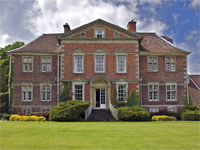
One of the many uses to which our country houses have been successfully adapted to is that of schooling – from the grandest such as Stowe and Bryanston to the many smaller houses which have delighted and terrified children in equal measure for many years.  Even as recently as April 2010, Wispers in Sussex, was sold to a London primary school as a satellite to their main campus. Yet for all the fond memories held by generations of youngsters, private schools and educational colleges are facing their own periods of austerity, forcing some to close.  With closure comes a rare opportunity for a house to once again become a home – though such a move is fraught with practical, and sometimes political, challenges.

Urchfont Manor, Wiltshire (Image: Augustus Photographic via flickr)

One of the bonuses of writing this blog is to discover houses so little known that, despite their obvious beauty, they seldom appear in books.  Urchfont Manor, Wiltshire is a classic example of this. Currently a residential college, this stunning smaller William and Mary country house was built around 1678 for William Pynsent, a wealthy London barrister, who would have been well-aware of the latest architectural fashions. The architect is unconfirmed but, with the hipped roof and projecting, pedimented centrepiece, it appears to draw inspiration from houses such as Horseheath Hall, Cambridgeshire (though 7-bays to Horseheath’s eleven) designed by Sir Roger Pratt in 1663-5 (dem.1777), and also clear stylistic similarities with houses such as  the north and south fronts of Fawley Court, Buckinghamshire (built 1684-5, by Sir Christopher Wren) and Puslinch, Devon (a late proponent of the style, being built c1720).  One curious anecdote, told to Sir John Julius Norwich, was that the house was substantially altered, creating the elegant east front, about twelve years after construction to designs by William Talman – but Colvin doesn’t mention it and no firm evidence has appeared to support this…so far.

Puslinch House, Devon (Image: Devon Rural Archive)

Urchfont is a fascinating and enchanting smaller manor house which successfully plays the neat visual trick of looking larger than it is – at least from some angles. The two key views of the house are from the main road from the village, which gave a clear view of the east front and the road running below the south front (the house was once more visible; maps from 1880s show only a few clumps of trees, much fewer than there are now).  If one only saw these two fronts, one might think this a large, cube-shaped house – but move round to the north and the house is clearly only one room deep on the east front. A lovely piece of social aggrandisement.  The house passed through various families and was tenanted before being bought by another lawyer, Hamilton Rivers-Pollock, in 1928, who lived there until his death in 1941.  It then became a home for London children suffering from tuberculosis, and was then bought in 1945 by Wiltshire County Council as a residential college.  Now, faced with cutbacks,  the council have decided to sell up, amid much local controversy, giving this beautiful house an opportunity to once again become a home.

The Hill, Abergavenny, Monmouthshire (Image: Cooke & Arkwright)

Across the country in Monmouthshire, The Hill, as the name implies, sits rather proudly on the edge of Abergavenny.  Built in the mid-18th century, the house sits in 20-acres of gardens (which are included on the Register of Parks and Gardens of Special Historic
Interest in Wales) from a once larger estate, the residential spread of the town having crept up towards it.  Sadly, poor planning has led to a small residential estate taking up the grounds to the east of the house, and further buildings associated with its time as a college now stand between them and the house.  This makes it exceptionally unlikely that the house would become a single-family home again but potentially a high-quality development, replacing the modern buildings and respecting the grounds, could offer a workable solution.

Bedgebury Park, Kent (Image: Knight Frank)

On a larger scale, the curse of the associated buildings also blights Bedgebury Park, Kent. The original house of the estate, seat of the influential Culpepper family, financed by a flourishing iron business based on the clay-ironstone on which it sits, was to the east of the current grand mansion (now a lake), and played host to Elizabeth I, who visited in August 1573.  The current house was built in 1688 for Sir James Hayes, a man who had become wealthy through  his wife’s inheritance and financing the recovery of jewels and gold from a sunken Spanish ship.  Sir John Cartier bought it in 1789 and added some impressive plasterwork and the chain of lakes on the estate.  Following Cartier’s death,  Bedgebury was bought by one of the Duke of Wellington’s most trusted men, Field Marshal Viscount Beresford.  He commissioned Alexander Roos c.1838 and the subsequent extensive alterations and the addition of the cross wings to create the H-shape, obscured the red-brick original behind an impressive cladding of warm, honey-coloured sandstone ashlar, creating a house which positively glows in the sun. Inherited by Alexander Beresford Hope in 1854, he made his mark on the house by adding the impressive Neo-Classical stairhall and the striking mansard roof.

Stairhall created c.1850s, Bedgebury Park, Kent (Image: Knight Frank)

The house was bought by the Church Education Corporation with 200-acres in 1919, opening as a school with just five pupils in 1920.  It quickly grew and new buildings were added in the grounds providing extra teaching and residential facilities, before closing in 2006.  Now offered at £7.5m, the grade-II* house sits in a 90-acre estate awaiting its future.  The brochure mentions that the local planning department are open to the idea of it becoming a single unit residence again – a possibly tempting prospect for a billionaire who needs an impressive house, a small estate, and doesn’t mind having to demolish the modern school buildings which have sprung up.  Considering the quality of the interiors, this must surely be a feasible prospect, especially in light of the recent sale of Park Place for £140m which proved that there are those willing to pay exceptional prices for the best quality properties.

Apethorpe Hall, Northamptonshire (Image: English Heritage)

For those seeking to move into a former school which has been partially restored to the highest standards and now only requires the finishing touches (if you have a couple of million pounds available), then possibly the finest option would be Apethorpe, Northamptonshire.  This fascinating Tudor/Jacobean/Elizabethan house has played a supporting role in royal entertainments for 500 years and features some of the finest plaster ceilings in the country – and became a particularly grand school between the late 1940s and 1982, when it closed. Bought by an absentee owner, it languished for years, flirting with dereliction.  Finally, intervention by English Heritage brought it into their care and it’s currently for sale for offers around £5m (English Heritage reputedly spent £7m on the rescue so far), and would require another approximately £4m to complete the restoration.  On an remarkable side note; the fact that Apethorpe was saved from the usual vandalism, arson and theft which so often afflicts empty buildings, was largely due to the tireless efforts of the caretaker, George Kelley, who carried on even though he wasn’t being paid to do so.

The most recent closure (at least partially) is of St Michael’s in Tawstock, Devon.  Originally known as Tawstock Court, it was built in 1787 in a provincial Gothick style to replace an Elizabethan house which burnt down that same year.  Although the staff and parents have made heroic efforts to save it, the concern for them is that the house will fall into the hands of developers who will convert it into flats – and considering the poor job most do of such a task, their concerns are very valid.

In these straitened times, sadly a number of parents and councils will be forced to economise and schools, usually private, may well close.  Sad though this will inevitably be for the many current and former pupils, it does also offer a possibility that these houses may revert to their former role for which they were designed – and few would argue that the spectacular Marshcourt in Hampshire, designed by Lutyens, was better off as a school. However, as the roll call of struggling schools lengthens, it is important that the future of the often wonderful buildings, which gave each school their character, are given due priority to ensure an appropriate transition and restoration if the opportunity arises for them to return to being family homes.

————————————————————————

Original story: ‘Urchfont Manor sale row erupts‘ [Gazette and Herald]

Listed building description: ‘Bedgebury Park, Kent‘ [British Listed Buildings]

PPS7 – the saviour of the new build country house

Grafton New Hall, Cheshire (Image: Robert Adam Architects)

The nature of our country houses is one of evolution in design, form, and function.  As society has changed, so too have the requirements of the wealthy and, as their houses have been a direct expression of their wishes, these changes can be traced through the architectural record.  Much as we love the many beautiful houses we have already there will always be the desire to build anew, which will constantly reinvigorate this branch of architecture.  As always, some designs will not stand the test of time and will be replaced but the best houses of today will be appreciated by generations to come.  Estate agents often have sites with planning permission for sale and the most interesting come with a design already approved – and in an interesting trend, they are almost all classical, rejecting the avant-garde in favour of brick, stone and Palladian proportions.

Longleat House, Wiltshire (Image: wikipedia)

Once Britain became a more domestically peaceful land under Elizabeth I, the form of our country houses changed from defensive, to one of show as exemplified by the Prodigy houses such as Longleat, Wollaton and Hardwick.  Gone was the need for walls, keeps and battlements and instead the requirements of the aristocracy became focused on courtly entertainments, sport and the display of one’s level of taste and education. This largely set the pattern which can still be seen today, with only the architectural choices as to style varying according to fashion and whim.

Yet it seems that for the wealthy who commission these houses, the overall exterior style has evolved as far as necessary because, despite the efforts of the last Labour government to promote the bold and radical as the only appropriate response, a majority of the houses designed and built today are in a form that your average 18th-century gentry would broadly recognise.  Although most construction in the countryside is largely forbidden, rules introduced by the Conservative government in 1997 – known as PPG7 section 3.21 – allowed for planners to approve houses where:

“An isolated new house in the countryside may … exceptionally be justified if it is clearly of the highest quality, is truly outstanding in terms of architecture and landscape design, and would significantly enhance its immediate setting and wider surroundings.”

In 2004 the Labour government sought to drop this, ostensibly because they thought it a loophole, but many suspected an undercurrent of class warfare (an early day motion put down that year by the former Member for Denton and Reddish, Andrew Bennett, stated that “this House … further believes that if the countryside is to be preserved by not building ordinary houses, it is even more important that is should not be polluted with big houses for the arrogant, vulgar and rich.“).  After a strong backlash with MPs (well worth reading is Alan Howarth’s spirited defence of the country house) and architects leading the charge, the rules were amended to become PPS7 which largely retained the status quo giving owners the opportunity to continue the fine tradition of new country houses but with a distorting preference for houses which would reflect “the highest standards in contemporary architecture.“. In fact, the market proved that clients know what they want more than misguided politicians and civil servants.

In response to the proposed changes the RIBA put on an exhibition called ‘The New English Country House‘ which looked at houses commissioned between 1997-2004 under PPG7.  Of the 24 houses included, 15 were in a historical style and only 9 contemporary, with a majority of the former being seen through to completion.  Interestingly, of the houses listed, at least half (by my reckoning) are replacements for previously demolished  country houses perhaps providing an object lesson in the folly of their original loss.

Proposed Grafton New Hall, Cheshire (Image: Ushida Finlay Architects)

The poster child for the new ‘modernist’ country house was the design produced by Ushida Finlay in response to the 2001 RIBA competition to build “the country estate of the future”.  The original Tudor Grafton Hall in Cheshire had been demolished in 1963 after becoming derelict but the 200-acres of parkland offered the ideal opportunity to create an excellent smaller country estate. Yet for the limited pool of those wishing to spend the estimated £20m to build this vision the design ticked none of their boxes. After 7 years of marketing by the estate agents, it was decided to commission a new design from one of our best Classicists, Robert Adam, whose new proposal was described as “an exceptionally outstanding design“. However, the opportunity to create this new house is still being marketed with Jackson-Stops for £5m – so the argument hasn’t been decisively won in this instance just yet.

Proposed Alderbrook Park, Surrey (Image: PRS Architects)

In much the same way as those in previous centuries wished to express themselves through their architecture, so it is the case today.  Houses such as the proposed Alderbrook Park in Surrey for the billionaire Lakshmi Mittal are a radical re-interpretation of the country house but driven by the particular requirements of the client.  Also of particular note is  Ferne Park in Wiltshire for Lady Rothermere – easily one of the finest country houses to be completed in the last 100-years and very much the product of the client working in conjunction with her architect, the brilliant Quinlan Terry.  Speculative developments seem less likely to find buyers as they become more an expression of the ego of the architect rather than the reflecting the personality of the buyer. The prime example of this is the poorly designed Updown Court in Surrey, once the most expensive house for sale in the UK at £70m, which now faces being carved up into flats or becoming a hotel.

Nyn Park, Hertfordshire (proposed) (Image: Julian Bicknell & Associates)

So what other architecturally attractive opportunities are out there? One quite close to London is Nyn Park, Hertfordshire to replace a house which burnt down in 1963 with a design by another icon of the Classicists, Julian Bicknell, who designed the brilliant Henbury Rotunda in Cheshire. The proposed plan bears no relation to the former house and shows the type of new design allowed under PPS7. Just to underline the level of wealth required for these projects, the estate is being marketed at £10m, built costs could easily be £1m-2m, and the buyer must lodge £3m with the local council as a Landscape Bond that they will fulfil their obligations with regards to restoration which will be returned in tranches as the work is completed.

The Ridge, Gloucestershire (proposed) (Image: Yiangou Architects / Knight Frank)

Another house which has featured before in this blog is the impressive ‘The Ridge’ in Gloucestershire; another replacement for a lost house designed by Humphrey Repton and demolished in 1934.  Designed by Ross Sharpe (who also designed the Icomb Grange), this 33,000 sq.ft. design takes the form of the original house but adds an extra level of architectural flair.  As expected, this is £5m for the opportunity with build costs on top.  Interestingly, the Knight Frank website also says that alternative plans for a smaller 15,000 sq.ft. house have been drawn up, hoping to draw in a wider pool of potential owners.

The Parkwood Estate in Surrey, designed again by Robert Adam, has also been featured previously on this blog back in July 2010 as part of the discussion around justifiable replacement.

For some, a new build will never be a substitute for a historic country house but for those with specific requirements or where there is a shortage of suitable houses, then the option of creating from scratch will always be enticing.  It is also important that the tradition of country house building is allowed to continue as it is only through development that it is shown that these fine buildings can contribute to, and enhance, the much-loved countryside.  PPS7 provides an important legal support for the principle that architecture should be allowed to flourish where it is justified and supportable and should be defended against any narrow-minded interests who would deny our history and diminish the future.

———————————————————–

The websites of the leading country house architects show the broad range of fascinating projects they are involved with, and that, fingers crossed, will one day be built:

New Series: The Country House Revealed – South Wraxall Manor, Wiltshire

South Wraxall Manor, Wiltshire (Image: Traumahawk / flickr)

In contrast to the weekly dramas of Country House Rescue, a new series starting on the BBC, presented by the excitable Dan Cruickshank, looks at some of the finest homes in ‘The Country House Revealed – A Secret History of the British Ancestral Home‘.  The series promises a look behind the estate wall at some homes which have never been open to the public, giving us a rare chance to glimpse houses which enjoy secure, well-funded ownership and demonstrating that the fears of those who thought these houses would never be sustainable have been thankfully proved wrong.

The first in the series (broadcast 10 May on BBC2 at 21:00) visits South Wraxall Manor in Wiltshire; a house which matches a beautiful exterior with impressive interiors dominated by some of the finest chimneypieces and period rooms in the country.  The house was originally built for Robert Long who made a fortune in cloth in the early 15th-century before becoming an MP in 1433, around which time it is thought the core of the house was started.  As was befitting a rich MP, he was keen to show his status and as was often the case with the gentry, his home was the main platform with which to show off his wealth and erudition, creating one of the finest houses in the country today.

England, at the time work started at South Wraxall Manor, was feeling the influence of the Italian Renaissance and elements of the new fashions were often incorporated into the best homes, though often adapted for our native traditions and styles.  This use of wider influences was also a symptom of the gradual shift in power as major building projects were increasingly commissioned by wealthy gentry rather than the Church or Royal Court.  Maurice Howard also highlights that although the Court was highly competitive which might have led to a single architectural style being favoured, in fact, the houses we still have show how tenacious local styles were.

Chimneypiece c.1600, South Wraxall Manor (Image: (c) Nicholas Cooper)

This continuation of the vernacular can be seen in the architectural vocabulary used by those commissioning the houses, drawing still strongly on ecclesiastical traditions.  Reading the full listing description for South Wraxall one might almost believe it to be a local church or monastery – windows with Perpendicular tracery, buttresses, even gargoyles.  The house was significantly remodelled around 1600, creating what John Julius Norwich calls ‘one of the major Jacobean rooms in all England‘.  A vast west window floods the room with light and is matched by one at the other end of the room, providing the illumination to highlight a most impressive fireplaces – a colossal, florid statement of importance.

Each generation of the Long family added to the house, with additional wings and chimneypieces, and extending the estate.  As with other such early houses which have survived subsequent centuries without ‘modernisation’, this was due to a small element of luck in that it was inherited by a branch of the Long family in 1814 who were already well established at Rood Ashton House, Wiltshire (largely demolished c.1950) meaning the house was often rented out.  The house let between 1820-26 and served time as a boys school, before the 1st Viscount Long took over c.1880 following his election as a local MP.  Viscount Long undid much of the damage caused during its time as a school when the linenfold panelling had been painted over and the ornate ceilings plastered over, however he never really took up residence there.  The house was let for the rest of the 19th-century and the early 20th, before the 2nd Viscount Long moved in in 1935.  Used to house refugees in WWII, the family again lived there before finally selling up in 1966, ending over 500-years of family ownership.

South Wraxall then entered a rather uncertain period, until it was bought by a businessman with plans to turn it into a country house hotel but who had some issues with the local planning authority over unauthorised changes (for example, I think he glassed in the loggia without permission).  The house was up for sale again in 2003 for £6.5m after the businessman abandoned his plans.  After languishing on the market for a couple of years – probably due to the extent of the restoration required – it was bought by the current owners: John Taylor (bass player with the band Duran Duran) and his wife Gela Nash (founder of the fashion house Juicy Couture) who apparently have done an excellent and sympathetic job of the repairs, thus rescuing a house that is a quintessential example of an English manor house.

Full listing description: ‘South Wraxall Manor‘ [British Listed Buildings]

Further information: ‘South Wraxall Manor‘ [Wikipedia]

Book of the series: ‘The Country House Revealed‘ [Waterstones]

Rest of the series

This looks to be a fascinating set of programmes – for reference the other houses featured are:

Going to the country: more country houses of UK Prime Ministers – Part 2

The first part of this series, highlighted the aristocratic background of our early Prime Ministers – Earls and Dukes abound.  This meant that a country house was just where they had been brought up and simply regarded as home rather than the aspirational purchase.  It also highlighted that the architectural tastes of the PMs reflected their political beliefs with a strong preference for the Classical, representing structure and order.

So, to continue the tour of country houses of Prime Ministers, this time those who served  under George III (1760–1820):

Luton Hoo, Bedfordshire (Image: ickle_angel/Flickr)

The first was John Stuart, 3rd Earl of Bute. Originally a man of rather limited means who only acquired great wealth following his marriage to the rich heiress, Mary Wortley Montagu. The family seat was Mount Stuart on the Isle of Bute; at the time a small Queen Anne house which burnt down in 1877 to be replaced by the Gothic palace we see today.  With his later wealth and prominence the Earl created two fine new country houses.  On his retirement as PM, he bought Luton Hoo, Bedfordshire in 1763 and in 1767 commissioned Robert Adam to create a large neoclassical mansion which, although this was never fully realised, the resulting house (now a hotel) is still sizable.  The wings are a later addition but faithful to Adam’s original conception. Ill health later forced a move to the Dorset coast and having bought a clifftop position he built High Cliff “to command the finest outlook in England.“.  Unfortunately it was a little to fine, the crumbling cliff not only necessitated the demolition of the house in the late 1790s, it also led to the Earl’s death in 1792 due to a fall whilst picking plants.

He was succeeded as PM in 1763 by George Grenville who was born, and lived, at the family seat, Wotton House, Buckinghamshire.  He is one of only nine PMs who did not become a peer on leaving office.

Wentworth Woodhouse, Yorkshire (Image: geograph.co.uk)

If there was a competition for the most impressive house of Prime Ministers then Charles Watson-Wentworth, 2nd Marquess of Rockingham would be feeling rather confident.  His family home, Wentworth Woodhouse, Yorkshire, is one of the largest private country houses in Britain with a main front extending to over 600ft. Built over a 25-year period, the house exemplifies the grand palaces which became possible in Georgian England. Faced with the usual pressures on later owners, plus vindictive coal mining, the family moved out and the house was leased as a teacher training college but since 1999 it has been the home of architect Clifford Newbold and his family who have been undertaking a massive and very impressive restoration programme.

William Pitt the Elder, 1st Earl of Chatham was brought up in great comfort from the proceeds of the sale of the Regent Diamond by his father.  As the younger son, Pitt would not inherit the family seat and so made his own way, choosing politics and becoming PM in 1766.  His country residence was the relatively modest Hayes Place in Kent, which he had built after he bought the estate in 1757.  He later sold it in 1766 to Horace Walpole who encased the house in white brick and enlarged it before selling back to Pitt in 1768 on his retirement.  The house survived until 1933 when it was demolished and houses built on the land.

Euston Hall, Suffolk (Image: David Robarts / flickr)

Another Prime Ministerial seat to suffer later loss was Euston Hall in Suffolk seat of Augustus FitzRoy, 3rd Duke of Grafton who succeeded William Pitt.  The Dukes of Grafton were very wealthy with extensive land holdings in Suffolk, Norfolk, Northamptonshire and London.  Euston Hall had been extensively remodelled by the Palladian architect Matthew Brettingham for the 2nd Duke between 1750-56.  The house suffered a devastating fire in 1902 which destroyed the south and west wings, which were subsequently rebuilt on the same plan but then demolished again by the 10th Duke in 1952.  It should also be noted that the Dukes also owned the splendid Wakefield Lodge in Northamptonshire, designed by William Kent, though it was tenanted and therefore the Dukes never lived there.

William Petty-FitzMaurice, 2nd Earl of Shelburne had the splendid fortune to be brought up in one of the finest of Georgian country houses, Bowood House in Wiltshire, which also became a scandalous loss when it was demolished in 1955/56.  Remodelled for the 1st Earl by Henry Keene between 1755-60, the house also featured interiors by Robert Adam, who also altered Keene’s original portico to create a much grander version.  Afterwards the stables were converted to function as the main house where the 9th Marquess of Lansdowne (as the Earls became) still lives today.

Welbeck Abbey, Nottinghamshire (Image: Mr Nibbler / flickr)

The next PM, William Cavendish-Bentinck, 3rd Duke of Portland inherited Welbeck Abbey, Nottinghamshire, which had also been the home of an earlier PM, his relative Thomas Pelham-Holles, 1st Duke of Newcastle.  As stated in Part 1, this is a fascinating house which has often been overlooked due to the fact that it has been rarely open to the in the last 100 years, public tours having finished in 1914. Extensive work was carried out between 1742-46 by the relatively unknown architect John James who reconstructed the south wing and remodelled the west front for Henrietta, Countess of Oxford.  The west front was subsequently changed again in 1790 to designs by Sir Humphry Repton.  The Dukes of Portland also had a southern seat at Bulstrode Park in Buckinghamshire, though this house was replaced in 1865 by the 12th Duke of Somerset who by then owned the estate.

In contrast to the vast wealth and aristocratic status of the preceeding PM, William Pitt the Younger was able to bring political heritage; his father also having served in the same role. In stark contrast to the size and splendour of Welbeck, his country home was Holwood House in Kent, a modest mansion set in 200-acres for which Pitt paid £7,000 in 1783 before commissioning Sir John Soane to alter and enlarge it in 1786 and 1795.  Soane’s work here led to Pitt recommending him for the work to build what was to be one of Soane’s masterpieces; the Bank of England building which was so sadly demolished in the 1920s.  Holwood was also to be demolished, in 1823, to be replaced by a much grander house designed by Decimus Burton.

The country houses of Henry Addington 1st Viscount Sidmouth have both largely now vanished under the sprawl that is Reading University.  Addington had a low-key record as PM and his houses were equally modest.  Although on becoming PM Addington moved into the beautiful White Lodge in Richmond, his main seat was Woodley House, Berkshire, which had been built in 1777 before being bought by Addington in 1789. At the same time, he also bought the neighbouring estate of Bulmershe Court which was then tenanted, before falling into disrepair in the 19th century leading to two-thirds of it being demolished. Woodley House was used by the Minstry of Defence during WWII but subsequent dereliction led to its demolition in 1960.

William Wyndham Grenville, 1st Lord Grenville, as well as abolishing slavery, also created one of the most elegant of the houses in this series; Dropmore House in Buckinghamshire.  Built in 1795 and designed by Samuel Wyatt (b.1737 – d.1807) with later work by Charles Heathcote Tatham (b.1772 – d.1842), it was Grenville’s refuge, describing it as ‘deep sheltered from the world’s tempestuous strife‘. The grounds were also lavished with attention with Grenville planting 2,500 trees, and creating numerous walks which took in the superb views and even going as far as to remove a hill which blocked the view to Windsor Castle.  Tragically, devastating fires in 1990 and 1997 left a ruined shell but it has been recently rebuilt as a series of luxury apartments.

The only PM to be assassinated, Spencer Perceval, never really had a country seat of his own but had grown up in Enmore Castle, Somerset though he would never inherit as he was the second son of second marriage.  Only a small section of the main house now remains after it was largely demolished in 1833, but originally Enmore, built c1779, was one of the largest houses in the county.  In later life, Perceval lived in a large house called Elm Grove on the south side of Ealing Common in London – though at the time this would have been quite a rural area but not quite enough to classify this as a true country house.

The final PM under George III was Robert Banks Jenkinson, 2nd Earl of Liverpool who again chose to live close to London, though in a country house, at Coombe House in Kingston upon Thames in Surrey.  Originally Tudor, this brick house was replaced with a Georgian mansion which was later altered by Sir John Soane, including the addition of a library.  The house survived until 1933 when it was demolished with houses now covering the site.

So although the Gothic revival movement had started in the 1740s and was the main alternative to the dominant Classical architectural style, even by the 1820s, it did not reflect the tastes of any of the Prime Ministers.  Considering the system still echoed the exclusions of the Reformation with its explicit rejection of all things ‘catholic’ (architectural, theological, political) it was unlikely to change, especially as the Catholic Emancipation Bill wasn’t passed until 1828.  Architecture was taken an expression of belief and so to favour the Gothic could potentially have given the wrong signals.

Next: Prime Ministers under George IV and William IV

List of UK Prime Ministers