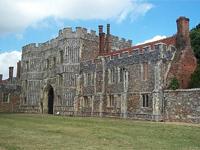
Looking for a saviour: St Osyth Priory, Essex

St Osyth Priory, Essex (Image: Stephen Dawson/geograph.co.uk)

Of the phrases most likely to cause concern for those who love our country houses, up there with ‘dry rot’, ‘water leak’ and ‘death duties’ has to be ‘enabling development’.  Originally designed to protect heritage assets by permitting limited development to fund repairs, it appears to now be used to circumvent local and national planning guidelines to facilitate inappropriate development where it otherwise ought to be refused.

In Essex, perhaps one of the largest examples of its kind was submitted by the Sargeant family who bought St Osyth Priory in 1999 through their development company ‘City and Country Group‘ (CCG) .  The company applied to build 190 houses as part of an enabling development to fund repairs to the main house and the other 22 listed buildings in the complex claiming that some £30m-worth of repairs were required (and personally I doubt the cost would be that high – happy to be proved wrong by an independent survey from a SPAB scholar).   This number would naturally bolster the calculation for the total conservation deficit (that is, the amount by which the cost of repair (and conversion to optimum beneficial use if appropriate) of a significant place exceeds its market value on completion of repair and conversion, allowing for all appropriate development costs, but assuming a nil or nominal land value).  But is this a case of a developer using the provisions of enabling development to gain permission regardless of the consequences for the house – and the local area?

After passing through various Royal hands, it was sold to Lord Darcy in 1553 and remained the home of various Earls, Viscounts, Lords and Baronets until it was eventually bought in 1954 by author Somerset de Chair who, in 1974, married Lady Juliet Wentworth-Fitzwilliam, daughter of the 8th Earl Fitzwilliam of Wentworth Woodhouse. The couple lived in the gatehouse, with much of the valuable Wentworth Woodhouse art collection, but de Chair died in 1995, so in 1999 Juliet married Dr. Christopher Tadgell and sold St Osyth to CCG and went to live in Bourne Park, near Canterbury.

CCG have a track record of taking on historic houses and have recently restored Balls Park, Hertfordshire and Herringswell Manor, Suffolk and previously Cheverells and Gilston Park – but these were easier to convert as they had all been used for other institutional or commercial purposes rather than as a family home.  St Osyth Priory and related buildings have sad recent history of insufficient maintenance over many years and have been included on the various buildings at risk registers and undoubtedly needs significant work – but can the repair bill really be £30m (by comparison, the whole of St Paul’s Cathedral was recently restored for £40m)?

To play Devil’s advocate, perhaps this figure might be explained by the provisions of ‘enabling development’ which require that;

It is demonstrated that the amount of enabling development is the minimum necessary to secure the future of the place”
– ‘Enabling development and the conservation of significant places‘ English Heritage (2008)

…so to secure a development of sufficient size to make it profitable for CCG, it would need a suitably large repair bill to justify this (see letter from local resident).  It has been suggested on the St Osyth Parish Council website that offering the house for sale (with just 20-acres rather than the full estate) is merely part of the process of proving that no-one is willing to take on the house and restore it and therefore the enabling development is the only option.  In reality, for someone to invest that much in a house (purchase+restoration) they would expect an estate of at least 100-acres, if not two or three times that.  The plans also seem inappropriate with regard to other provisions of the English Heritage guidance:

  • It will not materially harm the heritage values of the place or setting.
  • It avoids detrimental fragmentation of management of the place.

This all seems depressingly familiar where a developer ignores what’s best for the house, and, in this case, what seems to be determined to bloat the size of the local village in pursuit of this unpopular and out-sized scheme.  An active and well-supported local campaign has been highlighting the various flaws of the scheme and the potential damage to the setting and the village if the scheme were to go ahead, but of course, it’s the house which is continuing to suffer.

In an ideal world, the house would be restored for much less than £30m thus showing that the scale of development proposed was unjustifiably large. This again would show that ‘enabling development’ is apparently being used as a means to try and circumvent the usual planning restrictions which are there to protect our heritage and countryside. Then perhaps one day the house with the full estate (hopefully once CCG realise they won’t get permission) will be offered for sale and someone will get the chance to take care of this important house and estate without sacrificing it for housing.

Property details: ‘St Osyth Priory, Essex‘ – Bidwells

More details:  ‘Priory battle gathers pace‘ [Daily Gazette]

Developer shows sense; Ruperra Castle for sale

Ruperra Castle, Newport, Wales (Image: Savills)

Run-down or derelict country houses are often an enticing prospect for a developer, especially where the house still retains some land, on which they can propose ‘enabling development’.  In theory this is the correct use of this exemption but frequently the developer will suggest too many houses or ignore the fact that the house has too little land to avoid any development compromising the setting of the house.  When this happens, it is often the house which suffers as the developers wait for appeals or a change in policy whilst allowing the house to deteriorate further.  So in the case of Ruperra Castle in Wales it’s encouraging that the owner has decided to bow out giving someone else the chance to restore this architecturally interesting house.

Ruperra is an early example of the ‘mock’ castles which became fashionable in the Elizabethan and Stuart eras and were an example of life imitating art as the idea of these houses drew from the ‘pageant castles’ as featured in court entertainment of the time.  These stage castles formed the centrepiece to the royal ‘masques’ and were laden with allegorical symbolism as they might be populated by damsels (signifying virtue) but successfully defended against attacking knights (signifying baser desires).  Works such as Edmund Spenser’s The Faerie Queen (published in 1590 and 1596) also fed a fashion for chivalry and heraldic forms. Importantly, the long period of domestic peace during Elizabeth’s reign meant that the design of houses moved from being primarily military and defensive to more simply domestic with the look of a house increasingly dictated by aesthetics.

Ruperra wasn’t quite the first of it’s type; that distinction could be said to be held by houses such as Michaelgrove in Sussex built for the Shelley family in 1536 (dem. 1830s), and Mount Edgcumbe in Devon, built between 1547 – 1554, which also were not fortresses and featured a square or rectangular central block with drum or square towers on each corner.  This was followed by the fabulous Wollaton Hall in Nottinghamshire, begun in 1580, which was an altogether more grandiose statement of power but broadly followed the same layout – as did Hardwick Hall, although in an adapted form. However, the Renaissance ornamentation of Robert Smythson‘s design at Wollaton contrasted dramatically with more austere designs of the true ‘mock’ castles which harked back to the earlier simplicity of decorated castles such as Herstmonceaux Castle in Sussex, begun in 1440, with its many windows and regularised defensive elements (such as the arrow loops) making them almost decorative.

Lulworth Castle, Dorset (Image: Matthew Beckett)

The design for Ruperra Castle was clearly based on that for Lulworth Castle, just 100 miles away in Dorset, and built between 1603-05.  Always called a ‘castle’ but built with the instruction from Lord Howard of Bindon that it ‘prove pretty’, it was never military.  Indeed, Thomas Gerard writing in 1630 described it as ‘well seated for prospect and pleasure; but of little other use’. Bought by the Weld family from Lord Howard it remained their family seat until a devastating fire in 1929 completely gutted the interior – as it remains today, although the building itself has been restored.  Another house thought to have been built around 1612 is Compton Bassett House in Wiltshire (dem. c1929) which clearly shared a similar layout although the corner turrents were square.

The builder of Ruperra Castle was Thomas Morgan (b.1564 – d.1632), who made his fortune as the Steward for the Earls of Pembroke at Wilton House, Wiltshire.  Morgan would have been regularly exposed to court life and would have been very aware of the latest architectural fashions.  Hence when he came to build his own house, which was finished in 1626, he deliberately drew on the latest architectural fashions and created one of the first of the ‘modern’ country houses.  The layout was a significant departure as the rooms were orientated to the outside to make the most of views – hence Ruperra’s elevated site chosen for its beauty rather than defensibility.  Interestingly the ‘castle’ design seemed to fall quite quickly from favour and so there are few other examples of this type – though one late example was Beaurepaire Park in Hampshire built in 1777 (sadly burnt down in 1942).

Ruperra Castle remained as part of the Morgan’s vast Tredegar estate and was traditionally used to house the eldest son before he inherited Tredegar House, the family’s principal seat.  The castle originally had dormers but these were removed during the rebuilding after a fire in 1785 and replaced with the crenellations there today.  It was last inhabited during World War II when a searchlight battery requisitioned it and they were there when the terrible fire caused by faulty wiring broke out in 1941.  Despite best efforts, the house was completely gutted and was eventually sold, along with the rest of the 52,000-acre Tredegar estate in 1952.

Since then, constant promises of restoration have come to nothing and it has steadily deteriorated, most dramatically when, in 1982, the south east tower largely collapsed.  Sold to the current vendor, Mr Ashraf Barakat, in 1998 he had hoped to convert the house into 11 flats and build 18 more houses in the 14-acre grounds that remained with the house.  After a final rejection at a public enquiry in 2009, Mr Barakat has now, wisely, put the still grade-II* listed Ruperra Castle on the market for £1.5m, rather than holding on and letting the house deteriorate further.  This should not be considered a development opportunity, so hopefully now someone with deep pockets will come forward to restore, as a single family house, this architecturally important building.  Its rescue would once again connect the modern history of country house design in Wales, bringing life back to a house which, when it was built, was the most sophisticated in the country.

Property details: ‘Ruperra Castle, Lower Machen, Gwent, Wales‘ [Savills]

More on this story:

More information:

Credit: I’m indebted to the prior work of Mark Girouard (‘Elizabethan Architecture‘ 2009) and the late Andor Gomme for their knowledge of Elizabethan architecture.

The greatest threat: fire strikes at Tidmington House, Warwickshire

Tidmington House, Warwickshire (Image: Philip Halling/Geograph)

With sad co-incidence, having recently posted about how owners respond to fires in country houses, news comes through that Tidmington House in Warwickshire was badly damaged whilst undergoing renovations.

Tidmington was built in the early 17th-century but was re-fronted in the 18th-century giving it a pleasing and elegant facade, which is visible from the road. Distinctive gables top a neat front which successfully mixes Elizabethan elements with the classical.  The recessed central section runs from a smaller middle gable featuring a Diocletian (or thermal) window, above a first floor tripartite Venetian window, sometimes known as Palladian or Serlian after the two architects most associated with popularising it, with finally the two wings being joined by a Tuscan colonnade.  Two 1-bay pavilions extend to the left and right, providing a clever balance to the height of the main house.

The grade-II* listed house was once the home of Thomas Beecham, 2nd son of the famous conductor, before being put up for sale in 2009 for £3.95m by the owners who had moved there in 1988.  The house was then given a glowing write-up in The Times by Marcus Binney who relished the bold use of colour; the sky-blue library, the jade green dining room – but I wonder if the bold colours in the house contributed to the situation as it was during renovations by the new owners that the fire started.

The blaze is reported to have badly damaged the first floor where the fire started and also part of the ground floor but hopefully a majority of the 8,500 sq ft house will have been spared from the flames – though the inevitable smoke and water damage will have spread beyond the immediate blaze.  Again, it shows that insurance companies are right to demand to be told when works are taking place as it is so often during renovations when these fires seem to break out – please don’t let this be another workman being careless with a blow-torch.

More details: ‘Country house is hit by fire‘ [Cotswold Journal]

A salute to determination: Goldsborough Hall, Yorkshire

Goldsborough Hall, Yorkshire (Image: Goldsborough Hall)

Love is a strange emotion which by chance can leave a person very attached to something.  For Clare and Mark Oglesby the object of their affections is the elegant Goldsborough Hall in Yorkshire, which, after five years hard work and a substantial budget has been rescued from dereliction and possible development.

Goldsborough Hall was built between 1601-1625 for Sir Richard Hutton, a London judge who used his wealth to establish himself in Yorkshire and was High Sheriff in 1623.  The internal plan of the house is interesting as it features a lateral corridor on all three floors and originally included fashionable features Sir Richard probably learnt of from his London friends such as a long gallery which useful for exercise in the inclement weather. Slightly unusually it was on the first floor (though not uniquely as Beaudesert, Condover Hall, and Treowen House also have this) when they were normally on the upper floors as, high up, their excess of glass gave visitors the most impressive view of the house – see, most famously, ‘Hardwick Hall, more glass than wall’.

The house was then rebuilt in the mid 18th-century for Richard Byerley before being bought by the Earls of Harewood, the Lascelles family, who employed the famous architect John Carr of York to remodel the interior in 1764-5, whilst he was also working on their main house, Harewood.  Goldsborough features numerous mementos of the family with their crest embedded in rainwater heads and in stained glass.  The house remained in the Lascelles family until 1965 when it was sold to pay death duties.  It then became a school, a private home, a hotel and then nursing home before being put up for sale in 2003 when the Oglesby’s first saw it but had their offer rejected.  At that time the house was still in good condition but this had changed dramatically when the estate agent contacted them again in 2005 to say it was between them and a developer. They successfully bid but now, just two years later, water was running down the 17th-century oak staircase and the panelling in the library, and the house lacked heating or working plumbing.  Undaunted, over the last five years they have spent around £2m on the restoration which has now rescued this wonderful house from ruin and is back to being a family home which pays it way by hosting weddings.

Rise Hall, Yorkshire (Image: Pastscape)

Another house which needed work and has now been restored explicitly as a wedding venue and family home is Rise Hall, also in Yorkshire.  Set in a beautiful small park laid in the 1770s, the grade-II* listed seat of the Bethell family was rebuilt between 1815-25, though the architect is disputed with some claiming it’s by Robert Abraham (whose eldest daughter was conveniently married to the owner, Baron Westbury) but more likely, as given by Howard Colvin, it was by Watson & Pritchard who also designed a Doric lodge for the house in 1818.  The slightly austere, 9-bay ashlar Georgian facade is dramatically enlivened by a full-height, tetra-style Ionic portico.  Inside the house features a top-lit staircase hall and some neoclassical decoration with an Adam-style dining room.  The house remained in the Bethell family until 1946 when they moved into the former rectory, now Rise Park, and let the house to the Canonesses Regular of St. Augustine, who ran a Catholic boarding school there until 1998.

The house was then bought as a second home by Sarah Beeny, star of many property restoration TV shows.  She and her husband used the house for many years but realised that the 97-room house was simply too large to function as just a weekend retreat and it also needed to pay for its own restoration. Beeny seems to take a rather hard-headed approach – unsurprisingly given her background – but is committed to achieving the right result. The location ruled out use as a hotel so they decided that they would convert it into a wedding venue in just eight months as part of a TV show called ‘Beeny’s Folly‘ which will be broadcast in Autumn 2010 on Channel 4.  This will be a chance for the wider public to get a real insight into just how much work is required to restore and maintain a stately home.  Who knows, it might even inspire someone with deep pockets and hopefully a sympathetic attitude, to find and fall in love with a one of our other country houses at risk and bring it back to life as a home.

Full story on Goldsborough Hall: ‘We’ve moved from our 4-bed detached to an 80-room stately home‘ [Daily Express]

Official website: ‘Goldsborough Hall

Detailed architectural description: ‘Rise Hall, Yorkshire

More buildings at risk: ‘Live and Let Die – 2010 Buildings at Risk Register‘ [SAVE Britain’s Heritage]

Views of seats; the mixed relationship between houses and motorways

Hardwick Hall, Derbyshire (Image: Bolsover Online)

Our best motorways draw us through beautiful landscapes, by turns revealing hills, valleys, broad vistas and narrow glimpses, sometimes punctuated with a country house.  Yet, country house owners have long fought many battles to keep the roads from carving up their precious parks and ruining the Arcadian views.

A recent article in the Guardian (‘Britain’s best views: motorway mansions‘) highlighted three great houses of Derbyshire each visible from the M1 motorway: Bolsover Castle, Sutton Scarsdale, and Hardwick Hall.  In our haste to get to destinations it’s easy to forget that where we drive was once part of great estates and previous owners would have wielded sufficient political power to ensure roads were routed away from their domains.  The echoes of this power can still be seen today if you look at aerial views of some of the great houses – major roads circle the gardens and immediate parkland such as at Chatsworth, Eaton Hall, and Clumber Park (though for the latter the house was demolished in 1938).

Yet, in other cases, officials either due to sheer bureaucratic efficiency, malice, or philistinism have carved roads through some historic parklands, cutting off the house from its setting, sometimes playing their part in step towards the eventual demise of the house. Sometimes the motorway is the gravestone; tarmac lies across the original sites of two lost houses so spare a thought for Tong Castle as you drive northbound just past junction 3 on the M54, or for Nuthall Temple, just north of junction 26 on the M1.

For planners, bypasses naturally need space and the obvious choice would be through the convenient estate which often borders a town.  From their perspective, taking on just single owner seems the easiest option, especially as it can be difficult to muster public support to defend a private landowners personal paradise.

One country house owner who has had several run-ins with roads is the National Trust, with varying degrees of success.  When they accepted Saltram House in Devon in 1957 they knew that a road was proposed which would cut across the parkland to the east of the house.  However, as a matter of principle they had to fight when finally earmarked for action in 1968, particularly as the road was much wider than originally proposed – though ultimately they were unsuccessful. For the private owners of Levens Hall in Cumbria, it was their research which prevented a link road to the M6 cutting across an avenue by proving it was originally planted in 1694 by garden designer Guillaume de Beaumont.  Yet other battles were lost; Capability Brown’s work at Chillington, Staffordshire was butchered by the M54, with the road now running just 35 yards from the grade-I listed Greek Temple.  At Tring Park in Hertfordshire the A41 slashes through the original tree-lined avenue.

The longest running, and most successful battle has been by the National Trust at Petworth House in Sussex.  The Trust has long accepted evolutionary changes but opposes drastic alterations regardless of the possible benefits to the local area – convenience does not trump heritage.  The village of Petworth suffers from heavy traffic so in the 1970s a four-lane bypass was approved which would run through the middle of the 700-acre, Capability Brown parkland, forever destroying the celebrated views painted by J.M.W. Turner in the early 1800s.  After objections were raised, an alternative, but equally damaging plan was suggested which used a ‘cut and cover’ tunnel – causing just as much destruction, particularly to the gardens, but then hiding their vandalism.  However, after a spirited public campaign, which included a dramatic poster showing the house with tyre tracks rolling over it (designed by David Gentleman for SAVE Britain’s Heritage), the plan was blocked and has almost certainly been killed off permanently.

So although the motorway has helped us to visit our wonderful country houses they also have, and continue to, pose a threat to them.  Thanksfully, stronger planning legislation which recognises the value of historic parkland has made it harder for the planners to simply draw a line between A and B without regard for the beautiful and important landscapes they would destroy.

Article: ‘Britain’s best views: motorway mansions‘ [The Guardian]