Country House Rescue: a matter of taste – Monreith House, Galloway

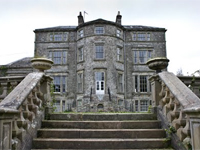
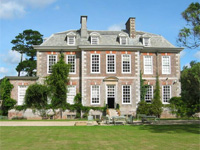
Monreith House, Scotland (Image: Mike Harrison / UK Wildlife Photography)

Country House Rescue heads from Tapeley Park in Devon to the other end of the country to Monreith House in Galloway, Scotland.  A dignified house, it has suffered from a classic problem for those that inherit, as the current owner Sir Michael Maxwell did in 1987, that: “…to put it politely, my relatives’ expenditure exceeded their income by many times.”. The necessary economies forced on Sir Michael have meant some cut corners which Ruth Watson quickly identifies as hindering his attempts to move upmarket.

The Maxwells of Monreith were certainly aristocratic with their baronetcy granted by Charles II in 1681 and various family members marrying well including the 8th Baronet’s wife, Lady Mary, who was a daughter of the Duke of Northumberland, one of the richest and largest landowners in England. The Maxwells had been based at Myrton Castle since they bought it in 1685, obviously needing a house to match their newly elevated status.

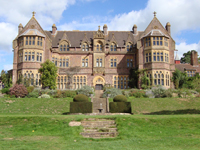
Leuchie House, Scotland (Image: John Small - 1883 / buildings fan on flickr)

Monreith House was built in 1791 by Sir William Maxwell, 4th Baronet, to replace Myrton, which was partially demolished to provide building materials for the new one.  The architect was the Edinburgh-based Alexander Stevens, son of a better known Alexander Stevens who specialised in designing and building bridges.  His design at Monreith shows that he was well versed in the Palladian vocabulary but is in contrast to his other principal design; the impressive Raehills in Dumfriesshire, built for the 3rd Earl of Hopetoun in 1786, which is an imitation of Robert Adam‘s castle style.  Monreith shows closer similarities with Leuchie House in Lothian, built for Sir William Dalrymple between 1779-1785, to designs by the little known Alexander Peacock who was also based in Edinburgh.  By the 1790s, the first wave of Palladianism had long ago swept through the country and much provincial design can be traced back to the many architectural pattern books which had been produced.  Stevens’ limited but varied output could indicate he used also used them, though perhaps more competently than most.

The Maxwells of Monreith became one of the most important families in the area with a substantial estate which totalled 17,000-acres.  The house has passed down through the Maxwells, though it never went to the most famous of the family, the writer Gavin Maxwell, heir to the 8th Baronet, Aymer Maxwell, but who died of cancer in 1968.  Gavin’s books were best-sellers, with his most famous being the autobiographical ‘A Bright Ring of Water‘ about his pet otter, the profits of which might have helped the estate but for his profligate ways.  His father also faced financial difficulties and, lacking funds to maintain the house, apparently felt it easier – and cheaper – to let the house deteriorate rather than pay to have it demolished.

When Sir Michael inherited the house from his uncle it was in a seriously neglected state, saying he remembers that “When it rained hard the water would run down the stairs and land in puddles on the floor.”.  Sir Michael had trained as a surveyor so he was able to approach much of the work himself – though this also appears to be part of the problem. One money-making scheme was to convert the top floor into holiday flats but these, and the rest of the house, all show signs of his major flaw – a determination to do things as cheaply as possible leading to various poor choices which compromise his aspirations.

Sir Michael displays an admirable duty towards maintaining the house – a contrast to that displayed initially by Hector Christie of Tapeley Park in the previous episode.  Sir Michael says “It would be too easy if your great-grandfather dropped dead and left you money to end up a drunk in the gutter – so it’s a challenge. Essentially, you’re not given much choice when you inherit a house like this.”.  Thankfully he does appear to want to listen to Ruth Watson’s advice and one hopes that this will put him on the path to a sustainably prosperous future which will ensure the Maxwells remain at Monreith.

Official website: Monreith House, Galloway

Programme website: Country House Rescue: Monreith House [Channel 4]
The growth of smaller country houses: Harewood Park, Herefordshire

The size of a country house was traditionally the physical embodiment of the wealth (or aspirations) of the owner.  Yet as the role of the country house changed and the emblems of power altered, new, smaller forms of houses to emerge for both the aristocracy and minor gentry.  The acceptability of a smaller house was to prove valuable in the financial crises of the 20th-century – though this is not to say that the later houses lacked anything in terms of quality of interiors or the richness of the architectural language used outside.

Puslinch House, Devon (Image: Devon Rural Archive)

Wealth was obviously the most important consideration when deciding on the size of the house.  However, the learned sophistication of many of the lesser aristocracy meant that although their funds may not be able to provide a palace, they were well-versed in the aesthetics of good (often Classical) architecture. This meant they were able to commission or design for themselves coherent and elegant smaller houses, giving us the much-coveted Queen Anne or Georgian smaller houses we see today up and down the country, such as Puslinch House in Devon.

The considerations in the 20th-century were also financial but driven by a different set of demands.  The financial pressures of the early part of the century, particularly the agricultural slump and the Wall Street crash, naturally limited the size of the houses built (though not all e.g. Gledstone Hall by Sir Edwin Lutyens built in 1926). Yet, the changing social climate also meant that not only was it considered somewhat insensitive to build such large palaces, it was also unnecessary as the houses no longer required so many bedrooms to accommodate the now vanished armies of staff and house guests who used to turn up for the large weekend parties.

Hurtwood Edge, Surrey

Yet smaller didn’t have to mean less interesting as architects faced up to the new challenges with intelligent interpretations of Georgian, whilst others sought to experiment with different styles, such as at the now grade-II listed Hurtwood Edge in Surrey, where the builder/architect Arthur Bolton created an Italian villa in the English countryside.

In the immediate period following World War II, many larger houses, having been requisitioned and mistreated, were demolished, but the families often retained the ancestral estate but now required a new seat.  The tight restrictions on materials, particularly for ‘luxury building’ under the Socialist Attlee government, naturally limited the ambitions of the owners.  Yet the election of Conservatives in 1951 ushered in the gradual lifting of the restrictions until their abolition in 1954 which allowed a new wave of construction.  The war seemed to have had a lasting effect – or maybe fear of a future Socialist government enacting a tax based on house size – as many of the houses were significantly smaller than those in previous eras.

Eaton Hall by John Dennys for Duke of Westminster (Image: Kathryn Gammon)

An example of this is Eaton Hall, seat of the Dukes of Westminster, where, following the demolition between 1961-63 of Sir Alfred Waterhouse’s high Gothic-Revival masterpiece, it was decided that a new house should be built.  The commission went to John Dennys, who happened to be the Duke’s brother-in-law, for a starkly modern house which sat cross-wise on the main axis of the old house.  Unfortunately in this case the new house was overwhelmed by the grandeur of the setting, appearing too small against the remaining buildings and the as the focus for the grand gardens.  Worse, the house was unsuccessfully remodelled again in the late 1980s in an almost French chateau-style to create a larger house.

In recent years, planning restrictions have usually limited the size of new houses (though not always; see my recent post on large houses).  The lack of architecturally educated clients has naturally led to a growth in crass, ugly smaller country houses, but all is not lost as determined clients are still able to demand and produce good designs, such as the one proposed for Harewood Park in Herefordshire, now mooted as the potential marital home for Prince William and Kate Middleton.

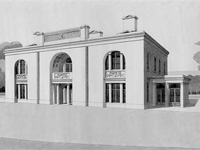
Harewood Park (proposed), Herefordshire (Image: Craig Hamilton Architects)

Ever since the Harewood Park estate was bought by the Duchy of Cornwall in 2000 as part of a larger purchase of 12,000 acres, rumours had been circulating that it would be for one of the Princes.  The original house had been demolished in 1959 so the expectation was that another would have to be built if it was to have such a role.  Considering the views of the Prince of Wales on modern architecture there was little surprise when a planning application was submitted in 2006 for a strongly Classical small country house by Craig Hamilton Architects.

Craig Hamilton originally prepared three designs but the final design (shown above) complements the existing stables and is perhaps the most interesting and the one successfully submitted for approval.

The house is based around the motif of the triumphal arch but, apparently drawing on the influence of Sir John Soane, it presents a simplified version rather than the more decorated versions often seen.  Soane was schooled in the Classical style but re-invented the language to create a new direction for Neo-Classicalism; a much simpler version with an emphasis on the effective use of space and most importantly, light.  Soane spent several years in Italy and was well-versed in Roman architecture and incorporated the three-arch motif into his designs, notably the entrance front to his own house at Pitzhanger Manor, Ealing, west London, and in one of his most impressive commissions for the old Bank of England (scandalously demolished in the the 1920s) as seen in the internal Lothbury Court.

The new Harewood Park is an inventive extension of this Soanian language and it’s encouraging that the planners had the courage to approve what will surely be one of the most interesting smaller country houses built in the UK.  Sadly, I suspect that for security reasons, we won’t see the house featured in Country Life but I keep my fingers crossed.


Competition: nominate your choice for ‘England’s Favourite House’

Competition: 'England's Favourite House'

This seems a good moment to mention the competition to find the best smaller country house (i.e. with less than seven bedrooms).  Most people have a favourite and usually it’s not so much the grand palaces of Chatsworth or Blenheim but the smaller houses of our local areas which form part of our local heritage.  The competition is being run by Country Life magazine and Savills the estate agents and the house should be in private ownership and not currently for sale. The deadline is Wednesday 24 November 2010 so submit your suggestions as soon as possible.

To nominate a house simply either print this form [pdf] and send it in or email favourite_house@ipcmedia.com

More information: ‘England’s Favourite House‘ [Country Life]


‘The National Trust can have it’: why the NT can’t accept all offers

Seaton Delaval Hall, Northumberland

In an ideal world no country house would ever be at risk but poor finances, often caused by pernicious death duties, and insufficient income from the estate or investments leaves families facing the reality of being unable to stay in their ancestral home.  When this situation arises the cry has often been for the National Trust to step in and ‘save’ the house.  Yet the financial complexities of taking on a house and the responsibilities of the many others they already care for mean that it’s unlikely the National Trust would be able to unless it meets their necessarily strict conditions – a marked contrast to the rather more ad hoc approach of the early years of country house acquisitions.

The National Trust owns over 330 houses though only about half would be considered true country houses.  The first, Barrington Court, Somerset was acquired in 1907, though it wasn’t until the 1940s that the National Trust began to acquire houses in any significant numbers.  Instrumental in the early acquisitions was James Lees-Milne, the Secretary of the Country Houses Committee between 1936-51 (see also this fascinating reflection on JLM and the NT).  A complex man from a well-to-do family who got progressively poorer, but with his good looks and manners, and a certain charm, he was able to lay the ground for many of the later acquisitions through his aristocratic contacts.

The National Trust was initially focussed on the countryside with any houses being taken on as rescue missions to save them from demolition.  This changed after an impassioned speech in 1934 by Philip Kerr, Lord Lothian, who argued that our country houses were a unique and valuable heritage and worthy of being saved. Following this, the Trust established the Country Houses Committee with James Lees-Milne at the important first Secretary who set the tone for years to come.  In the early years, Lees-Milne would travel the country meeting the many owners and starting a gentle conversation leading to more hard-headed negotiations – though some would approach the NT begging for them to take their houses such were their financial straits.

For many owners faced with the dramatic social changes after the wars, and their own impoverishment, the options were fairly stark; soldier on in an increasingly dilapidated house, rent or sell to a new resident owner, sell for demolition, or hand it over to the National Trust.  For many owners who were the latest in a line stretching back over hundreds of years the latter option was often the most appealing (especially as they could often continue living there), though many chose to take the other options leading to mass demolitions, particularly in the 1930s and 1950s.  Yet, as Lees-Milne acknowledged, his own enthusiasm meant, “I have to guard against a collector’s acquisitiveness.  It isn’t always to the advantage of a property to be swallowed by our capacious, if benevolent, maw.” (Diaries, 1 June 1945).  However, it was never an easy task as the rest of his entry for that day notes, “The lengths to which I have gone, the depths which I have plumbed, the concessions which I have (once most reluctantly) granted to acquire properties for the National Trust, will not all be known by that ungrateful body.  It might be shocked by the extreme zeal of its servant if it did.  Yet I like to think that the interest of the property, or building, rather than the Trust has been my objective.“. (Amusingly he finishes with “These pious reflections came to me in the bath this morning.“)

The troubled acquisition of Barrington Court had a profound impact on how the National Trust dealt with later offers.  Merlin Waterson in ‘The National Trust – The First Hundred Years‘ highlights that even thirty years later those with fears about unexpected costs for repairs and maintenance were citing Barrington Court in evidence.  Caught between the rock of their own very high standards and the hard place of not having limitless funds, the National Trust began insisting that any house they took on came with a sufficient endowment.  This was formalised in 1968 as the ‘Chorley formula’ (after Roger Chorley who created it and later served as chairman from 1991-1995) which calculates the endowment required, taking in to account expected high-level maintenance and repairs, likely revenues, workers wages and many other factors.

Initially though this meant that a strange paradox developed whereby the NT would only be able to accept houses from wealthy owners – who were unlikely to want or need to hand them over.  However, in 1937, Parliament enabled the National Trust to make money from its properties by allowing it to accept additional property, cash or securities to provide income producing endowments.  One of the first to do so was Philip Kerr himself who, in 1941, bequeathed Blicking Hall in Norfolk along with its content, more than one hundred other houses and cottages, and over 4,700-acres of woodland.  By the end of WWII, the NT owned 23 houses including West Wycombe Park and Cliveden in Buckinghamshire, and Polesden Lacey in Surrey, each of which had come with generous endowments.

Kedleston Hall, Derbyshire

However, where owners didn’t have the money other sources had to be found, as the protracted negotiations around Kedleston Hall in Derbyshire proved.  This stunning neo-classical mansion of the Curzon family was designed by Robert Adam in the 1760s and has one of the finest collections of Chippendale furniture in the world.  Faced with crippling death duties and a need to pay the grandson a ten-percent inheritance (which he demanded regardless of the threat this posed to the house and estate), the 3rd Viscount Scarsdale opened negotiations with the Trust who determined that it would need a £6m endowment plus another £2.5m for immediate repairs.  Faced with the breakup and sale of the house and its collections, English Heritage, the National Trust, American donors, and the Curzon’s themselves all contributed. This neatly demonstrated the broad spectrum of public and private sources that now had to be called upon to meet obligations such as this – and the difficulties of marshalling such a diverse range each time an opportunity presented itself.

The Trust has been consistent in this policy even when offered fine houses such Heveningham Hall, designed by Sir Robert Taylor with interiors by Wyatt, which had been accepted by the Goverment from the Vanneck family in lieu of inheritance tax in 1970.  Without endowment the Trust refused to take ownership but were happy to manage it for five years whilst the Government found a buyer.  Conversely, when the Dryden family were looking to offload the 16th-century Canons Ashby in 1981 the newly established National Heritage Memorial Fund was able to provide the endowment to fund the family’s gift.

These cases have now formed the model for subsequent campaigns such as the impressive Tyntesfield in Somerset and recently Seaton Delaval Hall in Northumberland where a combination of grants and generous local support enabled them to raise £7m to repair and endow the property.

For many within the National Trust the thinking is now that they have enough houses – for them, current campaigns are mostly around the protection of landscape.  Yet, their obvious financial and political power means that when the need arises they are able to step up to ‘save’ a house.  However, as it is usually preferable that a house remain with the family, hopefully the careful trust arrangements many now have in place mean that increasingly they are able to stay in their home.  Perhaps more houses could have been saved if the National Trust had accepted more of those offered to it, but in reality it is difficult to see how they would have been able to fund so many, especially where the existing owners had proved just how difficult it was to stay financially afloat.  Rather than just saying ‘the National Trust can have it’ we all must be aware that it is not a simple solution and that the long-term care of our country houses requires exceptional planning and commitment – and, ideally, very deep pockets.

The National Trust’s policy on acquisitions [National Trust]

Looking for a saviour: St Osyth Priory, Essex

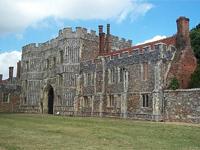
St Osyth Priory, Essex (Image: Stephen Dawson/geograph.co.uk)

Of the phrases most likely to cause concern for those who love our country houses, up there with ‘dry rot’, ‘water leak’ and ‘death duties’ has to be ‘enabling development’.  Originally designed to protect heritage assets by permitting limited development to fund repairs, it appears to now be used to circumvent local and national planning guidelines to facilitate inappropriate development where it otherwise ought to be refused.

In Essex, perhaps one of the largest examples of its kind was submitted by the Sargeant family who bought St Osyth Priory in 1999 through their development company ‘City and Country Group‘ (CCG) .  The company applied to build 190 houses as part of an enabling development to fund repairs to the main house and the other 22 listed buildings in the complex claiming that some £30m-worth of repairs were required (and personally I doubt the cost would be that high – happy to be proved wrong by an independent survey from a SPAB scholar).   This number would naturally bolster the calculation for the total conservation deficit (that is, the amount by which the cost of repair (and conversion to optimum beneficial use if appropriate) of a significant place exceeds its market value on completion of repair and conversion, allowing for all appropriate development costs, but assuming a nil or nominal land value).  But is this a case of a developer using the provisions of enabling development to gain permission regardless of the consequences for the house – and the local area?

After passing through various Royal hands, it was sold to Lord Darcy in 1553 and remained the home of various Earls, Viscounts, Lords and Baronets until it was eventually bought in 1954 by author Somerset de Chair who, in 1974, married Lady Juliet Wentworth-Fitzwilliam, daughter of the 8th Earl Fitzwilliam of Wentworth Woodhouse. The couple lived in the gatehouse, with much of the valuable Wentworth Woodhouse art collection, but de Chair died in 1995, so in 1999 Juliet married Dr. Christopher Tadgell and sold St Osyth to CCG and went to live in Bourne Park, near Canterbury.

CCG have a track record of taking on historic houses and have recently restored Balls Park, Hertfordshire and Herringswell Manor, Suffolk and previously Cheverells and Gilston Park – but these were easier to convert as they had all been used for other institutional or commercial purposes rather than as a family home.  St Osyth Priory and related buildings have sad recent history of insufficient maintenance over many years and have been included on the various buildings at risk registers and undoubtedly needs significant work – but can the repair bill really be £30m (by comparison, the whole of St Paul’s Cathedral was recently restored for £40m)?

To play Devil’s advocate, perhaps this figure might be explained by the provisions of ‘enabling development’ which require that;

It is demonstrated that the amount of enabling development is the minimum necessary to secure the future of the place”
– ‘Enabling development and the conservation of significant places‘ English Heritage (2008)

…so to secure a development of sufficient size to make it profitable for CCG, it would need a suitably large repair bill to justify this (see letter from local resident).  It has been suggested on the St Osyth Parish Council website that offering the house for sale (with just 20-acres rather than the full estate) is merely part of the process of proving that no-one is willing to take on the house and restore it and therefore the enabling development is the only option.  In reality, for someone to invest that much in a house (purchase+restoration) they would expect an estate of at least 100-acres, if not two or three times that.  The plans also seem inappropriate with regard to other provisions of the English Heritage guidance:

  • It will not materially harm the heritage values of the place or setting.
  • It avoids detrimental fragmentation of management of the place.

This all seems depressingly familiar where a developer ignores what’s best for the house, and, in this case, what seems to be determined to bloat the size of the local village in pursuit of this unpopular and out-sized scheme.  An active and well-supported local campaign has been highlighting the various flaws of the scheme and the potential damage to the setting and the village if the scheme were to go ahead, but of course, it’s the house which is continuing to suffer.

In an ideal world, the house would be restored for much less than £30m thus showing that the scale of development proposed was unjustifiably large. This again would show that ‘enabling development’ is apparently being used as a means to try and circumvent the usual planning restrictions which are there to protect our heritage and countryside. Then perhaps one day the house with the full estate (hopefully once CCG realise they won’t get permission) will be offered for sale and someone will get the chance to take care of this important house and estate without sacrificing it for housing.

Property details: ‘St Osyth Priory, Essex‘ – Bidwells

More details:  ‘Priory battle gathers pace‘ [Daily Gazette]

A restoration or a recreation: Knightshayes Court, Devon

Knightshayes Court, Devon (Image: Matthew Beckett)

For all the wonderful work the National Trust has done over the last hundred years saving numerous country houses from demolition, one criticism that has been levelled at it is the almost artificial atmosphere it has created inside.  A recent visit to Knightshayes Court in Devon has also highlighted an interesting series of judgements as to how far an interior should be restored, even to the point of creating a room which was planned but never executed.

Knightshayes Court sits in an elevated and enviable position above the market town of Tiverton where the Heathcoat Amory family had the factory which generated their wealth.  The family fortune was created by the Loughborough-based John Heathcoat (b.1783 – d.1861) inventor of a revolutionary industrial lace-making machine who moved to Tiverton in 1816 after all 55 machines were smashed by drunken Luddites.  A caring man, he ensured the workers were well-housed and the children educated, and the factory became the largest lace-making factory in the world, employing 1,100 workers.

Knightshayes Court, however, was built by his grandson, John Heathcoat Amory (b.1829 – d.1914), whose father had married the only daughter of John Heathcoat, and had added his father-in-laws surname on inheriting. Although politically active, being knighted in 1874, he had sufficient time to indulge the usual pastimes of the wealthy Victorian aristocrat, particularly hunting.   So why would a provincial hunting gent commission a house from an eccentric medievalist, such as William Burges?

Burges (b.1827 – d.1881) has been described by Mark Girouard as ‘one of the most Gothic of the Gothicists‘.  His spectacular remodelling of Cardiff Castle, and the creation of the fantastical Castell Coch, both for the immensely wealthy 3rd Marquess of Bute, allowed him free reign to indulge his bold and imaginative decorative schemes.  Burges worked to a relatively simple philosophy that “No rule can be deduced except the golden one; whatever looks best is best‘ which combined with his other aphorism ‘Money is only a secondary concern in the production of first rate works…There are no bargains in art‘, meant that his work was never going to be cheap.  Yet Heathcoat Amory chose him – but the suspicion is that it was his wife Henrietta who made the choice, perhaps on the back of family connections which included the 2nd Lord Carrington for whom Burges had remodelled Gayhurst in Buckinghamshire (now flats), in the late 1850s-early 1860s.

Perhaps John Heathcoat Amory had only given broad instructions as to what he wanted and had left his wife to chose the aesthetics – either way, as paymaster, Sir John would later regret not taking perhaps a closer interest in the choice of architect.   Construction of the house started in 1869 and the exterior of the house was built almost exactly to Burges’ original design, with the exception of the reduced height of the great tower and a re-orientation of the billiard room.  With the shell completed in July 1870, at a cost of £14,080 (approx. £1m today), the Architect magazine observed that for completion ‘…the actual cost will be something more.‘ – a classic in the canon of architectural understatements as Burges had reserved his most incredible work for the interior.

In 1873, Burges presented the family with a 57-page album of detailed drawings which depicted everything from floor to ceiling.  Faced with such a grand and lavish scheme the Heathcoat Amorys abandoned Burges’ scheme, apart from the stone and wood carving, and, in 1874, brought in the cheaper but very talented John Diblee Crace.  Crace was the fifth generation of architectural decorators and between 1875 and 1882 he completed the interior of the house in his own more restrained but still colourful designs. The last additions to the house were an extra floor to the service wing in 1885 and a Smoking Room in 1902.

However, in the 1930s and 1950s, when appreciation for Victorian exuberance was at its lowest, the Heathcoat Amorys retreated from the bold colour schemes, removing fireplaces, screen and bookcases and covering or repainting ceilings and walls.  So when the National Trust took over in 1973 the house was very different, and less architecturally interesting, than the one of a century earlier.  The guide book, to its credit, does an admirable job of spelling out what is original, what was originally planned, what Burges executed, what Crace did, and what the National Trust has restored – and, perhaps more controversially, has recreated.

The obvious question when deciding on restoration is what particular period you pick as the ‘authentic’ period.  The National Trust took over Kedleston Hall in Derbyshire in 1987, easily one of the finest Adam houses in the country, but by 1994 the then Lord Scarsdale was complaining that the NT had decided that anything post-1760 had to go.  This led to the emptying of rooms, the repainting of others to how they thought Adam had painted them, and the removal in the grounds of anything not thought to have been put there by the first Lord Scarsdale and Robert Adam.

This is in contrast to the principles of the Society for the Protection of Ancient Buildings (SPAB) who state: “In the architectural context “restoration” means work intended to return an old building to a perfect state. It can be the unnecessary renewal of worn features or the hypothetical reconstruction of whole or missing elements; in either case tidy reproduction is achieved at the expense of genuine but imperfect work.“[source].

The Burges Room - Knightshayes Court, Devon (Image: Britain's Finest)

So was the National Trust wrong to strip back the layers of changes?  In view of the fascinating end result and the relative rarity of Burges country houses it can be argued that this work rescued what remained and cleverly exposed the earlier work.  But whose earlier work?  The guidebook explains that most of the interior is by Crace, and it’s his work which has been restored.  Yet upstairs in ‘The Burges Room’, the National Trust took it a step further and took Burges unexecuted plan for that room and created it as it imagined it would have looked.

So is this mere architectural theme park-ism?  Perhaps as it has be made clear what has been created from scratch there is less risk of confusion, but considering how few read the guidebook in detail (or at all), the National Trust has the unenviable choice between respecting all the changes or presenting a more visually interesting house but with necessary compromises in architectural integrity. On balance, there has to be a very strong case to take such a course of action otherwise we risk seeing recreations of idealised or imagined versions of houses rather than the rich and varied buildings which have honestly adapted and changed as family homes over time.

Visitor information: ‘Knightshayes Court, Devon‘ [National Trust]