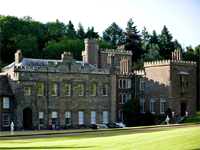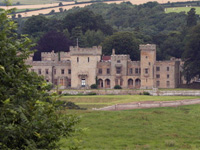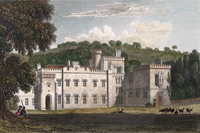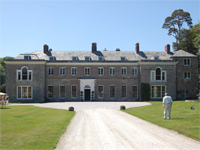
Peckforton Castle, Cheshire, seriously damaged in arson attack

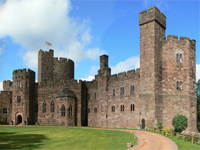
Peckforton Castle, Cheshire (Image: the pepper tree / flickr)

In the early hours of Sunday (19 June 2011) a serious fire broke out in the Drawing Room of grade-I listed Peckforton Castle and has gutted all three floors of that wing, affecting approximately 25% of the building. Sadly, it appears that this terrible destruction in one of the finest mock castles in the country is reported to be the result of an arson attack by the groom, apparently over the wedding bill.  That such a wonderful building could be damaged over something so stupid is beyond belief.  The full extent of the damage – and credit to the fire service for preventing it spreading – will only become truly apparent over the next few days.

Peckforton Castle sits on a Cheshire hill-top, facing down the medieval Beeston Castle on the neighbouring peak.  Yet, Peckforton is a Victorian creation for the 1st Lord Tollemache, who had commissioned Anthony Salvin to marry the conveniences demanded by a Victorian landowner with a scholarly re-creation of an ancient castle, creating the muscular skyline so visible today.  The style of the castle is a reflection of the character of Tollemache – vigorous sportsman, statesman, father to 24 children, and, above, benevolent landlord.  Tollemache had inherited the 26,000-acre estate through his grandmother, co-heiress of the 4th Earl of Dysart, and had particularly Victorian vision of how an estate should be run, saying “The only lasting pleasure to be derived from the possession of a landed estate is to witness the improvement of the social condition of those residing on it.” To this end, he reduced the size of each farm to 200-acres and rebuilt every farmhouse and labourers cottage on the estate at a cost of £280,000 (approx. £20m) and to each cottage he allocated a further 3-acres to help them grow their own produce.

The estate lacked a main house and so Tollemache went against the prevailing fashion of the time and commissioned an authentic re-creation of a medieval castle which was built between 1844 and 1850.  The fashion for sham castles had grown out of the Georgian Picturesque movement which applauded such visions of a castle – symbol of ancient chivalry – and landscape combined to create an aesthetically pleasing view. Yet, in demanding an accurate castle, Tollemache rejected many of the compromises that had previously characterised the lesser shams, such as having a great gatehouse but also acres of glass, which were being roundly criticised by architects such as Pugin who demanded architectural authenticity.
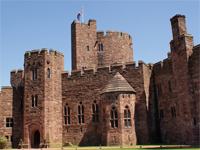
Courtyard, Peckforton Castle, Cheshire (Image: Bob W / flickr)

Tollemache’s architect was Anthony Salvin (b.1799 – d.1881), who, on the strength of the success of Peckforton, was commissioned to also work on Alnwick Castle and the Tower of London, and many more.  Salvin was the perfect architect for the job with his Victorian understanding of the romance of castles and the appeal of the Middle Ages but also a sound practical training with John Nash which gave him the skill to successfully, as Alfred Waterhouse wrote to Lord Tollemache in 1878, “…combine the exterior and plan of an Edwardian [Edward I] Castle with nineteenth-century elegance and comfort.

Castle Drogo, Devon (Image: wikipedia)

Faced with the choice between architectural accuracy and convenience most of Tollemache’s contemporaries opted for more fashionable styles leaving relatively few of these large-scale re-creations.  Other examples of ‘real’ sham castles include William Burges‘ designs for Lord Bute at Castell Coch, Belvoir Castle for the Dukes of Rutland, and the powerfully brooding Penryhn Castle, built between 1840-50, for George Hay Dawkins-Pennant.  The demand for an authentic castle then largely abates until Julius Drewe’s commission, built in the 1910s and 1920s, for Sir Edwin Lutyens which results in the wonderful Castle Drogo.  By their very nature, their stern exteriors make them untraditional country houses yet they hark back to the oldest form of home for the landed gentry, and a symbol of power and prestige.

Sadly, arson attacks on country houses are not unknown – witness the terrible devastation brought to Hafodunos Hall in Wales by two bored idiots in 2004. With Peckforton Castle, the success of the design, both as an exterior composition, but also for the practical yet impressive interiors is why the house is such an important part of the nation’s architectural heritage.  The house was only recently subject to a £1.7m restoration programme by the Naylor family who own it and have worked immensely hard to bring to life a house that had been empty since WWII.  Hopefully the damage will not turn out to be as extensive as feared – though estimates for restoration are already said to be around £1m.  The strength of the construction means that it will almost certainly be restorable and will hopefully again rise soon from the ashes of this terrible fire.

———————————————————————

News stories:

Listing description: ‘Peckforton Castle‘ [britishlistedbuildings]
‘Take a Chance on Me’ – Buildings at Risk Register 2011

'Take a Chance on Me' - 2011 SAVE Buildings at Risk Register

Despite the obvious deep and passionate interest society has with historic buildings every year the SAVE Britain’s Heritage Buildings at Risk Register highlights just how many properties are still under threat from neglect and those in power who believe the only good building is a new one with their name on the opening ceremony plaque.  The 2011 BaR register – ‘Take a Chance on Me‘ – has just been published and sadly, as always, it contains some country houses which really deserve a better fate.

Perhaps the one of the most attractive, both architecturally and in terms of being a  case for restoration is Blackborough Hall, near Cullompton in Devon. This elegant, if thoroughly dilapidated grade-II house, is a remnant of the grand building plans of the Earl of Egremont whose many-columned main house, Silverton Park, was demolished in 1902.  The house is actually two, as when built in 1838, it formed one house at the front and a second at the rear for the local rector.  In recent years it became a car scrap yard which covers most of the immediate grounds and would obviously need clearing first – though I suspect the costs could be made back through selling some of the classic cars. The house is currently for sale for a nice round £1m and has been listed with Winkworths who, after an initially poor showing, have now managed to put a few more photos and a floor-plan online.

Elvaston Castle, Derbyshire (Image: Steve Tomkinson / Friends of Elvaston Castle)

Elvaston Castle in Derbyshire has a grade-II* listing putting it in the top 4% of buildings nationally but that hasn’t stopped it making an entry into the Register this year.  Originally built in 1633 for the Earls of Harrington it was largely rebuilt in a ‘Gothick’ style c.1817 to designs by James Wyatt.  Now owned and managed by Derbyshire County Council (who had a fairly poor record in the 20th-century of demolishing country houses in their ‘care’) it is today mostly vacant and with the Council now claiming it can’t afford to maintain it they are seeking a developer to get them out of a hole of their own making.  Luckily an active local campaigning group – the Friends of Elvaston Castle – have been objecting to these plans and trying to force the Council to face up to their responsibilities – though perhaps there is an opportunity for someone else to come up with a viable plan.

Stone Cross Mansion, Cumbria (Image: HiddenShadow / 28dayslater)
Stone Cross Mansion, Cumbria (Image: HiddenShadow / 28dayslater) - click for more images of the house today

Stone Cross Mansion, Cumbria presents the interesting confusion of a Scots Baronial design in England.  Built in the 1870s by a stubborn man, one Myles Kennedy, who wanted to buy Conishead Priory for £30,000, but who met an equally stubborn vendor who wouldn’t accept less than £35,000.  Mr Kennedy may have come to regret his obstinacy when presented with the final bill which totalled nearly £45,000.  The sum reflected the high quality of the workmanship, particularly the impressive High Victorian Gothic grand hall (scroll down) which originally had a fine staircase which was later removed when the house became a special school to make it easier to play indoor football (seriously, where do they find these people?!).  The house then became a corporate headquarters during which it time it was restored to a high-standard before falling into neglect.  Repeated enabling development proposals have been rejected (not that the council is against it) so this house either needs someone willing to restore the house on the back of a sensitive ED proposal – or, ideally, someone to rescue this house and make it a home again.

Plas Gwynfryn, Wales (Image: SAVE Britain's Heritage)

Another house which would make a fantastic home is Plas Gwynfryn in south Wales.  This house has been featured before on this blog (‘Orphan seeks new carers: Plas Gwynfryn, Gwynedd‘) which sparked some passionate debate in the comments about who the owner is – and that same unresolved question is why the house makes an appearance in the BaR this year. Built in 1866 to replace an earlier one, this distinctive house – described in the listing description as ‘romantically assymetrical’ – was a hospital in WWII, before becoming an orphanage and then a hotel before a serious fire in 1982 gutted it.  Although in a derelict condition this house can be restored and would once again be a fine part of the local architectural heritage.

The Register is available from 1 June 2011 priced at £15 (£13 to Friends of SAVE) and can be ordered from the SAVE website. The BaR contains many other types of property so even if your budgets are less lavish than these house might require it is well worth having a look.  Of course, SAVE does superb work across the country to protect our architectural heritage and I would strongly urge everyone to become a Friend to help support their efforts (well, I would say that as I’m on the Committee – but I’d also say it anyway!) which will also give you access to the online version of the BaR register which contains hundreds of other potential future success stories.

——————————————————————————–

A more comprehensive list of country houses currently at risk can be found on my Lost Heritage website: ‘Houses at Risk

Country House Rescue: the weight of history – Kentchurch Court, Herefordshire

Kentchurch Court, Herefordshire (Image: mhaswell / flickr)

For some who inherit, the weight of family history can easily overcome the burden of running a historic home on a limited budget.  As we saw in the previous episode of Country House Rescue at Trereife House in Cornwall, the desire to not be the generation which loses the ancestral home, a prospect which faced the Le Grice family who had been there since 1799.  So imagine the weight of responsibility facing the Lucas-Scudamore family who have lived for ten centuries at Kentchurch Court in Herefordshire.

The house itself was originally a Saxon tower with further additions in the 14th-century.  However, the main style of the house as it stands today is due to work commissioned from the famous Regency architect John Nash (b.1752 – d.1835).  More importantly, Kentchurch is a significant as one of a number of houses built in the area around that time which were a visible expression of a new wave of architectural fashion; the Picturesque.

Strawberry Hill, London (Image: D Kendall / EH Viewfinder)

When thinking of Georgian architecture many think of the symmetrical classical façades and strictly proportioned Palladian designs which were so prevalent in that era.  Yet one house, Strawberry Hill in Twickenham, south London, was to be the catalyst for a new way of thinking, breaking these patterns and ushering in a more organic way of viewing architecture. This saw the house as part of a landscape with the design playing its part in the beauty of the view as much as the lakes, gardens and parkland. Originally an unremarkable house, it was bought in 1747 by the wealthy Horace Walpole, 4th Earl of Orford and fourth son of Walpole the Prime Minister, who was an astute observer of society, art, and architecture. Walpole contributed little to art but was particularly well read and as he pursued his academic studies decided to start experimenting with alterations to his house.

Fonthill Abbey, Wiltshire (Image: John Rutter (1823) / RIBA)

His original changes from about 1749 were uncontroversial and, importantly, followed the convention for symmetry.  However, from 1753 onwards the interiors were fashioned in a gothic style with the help of what he called his ‘Committee of Taste’ comprising a few of his equally well-read friends.  This experimentation was confined to the interiors until, in 1759, he broke with architectural convention and had a great circular tower constructed but which, radically, had no matching pair.  The house was to continue to grow in a rather free fashion which can still be admired today (particularly so following the completion of phase one of a fantastic restoration by the Strawberry Hill Trust, the Heritage Lottery Fund and the World Monuments Fund). The house became famous, attracting day trippers in large numbers and spawned imitators; though it was James Wyatt’s Lee Priory (built 1785-90 – dem. 1955) which was said to the be first ‘child of Strawberry’.  Also considered worthy, and also designed by Wyatt were the fantastical Fonthill Abbey (collapsed in 1825) for William Beckford, and Ashridge Park for the 7th Earl of Bridgewater.

Downton Castle, Herefordshire (Image: gardenvisit.com)

One man particularly taken with this new style was Richard Payne Knight, a Herefordshire MP and intellectual with a large inheritance.  Using his wealth, in 1774 Payne Knight started the construction of a new home, Downton Castle, which bore similarities to Strawberry Hill, with the asymmetry and a large circular tower, and an irregular plan which was quite radical for the time.  This house was a prototype for a new ‘castellated’ style of house which was to be popular for fifty years from about 1790.  Driving this new style was the publication of three key books, the first two in 1794; ‘The Landscape, a Didactic Poem‘ by Payne Knight, and ‘Essay on the Picturesque‘, a brilliant reply in support by Uvedale Price (another local landowner), and, in 1795, ‘Sketches and Hints on Landscape Gardening‘ by the landscape-gardener, Humphrey Repton, who formed a successful and highly influential partnership with the architect John Nash that same year.

Nash had moved to Aberystwyth after his bankruptcy following a failed speculative buildings scheme in Bloomsbury in London.  Yet, the contacts he was to make in Wales led to Nash becoming one of the leading architects of the Picturesque.  The early development of his interest in the ideas of the movement can be seen when he designed a castellated triangular lodge for Uvedale Price sometime between 1791-4.  He also worked for Thomas Johnes at the spectacular Hafod estate where Johnes had planted 3 million trees to paradoxically create a more ‘natural’ looking Picturesque landscape.

For Nash, the ideas he developed in that short period from 1790 until he left to go back to London in 1796, were what made him one of the most significant architects of the period. The influence of Downton Castle and Nash also created a strong regional collection of these mock castles – Garnons (dem. 1957), Saltmarshe Castle (dem. 1955), Goodrich Court (dem. 1950), Garnstone Castle (by Nash, built 1806-10 – dem. 1958) Hampton Court Castle (alterations 1830s-40s) and extending down to Devon where Nash designed perhaps one of his best creations; Luscombe Castle (built 1800-4), and into Cornwall, where he designed Caerhays Castle (built 1807-10).

Kentchurch Court from "Views of the Seats, Mansions, Castles, etc. of Noblemen and Gentlemen" (London : 1829-1831)

By their very nature these were large houses and often a little impractical which sadly meant many were demolished.  This is why Kentchurch Court is important – not only is an early work by Nash in the style of house which was to become his trademark, but it’s also one of the survivors of the tragedy of the many demolished country houses.

Perhaps the current Mrs Lucas-Scudamore should be grateful, in some ways, that their branch only inherited some fine carvings from the sale of the other much grander family seat, the grade-I Holme Lacy House (now a hotel) rather than the house itself with its 9 fine rooms with plaster ceilings which Pevsner though to be some of the best in the county.  The story of Kentchurch Court today is a familiar one of a family with an incredible history and a fine house and estate struggling with the usual demands for maintenance and £120,000 per year running costs.  Mrs Lucas-Scudamore and her two children (Mr Lucas-Scudamore being estranged and living away) battle on with determination but managing a house like this requires a money tree not a family tree – but this house is too important to be neglected.

Country House Rescue: ‘Kentchurch Court‘ [Channel 4]

Country House Rescue: efforts misapplied – Trereife House, Cornwall

Trereife House, Cornwall (Image: matt bibbey / flickr)

Inheritance is a double-edged sword – for all the perceived luck of being given a large country house, the reality is that, in many cases, the house requires significant investment.  For some, this is a chance to shine; to put in place the plans they had been making, or develop new talents and unexpected skills. For others it quickly becomes burden as it pushes them into situations they seem unprepared for – as it frequently proves on Country House Rescue.  This week (27 March), heading back down to the south west, Ruth Watson visits Trereife House in Cornwall, to a house threatened by the odd schemes of the owner.

Antony House, Cornwall (Image: mothproofrhubarb / flickr)

Trereife (pronounced ‘treeve’) nestles in the hills above Penzance, an neat pink hued Queen Anne house with an elegant parterre garden laid out below the south front.  The original house was an Elizabethan farmhouse which was home to the Nicholls family, who had become wealthy landowners and minor gentry through farming and marriage.  The first records of them is the marriage of William Nicholls (also known as William Trereife) in 1590, though it is thought the family had been in the area for several generations earlier.  The design of the grade-II* house as we see it today is the result of an extensive rebuilding in 1708 which not only added the wonderful Queen Anne front with its hipped roof but also created some fine interiors with plasterwork ceilings, probably by travelling Italian workmen, who were known to have worked on several houses in the south west.

Boconnoc House, Cornwall (Image: cornishmoth / flickr)

Architecturally, the echoes of the style of Trereife can be seen at the much grander Antony House for the much wealthier Carew family. The house was begun in 1718 shortly after Trereife’s remodelling and so is technically Georgian (Queen Anne died in 1714) but the basic form of the house is similar.  Also Boconnoc House, near Lostwithiel, displays the same two-storey with dormer windows design as Trereife and Antony – though again for a much wealthier family, the Pitts.  Boconnoc features later alterations in 1786 by Thomas Pitt, cousin of Pitt (the Younger) the Prime Minister, in conjunction with Sir John Soane, who he had met in Italy in 1778, which probably explains the serlian window to the projecting bay.  Another house of a similar design was Dunsland House, Devon which was one of the most important houses in the area, with particularly fine plasterwork, which sadly burnt down in 1967.  On a smaller scale than any of these, but possibly even more beautiful, is Great Treverran, near Fowey, a compact (one room deep) house built in 1704 but given a dose of grandeur with fine granite Ionic columns, it was last sold in 2003 for around £650,000 and is now wasted as a holiday cottage.

Trereife is a significant part of a great tradition of Cornish houses with a fine family history with connections to the Romantics such as Coleridge, Wordsworth, Charles Lamb and Leigh Hunt through Revd Charles Valentine Le Grice, affectionately known as ‘CV’.  The house passed to the Le Grice family through inheritance in 1821 following the marriage of Mary Nicholls, whose son had died childless, to ‘CV’ in 1799.  The house is now owned by Tim Le Grice, a solicitor who inherited the neglected house in 1986 from his grandmother and who now lives at Trereife with his family.

Sadly, Tim appears ill-equipped for the role as country house rescuer as a series of slightly eccentric – gypsy caravan theme park anyone? – or badly planned business ventures have taken up significant time and money with little to show for it.  For the family, the £40,000 per year running costs were proving ruinous and so they turned to Ruth for advice; which is typically hard-hitting.  Much as the family would rather avoid having their family finances shared with the nation this appears to be the only way to persuade Tim that he needs to draw on the skills and experience of his literary agent daughter to organise events and his wife to develop the potential for B&B and weddings within the house.  Considering that the house now comes up well in Google searches as a venue for weddings and events it seems that Ruth was right – and has hopefully enabled another family to remain in their ancestral home.

——————————————————————

Country House Rescue: ‘Trereife House‘ [Channel 4]

Official website: ‘Trereife House

Interiors: ‘Trereife House‘ [UK Film Location]

Official Facebook page: ‘Trereife House

More details: ‘Trereife – a family home‘ [Cornwall Life]

Country House Rescue: Tapeley Park, Devon

Tapeley Park, Devon (Image: chatoul / flickr)

The subject of the 13 March episode of Country House Rescue, Tapeley Park in Devon, carries on the wonderful tradition for country house eccentricities – and eccentrics.  From how the site was chosen to the manner of the inheritance, this beautiful house has a fascinating history – though more recently it’s been a little neglected.

According to Simon Jenkins, “Few Devon houses have so spectacular an outlook” – and few would disagree.  Situated above the pretty seaside town of Bideford, the site of the house was apparently chosen by the builder, Captain William Clevland, who apparently spotted the location through his telescope as he sailed up the Torridge in 1702.  He made good on his wish, rebuilding the existing manor house in an austere and somewhat uninspiring style but which took full advantage of the fine views from its elevated position – though this was later largely negated by an enthusiastic blocking up of windows to avoid the window tax.

Tapeley Park, Devon - before Belcher alterations (Image: tapeleygardens.com)

The house eventually passed to the Christie family through marriage when Agnes Clevland married William Langham Christie in 1855.  The Christie fortune was made when one Daniel Christie joined the East India Company and was later given a fortune in gems by a Sultan in thanks for having prevented troops from pillaging a harem.  On his return he married the daughter of Sir Purbeck Langham of Glyndebourne in East Sussex and Saunton Court in Devon.  His grandson, Augustus Langham Christie, inherited both estates and now being a very eligible and wealthy man was able, in 1882, to marry the daughter of the Earl of Portsmouth, Lady Rosamund, whose family seat was the nearby Eggesford House (demolished in 1917).  Coming from such a grand house she was fairly unimpressed with Tapeley, writing in her diary:

“When I first saw Tapeley it was in the winter of 1881 before my marriage to Augustus Langham Christie. It was a Georgian stucco house, very plain and rather dreary in appearance, for many of the front windows had been blocked and the sunk apertures painted black with halfdrawn paint blinds, cords and tassells, looked very dull. The terrace walk and garden did not exist and the drive approached between iron railings.”

The marriage was not a particularly happy one with Lady Rosamund eventually banishing Augustus to the other Christie estate, the nearby Saughton Court, for his ‘eccentricities’ which apparently included ‘childish behaviour’ such as kicking the furniture repeatedly to annoy her.  In his absence, Lady Rosamund poured her energies into rebuilding Tapeley and engaged one of the leading neo-baroque architects, John Belcher (b.1841 – d.1913).  Due to limited finance, the work was to last from 1896 until 1916 but the professional relationship between client and architect was a happy one – so much so that on his death she had a plaque added to a wall in his memory.

Belcher is not as widely known as perhaps he should be, though his work is well regarded. He worked mainly on commercial buildings and institutions including the Whiteleys department store in London, and the brilliant Mappin & Webb building in the City of London which was scandalously demolished in 1994 to build No.1 Poultry (the only good view is looking out from the top of it!). More prominently, Belcher also designed in 1907  the imposing Ashton Memorial in Lancaster for Baron Ashton.

Belcher transformed the ‘dreary’ house to create an imposing but elegant ‘Queen Anne’ style Georgian villa of brick with stone pilasters, parapet and a pediment, sitting above the impressive terraced gardens. The interiors are also of note, featuring a grand staircase hall and also several good fireplaces and plaster ceilings from the original house.  Lady Rosamund had to fight to keep hold of her creation as, in an act of revenge, Augustus left the house in his will on his death in 1930 to a distant cousin in Canada, forcing her to have to go to court to argue, successfully, that Augustus was obviously insane.

The house and estate were inherited by her son, John Christie, who founded the famous opera at Glyndebourne, where he spent the other half of his time when he wasn’t at Tapeley.  Tapeley was then inherited by his daughter, another Rosamund, who frugally ran the house until her death in 1988 and was known for conducting the tours with a parrot on her head.

The current owner is one Hector Christie, Rosamund’s nephew, who apparently decided with his brother which was to inherit Glyndebourne and Tapeley by flipping a coin whilst in a Brighton nightclub.  Hector, though Eton-educated, is something of a rebel, once sneaking into a Labour party conference to heckle Tony Blair about the Iraq war, and also extending a fairly broad invitation to various hippies to create something of an eco-commune at Tapeley.

Though almost all the hippies have now left, Hector has now decided that he should focus on managing the house and estate on a more commercial basis, and not a moment too soon judging by the deteriorating condition of the grade-II* listed house, where part of the dining room ceiling fell in shortly before Ruth Watson’s first visit.  Fingers crossed her advice can provide a means for the family to stay in their ancestral seat without compromising either the architecture or setting or his principles.

Official site: Tapeley Park, Devon

Country House Rescue: Tapeley Park