Going to the country: more country houses of UK Prime Ministers – Part 2

The first part of this series, highlighted the aristocratic background of our early Prime Ministers – Earls and Dukes abound.  This meant that a country house was just where they had been brought up and simply regarded as home rather than the aspirational purchase.  It also highlighted that the architectural tastes of the PMs reflected their political beliefs with a strong preference for the Classical, representing structure and order.

So, to continue the tour of country houses of Prime Ministers, this time those who served  under George III (1760–1820):

Luton Hoo, Bedfordshire (Image: ickle_angel/Flickr)

The first was John Stuart, 3rd Earl of Bute. Originally a man of rather limited means who only acquired great wealth following his marriage to the rich heiress, Mary Wortley Montagu. The family seat was Mount Stuart on the Isle of Bute; at the time a small Queen Anne house which burnt down in 1877 to be replaced by the Gothic palace we see today.  With his later wealth and prominence the Earl created two fine new country houses.  On his retirement as PM, he bought Luton Hoo, Bedfordshire in 1763 and in 1767 commissioned Robert Adam to create a large neoclassical mansion which, although this was never fully realised, the resulting house (now a hotel) is still sizable.  The wings are a later addition but faithful to Adam’s original conception. Ill health later forced a move to the Dorset coast and having bought a clifftop position he built High Cliff “to command the finest outlook in England.“.  Unfortunately it was a little to fine, the crumbling cliff not only necessitated the demolition of the house in the late 1790s, it also led to the Earl’s death in 1792 due to a fall whilst picking plants.

He was succeeded as PM in 1763 by George Grenville who was born, and lived, at the family seat, Wotton House, Buckinghamshire.  He is one of only nine PMs who did not become a peer on leaving office.

Wentworth Woodhouse, Yorkshire (Image: geograph.co.uk)

If there was a competition for the most impressive house of Prime Ministers then Charles Watson-Wentworth, 2nd Marquess of Rockingham would be feeling rather confident.  His family home, Wentworth Woodhouse, Yorkshire, is one of the largest private country houses in Britain with a main front extending to over 600ft. Built over a 25-year period, the house exemplifies the grand palaces which became possible in Georgian England. Faced with the usual pressures on later owners, plus vindictive coal mining, the family moved out and the house was leased as a teacher training college but since 1999 it has been the home of architect Clifford Newbold and his family who have been undertaking a massive and very impressive restoration programme.

William Pitt the Elder, 1st Earl of Chatham was brought up in great comfort from the proceeds of the sale of the Regent Diamond by his father.  As the younger son, Pitt would not inherit the family seat and so made his own way, choosing politics and becoming PM in 1766.  His country residence was the relatively modest Hayes Place in Kent, which he had built after he bought the estate in 1757.  He later sold it in 1766 to Horace Walpole who encased the house in white brick and enlarged it before selling back to Pitt in 1768 on his retirement.  The house survived until 1933 when it was demolished and houses built on the land.
Euston Hall, Suffolk (Image: David Robarts / flickr)

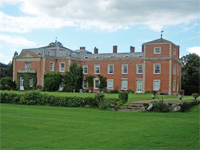
Another Prime Ministerial seat to suffer later loss was Euston Hall in Suffolk seat of Augustus FitzRoy, 3rd Duke of Grafton who succeeded William Pitt.  The Dukes of Grafton were very wealthy with extensive land holdings in Suffolk, Norfolk, Northamptonshire and London.  Euston Hall had been extensively remodelled by the Palladian architect Matthew Brettingham for the 2nd Duke between 1750-56.  The house suffered a devastating fire in 1902 which destroyed the south and west wings, which were subsequently rebuilt on the same plan but then demolished again by the 10th Duke in 1952.  It should also be noted that the Dukes also owned the splendid Wakefield Lodge in Northamptonshire, designed by William Kent, though it was tenanted and therefore the Dukes never lived there.

William Petty-FitzMaurice, 2nd Earl of Shelburne had the splendid fortune to be brought up in one of the finest of Georgian country houses, Bowood House in Wiltshire, which also became a scandalous loss when it was demolished in 1955/56.  Remodelled for the 1st Earl by Henry Keene between 1755-60, the house also featured interiors by Robert Adam, who also altered Keene’s original portico to create a much grander version.  Afterwards the stables were converted to function as the main house where the 9th Marquess of Lansdowne (as the Earls became) still lives today.

Welbeck Abbey, Nottinghamshire (Image: Mr Nibbler / flickr)

The next PM, William Cavendish-Bentinck, 3rd Duke of Portland inherited Welbeck Abbey, Nottinghamshire, which had also been the home of an earlier PM, his relative Thomas Pelham-Holles, 1st Duke of Newcastle.  As stated in Part 1, this is a fascinating house which has often been overlooked due to the fact that it has been rarely open to the in the last 100 years, public tours having finished in 1914. Extensive work was carried out between 1742-46 by the relatively unknown architect John James who reconstructed the south wing and remodelled the west front for Henrietta, Countess of Oxford.  The west front was subsequently changed again in 1790 to designs by Sir Humphry Repton.  The Dukes of Portland also had a southern seat at Bulstrode Park in Buckinghamshire, though this house was replaced in 1865 by the 12th Duke of Somerset who by then owned the estate.

In contrast to the vast wealth and aristocratic status of the preceeding PM, William Pitt the Younger was able to bring political heritage; his father also having served in the same role. In stark contrast to the size and splendour of Welbeck, his country home was Holwood House in Kent, a modest mansion set in 200-acres for which Pitt paid £7,000 in 1783 before commissioning Sir John Soane to alter and enlarge it in 1786 and 1795.  Soane’s work here led to Pitt recommending him for the work to build what was to be one of Soane’s masterpieces; the Bank of England building which was so sadly demolished in the 1920s.  Holwood was also to be demolished, in 1823, to be replaced by a much grander house designed by Decimus Burton.

The country houses of Henry Addington 1st Viscount Sidmouth have both largely now vanished under the sprawl that is Reading University.  Addington had a low-key record as PM and his houses were equally modest.  Although on becoming PM Addington moved into the beautiful White Lodge in Richmond, his main seat was Woodley House, Berkshire, which had been built in 1777 before being bought by Addington in 1789. At the same time, he also bought the neighbouring estate of Bulmershe Court which was then tenanted, before falling into disrepair in the 19th century leading to two-thirds of it being demolished. Woodley House was used by the Minstry of Defence during WWII but subsequent dereliction led to its demolition in 1960.

William Wyndham Grenville, 1st Lord Grenville, as well as abolishing slavery, also created one of the most elegant of the houses in this series; Dropmore House in Buckinghamshire.  Built in 1795 and designed by Samuel Wyatt (b.1737 – d.1807) with later work by Charles Heathcote Tatham (b.1772 – d.1842), it was Grenville’s refuge, describing it as ‘deep sheltered from the world’s tempestuous strife‘. The grounds were also lavished with attention with Grenville planting 2,500 trees, and creating numerous walks which took in the superb views and even going as far as to remove a hill which blocked the view to Windsor Castle.  Tragically, devastating fires in 1990 and 1997 left a ruined shell but it has been recently rebuilt as a series of luxury apartments.

The only PM to be assassinated, Spencer Perceval, never really had a country seat of his own but had grown up in Enmore Castle, Somerset though he would never inherit as he was the second son of second marriage.  Only a small section of the main house now remains after it was largely demolished in 1833, but originally Enmore, built c1779, was one of the largest houses in the county.  In later life, Perceval lived in a large house called Elm Grove on the south side of Ealing Common in London – though at the time this would have been quite a rural area but not quite enough to classify this as a true country house.

The final PM under George III was Robert Banks Jenkinson, 2nd Earl of Liverpool who again chose to live close to London, though in a country house, at Coombe House in Kingston upon Thames in Surrey.  Originally Tudor, this brick house was replaced with a Georgian mansion which was later altered by Sir John Soane, including the addition of a library.  The house survived until 1933 when it was demolished with houses now covering the site.

So although the Gothic revival movement had started in the 1740s and was the main alternative to the dominant Classical architectural style, even by the 1820s, it did not reflect the tastes of any of the Prime Ministers.  Considering the system still echoed the exclusions of the Reformation with its explicit rejection of all things ‘catholic’ (architectural, theological, political) it was unlikely to change, especially as the Catholic Emancipation Bill wasn’t passed until 1828.  Architecture was taken an expression of belief and so to favour the Gothic could potentially have given the wrong signals.

Next: Prime Ministers under George IV and William IV

List of UK Prime Ministers

The price of progress: country houses and the High Speed 2 rail project

One of the sadly almost inevitable side-effects of urban and industrial growth is the loss of more of our countryside. Sometimes it can be on a smaller scale for residential developments and industrial units but occasionally society’s plans are much grander and require a greater sacrifice. This has been shown with the publication of the latest proposed route for the new High Speed 2 rail project to provide a fast link between London and Birmingham.  In previous generations, landowners could influence the path of developments such as roads or canals to their benefit but as their power has diminished so routes of these developments can now threaten the settings of our country houses.

The High Speed 2 railway is aiming to dramatically reduce the need for internal domestic flights in the UK by linking London to, first, the West Midlands, followed by Leeds and Manchester.  The plan has always been controversial, requiring the loss of hundreds of homes in the urban areas around the terminals and also a significant loss of farmland.  Following an initial proposal, the latest route was announced to the House of Commons on 20 December 2010 which reflected some concerns about the initial proposal.  However, 13 of the 30 sections (yes, I have been through all of them!) contain a number of country houses and manors which will still be significantly affected by the plans.

Edgcote House, Northamptonshire (Image: Bacab)

One bit of good news is that fears over the proximity of the link to the wonderfully elegant West Wycombe Park (raised in a blog post in Oct 2009) have been alleviated as the new route is further away.  However, another significant house will still be badly affected; the Georgian, grade-I listed, Edgcote House, Northamptonshire.  The proposed route now slices through the remarkably unlisted grounds with the line passing just to the east of the ornamental lake which forms one of the main axial views from the house.  Edgcote was built between 1747-1752 for London merchant Richard Chauncey by architect William Jones and featured as ‘Netherfield’ in the 1995 TV adaptation of ‘Pride and Prejudice’.  The house and grounds form the centrepiece to a 1,700-acre estate which was bought for £30m in 2005. Interestingly, this value has not deterred the planners (who moved the line from the original position cutting across the lake) so it will be interesting to see if the owner submits a claim a for ‘statutory blight‘ [.pdf]. This gives the Secretary of State the option to buy the property at the current market value if the owner can show that they have been unable to sell due to the Government proposals, or only at a substantially lower value.

Hartwell House, Buckinghamshire (Image: Giano via Wikipedia)

Amendments have also been made to protect another significant property; Hartwell House in Buckinghamshire.  A grade-I listed house, now run as a hotel, it was built in the early 17th-century for the Hampden family but was later let to the exiled King Louis XVIII of France who lived there between 1809-14.  Originally Jacobean, it was substantially enlarged and ‘Georgianised’ between 1759 and 1761 by the architect Henry Keene.  Again, following initial concerns, the route has now been moved further away from the house so that it would not be visible and will benefit from extra earth works and planting to reduce the noise.

Stoneleigh Abbey, Warwickshire (Image: PinkyVicki via Flickr)

Another grade-I house which would have been worse affected if it hadn’t been blighted already is Stoneleigh Abbey in Warwickshire.  This imposing house, now converted into apartments, is part medieval, part Georgian designed by the talented Francis Smith of Warwick, exists in a seriously compromised setting with the Stoneleigh Park exhibition and conference venue built in one half of the immediate parkland.  The proposed line will not only cut through the conference venue but also forever separate the house from the northern edge of the original park – though the massive scale of development already means this was never a house which was going to be returned to splendid isolation.

Another compromised house is Swinfen Hall in Staffordshire where the train will pass in front but quite some distance away.  The house itself, a beautiful Baroque-style Georgian mansion was built in 1757 to a design by Benjamin Wyatt and remained the home of the Swinfen family for nearly 200 years.  After the death of the last Swinfen in 1948 the land was sold and later a huge youth detention centre built to the immediate north-west with the house being left to deteriorate until it was converted into a hotel in the 1980s.  Having a railway line in the middle distance is the least of the concerns for the setting of this house.

Waddesdon Manor, Buckinghamshire (Image: National Trust)

Despite the vocal complaints of Lord Rothschild it seems that the route will be quite far from their old family seat of Waddesdon Manor.  However, Rothschild has become one of the leading opponents of the scheme – along with 16 other Conservative MPs whose constituencies will be affected.

With the rail route cutting across the countryside it was unavoidable that it would pass near to country houses, ironically which, of course, were often built to get away from the industrial blight.  Other houses which now lie close to the proposed route include:

  • The Vache (image), Buckinghamshire
  • Pollard Park House – a 1903 house built to a Lutyens design.
  • Classical Shardeloes, built between 1758-66 for William Drake MP by the architect Stiff Leadbetter would also suffer from the high speed line cutting across the main view from the house.
  • Grade-II* Doddershall House would be within a couple of hundred metres of the line on which up to 18 trains per hour are expected to rush past at speeds of up to 400kph.
  • Chetwode Manor
  • Oatley’s Hall
  • Berkswell Hall, Warwickshire – a grade-II* listed house now converted into apartments
  • Coleshill Manor, Birmingham – now offices and already suffering from being surround by motorways, the house will now have the line within metres, also necessitating the demolition of a new office complex next door.

The route also cuts across the old estate of the now demolished Hints Hall in Staffordshire – an elegant two-storey Georgian mansion with giant pilasters to enliven the facade.  It’s unlikely that if the house had survived it would have prevented the proposed route but again, without the house, an estate becomes even more vulnerable.

These are just the houses affected by the first 120 miles of the proposed 355 mile scheme.  If successful, we can expect more houses to be blighted as the route carves through the Midlands and up into Lancashire, shattering the peace and quiet that were the original reasons for the creation of these refuges from the industrial reality of the cities.  Although progress can often bring benefits, in this case the price is being paid by our country houses as their parklands and estates are judged the path of least resistance.


More information: High Speed 2 [wikipedia]

The rise and fall of French taste on UK country houses

Wrest Park, Bedfordshire (Image: English Heritage)

For all the traditional antipathy towards the French, the influence of their architecture has been felt throughout Britain’s country houses.  Although initially the use of the French architectural vocabulary was a sign of wealth and education only available to the best families, the style was regarded as sullied by the later, more energetic, constructions of the Victorians – an association which still sadly lingers today.

The first wave of Anglo-French design started in the Elizabethan period; a time when it was acceptable to display one’s knowledge conspicuously. The French style, with its dramatic rooflines, dovetailed with the traditional English manor house and its own profusion of gables and chimneys.  Houses such as Burghley in Northamptonshire made dramatic use of the style with the central, three-storey pavilion, dated 1585, based on the French triumphal arch but oddly includes a traditional mullioned window on the third floor. Burghley was the product of the owner, Lord Burghley, an architectural enthusiast who as far back as 1568 was known to have been writing to France to obtain specific architectural books.

This early use of the French style was relatively restrained – probably more by the conservatism of the ruling gentry who were most likely to be building these houses.  Yet, our impressions now are more strongly influenced by the bolder, more assertive French style which was so popular during the Victorian era – though this same popularity was to also lead to it being derided.

The first of the Victorian nouveau-riche were keen to be accepted by society and so built houses which largely followed the same designs used by the local families.  The end of the Napoleonic wars in 1815 led to a rush across the Channel leading to a revival of interest in French design, particularly in relation to interiors, such as the Elizabeth Saloon at Belvoir Castle, Rutland, built c.1825.  By the mid-nineteenth century this was being more confidently expressed in dramatic houses which sought to boldly make their mark.

The second French Renaissance was influenced by lavish works such as the new block at the Louvre in Paris, built between 1852-70.   However, there were earlier examples such as the complete Louis XV chateau at Wrest Park in Bedfordshire, designed by the owner Earl de Grey, built in 1834-39, and Anthony Salvin’s French roofs added to Oxonhoath in Kent in 1846-47.  Yet, after the Louvre, the fashion gathered pace with designs such as R.C. Carpenter’s redesign of Bedgebury in Kent in 1854-55, and Salvin’s work at Marbury Hall in Cheshire in 1856-8.  Less successfully, the architect Benjamin Ferrey built Wynnstay in Denbighshire for Sir Watkin Williams-Wynn which, for all its dramatic high roofs and pavilions, was thought rather gloomy.  Another dramatic, albeit slightly awkward, design was that of Plas Rhianfa, Wales, built in 1849, which seems to mix both Scots baronial and French, whilst Sir Charles Barry completed a more successful use of the two styles at Dunrobin Castle for the Dukes of Sutherland in 1845.  Also of note was Nesfield’s design for Kinmel Hall, described as a Welsh ‘Versailles’.

These houses were largely for the existing gentry who found the impressive skylines met their needs for a dramatic statement as was fashionable at the time.  With the fashion spreading into London and being used for luxury hotels, clubs and offices it was inevitable that the newly wealthy would wish to emulate in the country the world they already enjoyed.  The last burst of ‘aristocratic French’ could be seen in the designs for Hedsor House in Buckinghamshire, 1865-68 for Lord Boston, Alfred Waterhouse’s Eaton Hall in Cheshire, 1870-72 for the Duke of Westminster, and T.H. Wyatt’s Nuneham Paddox in Warwickshire for the Earl of Denbigh, built in 1875.  From around this time, its fashionability declined.

One of the earliest of this new wave was Normanhurst in Sussex, built in 1867 for Thomas Brassey, son of the famous railway contractor.  Reputedly, Lady Ashburnham from nearby Ashburnham Place (note the very different architectural style of house) would snootily refer to him as ‘that train driver over the hill’.  In Worcestershire, the equally dramatic red-brick Impney Hall – later Chateau Impney – was built in 1869-75 for local salt tycoon John Corbett, who employed Auguste Tonquois, who had extensive experience around Paris.  In County Durham, the foundation stone of the Bowes Museum, originally designed to be part-home also, was laid in 1869 for John and Josephine Bowes.  Designed by Jules Pellechet with J.E. Watson of Newcastle-upon-Tyne, the house reflected their love of France but also made a statement as to their wealth – and possibly sought to hide their less-than-solid social position as illegitimate son of an Earl and an actress.  In Yorkshire, the additions to Warter Priory were considered unsuccessful, either due to the strange proportions or because the style had simply fallen out of favour.  More successfully, St Leonard’s Hill, Berkshire, was transformed from a Georgian house in the mid-1870s to create a dramatic chateau visible from Windsor Castle.

Waddesdon Manor, Buckinghamshire (Image: National Trust)

Interestingly though, perhaps the most famous of the English chateau was also one of the latest.  Waddesdon Manor in Buckinghamshire was built in 1889 for Baron Ferdinand de Rothschild to a design by French architect Gabriel-Hippolyte Destailleur, mixing elements from various famous French chateaux such as Blois, Chambord and Anet.  The last of these grand French imports was Halton House, designed by William R. Rogers and built in 1882-88, also in Buckinghamshire and also for a Rothschild, Alfred Charles; Baron Ferdinand’s cousin.  Equally grand, this house also featured a wonderful winter garden, though this was sadly demolished to make way for an accommodation block for the RAF who bought the house and turned it into an officer’s mess.

Perhaps one of the final straws as to the desirability of the French style was the spectacular collapse of the Victorian financier Baron Grant who, in 1875, spent over £270,000 (approx. £20m) building a huge house in Kensington before his crimes were exposed in 1879 with the subsequent public disgrace, and the demolition the house in 1883.  Such a high-profile scandal and its flash monument would have been felt in society and tarnished the style for no-one would wish to be associated with such disgrace.  However, fashion would have played a more significant role, with taste moving on to new styles, leaving these extravagant mementos to an earlier, brasher architectural exuberance which now give us an unexpected glimpse of France in the British countryside.


Credit: a wonderful insight into the period is Mark Girouard’s ‘The Victorian Country House’ which was most useful in the research for this post.

For more information on Chateau Impney; ‘Chateau Impney – the story of a Victorian country house’ by John Hodges

‘The National Trust can have it’: why the NT can’t accept all offers

Seaton Delaval Hall, Northumberland

In an ideal world no country house would ever be at risk but poor finances, often caused by pernicious death duties, and insufficient income from the estate or investments leaves families facing the reality of being unable to stay in their ancestral home.  When this situation arises the cry has often been for the National Trust to step in and ‘save’ the house.  Yet the financial complexities of taking on a house and the responsibilities of the many others they already care for mean that it’s unlikely the National Trust would be able to unless it meets their necessarily strict conditions – a marked contrast to the rather more ad hoc approach of the early years of country house acquisitions.

The National Trust owns over 330 houses though only about half would be considered true country houses.  The first, Barrington Court, Somerset was acquired in 1907, though it wasn’t until the 1940s that the National Trust began to acquire houses in any significant numbers.  Instrumental in the early acquisitions was James Lees-Milne, the Secretary of the Country Houses Committee between 1936-51 (see also this fascinating reflection on JLM and the NT).  A complex man from a well-to-do family who got progressively poorer, but with his good looks and manners, and a certain charm, he was able to lay the ground for many of the later acquisitions through his aristocratic contacts.

The National Trust was initially focussed on the countryside with any houses being taken on as rescue missions to save them from demolition.  This changed after an impassioned speech in 1934 by Philip Kerr, Lord Lothian, who argued that our country houses were a unique and valuable heritage and worthy of being saved. Following this, the Trust established the Country Houses Committee with James Lees-Milne at the important first Secretary who set the tone for years to come.  In the early years, Lees-Milne would travel the country meeting the many owners and starting a gentle conversation leading to more hard-headed negotiations – though some would approach the NT begging for them to take their houses such were their financial straits.

For many owners faced with the dramatic social changes after the wars, and their own impoverishment, the options were fairly stark; soldier on in an increasingly dilapidated house, rent or sell to a new resident owner, sell for demolition, or hand it over to the National Trust.  For many owners who were the latest in a line stretching back over hundreds of years the latter option was often the most appealing (especially as they could often continue living there), though many chose to take the other options leading to mass demolitions, particularly in the 1930s and 1950s.  Yet, as Lees-Milne acknowledged, his own enthusiasm meant, “I have to guard against a collector’s acquisitiveness.  It isn’t always to the advantage of a property to be swallowed by our capacious, if benevolent, maw.” (Diaries, 1 June 1945).  However, it was never an easy task as the rest of his entry for that day notes, “The lengths to which I have gone, the depths which I have plumbed, the concessions which I have (once most reluctantly) granted to acquire properties for the National Trust, will not all be known by that ungrateful body.  It might be shocked by the extreme zeal of its servant if it did.  Yet I like to think that the interest of the property, or building, rather than the Trust has been my objective.“. (Amusingly he finishes with “These pious reflections came to me in the bath this morning.“)

The troubled acquisition of Barrington Court had a profound impact on how the National Trust dealt with later offers.  Merlin Waterson in ‘The National Trust – The First Hundred Years‘ highlights that even thirty years later those with fears about unexpected costs for repairs and maintenance were citing Barrington Court in evidence.  Caught between the rock of their own very high standards and the hard place of not having limitless funds, the National Trust began insisting that any house they took on came with a sufficient endowment.  This was formalised in 1968 as the ‘Chorley formula’ (after Roger Chorley who created it and later served as chairman from 1991-1995) which calculates the endowment required, taking in to account expected high-level maintenance and repairs, likely revenues, workers wages and many other factors.

Initially though this meant that a strange paradox developed whereby the NT would only be able to accept houses from wealthy owners – who were unlikely to want or need to hand them over.  However, in 1937, Parliament enabled the National Trust to make money from its properties by allowing it to accept additional property, cash or securities to provide income producing endowments.  One of the first to do so was Philip Kerr himself who, in 1941, bequeathed Blicking Hall in Norfolk along with its content, more than one hundred other houses and cottages, and over 4,700-acres of woodland.  By the end of WWII, the NT owned 23 houses including West Wycombe Park and Cliveden in Buckinghamshire, and Polesden Lacey in Surrey, each of which had come with generous endowments.

Kedleston Hall, Derbyshire

However, where owners didn’t have the money other sources had to be found, as the protracted negotiations around Kedleston Hall in Derbyshire proved.  This stunning neo-classical mansion of the Curzon family was designed by Robert Adam in the 1760s and has one of the finest collections of Chippendale furniture in the world.  Faced with crippling death duties and a need to pay the grandson a ten-percent inheritance (which he demanded regardless of the threat this posed to the house and estate), the 3rd Viscount Scarsdale opened negotiations with the Trust who determined that it would need a £6m endowment plus another £2.5m for immediate repairs.  Faced with the breakup and sale of the house and its collections, English Heritage, the National Trust, American donors, and the Curzon’s themselves all contributed. This neatly demonstrated the broad spectrum of public and private sources that now had to be called upon to meet obligations such as this – and the difficulties of marshalling such a diverse range each time an opportunity presented itself.

The Trust has been consistent in this policy even when offered fine houses such Heveningham Hall, designed by Sir Robert Taylor with interiors by Wyatt, which had been accepted by the Goverment from the Vanneck family in lieu of inheritance tax in 1970.  Without endowment the Trust refused to take ownership but were happy to manage it for five years whilst the Government found a buyer.  Conversely, when the Dryden family were looking to offload the 16th-century Canons Ashby in 1981 the newly established National Heritage Memorial Fund was able to provide the endowment to fund the family’s gift.

These cases have now formed the model for subsequent campaigns such as the impressive Tyntesfield in Somerset and recently Seaton Delaval Hall in Northumberland where a combination of grants and generous local support enabled them to raise £7m to repair and endow the property.

For many within the National Trust the thinking is now that they have enough houses – for them, current campaigns are mostly around the protection of landscape.  Yet, their obvious financial and political power means that when the need arises they are able to step up to ‘save’ a house.  However, as it is usually preferable that a house remain with the family, hopefully the careful trust arrangements many now have in place mean that increasingly they are able to stay in their home.  Perhaps more houses could have been saved if the National Trust had accepted more of those offered to it, but in reality it is difficult to see how they would have been able to fund so many, especially where the existing owners had proved just how difficult it was to stay financially afloat.  Rather than just saying ‘the National Trust can have it’ we all must be aware that it is not a simple solution and that the long-term care of our country houses requires exceptional planning and commitment – and, ideally, very deep pockets.

The National Trust’s policy on acquisitions [National Trust]

The state of the country house market: Autumn 2010

Noseley Hall, Leicestershire (Image: Knight Frank)

Throughout September, the increasing weight of each week’s ‘Country Life‘ magazine heralds the starts of one of the busy periods for launches of country houses.  As an relatively unscientific barometer it would appear that the market is doing well with some impressive estates and houses being offered up to tantalise the armchair enthusiast and serious purchaser alike – but a few houses are still proving difficult to shift.

The September 1 magazine provided a summary of the successes of the year-to-date with glowing reports from estate agents who, despite some fears in January about an uncertain year ahead, are happy to highlight their successes.  The article quotes Crispin Holborow of Savills who rightly points out that ‘best in class‘ houses will always sell quickly and for above their guide price if the right buyers start competing.  He cites Ropley House in Hampshire which sold at over it’s guide price of £4.25m, as did the grade-I listed Shanks House in Somerset which was offered with 70-acres for £5.5m, but their biggest success was the coveted Chadacre estate in Suffolk with 680-acres which reputedly sold for more than double it’s £10m asking price.  Other houses such as the elegant grade-I Worlingham Hall – regarded by Norman Scarfe as ‘the most beautiful house of manageable size in Suffolk’ – also sold over it’s guide price of £3.9m.

Other houses sold close to their guide include Peatling Hall in Leicestershire (mentioned on this blog in July) which was offered at £4.75m, whilst the stunning Compton Pauncefoot Castle in Somerset suffered from an unfortunately timed launch in September 2008 at £17m which knocked buyer confidence meaning that it hung around until Febuary 2010 before selling at £15m.  Others had to drop their prices or accept being sold in lots with Kiddington Hall in Oxfordshire selling for £15m to Jemima Khan once the rest of the 2,000-acre estate had been sold (originally offered as one for £42m), whilst Fillongley Hall in Warwickshire has yet to find a buyer even after selling 400- out of the original 500-acres originally offered when it went on the market in 2005 (£3.5m, Savills).  Pusey House in Oxfordshire, which was originally launched with 643-acres but when featured as the lead property advert in the September 15 magazine it was offered with just 67.

So who are the awkward squad?  Grade-I listed Noseley Hall in Leicestershire is still with Knight Frank with the same acreage; though now at £12m rather than the original £14m asking price, and Iver Grove in Buckinghamshire, a pocket Palladian gem, is still being offered (again with Knight Frank) – though mysteriously with no price, so probably less that the £4.5m guide in February 2010; and way down from it’s original price of £6.5m when it was first launched in 2007.  Up country, Yester House in Scotland is still available despite having had it’s price halved from £15m to £8m since the original launch in August 2008.

So, although the property market does seem buoyant, it does seem that some are struggling.  Perhaps the flurry of launches will bring an influx of new buyers who may take a renewed interest in the harder-to-sell properties, but they equally may well wonder why they are still available and pass them over.  It seems that some owners who are keen to sell are being flexible, either dropping the price or selling in lots, but for owners who refuse to budge the market may take a very long time to rise to meet what they think their property is worth.  It seems flexibility is still a vital attribute whatever rung of the property ladder you are on.