The Country House Revealed – Easton Neston, Northamptonshire

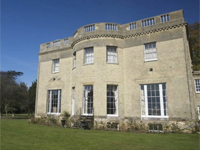
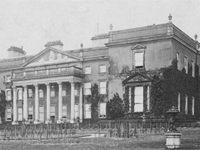
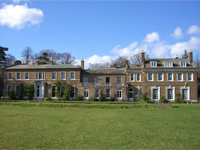
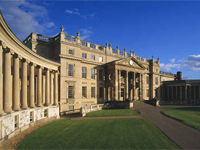
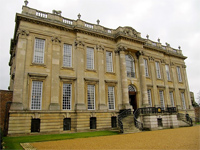
Easton Neston, Northamptonshire (Image: Trish York)

The stated objective of Dan Cruickshank’s series ‘The Country House Revealed‘ is to “…explore Britain’s finest country houses” and after the relatively low-key start with South Wraxall Manor, it upped the ante with the elegant Kinross House, and now it truly reaches one of the finest houses in the country: Easton Neston, Northamptonshire.  The only country house by one of the finest architects of his generation, when it was put up for sale in 2005, it marked the end of one of the great family estates.

Although many fine adjectives can be applied to Easton Neston, one seems to sum it up: noble.  Sitting on a slight rise of ground, this beautifully proportioned house neither lords it over the area but neither does it shirk from elegantly dominating its environment.  That the house looks as it does is due to a unique set of circumstances which gave the opportunity for Nicholas Hawksmoor (b. c.1662 – d.1736) to design his only country house – though he did help with others.

Hawksmoor was born in Nottinghamshire and, after finishing school, was employed as a clerk by a local landowner.  Such was his ‘early skill and genius‘ that word of his talent reached the finest architect in the country, Sir Christopher Wren, who took him on as a clerk at the age of 18.  This employment gave Hawksmoor a role in almost all Wren’s projects from c.1684 onwards, including Winchester Palace, the London City churches and St Paul’s Cathedral. In 1689, thanks to Wren, Hawksmoor obtained the post of Clerk of Works at Kensington Palace – the first in a series of official state roles he was to hold throughout his life, which provided both opportunities and frustrations.

It was this close relationship with Wren which gave Hawksmoor the opportunity to design the house at Easton Neston for Sir William Fermor.  Wren seemed not to display much of an interest in designing country houses but, as he was related by marriage to Sir William, he had originally been consulted about a new house in 1682 and had provided designs for two wings built in the early 1690s, of which one now survives (despite a serious fire in 2002).  Importantly, these two facing wings were 125-feet apart, limiting the size of the main house which would site between them.

Oak model of Easton Neston, c.1690 (Image: Sotheby's?)
Oak model of Easton Neston (as proposed? as built?) (Image: Sotheby's?)

Due to the lack of virtually any drawings or documents relating to Hawksmoor and Easton Neston, there seems to be some debate between such distinguished historians as Howard Colvin, John Julius Norwich and Kerry Downes as to exactly what Hawksmoor designed.  The couple of surviving letters relating to the build from Wren and others indicate that there was possibly a brick house, to Wren’s design, which looked similar but the house as it is today differs in several notable ways, not least the use of engaged columns and giant pilasters.

The first use of the giant pilaster order in English residential architecture can be seen in the south front of Chatsworth, designed by William Talman in 1687 and which also introduced the rectangular silhouette, the echoes of both of which can be seen in Easton Neston.  If the house as modelled is what was proposed or built then it is Wren’s design as Talman’s influence was not yet to be felt.

Staircase, Easton Neston (Image: English Heritage / NMR)

Norwich argues that the form of the house was substantially Wren’s, as was the interior, though Downes argues that, on the evidence of Hawksmoor’s sophisticated alterations for the interior at Ingestre Hall in 1688, with its clever use of internal screens of columns and dramatic spaces, and similarly demonstrated with the original hall and the brilliant cantilevered, shallow-stepped staircase at Easton Neston, he comes down firmly on the side of Hawksmoor.

The overall look of the house as it stands today is clearly Hawksmoor – it’s exciting, erudite, and draws on his extensive knowledge of classical architecture to create  bold fronts but with brilliant proportions which make perfect use of the form.  Hawksmoor also had the advantage of the use of Helmdon stone which, due to its durability and exceptional crispness when carved, ensures the house looks as good today as when it was first built.

Easton Neston as shown in 'Vitruvius Britannicus' (Image: wapedia)
Easton Neston as shown in 'Vitruvius Britannicus' - click for larger image (Image: wapedia)

Hawksmoor never undertook the usual Grand Tour to Italy so his architectural style was essentially drawn from a close study from various books of earlier classical architects.  This gives his work an intellectual quality which others lacked but also gave him the vocabulary to be inventive.  Easton Neston appears as a much bigger house, including a huge forecourt, in Colen Campbell‘s ‘Vitruvius Britannicus‘ though, thankfully they were never executed.  However, the drawing clearly show a clear link between Hawksmoor’s country house and the six London churches (of the 12 built from the proposed 50) he designed: St Alfege’s Church, Greenwich, St George’s Church, Bloomsbury, Christ Church, Spitalfields, St George in the East, Wapping, St Mary Woolnoth, and St Anne’s, Limehouse.

Hawksmoor was also to work, from 1702, with that other genius architect of that age; Sir John Vanbrugh; the playwright turned architect who came to rely on Hawksmoor’s practical skills to translate his fanciful visions into a reality at Castle Howard and Blenheim Palace (even more so when he had to take over following Vanbrugh’s bitter falling out with the Duchess of Marlborough).  Hawksmoor can therefore be seen as a link between Wren’s classicism and the exuberance of Vanbrugh’s particular brand of English Baroque.

Easton Neston remained essentially unchanged (except for some later flamboyant and slightly rampant interior plasterwork by a local artisan in the 18th-century) and in the Fermor-Hesketh family for nearly 500-years until in 2004 Lord Hesketh decided that he was not willing to burden his children with running a house and estate which “…in a good year it loses £500,000 and in a bad year it could lose £1.5m.” and risk seeing the family wealth slowly ebb away on maintenance. He was possibly also influenced by the likely cost of the restoration of Wren’s badly-damaged East wing which suffered a serious fire in 2002. Originally the house and 3,000-acres were put on the market for £50m in a once-in-a-generation opportunity to purchase one of the finest estates to come on the market for decades. Yet with no takers for the whole, Knight Frank sold over 2,200-acres for around £20m leaving just the house and 600-acres for £15m.

In July 2005 it was announced that Easton Neston had been sold to the American clothing retail tycoon Leon Max, the Russian-born owner of the California-based Maxstudio.com retail chain.  For all the fear about overseas buyers, Mr Max appears to have taken his custodianship of this grade-I masterpiece very seriously; hiring the architect Ptolemy Dean to oversee the work and investing an estimated £5m on the restoration to update the services of the house but also to restore the damaged wing to create a European headquarters for his company.  The interiors are equally splendid, overseen by Henrietta Spencer-Churchill (who grew up at Blenheim), with Max taking an ‘almost pedantically historicist approach‘ to sourcing furnishings and furniture which includes Aubusson tapestries from a chateau in France, Louis XVI chairs, and even a couple of the paintings sold by Lord Hesketh as he emptied the house of everything in a series of grand country house sales before moving out.

Easton Neston probably now looks better now than it has done since it was built, with the investment from the new owner likely to have secured the future of one of our greatest and most interesting country houses.

——————————————————————–

Book of the series: ‘The Country House Revealed‘ [Waterstones]

Official listing: ‘The Country House Revealed‘ [BBC2]

Quotes, figures and details in final paragraph come from an interview with Leon Max in the Sunday Times ‘Home’ section – 3 October 2010.
New Series: The Country House Revealed – South Wraxall Manor, Wiltshire

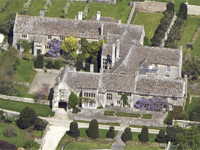
South Wraxall Manor, Wiltshire (Image: Traumahawk / flickr)

In contrast to the weekly dramas of Country House Rescue, a new series starting on the BBC, presented by the excitable Dan Cruickshank, looks at some of the finest homes in ‘The Country House Revealed – A Secret History of the British Ancestral Home‘.  The series promises a look behind the estate wall at some homes which have never been open to the public, giving us a rare chance to glimpse houses which enjoy secure, well-funded ownership and demonstrating that the fears of those who thought these houses would never be sustainable have been thankfully proved wrong.

The first in the series (broadcast 10 May on BBC2 at 21:00) visits South Wraxall Manor in Wiltshire; a house which matches a beautiful exterior with impressive interiors dominated by some of the finest chimneypieces and period rooms in the country.  The house was originally built for Robert Long who made a fortune in cloth in the early 15th-century before becoming an MP in 1433, around which time it is thought the core of the house was started.  As was befitting a rich MP, he was keen to show his status and as was often the case with the gentry, his home was the main platform with which to show off his wealth and erudition, creating one of the finest houses in the country today.

England, at the time work started at South Wraxall Manor, was feeling the influence of the Italian Renaissance and elements of the new fashions were often incorporated into the best homes, though often adapted for our native traditions and styles.  This use of wider influences was also a symptom of the gradual shift in power as major building projects were increasingly commissioned by wealthy gentry rather than the Church or Royal Court.  Maurice Howard also highlights that although the Court was highly competitive which might have led to a single architectural style being favoured, in fact, the houses we still have show how tenacious local styles were.

Chimneypiece c.1600, South Wraxall Manor (Image: (c) Nicholas Cooper)

This continuation of the vernacular can be seen in the architectural vocabulary used by those commissioning the houses, drawing still strongly on ecclesiastical traditions.  Reading the full listing description for South Wraxall one might almost believe it to be a local church or monastery – windows with Perpendicular tracery, buttresses, even gargoyles.  The house was significantly remodelled around 1600, creating what John Julius Norwich calls ‘one of the major Jacobean rooms in all England‘.  A vast west window floods the room with light and is matched by one at the other end of the room, providing the illumination to highlight a most impressive fireplaces – a colossal, florid statement of importance.

Each generation of the Long family added to the house, with additional wings and chimneypieces, and extending the estate.  As with other such early houses which have survived subsequent centuries without ‘modernisation’, this was due to a small element of luck in that it was inherited by a branch of the Long family in 1814 who were already well established at Rood Ashton House, Wiltshire (largely demolished c.1950) meaning the house was often rented out.  The house let between 1820-26 and served time as a boys school, before the 1st Viscount Long took over c.1880 following his election as a local MP.  Viscount Long undid much of the damage caused during its time as a school when the linenfold panelling had been painted over and the ornate ceilings plastered over, however he never really took up residence there.  The house was let for the rest of the 19th-century and the early 20th, before the 2nd Viscount Long moved in in 1935.  Used to house refugees in WWII, the family again lived there before finally selling up in 1966, ending over 500-years of family ownership.

South Wraxall then entered a rather uncertain period, until it was bought by a businessman with plans to turn it into a country house hotel but who had some issues with the local planning authority over unauthorised changes (for example, I think he glassed in the loggia without permission).  The house was up for sale again in 2003 for £6.5m after the businessman abandoned his plans.  After languishing on the market for a couple of years – probably due to the extent of the restoration required – it was bought by the current owners: John Taylor (bass player with the band Duran Duran) and his wife Gela Nash (founder of the fashion house Juicy Couture) who apparently have done an excellent and sympathetic job of the repairs, thus rescuing a house that is a quintessential example of an English manor house.

Full listing description: ‘South Wraxall Manor‘ [British Listed Buildings]

Further information: ‘South Wraxall Manor‘ [Wikipedia]

Book of the series: ‘The Country House Revealed‘ [Waterstones]

Rest of the series

This looks to be a fascinating set of programmes – for reference the other houses featured are:

Country House Rescue: spectacular spats – Hill Place, Hampshire

Hill Place, Hampshire (Image: Historic Houses Association)

The challenges of inheritance have been a recurring theme throughout Country House Rescue.  The obvious challenges are perhaps more tangible; taking on the new house, contents, gardens and the related discoveries – for good or ill.  Yet part of the nature of inheritance is often the bequeathing of disappointment to others who expected to benefit or who disagree with the choices of the new owners.  Country House Rescue this week (17 April) visits Hill Place in Hampshire where Ruth Watson’s skills seem to be in demand to placate some disgruntled aunts rather than to simply identify business opportunities.

Hill Place is an elegant, grade-II listed Georgian villa, built in 1791 on the back of wealth made in India.  The architect is unknown but there is a beautiful simplicity to it, with each side five bays wide with a canted three-bay projection on the entrance front and a graceful three-bay bow front to the south.  The style is in the fine traditions of Sir John Soane and there are even suggestions that it may have been by the man himself.   At some stage, a mansard roof was added and then later removed, leaving an unfortunate flat roof with the stub end of the staircase still rising to a small access extension.  Overall, this is a particularly neat example of the smaller country villa which was to prove so popular at that time.  However, what is of particular interest that the current owner, Will Dobson, inherited the house due to his grandparent’s commitment to the tradition of primogeniture – that of the eldest male inheriting, which, in Will’s case, meant the bypassing of his grandparent’s four daughters, which is the cause of the strife in the programme.

The rules of inheritance in the UK have ensured that ownership of country houses, estates and contents can be passed down as a unified possession.  This has ensured a multi-generational continuity which has benefited the country by embedding a very long-term perspective to plans and that a culture of paternalism was fostered; the spirit of noblesse oblige. Ironically, in France, the Napoleonic code demands equal shares for all potential inheritors, forcing the break-up and sale of large estates, preventing the same depth of connection between the nobility and society.  Yet, for this culture to be preserved it is important that the estate is kept together – especially as it usually has to fulfil its traditional role of funding the main house.

Knighton Gorges, Isle of Wight (Image: wikipedia)

Yet inheritance has caused incredible friction for hundreds of years between those favoured by those who inherit and those who do not, leading to extreme outcomes and court cases.  One example of the former was Knighton Gorges, a manor house on the Isle of Wight, where, in 1821, the owner George Maurice Bisset had the entire ancient house demolished to ensure that his heir (his daughter or nephew – accounts vary) wouldn’t be able to cross his threshold even after his death, their having angered him through an unauthorised marriage.  In Kent, Lynsted Park was originally a huge Elizabethan E-plan house built for Sir John Roper, later Lord Teynham, in 1599, but an inheritance dispute between two Roper brothers in the 1800s led to the one living there demolishing all but the entrance porch (later Georgian additions created the current house) as he thought he would lose the case and have to give the house to his brother.

Gopsall Hall, Leicestershire (Image: Lost Heritage)

Perhaps the most famous litigation from inheritance was that surrounding William ‘the Rich’ Jennens which reputedly took nearly 120 years before the cases finished being heard and was also thought to be the inspiration for Jarndyce v Jarndyce in Charles Dickens’ Bleak House – though recent scholarly opinion now discounts that. The Jennens family had created a huge family fortune as ‘ironmasters’ in Birmingham but due to a lack of heirs and, more importantly, a will, when William died intestate in 1798, his fortune (including houses such as Gopsall Hall, Leicestershire and Acton Place, Suffolk) was passed to three distant – though very aristocratic – relatives.  This was the catalyst for a small cottage industry of claimants who all thought themselves related and therefore due a share of the inheritance.  This was partly due to a popular fad at the time for novels to feature an unexpected inheritance – though, in real life, it was usually just the lawyers who became richer.

So, inheritance can often be a mixed blessing, laden with expectations and complications.  A recent survey by Country Life magazine (6 April 2011) found that 61% of current owners were concerned that estates stay in the family – with only 25% not bothered if their heir were to sell (it would be interesting to see if there was a correlation between whether those in the latter group were also those whose family had owned for the least time).  For some, it’s particularly important to ensure that the family name is preserved. In the same Country Life article, David Fursdon, whose family have been on the Fursdon estate in Devon since 1289, highlights that after 750 years in single ownership the pressure is on to ensure that a male heir is produced to provide that continuity (though with three sons he should be OK).

Holker Hall, Cumbria (Image: andrew_j_w / flickr)

Primogeniture, or full inheritance by the eldest son, has been the rule for hundreds of years.  It was expected that all other children either had to marry or make their own fortune or living with the second son often going into the Army and the third to the clergy.  The strict rules may now be relaxing with parents choosing the child most inclined and best equipped to take on the inheritance – the Country Life article highlights how Holker Hall in Cumbria will be inherited by the middle child, Lucy Cavendish, who has moved back to the estate to learn the ropes before her parents ‘retire’ and move out in a few years time.

The challenge for families such as the Dobson’s is ensuring that the one who inherits feels they have complete ownership and is able to take decisions for the good of the house and estate without sniping from other quarters.  It is no light responsibility to be the owner of a country house and the Dobson’s should be thanked for taking on such a lovely home when others might have simply sold up and enjoyed the spoils.  Here’s hoping they can truly make a success of the house as a business to ensure that they can also pass it on to future generations.

Country House Rescue: ‘Hill Place‘ [Channel 4]

Country House Rescue: see complete previous episodes

Official website: ‘Hill Place

Guest blogger: Jeremy Musson – ‘English Ruins: an odyssey in English history’

Having written all nearly 200 posts since I started writing this blog I now thought it would be interesting to try and broaden the voices involved.  So as the first post in this new direction/experiment, I am delighted and honoured that one of our leading architectural historians, Jeremy Musson, kindly agreed to write a piece on country house ruins linked to his new book published this month, ‘English Ruins‘, a fascinating look at their role in shaping our perceptions of the past and our architecture.

——————————————————————————————-

Jeremy Musson
Jeremy Musson

The English landscape is a landscape of ruins. Fragmentary or sometimes only roofless and windowless, these part dismantled buildings stand out to mark our national history in a number of different ways, and above all, provide a sense of historic scenery for our journeys, physical and imagined – and glimpsed from motorways and footpath alike. In this new book, photographer Paul Barker and I wanted to explore something of this particular cultural landscape and through this exploration trace something of how the English see themselves and their past.

I feel that we live in an old country, and the past is always there, to paraphrase T.S.Eliot, “pressing on the future”. Some love the past, some hate it, many are indifferent to it, happy enough to take pleasure in a good day out, with a dash of historic scenery. But the whole process of our encounter with ruins, is somewhat special – a deeply subjective, and in effect, an almost artistic experience. It is personal and often emotional, while it is also formed and shaped by a whole series of sometimes opposing cultural inheritances: Romanticism, anti-establishment, veneration for the classical, veneration for the Gothic, history seen through the very shape of the landscape.

There is something that seems to appeal about ruins to the English imagination over the centuries. Think of how John Aubrey, for instance, the late seventeenth antiquary and author of that amusing volume of English biography Brief Lives, observed that

“the eie and mind is no less affected with these stately ruines than they would be if they were standing and entire. They breed in generous mindes a kind of pittie; and set the thoughts aworke to make out their magnificence as they were in perfection.”

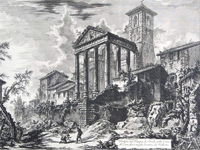
Piranesi: 'Temple of Hercules, at Cori' - 1769 (Image: Mattia Jona Gallery)

During the 18th century, the Grand Tour, part of the expected education of a gentleman or aristocrat, consisted of a journey through Holland and France to visit the great monuments of the Roman world, excited the aesthetic and cultural awareness of the 18th-century English gentleman, who was in turn the patron of artists and architects following the same path in trying to import the drama and excitement of great classical ruins to an English audience. Walk through any major house built in the 18th century, with anything of its original collections still in situ and the ruin is visible in painting after painting, and then echoed in the classical temples of the park.

The phenomenon of creating artificial ruins, in which the English seem to be pioneers, belongs to this period, and while the earliest garden temples seem to be classical, the contrivance of designing ‘ruined’ structures, was largely sourced in England’s own Gothic past. Horace Walpole the 18th-century diarist, who designed his own Gothic style house, Strawberry Hill, hugely admired the work of Sanderson Miller who designed a ruined tower at Hagley Park, with the perhaps slightly teasing phrase that it had “the true rust of the barons’ wars” referring to the Wars of the Roses.

When making this tour of England in tandem with photographer Paul Barker, I could not help noticing that we were often treading in the footsteps of the great landscape painter, J.M.W.Turner, for whom the evocative power of the ruin played a central role in his career, although we perhaps think of him most naturally as a landscape painter, and a painter of skies.

In the last years of the 18th century he exhibited numerous studies of great historical ruins in landscapes, appealing to the Romantic spirit of his audience – characteristically these are the foil for dramatic expositions of sky or sea. He continued to make special studies of ancient ruins, castles and abbeys on tours around the whole of England, for his ambitious Liber Studiorum project, and many were published in different histories, especially in Charles Heath’s Picturesque Views in England and Wales.

Turner looked principally at abbeys and castles, but abandoned country houses have come to be a feature of our landscape too. The dramatic changing status of the country house from the first world war, into the great depression of the late 20s and early 30s, becomes even more intense after the second world war – think of John Harris’s memoir, No Voice from the Hall. This was a period which resulted in so much change in English life, that it is easy to overlook the symbolic collapse of the world of the English country house. This was a feature of interwar life too, with the rise of income tax and death duties, but the upheaval of the Second World War, the widespread institutional use of country houses for military and other government purposes often hastened their subsequent abandonment.

Cowdray House, Sussex (Image: Cowdray Heritage Trust)

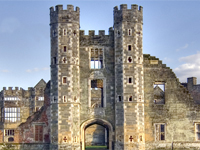
Inevitably, given my interest, the country house looms large in our new book. We focus on the story of buildings from different themes and for the ruins of country house, beginning with Cowdray House, in Sussex, a substantial Elizabethan mansion damaged by a fire in the late eighteenth century, and then abandoned, partly as a result of complications over inheritance; but quickly becoming a destination for artists, for instance, Turner visited the ruins while staying at Petworth – it is now looked after by a newly formed trust, and feels like the sets left over from a Grand Opera, standing amongst the meadows and paddocks on the edge of Midhurst.

We also visited the ruin of an elegant early-seventeenth-century lodge at Wothorpe Towers, a lodge once part of the Burghley estate, which was used as a dower house and then, apparently, part dismantled to provide an eye-catcher in the new landscaped park. It was falling into serious decay and has recently been taken on by the Griffin family, who putting the main house into a trust, which is restoring the gardens, are converting the ancillary seventeenth century buildings into a new home.

Seaton Delaval Hall, Northumberland (Image: Alan J. White / wikipedia)

The classical country house tradition is represented in our book, by 1720s Seaton Delaval Hall, near Newcastle – one of the finest houses by Sir John Vanbrugh, re-roofed after a major fire, the interiors are otherwise the very picture of a ruin. In Derbyshire, we encountered the memorable and mournful spectacle of Sutton Scarsdale Hall in Derbyshire, also built in the early 18th century. The latter, partly due to its proximity to mine-works, acquired in 1919, by businessman out to profit from its materials and fittings. The panelling was sold United States collectors, and some at least found its way into the Museum of Fine Arts in Philadelphia. Its demolition was in fact prevented by local landowner Sir Reresby Sitwell, whose family later presented it to the state.

James Lees Milne, looked at the Sutton Scarsdale ruins for the National Trust, but said that “classical ruins in England are much satisfactory than Gothic ones, the lack picturesque gloom.” English Heritage look after it now, as they do Witley Court, a multi-layered great house and former seat of the Earl of Dudley, a splendid Italianiate palace with a vast portico by John Nash, was burnt out in 1937, and by some chance was not demolished during the 1950s, like so many abandoned houses, and it was subject to preservation order in the 1970s, and in the early 70s taken into state protection. Christopher Hussey thought that it conjured the beauties of the classical ruins visited by the Grand Tourist in the 18th century, as much as anything else.

Lowther Castle, Cumbria

Forgotten Victorian Gothic mansions such as Lowther Castle in Cumbria, possibly become more Romantic in their ruined state. Lowther, the historic seat of the Earls of Lonsdale, designed by Smirke in Gothic baronial style was not re-occupied after the second world war, and in 1957, de-roofed and only the exterior walls preserved. A haunting presence in the beautiful Cumbrian landscape, a new trust has been created to protect the runs and open them and the overgrown Edwardian gardens to the public, in the course of 2011.

For myself, as a historian of the English country house, there is no doubt that the ruin occupies a special place in English culture; the castle, the abbot’s lodgings, the country houses of the sixteenth century onwards, when they stand open to the elements, draw us in to a dialogue with our history and the mutability of fortune.

Jeremy Musson’s ‘English Ruins‘ with photographer Paul Barker, is published by Merrell publishers.

Text by Jeremy Musson, choice of links and images by Matthew Beckett.

——————————————————————————————-

Dear Readers – as always I welcome your comments and feedback.

Country House Rescue: school’s out – High Elms Manor, Herts

High Elms Manor, Hertfordshire (Image: Ishin Ryu)

If there was a prize for commitment above and beyond financial sense then the owner of High Elms Manor/Garston Manor could probably win ‘Highly Commended’ for her determination to rescue this once-derelict country house on the edge of Watford, Hertfordshire, which is the next destination of Ruth Watson and Country House Rescue. The house is an interesting example of the various pressures which can affect country houses and the solutions having experienced almost the complete range over the last century with the new owners adding a few more.

Built sometime before 1813 and once the centre of a 500-acre estate, High Elms Manor originally enjoyed fine rural seclusion, its nearest neighbours the St Pancras Industrial School and Metropolitan District Asylum to the west (now demolished and built over) and Bucknalls, a Victorian manor house now home to the Buildings Research Establishment, to the east.  Originally known as High Elms Manor, it was changed to Garston Manor in 1895, though the current owner has apparently decided to go back to using the original name; even if it’s not the one used by Channel 4.

Relentless urban growth over the last 100 years pushed housing estates and industry right up to the boundaries of many country estates – and usually then overwhelmed them.  The sad pattern was often industry moving closer and blighting the views, then the air, ruining the very attributes which had been their reason for being built in the first place.  As workers followed industry so more land was needed for housing and so estates on the edges of towns were particularly vulnerable (as they still unfortunately are today).

Cassiobury House, Hertfordshire (Image: Lost Heritage)

Watford has already lost one major house – Cassiobury – to just these pressures, though this was much closer to the centre of the modern town and was lost back in 1927. The long-time seat of the Capel family, Earls of Essex, who built a fine house which was altered by Hugh May c.1674-80 and which boasted superb interiors, with carvings by Grinling Gibbons, and which was later ‘Gothicised’ by James Wyatt (c.1800).  Visited by Country Life magazine in 1910 it was still rural:

“‘…set in great and delightful grounds and surrounded by a grandly timbered park. Therein is peace and quiet; the aloofness of the old-country home far from the haunts of men reigns there still, and Watford and its rows of villas and its busy streets is forgotten as soon as the lodge gates are passed’.”

Yet by 1922 the house and 458-acre park were for sale and were bought in 1927 by a consortium of local businessmen who stripped the house for materials, sold the carvings to museums and private collectors and then demolished the house, with residential estates over-running that once rural idyll.  Sadly this was the case for so many of our demolished country houses.

High Elms Manor, being further north, escaped these immediate pressures.  The house became home to the Watney brewing family around 1870, who commissioned alterations which enlarged the house.  The house was then sold to the Benskins, another family of brewers, before it was bought in 1911 by Walter Bourne, co-founder of the Oxford Street department store Bourne & Hollingsworth (now split into retail units and offices – history (scroll past the odd photos at top of the page)), who made further changes around 1920, shortly before his death in 1921.  Stafford Bourne, one of the sons of the founder, described High Elms as:

“…one of the finest and most dignified medium-sized estates in the county of Hertfordshire.”

With fine and interesting interiors, this was a house built for entertaining and accommodating large numbers of guests and visitors.  This was to perhaps save the house from demolition as the house was sold once again after Walter Bourne’s death and took on another of the many uses our country houses have been adapted for and became a medical rehabilitation unit, still known as Garston Manor.  It remained in this role until the 1990s when the council, faced with rising maintenance costs, abandoned it and left it to decay.

Sadly, although boarded up, the house suffered from repeated vandalism and theft, with roof lead and floorboards proving particularly attractive.  When the now-owner Sheila O’Neill came to view the house it was a daunting prospect:

‘It had been empty for years when I came to see it,’ says the present owner. ‘It was more or less derelict. Ceilings had fallen in, all the floors had been damaged, the wood panelling had turned green, chimneys had collapsed, lead had been stripped off the roof by vandals, there were 100 broken windows, the garden was a jungle, it was in a terrible state…”

Stowe House, Buckinghamshire (Image: e-architect)

Thankfully, as many other country houses have discovered, they can be rescued from such a parlous state.  High Elms was now adapted to that familiar role for a country house; that of being a school.  There is a long and fine tradition of our country houses educating future generations in grand adapted ballrooms and dining rooms.  In cases such as the spectacular Stowe House in Buckinghamshire, (now being wonderfully restored by the Stowe House Preservation Trust with backing from the World Monuments Fund) it almost certainly saved it from demolition.  Stowe is an especially grand example of the country house as a school but there are hundreds across the UK, each doing their bit to preserve our architectural heritage – though sadly the necessary ancillary buildings can sometimes detract from the setting.

Thankfully though, in the case of High Elms Manor, the needs of the school have been accommodated within the 80-odd rooms of the house with, for example, the ballroom serving as a gymnasium.  However, a house of this size requires significant funding not only in terms of capital investments in the house but also just to meet the £75,000 per year running costs.  Having bought it for £500,000, Sheila O’Neill estimates she has poured at least that much again in her quest to restore the house.  Faced with her own need for a replacement hip, and the relatively low profits from running her Montessori school, Mrs O’Neill has turned to Ruth to provide guidance as to how to make more from the not-very-successful wedding hire business and for any other tips. With strong local competition from the incredibly pretty Hunton Park, it seems that it is the posse of daughters who appear to hold the key to maintaining and improving their situation.

Country House Rescue: ‘Garston Manor‘ [Channel 4]

Country House Rescue: see complete previous episodes

Interview with Sheila O’Neill: ‘Country House Rescue in Garston‘ [Hertfordshire Life]