So you can’t afford a whole house: country house apartments

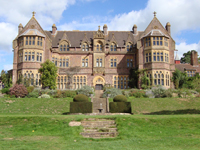
Charlton Park, Wiltshire (Image: Chesterton Humberts)

Country houses were always a community with not only the family but also a significant number of staff.  Yet as these houses became more uneconomical and houses emptied, large sections often lay dormant, until the family moved out and, in darker times, the house might be demolished.  However, conversion of the house into multiple individual homes offered a route to not only save the house but ensure that it was lived in rather than just used as a conference centre or hotel.  These apartments are now highly prized and offer the fascinating possibility of living in a grand stately home without many of the burdens – but only if it was converted sensitively and the setting preserved, which sadly isn’t always the case.

The idea of converting country houses into smaller, more manageable units is a fairly modern practice, largely since World War II, though some smaller conversions had taken place previously.  A pioneer was the now defunct Country Houses Association which was set up in 1955 to provide shared accommodation, with communal meals, for well-to-do retirees in good health in a style to which many residents had formerly been accustomed. The first house to be bought and converted, in 1956, was the red-brick Elizabethan Danny in Sussex. Next, in 1959, was the grade-I listed Aynhoe Park in Northamptonshire, a Soanian masterpiece with an elegant central block framed by two wings (though this has now been converted back into being a single home).  These set the pattern which was successfully repeated for seven other houses, some of which remain as retirement communities despite the collapse of the CHA scheme.

Around the same time, Christopher Buxton formed ‘Period and Country Houses Ltd’ which focused on creating independent units within the house and estate buildings.  Buxton had several notable successes such as the restoration of Kirtlington Park in Oxfordshire, keeping the splendid central portion as his own home, and also Charlton Park in Wiltshire, seat of the Earls of Suffolk, who currently still live in a portion of the house and own the 4,500-acre estate surrounding it.

In the 1950s and 60s, sale adverts for country houses often included the phrase “eminently suitable for conversion”.  Other developers could now see the potential and developed their own schemes – but with little heritage protection they often did more harm than good.  For them the key to getting the maximum profit was to cram in as many units as possible within the house and estate buildings before trying to built in the parkland.  This sadly meant that the grandest rooms in the houses – ballrooms, libraries etc, – would be crudely sub-divided, wreaking their proportions and destroying decorative details.  Sometimes developers simply developed the houses in the estate and then neglected to restore the main house, often citing the mounting costs of the work.

Northwick Park, Gloucestershire (Image: Cotswold District Council)

A sad example of where the house has been compromised through too many units is at Northwick Park in Gloucestershire, a grade-I listed house of 1686, with later work by Lord Burlington in 1728-30 for Sir John Rushout.  An architecturally interesting house with a Classical east front topped with a decorated pediment, which contrasts with Burlington’s work on the east front, which was later, oddly, given shaped gables sometime between 1788-1804.   Empty from 1976 with significant thefts of chimneys and doorcases and general deterioration, it was then bought including just 19-acres in 1986 by a local developer for £2m.  With repairs estimated at the time to come to at least £1.5m, the local authority permitted some enabling development totalling 68 new units – with just six in the main house itself.  However, the new properties had to be sited within the footprint of existing estate buildings leading to an overcrowded development with the house becoming almost an architectural ornament, lost in the rest of the residential development.

Many of the most successful and sensitive conversions have been undertaken by Kit Martin, a gifted architect who has saved some wonderful houses and been instrumental, with assiduous promotion by Marcus Binney of SAVE Britain’s Heritage, in demonstrating that it is possible to convert a house without compromising it.  His particular skill was in dividing the houses vertically, rather than horizontally, which gave each residence (as they always are in KM’s developments – never apartments) a range of rooms and usually included one of the fine rooms.  Starting with Dingley Hall, a beautiful but terribly derelict house at risk of complete loss, he has worked on a number of significant houses including The Hazells in Bedfordshire, Burley-on-the-Hill in Leicestershire, and Ecton Hall in Northamptonshire.  His finest work, however, has been at Gunton Park in Norfolk, grade-II* listed house of 1742 designed by Matthew Brettingham with later work c1785 by Samuel and William Wyatt.

Formerly seat of Lord Suffield it had suffered a serious fire in 1872 leaving a large section of the main house as a burnt out shell.   Fortunately for Mr Martin, extensive Georgian estate buildings had been constructed in anticipation of future work to enlarge the house which never happened, leaving him with a perfect opportunity to create a new community.  He then proceeded to vertically divide the main house into four large 5,000 sq ft houses, with other smaller houses created in the wings and outbuildings.  Having restored the house, he then sought to recreate the 1,500-acre parkland by William Gilpin and Humphrey Repton and has succeeded in re-acquiring over 1,000-acres and has been replanting over 6,000 trees – each one in the place originally marked out on Repton’s plan.

It’s not known in total how many country houses have been converted to multiple residences but it is probably at least between 40-50.  Many of these would otherwise likely have been demolished so conversion is preferable but only where it respects the existing architectural heritage and setting.  However, where successful, these fascinating properties allow the opportunity for those of lesser means to experience living in the grandeur of a stately home with the cost and responsibility of owning a whole one.


Examples of apartments currently for sale in country houses:


Looking for a saviour: St Osyth Priory, Essex

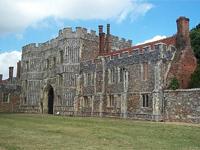
St Osyth Priory, Essex (Image: Stephen Dawson/geograph.co.uk)

Of the phrases most likely to cause concern for those who love our country houses, up there with ‘dry rot’, ‘water leak’ and ‘death duties’ has to be ‘enabling development’.  Originally designed to protect heritage assets by permitting limited development to fund repairs, it appears to now be used to circumvent local and national planning guidelines to facilitate inappropriate development where it otherwise ought to be refused.

In Essex, perhaps one of the largest examples of its kind was submitted by the Sargeant family who bought St Osyth Priory in 1999 through their development company ‘City and Country Group‘ (CCG) .  The company applied to build 190 houses as part of an enabling development to fund repairs to the main house and the other 22 listed buildings in the complex claiming that some £30m-worth of repairs were required (and personally I doubt the cost would be that high – happy to be proved wrong by an independent survey from a SPAB scholar).   This number would naturally bolster the calculation for the total conservation deficit (that is, the amount by which the cost of repair (and conversion to optimum beneficial use if appropriate) of a significant place exceeds its market value on completion of repair and conversion, allowing for all appropriate development costs, but assuming a nil or nominal land value).  But is this a case of a developer using the provisions of enabling development to gain permission regardless of the consequences for the house – and the local area?

After passing through various Royal hands, it was sold to Lord Darcy in 1553 and remained the home of various Earls, Viscounts, Lords and Baronets until it was eventually bought in 1954 by author Somerset de Chair who, in 1974, married Lady Juliet Wentworth-Fitzwilliam, daughter of the 8th Earl Fitzwilliam of Wentworth Woodhouse. The couple lived in the gatehouse, with much of the valuable Wentworth Woodhouse art collection, but de Chair died in 1995, so in 1999 Juliet married Dr. Christopher Tadgell and sold St Osyth to CCG and went to live in Bourne Park, near Canterbury.

CCG have a track record of taking on historic houses and have recently restored Balls Park, Hertfordshire and Herringswell Manor, Suffolk and previously Cheverells and Gilston Park – but these were easier to convert as they had all been used for other institutional or commercial purposes rather than as a family home.  St Osyth Priory and related buildings have sad recent history of insufficient maintenance over many years and have been included on the various buildings at risk registers and undoubtedly needs significant work – but can the repair bill really be £30m (by comparison, the whole of St Paul’s Cathedral was recently restored for £40m)?

To play Devil’s advocate, perhaps this figure might be explained by the provisions of ‘enabling development’ which require that;

It is demonstrated that the amount of enabling development is the minimum necessary to secure the future of the place”
– ‘Enabling development and the conservation of significant places‘ English Heritage (2008)

…so to secure a development of sufficient size to make it profitable for CCG, it would need a suitably large repair bill to justify this (see letter from local resident).  It has been suggested on the St Osyth Parish Council website that offering the house for sale (with just 20-acres rather than the full estate) is merely part of the process of proving that no-one is willing to take on the house and restore it and therefore the enabling development is the only option.  In reality, for someone to invest that much in a house (purchase+restoration) they would expect an estate of at least 100-acres, if not two or three times that.  The plans also seem inappropriate with regard to other provisions of the English Heritage guidance:

  • It will not materially harm the heritage values of the place or setting.
  • It avoids detrimental fragmentation of management of the place.

This all seems depressingly familiar where a developer ignores what’s best for the house, and, in this case, what seems to be determined to bloat the size of the local village in pursuit of this unpopular and out-sized scheme.  An active and well-supported local campaign has been highlighting the various flaws of the scheme and the potential damage to the setting and the village if the scheme were to go ahead, but of course, it’s the house which is continuing to suffer.

In an ideal world, the house would be restored for much less than £30m thus showing that the scale of development proposed was unjustifiably large. This again would show that ‘enabling development’ is apparently being used as a means to try and circumvent the usual planning restrictions which are there to protect our heritage and countryside. Then perhaps one day the house with the full estate (hopefully once CCG realise they won’t get permission) will be offered for sale and someone will get the chance to take care of this important house and estate without sacrificing it for housing.

Property details: ‘St Osyth Priory, Essex‘ – Bidwells

More details:  ‘Priory battle gathers pace‘ [Daily Gazette]

The state of the country house market: Autumn 2010

Noseley Hall, Leicestershire (Image: Knight Frank)

Throughout September, the increasing weight of each week’s ‘Country Life‘ magazine heralds the starts of one of the busy periods for launches of country houses.  As an relatively unscientific barometer it would appear that the market is doing well with some impressive estates and houses being offered up to tantalise the armchair enthusiast and serious purchaser alike – but a few houses are still proving difficult to shift.

The September 1 magazine provided a summary of the successes of the year-to-date with glowing reports from estate agents who, despite some fears in January about an uncertain year ahead, are happy to highlight their successes.  The article quotes Crispin Holborow of Savills who rightly points out that ‘best in class‘ houses will always sell quickly and for above their guide price if the right buyers start competing.  He cites Ropley House in Hampshire which sold at over it’s guide price of £4.25m, as did the grade-I listed Shanks House in Somerset which was offered with 70-acres for £5.5m, but their biggest success was the coveted Chadacre estate in Suffolk with 680-acres which reputedly sold for more than double it’s £10m asking price.  Other houses such as the elegant grade-I Worlingham Hall – regarded by Norman Scarfe as ‘the most beautiful house of manageable size in Suffolk’ – also sold over it’s guide price of £3.9m.

Other houses sold close to their guide include Peatling Hall in Leicestershire (mentioned on this blog in July) which was offered at £4.75m, whilst the stunning Compton Pauncefoot Castle in Somerset suffered from an unfortunately timed launch in September 2008 at £17m which knocked buyer confidence meaning that it hung around until Febuary 2010 before selling at £15m.  Others had to drop their prices or accept being sold in lots with Kiddington Hall in Oxfordshire selling for £15m to Jemima Khan once the rest of the 2,000-acre estate had been sold (originally offered as one for £42m), whilst Fillongley Hall in Warwickshire has yet to find a buyer even after selling 400- out of the original 500-acres originally offered when it went on the market in 2005 (£3.5m, Savills).  Pusey House in Oxfordshire, which was originally launched with 643-acres but when featured as the lead property advert in the September 15 magazine it was offered with just 67.

So who are the awkward squad?  Grade-I listed Noseley Hall in Leicestershire is still with Knight Frank with the same acreage; though now at £12m rather than the original £14m asking price, and Iver Grove in Buckinghamshire, a pocket Palladian gem, is still being offered (again with Knight Frank) – though mysteriously with no price, so probably less that the £4.5m guide in February 2010; and way down from it’s original price of £6.5m when it was first launched in 2007.  Up country, Yester House in Scotland is still available despite having had it’s price halved from £15m to £8m since the original launch in August 2008.

So, although the property market does seem buoyant, it does seem that some are struggling.  Perhaps the flurry of launches will bring an influx of new buyers who may take a renewed interest in the harder-to-sell properties, but they equally may well wonder why they are still available and pass them over.  It seems that some owners who are keen to sell are being flexible, either dropping the price or selling in lots, but for owners who refuse to budge the market may take a very long time to rise to meet what they think their property is worth.  It seems flexibility is still a vital attribute whatever rung of the property ladder you are on.

How tourism split a house from the estate: Warwick Castle, Warwickshire

Warwick Castle, Warwickshire (Image: Gernot Keller/Wikipedia)

A small advert tucked away in a recent Country Life marks the final split of a house from it’s estate. With the sale of the parkland associated with Warwick Castle in Warwickshire, another house loses control over an important asset – though this separation is very much tied up with the history of the opening of country houses to tourists, and this castle in particular.

Country house visiting is perhaps thought of as a more modern phenomenon but Warwick Castle was one of the first houses to be truly exploited as a tourist attraction with visitors coming in significant numbers from 1815 onwards. The growth of the industrial Midlands in the Victorian era and consequently a growing middle class seeking excursions, shifted the pattern of ‘show-houses’ (that is, ones regularly open to the public when the family were absent or on specific days) northwards, away from the more aristocratic 18th-century London-Bath axis.  The Midlands were particularly well provided for with many houses open to the public from the 1850s including Eaton Hall, Chatsworth House, Haddon Hall, Newstead Abbey, and Belvoir Castle amongst perhaps a hundred.  This reached a peak in the 1880s when the most popular houses would receive tens of thousands of visitors a year, reflecting a popular interest in the houses of ‘Olden Time‘ as popularised by writers such as Joseph Nash and Sir Walter Scott.

Warwick Castle, with it’s prized medieval origins, was particularly popular – to the extent that not opening it was considered unthinkable.  That the public expected to be allowed to see inside these houses could be shown in a comment in the Daily Telegraph in 1871 which said:

An Earl of Warwick who would make his whole castle his own in the spirit of an inhospitable curmudgeon, who would shut out all eyes but his own from the feast within those walls, is a being so opposed to every English tradition that it is difficult to realise him.

For the aristocratic owners, economics certainly played a stronger role than any sense of public generosity.  For some, having a popular house in the country was no inconvenience as, such as at Dunster Castle in Somerset, it was remarked in 1845; ‘The owner, an inveterate Bachelor, lives in London and hardly ever comes here‘.

Especially convenient for trippers from Birmingham and the nearby resort of Leamington Spa, Warwick Castle was hosting as many as 6,000 visitors per year in 1825-26 and when the Earl of Warwick’s housekeeper died in 1834 she was said to have left £30,000 earned from tips.  Yet it was the devastating fire of December 1871 which firmly moved the castle from being simply a home to a business. The fire destroyed the family apartments but luckily left the oldest parts of the castle untouched.  The Earl of Warwick’s financial situation meant that he simply could not afford to restore the house to its former glory, a prospect which scared the local tradespeople, fearing the loss of the tourist trade and so a restoration fund was created.  However, to ensure the Earl’s pride was not dented it was presented as recognition of the burden he bore as owner of a national treasure.

However, a furious response from no lesser figure than John Ruskin marked the start of a backlash, saying ‘If a noble family cannot rebuild their own castle, in God’s name let them live in the nearest ditch till they can‘.  Behind this was the growing social democratic movement which moved from support of national treasures privately-owned towards a more socialist belief that national assets ought to be owned by the ‘people’.  The purchase of Aston Hall by Birmingham Council in 1864 as a public museum and park was no doubt playing on the minds of both certain radical sections of society and Lord Warwick – though for different reasons.  The appeal eventually raised £9,000 which paid for restoration by Anthony Salvin but the importance of opening the house as an attraction was highlighted as a way of not only funding costs but also as a way of keeping the public happy that they had ‘access’ to what they now felt of as ‘theirs’.

From this point, the house was never really a private home again.  The Earl and his son embraced the tourist industry but in 1885 closed the castle for a year to re-organise the showing on a more commercial basis.  Gone were the old servants acting as guides; in came professionals paid for by the one shilling admission tickets.  The new system was a success, with 20,000 visitors in the first full year of the new regime.  The new domestic arrangements were confirmed by the 5th Earl who inherited in 1893 and preferred to live at his wife’s estate Easton Lodge in Essex.  In the same year, the castle staged its first historical pageant, which was repeated on a grander scale in 1906.  The 6th Earl, who took over in 1924, further promoted the tourist business, pushing visitors to a peak in 1930 of over 80,000.  Even during the war years, there were over 10,000 visitors in 1943-44, and numbers had recovered to their pre-war peak by 1949-50.

All this increasingly showed that the wider estate, for all its charms – landscaped by Capability Brown in 1747 and much admired by Horace Walpole, it was considered secondary to the primary purpose of the enterprise; to get people into the castle. When the 8th Earl decided to abandon Warwick Castle once and for all in 1978, selling it to the Madame Tussauds group which underlined just how much a tourist attraction it had become, the estate was included but farmed by tenant farmers leaving the grounds as a mere sideshow.  The 679-acres now under offer (guide price: £3m) is the bulk of the estate bar a few acres around the castle.  Land and house have been separated as assets and are unlikely to be reunited. This leaves a house without control of the setting which, although sidelined, has been an important part of what made it into such a popular tourist attraction, and leaving fans of our country houses sad that another has been split up in this way.

Property details: ‘Warwick Castle Park, Warwickshire‘ [John Shepherd]

For more history on country house tourism I can strongly recommend ‘The Fall and Rise of the Stately Home’ by Peter Mandler which proved very useful in relation to this article.

A restoration or a recreation: Knightshayes Court, Devon

Knightshayes Court, Devon (Image: Matthew Beckett)

For all the wonderful work the National Trust has done over the last hundred years saving numerous country houses from demolition, one criticism that has been levelled at it is the almost artificial atmosphere it has created inside.  A recent visit to Knightshayes Court in Devon has also highlighted an interesting series of judgements as to how far an interior should be restored, even to the point of creating a room which was planned but never executed.

Knightshayes Court sits in an elevated and enviable position above the market town of Tiverton where the Heathcoat Amory family had the factory which generated their wealth.  The family fortune was created by the Loughborough-based John Heathcoat (b.1783 – d.1861) inventor of a revolutionary industrial lace-making machine who moved to Tiverton in 1816 after all 55 machines were smashed by drunken Luddites.  A caring man, he ensured the workers were well-housed and the children educated, and the factory became the largest lace-making factory in the world, employing 1,100 workers.

Knightshayes Court, however, was built by his grandson, John Heathcoat Amory (b.1829 – d.1914), whose father had married the only daughter of John Heathcoat, and had added his father-in-laws surname on inheriting. Although politically active, being knighted in 1874, he had sufficient time to indulge the usual pastimes of the wealthy Victorian aristocrat, particularly hunting.   So why would a provincial hunting gent commission a house from an eccentric medievalist, such as William Burges?

Burges (b.1827 – d.1881) has been described by Mark Girouard as ‘one of the most Gothic of the Gothicists‘.  His spectacular remodelling of Cardiff Castle, and the creation of the fantastical Castell Coch, both for the immensely wealthy 3rd Marquess of Bute, allowed him free reign to indulge his bold and imaginative decorative schemes.  Burges worked to a relatively simple philosophy that “No rule can be deduced except the golden one; whatever looks best is best‘ which combined with his other aphorism ‘Money is only a secondary concern in the production of first rate works…There are no bargains in art‘, meant that his work was never going to be cheap.  Yet Heathcoat Amory chose him – but the suspicion is that it was his wife Henrietta who made the choice, perhaps on the back of family connections which included the 2nd Lord Carrington for whom Burges had remodelled Gayhurst in Buckinghamshire (now flats), in the late 1850s-early 1860s.

Perhaps John Heathcoat Amory had only given broad instructions as to what he wanted and had left his wife to chose the aesthetics – either way, as paymaster, Sir John would later regret not taking perhaps a closer interest in the choice of architect.   Construction of the house started in 1869 and the exterior of the house was built almost exactly to Burges’ original design, with the exception of the reduced height of the great tower and a re-orientation of the billiard room.  With the shell completed in July 1870, at a cost of £14,080 (approx. £1m today), the Architect magazine observed that for completion ‘…the actual cost will be something more.‘ – a classic in the canon of architectural understatements as Burges had reserved his most incredible work for the interior.

In 1873, Burges presented the family with a 57-page album of detailed drawings which depicted everything from floor to ceiling.  Faced with such a grand and lavish scheme the Heathcoat Amorys abandoned Burges’ scheme, apart from the stone and wood carving, and, in 1874, brought in the cheaper but very talented John Diblee Crace.  Crace was the fifth generation of architectural decorators and between 1875 and 1882 he completed the interior of the house in his own more restrained but still colourful designs. The last additions to the house were an extra floor to the service wing in 1885 and a Smoking Room in 1902.

However, in the 1930s and 1950s, when appreciation for Victorian exuberance was at its lowest, the Heathcoat Amorys retreated from the bold colour schemes, removing fireplaces, screen and bookcases and covering or repainting ceilings and walls.  So when the National Trust took over in 1973 the house was very different, and less architecturally interesting, than the one of a century earlier.  The guide book, to its credit, does an admirable job of spelling out what is original, what was originally planned, what Burges executed, what Crace did, and what the National Trust has restored – and, perhaps more controversially, has recreated.

The obvious question when deciding on restoration is what particular period you pick as the ‘authentic’ period.  The National Trust took over Kedleston Hall in Derbyshire in 1987, easily one of the finest Adam houses in the country, but by 1994 the then Lord Scarsdale was complaining that the NT had decided that anything post-1760 had to go.  This led to the emptying of rooms, the repainting of others to how they thought Adam had painted them, and the removal in the grounds of anything not thought to have been put there by the first Lord Scarsdale and Robert Adam.

This is in contrast to the principles of the Society for the Protection of Ancient Buildings (SPAB) who state: “In the architectural context “restoration” means work intended to return an old building to a perfect state. It can be the unnecessary renewal of worn features or the hypothetical reconstruction of whole or missing elements; in either case tidy reproduction is achieved at the expense of genuine but imperfect work.“[source].

The Burges Room - Knightshayes Court, Devon (Image: Britain's Finest)

So was the National Trust wrong to strip back the layers of changes?  In view of the fascinating end result and the relative rarity of Burges country houses it can be argued that this work rescued what remained and cleverly exposed the earlier work.  But whose earlier work?  The guidebook explains that most of the interior is by Crace, and it’s his work which has been restored.  Yet upstairs in ‘The Burges Room’, the National Trust took it a step further and took Burges unexecuted plan for that room and created it as it imagined it would have looked.

So is this mere architectural theme park-ism?  Perhaps as it has be made clear what has been created from scratch there is less risk of confusion, but considering how few read the guidebook in detail (or at all), the National Trust has the unenviable choice between respecting all the changes or presenting a more visually interesting house but with necessary compromises in architectural integrity. On balance, there has to be a very strong case to take such a course of action otherwise we risk seeing recreations of idealised or imagined versions of houses rather than the rich and varied buildings which have honestly adapted and changed as family homes over time.

Visitor information: ‘Knightshayes Court, Devon‘ [National Trust]