What goes around; the use of rotunda in UK country houses

The UK aristocracy brought back many souvenirs from their grand tours to Italy – pictures, sculpture, drawings etc – but also a delight in the architecture inspired by the ancient ruins.  This fascination manifested itself in country houses across the UK with a profusion of arches,  Serlian windows, porticos and pediments.  However, one device, despite its impressiveness, has been notable by its relative rarity; the rotunda – that grand circular space often featuring a parade of columns leading the eye up to a spectacular dome.  So why would this grand centrepiece be so infrequently used inside our country houses?

Italy - Villa Capra or 'La Rotonda' (Image: Marco Bagarella / Wikipedia)
Italy – Villa Capra or ‘La Rotonda’ (Image: Marco Bagarella / Wikipedia)

The most famous rotunda, and that which was so influential on the Anglo-Palladians, was the Pantheon in Rome.  Built in AD 124, this vast space under a 142ft diameter dome was closely studied by Andrea Palladio and became a key destination for UK architects who later travelled to Rome.  Palladio then developed the use of the rotunda as the central circulation space in his residential villas, most famously with the Villa Capra or “La Rotonda” in Vicenza, begun in 1567.

Palladio was not the first to use a rotunda in a residential setting; the artist Mantegna built his own home in Mantua in the 1470s using a layout and scale very similar to that later used at Villa Capra, using a design probably suggested by the architect-engineer Francesco di Giorgio.  Palladio then modified it and used it to great success to create what is regarded as one of his finest houses.  The rotunda would have neatly solved the challenge of the Villa Capra in that a visitor may at any front, thus negating the traditional linear plan which assumed only one main entrance.
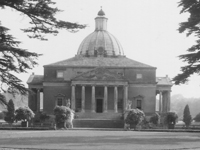
Mereworth Castle, Kent

Looking through Colen Campbell‘s ‘Vitruvius Britanicus’ – a highly regarded collection of plans and prints of the best Georgian houses published between 1715-1725 – that over the three volumes a rotunda is only used twice.  The first is in a proposed (but never executed) design for Goodwood House in Sussex for the Earls of March designed by Colen Campbell in 1724 which featured a 40ft diameter space.  The second is the 35ft diameter version which forms the dramatic central hall of Mereworth Castle in Kent.  Mereworth (built 1722-25) was one of only four Georgian houses to be built in the UK which closely followed the design of the Villa Capra; the others being Chiswick House, Middlesex (1726-29), Foots Cray Place, Kent (1754 – demolished 1949), and Nuthall Temple, Nottinghamshire (1757 – demolished 1929).

A later use of the rotunda was at the slightly eccentric Ickworth House, Suffolk. Built in 1795 and based on the designs of Mario Asprucci, an Italian architect;  it was later adapted by Francis and his brother Joseph Sandys who also oversaw construction.  This later use of the rotunda showed how it could be employed as a single dramatic centrepiece in its own right, not hidden in the centre of the house.

Central stairwell and gallery, Wardour Castle, Wiltshire (Image: Strutt & Parker)
Central stairwell and gallery, New Wardour Castle, Wiltshire (Image: Strutt & Parker)

Yet, if it was hidden, it could form a dramatic and surprising irregularity to the procession of square and rectangular rooms which often dominated houses.  One example of this is at Kedleston Hall in Derbyshire where Robert Adam was inspired by his own 1764 study of the ‘Ruins of the Palace of the Emporer Diocletian at Spalatro [Split]’ which paired the circular rotunda with a square vestibulum. Adam also later proposed to convert the courtyard at Syon Park into a huge rotunda. Perhaps one of the most impressive and beautiful expressions of the rotunda is the central staircase at New Wardour Castle in Wiltshire, designed by James Paine, and built between 1769-1776 and later described by Pevsner as ‘the most glorious Georgian interior of Wiltshire’.

So, despite its impressiveness why are most entrances and staircases so determinedly right-angled?  Simple finance can explain it in part; it would be more expensive to create a rotunda as they are more complex, require more space and also usually compromises in the floor plan to include the curvature.

Fashion can also play its part. As architectural taste moved in the Victorian era towards a preference for the gothic, so the opportunities for the use of the rotunda diminished. With its origins in the temple ruins of Classical ancient Rome, the most famous Gothic Revival architect, A.W.N. Pugin (b.1812 – d.1852) considered it part of a more pagan tradition – and therefore completely antithetical to his belief that gothic represented the only true expression of Christianity through architecture. And where Pugin led, others followed.

Or perhaps the answer is more pragmatic.  One of the primary purposes of the country house was to impress visitors.  Often a political power base, the grandest houses were designed to create an impression even before the visitor actually met the owner.  As one of the principal spaces in a house, entrance halls have often played an important role in this domestic ‘theatre’ – and the use of a rotunda requires perhaps too many compromises.

Traditionally the grand rooms where visitors would be met were often on the ground floor and would be processed through, with only the most important visitors reaching the best rooms.  Elizabethan houses changed this with the principal rooms moving to upper floors, such as at Hardwick Hall in Derbyshire, requiring more impressive staircases which, through the use of heraldic and political symbolism in the carving on balusters and handrail could make many a statement before the guest reached the required floor.

Palladian designs continued this with the preference for the piano nobile which moved the principle rooms to a raised ground floor.  The large empty wall spaces of the staircase also formed a useful space for the display of paintings including family portraits or a large selection to show the owner’s taste and style.  The staircase also provided a way to make a dramatic entrance – think ladies in their evening gowns gliding down to join the party.  Yet if a house used a rotunda it compromised both these features.  A curved wall made it difficult to hang the largest and most impressive works of art and staircases were usually spiral and tucked into the walls in the corners, meaning those coming down would only be seen when they emerged at the ground floor – which would never do.
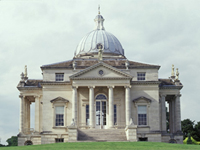
Henbury Hall, Cheshire (Image: Country Life Picture Library)

Yet, the rotunda has not died out and those with the vision and wealth can still create these dramatic spaces.  One of the most impressive has to be Henbury Hall in Cheshire, built between 1984-86 for Sebastien de Ferranti and designed by the architect Julian Bicknell from a painting by the artist Felix Kelly. A faithful recreation of Villa Capra, the dome rises to 15m with the principal rooms radiating from the central hall.  Nigel Anderson at Adam Architects also designed a replacement country house in Surrey which, according to them, is based (I’d say loosely – at least externally) on Villa Capra.  Another fine example is that at Tusmore Park in Oxfordshire, winner of the best new building in the classical tradition award from the Georgian Group in 2004 where the scagliola columns in the central rotunda are said to rival those of the imperial palaces of St Petersburg.

These examples show that, although comparatively rare, the impressive traditions of the rotunda are being continued by architects and clients determined to create the most dramatic interiors in contemporary country houses despite the compromises which have perhaps unfairly limited their use in previous centuries.

‘The National Trust can have it’: why the NT can’t accept all offers

Seaton Delaval Hall, Northumberland

In an ideal world no country house would ever be at risk but poor finances, often caused by pernicious death duties, and insufficient income from the estate or investments leaves families facing the reality of being unable to stay in their ancestral home.  When this situation arises the cry has often been for the National Trust to step in and ‘save’ the house.  Yet the financial complexities of taking on a house and the responsibilities of the many others they already care for mean that it’s unlikely the National Trust would be able to unless it meets their necessarily strict conditions – a marked contrast to the rather more ad hoc approach of the early years of country house acquisitions.

The National Trust owns over 330 houses though only about half would be considered true country houses.  The first, Barrington Court, Somerset was acquired in 1907, though it wasn’t until the 1940s that the National Trust began to acquire houses in any significant numbers.  Instrumental in the early acquisitions was James Lees-Milne, the Secretary of the Country Houses Committee between 1936-51 (see also this fascinating reflection on JLM and the NT).  A complex man from a well-to-do family who got progressively poorer, but with his good looks and manners, and a certain charm, he was able to lay the ground for many of the later acquisitions through his aristocratic contacts.

The National Trust was initially focussed on the countryside with any houses being taken on as rescue missions to save them from demolition.  This changed after an impassioned speech in 1934 by Philip Kerr, Lord Lothian, who argued that our country houses were a unique and valuable heritage and worthy of being saved. Following this, the Trust established the Country Houses Committee with James Lees-Milne at the important first Secretary who set the tone for years to come.  In the early years, Lees-Milne would travel the country meeting the many owners and starting a gentle conversation leading to more hard-headed negotiations – though some would approach the NT begging for them to take their houses such were their financial straits.

For many owners faced with the dramatic social changes after the wars, and their own impoverishment, the options were fairly stark; soldier on in an increasingly dilapidated house, rent or sell to a new resident owner, sell for demolition, or hand it over to the National Trust.  For many owners who were the latest in a line stretching back over hundreds of years the latter option was often the most appealing (especially as they could often continue living there), though many chose to take the other options leading to mass demolitions, particularly in the 1930s and 1950s.  Yet, as Lees-Milne acknowledged, his own enthusiasm meant, “I have to guard against a collector’s acquisitiveness.  It isn’t always to the advantage of a property to be swallowed by our capacious, if benevolent, maw.” (Diaries, 1 June 1945).  However, it was never an easy task as the rest of his entry for that day notes, “The lengths to which I have gone, the depths which I have plumbed, the concessions which I have (once most reluctantly) granted to acquire properties for the National Trust, will not all be known by that ungrateful body.  It might be shocked by the extreme zeal of its servant if it did.  Yet I like to think that the interest of the property, or building, rather than the Trust has been my objective.“. (Amusingly he finishes with “These pious reflections came to me in the bath this morning.“)

The troubled acquisition of Barrington Court had a profound impact on how the National Trust dealt with later offers.  Merlin Waterson in ‘The National Trust – The First Hundred Years‘ highlights that even thirty years later those with fears about unexpected costs for repairs and maintenance were citing Barrington Court in evidence.  Caught between the rock of their own very high standards and the hard place of not having limitless funds, the National Trust began insisting that any house they took on came with a sufficient endowment.  This was formalised in 1968 as the ‘Chorley formula’ (after Roger Chorley who created it and later served as chairman from 1991-1995) which calculates the endowment required, taking in to account expected high-level maintenance and repairs, likely revenues, workers wages and many other factors.

Initially though this meant that a strange paradox developed whereby the NT would only be able to accept houses from wealthy owners – who were unlikely to want or need to hand them over.  However, in 1937, Parliament enabled the National Trust to make money from its properties by allowing it to accept additional property, cash or securities to provide income producing endowments.  One of the first to do so was Philip Kerr himself who, in 1941, bequeathed Blicking Hall in Norfolk along with its content, more than one hundred other houses and cottages, and over 4,700-acres of woodland.  By the end of WWII, the NT owned 23 houses including West Wycombe Park and Cliveden in Buckinghamshire, and Polesden Lacey in Surrey, each of which had come with generous endowments.

Kedleston Hall, Derbyshire

However, where owners didn’t have the money other sources had to be found, as the protracted negotiations around Kedleston Hall in Derbyshire proved.  This stunning neo-classical mansion of the Curzon family was designed by Robert Adam in the 1760s and has one of the finest collections of Chippendale furniture in the world.  Faced with crippling death duties and a need to pay the grandson a ten-percent inheritance (which he demanded regardless of the threat this posed to the house and estate), the 3rd Viscount Scarsdale opened negotiations with the Trust who determined that it would need a £6m endowment plus another £2.5m for immediate repairs.  Faced with the breakup and sale of the house and its collections, English Heritage, the National Trust, American donors, and the Curzon’s themselves all contributed. This neatly demonstrated the broad spectrum of public and private sources that now had to be called upon to meet obligations such as this – and the difficulties of marshalling such a diverse range each time an opportunity presented itself.

The Trust has been consistent in this policy even when offered fine houses such Heveningham Hall, designed by Sir Robert Taylor with interiors by Wyatt, which had been accepted by the Goverment from the Vanneck family in lieu of inheritance tax in 1970.  Without endowment the Trust refused to take ownership but were happy to manage it for five years whilst the Government found a buyer.  Conversely, when the Dryden family were looking to offload the 16th-century Canons Ashby in 1981 the newly established National Heritage Memorial Fund was able to provide the endowment to fund the family’s gift.

These cases have now formed the model for subsequent campaigns such as the impressive Tyntesfield in Somerset and recently Seaton Delaval Hall in Northumberland where a combination of grants and generous local support enabled them to raise £7m to repair and endow the property.

For many within the National Trust the thinking is now that they have enough houses – for them, current campaigns are mostly around the protection of landscape.  Yet, their obvious financial and political power means that when the need arises they are able to step up to ‘save’ a house.  However, as it is usually preferable that a house remain with the family, hopefully the careful trust arrangements many now have in place mean that increasingly they are able to stay in their home.  Perhaps more houses could have been saved if the National Trust had accepted more of those offered to it, but in reality it is difficult to see how they would have been able to fund so many, especially where the existing owners had proved just how difficult it was to stay financially afloat.  Rather than just saying ‘the National Trust can have it’ we all must be aware that it is not a simple solution and that the long-term care of our country houses requires exceptional planning and commitment – and, ideally, very deep pockets.

The National Trust’s policy on acquisitions [National Trust]

How tourism split a house from the estate: Warwick Castle, Warwickshire

Warwick Castle, Warwickshire (Image: Gernot Keller/Wikipedia)

A small advert tucked away in a recent Country Life marks the final split of a house from it’s estate. With the sale of the parkland associated with Warwick Castle in Warwickshire, another house loses control over an important asset – though this separation is very much tied up with the history of the opening of country houses to tourists, and this castle in particular.

Country house visiting is perhaps thought of as a more modern phenomenon but Warwick Castle was one of the first houses to be truly exploited as a tourist attraction with visitors coming in significant numbers from 1815 onwards. The growth of the industrial Midlands in the Victorian era and consequently a growing middle class seeking excursions, shifted the pattern of ‘show-houses’ (that is, ones regularly open to the public when the family were absent or on specific days) northwards, away from the more aristocratic 18th-century London-Bath axis.  The Midlands were particularly well provided for with many houses open to the public from the 1850s including Eaton Hall, Chatsworth House, Haddon Hall, Newstead Abbey, and Belvoir Castle amongst perhaps a hundred.  This reached a peak in the 1880s when the most popular houses would receive tens of thousands of visitors a year, reflecting a popular interest in the houses of ‘Olden Time‘ as popularised by writers such as Joseph Nash and Sir Walter Scott.

Warwick Castle, with it’s prized medieval origins, was particularly popular – to the extent that not opening it was considered unthinkable.  That the public expected to be allowed to see inside these houses could be shown in a comment in the Daily Telegraph in 1871 which said:

An Earl of Warwick who would make his whole castle his own in the spirit of an inhospitable curmudgeon, who would shut out all eyes but his own from the feast within those walls, is a being so opposed to every English tradition that it is difficult to realise him.

For the aristocratic owners, economics certainly played a stronger role than any sense of public generosity.  For some, having a popular house in the country was no inconvenience as, such as at Dunster Castle in Somerset, it was remarked in 1845; ‘The owner, an inveterate Bachelor, lives in London and hardly ever comes here‘.

Especially convenient for trippers from Birmingham and the nearby resort of Leamington Spa, Warwick Castle was hosting as many as 6,000 visitors per year in 1825-26 and when the Earl of Warwick’s housekeeper died in 1834 she was said to have left £30,000 earned from tips.  Yet it was the devastating fire of December 1871 which firmly moved the castle from being simply a home to a business. The fire destroyed the family apartments but luckily left the oldest parts of the castle untouched.  The Earl of Warwick’s financial situation meant that he simply could not afford to restore the house to its former glory, a prospect which scared the local tradespeople, fearing the loss of the tourist trade and so a restoration fund was created.  However, to ensure the Earl’s pride was not dented it was presented as recognition of the burden he bore as owner of a national treasure.

However, a furious response from no lesser figure than John Ruskin marked the start of a backlash, saying ‘If a noble family cannot rebuild their own castle, in God’s name let them live in the nearest ditch till they can‘.  Behind this was the growing social democratic movement which moved from support of national treasures privately-owned towards a more socialist belief that national assets ought to be owned by the ‘people’.  The purchase of Aston Hall by Birmingham Council in 1864 as a public museum and park was no doubt playing on the minds of both certain radical sections of society and Lord Warwick – though for different reasons.  The appeal eventually raised £9,000 which paid for restoration by Anthony Salvin but the importance of opening the house as an attraction was highlighted as a way of not only funding costs but also as a way of keeping the public happy that they had ‘access’ to what they now felt of as ‘theirs’.

From this point, the house was never really a private home again.  The Earl and his son embraced the tourist industry but in 1885 closed the castle for a year to re-organise the showing on a more commercial basis.  Gone were the old servants acting as guides; in came professionals paid for by the one shilling admission tickets.  The new system was a success, with 20,000 visitors in the first full year of the new regime.  The new domestic arrangements were confirmed by the 5th Earl who inherited in 1893 and preferred to live at his wife’s estate Easton Lodge in Essex.  In the same year, the castle staged its first historical pageant, which was repeated on a grander scale in 1906.  The 6th Earl, who took over in 1924, further promoted the tourist business, pushing visitors to a peak in 1930 of over 80,000.  Even during the war years, there were over 10,000 visitors in 1943-44, and numbers had recovered to their pre-war peak by 1949-50.

All this increasingly showed that the wider estate, for all its charms – landscaped by Capability Brown in 1747 and much admired by Horace Walpole, it was considered secondary to the primary purpose of the enterprise; to get people into the castle. When the 8th Earl decided to abandon Warwick Castle once and for all in 1978, selling it to the Madame Tussauds group which underlined just how much a tourist attraction it had become, the estate was included but farmed by tenant farmers leaving the grounds as a mere sideshow.  The 679-acres now under offer (guide price: £3m) is the bulk of the estate bar a few acres around the castle.  Land and house have been separated as assets and are unlikely to be reunited. This leaves a house without control of the setting which, although sidelined, has been an important part of what made it into such a popular tourist attraction, and leaving fans of our country houses sad that another has been split up in this way.

Property details: ‘Warwick Castle Park, Warwickshire‘ [John Shepherd]

For more history on country house tourism I can strongly recommend ‘The Fall and Rise of the Stately Home’ by Peter Mandler which proved very useful in relation to this article.

A restoration or a recreation: Knightshayes Court, Devon

Knightshayes Court, Devon (Image: Matthew Beckett)

For all the wonderful work the National Trust has done over the last hundred years saving numerous country houses from demolition, one criticism that has been levelled at it is the almost artificial atmosphere it has created inside.  A recent visit to Knightshayes Court in Devon has also highlighted an interesting series of judgements as to how far an interior should be restored, even to the point of creating a room which was planned but never executed.

Knightshayes Court sits in an elevated and enviable position above the market town of Tiverton where the Heathcoat Amory family had the factory which generated their wealth.  The family fortune was created by the Loughborough-based John Heathcoat (b.1783 – d.1861) inventor of a revolutionary industrial lace-making machine who moved to Tiverton in 1816 after all 55 machines were smashed by drunken Luddites.  A caring man, he ensured the workers were well-housed and the children educated, and the factory became the largest lace-making factory in the world, employing 1,100 workers.

Knightshayes Court, however, was built by his grandson, John Heathcoat Amory (b.1829 – d.1914), whose father had married the only daughter of John Heathcoat, and had added his father-in-laws surname on inheriting. Although politically active, being knighted in 1874, he had sufficient time to indulge the usual pastimes of the wealthy Victorian aristocrat, particularly hunting.   So why would a provincial hunting gent commission a house from an eccentric medievalist, such as William Burges?

Burges (b.1827 – d.1881) has been described by Mark Girouard as ‘one of the most Gothic of the Gothicists‘.  His spectacular remodelling of Cardiff Castle, and the creation of the fantastical Castell Coch, both for the immensely wealthy 3rd Marquess of Bute, allowed him free reign to indulge his bold and imaginative decorative schemes.  Burges worked to a relatively simple philosophy that “No rule can be deduced except the golden one; whatever looks best is best‘ which combined with his other aphorism ‘Money is only a secondary concern in the production of first rate works…There are no bargains in art‘, meant that his work was never going to be cheap.  Yet Heathcoat Amory chose him – but the suspicion is that it was his wife Henrietta who made the choice, perhaps on the back of family connections which included the 2nd Lord Carrington for whom Burges had remodelled Gayhurst in Buckinghamshire (now flats), in the late 1850s-early 1860s.

Perhaps John Heathcoat Amory had only given broad instructions as to what he wanted and had left his wife to chose the aesthetics – either way, as paymaster, Sir John would later regret not taking perhaps a closer interest in the choice of architect.   Construction of the house started in 1869 and the exterior of the house was built almost exactly to Burges’ original design, with the exception of the reduced height of the great tower and a re-orientation of the billiard room.  With the shell completed in July 1870, at a cost of £14,080 (approx. £1m today), the Architect magazine observed that for completion ‘…the actual cost will be something more.‘ – a classic in the canon of architectural understatements as Burges had reserved his most incredible work for the interior.

In 1873, Burges presented the family with a 57-page album of detailed drawings which depicted everything from floor to ceiling.  Faced with such a grand and lavish scheme the Heathcoat Amorys abandoned Burges’ scheme, apart from the stone and wood carving, and, in 1874, brought in the cheaper but very talented John Diblee Crace.  Crace was the fifth generation of architectural decorators and between 1875 and 1882 he completed the interior of the house in his own more restrained but still colourful designs. The last additions to the house were an extra floor to the service wing in 1885 and a Smoking Room in 1902.

However, in the 1930s and 1950s, when appreciation for Victorian exuberance was at its lowest, the Heathcoat Amorys retreated from the bold colour schemes, removing fireplaces, screen and bookcases and covering or repainting ceilings and walls.  So when the National Trust took over in 1973 the house was very different, and less architecturally interesting, than the one of a century earlier.  The guide book, to its credit, does an admirable job of spelling out what is original, what was originally planned, what Burges executed, what Crace did, and what the National Trust has restored – and, perhaps more controversially, has recreated.

The obvious question when deciding on restoration is what particular period you pick as the ‘authentic’ period.  The National Trust took over Kedleston Hall in Derbyshire in 1987, easily one of the finest Adam houses in the country, but by 1994 the then Lord Scarsdale was complaining that the NT had decided that anything post-1760 had to go.  This led to the emptying of rooms, the repainting of others to how they thought Adam had painted them, and the removal in the grounds of anything not thought to have been put there by the first Lord Scarsdale and Robert Adam.

This is in contrast to the principles of the Society for the Protection of Ancient Buildings (SPAB) who state: “In the architectural context “restoration” means work intended to return an old building to a perfect state. It can be the unnecessary renewal of worn features or the hypothetical reconstruction of whole or missing elements; in either case tidy reproduction is achieved at the expense of genuine but imperfect work.“[source].

The Burges Room - Knightshayes Court, Devon (Image: Britain's Finest)

So was the National Trust wrong to strip back the layers of changes?  In view of the fascinating end result and the relative rarity of Burges country houses it can be argued that this work rescued what remained and cleverly exposed the earlier work.  But whose earlier work?  The guidebook explains that most of the interior is by Crace, and it’s his work which has been restored.  Yet upstairs in ‘The Burges Room’, the National Trust took it a step further and took Burges unexecuted plan for that room and created it as it imagined it would have looked.

So is this mere architectural theme park-ism?  Perhaps as it has be made clear what has been created from scratch there is less risk of confusion, but considering how few read the guidebook in detail (or at all), the National Trust has the unenviable choice between respecting all the changes or presenting a more visually interesting house but with necessary compromises in architectural integrity. On balance, there has to be a very strong case to take such a course of action otherwise we risk seeing recreations of idealised or imagined versions of houses rather than the rich and varied buildings which have honestly adapted and changed as family homes over time.

Visitor information: ‘Knightshayes Court, Devon‘ [National Trust]

Houses as hospitals: the country houses in medical service

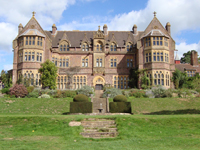
Hatfield House, Hertfordshire (Image: Amy Lloyd/flickr)

Our country houses have always been adaptable as changing fashions or functions required they accommodate new ways of living or roles.  One role which quite a few houses have taken on is that of hospital – either privately or as a fully-fledged part of the NHS – though this use has not always been sympathetic.  However, as the modern health service centralises to larger sites it seems some country houses are re-emerging to become homes again.

Hospitals were traditionally monastic, centred on the abbeys and convents but these were obviously scarce.  The ill were treated in large dormitories although some established houses in the country away from the main abbey to care for the mentally ill.  However the dismantling of the religious orders during the Reformation from 1536, meant that increasingly the burden for care of the pauper sick fell to secular civic bodies, with towns creating their own hospitals.  This model persisted until the 17th-century when private benefactors became increasingly prominent, donating funds and buildings for the care of the ill.

One of the earliest country houses to be converted was the partially completed Greenwich Palace. Originally a Tudor royal house, it had become derelict during the English Civil War, so in 1664 Charles II commissioned John Webb to design a replacement but which was only partially completed.  It was this building which Queen Mary II, who had been affected by the sight of the wounded sailors returning from the Battle of La Hogue in 1692, ordered to be converted to a navel hospital in 1694, to the designs of Sir Christopher Wren and Nicholas Hawksmoor and later Sir John Vanbrugh.

Possibly inspired by the royal example, other country houses were donated or converted for use as hospitals.  However, it quickly became apparent that they weren’t particularly suitable with one Irish physician, Edward Foster, complaining in 1768 that ‘In general, Houses have been rented for Hospitals, which are as fit for the Purposes, as Newgate for a Palace‘.  By the 1850s hospital design was beginning to emerge as a distinct branch of architecture -Florence Nightingale wrote to an officer of the Swansea Infirmary in 1864 saying that a hospital was a difficult to construct as a watch; no building ‘requires more special knowledge‘.  From this time, the country houses themselves became less important than the space they offered with the house itself being used as accommodation or offices. However, for the treatment of respiratory illness the clear country air was considered part of the cure with houses being acquired as tuberculosis sanatoria such as at Moggerhanger Park in Bedfordshire originally designed by Sir John Soane for the Thornton family.

The First World War necessarily required country houses to come back into medical use due to the terrible consequences of the strategy of attrition through trench warfare in WWI which created large numbers of wounded.  Without a national health service there were fewer hospitals able to cope with the seriously disabled or even those simply convalescing.  Many country houses were pressed into service, their clean country air and fine grounds considered most helpful to rest and recuperation. During WWII, fewer houses were used as military hospitals as changes in military tactics led to many fewer casualties than expected.  However, a significant number were used either by the military or as civilian replacements for urban hospitals which it was feared would be bombed.

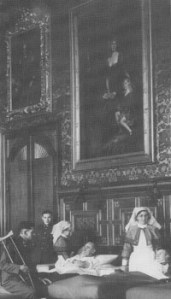
Hatfield House, Herts - King James Drawing Room as a hospital ward in WWII

For country house owners, given the possible options of who might take over their house, the bed-ridden were infinitely preferable to the bored squaddies who wreaked such havoc at other houses (apparently housing art treasures was first preference, evacuated schools second, hospitals third).  This reality plus a genuine sense of wanting to help led to many owners voluntarily turning over their houses as hospitals including the Earl of Harewood offering Harewood House, Lord Howard of Glossop Carlton Towers, Lady Baillie lent Leeds Castle and the 4th Marquess of Salisbury offering Hatfield House as he had done during WWI.  On the civilian side, Brocket Hall in Hertfordshire became a maternity hospital as was Battlesden Abbey in Bedfordshire, Stockeld Park and Farnley Hall, both in Yorkshire. Cholmondeley Castle in Cheshire became a Royal Navy Auxiliary Hospital, treating ‘cases of good morale, who are suffering from nervous breakdown usually as the result of operational stresses’.

After the war many houses were returned to their owners in such terrible disrepair that unfortunately hundreds were demolished.  Others continued in their wartime roles with some such a Poltimore House in Devon becoming hospitals after the war when two local GPs recognised the need for more bedspaces and so took over the old seat of the Bampfyldes until it was nationalised after the creation of the NHS in 1948.  There were also many War Memorial hospitals, founded by public subscription after WWI, which often made use of a country house. The nationalisation of these hospitals gave the NHS many of the country houses it has today – although it is relatively few overall as less than 5% of all their buildings are grade II* or grade I listed.  Of the historic ‘therapeutic’ landscapes it manages, seven are included on the English Heritage Register of Parks and Gardens of Special Historic Interest in England.

However, sometimes these country houses and their settings can escape and revert to being homes, either through conversion or, if the houses has been lost, replacement.   Bretby Hall in Derbyshire, built between 1813-15 by Sir Jeffry Wyatville for the Earl of Chesterfield, was an orthopaedic hospital until the 1990s when the main house was converted into flats, as was the High Victorian Wyfold Court in Berkshire.  Harewood Park in Hertfordshire was demolished in 1959 after use as hospital in WWII but the estate has been bought by the Duchy of Cornwall with proposals for an elegant and very impressive new Classical house by Craig Hamilton Architects.  A similar plan has been put forward for the 57-acre site of the former Middleton Hospital in Yorkshire with the permission requiring the demolition of various redundant buildings from its former use to restore the site.

Sadly though, sometimes the NHS fails to adequately look after the houses it has in its care.  As the trend has moved towards large, new hospitals so the historic elements have been overlooked or abandoned as new hospitals are built elsewhere. As funding for new hospitals is not dependent on the sale of the old site and the house, sadly they can be neglected or subject to inappropriate development as has been the case with the grade-II listed Stallington Hall in Staffordshire, which became a home for the mentally ill in 1928, but after it closed has been vandalised and neglected with a housing development built inappropriately close to the house across the lawn, forever ruining it as a country house –  a poor payback for years of public service.

Related story: ‘Developers draw up plan for country house‘ [Ilkley Gazette]

Background information: ‘Reusing historic hospitals‘ [Institute of Historic Building Conservation]