Developer shows sense; Ruperra Castle for sale

Ruperra Castle, Newport, Wales (Image: Savills)

Run-down or derelict country houses are often an enticing prospect for a developer, especially where the house still retains some land, on which they can propose ‘enabling development’.  In theory this is the correct use of this exemption but frequently the developer will suggest too many houses or ignore the fact that the house has too little land to avoid any development compromising the setting of the house.  When this happens, it is often the house which suffers as the developers wait for appeals or a change in policy whilst allowing the house to deteriorate further.  So in the case of Ruperra Castle in Wales it’s encouraging that the owner has decided to bow out giving someone else the chance to restore this architecturally interesting house.

Ruperra is an early example of the ‘mock’ castles which became fashionable in the Elizabethan and Stuart eras and were an example of life imitating art as the idea of these houses drew from the ‘pageant castles’ as featured in court entertainment of the time.  These stage castles formed the centrepiece to the royal ‘masques’ and were laden with allegorical symbolism as they might be populated by damsels (signifying virtue) but successfully defended against attacking knights (signifying baser desires).  Works such as Edmund Spenser’s The Faerie Queen (published in 1590 and 1596) also fed a fashion for chivalry and heraldic forms. Importantly, the long period of domestic peace during Elizabeth’s reign meant that the design of houses moved from being primarily military and defensive to more simply domestic with the look of a house increasingly dictated by aesthetics.

Ruperra wasn’t quite the first of it’s type; that distinction could be said to be held by houses such as Michaelgrove in Sussex built for the Shelley family in 1536 (dem. 1830s), and Mount Edgcumbe in Devon, built between 1547 – 1554, which also were not fortresses and featured a square or rectangular central block with drum or square towers on each corner.  This was followed by the fabulous Wollaton Hall in Nottinghamshire, begun in 1580, which was an altogether more grandiose statement of power but broadly followed the same layout – as did Hardwick Hall, although in an adapted form. However, the Renaissance ornamentation of Robert Smythson‘s design at Wollaton contrasted dramatically with more austere designs of the true ‘mock’ castles which harked back to the earlier simplicity of decorated castles such as Herstmonceaux Castle in Sussex, begun in 1440, with its many windows and regularised defensive elements (such as the arrow loops) making them almost decorative.

Lulworth Castle, Dorset (Image: Matthew Beckett)

The design for Ruperra Castle was clearly based on that for Lulworth Castle, just 100 miles away in Dorset, and built between 1603-05.  Always called a ‘castle’ but built with the instruction from Lord Howard of Bindon that it ‘prove pretty’, it was never military.  Indeed, Thomas Gerard writing in 1630 described it as ‘well seated for prospect and pleasure; but of little other use’. Bought by the Weld family from Lord Howard it remained their family seat until a devastating fire in 1929 completely gutted the interior – as it remains today, although the building itself has been restored.  Another house thought to have been built around 1612 is Compton Bassett House in Wiltshire (dem. c1929) which clearly shared a similar layout although the corner turrents were square.

The builder of Ruperra Castle was Thomas Morgan (b.1564 – d.1632), who made his fortune as the Steward for the Earls of Pembroke at Wilton House, Wiltshire.  Morgan would have been regularly exposed to court life and would have been very aware of the latest architectural fashions.  Hence when he came to build his own house, which was finished in 1626, he deliberately drew on the latest architectural fashions and created one of the first of the ‘modern’ country houses.  The layout was a significant departure as the rooms were orientated to the outside to make the most of views – hence Ruperra’s elevated site chosen for its beauty rather than defensibility.  Interestingly the ‘castle’ design seemed to fall quite quickly from favour and so there are few other examples of this type – though one late example was Beaurepaire Park in Hampshire built in 1777 (sadly burnt down in 1942).

Ruperra Castle remained as part of the Morgan’s vast Tredegar estate and was traditionally used to house the eldest son before he inherited Tredegar House, the family’s principal seat.  The castle originally had dormers but these were removed during the rebuilding after a fire in 1785 and replaced with the crenellations there today.  It was last inhabited during World War II when a searchlight battery requisitioned it and they were there when the terrible fire caused by faulty wiring broke out in 1941.  Despite best efforts, the house was completely gutted and was eventually sold, along with the rest of the 52,000-acre Tredegar estate in 1952.

Since then, constant promises of restoration have come to nothing and it has steadily deteriorated, most dramatically when, in 1982, the south east tower largely collapsed.  Sold to the current vendor, Mr Ashraf Barakat, in 1998 he had hoped to convert the house into 11 flats and build 18 more houses in the 14-acre grounds that remained with the house.  After a final rejection at a public enquiry in 2009, Mr Barakat has now, wisely, put the still grade-II* listed Ruperra Castle on the market for £1.5m, rather than holding on and letting the house deteriorate further.  This should not be considered a development opportunity, so hopefully now someone with deep pockets will come forward to restore, as a single family house, this architecturally important building.  Its rescue would once again connect the modern history of country house design in Wales, bringing life back to a house which, when it was built, was the most sophisticated in the country.

Property details: ‘Ruperra Castle, Lower Machen, Gwent, Wales‘ [Savills]

More on this story:

More information:

Credit: I’m indebted to the prior work of Mark Girouard (‘Elizabethan Architecture‘ 2009) and the late Andor Gomme for their knowledge of Elizabethan architecture.
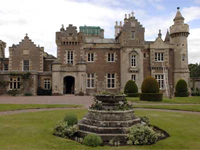
The danger of interpretation: Abbotsford House, Scotland

Abbortsford House, Scotland (Image: The Scotsman)
Abbotsford House, Scotland (Image: The Scotsman)

For Abbotsford House in Scotland, home of the famous author Sir Walter Scott, the recent news that it was to receive a £4.85m Heritage Lottery Fund grant is the sort of news which should be welcomed as that level of funding can usually remedy any necessary maintenance or repairs.  However, the grant is not actually to be spent on the house (despite headlines such as ‘Lottery cash means Walter Scott’s beloved Abbotsford will get £10m facelift‘ [The Scotsman]) but mainly on a new, separate visitors centre.

Sir Walter Scott (b.1771 – d.1832) played a key part creating a literary context for the developing Picturesque movement which sought to reject the rigid formality of the Georgians and create a more organic architecture, which he developed in the construction of his own house.

The theory of the Picturesque raised the importance of how one ‘felt’ about a scene or view – a definite break with the austere, ‘correct’ classicism which so dominated.  The exploration of more fluid forms had started in the 1750s and had been adopted by such noted figures as Sir Horace Walpole for his own house at Strawberry Hill in Surrey.  However it was a local Surrey parson, the Rev. William Gilpin, whose guidebooks were to lead the way for those who came afterwards such as Herefordshire squires Sir Uvedale Price and Richard Payne Knight who had the funds to realise these ideas.

Inspired in part by the idealised landscapes of the artists Nicholas Poussin or Claude Lorrain, architects sought to provide an almost ‘arcadian’ vision of buildings integrating naturally with an environment, forcing them to think of the building and environment as a whole rather than simply viewing their particular work in isolation. This also affected the plan of the house, with rooms now being aligned along the best viewing lines rather than simply lined up. One architect who took on this new style was John Nash who met Uvedale Price in about 1790 during Nash’s time in Wales.  Price was at the time building a small summer house and Nash, after meeting him, proposed a typical villa – a design antithetical to Price’s own philosophy.  Price instead guided Nash to design a new house where rooms followed views, and the overall design echoed its rocky coastal location; as he wrote ”The form of it is extremely varied from my having obliged him [Nash] to turn the rooms to different aspects‘.  Castle House, sadly demolished in 1897, was a watershed in the rejection of the dominant Georgian style and Nash quickly developed new designs based on these radical principles which became his distinctive ‘cottage orne‘ style.

Sir Walter Scott didn’t set out to link literature and architecture – in fact his ‘Waverley’ novels were simply a quick way to make some money after financial difficulties.  The books, which he initially wrote anonymously, were the first truly successful historical fiction, and brought Scott considerable wealth and, once his authorship was known, praise.  It was this wealth that enabled him to set about creating his ideal house.  Raised in the Scottish borders he had a close affinity for the natural landscape and so the Picturesque style would have appealed.  However, Scott ensured the existing designs for Abbotsford House had a distinctly Scottish twist, creating what is known today as the ‘Scots Baronial’ style so closely associated with our romantic notions of Scotland today.

Scott bought a small farmhouse in 1811 and engaged William Atkinson (b.c1774 – d.1839) who, between 1814-24, created the house we see today.  Atkinson was not considered one of the best ‘Gothick’ architects, with Howard Colvin thinking that his designs lacked the elegant charm of the 18th-century work and the scholarly accuracy of the 19th-century.  However at Abbotsford, the architectural vocabulary he employed – steeply pitched slate roofs, turrets, bartizans, and crowstepped gables – became the standard language of Scots country houses for anyone not following the Classical style.

So Abbotsford House is an architectural genesis – the first of it’s kind.  It seems a shame to lavish millions on a separate interpretation centre in a modern design which will only compete with the existing architecture of the house and estate.  It’s also a competition the new building is unlikely to win.  Perhaps it would be better for the money to be spent on sensitively incorporating the displays and materials from Scott’s life and work into the home he so lovingly and thoughtfully created.

More details: ‘Lottery cash means Walter Scott’s beloved Abbotsford will get £10m facelift‘ [The Scotsman]

Official website: ‘Abbotsford House

Background: the Picturesque movement [Wikipedia]

What may come? Ireland’s country house property crash

Bellamont Forest, Ireland (Image: Knight Frank)

One side effect of the exceptionally buoyant Irish property market which made areas of Dublin as expensive as central London was a similar rise in value of their country houses.  Now with the drastic drop in property values, Irish country houses have proven to be far from immune and offer a useful indicator of what might happen in a similar situation on this side of the Irish sea.

The country house market in Ireland truly rode the boom when property became a sure-fire route to riches in the republic.  Houses which had been neglected for many years were suddenly ‘discovered’, bought and lavishly refurbished as private houses for the newly wealthy.  This is actually unsurprising as a key aspiration for anyone acquiring riches over the last 400 years has been to establish themselves in a rural domain.  Owning land was the route to power since time immemorial with greater acreage giving greater influence.  Despite the breaking of that link in the UK between 1870 and 1920 (and most decisively with the passing of the Lords Reform Bill of 1911) the idea of the country estate as the acme of achievement had become embedded as the ultimate status symbol.  Therefore any boom in the economy has usually led to a rush to the country.

Ireland’s situation was slightly different in that, unlike in the UK with it’s stricter planning laws, the purchase of a country house was also viewed with residential development potential in mind. For those projects which completed this meant that the house was simply a means to an end leaving fine houses stranded in the middle of a new suburb (many of which are now half-empty) thus ruining a perfectly good house. This also meant that some houses were bought with over-inflated ‘development value’ built into the price.

So now the crash has hit, what has happened to the houses?  For those owners who were simply in the family home and managed to sell a few acres for development they have ‘won’ as they still have their house and estate but also gained money to sustain the estate and complete much needed restoration and improvements.  For others who didn’t capitalise there must be a certain disappointment as they’ve gone from lying in bed thinking about how the house is now worth ten times what it was a few years ago, back to lying awake wondering how to pay the bills again.

Worse though are those who paid hyped prices and now are stuck either with a home they may have paid for but which is now worth much less than they paid for it – country houses prices can race ahead of the trend in a bull market but can easily do the same when it falls.  On a positive note, for those owners who can afford to, they are likely to stay longer than otherwise they might, providing stable ownership and perhaps a commitment to invest in the estate to sustain what value they can.  For those who bought on finance or who now lack the funds to meet the running costs they may now be forced to sell at a loss.  Declines of 30-50% aren’t unheard of, even for the very best properties.  The Lyons Demesne, one of the finest estates in Ireland and former home of Tony Ryan, founder of Ryanair, is currently for sale with 600-acres at €50m, down from its former valuation of €80m.  Even on the less stratospheric level, Bellamont Forest, the first Palladian house in Ireland (and ridiculously beautiful) was initially marketed at €10m but is now offered at €7.5m.

So what could happen over here?  UK country houses prices, certainly for the best properties, have risen dramatically over the last 10-20 years.  However, that rise has been on the back of a broader boom in the economy which, despite some aspects turning out to be smoke and mirrors, did actually generate real money. In addition, the commodity value of UK farmland which has risen from £2,000 per acre to around £7,000 per acre has also provided a stronger capital base for the estates.  The natural British caution does have its advantages.

The dangers are where owners are left with over-priced houses unable to meets the cost of maintenance and there is the risk that basic tasks are put off leaving the houses at risk from any number of ailments such as water ingress due to blocked gutters.  Unfortunately government austerity means that at a time when local councils need to be most vigilant they are going to be less likely to fund the necessary heritage conservation staff.

Country houses are never immune from the challenges of the wider economy but they can also be insulated if the owner has the resources to weather the storm.  Luckily for the UK, many owners are in a strong position but there is always the danger that the over-excited may get carried away and over-pay leading to problems if the property market weakens. The situation in Ireland should be watched as a useful case study in the dangers of an over-heated market.

Full story: Crash-landed gentry [ft.com]

How to get depressed quickly: the English Heritage Buildings at Risk Register 2010

Winstanley Hall, Lancashire (Image: English Heritage)

This blog has highlighted several country houses which are at risk but the true scale of the issue is unfortunately much larger, as the publication of the 2010 English Heritage Buildings at Risk Register shows.

Country houses all too easily can move from being secure, watertight buildings to having minor problems to becoming seriously at risk due to their size and the high standards required to repair them necessarily making even simple tasks much more expensive.  For the owners this can mean that the burden of looking after their ancestral family home becomes a daily challenge which, rather than facing, can be easier to ignore – especially if they are able to simply shut the door to a wing and forget the damp and leaks.

One of the greatest enemies of the country house is obscurity – particularly when combined with negligent or incapable owners. For some the house is merely an obstacle to redevelopment and so it is in their interest to forgo maintenance and hope that the house quickly and quietly deteriorates to the point where they can apply for permission to demolish.  Unfortunately under-resourced councils are rarely able to regularly survey all the listed buildings in the area meaning that houses can slip through the cracks.  The current economic climate means that it is even more unlikely that councils will be able to fully fund the heritage teams to ensure that they are able to ensure owners meet their obligations.

Melton Constable Hall, Norfolk (Image: English Heritage)

Although English Heritage have had some limited successes (e.g. Sockburn Hall, County Durham) there are still far too many houses at risk – I counted nearly 100 in a couple of searches.  It should be noted that houses are included even where works are planned or under way such as at Clarendon House, Wiltshire which was recently sold (with estate) for a reputed £30m and where restoration is expected to be completed by the end of 2010).  However, other examples include:

Others on the list include:

The head of English Heritage, Simon Thurley, said at the launch:

“Neglect is a slow, insidious process whose costly damage takes time to become clearly visible. Cuts in both private and public spending are currently inevitable but armed with our Heritage at Risk Register, English Heritage is well-equipped to guard against the loss of the nation’s greatest treasures and to suggest effective and economical strategies to protect our national heritage.”

One can only hope that this proves to be the case and that EH are able to fully fulfil their role particularly in relation to country houses and ensure that these beautiful buildings aren’t allowed to quietly slip into dereliction, depriving future generations of wonder of these grand houses.

More details: English Heritage Buildings at Risk 2010 or you can search the 2010 Register

When bling attacks: Ollerton Grange, Cheshire

Ollerton Grange, Cheshire (Image: Knight Frank)

A constant danger for smaller, less historic – but no less attractive – country houses is when the local area becomes more fashionable with an influx of newer, brasher ideas which can be unsympathetic to the original designs. Ollerton Grange in Cheshire, now for sale for an eye-watering £30m with Knight Frank, could be seen as a example of what happens when a small country house meets a large amount of money.

From the picture the house has echoes of the early East Anglian Prodigy houses such Blicking Hall with the neat gables and rambling roofline, built in 1619-27.  Yet Ollerton Grange is a fairly modern construction, built in 1901 by the Manchester architect John Brooke for Cyril Lowcock.  The neo-Tudor style was popular in the Arts & Crafts period with it’s evocation of ancient history which the newly rich were keen to adopt.  The octagonal tower with its ogee cap is the main feature of the entrance front with the gables, mullioned windows, and tall, diagonally-set chimneys following its lead.

The house, plus 141 acres, was bought in 2000 by the heir to the Matalan empire, Jamey Hargreaves for between £5m-10m and he has since spent an estimated £20m over the last ten years.  To his credit he has spared no expense on restoring the main house with fine quality Arts & Crafts panelling set off by some excellent quality antiques.  This reflects the fact that he confesses to having been a reader of Country Life magazine since the age of eight – despite the inevitable joking from his family in the terrace house where he grew up.

Plunge pool, Ollerton Grange, Cheshire (Image: Knight Frank)

Yet if this was the only work to have taken place all would be well.  However, the house is situated in the area of Cheshire known as the ‘Golden Triangle’ inhabited by footballers and their girlfriends.  The prevailing interior style is brash and flashy with an emphasis on gadgets and gimmicks.  At Ollerton Grange this has manifested itself in a huge pleasure complex to the north of the house which more than doubles the original size of the house. This features a full spa, a pool with retractable roof, a red-tiled plunge pool with sculpted aluminium ceiling [pictured], sauna, steam room – with the ability to seal all this off from the main house with a steel shutter during the big house parties.

Credit to Mr Hargreaves for not butchering the original house to fit it in these facilities but is it right that now fully half the space of the new extended house is this modern ‘pleasure-dome’? The photos of the exterior of the house all focus on the original house because, I suspect, the exterior of the new wing will not match the careful architectural composition of John Brooke’s original.  This is not to be snobby but merely to highlight that although a house can be restored to within an inch of it’s life, that doesn’t mean that other alterations may not compromise the overall setting.  Planners have to tread a fine line between allowing necessary and hoped for alterations but perhaps there should be a greater emphasis on ensuring that any new extension continues using the architectural vocabulary of the original house to harmonise the overall look of the property.

Property details: ‘Ollerton Grange‘ [Knight Frank]

Source credit: original story ‘Tangerine Dream’ in the Home section of The Sunday Times – 27 June 2010.