Going to the country: the country houses of UK Prime Ministers – Part 1

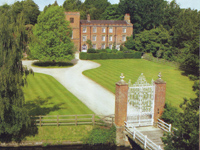
Houghton Hall, Norfolk (Image: Dennis Smith / Geograph)

Those in important political roles have often sought to escape the pressures of office by escaping to the calm and tranquillity of the countryside.  This has been particularly true of the holder of the most important role; that of Prime Minister.  With early PMs drawn from the aristocracy, their backgrounds provided them with a seat which became a natural refuge but was also an important part of their political identity.  However, as their origins changed, so too did the nature of the country retreat.  However, for all PMs the country retreat has been a fairly constant feature – though not all aspired to live in grandeur.

To make this broad survey more digestible I’ve split this into PMs by ruling monarch, starting from when the role of Prime Minister was first recognised in 1721 under King George I.

The first holder of the office, Robert Walpole, 1st Earl of Orford, was the epitome of the aristocratic leader.  Walpole was born at Houghton Hall in Norfolk – though the house was a more modest one before Sir Robert engaged Colen Campbell in 1722 to rebuild it, creating one of the finest Palladian houses in the country.  The second PM was Spencer Compton, 1st Earl of Wilmington, who also employed Colen Campbell in 1726 to create a more modest home; Compton Place in Sussex.

The seat of Henry Pelham, who became the 3rd PM in 1743, was (according to Howard Colvin) Esher Place in Surrey which he bough in 1729. In 1733, he commissioned William Kent, who was also to create some garden buildings for Claremont for the Duke of Newcastle (see below), to add wings to the original house, Wolsey’s Tower, in a Gothic style.  The wings and garden buildings at Esher have now been demolished but drawings survive in the Victoria & Albert Museum in London.

Pelham was succeeded as PM by his older brother, Thomas Pelham-Holles, the 1st Duke of Newcastle, whose main seat was Claremont in Esher, Surrey which he had bought from Sir John Vanbrugh who had built a ‘very small box’ as his own home.  The Duke then commissioned Vanbrugh to extend the house, adding two large wings.  This house was subsequently demolished as unfashionable by Clive of India who had bought the estate in 1768 following the Duke’s death, before being rebuilt in the Palladian style we see today.   The Duke also had other homes including in Halland, Sussex, an area the Pelham family had dominated since 1595 when they first bought land there.  Halland Place was also sold in 1768 and later demolished for materials.  [Originally I gave Welbeck Abbey as his seat but it was, in fact, inherited by the Holles Earls of Clare branch of the family creating a bitter feud.  A more detailed history of the feud is given by dennis in this comment below (thank you for the correction).]

One of the most fascinating houses in the country, particularly due to the extensive tunnelling work commissioned by the 5th Duke, but also one of the least known due to the reclusiveness of the Bentinck family and then later due to its role as the Army Sixth Form college which ensured military-level privacy. The house was largely the work of Sir Charles Cavendish who was given the house and estate by his mother, the remarkable Bess of Hardwick. [Corrected in response to comment below]

To complete the list of aristocratic PMs during the reign of George I (1714–1727) and George II (1727–1760), the last was William Cavendish, 4th Duke of Devonshire who lived in the peerless Chatsworth in Derbyshire – then, as now, one of the finest of our large country houses.  Interestingly, at the same time as he took on the role of PM in 1756, he also engaged in building at Chatsworth employing James Paine to add a new office wing and court (later replaced by Sir Jeffry Wyatville), a stable block, a bridge in the park, a bridge at Beeley, a water mill and also alterations to interiors of the house – though this work was not to be completed until 1767, long after his time as PM finished in 1757.

One notable feature of all the first PMs was they were all Whigs, a party nicknamed the ‘Country Party’ for their support was strongest in the shires and amongst the great landowners.  Unsurprisingly, these leaders were already managing vast estates which naturally came with sizeable houses which reflected their status – which then gave them the authority to aspire to be PM.  At this time, elections were rather crude affairs with the major landowners having MPs in their pockets due to ‘rotten boroughs‘ which gave the landowner a disproportionate, not to mention undemocratic, influence in the Houses of Commons.  Their country houses were therefore not a symptomatic trapping of power, something that they had aspired to and then acquired, but, in fact, were the foundation of the power which had secured them the position in the first place.
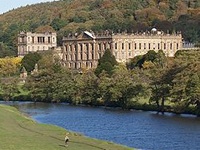
Chatsworth House, Derbyshire

Architecturally, the apparently only acceptable styles were either Palladian or Classical which reflected the political nature of the landowners – symmetry, structure, proportion and the use of the correct orders would have appealed to those who were against monarchical absolutism (which would have challenged their own power) but also reflected a societal structure which ensured their wealth and status.  The Whigs were also closely associated with the Church of England and, as such, would not have entertained the idea of building their houses in the ‘Catholic’ Gothic style, and anyway, with the neo-Gothic movement only really starting in the 1740s it would be several decades before it gained real influence.

So the early years of the role of PM was dominated by the existing ruling class; the great landowners who now shifted from trying to solely influence events through the levers of Royal favouritism (though their support of the Hanoverian succession and therefore King George wasn’t overlooked) to the use of Parliament – though on their terms.  The houses which had often been built to attract and impress a visiting monarch in the hope of securing influence now shifted to helping build alliances with other landowners – and what better way than creating a home they would feel comfortable in? Architecture had become a key part of the political landscape; a physical expression of certain values but also part of a supporting cast which would build the alliances which elevated men to be Prime Minister.

Next: a change of King, and a new PM.

List of UK Prime Ministers

Thanks to Andrew for the original suggestion for this survey
An autumn flutter: country houses currently for sale

Country houses are often launched on the market to catch either bonus money early in the year or those looking to move before the summer.  However, circumstances or owner preference can lead to some interesting houses being given a promotional push in the autumn (usually through Country Life magazine) to catch those who fancy Christmas in front a different log fire.  So, here’s a quick round-up of some of the better country houses currently for sale.

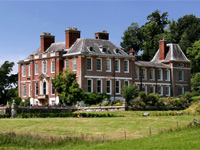
Upton Pynes, Devon (Image: Upton Pynes website)

Easily one of the most impressive houses is one that has always been a sign for me that I’m nearly home when travelling back to Devon on the train.  Just outside Exeter is the beautiful grade-II* listed Upton Pynes, which, despite the very English sounding name, bears a striking resemblance to a French chateau.  Built c.1700 by Hugh Stafford with very sympathetic later additions, this large but elegant house sits in a commanding position in the Exe Valley, perfectly positioned to catch the sun throughout the day, giving the red-brick façades a warm glow.  Described by Pevsner as “…an excellent example of the stately double-pile house that became popular after the Restoration but is relatively rare in Devon.”, the interior features a particularly grand entrance hall created as part of alterations in 1852 by the architect Ambrose Poynter for Sir Stafford Henry Northcote (later the Earl of Iddesleigh).  The main interiors of the house, including an enfilade of rooms on the south front and a notable library, largely dates from 1700.  The house also has the claim that it was the one Jane Austen had in mind when describing ‘Barton House’ in ‘Sense & Sensibility’.  The house still requires some restoration but will definitely reward whoever completes this grand project.

> More information: ‘Upton Pynes, Devon‘ £3.25m, 37-acres [Savills]

Crendle Court, Dorset (Image: Savills)

Sometimes a grand house designed by an interesting architect can remarkably remain unlisted, as is the case with the Edwardian Crendle Court in Dorset which was designed by Walter H. Brierley (b.1862 – d.1926) who has been described as ‘the Yorkshire Lutyens’.  A prolific architect, he designed over 300 buildings including schools, churches and several country houses including the elegant neo-Georgian Sion Hill Hall in Yorkshire.  Brierley was a versatile architect able to work successfully in various styles though with a preference for ‘Wrenaissance’ – a modern re-working of the architectural language of Sir Christopher Wren.  Crendle Court was built in 1909 and features elaborate ornamental plasterwork in the main reception rooms by George Bankart, and sits, well, more luxuriates, in 270-acres of grounds.  Considering the architect and the quality English Heritage ought to send someone round to evaluate and spot list it before it gets ruined by someone with more money than taste.

> More information: ‘Crendle Court, Dorset‘ £6.95m, 270-acres [Savills]

Rudby Hall, Yorkshire (Image: Carter Jonas)

Other significant houses available were launched earlier but are now being promoted following price cuts.  One such house is the grade-II* listed Rudby Hall in Yorkshire, which was originally given a guide price of £3.5m but now is offered at £2.75m.  Designed by Anthony Salvin in 1838 for the 10th Viscount Falkland, who originally called it Leven Grove, but by the late 19th-century it was known as Skutterskelfe Hall before being given its present name by the company which owned it in the 1990s.  The house was restored in the 1980s and comprises the main house but with the ancillary buildings converted into let accommodation bringing in a handy £50,000 p/a – so long as you don’t mind sharing your gardens, grounds and woodlands with them.

> More information: ‘Rudby Hall, Yorkshire‘ £2.75m, 10-acres [Carter Jonas]

Blairquhan Castle, Ayrshire, Scotland (Image: Blairquhan Castle website)

For those who fancy something more baronial, then Blairquhan Castle in Ayrshire, Scotland may be perfect.  The core of the property is a tower house built in 1346 but was later given a new front by William Burn in 1820-24 to provide the imposing if slightly stern façade we see today.  The estate was noted for it beauty with Lord Cockburn writing in 1844: “I rose early…and surveyed the beauties of Blairquhan. It deserves its usual praises. A most gentleman-like place rich in all sorts of attractions – of wood, lawn, river, gardens, hill, agriculture and pasture.”.  What more could a squire desire?

> More information: ‘Blairquhan Castle, Scotland‘ £4.85m, 670-acres [Savills]

Beaurepaire House, Hampshire (Image: Knight Frank)

Most of these houses seem to be with Savills so to even things up, and to include a house I’m surprised hasn’t sold already, is Beaurepaire in Hampshire.  The house was featured on the blog in more detail (‘Phoenix for sale: Beaurepaire House, Hampshire‘) when it was first launched in June this year.  The house is what remains after a devastating fire in 1942 destroyed the main block of the house, leaving the current service wing which was extensively refurbished and remodelled after WWII to give the elegant house which is for sale today.  Approached down a long drive, what guest couldn’t fail to be impressed by the wonderful gates designed by Sir John Soane which guard the entrance over the moat?  Sitting in a 250-acre estate, the £8m price tag is probably justified for the area – and the owner is apparently in no rush to sell so don’t expect any big price cut soon.

> More information: ‘Beaurepaire, Hampshire‘ £8m, 250-acres [Knight Frank]

How tourism split a house from the estate: Warwick Castle, Warwickshire

Warwick Castle, Warwickshire (Image: Gernot Keller/Wikipedia)

A small advert tucked away in a recent Country Life marks the final split of a house from it’s estate. With the sale of the parkland associated with Warwick Castle in Warwickshire, another house loses control over an important asset – though this separation is very much tied up with the history of the opening of country houses to tourists, and this castle in particular.

Country house visiting is perhaps thought of as a more modern phenomenon but Warwick Castle was one of the first houses to be truly exploited as a tourist attraction with visitors coming in significant numbers from 1815 onwards. The growth of the industrial Midlands in the Victorian era and consequently a growing middle class seeking excursions, shifted the pattern of ‘show-houses’ (that is, ones regularly open to the public when the family were absent or on specific days) northwards, away from the more aristocratic 18th-century London-Bath axis.  The Midlands were particularly well provided for with many houses open to the public from the 1850s including Eaton Hall, Chatsworth House, Haddon Hall, Newstead Abbey, and Belvoir Castle amongst perhaps a hundred.  This reached a peak in the 1880s when the most popular houses would receive tens of thousands of visitors a year, reflecting a popular interest in the houses of ‘Olden Time‘ as popularised by writers such as Joseph Nash and Sir Walter Scott.

Warwick Castle, with it’s prized medieval origins, was particularly popular – to the extent that not opening it was considered unthinkable.  That the public expected to be allowed to see inside these houses could be shown in a comment in the Daily Telegraph in 1871 which said:

An Earl of Warwick who would make his whole castle his own in the spirit of an inhospitable curmudgeon, who would shut out all eyes but his own from the feast within those walls, is a being so opposed to every English tradition that it is difficult to realise him.

For the aristocratic owners, economics certainly played a stronger role than any sense of public generosity.  For some, having a popular house in the country was no inconvenience as, such as at Dunster Castle in Somerset, it was remarked in 1845; ‘The owner, an inveterate Bachelor, lives in London and hardly ever comes here‘.

Especially convenient for trippers from Birmingham and the nearby resort of Leamington Spa, Warwick Castle was hosting as many as 6,000 visitors per year in 1825-26 and when the Earl of Warwick’s housekeeper died in 1834 she was said to have left £30,000 earned from tips.  Yet it was the devastating fire of December 1871 which firmly moved the castle from being simply a home to a business. The fire destroyed the family apartments but luckily left the oldest parts of the castle untouched.  The Earl of Warwick’s financial situation meant that he simply could not afford to restore the house to its former glory, a prospect which scared the local tradespeople, fearing the loss of the tourist trade and so a restoration fund was created.  However, to ensure the Earl’s pride was not dented it was presented as recognition of the burden he bore as owner of a national treasure.

However, a furious response from no lesser figure than John Ruskin marked the start of a backlash, saying ‘If a noble family cannot rebuild their own castle, in God’s name let them live in the nearest ditch till they can‘.  Behind this was the growing social democratic movement which moved from support of national treasures privately-owned towards a more socialist belief that national assets ought to be owned by the ‘people’.  The purchase of Aston Hall by Birmingham Council in 1864 as a public museum and park was no doubt playing on the minds of both certain radical sections of society and Lord Warwick – though for different reasons.  The appeal eventually raised £9,000 which paid for restoration by Anthony Salvin but the importance of opening the house as an attraction was highlighted as a way of not only funding costs but also as a way of keeping the public happy that they had ‘access’ to what they now felt of as ‘theirs’.

From this point, the house was never really a private home again.  The Earl and his son embraced the tourist industry but in 1885 closed the castle for a year to re-organise the showing on a more commercial basis.  Gone were the old servants acting as guides; in came professionals paid for by the one shilling admission tickets.  The new system was a success, with 20,000 visitors in the first full year of the new regime.  The new domestic arrangements were confirmed by the 5th Earl who inherited in 1893 and preferred to live at his wife’s estate Easton Lodge in Essex.  In the same year, the castle staged its first historical pageant, which was repeated on a grander scale in 1906.  The 6th Earl, who took over in 1924, further promoted the tourist business, pushing visitors to a peak in 1930 of over 80,000.  Even during the war years, there were over 10,000 visitors in 1943-44, and numbers had recovered to their pre-war peak by 1949-50.

All this increasingly showed that the wider estate, for all its charms – landscaped by Capability Brown in 1747 and much admired by Horace Walpole, it was considered secondary to the primary purpose of the enterprise; to get people into the castle. When the 8th Earl decided to abandon Warwick Castle once and for all in 1978, selling it to the Madame Tussauds group which underlined just how much a tourist attraction it had become, the estate was included but farmed by tenant farmers leaving the grounds as a mere sideshow.  The 679-acres now under offer (guide price: £3m) is the bulk of the estate bar a few acres around the castle.  Land and house have been separated as assets and are unlikely to be reunited. This leaves a house without control of the setting which, although sidelined, has been an important part of what made it into such a popular tourist attraction, and leaving fans of our country houses sad that another has been split up in this way.

Property details: ‘Warwick Castle Park, Warwickshire‘ [John Shepherd]

For more history on country house tourism I can strongly recommend ‘The Fall and Rise of the Stately Home’ by Peter Mandler which proved very useful in relation to this article.

Developer shows sense; Ruperra Castle for sale

Ruperra Castle, Newport, Wales (Image: Savills)

Run-down or derelict country houses are often an enticing prospect for a developer, especially where the house still retains some land, on which they can propose ‘enabling development’.  In theory this is the correct use of this exemption but frequently the developer will suggest too many houses or ignore the fact that the house has too little land to avoid any development compromising the setting of the house.  When this happens, it is often the house which suffers as the developers wait for appeals or a change in policy whilst allowing the house to deteriorate further.  So in the case of Ruperra Castle in Wales it’s encouraging that the owner has decided to bow out giving someone else the chance to restore this architecturally interesting house.

Ruperra is an early example of the ‘mock’ castles which became fashionable in the Elizabethan and Stuart eras and were an example of life imitating art as the idea of these houses drew from the ‘pageant castles’ as featured in court entertainment of the time.  These stage castles formed the centrepiece to the royal ‘masques’ and were laden with allegorical symbolism as they might be populated by damsels (signifying virtue) but successfully defended against attacking knights (signifying baser desires).  Works such as Edmund Spenser’s The Faerie Queen (published in 1590 and 1596) also fed a fashion for chivalry and heraldic forms. Importantly, the long period of domestic peace during Elizabeth’s reign meant that the design of houses moved from being primarily military and defensive to more simply domestic with the look of a house increasingly dictated by aesthetics.

Ruperra wasn’t quite the first of it’s type; that distinction could be said to be held by houses such as Michaelgrove in Sussex built for the Shelley family in 1536 (dem. 1830s), and Mount Edgcumbe in Devon, built between 1547 – 1554, which also were not fortresses and featured a square or rectangular central block with drum or square towers on each corner.  This was followed by the fabulous Wollaton Hall in Nottinghamshire, begun in 1580, which was an altogether more grandiose statement of power but broadly followed the same layout – as did Hardwick Hall, although in an adapted form. However, the Renaissance ornamentation of Robert Smythson‘s design at Wollaton contrasted dramatically with more austere designs of the true ‘mock’ castles which harked back to the earlier simplicity of decorated castles such as Herstmonceaux Castle in Sussex, begun in 1440, with its many windows and regularised defensive elements (such as the arrow loops) making them almost decorative.

Lulworth Castle, Dorset (Image: Matthew Beckett)

The design for Ruperra Castle was clearly based on that for Lulworth Castle, just 100 miles away in Dorset, and built between 1603-05.  Always called a ‘castle’ but built with the instruction from Lord Howard of Bindon that it ‘prove pretty’, it was never military.  Indeed, Thomas Gerard writing in 1630 described it as ‘well seated for prospect and pleasure; but of little other use’. Bought by the Weld family from Lord Howard it remained their family seat until a devastating fire in 1929 completely gutted the interior – as it remains today, although the building itself has been restored.  Another house thought to have been built around 1612 is Compton Bassett House in Wiltshire (dem. c1929) which clearly shared a similar layout although the corner turrents were square.

The builder of Ruperra Castle was Thomas Morgan (b.1564 – d.1632), who made his fortune as the Steward for the Earls of Pembroke at Wilton House, Wiltshire.  Morgan would have been regularly exposed to court life and would have been very aware of the latest architectural fashions.  Hence when he came to build his own house, which was finished in 1626, he deliberately drew on the latest architectural fashions and created one of the first of the ‘modern’ country houses.  The layout was a significant departure as the rooms were orientated to the outside to make the most of views – hence Ruperra’s elevated site chosen for its beauty rather than defensibility.  Interestingly the ‘castle’ design seemed to fall quite quickly from favour and so there are few other examples of this type – though one late example was Beaurepaire Park in Hampshire built in 1777 (sadly burnt down in 1942).

Ruperra Castle remained as part of the Morgan’s vast Tredegar estate and was traditionally used to house the eldest son before he inherited Tredegar House, the family’s principal seat.  The castle originally had dormers but these were removed during the rebuilding after a fire in 1785 and replaced with the crenellations there today.  It was last inhabited during World War II when a searchlight battery requisitioned it and they were there when the terrible fire caused by faulty wiring broke out in 1941.  Despite best efforts, the house was completely gutted and was eventually sold, along with the rest of the 52,000-acre Tredegar estate in 1952.

Since then, constant promises of restoration have come to nothing and it has steadily deteriorated, most dramatically when, in 1982, the south east tower largely collapsed.  Sold to the current vendor, Mr Ashraf Barakat, in 1998 he had hoped to convert the house into 11 flats and build 18 more houses in the 14-acre grounds that remained with the house.  After a final rejection at a public enquiry in 2009, Mr Barakat has now, wisely, put the still grade-II* listed Ruperra Castle on the market for £1.5m, rather than holding on and letting the house deteriorate further.  This should not be considered a development opportunity, so hopefully now someone with deep pockets will come forward to restore, as a single family house, this architecturally important building.  Its rescue would once again connect the modern history of country house design in Wales, bringing life back to a house which, when it was built, was the most sophisticated in the country.

Property details: ‘Ruperra Castle, Lower Machen, Gwent, Wales‘ [Savills]

More on this story:

More information:

Credit: I’m indebted to the prior work of Mark Girouard (‘Elizabethan Architecture‘ 2009) and the late Andor Gomme for their knowledge of Elizabethan architecture.

For the polo enthusiast; for sale – Cowdray Park House, Sussex

Cowdray Park House, West Sussex (Image: Knight Frank)

Despite a house having been in the family for over a hundred years, sometimes it can seem the most rational choice to sell.  For the current Lord Cowdray, the idea that he might saddle his heir with what he considers a burden has led to his decision to put the impressive Cowdray Park House up for sale.

If you mention Cowdray often the first house which springs to mind are the atmospheric ruins which are all that are left of one of the grandest Tudor houses in the country.  The fire in September 1793 destroyed not only a large part of the house but also many priceless and historically important artefacts including William the Conqueror’s sword and also the roll-call of those present at the Battle of Hastings.   Just two weeks after the fire the 8th Viscount Montague drowned whilst swimming in the Rhine, forcing the title to a distant descendent of the the 2nd Viscount, who died childless, extinguishing the Viscountancy.

The tragedies continued – the 8th Viscount’s sister inherited but both her sons died whilst swimming off Bognor in 1815.  The three daughters who then inherited in 1840 eventually decided to sell and it was bought by the 6th Earl of Egmont for £300,000.  The current Cowdray Park House dates from 1878 when the 7th Earl, who had inherited the estate in 1874, massively enlarged the Keeper’s Lodge to create the house we see today.  A large rambling, but very picturesque creation, it obviously has taken its cues from houses such a Knole and Penhurst with their varied rooflines and many courtyards.  The grounds had been previously landscaped by Lancelot ‘Capability’ Brown between 1768 and 1774 with the ornamental gardens laid out in the early 18th-century.

The house was bought in 1908 by Sir Weetman Pearson who was created Viscount Cowdray in 1917.  Sir Weetman was a brilliant engineer who not only built the Blackwall Tunnel under the Thames but also had extensive oil interests in Mexico.  The house then passed through the Pearson family with few changes until the 3rd Viscount, in pursuit of his passion for polo, created one of the premier polo grounds in the country within the 16,500-acre estate.

Yet being a titled aristocrat living in a 16-bedroomed, 44,000 sq ft house in the middle of a fine estate proved to not be what the current Viscount hoped for after he inherited in 1995.  In May 2009 it was announced that he and his wife and son were to move out of the main house and into a smaller house on the estate, Fernhurst, where they had lived before inheriting.  The 2009 plan involved finding someone to take a long lease and create a hotel and spa in the house but the wider economic circumstances have forced this plan to be abandoned.    Unwilling to continue managing such a large house, with all the attendant issues with staffing and maintenance, the Viscount has decided to sell, putting it on the market, with 110-acres, for £25m, whilst retaining the rest of the estate including the world-famous polo grounds.  Renting the house out, he says, would just be delaying the decision.

Speaking to the Sunday Times in 2009 when he announced his plans, Viscount Cowdray admitted that “I’m not the sort of person who feels hugely attached to things, and it’s a big house.” and later speaking to the Observer that same year he said “I have worried whether I will be leaving Perry a wonderful asset or a noose around his neck. I fear it is likely to be the latter,”.

Whilst the arguments put by the Viscount seem rational it does seem a shame to divorce the house from the estate.  The Cowdray estate has long adapted to changing circumstances but to dismember it seems to be a short-term solution which his son may, with hindsight, regret when he comes to take over, as it leaves one of the most significant estates in Sussex without a principal house.

*Update* Remarkably, Cowdray Park House is unlisted so any buyer has the opportunity to make any changes they wish – and I’m willing to bet they won’t be good.  Knight Frank are touting this as a benefit but perhaps representations ought to be made to Chichester District Council to nominate it for listing using this form.

More details: ‘Cowdray Park House on sale for £25m‘ [Chichester Observer]

Property details: ‘Cowdray Park House, West Sussex‘ [Knight Frank]

The Cowdray Estate